When Life Feels Empty and Without Meaning: Are You Ready to Begin Your Soul’s Epic Journey?
When you start to feel that your life lacks meaning — when you rush through the days without truly feeling alive — a quiet but powerful question may begin to rise within you: Is this really all there is?
In this article, I invite you to go deeper, to explore the natural cycles of life, and to reflect on how you can step into something far greater than achievement, performance, and material success. This is the beginning of the Soul’s Epic Journey — a journey where you are no longer a passive participant in your own life, but an active creator of your path ahead.
In this article, we explore the great cycles that shape our lives — why we move through them, what they are trying to teach us, and how we can take the very first step into the most important journey of all: the Soul’s Epic Journey.
It is one of life’s strange paradoxes that many of us only begin to sense what truly matters when our time in this life is drawing to a close. When the noise of everyday life fades, and everything superficial falls away, we suddenly find ourselves face to face with what is essential.
A mother of two, diagnosed with triple-negative breast cancer — an incurable form of breast cancer — was told by her oncologist that she had one month left to live. In an interview with a daily newspaper, she described her experience in this way:
“The birds chirp cheerfully in the bushes. I never noticed things like that before. It’s something about the relentless drive of everyday life. The hamster wheel, if you will. Obligations here, obligations there. Never stillness. Always movement. But now it’s different. Now it’s as if my awareness lingers on every sensory impression. As if it takes in the world in its true form. Now I walk around smelling plants and trees. Simply enjoying what is around me here and now. These small things have become so much more important.”
When life is distilled down to its bare essence, a space of clarity opens. What we once rushed past becomes visible. What once felt like noise turns into silence.
And in that silence — in that intimate contact with the present moment — the Soul’s Journey often begins in earnest.
The Burden of the Hamster Wheel
One of the great tragedies of our time is this: We live in the most materially prosperous era in human history — yet more people than ever struggle with depression, anxiety, and other mental-health challenges.
The numbers are staggering. Mental illness places an enormous economic and social burden on countries worldwide, and depression consistently ranks as one of the most debilitating conditions. And these statistics only account for those who receive a diagnosis. The invisible number of people suffering quietly, without support or recognition, is undoubtedly immense.
How is it possible that so many people — even in wealthy, safe, and modern societies — feel drained, empty, discouraged, and disconnected from meaning?
A significant part of the answer lies in the culture we live in. From every direction, we are met with expectations that we should succeed — at everything.
Work. Career. Finances. Relationships. Social media. Hobbies. Studies. Grades. Fitness. Health. Appearance.
The list is endless, and the pace unrelenting.
Many feel there is no real alternative to this constant pressure to perform, to improve, to reach higher. It’s as if we have collectively accepted that this is what life is — an unstoppable hamster wheel we must keep running in, no matter how exhausted we become.
And at the same time, we live in a global society designed to keep us consuming. We are constantly tempted with newer, nicer, more advanced things. We are surrounded by messages telling us that happiness can be bought, that status equals worth, and that success is measured in material wealth, outward achievements, and how well we appear to be doing.
The result?
A world filled with people who gain access to almost everything — except what they truly long for:
peace, meaning, belonging, closeness, and a life that feels real.
International Research Projects
Large international research projects clearly show that many of us spend our lives chasing goals that bring neither happiness nor deeper meaning. A striking example comes from a study conducted by Harvard University among the millennial generation — people born between 1980 and 1995. When asked about their most important life goals, 80 percent said they wanted to become wealthy, and half said they dreamed of becoming famous.
This raised an even deeper question for the researchers:
What truly makes a human being happy — not just momentarily, but throughout an entire lifetime?
To explore this, they launched The Harvard Study of Adult Development in 1938 (ref. ref. 1, 2 and 3) — one of the world’s most extensive and longest-running research projects. The study has followed a group of participants from the age of 19 well into old age. Every two years, they have undergone interviews, medical examinations, blood tests, and psychological assessments. After more than 80 years of continuous data, the results are remarkably clear.
Here are the main findings:
- Wealth, career success, hard work, and fame do not create a happy or fulfilling life.
- Strong, stable, and close relationships — with partners, family, and friends — are the most important factors for lifelong happiness and good health.
- Loneliness is deadly. It is one of the strongest predictors of poor health, psychological struggles, and a deep sense of inner emptiness.
With this knowledge, it becomes easier to understand why depression, anxiety, and chronic illness are rising across the world. So many people devote their lives to chasing what fails to provide lasting fulfillment — while neglecting what truly matters.
The Path to a Meaningful Life
What gives life meaning is one of the deepest questions a human being can ask — and there is no universal answer that fits everyone. Yet from a shamanic perspective, there is a clear guiding map:
The path to a meaningful life begins with understanding our true nature — and then expressing that truth through the ordinary actions of our daily lives.
When we look at Indigenous cultures that have lived free from Western society’s dogmas, moral rules, and modern lifestyle pressures, we gain a remarkable insight into what a balanced human life can truly look like. In these cultures, depression, anxiety, and chronic illness are rare.
Why?
Because they still live in harmony with nature — and with nature’s rhythms.
There is a natural balance between activity and rest. Life flows with the seasons: winter’s stillness, spring’s growth, summer’s vitality, and autumn’s reflection.
Relationships form the core of everything — the tribe, the family, the community provide safety, belonging, and purpose.
And nature is not just a resource — but a teacher: a place where people seek nourishment, guidance, wisdom, and perspective.
This stands in sharp contrast to modern culture, where nature’s rhythms have slowly faded from our lives. Today, we live in constant activity, day and night, simply because technology allows it — and because we often chase goals that are out of alignment with who we truly are. Many of these goals have little to do with why we are here or what gives us authentic meaning.
If you want to explore more about the shamanic perspective on modern health, joy, and living a life that feels true and fulfilling, I recommend diving into my collection of articles on shamanism here.
Why We Fall Out of Rhythm
Our human existence is made up of three equally important parts:
the physical body, the mind (our thoughts and emotions), and the soul — our existential life.
But in today’s modern society, only the first two have been allowed to take up space. Almost all our energy and attention go toward understanding, improving, and developing the body and the brain.
We celebrate those with the perfect physique, and we admire — and often follow — those we consider “smart,” usually people with high academic status.
Yet in this celebration of the body and intellect, we have overlooked something essential:
the existential part of us — the soul.
The part that gives our life direction, meaning, and depth.
The part that reminds us why we are here.
Think of baking bread. A dough typically needs three main ingredients: water, flour, and yeast.
Leave one out, and the entire result collapses.
Human beings are no different.
When we fail to nurture all three aspects of our existence — body, mind, and soul — we lose our balance. It becomes nearly impossible to experience deep inner peace, a sense of belonging, or genuine fulfillment.
And the consequences are all around us:
- a dramatic rise in chronic illness and exhaustion
- more depression, anxiety, and inner restlessness than ever before
- a growing sense of emptiness and lack of meaning
This is the price we pay when we live a life built on only two-thirds of who we truly are — trapped in the rhythm of the hamster wheel, disconnected from the needs of the soul and the wisdom of nature.
Life’s Cycles and the Midlife Crisis
When we look to nature, we discover a profound truth: everything moves in rhythms and cycles.
The Earth rotates. The seasons shift. Day melts into night. The moon waxes and wanes.
And just like nature, we too live our lives in cycles — moving through phases of growth, stillness, learning, and transformation.
The greatest and most defining cycle begins with our first breath and ends with our last. The years in between can be divided in many ways, but one of the most insightful is to view life through a series of seven-year cycles — each with its own themes, challenges and gateways to maturity:
- 0–14: Birth, childhood, and the foundation of life
- 14–21: Puberty and identity formation
- 21–28: Professional orientation and early establishment
- 28–35: Life’s “rush hour” — children, responsibility, career
- 35–42: Further establishment in work, family and society
- 42–56: The transition phase — often labeled the midlife crisis
What happens after this transition, and how the rest of life unfolds, depends greatly on the choices we make right here, in this pivotal period.
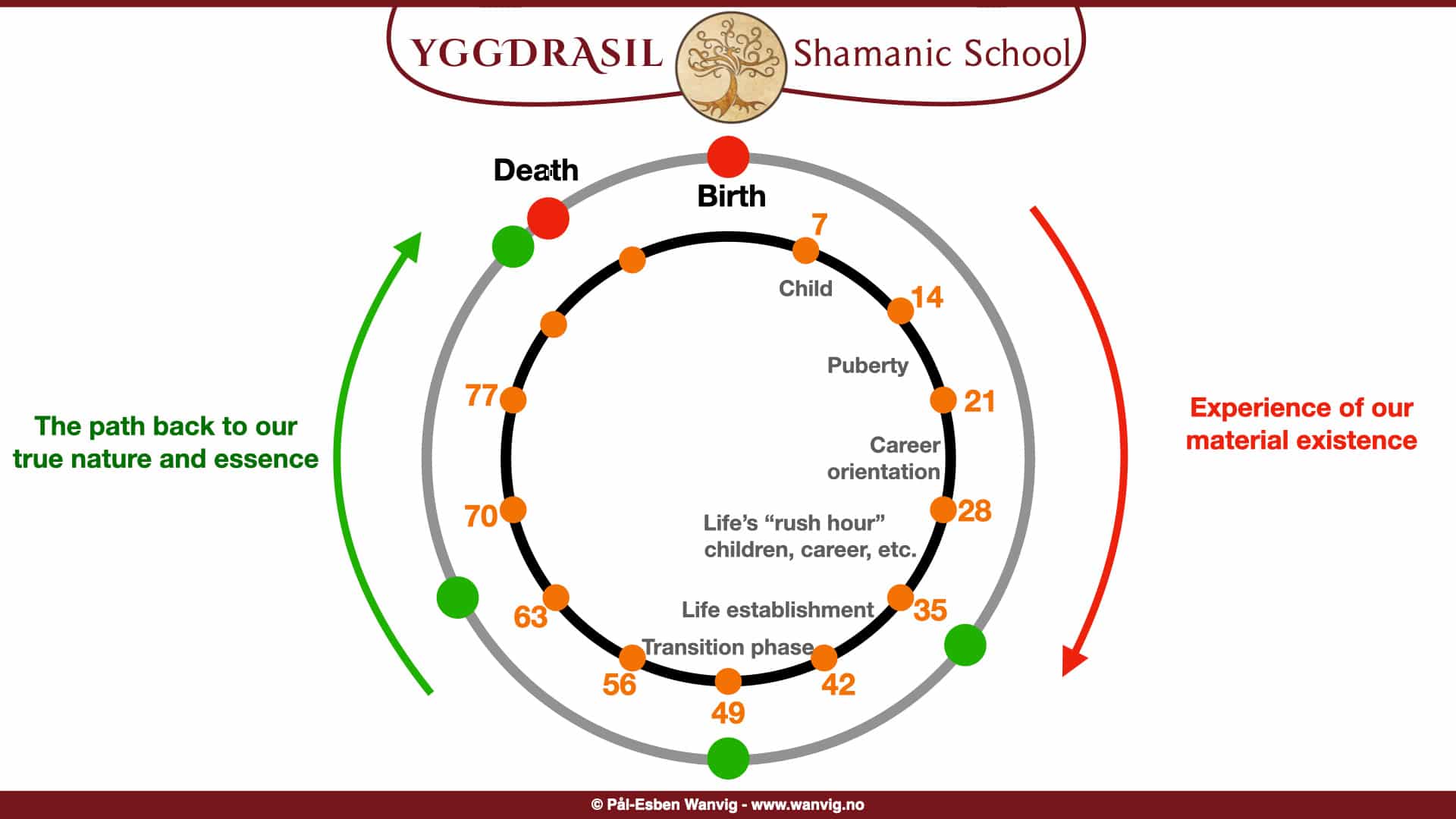
In Figure 1, the two red dots mark birth and death — the only fixed points in our physical existence. Everything between them is a landscape we shape ourselves, through our choices, our experiences and our growing insight.
When the soul enters this life, it leaves behind a realm without time or space and steps into a world of limitations.
For the soul, this can feel like slipping into a tight, restrictive garment — a life where the direct connection to its true nature becomes muted.
But it is within these limitations that the soul gains the opportunity to experience exactly what it came to learn.
And deep within us, something else stirs:
A quiet longing.
An inner whisper reminding us of who we truly are and where we come from.
For many people, this whisper grows louder after the age of 40.
Suddenly, life no longer feels as fulfilling as it once did. Something feels off — empty, unbalanced, or inexplicably incomplete.
Even those who have “everything”—a family, a career, stability, material comfort—may feel a subtle ache, a sense that something essential is missing.
We often call this a midlife crisis.
But from a shamanic perspective, it is not a crisis at all.
It is a calling.
A sign that the soul is knocking on the door, asking you to pause, to listen, and to begin the next phase of your journey:
The Soul’s Epic Journey.
This is not about abandoning the life you have built.
It is about rediscovering the deeper meaning that got buried beneath the noise and pace of everyday life.
It is about allowing yourself to ask one of the most important questions a human being can utter:
“What truly matters — to me?”
When this question awakens, a new cycle begins.
And it is precisely here that the most transformative part of our journey unfolds:
the moment we turn inward and begin to rediscover who we are beneath roles, expectations and performance.
The Transition Toward the Existential Life
The transition phase described in Figure 1—often between the ages of 42 and 56, though it can arrive earlier or much later—is a period when something deep within us begins to stir. It is as if a part of ourselves that has long been forgotten, pushed aside, or left in the shadows finally rises and insists on being heard. The voice becomes stronger now, more persistent—a longing that can no longer be ignored.
What calls to us is the soul—the existential, eternal part of us that never dies. It has always been there, but during this transition it begins to speak louder. Many experience this as a sudden and powerful pull toward the mysterious, the unknown, the spiritual. Esoteric books, lectures, podcasts, and seminars become irresistibly appealing. You find yourself searching, questioning, exploring—as if an inner door is quietly swinging open.
No matter how this phase shows itself, the message is the same:
a transition is underway—a reorientation toward a deeper connection with our existential nature, our true and immortal essence.
When we listen to this voice and make space for it, something remarkable happens. Many describe an emerging sense of meaning, inner peace, and genuine contentment. Life gains depth, direction, and a clarity that feels both new and deeply familiar.
But when we ignore this inner call, the opposite often unfolds. A pressure builds inside—a sense of emptiness, numbness, lack of enthusiasm, or a quiet despair. This is the soul’s way of telling us that we are out of alignment with something essential.
Tragically, many never dare to listen.
They don’t realize what they’ve missed until life is nearing its end—when the time to explore the most important part of existence has slipped away.
The Soul’s Epic Journey
In the end, it is up to each of us whether we choose to begin—and truly experience—the Soul’s Epic Journey in this lifetime. This journey is defined by a profound inner reorientation, where all three dimensions of our existence finally receive the attention they deserve: the body, the mind (our thoughts and emotions), and the soul—our existential, immortal essence.
In Figure 1, the beginning of this journey is marked with green points. Some people embark on it early in life, almost as if they intuitively sense that life contains more than what meets the eye. Others enter the journey in the middle of the transition phase between 42 and 56, when life itself calls for change. Some begin only in later years, when the passing of time becomes impossible to ignore. And many—far too many—never begin at all.
My own epic journey began long before I was ready for it. At the age of 35, I burned out so severely that it nearly cost me my life. It was a brutal turning point—a complete collapse that forced me to question everything I believed I knew about life, meaning, and myself.
Yet within that darkness lay the seed of something transformative. That crisis became the doorway into a new direction—a path toward understanding what life truly is, and what vision the soul carries into each incarnation. It opened a passage into the world of the shaman: a mystical, profound, and extraordinarily rich tradition where the greatest questions are not only asked—they are answered.
The journey I was thrust into—unwilling, unprepared, and terrified—has become the most meaningful, illuminating, and rewarding experience of my life. And this journey is available to everyone—absolutely everyone—who dares to listen inwardly and follow the call when it arrives.
Power Animal Hummingbird – The Guide to Your Soul’s Epic Journey
A shamanic power animal is a form of light-being or angelic presence—appearing to us in the shape of an animal when we look with our inner vision. It carries many of the same qualities as its physical counterpart, yet it acts on a much deeper, intuitive, spiritual level. The Hummingbird as a power animal has been with you since the very moment you entered this world. Its purpose is clear: to help you discover, embrace, and live your Soul’s Epic Journey in this lifetime.
The hummingbird itself is extraordinary. Every spring and autumn, it embarks on an almost unimaginable migration from Central and South America—places like Mexico and Brazil—all the way to Canada and Alaska. This tiny creature, often lighter than a coin, can fly more than 2,000 kilometers without landing, its heart beating up to 1,260 times per minute. The hummingbird is nature’s living symbol of endurance, courage, and boundless life force.

Here are some of the gifts and qualities the Hummingbird brings:
The Wisdom and Energy of the Hummingbird:
- It awakens the call to your Epic Journey. The hummingbird supports those who are ready to begin. It ignites courage, inspiration, and the inner spark that urges you to step into your true mission.
- It teaches us that growth is our natural state. From birth to death, the soul is designed to evolve. Stagnation hurts—but growth creates meaning.
- It helps us continue even when life challenges us. The hummingbird reminds us that obstacles are not the end of the journey—they are part of it.
- It gives us courage. It strengthens the heart when we stand before choices we might otherwise fear, especially when the soul is longing for change.
- Its wisdom is essential for discovering our true nature. The hummingbird points us back to who we have always been, and to what we came here to express.
The Hummingbird’s Qualities – And What They Teach Us
- Extraordinary endurance — the journey continues until the destination is reached.
- Vibrant life force, joy, and delight — reminding us to find joy in small, ordinary moments.
- Flexibility, agility, and willingness to change — life is not about waiting for perfect conditions.
- Variety and diversity — the opposite of autopilot; the fuel of spiritual growth.
- Natural curiosity — exploring new inner landscapes is part of the soul’s evolution.
- Speed, energy, and efficiency — even small steps can create enormous movement.
- A vital pollinator in nature — just like butterflies and bees, it sustains life everywhere it goes.
- And above all: Size means nothing. Even when you feel small or insignificant, the hummingbird shows you the immense power you carry within.
- The ability to slow its metabolism and rest deeply — reminding you that rest is also part of the journey.
When We Ignore the Call of the Hummingbird
After the transition phase of life (typically ages 42–56), the hummingbird’s voice becomes stronger. It calls us into a new phase—from a life focused on the material to one rooted in deeper existential growth.
If we choose to ignore this call, something significant happens:
The soul’s energy begins to withdraw.
This marks the beginning of the incarnation’s yin-process—an inner withering, a spiritual retraction. It happens every time we choose comfort over growth, or when we silence the soul’s longing to expand.
When We Listen — We Live
But when you choose to keep the hummingbird’s instinct alive through daily curiosity, inner work, stillness, exploration, and the willingness to grow, the opposite occurs:
✨ You awaken the Soul’s Epic Journey.
✨ You begin to live it.
✨ You flourish within it.
The hummingbird does not just guide you — it reminds you of the magnificent being you already are.
Are You Ready to Begin Your Soul’s Epic Journey?
For many, the warm-up to the Soul’s Epic Journey begins quietly — like a soft breeze at the edge of awareness. It may start as a simple curiosity, a desire to understand the esoteric, a book that stirs something inside you, a video that opens a door, or a seminar that awakens a feeling you somehow recognize, even if you can’t explain it.
But the true Epic Journey doesn’t begin with a few inspiring moments.
It begins when you’re ready for a fundamental reorientation of your life — a shift that cannot be achieved by reading a little here and there or by attending an occasional workshop.
The real journey requires guidance, reflection, and support from a qualified spiritual teacher who can walk with you through a deeper, longer process… a process where wisdom is not just understood, but embodied.
If you’re searching for the right teacher, I recommend the article “ABC Guide to Finding Your Spiritual Teacher” It offers a clear and practical introduction to what you should look for — and what to avoid — when choosing someone to guide you on this profound path.
Many of the people who come to me are already in this transitional phase — a time when the inner voice grows louder and the longing for something deeper, truer, and more meaningful can no longer be ignored.
In the basic training in Yggdrasil Shamanic School, I personally guide my students through a 6–8 month transformative development process filled with insight, practice, and tools that gradually bring body, mind, and soul back into alignment.
When you complete this journey, you don’t just understand the path of the soul —
you live it.
You stand with clarity.
You walk with purpose.
You feel your inner compass awaken.
And you carry everything you need to fully step into your Soul’s Epic Journey — with strength, direction, and a deep, living connection to who you truly are.
References
Ref. 1: Harvard Study of Adult Development. https://www.adultdevelopmentstudy.org/
Ref. 2: Harvard University: Good genes are nice, but joy is better
https://news.harvard.edu/gazette/story/2017/04/over-nearly-80-years-harvard-study-has-been-showing-how-to-live-a-healthy-and-happy-life/
Ref. 3: TED Talk: What makes a good live? Lessons from the longest study of happiness. https://www.ted.com/talks/robert_waldinger_what_makes_a_good_life_lessons_from_the_longest_study_on_happiness