The Secrets Behind Death and Reincarnation: What Happens After Death?

Do we have concrete evidence of reincarnation? Should we fear death? Do hell, the devil, and fallen angels really exist? What happens at the moment of death? What challenges do we face when we die? What are ghosts, really? Is it possible to communicate with the dead? What is a poltergeist? The mysteries surrounding death and rebirth are the subject here.
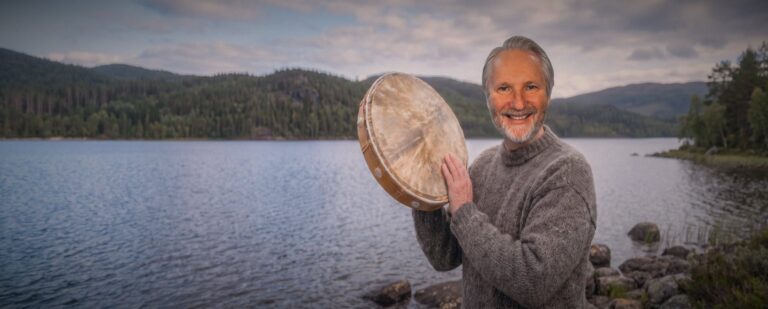
I regularly receive questions about what awaits us after death. As a practicing shaman, my role is to guide people to understand and appreciate the power of nature, both in their surroundings and in their inner world, and to help them live in harmony with their spiritual heritage. In the shamanic understanding of the world, everything that exists is ensouled and filled with life from the universal creative force, from the smallest stones to the mightiest trees, from streams to the oceans of the world.
Part of my work as a shaman is to help souls into this world, and to support them in the transition onward when their time in physical form is over.
Unfortunately, there are many misunderstandings, a great deal of drama, and much fear surrounding death and reincarnation, especially in religion and in the modern esoteric market. Yet this is knowledge every human being ought to have: an understanding of the cycle of life and death shows us more deeply why we are here, and how we can meet the transition without fear.
Life, death, and reincarnation from a linear perspective
Here we explore life, death, and reincarnation from a linear perspective, which makes it possible for the intellect to understand and relate to the subject in a concrete way. In the deeper spiritual reality, neither time, life, death, nor reincarnation exists as we usually perceive them.
Our whole existence plays out simultaneously across an infinite number of parallel existences. The experience of beginning and end, birth and death, is in truth an illusion and a dream, a symbolic theater your soul creates in order to learn and experience, and which you experience as you, the self, and as the material reality within the limits of time and space. You can read more about the actual structure behind reality in my article series on The Primordial Shamanic Path to Unity and Spiritual Enlightenment.
The aim here is to give a clear and down-to-earth introduction to life, death, and rebirth seen from a linear perspective. You will find more detailed information in the section on life, death, and incarnations in the online course Awaken Your Inner Primordial Shaman.
My first experience
Shortly after I began my shamanic training in 2004, I was drawn into an unusual incident at the home of an acquaintance. The family was experiencing extensive disturbances at night, and both the children and the parents were deeply affected by fear. They heard distinct footsteps in the attic and doors and windows slamming for no reason, and a heavy, unpleasant atmosphere hung over the whole house. It did not help matters that the home lay right next to a cemetery.
Through the grapevine, they had heard that I was training to become a shaman, and they asked me for help. As a beginner, I was unsure and humble. I had never dealt with poltergeist phenomena before, but my teacher at the time gave me clear and detailed instructions on what to do.
As a civil engineer who had just taken my first steps into the world of shamanism, I was naturally filled with skepticism, unease, and a sense of standing on very thin ice. Moving into a dimension I had no practical experience with was an enormous challenge. Even so, I devoted a whole day to shamanic rituals and thorough energy work to restore the balance in the home.
I followed my teacher’s instructions to the letter, but I could not shake the doubt about whether any of it had actually had an effect.
The next morning, my acquaintance called, elated and almost ecstatic. She told me that for the first time in a very long while, the family had slept through the whole night without a single disturbance. All the knocking, creaking, and unrest was completely gone. A calm, peaceful atmosphere had replaced the heavy mood, and the children were clearly more relaxed. All the unpleasant phenomena had vanished like dew in the morning sun.
Research on rebirth
There is extensive indirect documentation supporting the theory of rebirth, and research is ongoing at academic institutions around the world. The University of Virginia School of Medicine in the United States stands out as the most prominent research institution on reincarnation and rebirth. Its Division of Perceptual Studies (DOPS), founded by Professor Ian Stevenson, MD, in 1967, carries out thorough studies of paranormal phenomena.
One of their most fascinating areas of research is the study of young children who claim to remember previous lives. These children can often give detailed descriptions of their former lives, with specific information about where they lived, their occupations, their family relationships, and other personal circumstances. Most remarkable of all, neither the children nor their present families have any means of constructing these complex stories. The research team at the University of Virginia travels extensively to document the accounts and carries out thorough investigations to verify the accuracy of what the children describe.
Based on their extensive research, the researchers conclude that there are significant scientific indications that we live multiple lives. If you want to explore the subject in depth, their website has a large collection of research material: video documentation, in-depth interviews, publications, and extensive research data.
(Seen from the perspective of reality, where our existence consists of an infinite number of parallel existences unfolding simultaneously, such research findings can be understood in a different way: some people have stronger connections to certain of their parallel selves, existences that feel as if they lie “behind” or “ahead of” them on the timeline. This resonance allows memories, experiences, and scenes from life to break through the veil between the parallel existences and be experienced as previous, or future, lives.)
See also the podcast The Journey to Self-Realization, episode 17: “What Happens When We Die?”
Is death something to fear?
One of our greatest challenges in facing death is the deep, often irrational fear many people carry. This fear can create significant complications in the transition phase between life and death. For more than two thousand years, various religious institutions, especially the Christian church, have helped reinforce it through notions such as hell, the devil, fallen angels, and demonic beings.
These ideas function first and foremost as psychological control mechanisms built on fear, and they have no root in actual spiritual reality. As an absurd digression: the Catholics’ limbo (yes, they had a pre-hell you had to go through before you reached the real hell) was abolished by the pope a few years ago because it was no longer relevant in our time.
Many are surprised when I point out that most people, regardless of religious affiliation, carry a deep, inherent fear of what happens after death. Even people who claim not to believe in anything religious are unconsciously influenced through culture, the media, movies, and symbolism that keep repeating the same old notions. Part of this fear is also passed on through epigenetic mechanisms and through our own biological lineage and bloodline.
Kinesiology tests from applied kinesiology are a simple way to uncover how strong this fear is. Such tests often reveal that our subconscious is stuck in old belief patterns we have been exposed to since childhood. I have yet to meet a person who is completely free of death-related fear.
Yet death itself is nothing to fear. Death is a natural transition to another form of existence for the soul, a transition we have gone through countless times before. The real challenge arises when we meet death with fear. Fear can disrupt the transition and, at worst, create a self-constructed “hell” in the intermediate state called the Bardo.
I will come back to that later.
Death is a natural transition to another form of existence for the soul, a transition we have gone through countless times before. The real challenge arises when we meet death with fear.
Pål-Esben Wanvig
Hell, the devil, and fallen angels
The notions of hell, the devil, and fallen angels exist first and foremost in the human mind. There are no “evil angels.” The role of angels is to assist and support humanity, always with respect for our free will. In my years as a professional shaman, I have never met, or heard credible descriptions of, angels, beings of light, or power animals with any intention to harm.
What I do have extensive experience with, on the other hand, is people who have become stuck in the intermediate state of the Bardo after death, and who can create disturbances for the living from this level. This is what is often described as revenants, “evil spirits,” or poltergeist phenomena.
The notions of hell, the devil, and fallen angels exist first and foremost in the human mind. There are no “evil angels.”
Pål-Esben Wanvig
The universe also contains beings we may experience as frightening. But the truth is that the fear is mutual: we seem just as strange and threatening to them. When different races meet on the astral plane, the fundamental difference can create unease, especially if you are not trained to deal with beings that are fundamentally different from us.
That is one of the main reasons you should never make astral journeys uncritically or spontaneously to places you do not know. Exploring unknown dimensions should always happen under the safe guidance of an experienced shamanic teacher with solid competence in and understanding of these areas.
How to heal fear
Healing fear is one of the most significant things you can do for your existence, your soul, and your life path, and for avoiding the challenges that can arise before, during, and after death. No other forces create obstacles as great, in life or in the transitional phases between lives, as fear and anxiety do.
For anyone who seeks spiritual growth and wants a deeper connection with their soul and their life plan, healing fear is absolutely essential. The more we let ourselves be governed by fear, the further we move away from love and from the heart, the soul’s clear gateway into this world.
A shaman, healer, teacher, or mentor who carries a lot of fear themselves will always be limited in their ability to help others. Fear, whether conscious or unconscious, creates disharmony, and that disharmony is inevitably passed on to the people we work with. Even the best intention can create imbalance if the fear lies unresolved in the background.
That is why healing fear should be at the top of the priority list for anyone who wants a harmonious, strong, and meaningful life.
There are many effective methods for releasing fear. Among the ones I use myself are the techniques taught in Change Your Life in 90 Days and Awaken Your Inner Primordial Shaman. They can quickly erase fear reactions stored in the subconscious, such as a phobia of spiders, a fear of heights, or a fear of the dentist, often in just a few minutes. These are methods anyone can learn and put to use.
The most fundamental and deep-seated source of all human fear, primordial fear, is one of the themes we work deeply to heal in the basic training at the Yggdrasil Shamanic School.
See also episode 15, “Death Anxiety and the Fear of Death – When Everything Falls Apart and the Soul Demands Change: How to Come Back to Life,” and episode 16, “Primal Anxiety, Fear-Driven Shamanism and the Nervous System – How to Find Your Way Back to Safety Within Yourself.”
What happens when we die?
In the days, and sometimes the weeks, leading up to a natural death, the soul and the energy system gradually begin to withdraw from the physical world. This can be seen clearly in the light body and the eyes of the dying person, which slowly lose their clear glow and vital radiance and become duller and more withdrawn.
In this phase, you can often sense the presence of the angels of death: large, luminous beings who bring with them a deep peace and stillness. Their presence is never threatening. On the contrary, the task of the angels of death is to support, protect, and safely accompany the soul from material existence into the first phase after death, the temporary intermediate state called the Bardo.
The intermediate realm of the Bardo
The term Bardo comes from the Tibetan Book of the Dead, Bardo Thödol, in which Bardo means “the temporary” and Thödol means “liberation.” The title can be translated as “liberation through listening in the intermediate state.”
When death occurs, the soul is accompanied into the intermediate realm by the angels of death, together with parts of the energy system from the physical life. In this temporary state, the soul’s main task is to process, understand, and make peace with its actions and experiences from the incarnation that has just ended.
This phase of integration usually lasts from a few weeks to two or three months, but in some cases it can become considerably longer if the soul carries strong fear or particular karmic burdens.
It is entirely possible to communicate with souls who are in the Bardo, and they can also communicate with us when the conditions are right. When the process of acceptance and integration is complete, the soul can turn again to the angels of death, who then guide it on the last stage toward the Realm of Light and the next life.

The Realm of Light
In the Realm of Light, we are reunited with our soul, with the souls in our soul family, and with our spiritual guides. Here the soul takes part in a deep planning process together with selected members of its soul family and with special beings of light who serve as guides. Together they shape the plan for our next incarnation: the learning experiences we will go through, the challenges we will face, and the life path that best supports the phase of the incarnation cycle we are in.
When the time is once again ripe for a new incarnation, a new dream, the soul consciously seeks the setting that can best support its purpose and its learning tasks in the coming life. In other words, as souls, we choose our parents. The choice is often guided by our karmic current, seen in connection with the soul’s learning themes and with our meta-incarnation cycle. There is more about this in episode 9, “What Does Your Soul Really Want, Why Is It Here, and How Do You Find Your Life Mission?”
Problems related to the Bardo
The greatest challenge at the very moment of death is the fear of the unknown. When fear dominates, the soul can become “trapped” in the Bardo and create its own anxiety-filled state, a self-constructed hell shaped by unresolved conflicts, grief, and unsettled life experiences. If you avoid confronting what is happening here and now, or what has happened in the life you are leaving, the soul can remain in a kind of timeless paralysis in the intermediate realm.
I have assisted souls who have been bound to the Bardo for several decades, and in some cases far longer. Such souls often try to seek out power places or places with strong energy, in the hope that someone with the right expertise can help them move on.
When I work with clients who want support in the transition between life and death, I work closely with the angels of death and with the client’s own soul to ensure a peaceful and smooth transition. That is also why I recommend that every family have at least one well-trained shaman in its circle, someone who can receive new souls safely and guide them onward when the time of transition draws near.
What are ghosts?
In essence, ghosts are deceased people who are still in the Bardo state. Sometimes people who die have difficulty letting go of their physical existence, an attachment that binds them to the material world longer than necessary.
There can be many reasons. Some cling to their home, their partner, or their children. Others carry a strong need to control those they leave behind, or a deep fear that their loved ones will not manage without them. In some cases, the grief over losing those closest to them becomes so intense that it keeps the soul from moving on toward the Realm of Light.
I regularly meet clients who experience discomfort or unexplained phenomena in their homes, where the deceased are still lingering. In most cases, it is enough for me to establish contact with the soul, explain that its time in the material world is over, and show it why peace can only be found by letting go and moving on. When they understand and accept this, I work with the angels of death to lead them safely from the Bardo to the Realm of Light.
Now and then, however, I meet souls who flatly refuse to move on, no matter how much understanding and guidance they receive. In such situations, I use specialized shamanic tools to dissolve the bond between the soul and the material world, so that both the living and the dead can find peace.
Can we talk to the dead?
As long as a deceased soul remains in the intermediate state of the Bardo, it is possible to communicate with it, provided you have the right training and experience. But one important question should always be asked: why do we really want to contact the dead? Wouldn’t it be more loving to let them have the peace they need to complete their process and continue the journey to the Realm of Light, where they find peace and rest?
The stronger our emotional need to hold on to those who have passed away, the harder we make their transition. When the dead see our grief and our pain, it can feel so intense to them that they choose to stay in an attempt to comfort and support us, even though they no longer have any way of easing our pain. The grieving process is ours to carry, and no one who has died can complete it for us.
We must understand that their time in the physical world is over, and that our inability to let go can keep them from moving on. Even when death comes suddenly or under dramatic circumstances, we have to go through our own grieving process, an inner journey that is precisely about letting go, so that both we and the deceased can be set free. Only then can the soul end its stay in the Bardo.
The grieving process is ours to carry, and no one who has died can complete it for us.
Pål-Esben Wanvig
In the work of helping clients through the transition from physical life to the Realm of Light, the greatest challenge is often not the soul’s transition itself, but supporting the bereaved in letting go in a loving way.
That is why it makes me genuinely sad when I hear stories of people who, years after a death, keep up contact with the deceased and wear it as a badge of honor. What the dead really need is not attention or curiosity, but an experienced shaman who can help them on to the Realm of Light, so that they can finally find peace.
Our relationship with death
Death is a natural and inevitable transition, a transformation from one state of existence to another, which all living beings on earth go through again and again. When we learn to accept and understand the many sides of death, we also open ourselves to the deeper wisdom behind change and transformation. This insight can enrich every area of life, from how we meet grief to how we find our way through major shifts and life changes.
See also episode 10, “Gaia: The Elite University of Souls,” and episode 11, “Soul Friends, Soul Family, Karmic Relationships and the Great Misunderstanding About Twin Souls.”
When we learn to accept and understand the many sides of death, we also open ourselves to the deeper wisdom behind change and transformation.
Pål-Esben Wanvig
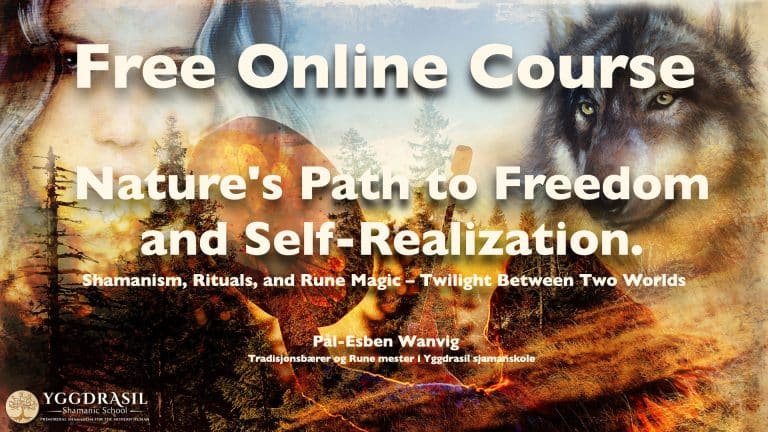
Do you want to go deeper? On my blog and in the podcast The Journey to Self-Realization, we explore the topics in this text in more depth. If you want to walk the path yourself, it begins at the Yggdrasil Shamanic School with our free online course on primordial shamanism: Nature’s Path to Freedom and Self-Realization. No path could begin more simply. How far it reaches is up to you.
This content does not replace professional medical help from a doctor or other health professional, and it is not intended as medical treatment. If you are ill, always see a doctor first.
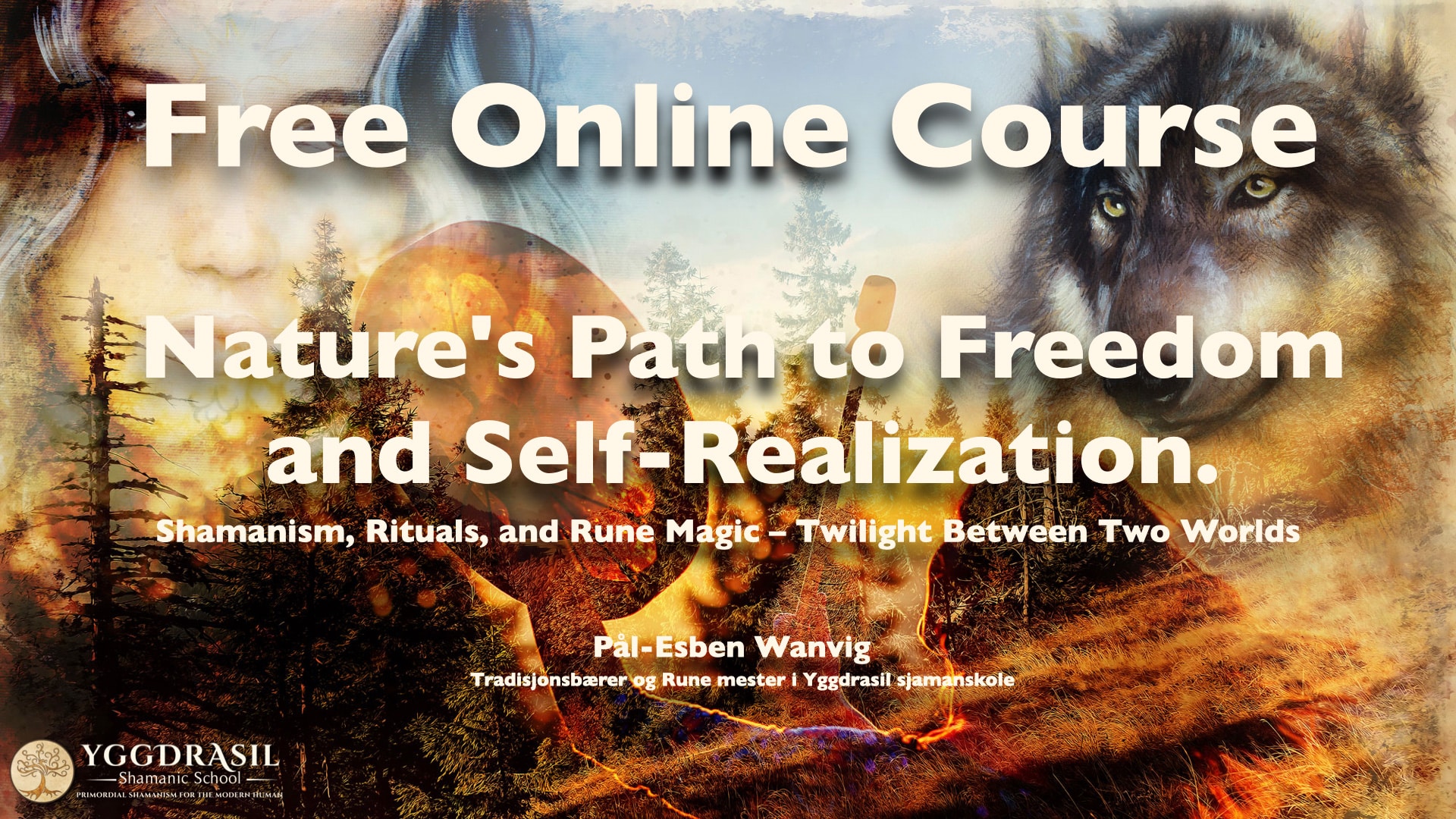
Nature’s Path to Freedom and Self-Realization
Curious about what primordial shamanism really is, behind the mystique and the misconceptions? In this short online course I tell the story of my own path from skeptical engineer to teacher of primordial shamanism, and give you a first introduction to what I teach: what shamanism and primordial shamanism are and are not, how rituals and rune magic are used in practice, and why the longing for growth matters so much for a good life.
The lessons are recorded in Norwegian; the English version will be ready in November or December 2026. Leave your email on the course page, and I will tell you when it is.