Episode 9 – What Does Your Soul Really Want, Why Is It Here, and How Do You Find Your Life Mission?
As a child, Amina felt she had a calling, and she thought it meant she was perhaps going to be a celebrity or a superstar. Today she hears the ego as a voice that is always in a hurry, and the soul’s voice as a calm breeze. Pål-Esben describes the soul as a sphere of energy the size of our solar system, and this planet as the elite university for souls, where your challenges make up your doctoral thesis.
In this ninth episode, Amina and her teacher and guide, Pål-Esben Wanvig, talk about the ninth of the 9 Pillars for Finding the Path of the Heart: becoming a master of understanding and living out your soul’s desires and life mission in this incarnation. They explore why the soul chooses to incarnate, how it speaks to us through the primary feelings, and why so many people feel an emptiness and a longing after 40. It is part of “The Journey to Self-Realization”, a podcast about the bravest journey a human being can set out on: the journey home to yourself.
This episode is an English translation of our Norwegian original, voiced by the digital avatars of Pål-Esben and Amina.
In this episode
- Pillar 9, the soul’s desires and life mission: the calling Amina felt as a child, and her search through religion, tarot, Reiki and astrology
- Why all the answers are within us, and how the tools become play once you can hear the soul’s voice
- The soul as a gigantic sphere of energy, and why it chooses this planet, the elite university for souls
- The crystallisation points of birth and death, and the learning tasks the soul sets up in between
- The soul’s language of primary feelings, and how to tell the ego’s haste from the soul’s calm breeze
- Changing perspective on illness, burnout and loss, and why no one should have to manage it alone
- How the direct contact with the soul fades in childhood, and the emptiness that often appears after 40
- Amina’s words of wisdom: listen to your passion, and look for possibilities instead of limitations
This podcast is for you if you:
- Seek real depth in your spiritual practice
- Want to understand yourself on a more fundamental level
- Are curious about shamanism but tired of superficial “new age” spirituality
- Have taken many alternative courses but still feel that something is missing
- Feel an inner longing for freedom, love and wholeness
In a time when so many get lost in external methods and promises of quick fixes, this podcast invites you back to the only place where true answers can be found: your own heart.
Listen above, or read the full conversation below.
Transcript
A warm welcome to the podcast “The Journey to Self-Realization”, a primordial shamanic journey of development back to your true nature. This podcast is a collaboration with our favourite magazine, the health and lifestyle magazine Medium, and is devoted to exploring the bravest journey a human being can set out on: the journey home to oneself. We follow Amina, a student at the Yggdrasil Shamanic School, as she goes through a deep primordial shamanic process of development together with her guide and teacher Pål-Esben. It is a raw, unpolished journey of discovery towards true joy in life, deeper meaning, and a life that truly feels good to live.
This episode is an English translation of our Norwegian original, voiced by the digital avatars of Pål-Esben and Amina.
Today’s topic: the soul and the life mission
Pål-Esben: A warm welcome to a new episode, Amina!
Amina: Thank you so much, likewise, Pål-Esben!
Pål-Esben: And we’d also like to give you, the listener, a warm welcome, because today we’re going to talk about a very, very exciting topic that has to do with the soul, and with how we understand why the soul is here. What are the soul’s desires? Why do we incarnate? What is my life mission, and how do I find it? It’s a gigantic topic to discuss in a short time, and we hope we’ll arrive at something that can inspire you as a listener and give you greater understanding and help in your daily life. Because that’s our goal. We’re not talking here for our own sake, even though we think it’s great fun to have our conversations, Amina. We’re doing this to inspire you as a listener, with the experience, insight and observations we’ve gathered.
To start with, Amina: before you began your real journey of development, that is, this profound primordial shamanic journey of development that this podcast revolves around, what were your thoughts about your soul? What your soul was, why it’s here, why you’re here, and what your life mission is?
A calling without a name
Amina: We can go back a bit further. I remember that even as a child I felt I had something I like to call a calling. There was something deeper in me that I didn’t understand, a sense that there was something I was here to do. I couldn’t think about it that way as a child, but there was something bigger in me, something more I was meant to explore, but I never understood what. When I was little, I thought that feeling meant I was perhaps going to be a celebrity or a superstar, because I felt there was a place for me on the stage or something like that. And on top of that, I had very poor self-confidence and self-esteem, so I couldn’t quite understand what this could be.
As I got older, I searched outwards a great deal. I searched in different religions to find my calling and my home, and I thought I’d found it every time, because it was so lovely and nice, and it felt so good inside me, since I’d found a sense of belonging. But then I understood more and more: no, it isn’t quite this either. It isn’t quite this either. So I left religion behind and got to know the esoteric, that is, more spirituality. There’s something more between heaven and earth. Perhaps not a God who rules up there, steering and arranging things, with heaven and hell and all that, but something more. I began working with tarot cards and thought that something was going on here. I kept at that for many years before I dived into other things. I was a bit of a closet tarot reader, if you can call it that. Then I went on to a Reiki healing course and felt that yes, this is more my kind of thing. But in these different courses and paths I took, there was no solid foundation. I somehow never reached that level, or those parts of me that were perhaps really screaming the loudest.
It was when I got to know you and the Yggdrasil Shamanic School, where personal development and spiritual development were woven together, that I began to peel off the layers I’m not, so that I could see more of what I really am. And it’s quite interesting, because I’ve worked with astrology for many years, and I’ve seen which path I’m most likely meant to walk. You always have free will and so on. But I’ve understood more and more that it just stays theoretical if you don’t walk the path, the experience-based path. And the interesting thing about Yggdrasil shamanism is that you don’t really need to have someone read your astrological birth chart for you either, because you feel it more and more in yourself. So that’s perhaps a short explanation of my path into this: getting to know who I am better and better. For me it feels as if it comes very naturally when I begin to peel off more and more of what I’m not.
All the answers are within us
Pål-Esben: Yes, and that’s really how it is. Because all the answers are within us. Absolutely all the answers are within us. We’ll talk a bit later about the soul and how incarnation happens, but all the answers are already in us. The divine spark is in us. All insight, all knowledge, everything is stored deep within us. We’re talking about the timeless and spaceless aspect of us, which we can also call the divine spark, and which you touch the day you have an experience of oneness and enlightenment. But this knowledge, this voice deep within us, is so numbed. There are so many layers around it, which we’ve been imprinted with in this life: through our upbringing, through imprints, through religion, through everything. And not least through the insane stress and chaos that is our society. There’s so much noise in our ears, in our senses and in our emotional system that it’s incredibly, incredibly hard to listen to this subtle voice in us, which actually has the knowledge and insight we need to find our way through this life without suffering.
That’s what you gradually notice when you start on a profound path of development: you no longer need so many external factors to tell you why you’re here and what you’re supposed to do. And I’m not saying anything negative about tarot, astrology and other systems that can help a person. They’re a very good place to start. Because when someone comes to you and gets an astrological horoscope, they get an idea of the thread running through their life. At the start that can be very helpful, as it was for me when I began my journey many, many years ago, in the old days. When we cross 50, we start using words like “in the old days”. Sometimes I think: what’s it like to have crossed 50? I still feel 35.
From astrology to inner certainty
In the old days, when I began my profound journey of development, I was everywhere. On one course after another. I travelled to the USA and Hawaii, looked for the best healers, and learned Reiki and all sorts of bits and bobs I came across. And of course astrology was very, very exciting at the start. When someone said to me: “Oh, there’s your planet, and there’s your Chiron. Chiron shows this and that,” I thought: “Oh, this shows me why I’m here.” But it was when I began to go deeper and deeper into the layers that I found more and more of these answers in myself. So today I don’t look at my horoscope or the transits any more, because I feel it. I don’t need anyone else to tell me, and I don’t need a computer calculating a horoscope to tell me what’s going on in the system around me, whether it’s planets or more metaphysical aspects. I feel it, and I know what it is, since I’m in contact with this divine spark, which represents our soul and the soul’s voice.
And that’s one of the things we hope for on a profound journey of development like the one you’ve chosen. Yes, we have many tools around us, and there’s nothing wrong with the tools, but in time we see that we no longer need them, since we feel the answers within us. The day you begin to feel these answers within you and to be in contact with this voice, life begins to change quite radically. Because then you know what’s right to do. You definitely know what’s wrong to do. And this voice becomes clearer and clearer, more and more distinct, louder and louder, the closer you come to this spark, or this core, in yourself. That’s one of the big goals when we take a person through a profound journey of development: to reach the point where they’re independent, where they don’t need the tools around them, but can use them if they find it exciting. You don’t have to have a tarot reader reading the cards for you every month or every year, or an astrologer drawing up horoscopes, because you feel it yourself. But now and then it’s fun to look into the transits and think: “I can feel this… wow, here I can see the transit between my sun and Chiron, whatever it is. Wow, I can feel that.” And of course it’s on a completely different level. That’s probably what you’re also beginning to come into contact with more and more, Amina: this voice, where you use the tools as tools, but no longer depend on them to tell you what you are, where you should go and which choices you ought to make.
When the tools become play
Amina: Yes, that’s absolutely right, and it gets more and more exciting. It’s almost a bit more exciting to use these tools now, whether it’s tarot cards, runes, or transits and astrology. It’s almost more exciting now, because I can recognise it: yes, of course, this really resonates. Or the times when I see that the way I would have read these cards, the birth chart or the runes before doesn’t resonate now. Then it must mean something else. And this is no longer about not agreeing with what comes up. Because at the beginning, when I was working with tarot cards, it was: “No, I don’t want those cards, I’ll draw them again, it must be wrong.” So it gets a bit more exciting the more firmly grounded I am in myself. And of course I still think it’s very important to get feedback from you or other fellow students on the runes I draw: “This was drawn for this phase, and this is what I think. What do you think?” It’s nice to get some input. But it’s as you say, at least in my experience: the more I manage to quieten the noise going on in my head, the more easily I can hear my true voice, or my soul’s voice. And of course some days and periods are easier than others. Then I have to look: has there been a bit too much going on lately, so that it’s a little harder to hear my innermost self? But that’s fun too: getting to know how far I’ve let the noise go before I reset myself again.
Because I also find that it has a short shelf life. It isn’t as if now I’ve seen the light, and then it’s done. No, I have to keep up the good routines and the way of living in order to keep having access to it.
What is the soul?
Pål-Esben: Perfect. And let’s look a little at what the soul’s voice actually is. That sounds very grand; put simply, it’s how the soul communicates with us. But first a little about what the soul is.
If we’re to use an image, we can imagine that the soul is a gigantic sphere of energy made of consciousness. It has no physical size, but if we want an idea of how huge the soul is, we can say the size of the solar system we live in. Imagine a sphere of energy that big. A gigantic thing. That’s you. That’s what you really are. And what gives life to your soul and animates it is what we can call the source, God, the creative force. It has many names: that which has created everything. It animates life in your soul, which in turn animates life in your physical body. So it’s something gigantic, and that’s what we really are. It’s our true nature.
The soul then chooses to create experience in a setting where it gets to experience what it is, and what it really isn’t. Where your soul is, which at the start I called your core, there’s of course no time and space. Everything exists here and now. And the soul has a desire to create experience, and when it chooses to incarnate or create a life in a physical existence, it chooses something that’s really very, very complex and difficult. Imagine: when you’re fully in contact with your soul and are your soul, there really are no limitations. Are there limitations? Yes, of course there are limitations, but none that we humans can imagine. You’re everywhere; you’re connected with everything. And then your soul, that is, you, what you really are, has actually chosen to say: “Right, now I’m really going to give myself a challenge.” And you then choose one of the most difficult challenges a soul can choose to take on.
And why do we do it? Well, to find new experiences, to learn, to grow. In other words, evolution. Because evolution, as we can see, is the whole point of the entire universe we live in. Expansion and evolution, from the universe to the galaxies to our planet: everything is about evolution and growth. And the soul’s way of carrying out its evolution is to choose areas where it can find new experience, so that it can grow and observe other perspectives on things. And the soul can do that in many, many different settings. One of the settings is, for example, to “incarnate”. We’ll come back to what incarnation really is in a later episode; it’s actually something very different from what most people think.
The soul’s choice of school
The soul can choose to manifest life in many different settings. An easy setting for the soul to manifest its life in could be choosing another race, that is, another place in the universe, where you have contact with your core from the start. There you have, for example, a physical or physical-energetic existence, and at the same time full contact with your soul, its knowledge and insight. Then of course you can do more spectacular things than we can do as human beings in our straitjacket of time and space. But it isn’t the same challenge as putting yourself in a situation where you literally have no contact with your insight and your knowledge. That’s what I call our straitjacket, where we’re limited by time and space. That’s a real challenge.
You could say that if the soul can choose between many different schools when it’s going to “incarnate”, then this planet, Gaia, Terra, where we are, is one of the most difficult and challenging schools to come to and create experiences in. It’s the elite university among the schools souls can attend. That means that your soul, you as a listener, has come here because it’s no beginner. A soul that’s a “beginner”, without much experience, will typically start by choosing so-called easier incarnations, where it still has contact with its divine source and all knowledge and insight, and can transport itself anywhere in the universe without any problem. Then you join one of those alien races that have spaceships and whatever else, that are connected and understand what it’s all about. But this planet is one of the most difficult and challenging places to incarnate, and only the most “developed” souls can choose to incarnate here. So I see our planet as the elite university for souls, and that’s where you and I are, and you as a listener too.
Your doctorate is under way
And we may think: yes, it can be hard to live in this chaotic world of ours on this planet. Yes, it is. But after all, you’re at university. Your soul is doing its doctorate. And that means it isn’t set up for you to lie on the beach sipping piña coladas, just stuffing your face and doing nothing. Your soul has set up challenges in your life, and you can see those challenges as the work of completing your doctorate. And you succeed in completing the doctorate itself the day you set yourself free from the straitjacket. That’s what we call spiritual enlightenment and self-realization. The day you manage to set yourself free from the straitjacket, you pass your PhD, your doctorate, with top marks, and after that you’re completely free to do whatever you want, since you’ve passed one of the soul’s most difficult learning tasks.
In other words, your soul, Amina, and yours as a listener, and mine, have chosen this themselves, because you are what you are: you are your soul. They have chosen to come to this planet to go through one of the most difficult and challenging schools a soul can choose to attend. And that says a lot about you.
The crystallisation points: birth and death
What’s a little challenging to relate to, then, is that before your soul “incarnates”, or manifests its form as a human being, it sets up its learning themes. What you want to engage in, what you want to learn, what kinds of challenges you want to learn from: that’s set up in advance. Not everything, but the main crystallisation points are set up. The most important crystallisation point is the point where you start “your life”, and the second most important crystallisation point is your exit, that is, death. So that’s more or less set up before you come into a physical body. Now, death isn’t set for an exact date. There’s a flexibility of plus or minus a few years, but not very much: let’s say plus or minus five years. Because there are certain things the soul wants to go through, and between these two crystallisation points, birth and death, it sets up certain settings with challenges, which then make up our doctoral thesis itself.
The soul’s language is the primary feelings
The soul communicates with you in a language connected to your primary feelings. Your soul is constantly trying to guide you through your journey, your schooling, your doctoral thesis, by giving you impulses about what’s right to do, and what isn’t so good to do. And primary feelings are connected to passion, enthusiasm, love, courage, gratitude and empathy, these kinds of primary feelings, or what arises as primary feelings when you, for example, live a humble life, where you are humble. Your soul sends information to you through your primary feelings. That means that when you do something out of passion, you can be certain that you’re in tune with your soul.
The challenge is when your soul sends primary feelings down to inspire you and help you, and you say: “No, I don’t want that. I want to do as I please, because that’s what’s right for me.” That’s something I hear regularly when I guide clients and students. I hear: “I’m doing it because it’s the right thing for me to do.” And I think: right for the ego and secondary feelings, control, compulsion and fear? Definitely. Right for your soul? Definitely not. And the day we say “I’m doing this because it’s the right thing for me to do”, we have to ask ourselves: which emotions are leading me towards it? Is it fear of having too little? Is it control? Or is there a genuine passion in this?
And it’s quite exciting, and you’ve surely noticed it too: when you started your profound journey of development with me, there were quite a few secondary feelings such as fear, and then you got more and more access to what are called primary feelings. How did you experience that?
The ego’s haste and the soul’s breeze
Amina: First I’d like to say something about what you said there, that some people can be a bit like: “Yes, but it’s right for me, my soul says so,” or my inner voice, or my guide. And from the outside you can see that it actually looks very wrong. But that’s also part of the challenge in the alternative scene, because you hear that wisdom lives within you and you just have to listen, and then you don’t really know what to listen to. Because my experience is that the more you build an identity or a truth around the idea that the truth is inside you, the louder the ego screams and tries to sneak in something that can look a bit like the soul’s voice, when it isn’t quite that. I’ve had a lot of experience with that too, where I’ve felt that yes, this must be right, and then I realise that no, it isn’t. But I’ve also realised something about the times it comes from the ego: then I’m often in a real hurry, or I get a bit stressed. “This has to be done before ten o’clock.” It’s always in a hurry. Whereas the soul’s voice comes more like a calm breeze. It’s very steady and self-assured, but calmer. But you asked me a question, Pål-Esben. What was it?
Pål-Esben: Yes, well, I never remember what I’ve said.
Amina: No.
Pål-Esben: What was it like at the start, when you were driven by a lot of what we call secondary feelings, such as fear and control and all that? And how did it feel when you became more and more oriented towards the soul’s language, which is connected to primary feelings: passion, enthusiasm, love, humility and those things? How did you experience that?
From the voice of fear to the voice of the soul
Amina: Well, I’ve had emotionally unstable personality disorder, where I’ve been tossed about by everything I felt, for better and for worse: every situation in life, every encounter with people and so on. It’s a bit hard to find the words today, because this is so big. For me it has gone so fast, but at the same time it feels as if it has always been the way it is today, so I can sometimes find it a bit challenging to explain. But before, I was driven much more by fear. I believed the fear; I believed the voice of fear. And on this journey of development I’ve been confronted even more with my deepest fears, both through images from the third eye and through belief systems inside me, which I’ve seen more clearly through the meditation process I started last year. And it’s as if I had to face the fear and the darkness, and everything I believed that isn’t true, in order to set myself even freer.
What I experience today is a bit interesting: I can often see my old software. I can see the fear, I can see the suffering, depending on what day it is and which planets are where, but I don’t experience myself as being the fear. And this is where these schizophrenic feelings come in. Perhaps in meditation, I can feel a thought come up that I don’t manage to move on from in time, which is perhaps an important thought for my healing. Then I can believe it for a couple of seconds, and then I feel that my body is a bit scared, perhaps in fear, but I’m not scared. And that’s the schizophrenic part: I feel that I’m now in a place where I can feel various human feelings coming from the ego, survival and fear. And sometimes feelings also come that are unpopular to say out loud: things like jealousy, or “whoops, I told a white lie there on autopilot. Why did I do that?” Things like that, which are also important for me. But then I look at it without beating myself up, and learn from it. So I don’t know if what I said made any sense, but not everything is equally easy to explain.
Calm is the precondition for contact
Pål-Esben: It isn’t that simple. Because in our society we’re often so numbed. We’re driven by our imprints, we’re driven by survival, we’re driven by all this fear and anxiety we’re fed on TV and on our phones all day long. The chronic stress in the system is sending us completely round the bend. And the more chronically stressed you are, the less contact you have with your core. Because one of the preconditions for making contact with your core, or what you really are, is calm: stillness in the mind. That’s one of the reasons why the meditation process you’ve learned is so incredibly, incredibly important. You learn to calm the system down, so that you can begin to think clearly and begin to feel these emotions. Because then you get better and better at sorting out what’s driven by fear and control, as opposed to what’s the genuine voice and impulse from your soul. You notice that straight away, as long as you’re quiet enough in the mind. But it’s a challenge. It doesn’t just happen overnight, because it’s a process of cultivation.
The learning tasks between birth and death
So if we go back to the soul now: we talked a bit about the soul’s crystallisation points. We have an entry point, which is what we call birth, or the manifestation of the physical body, which is the soul’s user interface into the manifested, material world. And then we have the other one, our exit point, which is death. And in between we have what we can call the soul’s themes or learning tasks. There the soul has set up certain challenges in advance, which are what we come here to deal with: not with control, fear and hatred, but by learning to handle them in a loving way.
Just to take an example from my own life: my burnout, which I experienced in 2003, when I nearly lost my life, is one of these crystallisation points that my soul had set up even before I came in here. Of course I didn’t understand that then, and it took me a while to understand it. But when I see how it built up, it simply had to happen. If it hadn’t happened then, it would have happened the year before or the year after. It was just something that was there, given where I chose to incarnate, my parents and all those things. And of course, at the start, when things like that happen, you don’t see it as anything good or as a learning task. Then everything is suffering, the whole world falls apart, everything is horrible and everything is terrible. But gradually I took hold of it and tried to make the best of it. That means I changed my perspective on my low point. Before, everything was crap and terrible and horrible. Why is this happening to me? It’s so-and-so’s fault that this is happening. In other words, all that ego-fear stuff. That’s a very particular perspective, where we suffer and are stuck in victim mentality. As I went through my process of development, I was willing to shift perspective and say: OK, what can I learn from this? What can I use this for, to become a better version of myself? What can I use this for, to become a happier version of myself? What can I use this for, to choose things in life that create more meaning for me? And that was the start of one of the most important learning tasks my soul has had.
I’ve had several others that I haven’t talked about very much. For example, my wife and I lost our child. That was of course horrible, beyond anything imaginable. We could have chosen to slip into suffering for the rest of this incarnation. Instead we changed perspective on the tragedy by saying: OK, somehow we have to get out of this. And gradually I thought: how can I use what I’ve experienced to inspire other parents who go through the same thing, so that they can find the way out of this suffering? That means I changed perspective on these low points. And that’s how I’ve gone through what you can call the themes or learning tasks of my soul: taking what’s difficult, transforming it, changing perspective on it and seeing: OK, what possibilities lie in this?
“The birds are chirping cheerfully in the bushes”
And I’d like to read something I’ve written on my blog, about a woman here in Norway who had been diagnosed with triple-negative breast cancer, an aggressive form of breast cancer that in her case could not be cured. She’d been told by her oncologist that she had one month left to live. And she describes what she experienced like this, in one of Norway’s daily newspapers:
“The birds are chirping cheerfully in the bushes. I never used to notice things like that. There’s something about the relentless drive of everyday life, life in the hamster wheel, if you like. Duties here and duties there. Never still, always moving. But now it’s different. Now it’s as if my awareness lingers on every sensory impression, as if it takes in the world in its true form. Now I walk around smelling plants and trees, simply enjoying what’s around me here and now. Little things like that have become much more important.”
So this is an example of shifting perspective, which is what we’re talking about. It’s hard: we’re working on our doctoral thesis here. And here was a woman who’d been given one of the most difficult settings. How you got into it, how you became ill, doesn’t matter. But once you’re there, you have a choice. You can choose to slip into endless suffering and victim mentality, or you can try to change it and see: what constructive thing can come out of this? How can I change my perspective on it? How can I inspire other people and do something positive and constructive with it? These are the very, very difficult things about living in our straitjacket, in the manifested form in our body, with our ego, our psyche and our imprinting. So when I say that the soul has chosen one of the most difficult schools, which is for the most “developed” souls, I mean it literally. And then we come into settings that are difficult, but we have a choice. That’s our doctoral thesis: we have a choice about how we relate to it.
When I stopped seeing the illness as the enemy
I used to think it was about getting well. I have many illnesses and major physiological health problems, which are also genetically determined, and at the start I fought against this. “I have to get well and fight: health, not illness.” I saw the illness as an enemy, and the only goal was to get well from all of this, so that I could start living again. So if we take a couple of steps back to this: as long as I had that attitude, I didn’t stand a chance. And gradually I understood that my illness was there as an opportunity for me to understand things, learn things, change things and grow in ways that wouldn’t have been possible for me without it. And the day I was willing to change that perspective, things began to happen. Today, for me, it isn’t about getting well, because that isn’t important at all. It’s about learning, it’s about inspiring others, it’s about going through my process. But the illness is no longer the enemy.
The same goes for you. When you came, you had massive anxiety. I’d say you’re one of the people I’ve met who had the most anxiety. You were driven by anxiety, and we’ll do an episode later about anxiety and demons and what they really are, and the process we went through. Do you recognise yourself in what we’re talking about here now?
Turning the power of suffering
Amina: 100 percent. I really recognise myself when it comes to my big learning themes: my relationship with men, violent men, manipulation, this business of getting into the wrong relationships, and this business of the darkness, demons that don’t exist, the anxiety, emotional instability, those things. And I’ve also had the big shifts, which I’ve found in bottomless suffering, where I’m so far down that I don’t think I can get any further down, and where something just turns: no, I’m turning the perspective around here. I realise today that I’ve used the power in all the suffering I’ve been in. Let’s say that power is a ball of energy made up of a great deal of suffering. And I haven’t undone it, but turned it around so that I could use it as a driving force for something else. And I’ve experienced that, paradoxically enough, through the times when I was really on the verge of taking my own life, which has happened two or three times in my life, when something suddenly turned.
And then there was the time I ended up in a violent situation with a partner, where I actually thought I was going to die. I fought and fought and fought, and in the end I realised: “Whoa, shit.” But in that moment, before I passed out, came what you might call the wisdom, or the aha moment that happened there: “Bloody hell,” yes, I’m swearing now, that’s what came up, “bloody hell, that you didn’t get it the first three times, that it had to go this far.” That children should grow up without their mother because you couldn’t be bothered to listen to the soul’s voice, because it was there all along.
Pål-Esben: Right, right, right.
Amina: And I can see now how incredibly important it has been for me: going through unhealthy relationships, through chronic illness, through emotional instability, through identity crises, the wish to die combined with an incredibly strong fear of death. There’s something deeply contradictory about trying to take your own life while at another moment being terrified of death. But I’ve seen how important it has been for me and my journey, because it means I can relate to other people in a way I couldn’t have if I hadn’t been through this.
No one should have to manage it alone
Pål-Esben: Yes. And if I have to say a few words about something here, it’s that what we’re talking about now is also a bit taboo. We have to be very careful about this, because what I hope is that you as a listener won’t deliberately misunderstand what we’re doing, but will try to give us the benefit of the doubt about what we’re trying to express. Because we’re talking here about the art of changing perspective on what happens in our lives. Once it has happened, the learning task, the doctoral thesis or parts of it, lies in our ability to change perspective on it. Because that’s where the growth in the learning task lies. And if you’re ill and have big problems, nobody expects you to do this on your own. We put so much pressure on ourselves. Say you’re in a severe burnout, where depression often comes along, perhaps other illnesses, as a result of chronic stress over a long time, and you’re completely down for the count and can’t think straight. Then you think: now I’ll just grit my teeth and change perspective. But that isn’t possible. It is possible, but it’s extremely difficult, and very few manage it.
That’s why we live in a society where we have other people around us. And there’s help for that, as long as we’re willing to seek professional help. That can be anything from a doctor to a psychologist to a counsellor. Or, God forbid, you come to a shaman like the two of us! But joking aside, that’s where you really get an analysis of the situation. Our task then is to try to help those who come to us understand what’s happening, understand the root causes of what’s happening, and see what we do about the root causes of the problem, not in a symptom-oriented way, as is often done in our society today. And see what we can learn from this, how we can change perspective on it.
Why rest alone doesn’t prevent the next burnout
For example, when you end up in burnout: what usually happens in society today, whether you go to a psychologist or a doctor, is that they say you need to start thinking more positively, then you need to rest, and when you feel well again, you go back to work. Of course, that’s meaningless in relation to what we’re talking about here. Because what often happens then is that you end up in the next burnout, and the next burnout, and the next burnout, because you’ve neither understood nor learned what needs to be learned. You haven’t understood why you ended up in burnout, and you haven’t become aware of what you need to change so that you don’t end up in a new burnout. So when someone comes to me with burnout, one of the most important parts isn’t helping them out of the burnout. That’s really not very complex. It’s this: how do you manage to live a life where you never end up in burnout again in this incarnation? That’s the real art.
So it’s about seeking help, and not thinking you have to reinvent the wheel and fix everything yourself. Neither you nor I could have fixed everything ourselves if we hadn’t sought out someone who was competent to help us: someone who could take us by the hand and guide us step by step through what we call our process of themes and learning. You can call this many different things, but those are at least the words we use for it. On the one hand it can be very, very exciting; on the other, of course, it’s challenging. But when you begin to see the light again and the sun again, it can be: wow! As it was for me when I began to understand what my burnout was about, instead of saying: “Good heavens, why is this happening to me?” Because without that I wouldn’t be where I am today. Without that I wouldn’t be sitting here talking to you today. Without that I wouldn’t have inspired thousands and thousands of people to create a better life, to take more self-responsibility for the choices they make, to live in contact with their heart, and to come to understand nature’s healthy rhythms, which show the blueprint: the way back to a meaningful life.
I’d probably be dead today. I’d have carried on as an engineer, probably working for Microsoft somewhere or other, working 16 to 18 hours a day, and in the end I’d have flatlined. Because if I’d ended up in another burnout after that, it would have been game over. That’s how close to death I was in 2003. So that’s how I see this, at least: seeing what happens to us as an opportunity. And you can choose that opportunity. You can be destructive about it and see it from the perspective of suffering, or you can get help to see it from a constructive perspective and use it for something that can help yourself and the people around you. That’s also a choice.
Snapping a new perspective into place
Amina: Yes. Sometimes in our guidance sessions, when I’ve been very far down and said, “No, it’s really dark now, Pål-Esben!”, it’s almost as if you snap your fingers, and then I snap out of it in a way. And my point is that you show me a very direct perspective, a different perspective, which I’m able to follow, and it makes sense to me. And I definitely wouldn’t have got to where I am today, I think, if I hadn’t had the guidance I’ve had, and been open to the idea that I can’t manage everything myself. And what I’ve learned from you about changing your attitude and changing perspective has really been a game changer, because I can use it for everything in life: OK, how can I see this from a different perspective? And I’ve learned that you actually always have a choice. It doesn’t always feel that way. I’ve been in those situations where it’s: “No, I don’t have a choice here.” And then it was: “Yes, you do.” And you set yourself freer and freer when you realise that you have so much more choice than you think you have. You don’t need to be chained to negative situations and people and connections and all that. No, you don’t need to be: you often have much more choice than you think, even though this business of choice is also a very sensitive topic. Because the ego says: “No, I don’t have a choice.” Fear says: “I definitely don’t have a choice.” The imprints you’ve been given say: “You don’t have a choice.”
The soul knows what you can handle
Pål-Esben: And that’s part of this challenge, this doctoral thesis we’ve set ourselves up for. You, Amina, are the one who chose to put yourself through this: coming into this world. Nobody else decided that. You, your soul, decided to come in here, nobody else. And the day I understood that, I thought: good grief. I felt this soul of mine was very sadomasochistic. Why does it put me through these things? Well, because it knows that this is something I’m able to handle. I have the resources to handle it, and I have the resources to get help to handle it. Otherwise the soul would never have wanted to put us through these things. So that’s how I, as a shaman, see this.
Childhood’s direct line to the soul
And to make this picture complete, to make our challenge complete, our doctoral thesis complete: when the soul decides to come in, that is, first that crystallisation point which is birth, it finds parents and everything that fits, and then you come in and are born as a child. From that moment until about the age of seven, you have a very deep contact with your soul, a very direct contact with the aspects of the soul. But around the age of seven, this changes. It can also start around five or six, depending on what the imprints and the field around you are like, meaning parents, the people you come across, kindergarten and all that. In that period children also pick up a great deal of their imprints telepathically, but that’s another story for another time. When you get to about seven, you reach a point where the imprints are becoming deeply ingrained. It can be five to seven, or for some perhaps as late as ten or twelve, but normally it’s about seven. And the imprints are what we call being fear-oriented: control, being afraid of things, “this is how it’s done”, and you have all these patterns from society and your parents. Then you reach a point where this contact with the soul more or less stops, this direct contact. Of course there’s always a thin thread there, otherwise you’d be dead, but the direct contact stops.
And that’s when something starts to happen to this young, joyful child who plays and squeals and shrieks with joy over nothing. I have a picture of a child throwing leaves up in the air and squealing with joy about it. When the child begins to reach 6, 7, 8, 9, 10, 11, 12, 13, 14, this more or less stops. Then you’re in the adult world, your imprinted world, where this access more or less doesn’t exist. And that’s by design. In other words, it’s no coincidence: it’s something the soul has set up, and that’s how it’s meant to be. Because it’s only when you cut the contact with the soul through the imprints you’re caught in that the real doctoral thesis begins. Because then you stand there, fully and completely, being what you’re not. That means you’re a limited version of yourself: limited by time and space, limited by a body, by a brain, by an ego, by a belief system, by society, by everything around you. Then you increase the level of difficulty quite radically when it comes to the learning tasks. And then you go through your learning tasks more or less completely disconnected from your soul, more or less on autopilot, as we see in society. I call that the hamster wheel; that’s my word for it.
The emptiness that appears after 40
And then something happens when you cross 40 to 45, typically, or perhaps 50. Then a feeling begins to arise in people, especially in women, who are often much more closely in touch with nature than men: an emptiness, a longing. And you don’t understand what this emptiness and longing are. You may have everything: you have a family, kids, you’re healthy, you have a cabin in the mountains and a cabin by the sea, you have a dog, a Volvo, whatever it is, and a good job. You have everything society says you need to be happy. And you feel utterly unhappy. You feel something is missing; you feel this emptiness. And you have no idea how many people come to me, especially once they’ve crossed 40, who say exactly this: “I actually have a good life, but I don’t understand why this emptiness is there. I have a longing. I don’t know what the longing is, but it’s something I have to find out about.” And when this begins to turn, it’s a sign that it’s time to start going back: finding your way back to the soul and back to your true nature. And if you choose it, that’s when what we call the soul’s epic journey begins.
The soul’s epic journey
You could say that what comes before is epic too, though perhaps epic in a slightly different way. But the epic journey is the way back to your soul, the way back to liberation, the way back to the timeless and spaceless, where you once again have full contact with your soul before you die. That’s the whole point here. That’s the very doctoral thesis at one of the most challenging, difficult and demanding schools a soul can choose to incarnate in. And it’s spectacular. The day I understood this, I thought: “Wow, is that how this is set up?” It’s actually not very complex, if you just understand things from a meta-perspective and learn the tools and the insight you need, such as seeing what’s happening, changing perspective, and seeking help from someone qualified, so that you can be guided through this process. And then the goal is the day you set yourself completely free. You can call it liberation, spiritual enlightenment, self-realization: call it what you like. The day you get there, you have one foot in the timeless and spaceless aspect of yourself, that is, where the soul resides, or lives, to use a rather trite word for it. The other foot stands firmly in the manifested, material world, where you live a life with your family and job and all those things. When you have a foot in both and stand firmly, you’ve been examined and have passed your doctoral thesis. You can ignore these things; that’s allowed. Then we start again next time, right from the beginning.
The shadow that waits until we’ve learned
Amina: Yes. That was an insight I had not long ago: we can try to run away and escape from our learning themes, but that shadow will follow us to the ends of the earth, again and again, until we’ve learned.
And what you said, this business of longing: I have a student who said not long ago: “Hey, Amina, I feel I’m doing a lot of strange things here, but I feel that I’m meant to be here. I feel that I’m meant to do it.” On the one hand she has an ego that just goes: “What are you doing? What are you up to?” And then there’s the other side of her, which says: “I’m meant to do this. I’m meant to be here. I don’t understand everything yet, but…” Here you see a person who really listens, even though the ego tries to make fun of it now and then.
Pål-Esben: And this is the challenge: this isn’t meant to be easy. It’s a challenge, and then you need to find insight and of course clarity about what it’s about, but you also need to find a way to motivate yourself to do what’s difficult.
University taught me to take myself in hand
Look, it’s the same as when I was at university studying computer science and telematics at NTH, today NTNU, the Norwegian University of Science and Technology. Of course you can start at university, but nobody says that you’ll pass and manage to graduate. You can go to university without doing anything at all, you can ignore everything, and then you fail everything, and then there’s no doctorate or anything else coming out of it. To get through university, you need a great deal of inspiration and motivation to get through the things at university that are difficult. I remember when I was going to start learning mathematics. I was good at maths at secondary school; it was no problem, I didn’t even need to read the book. Then I get to my first semester at NTH, and the professor starts talking, and I don’t understand a thing. I think: “What?” She began talking about things that neither I nor anyone else understood the first thing about. So I thought: OK, I can’t carry on here the way I did at secondary school. Here I have to take myself in hand and start motivating myself to do what it takes. And it took me half a year before I really caught up with what was going on there. So that applies whichever school we go to, especially when we’re talking about university.
And how, then, do we find the motivation, inspiration and strength to go through this process of development that the soul has come here to go through? That’s one of the things you and I and others are here to help people with, because motivating yourself is often challenging, even if you find this exciting. You start down the shamanic rabbit hole, you start learning about rituals, about your divine nature, about the light within yourself, you start learning about the runes and find it so exciting. But then we have the ego, which says: “No, this is weird stuff. Why am I doing this?” And then everyone says this shamanism is a load of rubbish, because they’ve heard about someone who calls himself a shaman and claims that we’re space lizards from the universe who have come to save humanity. And then you think shamanism is what people like that say, but that has nothing whatsoever to do with what shamanism is. You have lots of notions about things, and you’re imprinted, instead of saying: OK, it isn’t easy, but I need someone to inspire and motivate me. And for that we have people who are there to help you. The art is finding those who are competent, and who are the right fit. Nobody has come here to go through the learning on their own. I had a professor at university who led me through and helped me, and today I’m a professor for you.
Amina: Yes!
Pål-Esben: And nothing could be more joyful in my life than getting to do that. And I know that you’ve started with your own students and are a professor for them. It’s so joyful when you see people change and find this spark in their lives again.
Amina: Yes, yes, absolutely. Getting to witness transformation at that level is a real passion for me. It’s actually out of this world.
Words of wisdom to wrap up
Pål-Esben: So, do you have anything sensible to say, or anything you’re not sure is sensible to say? Do you have anything clever to wrap up with on the topic, Amina?
Amina: Yes, something clever, something…
Pål-Esben: Words of wisdom is the nice way of putting it.
Amina: Yes, words of wisdom, something clever, some insight that fits this. I can offer a little inspiration: check in with yourself a bit. What is it you long for? What’s your passion? What do you think is fun? Where do you want to go, and what do you want to experience? The reason I say that is that for very many years I felt drawn to different things, and that can be anything from playing football to becoming a shaman, and everything in between. That’s where I felt limited: “No, I have to do something sensible, I have to do something good.” But as I understand it today: the more I listen to the passion that lives in me, the closer I come to my soul. Like now: I’ve actually felt it for a few years. I have a need to paint, I have a need to draw. But I feel that “I can’t draw”, because I’ve heard since I was little: “Amina, you can only draw stick figures.” So whatever this is, whether I’m going to be the next Picasso or it’s a creative hobby I should take up because it’s good for me, I realise that the voice is getting louder and louder. So have a little check-in with yourself: what is it you really want to do, and how can you make it happen? Instead of only seeing limitations, can you see possibilities?
Pål-Esben: Yes. Exactly. The more you’re driven by passion, the closer you are to your soul, whatever you do. And wherever you stand, there’s hope. That’s my experience from helping myself and many thousands of people over the last two decades: there’s always hope, there are always possibilities, and there’s always a solution. And that’s what I want to give you as a listener here: that you mustn’t give up even if it’s difficult. Seek help from someone who can help you. Don’t think you have to fix everything in life yourself. That’s my tip here. And the day you get over the hump and manage to change perspective on things, it’s so rewarding. You feel so proud. It’s so meaningful. And that’s something I wish everyone could experience again and again and again: going through their doctoral thesis with meaning, so that it’s exciting, inspiring and challenging too. But you don’t need to go through it with suffering and fear and anxiety, in a situation where you’re stuck in victim mentality. That’s something you have a choice about. And don’t be afraid to ask for help: that’s my final point here.
I’m very impressed with you, Amina, and with what you’ve managed in such a short time. Utterly impressed. For me it’s so spectacular to get to experience how you’ve transformed your life in such a short time. That’s what makes my… well, I won’t call it a job, because I don’t define it as one, but what I do, at any rate, so extraordinarily meaningful. We hope you’ve been inspired and motivated by our short conversations here, and that you take what we’ve said in a positive way. Because anything can be twisted and misunderstood and seen negatively, but our intention, with all our heart, is definitely to help you, inspire you and motivate you to find the life your soul has come here to live. Thank you so much for staying with us all the way, dear listener. We really appreciate your feedback, and a five-star rating on Spotify helps our podcast reach more listeners. And thank you so much for being here with me, Amina. I really appreciate it.
Amina: Likewise, Pål-Esben.
Pål-Esben: Thank you for being with us, dear listener. I hope you’ll join us again in the next episode. And until then: have a truly wonderful day, evening, night or morning, wherever you are listening from. Take care.
Outro
Thank you so much for listening to this episode of “The Journey to Self-Realization”, a primordial shamanic journey of development back to your true nature. We hope Amina’s story has inspired you to explore your own journey of self-discovery and development. Remember that the path from suffering to self-realization can be demanding, but with courage, patience and support from a competent guide, mentor, teacher or therapist, almost anything is possible. We wish you all the best on your journey, and we’ll talk again in the next episode.
The Journey to Self-Realization
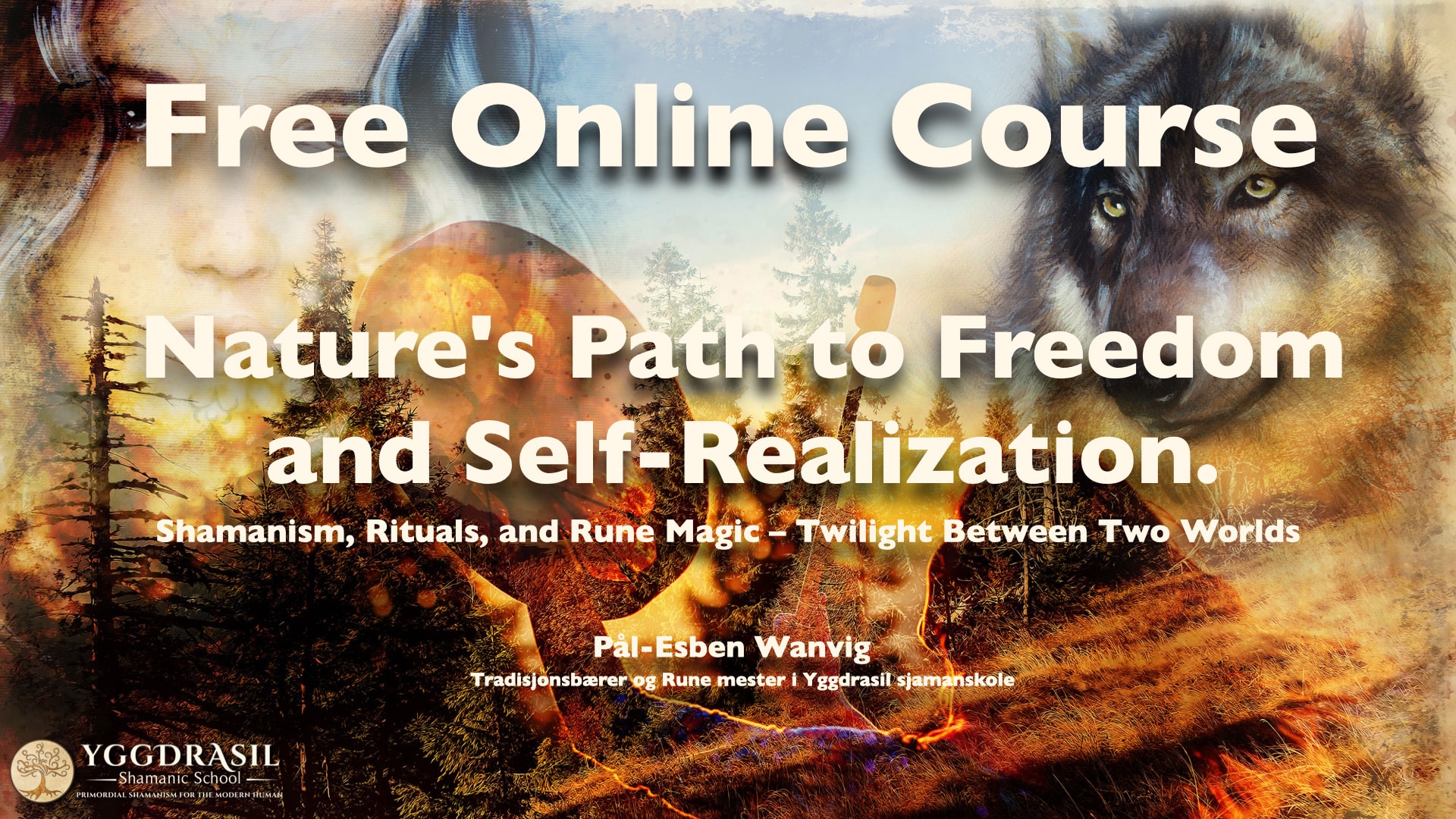
Nature’s Path to Freedom and Self-Realization
Curious about what primordial shamanism really is, behind the mystique and the misconceptions? In this short online course I tell the story of my own path from skeptical engineer to teacher of primordial shamanism, and give you a first introduction to what I teach: what shamanism and primordial shamanism are and are not, how rituals and rune magic are used in practice, and why the longing for growth matters so much for a good life.
The lessons are recorded in Norwegian; the English version will be ready in November or December 2026. Leave your email on the course page, and I will tell you when it is.