
Episode 46 – Aliens and the Origin of Humanity – Where Do We Really Come From?
A few years ago, Amina dated a man who could live with all the alternative things she was into, until the subject of aliens came up. That, he said, was where she had gone mad. Pål-Esben, for his part, has a good friend who spent more than two decades in Tibetan monasteries, where the wisest teachers say plainly that their land was once visited by beings from elsewhere.
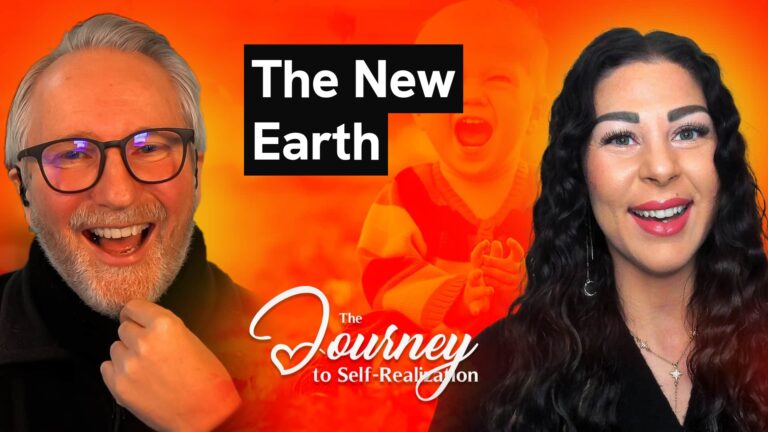
In this forty-sixth episode, Amina and her teacher and guide, Pål-Esben Wanvig, talk about aliens and the origin of humanity, starting from a listener who wonders whether we could have been Neanderthals in past lives. They explore why it seems illogical that we are alone in the universe, how myths and religions are born, what the congressional hearings in the USA have brought to light, and why we should never let fear steer us. It is part of “The Journey to Self-Realization”, a podcast about the bravest journey a human being can set out on: the journey home to yourself.
This episode is an English translation of our Norwegian original, voiced by the digital avatars of Pål-Esben and Amina.
In this episode
- A listener’s question about reincarnation and the Neanderthals, and why the conversation keeps to the linear view of time and space
- Why it seems illogical that we are alone in the universe, and how humanity might look to someone observing us from outer space
- Beings in the metaphysical world, gods on chariots of light, and what a friend from the Tibetan monasteries says about visitors from elsewhere
- Von Däniken, the Theosophists, the Sumerian king lists, the age of the Sphinx and the older advanced civilisations
- Why the idea of aliens holding our souls captive is a fear-driven interpretation, and why only our own head holds us back
- Roswell, the congressional hearings and the nuclear facilities put out of action, and why visitors who wanted to take over would have done so long ago
- Panspermia, the leap from Homo erectus to Homo sapiens, and the grain of sand as a playground for the soul
- Healthy scepticism, self-responsibility, and learning to tell the deep voice of intuition from fear impulses
This podcast is for you if you:
- Seek real depth in your spiritual practice
- Want to understand yourself on a more fundamental level
- Are curious about shamanism but tired of superficial “new age” spirituality
- Have taken many alternative courses but still feel that something is missing
- Feel an inner longing for freedom, love and wholeness
In a time when so many get lost in external methods and promises of quick fixes, this podcast invites you back to the only place where true answers can be found: your own heart.
Listen above, or read the full conversation below.
Transcript
A warm welcome to the podcast “The Journey to Self-Realization”, a primordial shamanic journey of development back to your true nature. This podcast is a collaboration with our favourite magazine, the health and lifestyle magazine Medium, and is devoted to exploring the bravest journey a human being can set out on: the journey home to oneself. We follow Amina, a student at the Yggdrasil Shamanic School, as she goes through a deep primordial shamanic process of development together with her guide and teacher Pål-Esben. It is a raw, unpolished journey of discovery towards true joy in life, deeper meaning, and a life that truly feels good to live.
This episode is an English translation of our Norwegian original, voiced by the digital avatars of Pål-Esben and Amina.
Pål-Esben: Hi, Amina, and a warm welcome to a new episode.
Amina: Hi, Pål-Esben. Thank you, and likewise.
Pål-Esben: Thank you. And a warm welcome to you too, dear listener. Today we’re going to open Pandora’s box, because we’re going into a topic that’s very different from what we’ve discussed before in our podcast. And that topic, Amina, is the origin of humankind. Is it evolution? Is it aliens? Is it something more?
The reason we want to open that part of Pandora’s box today is a question we’ve had from one of our listeners. It goes like this: “Reincarnation. I have a question about your thoughts on reincarnation. If you look at the history of the universe and of the Earth, we share some DNA with the Neanderthals, who lived on Earth for 300,000 years. Could we have been Neanderthals or Cro-Magnons in past lives? I’d love to hear your reflections on this.”
Reincarnation seen from time and space
Pål-Esben: The question is very complicated in itself, because it raises the matter of how we should look at this. Should we look at it from the point we discussed in the earlier episodes about the path to oneness, where everything exists at the same time, where there is no incarnation, and where everything takes place as parallel existences of our soul and our metasoul? Or should we look at it in a linear way, tied to time and space?
Since the question is tied to time and space, we’ll stick to time and space in this discussion. That means everything has a linear order: we live a life, then we die, and then our soul comes back and lives a new life later on the timeline. In reality it isn’t like that. There is no reincarnation. But to simplify the discussion, people often talk about reincarnation. Perhaps in a later episode we’ll come to what this really is, why there’s no such thing as reincarnation, and why it can still help to talk about it.
So, to the question you’re asking: what is the origin of humanity? That’s a pretty big question. You can of course go back through evolutionary biology and say it started with a cell, or with a fungus. Then come viruses and bacteria, and it builds up from there. The first living beings are created: plants, amoebas and so on. In the end this develops into the ape, then we move on to Homo erectus and all those things, and out of that comes humanity. That’s what the theory of evolution in this world says.
Like swearing in church
Pål-Esben: Discussing a topic like this is a bit tricky. A lot of people have very strong views about it. It’s often like swearing in church: if you say something that goes beyond the general understanding, you get branded a conspiracy theorist and a psychotic fantasist, or someone who hasn’t the faintest idea what’s going on. You’re confused, society will say.
In the previous episode we also talked about the problem humanity has with branding people as either friend or enemy, depending on whether or not we agree with their opinions. If you agree with what I think, you’re my friend. If you disagree, you’re my enemy. We also discussed the first chakra and so on.
When we go into a topic like this, it’s of course very difficult to find objective, measurable proof. Our whole podcast is really built on the theme of a primordial shamanic, profound process of development, where what we talk about rests on objective, measurable experience and proof. We’ve discussed that in the first 43 episodes. In the last 12 or so of them, we went into the path to oneness. What about objective, measurable proof there? Well, the only objective, measurable proof is to bring a human being into a state of oneness, a state where time and space don’t exist. Then they’ll understand this through their own experiences.
But with the topic we’re going to discuss today, we’re sliding into a place I wouldn’t normally choose, since my thing is to talk about what’s real and can be experienced objectively. The reason we’re still going into these topics is that a lot of people out there, including several of our listeners, wonder about them. And to me it would be disrespectful not to be willing to talk about what people are wondering about.
Again, it isn’t about us having a monopoly on the truth while everyone else is wrong. No, we have our insights, our opinions and our experiences, but they aren’t final. It isn’t a case of “that’s just how it is”.
When we talk about this topic, we may touch on some years, some names and some settings from history. I’d like to apologise in advance if I say something wrong or get a year wrong. I don’t go around remembering these things, because they aren’t really all that interesting to me personally. That was a long introduction, dear listener, a long pre-framing, you might say: we’re touching on this topic very carefully, and we never say “that’s how it is”.
Are we alone in the universe?
Pål-Esben: If we’re going to discuss the origin of humankind, perhaps we should first talk a little about whether there are living beings in this universe other than human beings. We humans live on this beautiful planet of ours, and we believe we’re the high point of creation. We believe we’re the cleverest, most intelligent beings in this universe. And if you take the religious line, we’re the only intelligent beings living in the universe.
But if we use a little logic, we see our galaxy, the Milky Way, and we see that our solar system is a small dot in that galaxy. A tiny, tiny dot in this gigantic galaxy. On top of that, there are billions of galaxies around us in the universe we live in. To say we’re alone in this universe isn’t very logical in my eyes. What do you think about that? Is it logical to think that we’re the ultimate being, and that there are no other beings in this universe who are cleverer than us, or who exist at all?
Amina: No, I don’t think it’s even logical. It’s one thing what you can feel, that sense that this doesn’t quite add up. But it doesn’t hold up logically either, from my perspective.
Humanity seen from outer space
Pål-Esben: Not from mine either. Imagine we observe us humans from an eagle’s perspective, that is, from outer space. You come in from another galaxy, in some kind of vessel or craft. You’ve stopped at Jupiter, or maybe come a bit closer and parked just beyond the Moon, and then you start observing this globe and the beings that live on it. What would you have thought then?
Amina: If I’d done it now, today?
Pål-Esben: What would you have thought? You’d have seen these so-called humans as completely rabid: they think they can do everything and understand everything, but they’re hyper-aggressive and destroy everything they come into contact with. We see that in how humanity is, with all the conflicts we have: friend or enemy, wars everywhere, “I want”. You’d see that this is nothing but monkeys and primates. Yes, they have a certain kind of intelligence, since they’re actually able to destroy a whole planet, but they aren’t terribly developed.
I think it’s only we humans who could believe we’re so terribly clever. If you see it from the outside perspective, that is, from those who live out there, there must be an incredible, incredible number of cultures; it can’t be anything else. It can’t be that the creative force, or whatever you believe created us, only created us monkeys. If that were the complete unfolding of a creation, it would be a sad affair.
Beings in the metaphysical world
Pål-Esben: My experience of the metaphysical aspects of reality is that you come across a lot of beings there. You come across what can be called angels, power animals, Norse gods and various kinds of beings of light from nature. They don’t have form, but they have an energetic radiance, an energetic signature and an energetic identity. So they have an identity of their own, and we humans give them different names.
In this metaphysical world you can also come into contact with other kinds of beings, which have more interdimensional qualities. When we humans leave the body and go into a form of astral travel, a part of us, a part of our consciousness, travels away from the body and into an astral field somewhere or other. It would be strange to believe that other beings who exist in this universe aren’t capable of the same. So there are a great many kinds of beings out there.
For me personally, it would be terribly illogical to believe that we humans are the only ones who exist in this fantastic, extreme universe. Of course there are beings out there with technology and development that are billions of years ahead of us. Again, I’m talking about things that can’t be proven here and now, but I’ll come a little later to how it actually can be proven.
When myths and religions are born
Pål-Esben: Ever since this planet became habitable, beings like these have visited us, from different cultures and different races. And the interesting thing is this: take a primitive being like us humans 100,000 years ago. Suddenly it sees something coming from the sky, a craft with lights that comes down and lands in front of it. What will the primitive human being believe? Well, that this is a god, that it’s something supernatural. And then the myths start to spread.
That’s the foundation for many myths: more primitive versions of human beings see something they can’t describe and don’t understand. So they make up their stories about their gods, about mysterious beings and about where we’ve come from. And then religion develops on that basis.
When we read the religions, and now we’re on slightly shaky ground, they often describe gods and beings who come down from the sky. Especially in the Vedic tradition, in the old Vedas, you often hear stories about “gods on chariots of light” who land in front of human beings. In the Indian and Vedic tradition they were described as gods, and people began to call them by different names.
A friend from the Tibetan monasteries
Pål-Esben: That takes us straight into a topic that makes the hairs on the back of your neck stand up. “But can it really be like that, Pål-Esben? Can you prove this?” No, of course I can’t prove it. But that’s how I see it, and that’s how it comes across when I talk to people who come from these cultures.
I have a good friend who has lived in Tibetan monasteries for more than two decades and got his education there. He’s one of the world’s better-known spiritually self-realised masters. I talk to him regularly, and now and then we talk about the topic of aliens. Then I laugh a little and ask what his view is on this: that there are beings in this universe far ahead of us in development, who perhaps don’t see us as all that clever, and who have been here and visited us, observed us and interacted with us.
Then he smiles and says that in the official religious scriptures, the ones available to the general public, this isn’t described very well. But he has lived in what are called mystical monasteries, that is, non-religious temples. There, the religious and the dogmatic were never taught; there, you learned the mystical aspects of our reality. What’s central there is the path to complete freedom, what we call real spiritual awakening. That isn’t so central in the dogmatic, religious temples; there it’s mostly about learning the scriptures.
He tells me that when he talks to the very wisest in the temples he has been in, they all say the same thing: “We know perfectly well that we’ve been visited by these beings in our country and in the area where we live. It’s described in such and such texts, but they aren’t very accessible. We all know this. We know that much of what we’re passing on to you now isn’t something we came up with ourselves, but something we’ve learned from others through history.”
Then we laugh. “You can’t really talk to ordinary people about these things, because then they think you’re weird,” we say. Then we just laugh and move on. But it’s quite interesting: when you talk to people who have been in contact with the deeper aspects of these cultures, you often hear things like this. It’s only in the modern society we live in, which is so shaped by religious dogma, that it’s taboo to discuss these kinds of topics.
A society raised on dogma
Pål-Esben: Because this has a number of consequences. We talk about God in the Bible, about Yahweh and all these things. What is that, really? Why did people in the old days start writing this story, which is shaped by mythology? Is it the gods, or is it beings who really existed on this planet? That’s the question.
These are pretty blunt thoughts to send out over the airwaves. But they’re worth reflecting on. Because we humans are taught to believe in things dogmatically. We’re raised in a dogmatic, religious society. You can say you’ve never been to church, but the whole of society is governed by religious dogma, in Norway too.
Look, for example, at how the average Norwegian deals with grief when well-known people die. It’s extreme: you have to grieve, and you have to grieve, and you have to grieve, and if you don’t grieve, there’s something wrong with you. It isn’t natural. What’s natural, given our nature, is to celebrate a person’s life instead of grieving and being sad about it. We talked about that a little in episode 44.
Von Däniken, the Theosophists and the New Age interpretations
Pål-Esben: The problem with what we’re talking about now is of course that many people throughout history have read and interpreted these religious texts. The best known of all is perhaps von Däniken, who wrote his first book back in the sixties; I think it came out in ’68 or thereabouts. That’s a long time ago, almost 60 years. The book is connected to certain aspects of Vedic mythology, and there he began to describe his interpretations of the gods who come from the sky in chariots of light. He’s one of the first in modern times to describe this. Out of that came a whole cult, and out of that cult came many other cults and many opinions.
But some of the first to put forward the alien explanation were the Theosophists, with Madame Blavatsky. I think it was in 1875 or thereabouts that she wrote her first book about this, about the gods who were aliens. It’s a long, long story, and out of it has come a massive amount of interpretation. Some of it is surely very real and connected to reality, some is terribly mythical, and some is perhaps completely out there, that is, not quite in touch with reality.
If you go to Google, ChatGPT, Claude, Gemini or whichever AI you use, you can search for how New Age movements interpret religious texts with regard to aliens. Then you’ll get a long list of how this has developed. And out of that come all the problematic theories that create limitations for people.
In the Gnostic religious texts, for example, there are descriptions of gods who hold our souls captive and control us. The Gnostic texts say that these gods have captured the souls of all the people who live on this planet, that they control them and suck energy out of them, and so on. A modern interpretation of this comes, for example, from David Icke, who has millions of followers. He says that it’s aliens who control the souls of all human beings and suck energy out of them, and that this is why so many people suffer.
That’s where we start getting into real problem areas in how things are interpreted. Because there are no gods and no aliens keeping us inside a computer where everything is simulated. That isn’t how this works.
Another time we can talk in more detail about exactly how it works, and we’ve talked about it in earlier episodes too: our soul dreams, and it’s a kind of construct you enter and live in. But it’s our soul and our metasoul that are responsible for that simulation. It isn’t aliens keeping us captive and creating suffering for us. Because the philosophy behind that idea is that the more suffering is placed on the souls living on this planet, the more anxiety they have, and the more energy can be sucked out of them.
That’s of course very, very problematic, since millions upon millions follow influencers like David Icke and all the others who talk about these things. Then people think: “Oh God, I don’t stand a chance, because it’s aliens who are controlling me. It’s aliens who are the reason I have anxiety.” And what happens then? Well, the person becomes paralysed. They don’t understand that every human being is responsible for their own life, for their own feelings, for their own suffering and for how they deal with that suffering. And they don’t understand the way to create a joyful life, which every human being can create, whatever their background, as we’ve discussed throughout our podcast.
When the interpretations of these alien stories and this alien mythology go in that direction, I find it incredibly, incredibly problematic, because it creates suffering for humanity. If you want to see what these gods really are, look no further than social media. Because the only thing I know of that sucks the quality of life out of people is when you sit scrolling your blasted feed and become more and more confused, more and more angry, more and more restless and more and more exhausted with every hour that passes.
OK, that turned into a monologue from me. I have a lot I want to say about this topic, so you’ll have to interrupt me. What are your thoughts on this, Amina?
Only our own head holds us back
Amina: Well, goodness me, where do I start? Ever since I was little, through the history books and when we learned about evolution at school, I’ve felt that something was wrong. Especially when we got to Homo erectus and Homo sapiens, I felt there was something that didn’t add up between the two. At school I often thought: why are we learning this? It isn’t true. But I had no grounds for saying so. It was just a feeling I had.
And when it comes to this business of being held captive, of someone sucking energy from us, or of demons or aliens or other things holding us back, in recent years I’ve seen very clearly from my own experience that it’s nothing but my own belief system and my own head that hold me back. I’m very good proof of that, at least for myself and for those I can inspire.
Pål-Esben: And when we talk about objective and measurable proof for what we’re talking about, this is exactly it: what happens to a human being’s life when they use the philosophy we’ve discussed in this podcast since episode 1, and authentically bring it into their life. Then these things happen, not just with Amina, but with every single one of those who do it authentically. That’s what we call objective and measurable proof that every human being has the power to create the life they want to live.
Amina: Yes, that’s absolutely right. It’s only our own head that can hold us back.
Pål-Esben: Yes, and that’s also like swearing in church. Because we’re raised to believe that other people are the cause of our problems. It’s the authorities, it’s demons or whatever, or it’s people sending negative energies our way: that’s why we’re having a hard time. And that belief system is a problem in itself.
Sumerian king lists and the age of the Sphinx
Pål-Esben: So let’s go back to our favourite topic, aliens. When we see how mythology develops, I’d guess most people can easily form an idea of this if we picture a very primitive version of ourselves, 100,000 years ago. Say a spaceship lands in front of us, or hovers in the air in front of us. We have no idea what this is. We just see the light. We don’t even know what these floodlights are, since we may only just have discovered fire. That’s all we have: we can light a fire. And suddenly we see these beams of light come out and sweep around. Then you can understand that people find supernatural explanations, and that mythology and religion start there. Because religion is really there to describe, in one way or another, what you need answers to: why you’re here, and how everything fits together. And that’s often described with supernatural things.
We see another example in the Sumerian religions. There you find, among other things, the Sumerian clay tablets with king lists, which describe humanity as having had kings as far back as 241,000 years ago, and some kings as having lived for 28,000 to 29,000 years. If we go to historians of religion and archaeologists, they’ll shoot down any explanation that this could have to do with anything other than gods and religious ideas. If someone says that others have visited our planet and governed and organised things, the response is that it isn’t possible, that it’s just nonsense.
That’s one of the problems with modern research, with modern archaeology and geology: they have a certain view of how this planet developed and how humanity came about, and then someone comes along and says something different. If you go to Egypt, for example, the Egyptologists will say that the pyramids, with the Sphinx and the whole thing, were built 4,000 to 5,000 years ago. But that isn’t even theoretically possible. If you go to the Sphinx, you see that there has been flooding there. Down at the foot of the Sphinx you can see that a massive amount of water has flowed there. And if we go back to the time when there was that much water and the Nile was that high, we’re talking about 11,000 to 12,000 years ago. For these researchers and Egyptologists that’s unacceptable, because it would mean the pyramids were built long before 5,000 years ago. They were built a long, long time before that.
The older advanced civilisations
Pål-Esben: Here we’re sliding into areas that are incredibly, incredibly difficult to discuss, because there are so many opinions about them. But one person who has done a great deal of work on these things, and who has many good and perhaps a few not so good ideas, is Graham Hancock, for example. He’s academically trained, but he has gone his own way to look at how the older cultures arose, what happened in the Younger Dryas around 11,600 to 11,800 years ago, and what happened when the meteorite shower came, created a flood and melted the ice. He has done a lot of work to describe these things. But among official academic geologists he’s described as thoroughly unreliable. They see him as a fool.
But it is interesting. I’ve seen a couple of his documentaries, and I find it very exciting when he has travelled around the world filming structures that can’t possibly have come about the way official geology, architecture and the academic writings describe. If you go to southern India and dive in the sea south of India, the Indian Ocean, you’ll find cities there, gigantic cities and structures that demonstrably existed quite a few thousand years ago. We’re talking about 8, 10, 15, 20 thousand years ago. There’s proof of this. But the mass media and the academic, fanatical way of seeing things say that only the way we see it is right. Everything else is just conspiracy. I think that’s unfortunate.
So there’s a lot of proof that we’ve had older cultures going back many tens of thousands of years, and that they were advanced civilisations. And then we come to this: what about Atlantis, Mu and Lemuria? They’re mythical stories, but every myth has a certain foundation in it. Perhaps we can come to these cultures later today or another time. But let’s first go back to aliens. We have to discuss that topic in order to discuss how humanity has developed.
It’s interesting to look at all these things, and perhaps to keep a level head when you look at them. As you may know, dear listener, a man like Erich von Däniken was massively ridiculed for what he wrote. But that was his way of describing how he read these scriptures, including those in the Vedic tradition: that they weren’t about gods, but were the way people of that time described something supernatural. Am I saying that Erich von Däniken is right about everything he says? No. I haven’t read any of his books, but I’ve dipped into it a little and heard him speak in a documentary. And some of the things he describes are, in my eyes, very close to the mark.
Is there proof? Roswell and the congressional hearings
Pål-Esben: Before we come to the beginning of humanity, which is really the question, perhaps we should answer this: is there proof that there are extraterrestrials, that is, aliens, ETs or whatever you call them, on this globe now? And to that I answer a 100 percent yes. An overwhelming yes.
The easiest way to find this proof is to look to American culture, because there it’s well known. The first known incident is the Roswell incident, I think it was in 1947 or 1948, right after the Second World War. It’s been described that a UFO, that is, a spaceship, crash-landed at Roswell, in the area around the town. That’s the first big known incident in modern times, at least in the USA. Since then it has happened many times. But what happened back then? Well, everything was hushed up and ridiculed. The mass media stepped in, the authorities stepped in, and they made it look as if this was just fantasy and nonsense.
But if we fast-forward to 2026, 2025 and 2024, something comes out very clearly. Look, for example, at the congressional hearings in the USA in recent years, where Congress has held hearings on the topic of aliens and UFOs. There, whistleblowers who have been part of military projects, secret projects that handle aliens, spaceships and technology, have testified before Congress. And it came out unambiguously there, officially in the American Congress, that aliens have been in contact with parts of the authorities since the late 1940s. On a massive scale! It’s described how the authorities interact with aliens who live on this globe, and who help some of our researchers with technology, and so on.
So if you, dear listener, are of the view that all this alien stuff is just nonsense: go on YouTube, and I think this is the only time I’ll ever recommend going on YouTube, and find some of these congressional hearings from the USA in recent years. Then you see the surface, at least. The problem is that most of what goes on happens behind closed doors. Because they don’t want it to come out that they already have the technology: that they already have anti-gravity technology, and that technology already exists that gives us free energy, and so on.
The pandemic and what was called conspiracy
Pål-Esben: That’s where you get into conspiracy theory territory. But perhaps it isn’t so much conspiracy after all. If we go back to the pandemic, everything was called conspiracy. All critical thoughts about the vaccine, for example, were seen as pure conspiracy theories. I’m very critical of the mRNA vaccine myself, and today much of what was dismissed back then is discussed far more openly.
Again, look up, for example, the hearings being held on how the pandemic was handled, where experts, senators and specialists come in and talk honestly about how the information to the public was shaped.
So we should be a little careful with these things. Especially when it comes to what the media say, what the authorities say and what academics call truth, I think every healthy human being should have a healthy scepticism. We should know that we humans are very easy to influence. That’s no conspiracy theory. It’s real.
One example is vitamin D. The advice to make sure you have enough vitamin D in your blood, that you’re above 150 nanomoles per litre, was dismissed. As I see it, the immune system stands much stronger against the coronavirus and other viruses when you have that. But the line was that vitamin D was just nonsense, that you don’t need this, and you don’t need that. And not only that, but also that it’s dangerous.
What I hope is that every human being today is willing to keep a bit of an eye on what comes out afterwards. Because that often happens after events like these. When you see what comes up 5, 6, 7, 8 years later, you’d have good reason to be a little alarmed at how easily you let yourself be influenced. And perhaps the next time something like this happens, you’ll ask yourself the question: could this have something to do with reality?
We slide back to the same thing when we talk about aliens. Through history, at least the last 50 years, the line has been that it’s only fools, fantasists and conspiracy theorists who talk about this UFO stuff. That’s why it’s very exciting to see what’s happening in Congress in the USA now, where they invite people from the military to describe their experiences with UFOs and with interaction with aliens on this globe, some of whom are actually already here. It’s very fascinating.
So is there proof that there are other beings in this universe who are dramatically more intelligent, and who are far ahead of us in development? Yes, there is, if we’re willing to look for it. And I think it’s pretty cool that this is now coming up loud and clear among the authorities in one of the biggest countries in the world. Say what you like about the Americans, but this is fascinating. What do you think about this, Amina?
Amina’s gut feeling
Amina: Back to this business of aliens: I’ve been saying for maybe ten years that I don’t know enough about this, but that I feel they’ll come onto the scene sooner or later. When I talk to people about it, I tend to hear that no, it’s completely impossible. I dated a man five or six years ago who said: “Yes, yes, it’s fine that you’re a bit alternative, with everything you’re into. But when it comes to aliens, you’ve gone mad, Amina. That’s a step too far.” That was the worst of everything I was into. I wasn’t even into aliens, but that topic was simply off the table.
But I’ve had a feeling that this is going to come more and more to the surface. What it will look like, I don’t know: whether they’ll walk the streets, whether we’ll become friends with them or enemies with them. But it’s a little feeling I’ve had.
And we talked about the COVID vaccine. There, too, I had a strong feeling, without knowing why: I can’t take that vaccine. I had no reasons and no logical grounds, and the whole of society was against me. So I’ve had feelings like that about things along the way, without really knowing enough about them. This isn’t what I know most about, but it’s exciting.
Following up after the pandemic
Pål-Esben: It isn’t about how much you know. It’s about having thoughts about it and discussing your thoughts. When we look at this a bit in hindsight, it’s quite spectacular how many people in the Norwegian population took the vaccine. 70 to 80 percent, I don’t know, let’s say 80 percent. A great many took a vaccine that had been developed in a very short time, and in my view the questions about side effects were taken too lightly.
Think how easily we humans let ourselves be influenced once fear has taken hold. That was probably the most important reason so many took the vaccine without asking questions. I can understand how it happens: when enough fear is spread in society, you want to protect yourself, your kids and your parents. But on the other hand, it should also come out very clearly how easily influenced we humans are.
That’s why I encourage all truly clear-headed people who have been through this to be willing to do some follow-up work, at least in hindsight, and find out what reality is. So much gets written about everything, left, right and centre. But now and then I like to look at what comes out in official hearings, whether in the American Congress, in the Canadian Parliament or in other official hearings. Everyone is invited there, including those who see things differently, and then you get a better picture of the landscape.
I think every clear-headed human being should do that work after going through such an intense, fear-filled period. You should ask yourself: am I willing to find out what the actual facts were, so that I can prepare myself for the next time this happens, take back the power over my own life and not let fear steer me in one direction or another?
What will happen? Salvation, fear and the first real proof
Pål-Esben: Back to aliens. We still haven’t got back to the first question we started with; I’ll take that right at the end. But what do you think will happen? If you go out into the esoteric world, you’ll find a lot of people have picked up on these things. There you’ll find some who channel aliens and talk about the new world that is coming, where we get an upgrade of our DNA, and where solar storms let us download lots of information, so that everything gets better.
With all things like this, I’ve learned to be very careful. When someone claims that something will happen where you don’t need to take conscious responsibility, and that everything will get better by itself, I’m sceptical. Because this world doesn’t get better unless we ourselves take personal responsibility for our lives, instead of waiting for some DNA upgrade from the universe.
So what’s happening with aliens, that is, extraterrestrials? I think we can go so far as to say that there is proof today that authorities have interacted with them since the late forties, that many of them have crash-landed, and that several of them, of different races, are already here. That’s clear. The question is how this goes on from here.
I think one of the next steps over the next few years will be that we get the first real proof. How many years it takes, nobody knows, but I don’t think it’ll take 20 years; I think it’ll happen in much less time. I think a UFO will be filmed, really clearly and unmistakably, so that it’s 100 percent proven that they’re around us and exist.
And then a question arises. If we look at the alternative world, we find two camps, to simplify. One camp is waiting for salvation from aliens. The other camp fears aliens like the plague: they’ll come and take over here, they’ll eat us, and they’ll take over the globe, because it’s a nice globe to live on, after all, with lots of resources.
Take the last camp first. If there are intelligent beings capable of travelling millions of light years, they obviously can’t use rocket engines for it. They must have technology that makes it possible to travel that far. A hundred light years takes light a hundred years to cover. That’s pretty far. So there must be technology that lets them travel interdimensionally: that they can bend time and space, slide interdimensionally into a field that has no time and space, move through it and enter time and space again. That’s how they can transport themselves around. Otherwise they couldn’t have landed here.
The nearest star we have is Alpha Centauri, isn’t it? Four or five light years away from us, or thereabouts. If you were to travel four or five light years in a spaceship with an ordinary rocket engine, it would take, what? Tens of thousands of years or something like that. So for me as an engineer, it’s logical that they must have technology that lets you travel in a different way from what we know today. And what will most likely happen, in my eyes, is that there comes a point where they show themselves in one way or another.
Why would they take over now?
Pål-Esben: So, to those who believe, and it’s a big group, that aliens are going to come and destroy our world, take over, eat us and use us as slaves, here’s what I think: if there are beings here who have already been here for 50 or 60 years and interacted with us, and who are dramatically more developed than us, both technologically and in intelligence, do you really think they’ve been waiting all these years to do this? Why didn’t they take over this planet 50 years ago, or 100 years ago, or 1,000 years ago, or 10,000 years ago? Why would they do it now? It makes no sense at all.
Why would they wait until we monkeys destroy our planet: destroy the resources, acidify the oceans, litter nature and destroy the atmosphere? Why not take over 50 years ago, when the planet was reasonably clean, the oceans were healthy and the fish weren’t full of mercury? Hello? It isn’t even remotely logical. So those who are afraid of them need to think this through: why should I be afraid now? Because if they’d wanted to take over and destroy us, they’d have done it long ago.
Fear as an instrument of power
Pål-Esben: But there are certain parts of society, certain power structures, and here we’re into conspiracy-theory territory again. The big economic power structures believe they have all the power, and they do, and they believe they can do whatever they want.
So there are structures in this world, power structures, let’s call them that without going further into it, that want to keep us humans afraid. Because the easiest way to manipulate people is to spread enough fear. The more fear, the more control you have. If I’d talked about this ten years ago, people would probably have said: “You’re a conspiracy theorist”, and all that. But today I can talk about it as something real.
So there are groups of people, as we saw during the pandemic, with economic and political power, who profit from people being afraid, because that makes them incredibly easy to manipulate. So it makes sense to be aware of that. And among them there are, in turn, groups who actively use this alien business to put fear into people.
We see that in pretty much all the films about aliens that have come out in the last 20 years, at least. They follow this scenario: aliens come here, they’re going to take over and ruin things for us, humanity fights against them, and sometimes it wins. And then you have some that are different, like Steven Spielberg’s “ET”, for example. That one is closer to the real version of reality: a little ET fellow lands, points and says: “I want to go home. Who can help me?” A very emotional thing, when we saw it as kids.
Spielberg has just released his latest film about aliens, with a title about the day things are revealed. It describes, very interestingly, some of what I see as reality: that government organisations, especially in the USA but elsewhere too, have had contact with these aliens for a long, long time, and have technology based on their technology, which is beyond anything we could ever dream of. The film shows this in a way I’d call an OK and decent portrayal. At the end these aliens come forward and have the last word: “Listen.” That is: humanity, listen.
What I think is most real is that those stationed around us are sitting, waiting and observing us humans. You can imagine that there are many of these spaceships and aliens around us. There’s a group positioned behind Jupiter, and all sorts, but we won’t talk about that now.
I hardly think they’ll wait until the monkeys destroy themselves with nuclear attacks. Do you? It’s almost easy to prove that some have landed, and through the hearings we can form an idea that some of them are stationed around us in observation mode. Do you really think they’ll wait to interact with us until Trump presses the nuclear button? No. That would be very illogical. But I hope they’ve got popcorn, because this looks set to get very exciting.
The nuclear facilities that were put out of action
Pål-Esben: Look again at what’s coming up, especially in the Senate hearings in the USA, about these UFOs. They’re called something other than UFOs now; they have a special name for them. It’s coming out that they’ve put nuclear bunkers and nuclear facilities out of action. It’s a fact that these beings, these lights and these craft have hovered over nuclear facilities, and that the people sitting in the facility suddenly lose the connection. That means they can’t launch a nuclear attack. They no longer have control of the nuclear silo.
Amina: So they’re protecting us?
Pål-Esben: They can put every nuclear facility out of action, and they’ve already shown that several times in various nuclear bunkers in the USA. And again, dear listener, you might be thinking: now he’s gone completely mad again. Has he totally lost the plot? No. If you follow a little of what’s happening in these hearings in the USA, these things are coming to the surface. Senators ask the military personnel standing in front of them: “Is it true that the craft have hovered over nuclear facilities and caused us to lose contact with and control over our nuclear facilities?” And the answer is: “Yes, that has happened many times.”
So the question is: why do you think these beings, let’s call them aliens, do that? Well, to show humanity: OK, up to a certain point we accept things, but then there comes a point where we stop you, monkeys.
So if you fear that the whole world will go up in smoke in a nuclear war, that’s a very unfounded fear in my eyes. A nuclear bomb going off, that can happen. But not a large-scale nuclear attack; that will definitely not happen. A dirty bomb or something like that going off in Ukraine, Putin going a little over the line, something happening in Iran: that can happen, but not on a large scale.
Back to those standing out there observing us: why haven’t they interacted with us and taken over before? Because they have an agenda, and it isn’t an agenda to ruin things for us. Their agenda is to help us.
Right now humanity is going completely off the rails. It’s like little five-year-olds with rifles and nuclear bombs firing away. And that’s the reason I believe the interaction we’re waiting for, a direct interaction with these beings, will happen within a fairly short time, and not in 20 or 40 years. The world is now going completely off the rails, into large-scale war; that’s where we’re heading, the way things are going now. And I believe this interaction will happen before it goes too far. That’s how I see it. Whether it happens in one year, in three years or in five years, I don’t know. But I don’t think it’ll be ten years; I think it’ll happen before that.
Amina: Yes.
Pål-Esben: The only thing we can prove is what comes out, for example, in these hearings, where official and military personnel speak directly and show videos of the UFOs, filmed from their fighter jets and from the ships, where you see how they dive into the sea, and things like that. You can’t say it doesn’t exist. Everything I’ve said in this last stretch is my own opinion, based on a certain kind of logic. And then perhaps we go back to the question you asked an hour and six minutes ago.
Amina: Yes, yes.
Healthy scepticism, not the almighty syndrome
Pål-Esben: But before that: do you have any thoughts on this, Amina?
Amina: I feel in every cell of my body that we’re onto something here. I feel that about a great deal of what you share, Pål-Esben, most of it, really. And looking back, I can see that I have reason to feel it, because it often turns out to be right. So we’ll see. But I feel we’re onto something, and I also think it’s logical.
I also think it makes a lot of sense to dive into what has happened throughout human history, and into this whole business of conspiracy theories, and how stubborn we were about certain things just a few years ago. Throughout history so much was called conspiracy theory that we live by quite normally today. Some oddball came along and said something or other, we pointed at him and thought it was completely silly, and then suddenly we started living by exactly that. So it’s about being open to the possibility that things we’ve heard or believed until now may not be quite like that, and about looking into it a bit yourself.
Pål-Esben: Yes. Using a bit of common sense. By common sense I mean having a healthy dose of scepticism, first and foremost towards everything. It has to be a healthy dose. Not a scepticism that says everything other than what I myself believe is wrong. We call that the almighty syndrome, and it’s a problem. It’s a fanatical way of experiencing the world. What matters is that you open up.
Panspermia: life from other star systems
Pål-Esben: So to sum up: where does humanity come from? The first question we can ask is: does all life arise in the biosphere? Now we’re talking about our Earth and our biosphere. Is it the case that all life arises in a biosphere, and has to arise in a biosphere? The answer is of course no.
Say that long, long ago there was life on some planet that exploded and sent out a meteorite shower. We know that meteorites have landed on this globe throughout its existence; it has rained meteorites on us. And it’s even been found that inside meteorites life can survive in a dormant state: everything from bacteria to viruses, cells and small organisms. That isn’t anything very esoteric or alternative. It’s something that has been discovered. So it would be very illogical for me to believe that the life we have on the globe today hasn’t been influenced from other star systems. For me it isn’t even remotely logical.
One of the most interesting beings on this globe, which I still don’t understand today, is the octopus.
Amina: Yes.
Pål-Esben: If you look at the DNA structure of the octopus, it isn’t like anything else that exists in this biosphere. But that’s another matter, for those who are interested in octopuses. And this idea of life arriving from elsewhere is called, to use the technical term, panspermia.
Amina: Panspermia.
Pål-Esben: Panspermia. That means, for example, that an asteroid or a big rock strikes, and inside it there are living cells, viruses or whatever it may be, which start to establish themselves in the biosphere they land in. That’s one way life can start.
The leap from Homo erectus to Homo sapiens
Pål-Esben: OK. So let’s fast-forward. These viruses first developed from a mycelium network, that is, fungus. Then it develops further: viruses, bacteria, single-celled organisms, amoebas and so on. And via other beings, along come the monkeys. Now we’ve come all the way up to monkeys. Has what happened up to the monkeys, up to the apes, happened on a normal, evolutionary basis? Can we say that the ape’s predecessor is a fish, a virus or a lizard, or perhaps not? But let’s not discuss that right now.
We come to the point around 250,000 years ago or thereabouts, where something strange happens. We have Homo erectus, apes that have stood up on two legs. And then there’s a leap from Homo erectus up to Homo sapiens that still can’t be explained today, and that couldn’t even theoretically have happened through evolution. Because if it had happened through evolution, directly from Homo erectus to Homo sapiens, it would have taken several hundred thousand years to make that leap.
So something else happened. And there are many stories about that. Many stories, and surely a lot of conspiracy theories. Because something or other happened in chromosome number two and with our DNA. Around two to three hundred thousand years ago, something strange happened to us that made us take a big evolutionary leap, almost overnight.
As I understand it when I look back along the timeline, and this is my subjective experience of the timeline, which I can’t back up with objective, measurable proof, some kind of change happened in our DNA. And then the question is: who made these changes? The only ones who can have made them are the ones we’ve talked about, those who existed on this planet before us.
Because humanity has been through a few rounds. The last reset of humanity happened around 11,800 years ago, when the meteorites struck the ice and created insane floods, and the Fimbulwinter of Norse myth, when everything went black and pretty much all life died. The last generation of humanity arises then, from those who survive the flood. That’s the last round of humanity, with perhaps a few hundred thousand people left. They migrate to different places in the world and start the cultures that have brought us to where we are today.
The cultures before us
Pål-Esben: But before that, and now I’m speaking at least from my own logic: this fantastic planet of ours, the Earth, the blue marble people so often talk about, hasn’t been alone here for the last two or three billion years. It’s been found that it arose around 4.6 billion years ago as a lump of lava. Then it calmed down, and through various processes the atmosphere and everything else was created, which took a billion years or more. Let’s simplify and say that living beings have been able to live on this planet for the last billion years.
Given that there are more intelligent beings than us out there, as we’ve talked about, and that they definitely found this planet long before we were even thought of, it’s almost unthinkable to me that there haven’t been other cultures on this fantastic planet before us. So there have been cultures here that had nothing to do with Homo sapiens.
And around 250,000 years ago a change happened in us, where we leapt from Homo erectus to Homo sapiens almost overnight. As it’s described, and as I understand it, we were genetically manipulated. Some of these beings, the culture that was on the globe at that time, did it to us, through a long story that I don’t want to tell right now, because then we’ll be at it for another hour. If the listeners are interested in that story in detail, we can tell it too. But what happened was a manipulation of our DNA that put development on a fast track, so that we humans became the way we really are today, and really have been for the last 250,000 years.
Then you have to wonder, when the excavations and archaeology stubbornly claim that 100,000 years ago we were pretty stupid and sat in caves, and that it was only 10,000 years ago, through farming, that we began to develop and our brain began to develop. That doesn’t add up for me. I see a completely different story behind us. If there’s interest in it, it might need an episode of its own to flesh out. But then we really slide into things that can’t be objectively verified. That’s how I observe some of these things, from my perspective at least.
Do you talk to aliens, Pål-Esben?
Pål-Esben: And then the question is: well, Pål-Esben, do you interact with aliens? That would be the obvious question to ask here.
Amina: Yes, I’ve been asking myself that. Do you? Pål-Esben, do you talk to aliens?
Pål-Esben: The answer is that I interact with a whole range of beings. I interact with what we know as beings of light, which in our culture we call, for example, angels, or power animals, gods and things like that. Many people in the esoteric and shamanic world have a great deal of experience with these beings.
But there are also other beings you can interact with, which are more interdimensional. We haven’t talked about dimensions and densities, but perhaps we’ll do that another time. They exist, for example, in the area where time and space mix with the timeless and spaceless, where the Primordial Dragons exist as an important part of our tradition. So they’re more interdimensional beings. And then there are other interdimensional beings who are now and then in contact, and who are connected to other parts of our reality: parallel versions of the globe, parallel versions of our existence and so on.
So my answer is that I’m in contact with a whole range of different kinds of beings, and none of them would I call aliens. Because if I call them aliens, then I’m an alien too. That’s what my world is like: often in interaction with these intelligences, these beings that are around us, just as much as with the intelligence of our globe, Maha Terra, which we’ve talked about, and the natural rhythms.
For me it isn’t about being in contact with someone and passing on what so-and-so says. For me everything is about how I can help you, my students and those who listen to me to create something better for themselves in practice. That’s what my world is about. Not about saying that now I’ve talked to so-and-so, and they say this and that. That has no meaning in itself.
The grain of sand and the Sahara
Pål-Esben: But what we can say is that life can be exceptionally exciting, even when we see it from the perspective of the grain of sand, which is what we’ve talked about today. Everything we’ve talked about today is part of what we call the grain of sand. We had many episodes before this one where we talked about the path to oneness, about the path to our Sahara, to our full existence, which is what’s real. But I find the grain of sand, the one grain of sand in my Sahara, so incredibly exciting.
We’re in the grain of sand, that is, in the material and metaphysical world, because our spirit, our soul, wants to experience and learn things that can’t be learned in its free state, where time and space are no limitation. We’ve talked about that before. It’s like entering the soul’s dream, which we’ve talked about, which is like a game, a computer game.
I find this grain of sand so fascinating. When I look at my hand, I think: I can control this hand! And that’s how my days go. Because I’m fascinated by the game too. I’m fascinated that I can control my game character, which is my body and all that, that I have reasonable control over it, and that I can see everything in Dolby Surround and not as a pixelated computer game. To me that’s so fascinating.
And what we’re talking about now, aliens and our history and this whole linear perspective, well, it’s just this one grain of sand. But why shouldn’t we delight in the grain of sand in every possible way? Why not explore it? I think it’s an exciting part of my life that I get to find this joyfulness in the grain of sand.
I can find the joyfulness at any time by slipping into my Sahara and being there. But how does that help the people around me? I could have sat as a hermit, perfectly happy, without any people around me. Because I don’t need anything. I don’t need any people, I don’t need anything at all. I’m completely content, happy and joyful with what I am now. But my soul has come into this grain of sand to gather certain experiences and do certain things. One of those things is being able to inspire you and help you out of your darkness, back to the joyful, free, liberating and uplifting life you live now, together with your students. And at the same time, hopefully, to inspire you, dear listener, with the fact that life can be so lovely and so joyful, even though we live in a world that’s chaotic.
Amina: Yes. Yes, I’ll second that.
A playground, without losing focus
Pål-Esben: So that was the topic of aliens. I never thought I’d end up talking about these things, but you were the one who tricked me into it.
Amina: Yes, I’m a bit curious to see how far I can manage to trick you, and whether there’ll be a part two of this or not. But it’s quite interesting, what I feel in myself. When I went into the alternative scene and the esoteric, I began to wake up to the fact that there’s more between heaven and earth than we know. Oh my goodness, tarot cards and astrology, and there are parallel lives, and aliens and all of that. All of this has meant less and less as I’ve walked the primordial shamanic path to oneness and spiritual enlightenment. Through my experiences there, all the symbolism that many people dive into and try to figure out hasn’t been so important any more: why is that symbol here? Why is that alien there? Why do we live? It hasn’t been as interesting any more.
So I feel I’m at that point now, as you say, and that’s perhaps part of the process: OK, now I can play a little with this again. What actually happens in parallel lives, and what’s the deal with these aliens? This is a playground, after all. We can play with what we are, enjoy it, laugh at it and spread the good news, while not forgetting what we are and not losing focus on what matters most of all. That’s how I see it.
Pål-Esben: Yes, and that’s how we see these things: you can find things exciting, you can delight in things. Why be so uptight about it? But to get to the point where we find this joyfulness, we need to go through a process. In that process we let go of our fear. And once you’ve let go of your fear, you’re very hard to control. Nobody can control me, for example. I’m impossible to control and impossible to manipulate. And of course it’s a bit problematic to deal with a human being like that. Authorities don’t like free thinkers like that, as they were called in the old days. They prefer people who can be steered, people they can put fear into. The more fear, the more control.
But it doesn’t have to be like that. You can play with this, you can delight in this. But for that you need to go through what we call a process of development, where you’ve let go of the straitjacket: of your grudges, your hatred, your fear, your insecurity, your primal anxiety and all these things, and have taken back the power over your own life. Then it doesn’t matter so much what happens around us.
Amina: Yes.
No shortcut around self-responsibility
Pål-Esben: That’s what we’re trying to encourage in our podcast too: to see the possibilities for life to be good to live. But it rarely comes by itself. And that’s often what we humans struggle with: we want things to be so easy. We’d rather listen to a podcast where the person being interviewed says: “Those of you listening, who have a so-called high vibration, will be invited into the new Eden, the new world, without needing to do anything. You just need to make sure your vibration is high.”
In my eyes that’s leading people up the garden path, because reality isn’t like that. It isn’t the case that we just sit here and download the upgrade of our DNA and believe that life and the world will get better. Not unless we take the self-responsibility that’s needed to heal our fear, our anxiety, our need for control, our grudges and all these things, so that we become a better human being, a more loving human being, a brighter human being. Nothing gets better without that, I believe. Everything else is fooling yourself.
But of course: if we had a podcast where we said: “Come to us. I can bring you into a really lovely guided meditation where you feel good and feel the light in yourself. And when you’re there, the door opens to the new Eden, the new world. Feel this DNA being upgraded now. You don’t just have two strands of DNA, you have thirteen strands. Feel how it works. Feel how good you feel. All is well in the world.” There and then you’d probably feel good. We’d probably have hundreds of thousands of listeners looking for exactly that.
But when we look at what happens to our life afterwards: not a damn thing. The same conflict in the relationship, the same basic anxiety, the same hassle with our kids: nothing changes. And I think it’s sad that we fool ourselves like this. But I understand it from the brain’s point of view. The brain is always looking for things to be simple, it wants to save energy, and it wants to avoid discomfort. So our brain heads straight for these things, which perhaps don’t help very much.
Tell us what you think
Pål-Esben: So, dear listener: if you think we’ve gone a bit too far now, crossed way over the line and drifted off into cloud cuckoo land, and you perhaps feel it’s time we reined ourselves in a bit in what we talk about, then feel free to share your thoughts in the comments, and the same if you’d like us to keep shedding light on topics that are perhaps a little challenging and a little taboo, and at least tell you what we think and feel about them. Do give us feedback. I’m curious about the feedback on this episode, which is really the first one where we slide over into an area I didn’t want to move into at all to begin with. You invited me into it so nicely. Since Amina is the boss here, I don’t have much say.
Amina: Of those who listen to this podcast, I think many will experience this as a pretty mild version of what you hear out there when you dive into a topic like this. Out there you’re bombarded with information about how everything really fits together. And if you’re left with a feeling of: OK, what have we actually talked about today? Why has it taken so long to go through these steps? Then I’d say it’s quite important. It’s very important to come along step by step through everything Pål-Esben has shared today, because it means you can start to think a bit for yourself too. That you aren’t just served a story that “this is how it is, they took over the Earth, and here we are”, and all those theories you get out there. It also gives you a lot more to go on for understanding the next part of the story.
Pål-Esben: Yes, so that you can think independently.
Amina: Yes.
Pål-Esben: And that’s what we encourage our students to do: to become independent thinkers. Don’t believe what we say. Don’t believe in things, because believing something means you don’t know it. Become an independent thinker instead. And take the blinkers off the way we think about things.
Amina: Yes.
Pål-Esben: That’s a bit of the art here. I’ve tried as best I can to offer some different input, so that it becomes possible to think a little differently about this, without categorically saying that this is how it is and this is how it isn’t. Because I don’t believe in that. When it comes to the fear-oriented theories, though, I can definitely say that it isn’t like that. When people tell you that we live in a simulation controlled by aliens who want to control our souls and suck energy out of us, I can say that this is definitely not how I experience reality, and nobody I know experiences reality like that either.
But the other things are there for you to look into and let yourself be fascinated by how mythology and religion describe things. You can think: if this is mythology, and mythology is just a mirror of things and definitely doesn’t describe reality, as is really true of all religious texts, then what lies behind it? How did it come about that the first person started talking about these things? If this had been a hundred thousand years ago, and I’d lived in a bamboo hut and only known wooden spears and ordinary fire, and a spaceship like that had landed in front of me: what would I have thought, what would I have said, and what would I have written about it? That’s the question. It matters to me to give people a nudge to start thinking about things like that.
Amina: When it comes to that topic, I’m a person who always has to stop at a certain point, because I’m always out to find out why. OK, that’s how it is, but what lies behind it? God came, and Jesus and heaven and all that. OK, but what lies behind it? What came before? What’s the backstory? So I’ve had to shelve things, because I can’t find the final answer, but feel that something doesn’t add up. So it’s about asking questions: why is it like that? What’s the backstory? What came first?
The deep voice and the fear impulses
Pål-Esben: Yes, and not to get a particular answer, but to contemplate it. Contemplation and reflection are there to help us expand our consciousness. It isn’t about finding a solution or a definitive answer. It’s about coming to see that what we believe may not be the way we believe it is.
If we look at everything that has come out in recent years, we get a great many examples of things rarely being the way we think. And then perhaps it’s also the case that there’s much more than what we think we know today. Then you start a process where you open your eyes and take off the blinkers. And when you get an impulse, you ask yourself: what’s going on inside me? Is my anxiety being triggered, or is it a deep voice saying: “Hmm, maybe this has something to do with reality?” That’s the deep voice, your real intuition, which lies beyond your body.
It’s good to watch out for things like that. Anything that triggers fear in you, you should question directly. And then you have this other voice, the real intuition, which is the signal from your core, from your higher self, from your soul. You feel a certain resonance with what’s being said, but you can’t quite describe where the resonance comes from. You just feel deeply: maybe it could be like that, let me think about it a bit. It’s a deeper resonance that has to do with your gut feeling. If you learn to listen to it, and to tell fear impulses and anxiety apart from this voice, you have a good foundation for finding your way through life in a much better way. That’s what I wanted to share. Are there other things we need to talk about before we wrap up?
Amina: No. I could have come up with lots of questions about what we’ve talked about today. I have lots of thoughts and lots of follow-up questions, but I think that would go far beyond the scope of the episode. It’s too much for today.
Words of wisdom to wrap up
Pål-Esben: For today, yes. And dear listener, if you have questions, or would like us to take up other topics: as you probably understand by now, we’re fairly open to discussing many taboo topics too, at least to share our thoughts about them. And we’ve discussed many taboo topics today. We’ve devoted these episodes to you, dear listener, and to what you’re wondering about. We’ll finish that before we take on something else in coming episodes. So, yes, do you have any words of wisdom to wrap up before we finish?
Amina: Oh, yes. Words of wisdom: think for yourself! Question what the authorities serve up to you about how everything is supposedly put together. If you have a voice inside you saying: “Is it really like that?”, then explore it. As Pål-Esben said: we’re not out to find the definitive answer, but to be open to the possibility that things perhaps fit together a little differently from what you first thought.
Pål-Esben: Yes, and then I’d like to expand a little on what you’re saying: question everything you hear, from everyone who speaks.
Amina: Yes. Including us.
Pål-Esben: Yes, that’s true. Don’t take anything at all for granted. Don’t believe anything at all, but sit down and form your own thoughts, and then you have a working hypothesis. And as long as that working hypothesis, which we call our opinion, is flexible and can be adjusted, you’ve done something really good in your life. This episode was a little different from the ones we’ve had before, and I hope it has also given you input of a slightly different calibre than before. Thank you so much for staying with us all the way, dear listener. We really appreciate your feedback, and a five-star rating on Spotify helps our podcast reach more listeners. And thank you so much for being here with me, Amina. I really appreciate it.
Amina: Likewise, Pål-Esben.
Pål-Esben: Thank you for being with us, dear listener. I hope you’ll join us again in the next episode. And until then: have a truly wonderful day, evening, night or morning, wherever you are listening from. Take care.
Outro
Thank you so much for listening to this episode of “The Journey to Self-Realization”, a primordial shamanic journey of development back to your true nature. We hope Amina’s story has inspired you to explore your own journey of self-discovery and development. Remember that the path from suffering to self-realization can be demanding, but with courage, patience and support from a competent guide, mentor, teacher or therapist, almost anything is possible. We wish you all the best on your journey, and we’ll talk again in the next episode.
The Journey to Self-Realization
Nature’s Path to Freedom and Self-Realization
Curious about what primordial shamanism really is, behind the mystique and the misconceptions? In this short online course I tell the story of my own path from skeptical engineer to teacher of primordial shamanism, and give you a first introduction to what I teach: what shamanism and primordial shamanism are and are not, how rituals and rune magic are used in practice, and why the longing for growth matters so much for a good life.
The lessons are recorded in Norwegian; the English version will be ready in November or December 2026. Leave your email on the course page, and I will tell you when it is.