
Episode 34 – Why the Path to Oneness Should Be Your Top Priority
As a child, Amina felt something constant inside her that knew everything she did, said and felt, and it wasn’t God. Pål-Esben was once sitting at a symphony concert in Trondheim when his whole system opened up: the tears ran, and the bliss stayed in his body for weeks. The same thing happened again at the alternative health fair in Oslo, when a band called Dakini began to play.
In this thirty-fourth episode, Amina and her teacher and guide, Pål-Esben Wanvig, talk about why the path to oneness should be every human being’s top priority. They explore how distorted our everyday reality is, the difference between hormone love and real love, why everything in our existence is music, and how dharmic synchronicity arises when we are retuned to our divine core rhythm. It is part of “The Journey to Self-Realization”, a podcast about the bravest journey a human being can set out on: the journey home to yourself.
This episode is an English translation of our Norwegian original, voiced by the digital avatars of Pål-Esben and Amina.
In this episode
- Pål-Esben’s claim, and Amina’s childhood sense of something constant in her that wasn’t God
- The longing that starts the search, and why the soul’s dream feels so real
- How sight, hearing and belief systems distort reality: the pen, the grass and the guitar string
- Playing with your own belief system and biases, and why the process towards oneness has to be carefully prepared
- Worry, the news and brain rot, and how our own choices reinforce the virtual reality
- Hormone love versus real love, the budget version of love, and the primary feelings
- The symphony in Trondheim, Dakini, 440 versus 432 hertz, and why we are music
- The divine core rhythm, dharmic synchronicity, the rubber band method, and the call home
This podcast is for you if you:
- Seek real depth in your spiritual practice
- Want to understand yourself on a more fundamental level
- Are curious about shamanism but tired of superficial “new age” spirituality
- Have taken many alternative courses but still feel that something is missing
- Feel an inner longing for freedom, love and wholeness
In a time when so many get lost in external methods and promises of quick fixes, this podcast invites you back to the only place where true answers can be found: your own heart.
Listen above, or read the full conversation below.
Transcript
A warm welcome to the podcast “The Journey to Self-Realization”, a primordial shamanic journey of development back to your true nature. This podcast is a collaboration with our favourite magazine, the health and lifestyle magazine Medium, and is devoted to exploring the bravest journey a human being can set out on: the journey home to oneself. We follow Amina, a student at the Yggdrasil Shamanic School, as she goes through a deep primordial shamanic process of development together with her guide and teacher Pål-Esben. It is a raw, unpolished journey of discovery towards true joy in life, deeper meaning, and a life that truly feels good to live.
This episode is an English translation of our Norwegian original, voiced by the digital avatars of Pål-Esben and Amina.
Pål-Esben: Hi, Amina, and a warm welcome to a new episode.
Amina: Thank you so much. Likewise, Pål-Esben.
The claim: your top priority
Pål-Esben: Thank you. A warm welcome to you too, dear listener. Today we’re going to talk about a topic that, in my eyes and Amina’s, is very interesting, because I have a claim, and we’re going to take a closer look at it in this episode. The claim is that seeking oneness, spiritual awakening and the enlightened nature should be every human being’s top priority in life. That’s quite a bold claim to make. We’re going to dissect it in this episode and shed light on it from different angles: why this will revolutionise a human being’s relationship to life on every level. So, Amina: what did you think when you first heard me say this?
Something constant in me
Amina: I felt that it resonated, but I couldn’t quite understand why. I remember from my childhood that I had a feeling there was something in me, something bigger than me or something deep within me, that was there all the time, and that knew everything I did, everything I said and everything I felt. But it wasn’t God, and I didn’t quite understand what it was. Even then I felt that there was something constant in me. I remember asking my mum about it, and then we talked a little about God as the Bible describes him: that God has always existed and always will exist. But I put the thought of God aside and felt it in a different way: it was something, but it wasn’t God. Then I put it behind me a bit. Later I explored different religions and thought I’d found the truth there, but I hadn’t.
When you started talking about these things, it resonated very deeply in me, deep in my heart and deep in my soul, without my being able to explain it. Today I understand why: it’s my true nature, of course. But back then I didn’t understand why it stirred so much in me.
The longing and the search
Pål-Esben: I notice this in a great many people who get in touch with me: you have a feeling of something, but you can’t put it into words. You feel that you haven’t got a grip on something very important, but you can’t work out what it’s really about. And that’s often where a human being begins their search into the spiritual, the esoteric and the alternative: you’re searching for something or other without knowing what, only that it’s something other than what you’ve experienced so far in life. It’s an indescribable feeling, but there’s also a kind of longing in it. That longing has to do with our fundamental nature. It begins to bubble up to the surface and say: I need something. I need something you haven’t engaged with so far in your life.
The first signs of this longing are that you begin to search for something bigger than yourself, and by that we mean bigger than our material being. Then people often end up the way I did, and the way you did: you learn a bit about angels and chakras, you learn a bit of channelling, you’re fascinated by astrology and the I Ching and all those things. But if you ask yourself why you’re really searching for exactly that, very few can answer. And that’s very curious.
The soul’s dream feels real
Pål-Esben: To put it in linear terms, and simplifying a little, we can say that our soul, which is after all what we really are, comes into this life. In reality this is a dream your soul is having, in order to experience something it can’t experience in its free state, as we talked about in an earlier episode. In one way or another the soul is in contact with us through our higher self. The challenge we face as human beings is that as newborns we have very deep contact with our true being, with the soul and our higher self. We talked about it in episode 27, where we started on the path to oneness, with the image of the joyful child sitting out in nature, throwing leaves and just giggling and delighting in it. That’s the genuine joyfulness in this being, without there really being any reason to be joyful. That’s what our fundamental nature is like.
But then life happens: we’re imprinted by our parents, by school and by the church, which tell us what’s good and not good, how we should be and shouldn’t be. That’s how we end up as almost functional robots, almost completely cut off from our soul and our real nature. It happens somewhere between the ages of 7 and 14, as we’ve talked about before. Life imprints us more and more into the hamster wheel, and the dream feels more and more real. If you ask human beings whether they believe that what they experience in life is real, the vast majority will answer: “Real? Of course it’s real. Here’s my hand, here’s my car, here’s my house, here are my kids, here’s my husband, here’s my job. Who are you to say it isn’t real?” So you believe fully and completely, a hundred percent, that the soul’s dream is reality.
And of course it’s like that by design, as we’ve talked about before: the soul wants to have experiences in a setting with minimal contact with its own nature, so that it can grow, learn and experience in surroundings that are completely different from where it is free.
The belief system lets nothing through
Pål-Esben: And when we talk to people, they fight tooth and nail for the idea that what they experience with their senses is reality. If you try to say it isn’t so, the first thing they answer is: “How can you say that? I can experience for myself that it’s like this.” And if you try to explain it intellectually, they say: “Yes, that’s an intellectual picture, but I don’t believe it.” The belief system is so strong that nothing gets through. The belief system says: this is how it is. It’s been drilled into us, year after year, through reference experience after reference experience, until we reach the point where, if someone tells us this pen isn’t really real, we just laugh at them, the way we laugh at people who are psychotic, who’ve gone off the rails, lunatics like that. Many people in the modern world see them like that: if someone starts to experience the opposite of what ordinary people believe is reality, they’re ridiculed. “You’re stupid, you haven’t got a clue, all this esoteric nonsense.” That’s what society says, and that’s what the one who is dreaming says, the one who believes the dream is real.
This is actually very easy to prove, and I’ll do that in a moment. But what do you think about this? You come across a lot of people too, and you’ve recognised yourself in situations like these, Amina.
What was the pen before anyone told you?
Amina: I find it very interesting to be around people now, after the experiences of oneness I’ve had, and with what I’ve brought back from them. I’m able to see things in a bigger perspective than before, and I feel more patient and understanding towards people’s straitjackets and the things they get caught up in. I’ve had a lot of that myself: I think things are one way, and then they really aren’t. I also feel a deep wish to help others see what I’ve seen, or experience what I’ve experienced. But I have no need to save the world. I had a bit of that in the past: when I went into the spiritual world, I thought: “OK, maybe I’m one of the chosen ones. I have something to contribute here, I’m going to save the world.” Now I feel more that I just want to help those who want help from me. But it also gives a depth to the work I do and will do. Because I feel that there’s something more here, and those who are drawn to the Yggdrasil Shamanic School, or talk to us, have really attracted something that can show them the way home.
There was a lovely saying I heard a few years ago, which I’ve really taken with me into this. I don’t remember who said it, but it was something like this: a child knew what a tree was before anyone told it what a tree was. I’ve applied that to several things, especially on this journey. And when you picked up your pen at one of the first seminars and said, “This isn’t a pen,” I began to think: what is this pen? Or: what was this pen before anyone told me what it was?
The grass has no colour
Pål-Esben: Yes, exactly. Then you start to think: how do you know the grass is green? In reality the grass has no colour. But we’ve learned that a certain vibration the grass has, the music of the grass, which we’ll come back to, is what we’re supposed to call green. That’s what the world says, and that’s why everyone in this world believes the grass is green. That’s when your head really starts to spin, because then you open your eyes and begin to think about something bigger than yourself. You become willing to think that the world and reality are something much more than what you’ve had drilled into you through life.
Experience, not belief
Pål-Esben: In our tradition, at least, it’s not about believing in anything. All theory is meant as inspiration; what it’s really about is going into experience, because only there can you experience for yourself what this is all about. It’s never about convincing anyone that what we experience is reality. It’s about sharing with you, dear listener, how we experience reality. Then it’s up to you to ask yourself: do I want to find a way where I can experience the same thing, to see whether it’s real? But one of the places we start is an intellectual, theoretical discussion around the topic, as inspiration, so that you can open up to thinking further.
And the truth, as I experience it: it’s very harsh to say “that’s just how it is”, and that’s the last thing I want to do; it’s meaningless to tell a human being “that’s just how it is”. What I say instead is: this is what it’s like to experience this. I’ll show intellectually why it is as it is, and then it’s up to you whether you want to go into the experience and experience what I experience.
The distorted reality: sight and belief systems
Pål-Esben: My claim is that we human beings are almost completely blind, and that what we experience as reality is an extremely distorted version of reality. It’s actually very easy to prove. I don’t need any mystical arguments about energy; we can derive it from ordinary medicine and Western psychology.
Imagine this: you’re seeing me now, Amina, and you’re creating an inner image of what I look like. The light is reflected off me, the reflection goes via my camera and the internet into your PC, and an image is formed on the screen. But let’s simplify and pretend we’re sitting in the same room. You look at me, and I look at you. In your head you think: “This is what Pål-Esben looks like. He has blond, or grey, hair, and it’s starting to thin a little, and he has a greyish beard and glasses.” Your brain makes these images and says that this is Pål-Esben. But that’s not how it is, because on top of that you say: “Pål-Esben is like this and like that.” You have opinions about Pål-Esben, and that’s your truth.
Let’s look at what actually happens: we’re sitting in the same room, the light is reflected off me, and the reflection hits your eye. From the eye, electrical and biochemical signals go to the visual centre at the back of the brain, which tries to make images of what the eye picks up. Already there the falsified, self-produced version of reality has begun, because there are many steps in the translation back to the rear part of the brain, where the inner image you believe is me is created. On top of that, everything is filtered through many, many belief systems. For example: Pål-Esben is a man. One belief system might be “I like men”, or “I don’t like men”. Another might be: “He’s authoritarian, he reminds me of my father, so it feels uncomfortable to sit with him.” All this creates a massive noise in your head about how you see and experience me, and any other human being around you.
This distorted version of reality is so extreme that it’s almost impossible for a human being to acknowledge it, even though it’s easy to prove through modern medicine, without any esoteric means at all. And think how many belief systems and opinions you’ve had drilled into you, that lie in the unconscious part of you: how you’ve learned to put labels on people. If someone speaks in a light, slow, gentle voice, you think: “Oh, that’s a loving person.” If someone radiates yang: “No, he’s aggressive.” It’s a bloody circus, and that’s what you believe is reality.
Amina: Yes.
Pål-Esben: When you begin to think this through, you can quickly lose your bearings. What’s said about us creating our own subjective reality, our own subjective map that often has little to do with the real reality, is literally true. But a human being who is fully inside their straitjacket, in the hamster wheel, in this dream, and believes it’s reality, will deny it at first. They say: “Bullshit. Don’t believe it. Don’t want it to be like that.” So: what do you think, Amina?
Playing with your own belief system
Amina: It’s great fun. And it’s something I’ve worked on in myself over the last few years too. When I come across someone and think “they’re like this” or “they’re like that”: oops, there I put you in that box. Or if a person makes me feel something or other, I’m always looking for why: what is it in me that lets that person draw those feelings out of me? What in me isn’t healed, or what belief systems do I have? I’ve used this in a fun way to find out even more about myself: what I identify with, and how I choose to identify other people. What you were touching on just now is great fun: how we have ideas about how someone should be when they have a particular title or are in a particular state. Then it comes out straight away: “No, Pål-Esben has a lot of yang energy, so that’s a bit low-frequency.” It’s easily done, especially if you’re a bit love and light and think that someone in a stable state of oneness should be a certain way. But I think it’s great fun to get to know these parts of ourselves too, these belief systems, and to find out what’s real and what isn’t, in a playful way. That’s how I’ve used it.
Pål-Esben: Yes, and that’s my attitude to life too. Why take this so negatively? Why not play with it, with your own head and your own belief system, and begin to question it? In psychology we have, among other things, something called bias, part of our autopilot, which determines to a massive degree how we experience the world and the people around us, without our being aware of it. So what a human being believes is reality is an exceptionally distorted version of it: a virtual reality created in the head.
As part of the preparatory process towards oneness, we begin to break up these misunderstandings, and we prepare the ground carefully. Because if you turn this on its head overnight, the intellect and the brain collapse. The day you experience reality too spontaneously, it means that nothing you’ve experienced in life and believed was real is real, and that’s such a big shock that the brain simply collapses. If the process towards oneness goes too fast, the brain can’t cope with it. That’s why it has to be done in a healthy way, in my eyes.
The guitar string: the sound you never hear
Pål-Esben: Music is another example of how distorted our perception of reality is. Imagine you’re sitting in a room playing the guitar. You strike the string and believe that what you hear is the sound of the string. But what you hear is as far from the real sound in the string as it’s possible to get. Because what happens? You strike the string, the air molecules begin to move, they set the body of the guitar moving, and that in turn creates new movement in the air. The waves that arise hit the outer ear and are distorted there, go through the ear canals and are distorted even more by the mechanisms in the ear, at every single step. Then biochemical impulses and electrical signals are formed and sent to the brain, and they’re distorted in themselves. The brain makes a comparison: that’s a guitar sound. And then comes our whole belief system, running on autopilot: “I like that, I don’t like that, that’s well played, that’s not well played, blah, blah, blah.” In the end we’re left with an experience of the guitar string that has nothing to do with reality.
So the sound you experience is extremely distorted compared with what it really is. And we don’t need to be either esoteric or mystical to prove that what a human being perceives as a sound has nothing to do with the core and origin of the sound: the vibrating guitar string.
Amina: Does that mean that’s why we can experience sounds and songs and people, and how things look, in different ways? That I see Pål-Esben one way, and hear a song differently from other people?
Pål-Esben: Correct. That’s one of the reasons why some people like a particular piece of music and others don’t. It’s part of our belief system. But the belief system only kicks in after a massive filtering of reality in our sensory apparatus. After that, something happens in the brain, with filtering and labels, and that’s what we believe is reality. It’s worth thinking about: when human beings believe they’re experiencing reality through their five senses, it’s only a very small part of reality they’re actually experiencing. And that part is so distorted by the brain’s processing of the signals that it has terribly little to do with reality and what’s genuine. That’s how we go through our lives.
My mother’s worries
Pål-Esben: So it’s no wonder that people suffer over things it’s completely unnecessary to suffer over, or have anxiety and fear about something there’s no real reason to fear. An example: my dear mother. She was the kind of mother who worried constantly about her son. I lived at home until I was 16, and then it was hasta la vista. After I moved out, Mum worried constantly about me, even though I never did anything crazy. I was an enthusiastic young man, but no daredevil who went skydiving and that sort of thing; I lived an ordinary life. Still she worried: if I didn’t come home at the time I’d said, if I didn’t call, if I was travelling and didn’t let her know when I’d landed and that everything was OK. Then she imagined the worst possible scenario: “Now the plane has crashed, now something’s wrong.” And I think: wow. That’s an example of how a human being, through this noise in the head that we’ve discussed, can worry about something there’s no real reason to worry about, live in constant turmoil and not sleep at night. That’s how it was for my mother: “I didn’t know where my boy was, whether everything was OK.” It was extreme, and people like that are very tiring to deal with. Over time my dear mother calmed down; when I turned 30, it got better, but she was still worried about me.
It says something about what goes on inside a human being’s head: a very distorted version of reality. You slip into patterns of fear and patterns of suffering for which there’s no real reason at all. Because in reality we have a choice. And you learn that over time, the way you learned it, and the way everyone we’re in contact with learns it: there’s no real reason to go around fearing anything at all.
News, shorts and brain rot
Pål-Esben: At the same time, people in today’s society create massive fear through their own choices. An example: watching the news every day, often several times a day. The radio has news every hour, and in the evening you have to watch the TV 2 news, or whatever’s on in Norway. Then you’re feeding your brain constantly, every single day, with war and nastiness and fear: “Now everything’s going to hell, now AI is taking over all the jobs and turning us into slaves, now Trump is going bananas, and World War Three is breaking out, nuclear war and all.” All this is fed into a head that’s already full of madness, and it triggers even more madness. And then we modern people wonder why we’re restless all the time, anxious about life itself, with existential anxiety that something frightening will happen tomorrow or a year from now: “What will happen to me then?” In my eyes, this is important to begin to break up if you want to create a better life for yourself. It’s part of the distorted, virtual reality we human beings create in ourselves, and which we reinforce through the choices we make.
Another example is scrolling through shorts: Instagram, YouTube Shorts, TikTok, whatever it’s called today, where you watch 30-second clips in your feed, constantly, for hours. That’s a choice too. And what does it do? It creates something called brain rot: your brain literally begins to rot away. It destroys your brain, and there’s nothing esoteric about it; it’s been proven by modern research. So, dear listener: search for brain rot, or go to the articles section on my blog and read what I write about how the brain rots from being on Instagram and TikTok for hours every day. It makes a human being less able to cope with life and creates even more stress and insecurity, and that’s how the madness is cultivated into even more madness. This is the virtual reality we believe is reality. And then we wonder why the world we live in is the way it is. It doesn’t surprise me at all; it’s completely nuts.
With what I offer you and my students, I want to help people begin to wake up from this. So that you’re no longer a victim of how your brain is programmed and imprinted, but can wake up to the real reality, which is so extraordinarily beautiful, more beautiful than you can even dream of as a human being.
Hormone love and real love
Pål-Esben: And you’ve experienced this: you thought that when you’re in love, or feel love for your child, then you know what love is. Then I come along at the start and say that it really has nothing to do with love, because it’s only the top layer of what we call love: a hormone-produced love, oxytocin and so on. But what lies beneath, the real love, which has nothing to do with hormones, is so vastly more intense and incredible than what you believe love is today. How did you experience it when you first heard that? Was it “I don’t believe that”?
Amina: No, I didn’t say I didn’t believe it; I thought it was very interesting. I didn’t quite understand how it could be like that, but I was open to exploring it. I remember thinking something like: “Huh? OK, so all of this is hormones, the love for my child, partners and friends.” But then I began to recognise it: the love is a bit stronger for that person in one moment, stronger for my child in one moment, perhaps weaker in the next. I noticed that it went up and down. And that’s how it is as a mother: you love your child, you do. But as many parents have noticed, and I’ve noticed it myself: I like you a bit more when you do this, and a bit less when you do that. Maybe it’s just me, but I think there’s a lot of that sort of thing people don’t dare say out loud, especially as parents.
The budget version of love
Amina: But since I began to experience more of what real love is, love isn’t love for me any more. The two aren’t even remotely alike. Ordinary love is a very poor version: the First Price version of love. First Price is a budget brand, at least in Norway, a cheaper alternative to, say, Norvegia cheese, so Norwegians will perhaps get the picture and hopefully laugh a little. Since I began to experience love on a completely different level, I can also feel that the love I bring into my relationships, as a mum, as a girlfriend and as a friend, has a deeper love in it that isn’t hormonal. This part is hard to explain, but it’s as if the real love somehow permeates the hormonal. I don’t know if that’s the right way to put it, but I’m trying as best I can.
The cocktail of falling in love and the primary feelings
Pål-Esben: It’s very hard to describe. Many people out there will say “bullshit, nonsense, that has nothing to do with hormones” when you say the love they experience is hormonal. That’s often the first reaction. But all this is actually very easy to prove in how we humans function. An example: you sometimes hear of mothers who don’t bond with their children, who don’t love their child; the child is a stranger to its mother. If you study the research on this, you see how important the hormone oxytocin is for the bond between, for example, mother and child to be experienced as love. When you have your child close to you, oxytocin is produced. There are also functions such as mirror neurons and other facets, but the hormones are the most critical thing in these bonds. The human bond to another human being depends heavily on our body being able to produce oxytocin, for example.
If you measure yourself when you’ve just fallen in love, the sex hormones are fizzing in your blood. And how do we experience life then? We’re just so in love, and whatever our partner does, it doesn’t matter. Everything is great and lovely, even the silly things: “Oh, that’s so sweet.” After three to six months, when the hormone cocktail balances out and goes into normal mode, something happens: what your partner has been doing right from the start suddenly triggers a reaction: “No, I don’t like that. That wasn’t very attractive. That wasn’t very nice.” We begin to get irritated by what we used to experience as beauty. That gives an idea of how brutally the hormones steer us.
Of course other, deeper bonds develop in a relationship over time. And if you’re willing to let go of your sacred cows and the baggage that creates problems in a relationship, such as jealousy, which we’ve talked about before, and the need for control, more and more of what we call unconditional love arises. That’s something completely different, and it’s closer to what we’re talking about here. Because what you and I are trying to describe is that an ordinary experience of love is fantastic, but nowhere near what we call real love, which has nothing whatsoever to do with hormones. It’s the impulses and vibrations that come directly from our soul and the higher self, the step before our primary feelings.
The primary feelings are those connected to our heart: joy, happiness, love, empathy and compassion. One of the most important things a human being can learn in life is to live from their primary feelings, so that life becomes much lovelier to live than it is when you live from secondary feelings such as hatred, resentment and jealousy. The primary feelings are hormone-related too. But what lies before them, their core and impulse, is what we’re talking about here: the impulses that come directly from our soul and our higher self, and that are experienced as radically more intense, complete and all-embracing than the top, hormonal layer.
Openness as a strength
Pål-Esben: And no one can believe what we’re talking about now. No one has the basis for it until they experience it for the first time. You’re a joy to guide, for many reasons. One of them: when you come across something you have no experience of, you don’t say “bullshit”, “don’t believe it”, “don’t want to” as the first thing. You have an open mind and explore the claim. That’s one of the reasons your process of development has gone so radically fast: you keep trying to be open to exploring, and you don’t let your biases and the virtual reality in your brain decide what you’re willing to try out. It’s one of your strengths, and it means things go much faster than for a human being who is sceptical for the sake of scepticism: “No, I don’t believe that. It’s just nonsense. Others say something different, and I’ve read that in that book.”
Amina: Oh, yes. I recognise it in the people around me too: those who are open to exploring, and those who are just a blunt no. “No, that’s not how it is. No, I can’t imagine that, because that’s just how it is.” Then you just have to say: OK, that’s fine. But thank you, it’s actually one of my strengths. I’ve always been open to seeing reality from perspectives other than my own, even when I’ve been completely convinced, because after all I have no experience of it being different. And again and again I’ve been able to experience the other side of reality by going in wholeheartedly and trying. That’s the best thing you can do, but it has to happen wholeheartedly, not as in “OK then, I’ll do it, and we’ll see”. It really has to be wholehearted. Then you can come back with an experience: was there something here, or wasn’t there?
And speaking of love and depth: I think you once talked about being content for no reason at all. That is, for no human reason: you haven’t won the lottery, the sun isn’t shining. Gradually I began to feel those feelings: “Goodness, everything is so good!” But that doesn’t mean everything on the outside is good. It’s a contentment that comes from the depths, and that isn’t about what’s happening on the outside. Those are very interesting experiences too.
Pål-Esben: It’s so fascinating. And it’s important to emphasise: this isn’t about believing in anything at all. We need a theoretical starting point where we try to explain the mechanism, and then it’s all about bringing the human being into the experience, so that you can experience it yourself. Because when you experience reality, you don’t need to believe in anything at all. To believe means that you don’t know. Believing is something you can do in other organisations all over the world, but not with me. I encourage my students not to believe in anything at all and to have a healthy scepticism towards everything that’s said, but at the same time to be open to trying out what’s said, which is based on experience, and to see whether it works in their lives. Then you have a healthy path of development. The opposite is ending up in a cult, with a supreme guru you have to believe in, and that’s very harmful.
That’s why we keep emphasising that we’re telling you about our experiences: how we experience the timeless and spaceless aspect of our reality, and how it permeates our whole reality. When we begin to touch these things, we begin to experience reality as it is. And that’s nothing other than true bliss. But not bliss as it’s often described in the literature, so extreme that “I can hardly bear it, I’m so happy and so joyful, everything is so good”. Not that kind of bliss, but something so much more powerful.
The experience at the symphony
Pål-Esben: It may seem subtle and delicate when you’re in contact with the guitar string itself, to use that metaphor. But the day you can make contact with and experience the vibration itself where you pluck the guitar string, you experience a pleasure and a bliss that surpasses, billions of times over, anything you experience inside your head. You’re not even close.
And I’ve had an experience like that. I’m not exactly musically gifted when it comes to singing and the like; one of my former teachers said: “You were born tone-deaf, since you never manage to hold a note.” I thought: OK. I was also born with dyslexia, and I think that’s pretty cool. There can be many advantages in our flaws, as we’ve talked about before. For me, dyslexia has been a gift: I don’t know difficult words, and I can’t pronounce them either, so my language is very simple and down to earth. You won’t hear me use all these complex words from Indian mythology that philosophers talk about, and that you don’t understand a word of. You get a very simple language, and that’s an advantage in what we’re doing now.
I like going to symphony concerts, and to the opera if the old masters are being played. Modern, psychotic music I don’t care much for; that probably has to do with my age, but I experience modern compositions as very psychotic and disturbing. I like the old ones: Verdi, Puccini, Wagner and the like. I remember I was at a symphony concert in Trondheim. I was still very young; I think it was when I was studying at the Norwegian Institute of Technology, or even before that. Normally you can experience a concert in a concert hall in many ways: cognitively, through your belief system, “that was lovely music, I liked that, that was pleasant”, or as what it is. And the day you sit at the symphony and experience the instruments, and what radiates out of them, as what it is, you fall into something deep, deep: the tears flow, and you have an ecstatic experience.
It was an extreme experience. I liked sitting at symphony concerts, I enjoyed myself with friends, went out to eat and all the rest of it. But one day I’m sitting there, the symphony orchestra begins to play, and my whole system opens up: the tears run constantly, and the experience was so extreme that I’d never experienced anything like it before. I wondered: what the hell is this? It stayed in my body for weeks afterwards. It was an orgasmic experience of bliss from another world, the like of which I’d never known. Most people can’t imagine how this is experienced, but it’s an example of the difference: hearing the music through all the translation mechanisms, versus experiencing the vibrations generated by the instruments, clean, pure, genuine and direct, fully and completely. That’s what we mean when we talk about bliss. In very special settings it can be experienced as orgasmic, but as a rule it’s experienced in a fine, subtle and mega-powerful way, as an inner state that’s terribly different from our everyday state.
So when we move onto the path to oneness and begin to touch our Saharas, these things begin to be experienced directly. I don’t know if you’ve had experiences like that, where you experience how things really are, as opposed to how the intellect, our cognitive self and our biases believe it’s experienced?
Amina: Yes, I think so, especially out in nature. When I’m with nature, I can feel that a part of me, or just me, becomes one with something, or sinks deep into something; I can’t quite explain it. Also through the meditation process, especially after one of our rituals, with the microcosmic orbit and a few other goodies like that, I really recognise what you’re saying, as far as I can understand it. When it comes to music, I’ve never been able to follow a rhythm or really listen to what I’m listening to. But lately, at concerts where the musicians have really delivered, I’ve noticed that I can go further in and just be present with what is. Not an experience like the one you describe, because that sounds totally spectacular, but more and more I can enjoy life, the world and what’s offered to me, when I’m in the right settings. And outside them too, of course.
Dakini at the alternative health fair
Pål-Esben: Yes. I remember once, a long time ago, before the pandemic, when the big alternative health fair was held in Oslo. We were there for many, many years. At the fair I like to walk around a bit, and I’m especially interested in the concerts, where I sit down and listen. As a rule it’s nice sound and often nice melodies, but nothing that strikes the chords that resonate with reality, if I can put it that way. But one day, still a few years before the pandemic, I’m sitting in a hall. I’m tired after walking around, and I really just sit down to listen to a band. The band is called Dakini, and so is the woman who sings. When she began to sing and the band began to play, exactly the same thing happened as when I sat listening to the symphony orchestra: the tears exploded, and the ecstatic experience came. She struck the strings that for me resonated with the real reality, through the way she expressed her vibration, and through her own connection to reality. It was something so thoroughly genuine: the most genuine thing I’ve heard.
That’s another example of how this is. A lot of the music you hear today, pop music for example, has nice rhythms, but very little of it is truly genuine. You can feel good with it, you can jump and dance to it, but the real genuineness is missing, because there are often completely different motivations behind the music than creating a state in a human being for the state’s own sake. Now I’m generalising, because it isn’t always like that, but a lot of it is banal rhythms and tones, connected to our virtual reality, which trigger programmes in it. If you listen to house music, for example, if it’s still called that today, it’s an insane rhythm that sets the whole body and the hormone system going. But the real depth, which some musicians have access to through their voice and their music, is deeply moving. You’ve probably noticed the difference too, between music that’s nice to listen to and music that touches you deeply. Those are two very different things.
Rhythms that attach themselves to experience
Amina: Yes. And now I think I’ve tuned in a bit more to what you’re trying to explain. So I have a question for you, live on air. There’s a song I sometimes put on before I go into the meditation process, or during the day when I feel like it and need it. When I put on that song, I’m just swallowed up into myself. The closest explanation I have is that I come back to the setting from the big ritual you hold for us at Spidsbergseter in the mountains, where I go deep, deep, deep into who I am, into the primary feelings, and can just be in it. I put on the song, and it takes two seconds. Is this what you’re talking about?
Pål-Esben: Yes. You have rhythms of your own that have attached themselves to an experience, so that you relive the experience when you hear the rhythms again. It’s the same with smell: a smell can be linked directly to an experience, so certain smells put us in certain emotional states. And you’re quite right: when I use music, and since I’m not very skilled at playing and singing myself, I depend on finding rhythms, as you and your fellow students have got to experience, that are connected to what I call genuine. If I’d had a better musical education, I could have explained precisely what the problem with modern music is, compared with what I’m looking for. Because these are very specific rhythms and combinations of rhythms I’m talking about here, connected to nature’s healthy rhythms. We touched on that in the first nine episodes, when we talked about forest bathing.
One of the first things a new student with us hears about is that we want to help students gain more and more access to the natural, healthy rhythms that Mother Earth shows us clearly and plainly through her being. Modern people are often very out of step in their rhythms, through their upbringing, fear, anxiety and bias. A human being often plays very out-of-tune music, if we use that image: many of the instruments in the symphony orchestra are playing out of tune, and then the human being becomes worn out, has challenges in their life, loses hope, ends up in burnout, whatever it may be. That’s why a new student hears early on why they feel the way they do today, seen through music and rhythms: healthy rhythms, false rhythms. Dr Masaru Emoto showed this nicely many years ago, with his photographs of water crystals. Water crystals that received love and kind words: fresh, amazing crystal forms. Those that received fear and hatred: they don’t look like water crystals at all.
We use nature and the forest to help students at the start experience what healthy rhythms are, because Mother Earth shows us the blueprint. When we learn Shinrin-yoku, forest bathing, special forms of utiseta and meditations where we connect to the natural, healthy rhythms in the forest, in the mountains and over the sea, this gradually begins to rub off, as long as the student is open to it: the notes of the out-of-tune instruments are adjusted, tuned in and come more and more into harmony.
440 or 432 hertz: the out-of-tune world
Pål-Esben: So when I hear music that doesn’t hit these natural rhythms, like modern pop music, it can be nice to listen to, and it can be nice when you’re heartbroken and use it to process your grief. But that’s not what I’m talking about here. I’m talking about music, tones and vibrations that are in step with the healthy, natural rhythms Mother Earth shows us, either directly or through overtones and undertones. That’s exactly what Dakini hit, spot on: through her nature, her connection to the natural rhythm, and the way she managed to radiate it, there and then. Very few musicians in our modern world are capable of that. They’ve learned to tune the A to 440 hertz instead of 432 hertz, one of the problematic tunings in the music of the modern world. If you tune the A to 440 hertz, you tune the foundation for all the music that comes out of your instrument to something that has nothing to do with the natural rhythms. If you tune the A to 432 hertz, the A, which is the foundation for tuning the rest of the strings and the scale in the instruments, hits the natural rhythms. Old musicians like Verdi did it that way. Today it’s distorted in pretty much all music, and that’s why I come across very few musicians who hit these natural rhythms. You don’t need to hit them directly; you can just as well hit them through overtones and undertones, because the spectrum is broad. But you have to hit either the rhythm itself, or one of the overtones, or one of the undertones. I’m not quite sure how we ended up in this discussion, but I find things like this very fascinating.
When I choose music for rituals, for example, it’s always music and rhythms that hit these natural rhythms, the blueprint rhythms for what’s healthy, which Mother Earth, among others, shows us. There are also many other rhythms connected to the real reality, but they’re most easily accessible to us humans through Mother Earth. We also have rhythms connected to the creation of the universe, which we find in the three fundamental rhythms in AUM. That is, AUM: in the modern world there are people who say OM, but OM is a botched version of AUM, the three fundamental sounds in the universe we live in.
This is one of the reasons our Western world is so out of tune with everything healthy and real. Pretty much all music is tuned to disharmony, and spiritual concepts are tuned to disharmony. If you’re going to learn yoga from an instructor who believes OM is OM and not AUM, you can learn gymnastics, which is healthy in itself, but you can’t learn yoga from a person like that, who doesn’t even understand the most basic thing: what the fundamental rhythm in an asana is. What’s interesting is that many of these yoga teachers did their training in India, and they still say OM, because that’s what they learned there. If you go to an ashram in India and believe it’s automatically connected to the real reality and the healthy, natural rhythms, to the fundamental structure of creation, then you need a good dose of luck. Today training yoga teachers is big business, especially in India; that’s how they earn most of their money. So you’d better go to a teacher, a yogi and an ashram that are connected to the real, fundamental rhythms of our existence. It’s not that simple. And when all this comes to the Western world, where academics also try to translate Sanskrit, it ends up in disharmonious writings that have very little to do with the real meaning behind the Sanskrit text. Then you have music that’s out of tune, words that are out of tune, concepts that are out of tune, books that are out of tune, teachers who are out of tune.
You are music
Pål-Esben: In the end, everything in our existence is about rhythm. Our existence is music. You are music, I am music, and you, dear listener, are music too. Everything in us vibrates: from the subatomic particles to the up and down quarks, the gluons, the electrons, the atomic nuclei, the protons, the neutrons and the molecules. Everything vibrates, and the vibration radiates light, and it radiates music. Your thoughts and your feelings radiate vibration, which in turn is music. When I observe a human being, I experience the music radiating out of them, and that’s how you see the truth in a human being. That takes a different ear from the ear for ordinary music. That ear develops the more you’re in contact with the real rhythms and vibrations, with reality, which we’re in full contact with in a state of oneness, when we bathe in our Sahara.
What happens is that human beings are retuned in quite a brutal way when they come into contact with these fields, and the virtual reality you believed was real begins to break up more and more. Because the guide has prepared every step, the breaking up happens in a healthy way, so that you don’t collapse, with life grinding to a halt and you unable to live it. You often see that in what’s called enlightenment illness: people become ill from a process of awakening, quite simply because it goes too fast. So everything is prepared. And then the process begins: in a healthy way you’re retuned more and more to the truly natural rhythms. The false music imprinted in our head and our psyche is broken up and adjusted more and more; the natural rhythms become more and more present, and you begin to experience reality for what reality is. Life becomes fascinating, spectacular, beautiful and fantastic to live. Whether there’s chaos in the world, whether you’re ill, whether you’re poor, whether you don’t have a partner: you experience life from a standpoint that is beauty. Yes, it’s madness, but my goodness, what a beautiful madness.
And in that moment there’s no more insecurity, no fear of the future, no anxiety, no depression. Because you’ve gone through the process where the whole self has been retuned to our real, true, complete nature. Then you stand with one foot firmly planted in your Sahara, and the other foot firmly planted in the grain of sand and in the material world. That’s my argument for why the path to oneness, the path to real spiritual awakening, the path to enlightenment, call it what you like, should be the top priority in every human being’s life. Because then you stop living from one percent and move over to living from a hundred percent. That’s how I see it, Amina. What do you think?
Amina: Nothing. I’m a bit lost for words. It was very, very lovely to hear you explain this. There’s so much behind the words themselves that shines through, the way I experience it. I felt a retuning like that in myself too, and what you said about the music was enlightening. I’ve learned a lot about frequencies and things like that, but it’s incredible how much more you can learn when you open up to things you think you already know. So this was really lovely to listen to. And I’m so grateful to get to walk this path together with you and all my fellow students. We’re really lucky to get to experience more and more of who we really are, more and more of reality, more and more of the truth. Because then life also becomes so much more joyful to live. To use your word for it: I’ve inherited the word joyful from you, so I use it quite a lot too. Then life becomes much more joyful to live.
The divine core rhythm and dharmic synchronicity
Pål-Esben: One of the side effects comes when we really begin to retune ourselves to the healthy, genuine blueprint, to the fundamental rhythms of our existence. I call it coming into harmony with our divine core rhythm, and that’s really what I’ve been talking about now. We won’t go into what the divine core rhythm is here, but in our tradition it’s very important, when we start on the path to oneness, to understand what it is, and how we find more and more access to it: the natural, healthy rhythm that our soul has as its nature, and that we can let spread through our everyday life.
The more you’re in contact with this blueprint rhythm in yourself, the more spectacular what happens becomes. Fear and anxiety and all those things disappear, and you see more of what reality is and become more fascinated by life than ever. But that’s not all. Something else exciting happens too: dharmic synchronicity arises in full force in your life. That means exactly what you need is placed right in front of your feet, constantly, all the time. If you’re unsure what I mean by dharmic synchronicity, which is the opposite of karmic synchronicity, we have a whole episode on it earlier in the podcast, and it’s even called “Karmic and Dharmic Synchronicity”. When you’re in this rhythm, that is, flowing unhindered in your boat on the river of life, dharmic synchronicity arises, with opportunities that help you live out the flow you’re in, fully and completely. All opportunities and all resources become available at all times. Karmic synchronicity is the opposite and arises when we’re in disharmony: we create problem after problem, challenge after challenge, we have to learn the hard way all the time, and things go wrong. It’s so much more joyful and spectacular to live a life where dharmic synchronicity comes one thing after another, like pearls on a string. It’s a completely different way of experiencing your existence.
In our tradition the student is trained in this from day one. When I start with a student in the basic training, my intention all along is to be able to guide the student as far as they want, all the way to the complete Sahara if that’s the student’s wish. Already at the first seminar we begin to talk about these rhythms and about how we use the forest and other things to find them again. So from day one we work on more and more access to the divine core rhythm in a human being. In the basic training we don’t of course talk about it the way we do here, because that’s where the foundation is laid. But seen from the guide’s perspective, the preparations for what we’re talking about now start from day one. That makes it possible to find stable access to this within a reasonably short time.
The rubber band method versus stable access
Pål-Esben: Some people talk about having access for a millisecond, and I call it the rubber band method: you stretch the rubber band and have a spectacular experience, with a hallucinogen, for example, and then the band snaps back at once. What’s the point of that? Are we going to keep stretching the rubber band all the time, or do we want a permanent state of what we’re talking about here? I can of course see good reason why a permanent state, a permanent experience of this music, must be much better for a human being than the rubber band method. But that takes preparation, before you start the process itself that we’re now in the middle of.
So that’s my argument: why what you believe is reality has very little to do with reality; how you gradually find your way back to what’s real; and why the path to oneness should be the top priority in a human being’s life, because your whole life will literally change from A to Z. And then I ask myself: why make it so difficult? It isn’t really difficult. What’s difficult is deciding to be authentic in your process of development, and of course that’s difficult for people today, because we want everything so fast.
Amina: Yes, I’d sign my name to that, if I can put it that way.
Called home: an invitation
Pål-Esben: So I don’t know if you have any thoughts as we near the end, to wrap up this episode, Amina?
Amina: I don’t really. Or rather: it’s been very, very lovely to talk about this, and to recognise the search I’ve had myself all my life. So many people feel that there must be something more: maybe it’s this, maybe it’s something else. So let me ask you a question, you who are listening: maybe it’s about you being called home, to who you really are, to reality. Especially if you’re someone who has searched here and searched there: try to listen a little inwards, into the depths. You know that longing. What is it really telling you, and where is it really pulling you, before all the filters come on? And then our translation mechanisms have a go: “Oh yes, maybe it’s that seminar, maybe it’s those clothes.” Whatever it may be.
Pål-Esben: Yes. That’s the spectacular challenge we have as human beings, which the soul has deliberately put us in, because this isn’t supposed to be easy. Later we’ll discuss why we incarnate here, seen in relation to the path to oneness. We’ll talk about the elite university for souls, which is what our biosphere is, and a little later about the soul’s epic journey, and why this is a central part of the last step in a soul’s epic journey. That lies ahead of us in the next episodes, and I’m looking forward to discussing it with you, Amina.
Amina: Yes.
Pål-Esben: Words of wisdom to wrap up? Oh, I think those were my words of wisdom. Do you have any?
Amina: No, I’ve said what I wanted to say for now.
Start with the forest
Pål-Esben: If I’m to give a word of wisdom, it has to be to think through what we’ve said about the rhythms today, and to begin to use the forest the way I describe in my article on forest bathing, which you’ll find on my blog: to experience the forest more for what the forest is. Modern people experience being out in the forest in a very numb way. Experiencing what it really is takes a bit more time, focus and attention, but it’s often very simple. That can be the start, if you haven’t engaged with these things before: then the work of retuning can begin today, if you want it to. That was the last thing I had in mind to say.
It wouldn’t be the same if I were sitting here talking to myself, Amina. I like that we have these discussions, and I hope that you, dear listener, enjoy them too. Everything we talk about is completely unscripted: nothing is planned in advance. We take a topic, and then we talk around it. That’s our style, and we hope you like it. In the next episode there’s a new, exciting topic about the path to oneness and the Sahara. Thank you so much for staying with us all the way, dear listener. We really appreciate your feedback, and a five-star rating on Spotify helps our podcast reach more listeners. And thank you so much for being here with me, Amina. I really appreciate it.
Amina: Likewise, Pål-Esben.
Pål-Esben: Thank you for being with us, dear listener. I hope you’ll join us again in the next episode. And until then: have a truly wonderful day, evening, night or morning, wherever you are listening from. Take care.
Outro
Thank you so much for listening to this episode of “The Journey to Self-Realization”, a primordial shamanic journey of development back to your true nature. We hope Amina’s story has inspired you to explore your own journey of self-discovery and development. Remember that the path from suffering to self-realization can be demanding, but with courage, patience and support from a competent guide, mentor, teacher or therapist, almost anything is possible. We wish you all the best on your journey, and we’ll talk again in the next episode.
The Journey to Self-Realization
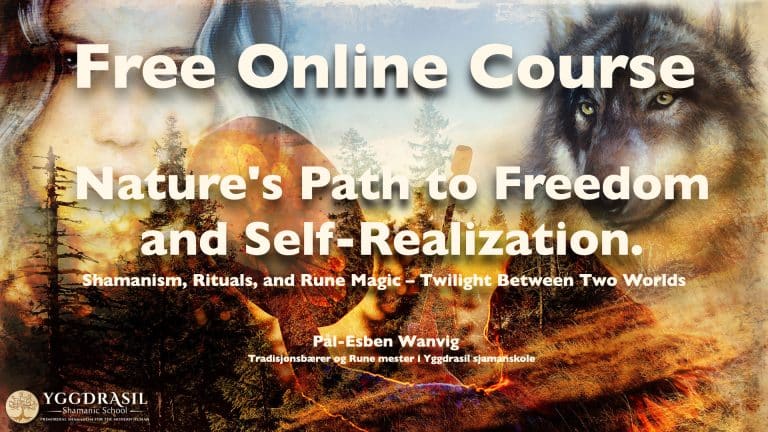
Nature’s Path to Freedom and Self-Realization
Curious about what primordial shamanism really is, behind the mystique and the misconceptions? In this short online course I tell the story of my own path from skeptical engineer to teacher of primordial shamanism, and give you a first introduction to what I teach: what shamanism and primordial shamanism are and are not, how rituals and rune magic are used in practice, and why the longing for growth matters so much for a good life.
The lessons are recorded in Norwegian; the English version will be ready in November or December 2026. Leave your email on the course page, and I will tell you when it is.