
Episode 15 – Death Anxiety and the Fear of Death – When Everything Falls Apart and the Soul Demands Change: How to Come Back to Life
For a year or two, Amina woke up night after night in a cold sweat, convinced that something was wrong with her heart, and she called the emergency number so often that she wonders whether they would still come today. Not long ago she went into anaphylactic shock. When her body told her she might die, she answered: “Yes, I might.” The nurse was amazed at how calm she was.
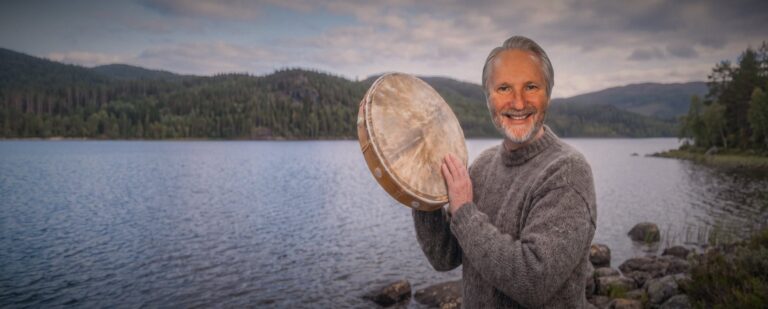
In this fifteenth episode, Amina and her teacher and guide, Pål-Esben Wanvig, talk about death anxiety and the fear of death. They explore why the first step out of an anxiety spiral is a detox from the news, how to widen the space between impulse and action, and why primal anxiety is really a fear of death that has to do with Dagaz, the rune of change. It is part of “The Journey to Self-Realization”, a podcast about the bravest journey a human being can set out on: the journey home to yourself.
This episode is an English translation of our Norwegian original, voiced by the digital avatars of Pål-Esben and Amina.
In this episode
- Amina’s story: nights of death anxiety, repeated calls to the emergency number, and a heart that turned out to be healthy
- How a society steeped in fear imprints the autopilot, and why the first step is a detox from destructive input such as the news
- The chief diplomat who never read the news, and the empath’s pitfall of feeling you have to follow and share every tragedy
- The space between impulse and action, and the pause button of the Interrupt Handling Technique in everyday life with children
- A simple exercise for panic attacks that Amina learned from Pål-Esben’s wife, Maria
- The triangle of suffering, and becoming friends with Dagaz, the rune of transformation and transition
- Amina’s test: meeting the thought of death calmly during an anaphylactic shock
- Why primal anxiety is a fear of death, and why healing it is essential on the shamanic path
This podcast is for you if you:
- Seek real depth in your spiritual practice
- Want to understand yourself on a more fundamental level
- Are curious about shamanism but tired of superficial “new age” spirituality
- Have taken many alternative courses but still feel that something is missing
- Feel an inner longing for freedom, love and wholeness
In a time when so many get lost in external methods and promises of quick fixes, this podcast invites you back to the only place where true answers can be found: your own heart.
Listen above, or read the full conversation below.
Transcript
A warm welcome to the podcast “The Journey to Self-Realization”, a primordial shamanic journey of development back to your true nature. This podcast is a collaboration with our favourite magazine, the health and lifestyle magazine Medium, and is devoted to exploring the bravest journey a human being can set out on: the journey home to oneself. We follow Amina, a student at the Yggdrasil Shamanic School, as she goes through a deep primordial shamanic process of development together with her guide and teacher Pål-Esben. It is a raw, unpolished journey of discovery towards true joy in life, deeper meaning, and a life that truly feels good to live.
This episode is an English translation of our Norwegian original, voiced by the digital avatars of Pål-Esben and Amina.
Today’s topic: death anxiety and the fear of death
Pål-Esben: Hi, Amina, and a warm welcome to a new episode.
Amina: Hi, Pål-Esben, thank you, likewise.
Pål-Esben: And a warm welcome to you, dear listener, because it’s for you that we do this. We hope this podcast can inspire you to create a better life for yourself, and perhaps you’ll also pick up a few tips for solving the challenges and problems you have. So what are we going to discuss today, Amina?
Amina: Today I’d like to talk about death anxiety and death. Because it’s something I’ve had big challenges with, death anxiety and the fear of death, and something I was also confronted with very directly during this training, during this process of development: making peace with death, quite simply.
Pål-Esben: Yes, it’s quite a harsh and difficult topic, since it’s also quite a big one. Let’s see if we can break it down a little, so that it becomes possible to digest. Where do you start, Amina?
Amina’s story: the nights of death anxiety
Amina: OK, let’s go back to 2017. That was when I started treatment at a DPS, a district psychiatric centre, and began working through some quite big themes in my life, and I began to struggle a lot with anxiety at night. At the time I couldn’t see the connection, but as soon as the treatment started, my anxiety also got much worse. Today I understand that’s because that’s where we process things. But I struggled badly with death anxiety at night. I got no peace, and this went on for months and months: I’d wake up terrified, in a cold sweat, thinking I was going to die. And I was completely convinced that there was something wrong with my heart. In that period, a year or two, I called 113, the emergency number, so many times that I don’t know whether they would come if I called today with the same symptoms. I was completely convinced that something was wrong with my heart, because I couldn’t understand why this pounding heart and this fear came every time I lay down. I now realise it was fear, but back then I just thought it was something physical. In the end I got to have an ultrasound of my heart, and that was actually really good, because then a man could tell me: “Your heart is perfectly fine; there’s nothing you need to worry about.” But it was still extremely difficult, because I was in so much fear that I had no way out.
And I remember one of the things I worked on back then to overcome it. I was also afraid of going to sleep, because this was when it came. So when the anxiety, the fear, came at night, I tried to accept the worst-case scenario, which meant accepting death. That OK, fine: if I fall asleep now and die, then OK. In a way, in the end I had no choice. And as the treatment went on, the death anxiety got better, but it didn’t disappear completely; I got used to living with it. And in this process of development, where I’ve dived into the depths of myself and worked through imprints and the autopilot and fears, I’ve also been confronted with death and with making peace with death, on my inner journeys and through all the material we’ve gone through. It has been quite a heavy theme for me. It can still come up for me today, but I handle it in a different way. I can come back to that a bit later. But it’s also something many people struggle with. I don’t know if I can say many, but many in my circle, and people I hear about, have a fear of death and struggle with death anxiety.
Two parts: the psyche and the shamanic
Pål-Esben: Yes, and as I said, this is a complex and difficult topic, and I think we should break it down a little. To keep things simple, I think we’ll split it into two parts. One is the psychological aspect of the anxiety and fear, and the other is the more shamanic aspect of fear and anxiety, if I can use such a trite word for it. But before we start, I want to say this: if you as a listener are struggling with severe anxiety and really have big problems with it, we always recommend seeking help from your GP, a therapist, a psychologist or others who can help you in a professional way. Because it isn’t as if you can just close your eyes and say: “Now I don’t want any more anxiety.” This is something that is often imprinted, and part of anxiety is genetic. We’ll come back to that later, when we talk about primal anxiety and the aspects around it, that is, the shamanic part of anxiety.
The shamanic part of anxiety… I’m in a bit of a world of my own at the moment. As we record this, it’s the spring equinox, today in fact. I’m in a state of complete balance, and when I talk to you now, I have to shift into yang, an active state. So I may be a little more muddled than usual in what I say today. But that’s just how I am. “Strange”, says my wife. Strange. Back to the topic.
The society of fear: imprinted by input
If you’ve struggled with anxiety and fear about these things, and it really is a big problem, there’s no shame in seeking professional help. And as I said, you can’t just close your eyes and say you don’t want anxiety and fear any more, because it’s a process you need to go through. And in the society we live in today, anxiety and fear, conscious and unconscious, are an exceptionally big problem, because they affect people in our society extensively: what they think, what they feel and how they act. And then there’s the extreme anxiety you had. Of course there may not be massive numbers of people with that kind of extreme anxiety, but this fear has permeated everything in our society today. There’s fear of war, there’s fear of politicians, of idiots around the world sitting on nuclear weapons, and you never know how to deal with these so-called leaders. And of course ordinary people, or most people, are affected by these things continuously. Through every news broadcast, online and on social media, you’re fed this input continuously. And it has a massive influence, not just on our consciousness, but on the unconscious part of us, which steers most of the emotional system and the behavioural system, 99 percent of it, that is, what we call the autopilot.
And just imagine: several times a day you’ve seen a threat of war here, a threat of nuclear war there; it comes at you continuously. Now the economy is going down the drain, now we’re heading for the next financial crash, what will happen to me if I can’t pay my mortgage, and so on. This goes on all day long, day after day after day, and then you think it has no consequences. Well, our brain is made in such a way that it’s imprinted by the input it gets and receives, consciously and unconsciously, awake or asleep. And the more times we repeat and receive the same input, the more easily a neural network is created, that is, an autopilot that runs by itself. In this case, autopilots and neural networks are created that are connected to the fear centre, for example the amygdala, the memory centre, the hippocampus, and so on. And then you wonder why you’re irritable and frustrated, why you feel restless all day, why you can’t wind down, calm down and just sit and look at the grass or the trees and feel good. You feel constantly restless. And not least, it affects what happens at home. When you’re steered by fear and irritation and frustration, it’s harder to hold back when the kids don’t do what you want, and with your partner too, and then you have this going on continuously. And what happens if you don’t push back against this? Because that’s what I’d recommend: pushing back. If you don’t actively push back against this madness, with all these imprints we get from our society, the autopilot and the neural network just get more and more imprinted. Gradually the anxiety and fear come more and more to the surface, and you’re constantly restless. And being in a situation like that, where you more or less constantly fear for your own existence, is suffering at a very high level. It’s terrible to experience, and you were one of those who experienced it in quite an extreme way, Amina.
Amina: Yes.
The first step: a detox from destructive input
Pål-Esben: And what was the first thing I started with in your case? What was the first thing? And then I’ll tell you what I do when I get someone who is struggling with fear and anxiety and restlessness and these things. There’s one thing I start with, and unless they’re willing to do it, I say hasta la vista: then I can’t help you. What is it, Amina? What is the first mandatory, necessary step for getting out of an anxiety spiral at all?
Amina: Cutting out the news and unnecessary input and information that you don’t need to carry with you into everyday life. Preferably replacing it with something joyful, something fun. In other words, eliminating that noise, so as to calm the system first of all.
Pål-Esben: Yes, of course, so that you can go through your healing process at all. The process of change that has to happen can’t happen, or it’s very difficult, when there’s chaos in our heads and in our emotional system. Your mind is in full monkey mode. You can’t talk sense to a person who’s full of fear. I can’t tell you, Amina, “Now I recommend that you do this and that”, while you’re completely wound up. It’s like talking to a Teflon pan: completely hopeless. So the first thing you need to go through is a period of detox, that is, a detox from destructive input. Some people come to me restless and fearful and so on. As long as they aren’t clinical cases, the first step I guide these students and clients through is a detox process. If they are clinical cases, I send them to a psychologist, of course, or to their GP, since I’m not a therapist. For 30 days, or 90 days as I recommend, you go on the wagon as far as destructive input from the outside world is concerned, especially the news. That means you have a news fast for 30 days: no news on TV, no news on the radio, local or national, no news on social media. You try it for 30 days and reduce it to an absolute minimum. This is a test process to see how you react to it. And what’s fascinating and interesting is what happens to a person who chooses to say: “OK, now I’m going to have 30 days without the Norwegian news outlets VG and Dagbladet and Nettavisen and TV 2, NRK, without this constant noise from the local radio.” You go completely nuts sitting there listening to these things. Or who says: “OK, I’ll go 30 days without this input, just to see what happens to my psyche and my emotional system.” It’s quite fascinating what happens to a person who chooses to try it fully for 30 days. And you were one of those who did it.
Amina: Yes, absolutely. And I just have to say there’s a life before and a life after a process like that. And it’s actually not that difficult. You can feel the autopilot going: “I just have to check, I just have to check.” And it got me many times during that detox process, where I just went: no, no. And in the end it becomes normal. In the end you don’t experience that no any more, being dragged along to check your phone or check VG or things like that. And I notice it. The news is one thing, but there’s also social media, the scrolling and taking in all that input, and having a detox from that too. And in particular you could perhaps introduce what I call social media pockets, where you allow yourself to go in and play a bit, and then come out again consciously, so that you at least do it consciously. But… oh, now I’ve completely forgotten what I was going to say. What was it? Oh yes: especially in a very active detox process like that, when there’s been a great deal of noise, you need to be very… I was about to say hardcore about it, that is, very extreme. I call it doing it wholeheartedly.
Pål-Esben: Wholeheartedly, yes. I make sure people do it wholeheartedly, because what will happen is that at the start you use discipline, and gradually it becomes a natural part of you. In a way you don’t even want to any more; you don’t have the need, because you’ve got over that kind of addiction.
Amina: Yes, it is an addiction, and that’s the challenge here.
An addiction to input
Pål-Esben: It is an addiction. You’re also addicted to this input, whether it’s from social media or the news, because the brain generates dopamine. The novelty centre, the brain’s centre for what’s new, creates a hit of dopamine when we experience something that gives us new input. That means you have a bunch of addicts sitting there feeding themselves with input all the time, and of course that’s an addiction you have to be willing to break. You don’t need to be fanatical. Fanaticism is a kind of illness. Fanaticism about nutrition, or the body, or exercise, or in this case social media too, isn’t healthy either. That’s why I prefer to recommend these things the way you do them: that you have these social media pockets during the day, whether once or twice, where you give yourself half an hour to go through your feed if you want to, and reply and communicate with the people you’re in touch with. But the news is different, because in our society today the news is pretty much constantly destructive. If you sit down and watch a news broadcast, at least 80 percent of it is negatively charged and about fear, about problems, war, the madness of the leaders we have in the world. And that’s what we want to get away from during this 30-day period, or, for those who are bold and brave, as you really are, 90 days. Because if we manage to do this for 90 days, a new behavioural pattern is created and we break a habit, but it takes at least 90 days. As a rule, 90 days does it.
“I have to keep up”: the story of the chief diplomat
But the argument I often hear against this is: “I have to keep up.” Yes, but do you need to know what madness Trump gets up to every day? Do you need to know what’s happening with Putin? Do you need to know all the other things you have no influence over? “Yes, but I have to keep up.” Yes, but do you really? “Yes, but what if I’m going to have a discussion with my colleagues? I have to have something to talk about, other than the madness Trump and company get up to.” And what’s interesting here is this. Some years ago I read an article in Die Zeit, one of the most serious newspapers here in Germany. It was an interview with Kofi Annan, who was then Secretary-General of the UN, and with one of his chief diplomats, an Egyptian whose name I don’t quite remember. This chief diplomat was responsible for making peace when there were wars and all these things in the Middle East. He was on the move all the time, trying to fix things so that they didn’t go to war with each other, so he was one of the best people Kofi Annan had for this. And the journalist asked him: “I assume you keep up with the news, so you know what’s going on?” And he says: “I never read the news; I never watch the news.” The journalist was very surprised: “Oh, why is that?” He says: “Pretty much all news is incomplete, or most of it is completely wrong. That means that when I get my information from the news, I’m imprinted wrongly and I understand the situations wrongly, and that’s why I never watch the news.” And when I read that, I thought: good grief, if he could survive without this, why shouldn’t I give it a try?
That was the impulse I got some years ago, because I was hooked on it too. I had to look through the online newspapers in the morning to check what was happening, spend half an hour, an hour in the morning browsing all the online papers, and perhaps listen to the radio a bit. Then I thought: “No, let me try this.” And that gave me the impulse to stop completely, to go cold turkey on these things. Of course it was a challenge at the start, because then you got the impulse you’re talking about: “I have to look, I have to look, I have to look.” But what was interesting, what I noticed… Because I believed, and here’s another argument I often hear: “The news doesn’t affect me negatively, I’m not stressed by it, I don’t have any anxiety,” people say. Bullshit, I say. You have no idea what’s going on in your unconscious, which is most of it. And I have to admit that I had the same idea: “No, I’m balanced, I have no problem watching the news these days, it has no negative effect on me.” Or so I thought. And what surprised me, and actually shocked me, was what happened to me after a couple of weeks. And I’m someone who meditates and does all these things, really, not just partly but fully. I noticed that things calmed down in my whole system like never before, as far as I can remember. The whole thing calmed down. The inner calm I had even back when I watched the news took on a completely different dimension, where I began to experience more and more what real calm is. And after a month I’m totally shocked at what’s happening to me: how I think, how I feel, how I experience the subtle. I think: “This is fascinating.” Then I got a taste for it and carried on for another month and another month. And what happens after six months is that you almost feel revulsion at the thought of a news broadcast coming on.
Take my dear wife, who likes to keep up, since she’s also a local politician, of all things, as well as being a psychologist. So I have my opinions about politicians, and we have our discussions here. She wants to keep up with what’s happening at the local or national level here in Germany, and would like me to watch the news with her. I have no interest; she can do that on her iPad. I simply don’t want to. And she was very surprised: “Why not?” Well, because I simply don’t want to. And now some years have passed without a newspaper or a news broadcast or anything at all, and I definitely have no interest in starting again. And then perhaps you’ll ask me: “Yes, but do you know what’s going on in the world, then? Are you completely in your cave, deep in the jungle, knowing nothing?” No, of course not. Everything filters through anyway. Suddenly you hear, as if from a distance, about some Chinese balloons flying over the US, then you hear that Trump has won the election, and then you hear that he’s going completely berserk with his stuff, and Musk, and co… You pick it up between the lines, so you’re not completely out of the loop. But it makes such a difference to how you feel and experience life. For me it was shocking when I did this fully, and I assume you had the same experience, with something as simple as that.
The empath’s pitfall
Amina: Yes, something as simple as that, and it’s actually one of the simpler things you can do to come back to more calm and less fear and anxiety. The challenge there, as I see it, is with people who are very empathetic and feel a lot of compassion, who feel, when there’s war and injustice and things like that… You talk to many people who feel they need to share it. They feel that if they don’t share what has happened to these people, then they don’t care, then they aren’t empathetic, and that following it and sharing it on social media is the least they can do. I’d also call that a bit of a pitfall, the way I see it, because you’re affected by all these images, by having to share it and discuss it and so on.
Choice and consequence
Pål-Esben: Yes, that’s one way of living life, and we’re not here to criticise the ways people choose to live, because we can choose to live our lives in different ways. But the way I see it, there’s no reason for us to actively create suffering in our lives. The way I see it, it’s about creating a life where we find meaning in what we do, and where we’re able to look after ourselves, our health, our family, our friends and the other people we come into contact with. A life where we can gradually become these beacons of light, this light, that can inspire the people around us to create a better life for themselves. And of course that’s a choice you make. You can choose to say “I want to do this and that”, but then you also have to be willing to take the consequences of the choices you make. That’s what I care about. You can choose whatever you like, but then don’t come moaning and complaining that “I have so much fear, anxiety and restlessness”, while you’re not willing to do any of this, because you just want to do as you please. Then I say that I can’t help you. Then I respect your choices, but you’ll also have to take the consequences of the choices you make. And that’s one of the things I try to inspire my students and you and my clients with: what choices you make is none of my business, as long as you’re willing to take the consequences of the choices you make. And of course, if you choose to say “I want to watch the news all day, because it’s my right”, then I say: “Yes, of course it’s your right, but then you really do have to take the consequences of what happens to your brain and your emotional system.” Or you can be a little brave and say: “Hm, I don’t really believe what you’re saying, but I’m willing to try it out for 30 days to see whether I can get these kinds of results myself.” That’s OK, I say. And then you’ve taken a big step towards finding a life that is less filled with stress and restlessness and anxiety. Because when you calm down enough, we can start talking together about the next steps towards becoming completely free of anxiety and fear, or at least being able to deal with these things in a way where they don’t take power over you.
Using empathy where it works
Amina: Yes. I think my message with what I shared there, about empathetic people who feel they have to watch and have to share, is something like this: it doesn’t mean you don’t care, or that you’re not empathetic or a caring person, if you don’t watch the news and follow it and share it. You can send light and love and healing, or whatever you choose to do, in other ways. You don’t need to drown your own light in suffering in order to help. So my question is: why not use your talents and your empathy to influence the people around you even more actively? I mean those you can really influence to have a better life, whether that’s family, friends, colleagues, students or clients. Because we humans can also use our resources very actively, and empathy is something the world really needs. The world is far too hard as it is, and we need more empaths who are willing to soften the hardness in the people they can reach, the people they can influence. That’s my way of thinking, at least.
Pål-Esben: I can’t do anything about the madness in the world, because the world has gone completely off the rails, and I have no influence over how the world develops. But what I do have influence over is how I inspire you, Amina, to find this light and this power in yourself: how you find your spiritual warrior inside, how you find access to your heart, how you find access to your Sahara, that is, your divine essence, so that you can become a beacon of light who can pass it on to your children, your partner, your family, your friends, your students. That’s meaning for me, because it actually has an effect. And in that way you can do your part to create a better world to live in. That’s what I use my energy for, and not for trying to send energy to Trump to make him a better person; the influence there is minimal. And I can see the consequence with you, to take that as an example. I used my empathy there. When you came to me, I saw that you were a person filled with a great deal of fear and anxiety and stress and chaos. I opened my heart to you and took you under my wing, to use that metaphor, and gradually helped you, with my energy, my insight, my knowledge, my patience, with all of this, to become who you really are. And when I see how you influence the people around you today, compared with how you could influence them a few years ago, it’s a total miracle. That’s meaning for me. That’s where I put all my resources, because it’s something that definitely works and definitely helps to create a better world. Because we can’t do this with the whole world at once, but we can do it one person at a time, and that person can carry the light on, and in the end there are more and more of us. That’s the path I’m walking, anyway.
Amina: Yes. There’s a big difference between living your life from an energy of fear and anxiety and living from the heart, from the soul, from joyfulness, from calm, in a way. Life becomes something completely different to live.
Back to nature’s rhythms
Pål-Esben: Yes, and you also get much easier and better contact with the healthy, natural rhythms. We talked about that in earlier episodes: how we humans, modern human beings, are so disconnected from the natural, healthy rhythms. We want stress and summer all the time, while winter and rest are something we don’t want. Then we wonder why we’re a society with so much chronic illness and all of that. We’re so disconnected from the natural rhythms that we’re stressed, and we don’t see things clearly. And when you calm your system down, it’s much easier to make contact with the natural rhythms, much easier to start thinking clearly again, much easier to make better choices for yourself. That’s why it’s well worth trying out what we’re talking about now for 30 days and just seeing what happens. Because if you’re willing to do that, we can go on to the next step. And what is that, Amina? Exam question here.
Amina: Exam question. Are you thinking of meditation and silence?
The space between impulse and action
Pål-Esben: Yes, exactly. Because once you’ve disconnected as much as possible from destructive input, especially from what you can’t influence, the next exercise, the next step, starts with calming the system down even more. For that we start with forest bathing, Shinrin-yoku. We move on to learning the first utiseta meditation, where you learn how to connect with the calm and harmony of nature, of the grass, the forest, the tree and so on. And gradually, as you settle more and more and become more and more balanced, the next step is that we can begin to discuss triggers and the Interrupt Handling Technique. That is: what do I do when the anxiety starts to make itself felt? Because I think we talked about this in an earlier episode too: when a person gets an impulse, say a negative impulse, this space between impulse and action is almost non-existent in most people. Your partner says something you don’t like, and almost on autopilot you answer back; we often see that. It means that between the impulse, your partner saying something, and how you react emotionally, with what you say and do, there’s no space. I call this space free will, the sacred space of free will. And in relation to anxiety and fear we also need to expand it, so that a little more time passes between the impulse arriving and your actions happening. And in that space, which we actively practise, we have methods such as the Interrupt Handling Technique, where we work out exactly what to do in this space.
That means an impulse comes, which can be a fear coming up from the first chakra, an emotion coming up. And we have no control over an emotion. It can be triggered by one of your kids falling over and hurting themselves; it can be triggered by anything at all. So the emotion comes up, and we have no control over it. But what develops from that emotion, which feelings develop, is something we have a choice over when we practise these things. Because normally an emotion comes up, and since there’s no space between impulse and action, it just develops into a set of negative, destructive feelings that can go on for hours, sometimes for days. And we need to stop this avalanche of destructive emotions that spins on by itself. We do that by expanding this space, free will, between impulse and action, by becoming aware of the trigger. When you get into a situation where the first chakra is triggered and the fear comes up, whoa, then you know there’s a trigger here and you need to be observant. And then you go through the Interrupt Handling Technique, with the pause button and what happens inside the technique. And perhaps we should… I don’t know whether we should talk about it now, exactly what we do; perhaps we should do it later. Because it’s a bit of a shame for you, the listener, if we talk about things without you being able to start trying them out straight away. So perhaps we should explain the Interrupt Handling Technique in detail later, but just briefly how it works. So you have the trigger: your son falls over and hurts himself, you see blood. Or perhaps better: he does something you don’t like. Then Mum can sometimes go ape and start scolding the little one. And as soon as that comes up, you know it’s a trigger. You’re then trained to press the pause button, and that’s impossible unless you’ve first done exercise 1, which is getting enough calm and balance; otherwise this won’t work. I’d say this comes after the first 30 days. And then you see: aha. You press the pause button, and then you think it through. OK, I see that the boy… Give me an example, Amina, of something you might react to, something one of your kids does that you’d normally get really angry about.
Amina: Not brushing their teeth, and not brushing their teeth properly, even though they’ve been told every day for twelve years. Trying to dodge the flossing. Very irritating.
Pål-Esben: Let’s take something a bit more brutal, something that makes you really furious. Before, I mean.
Amina: OK, if we’re thinking of before?
Pål-Esben: Yes, before, of course.
Amina: Before: real defiance and refusing to get dressed when we have to go out, when we have to be somewhere on time. Refusing to get dressed, refusing to move, refusing to go out, when we have to be somewhere on time. Very, very irritating; it ruined the whole day.
The Interrupt Handling Technique in practice
Pål-Esben: OK, that’s an example. Today, then, when you see this… Before, this would happen, and then Animal Mum came out and started scolding. Today it happens in a different way. Today, when the boy won’t get dressed, you know: whoa, I have a trigger here, one that before would normally have set off an avalanche of destructive feelings in me. You press the pause button. And then: what do I do in this space of free will? What do you do there?
Amina: What do I do? I crouch down, look the boy, or the girl, in the eye, and say: “You have to get dressed; otherwise there’ll be consequences.” “Oh, you’re punishing me,” and so on. “No, but every action has a consequence. Either you like it or you don’t, but this is what’s going to happen.” There have also been times when I’ve had to lift them out, put them in the car and get them on their way, even if there was howling and screaming. And then I give myself a few minutes afterwards, once they’ve been dropped off at school or wherever it may be, and breathe deeply in and out and think: “I don’t need to carry this with me through the rest of the day, because it doesn’t help anyone.” Then in a way I get rid of it straight away, the thing that could potentially grow. When they come home from school again, it’s sort of forgotten.
Pål-Esben: That means the trigger comes, whether it’s a fear impulse or an irritation impulse or whatever it is. When we become aware of the trigger, and we need to be balanced enough to be conscious of it, we press the pause button, and then we ask ourselves the question: what’s a good way to react to what’s happening here? And we’re talking about this: how can I react from my heart to what’s happening now? Then you go through the scenario. Is it to howl and scream here? No, perhaps not. Is it to be more constructive? Perhaps. So you go through a process there, and when you’ve finished that process, you press play and then you act, as you just described. And it’s the same with anxiety. That means that when an anxiety impulse comes up, you gradually… It takes a bit of practice, of course; it’s a process you need to be guided through, and we’re only scratching the surface here. So when the impulse for this anxiety comes, the sense that something you’ve heard means everything is now going to hell, you see that this is a typical trigger. You press the pause button, and then you ask yourself the question: does this have anything to do with reality right now? Is everything going to hell? Is everything going to explode now? Will I have no money for food tomorrow? Then you’ll see that 99.99 percent of the anxiety you have is irrational. So this is the ego’s fear.
And then you say: “OK, my experience shows something else. I’ve had food on the table for the last ten years, so I’ll surely have food on the table for the next few weeks too.” And then you talk to your ego, and then you decide which direction you want to go in: shall I feed the anxiety, or shall I change my focus? If you choose to say “I want to change my focus”, you can’t just say “now I don’t want any more fear and anxiety”. Then you need to do something physical, at least to begin with. And the physical thing could be, for example, having a playlist on your phone of your favourite songs. You put your… I don’t know what people use in their ears these days; it used to be headphones, now it’s perhaps their Bluetooth things, which they may have in their ears constantly, and we won’t talk about what that does to the brain. And then you press play and dance for a couple of minutes, and then your attention and focus go in a completely different direction, and you can get on with your day. Or you can choose to go out and chop wood, you can call a friend; you need to do something physical to break the impulse that comes up. And this requires practice. This is one of the processes you’ve been through. Tell us a bit about what happened, how it ended, how long it took before you started to get results.
Amina’s process: from noise to silence
Amina: In my head I divide it up a bit. Because we have the kind of process you’re talking about, with calming the noise, eliminating the news, being careful about which input I allow into my life. That lets me calm my system, so that I get more contact with nature and presence, experience who I am through my senses, can settle into and enjoy the present moment, can enjoy a meal, enjoy brushing my teeth, simple things like that. But then, when it comes to the Interrupt Handling Technique, there’s also the business of creating this space, because I wouldn’t have managed to create this space between impulse and action if I hadn’t calmed my system down. But after that I’ve also, in a way, gone further, where I’ve been led into the meditation process, where things then become quiet. Or not quiet straight away, because there I really got hit in the face. Personally, as someone who has struggled a lot with the darkness, demons and fear, as we’ve talked about before, I’m a bit of an extreme case there. At times I’ve gone through a lot of fear I didn’t understand, through the meditation process and the silence, which is a chapter in itself. I’ve had to understand: what is the darkness really? What is it that I’m really going through here? It has been extremely important for me to learn to understand, through this training, who we really are, the soul, where we come from, what the meaning of being here is, and also to accept that one day I’m actually going to die. That has been my personal process in this. Call it something a bit more mystical, this fighting against the darkness, whatever you take that to mean, which people often think of as a negative thing. And to tell you a bit about what I’ve done there: through inner journeys and so on, I’ve gone through some mystical things around the beings that have been around me. They’ve helped me understand, and not least you have, of course, what death really is, how safe it really is, how natural it really is. So it has been one of the biggest things for me to overcome, but I also carry it with me as part of my basic pattern as a human being: sometimes it can come up, and then I can look at it and say: “OK, I accept it.”
Sensitivity: all the more important to be critical of input
Pål-Esben: Yes. But it isn’t really something that steers you any more. So now you’re slipping into more advanced stuff here. And just to sum up: without taking the first steps we’ve discussed, this won’t be possible either. So it’s a process we guide a student through, and that’s what makes the results as permanent as they are for you today. And that’s one of the challenges for those who are very sensitive, just to sum that up before we go a bit into primal anxiety and the things you’re talking about now. Some people are very sensitive. That can mean emotionally sensitive or energetically sensitive, and there are many of them in the alternative world, and not just in the spiritual world, but also in the rest of our society, without knowing it. For them, these things we’ve talked about so far are incredibly important. The more sensitive you are, whether emotionally, energetically or in other areas, the more important it is to become critical of the input you allow to affect your consciousness, your unconscious and your subconscious. Because the more open you are to this, the more of a sponge you are for it. And then you have people who are numb, as a great many in our society are too, who simply have no access to primary feelings such as joyfulness and love. You have no idea how many people have that problem: close to seven or eight out of ten men have it. It’s quite frightening, but it’s possible to train it back again. So in my eyes, those who have this sensitivity, however sensitive they are, need to be very, very observant and critical and firm about what they let imprint them, consciously and unconsciously, during the day. Because what happens each time, the input you receive especially during the day and especially in the evening, is what buzzes away at full tilt through the night, in the unconscious and in your dreams. And then you wonder why you wake up restless and tired. So here we have much more power than we might think, and it all starts with what we discussed first. In other words, when I have a student like you, I start with what we want to do first. And the next step is dealing with the foundation of anxiety, that is, primal anxiety. Then we need to go a bit deeper into the subject, and we have to put on our shaman’s hat, or our shaman’s pelt, because it’s something that isn’t described very well in psychology, or in Western conventional medicine.
Panic attacks: the easiest anxiety to resolve
One thing I’d like to say about panic attacks: for anyone struggling with panic attacks, they’re the easiest form of anxiety to resolve. My dear wife, who is a psychotherapist, takes five minutes to resolve them permanently in a client. So if you’re struggling with panic attacks, there are ways of resolving them very quickly. And if listeners are interested in that kind of thing, we can discuss in another episode how you can go about resolving your panic attacks. Because they really are nasty stuff: you feel you have no control over them, but they’re one of the easiest forms of anxiety to get under control and stop.
Amina: Yes, just to chip in there: I had a conversation with your dear wife Maria and learned that exercise, and it’s absolutely fantastic. It’s almost like… when you hear about it, it feels like you’re on Candid Camera; it seems too simple. But it has worked for me, and I’ve also shown the exercise to several other people. So there’s something to it.
Pål-Esben: Then we can’t be cryptic now that we’re letting the cat out of the bag here. Let’s let the cat out. The exercise is something my dear wife has used with many, many clients and patients over many years, and it’s frightening how good the results are. So perhaps you could tell us a bit about what you did?
The exercise for panic attacks
Amina: What I did… Perhaps I can also put a little video about the method on Instagram once the episode is out. But what it’s about is this: when you have anxiety, it really sits in your chest. There’s real pressure, and there’s no room for anything, because you feel so incredibly squeezed in your chest. So the idea here is that you… now I have to move a bit away from the microphone… you sit upright, and then you push out. You make this movement, which I can make a separate film about: you sort of push out from your chest, and then you push outwards, in a circle and back to your chest, while at that moment saying: “I’m scared, I’m really scared, oh, I’m so scared.” What happens then is that you push out, you push away what’s sitting in your chest, or the feeling that’s in your chest, while at the same time telling your body that you’re scared. But what happens with your body is that in a way it perceives: “I hear you saying you’re scared, but nothing’s happening.” So it becomes a bit of, if I can call it that, reverse psychology, or whatever it is. When I first heard about the method, my reaction was a bit like: “Whoa, isn’t that a bit like manifesting more of what you don’t want?” But that’s certainly not what happens in the body. So it’s very interesting. To begin with, you go all the way, pushing your hands out and out to the side and back again. But once the pattern is well drilled in, you can use your fingertips and push outwards when the panic attack comes. And eventually, once that is drilled in too, you can close your eyes, or keep them open, and imagine you’re doing it, and the panic will calm down. That’s my experience with it, anyway.
Pål-Esben: Yes, and what you’re doing is also a paradoxical intervention. But you’re also using your body, you’re using a visualisation for it, and not least you’ve made a choice, because unless you make a choice that you want to let go of this, it isn’t possible either. This needs to be done in the correct way, and then you can put a video on Instagram and show how you do it. In addition, it’s important to control your breathing here, because the breath is one of the simplest factors for controlling a panic attack like this. What you shouldn’t do is put one of those plastic bags or paper bags over your mouth; that’s pre-war stuff, Freud stuff from way back. It can actually be very harmful, because if there’s too much carbon dioxide in the system, we can have a problem. But with this, eight or nine out of ten can get a great deal of help. This actually surprised me a lot, when my dear wife said that in most cases this isn’t all that complex, but it has to be done in exactly the right way to make it work. So my tip to you as a listener, if you’re struggling with these things: get in touch with Amina, book a guidance session with Amina, and let her guide you through this method in a professional way. That’s the best tip I can give here. Because watching a video where someone does something is one thing, but Maria also sat down for an hour or so, explained the whole thing, did the exercise together with you, answered questions and so on. So that’s the best tip I have here: get in touch with Amina.
Amina: Yes, you’re all very welcome to get in touch.
Pål-Esben: Don’t get in touch with me: fully booked, no capacity. I focus all my attention on students, so I don’t take on clients. But you do, Amina, thank goodness. OK, so we’ve done that, the cat’s out of the bag, and now we can get back on track. And I don’t know whether we should carry on now with primal anxiety, or whether we should continue with it in the next episode. What would you like? Shall we make this a long episode, or shall we…?
Amina: Oh dear, oh dear. Because primal anxiety is also a bigger topic.
Primal anxiety and Dagaz: the rune of change
Pål-Esben: It is a bigger topic. But we can at least do the introduction to it and see how far we get. And you as a listener will perhaps forgive us for going on a bit longer in this episode. A bonus episode: I think that will be appreciated. OK, let’s look a bit more at the basis of fear and anxiety. I’m leaving out the cases where there are chemical imbalances in the system, and where there’s serious trauma and those things; I’m not talking about that right now. Now I’m talking about the general, fundamental cause of why this restlessness, fear and anxiety arise in a person. And when we look at the Elder Futhark, with the runes, it’s described through a rune called Dagaz. Dagaz is the last of the 24 runes in the Futhark, and it’s the rune of transformation and the rune of transition from one state to another. Imagine that the Futhark starts with Fehu; then you go through the 24 runes, and right at the end you have the 24th rune, which is Dagaz. Not Othala, as some people mistakenly think, because that can’t be last. Because Dagaz describes that now we’ve come to the end, now there’s a transition that has to happen, and we have to complete the process we’re in now so that something new can be created, so that a new circle can be created. We come to the end of the circle, and then we have to complete it so that something new can be created. That’s Dagaz. And in the society we live in, a great many people have an insane resistance to and fear of all change, all the changes of state they have to make. That’s because the ego, the intellect and the karmic memory, that is, the triangle of suffering, hate every form of change. Because we don’t quite know what’s on the other side of the fence; the grass probably isn’t greener.
Amina: But then, to explain to the listeners what the triangle of suffering is: what is it, Pål-Esben?
The triangle of suffering
Pål-Esben: Yes, it’s one of my concepts, the triangle of suffering. So we have identity, ego, karmic memory and the intellect: they’re what govern the triangle of suffering. And what happens in this triangle of suffering is actually what creates all the suffering in your life. That is, what you identify with, your intellect, and the karmic memory, which holds the record of everything you’ve been through in this life and in previous lives, including traumas, imprinting and so on. And of course the ego, which runs all these things and ultimately generates: “No, that’s dangerous, we don’t want that”, and so on. So I call this the triangle of suffering, and it’s what actually creates all the suffering in a person’s life, because it runs more or less on autopilot. And of course, when you go through a profound primordial shamanic process of development at the Yggdrasil Shamanic School, you’re trained to understand what this is. And you’re trained to take back power over your own life, so that these aspects of our psyche and the unconscious no longer control your behaviour, how you feel and how you act. But normally, in most people who aren’t trained, this runs on autopilot, which means you fear and resist pretty much all change.
And in my book, The 7 Golden Keys, right after the first chapter, I talk about change, and why people have such a big challenge with every form of change, and why it actually creates pretty much all the suffering in a person’s life. Because if you have a problem, the only way to solve that problem is through change. The problem will stay exactly as it is as long as you won’t make the changes that would remove the cause of the problem. So you end up chasing your own tail: “I don’t want to change, I don’t want to make changes.” But then what you have today will just go on for ever. And then you can’t understand why you have fear: “I do want a better life, I do want to get rid of my type 2 diabetes, but it’s so hard for me to change my diet and start doing these things, lose weight and bring my blood sugar down. It’s so hard, I have so much resistance, but I do want to get well.” And then you’re in this chaotic state where on the one hand you want to, and on the other hand you feel blocked from doing it. That’s the foundation for not finding solutions to your challenges, your suffering or what you want to create in your life. Because it doesn’t help much to sit down and try to manifest towards the universe: “Now I want a new Porsche tomorrow”, then you do a special exercise, and the Porsche will be standing there. That’s meaningless; that’s not how it works. Many people have got rich on this kind of idea, though. It’s totally brilliant marketing for fooling people, because you hope it’ll be that simple: “Give me this special method, and everything in my life will be fixed.” But that’s not how it is.
We talked in earlier episodes about the soul and the elite university for souls: why we’ve come here as souls, to learn and experience, to develop. And to be able to learn and experience and develop, we need change. And then we’re stuck hanging in Dagaz, hanging at the very end. We fear change like the plague, and that creates massive frustration in people. So that’s the thing here: if you untangle this knot with Dagaz and gradually become friends with Dagaz… That’s actually the last module of the basic training in our shamanic tradition, where among other things we have an exercise in which we train the student to become friends with Dagaz. Where Dagaz becomes your best friend. And what does that mean? Well, it means you begin to learn to love change, to love constructive change. You embrace the changes that are needed to create a better life, a healthier life, a sounder life, to create a better relationship with your children, your partner, whatever it may be. So it’s one of the first things we start talking about when we put on our shaman’s hat: why we have such a big challenge with this Dagaz rune, which is the last rune in the Futhark. And the I Ching works in exactly the same way. You start with hexagram number 1, then you go through yin and yang, and then you come to the end, to hexagram 64, which describes this transition to hexagram number 1, to the next life process. It’s a cycle. So our task in a profound primordial shamanic process of development is to help the student flow with processes: a life process from the start, going through the life process, and when the life process comes to the point where it’s finished, we need to let go of it, so that we open ourselves to something new being created. But what’s it like in our society today? Well, we cling to what is. “I’m terrified of applying for a new job, even though I’m unhappy at work. I hate my job.” But why don’t you apply for a new job? “No, I don’t know, I don’t know.” Or you live in a dysfunctional relationship where you’ve suffered and suffered for years. Why do you carry on suffering? Why not end it and open up to something new? And so on. And you were one of the experts at clinging on to Dagaz around several themes in your life.
Becoming friends with Dagaz
Amina: Yes, well, I’ve had big problems with Dagaz, really. But I’ve also embraced it more and more. Everything has a beginning and an end. And starting to see through… You don’t need to tackle the very biggest themes straight away, just in everyday life, these transitions: we start a new job, we leave a job, we go to the shop, we go home from the shop, we’ve bought salt, and then the salt runs out. All of life consists of all these beginnings, endings, death processes.
Pål-Esben: And there you say the word death processes. That’s the first time we’ve said that this is a death process we’re discussing, because we’ve now only just started talking about what I call primal anxiety. Go on.
Amina: Yes. So I began to recognise it in my everyday life and began to accept that, OK, that’s how it is: accepting these small changes, and gradually the bigger changes. And I also managed to understand how the small choices, the small changes, the small processes were connected with the big picture, which is something we get a very good introduction to during the training. And I see: whoa, OK, this is our true nature, this is my true nature. And through that module you’re talking about, quite a lot happened to me. Becoming friends with Dagaz isn’t something I can quite put into words. It would come out a bit too mystical, but very, very beautiful. And it perhaps sounds a bit harsh to some people, actually loving that everything has a start and an end, everything from the smallest to the biggest. But it has been so important for me, and so empowering, not least: taking back my power as a human being, as a soul. And I got a test of that not so long ago.
Pål-Esben: Yes, so let’s see from a higher perspective how far you’ve come, Amina.
The test: the anaphylactic shock
Amina: It was through an anaphylactic shock I had when I ate a fruit I couldn’t tolerate. I’ve fainted before, and it gets very serious, because my throat swells up and things like that. And when it came on, at the start of the anaphylactic shock, I got very practical: I understood that I had to get myself somewhere I could get help. And at the start I thought: “Hm, is this about fear?” But afterwards I saw that no, it was more about… Yes, it may well be that fear was also engaged a bit here, but it was about me doing what was good for my body, what my body needed, and it needed help. But when I got to the emergency clinic and turned my attention inward while the nurses gave me an injection and things like that, what sort of happened inside me was that my body told me: “What if you die? You might die now.” And what I experienced then was that I answered my body: “Yes, I might. I might die.” And in that, and it may sound a bit brutal, in that I sort of took my power back. It was also proof for me of how far I’ve come with my death anxiety and my acceptance. Because we all know we’re going to die one day, but very few dare to talk about it; it’s a bit of a taboo subject. And I remember the nurse also said she thought I was so calm for someone in anaphylactic shock that she almost praised me to the skies. If this had been a few years ago, it would have been total chaos in there, because it’s terrifying, after all. So for me it was proof of how far I’ve come in my acceptance around Dagaz. Of course I had some after-effects in my physical body for a few days afterwards; I’m still a human being, after all. But it’s a situation I would have handled completely differently just a year ago.
Primal anxiety is the fear of death
Pål-Esben: And here there’s an advantage when you begin working on the more profound areas of anxiety and fear, and that’s where we come to primal anxiety and these things. Because it’s almost impossible to try to do this cognitively. If you try to do it in therapy, you have 15 years of therapy ahead of you, because you can’t relate to this cognitively; it goes so deep. And that’s the advantage when you bring yourself into the shamanic world. Because one of the rituals we work with, becoming friends with Dagaz, is also a deep and comprehensive shamanic ritual, a healing ritual you go through, and can go through several times. It makes these deeper changes and has an effect on the deeper layers of our psyche. And that’s where the brilliance comes in when you combine this form of primordial shamanism with modern science, technology, psychology and so on: then you have the power to deal with things that are otherwise extremely difficult to find your way out of. Because even getting this far and being willing to look at these things requires a process of development in itself.
Everything we’re dealing with here is fear of death, because that’s really what it is: this primal anxiety is fear of death, and it goes a very long way back. It’s also connected to our genetic system, to our being afraid of what happens after death. That is, I’m talking about our epigenetic system, not the genetic one. Because the genetic part of us is the most natural thing of all: you arise, you’re born, and then you move on, and then the body returns to nature, to Mother Earth, and then something new arises. Genetically, this is natural. Epigenetically means how the genetics have been imprinted, especially through several thousand years of religion and all this drivel about hell and suffering and so on. That’s what lies at the foundation of primal anxiety, and of this basic death anxiety that lives in the vast majority of people. Even in those who think they aren’t afraid of this, it’s very easy to show that they are, through tests such as kinesiology tests and so on. Then you see what’s really going on: that people are uneasy about dying physically. But that’s the most extreme form. The same anxiety, the same fear, the same foundation, is what steers you on autopilot to say: “It’s so hard to change my diet, even though I need to, and I don’t want to get type 2 diabetes, because it’s so serious. But when I have to stop eating Laban Seigmenn, the Norwegian jelly men, it’s so hard for me”, and so on. Or making changes in your relationship, seeking therapy, seeking help, finding a new partner. The same with work: you cling to the status quo on autopilot, even though you’d like to change, even though you want to; you just feel you can’t manage it.
So what happens when we go through a truly profound primordial shamanic process of development is that all these things are dissolved, worked through and healed, until you sit there finished and get spat out of the process, that is, a new Fehu, the start of a new life process. And then you no longer have these problems. And for any advanced shaman, for example, healing this primal anxiety is mandatory, because it’s also what ultimately stops you and blocks you from contact with metaphysical beings, power animals and other resources. So for a shaman’s process of development too, this is the be-all and end-all. It’s also an important part of the true shamanic death, which isn’t about suffering and extreme experiences, but about something completely different, and I think we should discuss that in another episode. It’s totally spectacular to go through a process like this, because life changes radically once you’ve been through it. You’re then not so affected by what happens around you in society, by the input coming at you and by what happens to you, because we can’t control that. But you have more and more power over how you act, react and interact with what’s happening externally and internally within yourself. That means you take back power over your own life, and that creates a much more meaningful life, a much more joyful life. That’s what I intend to inspire people to find. So there I just want to congratulate you, Amina. It hasn’t been easy to go through a process like this and talk about the fear. You’ve faced a lot of resistance too.
Experiences deeper than the intellect
Amina: A lot of resistance, a lot of resistance. And you touched on something earlier, about what you can and can’t do with the intellect. My intellect has had all the good food it could ask for. But what you touched on there, these experiences I’ve been through that don’t come from the intellect but from something deeper, are very hard to explain, but they’ve been an incredibly important part of the process. Because there have been some things I’ve sort of recognised, a bit like meeting an old friend, a bit like: “Oh yes, there you are.” Of course there’s nothing to fear. That’s something I’ve experienced through something deep, deep inside me, which comes from something completely different from a logical understanding that it must be like this or that. And also the ideas about what death really is. Because in my case I’ve also been afraid of death because I’ve had an idea of what it is that has been completely wrong, and many people have got it completely wrong too, as you touched on. Many say: “No, I’m not imprinted by religion, and I’m not a believer and that sort of thing”, but then you see what kind of thoughts they have about death, which can’t come from anything other than religion. So it has also been very important for me to resolve that. And through inner journeys in the dream world, in deeper fields and that sort of thing, I’ve also had some very deep experiences where I’ve sort of been led into the moment of death to see what it’s really about. Call it perhaps beings of light who have helped me open my eyes, and that sort of thing. But at any rate it has meant a great deal to me to be able to go through that process as best I can, while I’m alive, in my inner world, to see that, OK, there’s nothing dangerous about it.
Next episode: what death really is
Pål-Esben: Yes. And something else that’s important to emphasise here: there’s often a misunderstanding in the alternative, esoteric world that there’s one esoteric method, one energy method, that will fix everything. But notice what we’ve talked about in this episode. Yes, we use comprehensive energetic methods from the Shamanic School, but together with practical actions that people have to take in their daily lives, which we talked about in the first part of the episode. And when we combine these two things, we have a very, very powerful combination. And death itself: the day you experience a stable state of oneness, in your timeless and spaceless existence, you notice that you’re experiencing your Sahara, everything you are. The day you get a deep enough experience of that, there’s no longer any fear of death, because then you know what happens afterwards. So let’s talk about that in the next episode: what death really is, what happens, how you can prepare for death, what happens after you’ve died, what consequences things have, and so on. Perhaps we’ll follow that up in the next episode. What do you think about that, Amina?
Amina: It’s very exciting. It’s very interesting that I can talk to a person who says: “Yes, let’s talk a bit about death and what happens after it”, and I just go: “Yes, let’s do that.” A few years ago that would have created so much friction inside me. So it’s absolutely fantastic. I’d love to talk to you about that.
Wrapping up
Pål-Esben: Brilliant. Then let’s do that. And now we need to wrap up this episode, which has run a little longer than usual. I hope that you, dear listener, have been well entertained and have perhaps picked up some tips, input and inspiration from this episode. And remember that there’s no shame in seeking help if you’re struggling. It’s the first step in starting a process of development, because there are many things we can’t so easily fix ourselves, and there’s no shame in seeking help there. For me this has been a joyful episode, as usual, with the two of us here together. I love our conversations. They’re not scripted; we play it by ear, and it’s good that things go a bit sideways now and then too. And now it’s time for me to go back into my own world. Thank you so much for staying with us all the way, dear listener. We really appreciate your feedback, and a five-star rating on Spotify helps our podcast reach more listeners. And thank you so much for being here with me, Amina. I really appreciate it.
Amina: Likewise, Pål-Esben.
Pål-Esben: Thank you for being with us, dear listener. I hope you’ll join us again in the next episode. And until then: have a truly wonderful day, evening, night or morning, wherever you are listening from. Take care.
Outro
Thank you so much for listening to this episode of “The Journey to Self-Realization”, a primordial shamanic journey of development back to your true nature. We hope Amina’s story has inspired you to explore your own journey of self-discovery and development. Remember that the path from suffering to self-realization can be demanding, but with courage, patience and support from a competent guide, mentor, teacher or therapist, almost anything is possible. We wish you all the best on your journey, and we’ll talk again in the next episode.
The Journey to Self-Realization
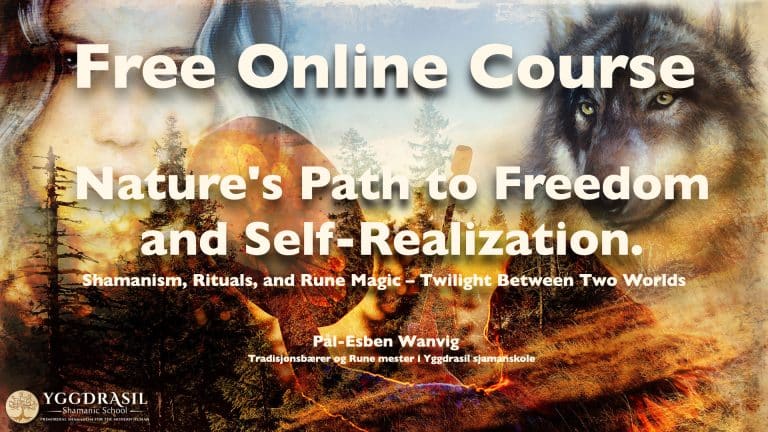
Nature’s Path to Freedom and Self-Realization
Curious about what primordial shamanism really is, behind the mystique and the misconceptions? In this short online course I tell the story of my own path from skeptical engineer to teacher of primordial shamanism, and give you a first introduction to what I teach: what shamanism and primordial shamanism are and are not, how rituals and rune magic are used in practice, and why the longing for growth matters so much for a good life.
The lessons are recorded in Norwegian; the English version will be ready in November or December 2026. Leave your email on the course page, and I will tell you when it is.