
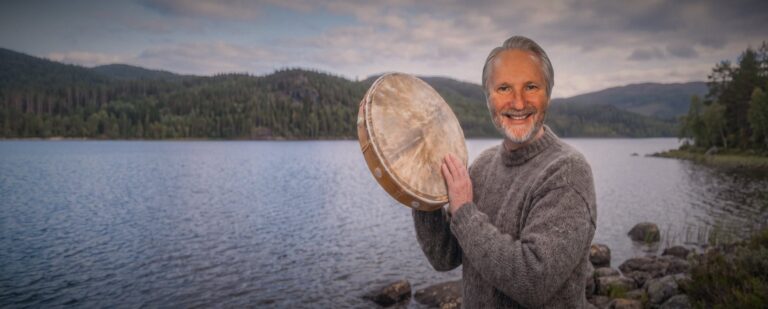
Episode 16 – Primal Anxiety, Fear-Driven Shamanism and the Nervous System – How to Find Your Way Back to Safety Within Yourself
Pål-Esben’s mother grew up during the war, when the Germans took over the farm she lived on, and she gave her son a mantra: the only thing that matters is survival. That existential anxiety drove him for years, through bigger and bigger companies and more and more money, until he collapsed with burnout on 23 December 2003. Amina, for her part, recently caught herself getting short with one of her children on a stressful day, and apologised almost at once.
In this sixteenth episode, Amina and her teacher and guide, Pål-Esben Wanvig, talk about primal anxiety, fear-driven shamanism and the nervous system. They explore why fear makes us so easy to control, how anxiety can be passed down the ancestral line, and why the trees are not afraid to let go of their leaves in autumn. It is part of “The Journey to Self-Realization”, a podcast about the bravest journey a human being can set out on: the journey home to yourself.
This episode is an English translation of our Norwegian original, voiced by the digital avatars of Pål-Esben and Amina.
In this episode
- Irrational anxiety, and the existential anxiety Pål-Esben inherited from a mother traumatised by the war
- Cutting out the destructive noise, and why fear makes people so easy to manipulate
- The space between impulse and action, and Amina catching herself on a stressful day
- Primal anxiety and life and death processes, why we cling on when it’s time to let go, and why the trees don’t fear autumn
- Epigenetics, and how fear and religious dogma are passed down the ancestral line
- Why deep change needs individual guidance, and the taste of strawberries
- Angels, power animals and fear-driven shamanism, and why the beings of light turn away from fear
- Voodoo, black magic and psychosomatics, and why you need a guide who isn’t driven by fear
This podcast is for you if you:
- Seek real depth in your spiritual practice
- Want to understand yourself on a more fundamental level
- Are curious about shamanism but tired of superficial “new age” spirituality
- Have taken many alternative courses but still feel that something is missing
- Feel an inner longing for freedom, love and wholeness
In a time when so many get lost in external methods and promises of quick fixes, this podcast invites you back to the only place where true answers can be found: your own heart.
Listen above, or read the full conversation below.
Transcript
A warm welcome to the podcast “The Journey to Self-Realization”, a primordial shamanic journey of development back to your true nature. This podcast is a collaboration with our favourite magazine, the health and lifestyle magazine Medium, and is devoted to exploring the bravest journey a human being can set out on: the journey home to oneself. We follow Amina, a student at the Yggdrasil Shamanic School, as she goes through a deep primordial shamanic process of development together with her guide and teacher Pål-Esben. It is a raw, unpolished journey of discovery towards true joy in life, deeper meaning, and a life that truly feels good to live.
This episode is an English translation of our Norwegian original, voiced by the digital avatars of Pål-Esben and Amina.
Pål-Esben: Hi, and a warm welcome to a new episode, Amina.
Amina: Thank you so much, Pål-Esben. Likewise.
Pål-Esben: And a warm welcome to all of you listening or watching, depending on whether you’re watching a video of us or just have us in your ears. Today we’re going to talk about a difficult topic connected to anxiety and fear. In the last episode we gave an introduction to the topic, and you come from a place where anxiety and fear very much ruled your life.
Amina: Yes, it hasn’t been easy. But my hope in bringing this up in the podcast and talking about it is also to be able to inspire others, so they see that there really is a way out.
Irrational anxiety: when fear rules for no reason
Pål-Esben: Yes, and in most cases there is a way out, and the way out is less complex than you might think. And again: we’re not talking about clinical anxiety here. If you have clinically diagnosed anxiety disorders, you of course need to seek expert help from a psychologist, a psychiatrist, your GP or a therapist. It isn’t something you can solve on your own; you need help with it. What we’re talking about here is the kind of fear and anxiety people have in their lives, which in 99.99 percent of cases is irrational. It’s anxiety and fear, it’s unease. But when we look back on it afterwards, after a few days or a few weeks, we see that what we fear, what we’re uneasy about, very seldom turns out to be real. So we’re talking about irrational anxiety.
In the old days, the really old days, when we lived in caves and in the forest and the jungle, it was a bit different. When you came across a king cobra, you had reason to feel anxiety. It’s this basic genetic anxiety that gets triggered, the one connected to the oldest part of our brain, which has to do with physical survival. But we don’t have that many king cobras and sabre-toothed tigers around us any more. We’ve found a fine substitute: through the way humanity has developed, more and more of this irrational anxiety has taken over. Before, we had real anxiety. Today we’re afraid of whether we’ll have food on the table tomorrow.
Existential anxiety: the legacy of the war
Pål-Esben: Like I had, for example. I had massive existential anxiety. I think I was brought up on it from the cradle through my mother, especially my mother, who grew up during the war, when the Germans and the Nazis took over the farm she lived on. They had no food for several years and were really, really traumatised. I think she passed this existential anxiety on to me, and she gave me the mantra: the only thing that matters is survival. You have to do well, you have to get a good education. Being happy isn’t that important, but having enough money so you have food on the table tomorrow, that’s the most important thing. That was the basic mantra, and it spilled over into every area of life.
I remember how this drove me all the time when I was much younger. It drove pretty much everything I did: generating enough money so I could have enough food and pay my rent and all that. And no matter how much or how little I earned, I constantly had an anxiety that it wasn’t enough, that I couldn’t survive financially. I call it the basic existential anxiety. It haunted me like a nightmare. It drove me to generate more and more, build bigger and bigger companies, earn more and more money. But no matter how much I had, I had this anxiety. Right up until I collapsed in December 2003, on 23 December 2003, with burnout so severe it nearly killed me. Then the time for awakening had come, or rather, the awakening happened in the months and years that followed. So I know how this anxiety feels: horrible, horrible, horrible.
You have a slightly different form of anxiety, as we talked about in episode 1, but in the end it’s the same feeling you have when you’re driven by irrational anxiety about things that don’t really exist, and that will never actually happen. What we talked about in the last episode was the foundations for being able to come out of this anxiety. So what’s the first thing we need to do, before we can start looking at practical steps for letting go of the anxiety, that is, the irrational anxiety? What does it take?
Amina: Eliminating all unnecessary noise from the news, from unnecessary discussions and unnecessary places to be. All that unnecessary input of destructive information that you can’t do anything about anyway.
The first step: eliminating the destructive noise
Pål-Esben: Correct. We talked about that in the last episode. You need to create a space where you can calm down enough to be able to go through a process of development. Because as long as you’re bombarded with destructive input that continuously triggers the amygdala, the hippocampus and our whole fear system, it’s very, very difficult to think clearly and go through a process of development to get out of a state of anxiety. At least that’s my experience through more than 20 years with quite a lot of clients and students. So that’s the first thing, and we talked quite a lot about it in the last episode: how important it is to try this for a period while you go through your process of development.
We’re not talking about a period where you go and live in a cave in the Himalayas and just ignore the world and sit in meditation in your cave. That’s not why the soul has come here. Your soul has come here to learn and experience in the material world we’ve come into. It hasn’t come here to flee into a cave with no contact with the material world. That’s not what we’re talking about. We’re talking about the unnecessary, constant input that people receive, consciously and unconsciously. It’s everything from news broadcasts where they talk about war and misery you have no way of influencing, to meaningless debates on TV where people sit there yelling and shouting, interrupting each other and showing no respect for each other. A bloody monkey circus. And you sit there and take it as entertainment, and then you think it doesn’t affect your psyche. Last time we talked about why this affects the psyche to such an extent.
But there’s another problem with this too. The more of this input you let in uncritically, the more disturbed you become. It might be newspapers you read, news broadcasts, the constant blare of local radio, debates or whatever you watch, trash TV for example. Watch ordinary TV and try to see what’s really going on, and you’ll see it’s no wonder people get disturbed when they take all this in uncritically the whole time.
Fear makes you controllable
Pål-Esben: Because one of the main problems is this: the more fear and unease a human being has, the more easily they’re swayed by other people’s opinions. The more fear you have, the less free will you have. The best way to control a human being is to make sure they’re filled with enough fear, because then that person is completely irrational and will swallow even the most meaningless ideas hook, line and sinker. We saw that in full force during the pandemic years, when that mechanism was plain to see. The world was in fear, and the input from the authorities and the official bodies was swallowed whole, even though it was completely meaningless.
One concrete example, which has been very well documented since, was vitamin D. Information comes out that high enough vitamin D levels help the body’s immune system handle infections better, which is a fact, and which came out very clearly after the pandemic. And then, on a massive scale, the Norwegian authorities among others seize on a report from some researchers in Brazil, a bogus study of sorts claiming that it’s dangerous to take vitamin D supplements. This goes around the world, here in Germany and in Norway, and it’s used to hit back at those who say: make sure you have a minimum of 100 nanomoles per litre of vitamin D in your blood, preferably up towards 150, and your immune system will work brilliantly. The authorities come out saying that it’s dangerous to take vitamin D, people are terrified and stop taking vitamin D, and the infection levels in the body go much higher. That’s an example of what happens when a human being or a group of people is filled with anxiety. Then they can be manipulated into believing anything, since they’re driven by their anxiety.
We could take so many examples around these things. But our task, Amina, my task and yours as guides, teachers and mentors in the shamanic field, is to help people find the way out of anxiety, so they take back power over their own lives. That’s one of our goals: that you take back more and more power over your own life, so that you yourself decide what to do and not to do, and don’t let others who generate fear control it. There’s another thing in the world we live in today, where there’s war, and you have all these psychotic leaders sitting on nuclear weapons and threatening to press the red button. How much control do you think that gives others over you, when you’re constantly walking around thinking about how dangerous it is? It’s frightening what that opens up inside you, because then others can have the power to control it on every level. Our task is to help people set themselves free. And that was one of the most important things you’ve experienced through your process of development: the feeling of what it’s like when you begin to set yourself free. Isn’t that lovely?
Amina: Yes, it’s absolutely lovely. It’s quite exceptional. And this business of free will: we humans think we have free will, and I realised more and more that, whoa, shit, with so much fear and so much anxiety I actually have zero free will. I’m a victim of my own inner robot, my own autopilot, my own fear. So this business of setting yourself free from this fear, from this relentless chase to survive, can look several different ways. Some have a fear of something specific, some have a fear of something general that they don’t quite understand. But really letting go of it, and getting in touch with the real essence of life itself, is something quite unique. I mean the real essence of how you can actually live as a human being on earth: really beginning to get in touch with who you are, and with the possibilities you have on this planet, with Mother Earth. Then you lift your life to a new level.
The space between impulse and action
Pål-Esben: Yes, and that freedom doesn’t come by itself, because it takes effort. You can of course choose to run on autopilot and just let whatever happens happen. The challenge is that this space between impulse and action, what we call free will, is so small, since you’re governed by so much conscious and, not least, unconscious fear and unease. When an impulse strikes, when someone says something or a piece of news comes in, your emotional fear system reacts immediately, and you act. It can show itself in getting irritated and frustrated, yelling and shouting at your kids, whatever it is, or having conflicts with your partner. That’s quite simply because you’re so uneasy that you can’t think clearly enough to act in a healthy way, in line with your heart. Do you have a couple of examples of how that feels?
Amina: Absolutely. And I actually caught myself doing it the other day, because I’ve come a very long way from where I was. I had a day when I felt a bit short of time. I had a bit too much to do on my to-do list and slipped a bit into “now I’m short of time”. Then something or other happened with one of the kids, who wouldn’t pick up everything he’d swept onto the floor in a little fit of rage, and I found myself getting very short with him. And then I caught myself very quickly and said: “Sorry, Mummy got a bit short there.” I said it a bit differently, but anyway: “Sorry about that.” Then I realised at once that, okay, there wasn’t enough space here, because I’ve been a bit stressed, and that stress was driven by fear, because I’m afraid of not getting everything done. But that’s what’s so good about the path I’ve walked, and the path I’m walking: I can see it more clearly straight away. Whoa, I came on a bit strong there, I used slightly the wrong energy there. But before, it definitely didn’t look like that at all. Back then I wasn’t aware of this at all. And it’s like you say: it’s not as if I woke up one day and everything disappeared. It’s been a long process of development, and for me things had to get much worse, I had to face it much more clearly, before it got better. I don’t know if it’s like that for everyone, but at least with what lived inside me, that’s how it had to be.
The heart, the straitjacket and the root of primal anxiety
Pål-Esben: Yes, it can often be like that, since at the start you’re very numb, and when you begin to see things clearly, it can feel more intense. But it can also just melt away like dew in the sun, because we humans are so different. One of the things closest to my heart is this: the more of this fear we heal, the closer we can come to our heart. And our heart is the most important link to our soul, to what we really are, as we talked about in earlier episodes where we went into the soul and how this fits together. In our shamanic tradition we have the Path of the Heart as the central guiding thread in a process of development. That’s why it’s especially important for us to make sure that the heart can gradually be so free that you can really be guided by your heart in everyday life. That means being guided by rich emotional states, and not by emotional states of suffering generated by fear. The more conscious and unconscious fear a human being has, the more the ego is in charge, and the less room there is for the heart. That’s why we need to unpack this as an important part of the primordial shamanic process of development.
Eventually we come to something called primal anxiety, which is really where the whole thing comes from. As a shaman, if you’re going to go through a primordial shamanic process of development, at least in our tradition, it’s ultimately about dissolving everything that stops you from having deep contact with the nature you come from, and the nature you are. The more fear, unease and anxiety you have, the stronger the straitjacket that binds you into time and space and into the hamster wheel, and the less contact you have with what you really are.
The grain of sand and the Sahara
Pål-Esben: In earlier episodes we talked about our divine nature, what it is. We talked about the grain of sand and the Sahara: that our material existence, what you think is life, what most people think is life, can be seen as a grain of sand, while your real existence, which lies in the timeless and spaceless, can be seen as the Sahara. That’s your real potential, what you really are. And the more anxiety and fear you have, the more tightly bound you are into the grain of sand. The goal in our tradition is to help our students set themselves completely free, so they can come into contact with this Sahara again. So right from the very start of the primordial shamanic process of development, we begin dissolving these straitjackets. The first part of the process of letting go of anxiety and fear is tackled from day one. Gradually this becomes deeper and more extensive, until the student reaches the point where they’re actually no longer governed by irrational anxiety and fear. On that day the heart has the chance to open fully and completely, and on that day there’s very little stopping you from planting both feet firmly in your Sahara and really feeling the warmth there. This isn’t metaphorical; this is literal. You’ve already begun to experience a little of this yourself, Amina: what it’s like when you begin to touch the Sahara.
Amina: Yes, that’s something we’re going to devote a few episodes to later, because it’s so spectacular that there are no words good enough. It’s very hard to describe, but spectacular is one of the words we can use. When we talk about anxiety here in this episode and the last one, we of course have the anxiety and fear that stop us from living a good life in our material world. But we in our tradition think much further than that. Getting rid of your daily anxiety and unease and fear about what’s going on is just the start. We want to take people much, much deeper than that.
Life and death processes
Pål-Esben: And for that, you eventually need to understand that the cycle between life and death is natural, and that when we die, things start again. We call it life and death processes. When a life process is finished, it ends with the last rune in the Futhark, the Elder Futhark, which is Dagaz; we talked a little about it in the last episode. And when we go through that process of transformation, a new life cycle starts with Fehu, which is the first rune in the Futhark, and carries on from there. Do you have examples of life and death processes you’ve been through, Amina, in life generally?
Amina: Yes, there’s no getting away from it: just buying salt is a birth process, and when the salt runs out, that’s a death process. But I’ve definitely had some bigger life and death processes than salt. They’ve been about different phases I’ve gone through in life, different death processes in my personality and in my fear. Not least, they’ve been on the way to freeing myself from the primal fear, the fear of death that I’ve carried with me. So I’m not quite sure which kinds of life and death processes you’re talking about here.
Pål-Esben: We’re just talking about examples, because everything is life and death processes. You start life, and then you start a life process, and then you go through a death process when you die, and then life starts again, since your nature is infinite. You have an infinite possibility of incarnation and so on, but maybe we’ll talk about that some other time. But also, for example: you find a partner, you fall in love, and a life process starts. Then what often happens happens: you’re not so in love any more, and it turns into a death process. Then some time passes, and it starts again with a new partner. Or you get a job and settle into the job; then you change jobs, a death process, and a new job arises as a life process. Your children are born, and you enter a life process as a mother; then the children move out, a death process, and a new life process starts when they’re adult children. For example.
Clinging on when it’s time to let go
Amina: Yes, and it sounds very easy when you say it: yes, then you get a new job, and then you leave it, and then there’s a new partner. But this is where you can find yourself clinging on for dear life, because you don’t want to go through that bloody death process. You don’t want to let go. Maybe it’s time to let go of that job or that place, or, not least, especially as a mother, to let the children fly the nest when they grow up. You cling on, telling yourself that it simply has to be that way. I’ve found myself in many situations where I’ve refused to let go, even though letting go, logically speaking, could lead to something better. You don’t want to let go; you’d rather stay in the familiar suffering than in the unknown, potential happiness. So I’ve worked a lot on that when I’ve felt a cycle coming to an end. It can be about a collaboration, or it can be about me offering a service and then no longer doing so, but offering something else instead. It can be several things like that. Or the times I try out a life process, try to get something going, but feel that no, maybe it’s not the time for that. I’ve realised that things don’t always stay the way you think they should. Today I’m struggling a bit to find words. I had quite a deep meditation before we recorded this, so I need a bit of grounding afterwards. But I’ve realised: okay, here’s a change I didn’t want in this life process, but there’s no point fighting it. Let me rather go with the flow and see what can arise when I actually dare to let go. At the beginning it was really hard, but then I got more and more reference experiences showing that it always works out. It’s never not worked out, in a way. And what does working out mean, anyway? You don’t always get what you want either, but often what you perhaps need.
Primal anxiety: the resistance to nature’s cycles
Pål-Esben: Yes, you’re describing what the ego-intellect wants. But what we’re going to talk about now are examples of how primal anxiety can show itself on the surface. It’s this often exceptional resistance to accepting nature’s cyclical rhythms: that when something starts, it will run its course, and then it will end and die, and something new will arise. That’s the foundation of primal anxiety. Primal anxiety is an irrational anxiety that sits in us humans and has been trained into us over thousands of years. Influenced especially by dogmatic religion, this primal anxiety has become stronger and stronger and stronger in us.
If we take the indigenous cultures, as we see for example with the Aboriginal people of Australia before the white man came and began destroying their culture, I don’t think they even had a word for anxiety and fear. They lived in step and in harmony with nature, and when it was time to go through their death process, even physical death, they went out on their walkabout, sat down in a sacred place and died in order to move on. There was no fear, there was no anxiety, there was no suffering around these things. It’s only we modern humans, shaped especially by religious dogma, who have this crazy, unconscious fear, where we cling to the status quo.
And it shows itself in pretty much everything. I’ve worked with quite a lot of people over quite a lot of years, and it’s the same thing. You might want to inspire a human being to make a change, to get better health or a better life, become a better mother or father, get better finances, or whatever it might be, in other words a process of change. Then I can hardly think of a time when I haven’t come up against massive resistance. That’s what we define as primal anxiety. Primal anxiety shows itself in so many different areas, but the core is this: our fear of ending something and starting something new, since we have no control over the new. And when we link that to religious dogmas, with ideas like death, hell, suffering and all these things, there’s a great deal swirling around in our unconscious about this. Our task, at least in our tradition at the Yggdrasil Shamanic School, is to help people and students make friends with these natural transitions.
The trees don’t fear autumn
Pål-Esben: For example, we start right at the beginning by finding the way to nature and getting to know nature again. We go out into nature with forest bathing and with special forms of meditation where you come into contact with nature and nature’s healthy cycles. You have to learn to understand summer, autumn, winter and spring, and how the cycles work. When you go out into nature in the autumn, the trees won’t say: “No, I’m afraid of letting go of my leaves, so I’ll hang on to my leaves for dear life.” They let go of their leaves when it’s time, they open up to go dormant in winter, and when spring comes, they say: “Yes, welcome, spring, I’m ready to sprout again!” It’s only we modern humans who are so warped in this that we try to hold on. We want summer all the time, non-stop action from morning to night. Rest, holidays, recovery? No, we don’t have time for that. Then we wonder why we’re so ill. That’s an example of how modern humans are governed by this primal anxiety in pretty much every aspect of life, and it leads to a fair amount of discomfort, everything from illness to anxiety to a reduced quality of life. So that’s also the motivation for why this is so important, at least at the first level.
Amina: About what you’re saying regarding the dogmatic and the religious: there are many who think they don’t fear death, but then you look at how they live their lives and see that, in a way, they do anyway. They think they’re not religious, or that they don’t fear hell or things like that. Can you explain a bit about that? Is it still what drives them, even if they may not be aware of it, because it lies in our DNA?
Epigenetics: fear inherited down the ancestral line
Pål-Esben: I’ve never met a human being who isn’t driven by this unconsciously. But I meet a good many who say: no, it’s not a problem for me. Death isn’t a problem for me, I’m not religious, I’ve never been to church, so this isn’t a problem for me. And I say: yes, dream on. Because we humans aren’t governed only by our conscious thoughts. We’re governed not least by our imprints, and by 3000 years of epigenetics, where these religious dogmas and the fear spread epigenetically down our ancestral line and affect us enormously in life. And just a short story about that, since you as a listener may not be entirely familiar with how we inherit epigenetic imprints down the ancestral line. Perhaps I should give an example?
Amina: Yes.
Pål-Esben: After Nazi Germany, after the Second World War, they did quite a bit of research on this. Psychologists saw that children of mothers who had been through the Second World War, whether in a concentration camp or in some other extreme setting, as pretty much everyone was, were experiencing anxiety and trauma they had never been through themselves. It could be traced directly back to the mother’s anxiety and trauma. This is research that has been done on a massive scale. And many years ago, it must be 18 years ago, I read a research article here in Germany, where they’ve done a lot of research on this. It was my wife who gave it to me to read. I knew, of course, that epigenetics affects us, but to such an extreme degree? It’s a research field of its own: how epigenetics is inherited down our ancestral line, especially from mother to child. It looks at how the mother’s traumas, the grandmother’s traumas, the great-grandmother’s traumas and the great-great-grandmother’s traumas spread and are inherited down the epigenetic line to where we stand today. And my wife, who is a psychologist and psychotherapist, is an expert in this. She’s trained in family psychology, family therapy, systemic therapy and these things, and there they have really deep insight into this.
So that’s an example of where this anxiety and unease can come from, even if you’ve experienced neither trauma nor religious dogma directly in this life. Of course you’ve also picked up imprints through films and all these things. But I’ve never come across a human being who isn’t massively driven by this fear, consciously and especially unconsciously. So if you think this doesn’t apply to you, the probability of that is less than one in a million. You can say “I don’t have this problem”, choose to see it that way, ignore it, bury your head in the sand and say that’s not my problem. But maybe you want to walk a path of development to set yourself free from this anxiety. You may want to come into contact with your heart again, with the soul and the soul’s disposition, with your full Sahara, your timeless and spaceless existence. Then it’s essential that you go through this part of the process of development we’re talking about here.
And it’s actually spectacularly exciting to go through. Because we don’t just learn the psychology and how it fits together from a modern point of view; we also see the mystical aspects around it. In particular, as well as taking the self-responsibility we talked about in earlier episodes, we learn to use shamanic rituals and ritual magic to dissolve these things that run so deep that you can’t be aware of where they come from. Through various tracking mechanisms we have in our rituals, we can track down the root of, for example, epigenetic traumas from a grandmother’s or a great-great-grandmother’s past, which govern a theme in you today, without your even needing to know what it is. We already start on this in the introductory course in our tradition, where you can begin to work with these things, so that you gradually set yourself more and more free.
Reaching the source: the practical and the mystical
Amina: Yes, that’s one of the things I experienced very strongly as early as module 0. We’ve cut these ties energetically, but we’ve also taken the practical steps I had to take to change the pattern going forward. So it’s the perfect combination of the practical and the mystical: both, please. I notice that a lot happens with my own students too. When you go in wholeheartedly and work with these methods, with the energy work, magic happens. You really get the chance to face what’s holding you back. And here you can often be a bit shocked at what’s actually there, and how much it has actually shaped you, especially when it comes to the unconscious that you’re talking about.
Pål-Esben: Yes, because it’s a challenge to get hold of this through talking therapy. In talking therapy, where you talk about having such and such a problem today, you can talk for years without this being dissolved, since you never reach the source it comes from. And it’s an important part of being able to set yourself free: to become a free human being, a joyful human being. It’s impossible to describe what that feels like without having experienced it. But I can say what it was like for me. I went from being completely filled with existential anxiety that I wouldn’t have the money to pay for food and rent tomorrow, to it quite simply not mattering any more. It’s just gone. No matter how little or how much I earn, it’s completely unimportant to me.
Out of the hamster wheel
Pål-Esben: And after that anxiety went away, I said: no, I don’t want to run groups any more. As teachers we depend on the group, and the bigger the groups, the safer we are financially, as well as getting to teach many people, of course, which is positive. But as this anxiety disappeared completely, I thought more and more that I want to work one to one with people, even if it takes much longer and much more effort. If I have ten students a year, I’m happy with that, as long as I can get the kind of results Amina has with each one. Where I stand today, purely financially, I earn less than ever, but I can still put bread on the table and pay my rent. It’s a completely different lifestyle, a completely different way of experiencing and living life, where you’re not driven by what people are used to in society today: ever more career, a cabin by the sea, a cabin in the mountains, this and that constantly. That’s the hamster wheel. But you can live your way out of the hamster wheel, and that’s a gift you can give yourself. That’s what I do today, and as a teacher I pass it on: yes, you can have a group, but it depends on following up each person individually. It’s like what you do today: you have a small group you work with, but you work with them individually, because that’s where the key lies. That’s really the gift that gives these incredible results: having individual contact with a mentor or teacher while you go through a process of development.
Amina: Yes, and I can say straight away that not everyone immediately understands the importance of the individual guidance and takes it on wholeheartedly. Some people actually throw themselves wholeheartedly into the personal guidance to work on themselves and use the material they’ve learned and the seminars they’ve watched. There’s a big difference between their process of development and that of those who don’t do it wholeheartedly.
Tailor-made guidance
Pål-Esben: So that’s also an important part of the way we work, because this is where you really get into the specific, individual themes. You can be at the same seminar and still be a bit unsure: how does this apply to me? Where does the shoe pinch for me? What’s holding me back? Then you can go specifically into the individual person and say: it’s here and here, Kari, and for Trude it may look a bit different. You get the tailor-made solution for the person. The day I understood that, my students’ results changed considerably. Because I’d been trained to have big groups. I had groups of up to 150 people at my seminars, and of course that’s a very pleasant social setting, very pleasant when you eat together in the evenings and in the breaks and all that. But in relation to the process of development it was very suboptimal. The change came the day I really went in and followed up each person in detail. I tailored each individual programme, tailored how they use the methods, the techniques and the philosophy to their needs and the way they’d use them, and helped them understand where the shoe pinches, as you say. Because people often say: “What does this have to do with me?” And it has everything to do with you. But as long as you don’t understand what it has to do with you, there’s a limit to what you can do with pretty much everything you learn.
And if your philosophy is that you seek your knowledge by reading books, I say: yes, fine. Books can inspire, books can give information. The same goes for YouTube: there’s lots of inspiration and information in YouTube videos. But it’s very rarely enough to go through a profound process of development, so that you come back to your joyful self again and set yourself free. The reason is that we’re all subjective, subjective towards each other and subjective towards ourselves. We don’t see our own inner landscape, because the ego-intellect ignores things and doesn’t want to look at them, so we slide into our own fantasy world about ourselves. That makes it very, very difficult to set yourself free with your own resources, quite simply because we’re subjective about ourselves.
That’s part of the insight I’ve gained. I’ve worked with groups and teaching for more than 50 years. I started as early as seven, teaching people orienteering with map and compass, and I’ve carried on with groups my whole life, been a teacher for quite a long time and worked with many, many groups. The smallest group had two people; the biggest had ten thousand, in a big arena in Los Angeles. And as you get a bit older and hopefully a bit wiser, you draw experience out of what you’ve done. One of the most important things I can draw out of all my experience of teaching people is this: if you want to understand something superficially and have information, it’s enough to read a book, watch a YouTube video or go on a course or seminar. If you want to make more profound changes, you depend on someone who can show you the individual path you need to walk, in relation to your real needs, not in relation to what your intellect and your ego think.
The taste of strawberries
Pål-Esben: An example: if you’re going to help someone understand the taste of strawberries, they can read ten thousand books about how strawberries taste, but they won’t have a hope of understanding what a strawberry really is. Only when you take that bite of the strawberry do you experience and understand what the taste of strawberries really is. And to get to the point where you bite into the strawberry, you need someone to show you that path, because it definitely doesn’t come from searching for information everywhere. It’s a process you need to be guided through, and that’s what we in our tradition call the primordial shamanic process of development. That’s why it’s a good idea, wherever you’re headed in life: when it’s surface things, you can read up on them. But when it goes deep into your personality, you depend on having a sharp, knowledgeable and experienced guide, therapist, doctor or mentor who guides you through the process. I’ve experienced that with my own health too: I can read lots about health, but when I find a brilliant doctor who can guide me through the process, that’s of course something completely different from reading 10,000 books about it.
Amina: Yes, and I just have to chip in that throughout all the time I’ve had guidance with you, and still have, your goal has always been for the student to become independent in their own themes. That’s something I find really good about the way you mentor: you guide us back to ourselves. And when the journey of development I’m on now begins, the primordial shamanic path to oneness and spiritual enlightenment, I’m a baby again. Then we go into new themes, and into a new phase: okay, now I have to get to know myself in this area. These different phases.
The goal is to make you independent
Pål-Esben: Yes, because when you go to a mentor, teacher or therapist, it’s important that you get help to come back to yourself, so you can begin to see yourself more clearly in your daily life and not be dependent on anyone. But also, not least, I notice today how easy it is for you, when I have a guidance session with you, to get help bringing yourself back to yourself in under two minutes, because we’ve been through this long process. If you’re about to slide into some old stuff, it only takes a couple of sentences, and then we’re back on the right track. Oh yes, of course, that’s how it was, Amina, and then you’re back on track. That’s the positive thing about having continuous guidance with someone who knows you and your story. And my goal is always to set you free. I probably don’t have that many years left in this life, so why would I make people dependent on me? My task is to make people independent of me, so they become self-reliant and can do their own thing, as you are now fully able to. Take pretty much everything you do with your own students, whom you take through the basic training: 95 percent of it you manage fine yourself, and then I help now and then with the last 5 percent. Eventually, when you’ve taken a few cohorts through, you won’t need me for that part any more. Then, if you like, you can seek help from me for something more advanced than what you understand today, because we can keep learning our whole lives if we want to. Making clients and students independent of the teacher and the therapist should be everyone’s goal, in my eyes at least. Because it’s about setting yourself free.
Down the shamanic rabbit hole: angels and power animals
Pål-Esben: And if we take this discussion a bit further now, down the shamanic rabbit hole: every form of anxiety and fear is a big, big problem. Because when we work in the shamanic sphere, at least the way we do it in our tradition, we seek help from metaphysical beings, such as angels, power animals and so on, for our magic, whether it’s healing or structural magic or rituals. There are many different shamanic schools, and not all of them do it the way we do. We constantly seek help from these metaphysical beings, who are willing to give us their resources in our magic. But for them to be willing to help us, we have to come without fear, control, hatred and manipulation, in other words the ego’s talents and stuff. Suppose you shift your state of consciousness and go into the shamanic dream state, which you do within 30 seconds, the way we teach it. Then you go over to Grandfather Wolf, who is the power animal Wolf, and say: “Grandfather Wolf, I don’t like my neighbour. Can you help me create a few problems for my neighbour, since he does things I don’t like?” Grandfather Wolf will just look at you blankly, turn his back and walk away. Because these metaphysical beings are of course intelligent beings, much more intelligent than a human being, and they’re deeply connected to the creative force and the natural order of things, which we see in nature through nature’s healthy rhythms. In nature you don’t find control, hatred or jealousy; it doesn’t exist in nature. These beings of light, let’s call them that, are also of a higher order, to put it glibly, than us humans. I mean higher than our material ego-intellect: not higher than us as beings or as souls, but than our ego, our intellect. If we try to come to them governed by fear, anxiety, hatred, unease, control and manipulation, they’ll just look at us blankly. They won’t help us.
That’s why it’s very important for a shaman in our tradition to learn to become free of anxiety and fear, in order to create a deeper relationship with these fantastic metaphysical beings. They have a wisdom and a power out of this world, which can help us in every aspect of life and also help us to help others. But for that we need to learn how to relate from our heart, how to hold an intention from our heart when we’re in contact with these beings. So that’s yet another reason, as well as creating a better life, why this is so incredibly, incredibly important in our tradition. One: to get a better life. Two: to dissolve the straitjacket, so that we can gradually come into contact with our full and complete nature. Three: for the sake of having contact with an angel, a power animal or the like, because they have zero interest in dealing with ego-driven people.
The cheering squad around every human being
Amina: Yes, and this is where it happens, when you crack that code, when you go into your own heart and open up to this world. If people knew what kind of cheering squad is actually around them, they’d never feel alone. There are so many who think or feel that they’re completely alone in things. But having contact with these beings, getting help and support from them and experiencing that you actually aren’t alone has been a really big thing, for me at least. There actually is someone by my side, if I let it in, if I open myself up, and if I have the right intentions.
Pål-Esben: Around every human being there are many, many of these metaphysical resources. We can call them guides, shamanic guides, individuals from our soul family and so on. It’s really massive; there are many, many around every human being. The problem is that most people have so much chaos in their heads that they’re not able to see these beings, communicate with them or have a relationship with them. On top of that, you’re governed by so much fear, so much of the straitjacket, that you’re completely blind to what’s around you. When you go through a process like the one you’ve been through, you manage more and more to calm down: more and more inner stillness, more and more inner calm, more and more anxiety floating away. And then you learn to actively enter into resonance with these helpers who are around us, to get help through this incarnation. That means help so the soul can experience and engage with its learning themes, and help to learn to go through that process in a way that’s meaningful and joyful. That’s instead of how many people have it today, where being in this life is suffering and a chore and a terrible business. That’s not how it’s meant to be. To be able to have contact with these beings, you need to go through the kind of process we’ve discussed in the last episode and this one. In addition, you need to learn to find the rhythm of the Path of the Heart; we talked about it in earlier episodes: the 9 Pillars for Finding the Path of the Heart. The more you move in step with that, the deeper a relationship you can have with these fantastic metaphysical helpers and beings around every human being. It’s a gift you give yourself. But it can’t happen as long as you’re in chaos.
Amina: Yes. I’ve tried it myself. Getting contact when you’re in total chaos is really hard, not least getting contact with your own heart. But as you practise this and do it more often, it also becomes much easier to go from a state of chaos into the heart.
Fear-driven shamanism: fear as a business model
Pål-Esben: Yes. And when we talk about this, especially the shamanic side, there’s unfortunately a great deal of anxiety and fear being spread, and I find that incredibly, incredibly sad. You hear that you need to protect yourself against evil spirits and demons, and that you should protect yourself against others who throw negative energies at you, and it’s often fear-driven. I call it fear-driven shamanism. The problem is that it feeds this fear; it leaves you stuck ever more firmly in the straitjacket. And of course it’s much easier to get people to a seminar when you say: “Oh, there’s so much danger around you! Over there are demons, over there is evil, and over there are people throwing bad energy at you. That’s why you’re having such a hard time. So come to me, I’ll teach you how to protect yourself.” Wow. I’m so strongly against that, because it only feeds this fear and makes it harder and harder for the person. Then you think: the reason I’m in pain is demons, evil, fallen angels and people throwing negative energy at me. That means you learn not to take self-responsibility, because the whole idea is that someone else is the cause of this. We ourselves are the ones who have this power. And the more anxiety and fear you’re wrapped up in, the less self-responsibility you’re taught to take, because of course everyone else is the reason I’m having such a hard time. And you can have less and less contact with all these metaphysical beings, because they just keep their distance. Then you have to seek your magical resources and sources of power elsewhere than from intelligent angels and other beings of light. And then you start working with archetypal energies like reptilian energies and those things, which definitely aren’t particularly healthy for anyone at all.
So if you resonate with what we’ve talked about in the podcast so far, and if you want to learn about shamanism and these things, you should at the very least find yourself a teacher who isn’t fear-oriented, who doesn’t talk about protection, evil spirits and all these things. Because no one can take power over you, since you’re the one responsible for spreading the light within yourself and kindling the light within yourself. And the stronger that light is, the less the darkness can exist. Don’t you think there are plenty who’ve tried to throw negative energy at me over the last two decades? I’m the one who sticks his neck out and says what’s unpopular, who talks about fear-driven shamanism and why it’s harmful. And of course those who practise fear-driven shamanism don’t like that at all. So they’ve tried to throw negative energies, but it’s like a fart in the wind. It’s nothing, as long as you don’t go around being afraid of it. Because it’s something you can only experience if you go around being afraid of it.
Voodoo, black magic and the power of psychosomatics
Pål-Esben: Take an example. If black magic, destructive magic, had so bloody much influence on people, the voodoo priests in Haiti would have had power over the world. Haiti is the place in the world with the densest population of voodoo priests. Do you really not think someone would have invested a couple of thousand euros in hiring a voodoo priest like that to kill Trump, then? Or Putin? Or whoever it might be? Hello? It’s the poorest country on this planet, with the most voodoo priests, and of course it has no influence over the world. But they do have influence and power over those who believe in them, who’ve grown up in the culture where they learn that the voodoo priest has power over you. They learn that such and such a symbol means the voodoo priest has now cast black magic on you, and now you’ll fall ill. Then your own brain can create a psychosomatic reaction so powerful that you can fall ill, and in the worst case also die. So it all depends entirely on your believing that someone has power over you. If they just give you a symbol, for example hang a goat’s head on your door, you say: “Oh, now this voodoo priest has cast black magic on me, good God, good God!” And then the psychosomatic chain reaction starts, unconsciously of course. You may notice that your heart starts pounding and that you start to get weaker, and eventually, in the worst case, illness or something even worse can be created out of it. That’s the challenge here: the more you believe that things have power over you, the more you can be swayed by your own psyche and by psychosomatic reactions.
Then you might ask: aren’t there ways of projecting energy over to another human being? Yes, of course there are black magicians in this world who are able to project energy into a human being, though there’s perhaps a one-in-a-million chance of something like that happening to you. In India there are some, and in South America there are some. And what do they do then? They make contact with their victim and project life energy. For example, they do a ritual and cut the head off a goat or a hen, take the life energy that’s released from it, and project it into you: into your subconscious, into a split-off and suppressed part of you. The split-off, suppressed part of you gets energy and comes up to the surface, and that can feel unpleasant. A part of you that you don’t want anything to do with suddenly comes up and says something to you: “I don’t want this, I don’t feel too good about this.” But that’s all that happens. And the more light you have, the more you’ve gone through a profound process of development, the fewer split-off parts you have in yourself, the more light you have, and the less these things can affect you.
Amina: Yes. Not long ago someone got in touch with me who was experiencing what she called spiritual attacks, day in and day out over a period, and it sounded absolutely awful. At the start of the conversation I told her a bit about my thoughts on this, what has helped me, and things like that. But this was also a person who wasn’t interested in seeing it that way. And then I said: sorry, then I can’t help you. Then you’ll have to go to another person who can help you with that. And I think quietly to myself: that will also help you keep up the idea that you actually don’t have power over your own life, because then it can come at any time. But that isn’t true. Before, I might have been more deeply affected emotionally by this, because I’ve been through similar things myself. Can’t this person just open their eyes and see the truth? Life can be so much better, and so on. But this has to be respected too: this is how you choose to use your free will. You got in touch with me; I can’t offer you anything if you don’t open that door at least a crack. And then I wish the person all the best for the future.
The belief system that keeps the fear in place
Pål-Esben: Correct. And this is one of the problems, especially in the esoteric alternative scene. People have been drilled, taught through the books they’ve read, YouTube videos and whatever courses they’ve been on, to believe that other people out there throwing negative energies at you, demons or whatever it might be, are the cause of your problems. People are drilled into that belief system, which is also a dogmatic belief system. And of course, someone might say: no, it isn’t like that, I’ll show you how to take self-responsibility and kindle light within yourself so this stops. That’s the same as telling someone who’s hyper-religious that hell doesn’t exist. It’s like talking to a wall. You can’t tell someone who’s hyper-religious that hell is just a hole; that person will get cross with you. But all of us who have woken up a little to life understand that hell is a very clever invention by religious institutions to have control over people. Most people in today’s society understand this. The Pope even abolished limbo a few years ago. Limbo doesn’t exist any more. For Catholics, limbo is the warm-up before you get into hell. In other words: kaboom.
And that’s of course a challenge: if you’re filled with this fear, it acts just as strongly on your consciousness and your unconscious as massive religious dogmas running on autopilot. If someone then tells you that no, it isn’t like that, you get furious: what’s wrong with you? You must know that this or that person is throwing negative energies at me, and that’s why I’m in so much pain. I can say: what hurts is the psychosomatic reaction to your belief that it’s like that. And my task, in that case, is to help you kindle the light within yourself. The more light you have, the less the darkness can exist in you, and then you’re all the less affected by the darkness around you. But if you want to keep this belief system, that’s completely fine. An episode or two ago we talked about what demons really are and how they arise from the collective consciousness, which is the very building material. That’s where this clay figure arises that you give energy to. It can be experienced as a real demon, but it’s just something 100 percent created by yourself. And you’ve experienced how we dissolve these things. So this is also one of the things I’m passionate about: explaining this madness that exists especially in the shamanic community, with this anxiety and fear that others are throwing negative energy at me and that’s why I’m in so much pain. Because it’s something that doesn’t exist. It’s a fabrication you’re taught to believe in, but which doesn’t exist in reality.
Now, of course, we humans do have a radiance. If you walk into a room with someone who’s incredibly negative, you notice that you almost become negative yourself, or tired and drained, straight away. But a human being’s electromagnetic field usually only extends two to three metres around them. It’s the heart beating: the electromagnetic field of the heart, which is shaped by our thoughts and feelings and spreads two to three metres around us. Of course, when you come into contact with a heavy, negative person like that, you can feel all the spark of life drain out of you, as if you were in contact with vampires. That’s of course something that exists, but then you may need to avoid that kind of person, or at least not have too much close contact with them. But here we’re talking about someone a few kilometres away, ten kilometres away, throwing negative energy at you, and that’s quite simply not how this works. But when the belief system is strong enough, these psychosomatic mechanisms can work with tremendous force. It’s an extreme force, so I can really understand that some people think they’re possessed, in a way.
When it feels like possession
Amina: I don’t think I’ve shared this, but I’ve also harmed myself, I’ve clawed at myself, and voices have come out of me. It’s been completely wild. It can get really, really scary. But as long as you’re not open to seeing it in a slightly different way, this will sit so strongly in a person that it can take time to dissolve.
Pål-Esben: Yes, and this is experienced as real. The person experiencing it experiences it as real. It’s not as if you’re making it up. And it’s important that we say this here too: it’s something that’s experienced as real. In this case you experienced that it was an evil being, or a demon, or others who took power over you. It wasn’t something you sat there wanting to happen; it was just something that happened.
The way out: a guide without fear
Pål-Esben: In an earlier episode we explained in detail how this fits together, and how this happens. What’s necessary if you want to get out of this is to find yourself a mentor, therapist, shaman or guide who isn’t driven by fear, and who can help you find the way out of this tangle. Because if you find a therapist, guide, mentor or shaman who is driven by fear, who talks about the importance of protection, about demons, about evil forces, then you’ll never ever get out of this in this incarnation, because they’ll only reinforce the problem. I’ve worked with a good few thousand students in shamanism over the last 20 years and have lots and lots of experience with this. I have a lot of experience of people coming to me very, very frightened and feeling that they’re experiencing these things. And I always take it seriously. I’m never flippant about it, because it’s something people genuinely experience. It’s real experience. But the experience isn’t that someone from outside is coming to get you. One of the challenges I have is that those who have lived and grown up in northern Norway often find it much harder to be willing to go through a process like this, because they believe in this so very deeply. And then there’s nothing I can do to help, as long as they hold on to it. But as for all those who are open to letting go of this, to this day I’ve never seen one of them fail to set themselves free from these things. I’ve never experienced it. But it requires you to be willing to look at things you find uncomfortable, namely to let the belief system that external forces govern how you think, how you feel and how you’re doing go through its death process. And you were brave enough, Amina, to take on your task. And dear listener, I have to be honest: at the start it wasn’t easy here either, with Amina. The fear she had was so tremendous that at the start I wondered a little whether she was willing to open her eyes to how reality really is. Because I never know at the start whether it’ll work, or whether the person won’t want anything to do with this.
Amina: I trusted it enough to let you guide me through the process. And then I wanted to see, after a few weeks, a few months, whether what you’re doing with me works.
Pål-Esben: That was the attitude you brought with you at the start, wasn’t it?
Amina: Yes, and it was really important that it was wholehearted too. Okay, let’s say, hypothetically, that he’s wrong. Let me at least go through this wholeheartedly, because otherwise I can never know. And luckily I’m curious enough to be able to do something like that, and I’d say that has saved my life.
Pål-Esben: You saved your own life by being willing to do something wholeheartedly that was incredibly difficult for you. If you hadn’t been willing to go wholeheartedly into the process, and trusted me enough to go through that process, which goes step by step and where you find new reference experiences, I don’t think life would be smiling on you quite so much today, or for the rest of this incarnation, to put it that way.
Amina: Definitely.
Pål-Esben: I really want to congratulate you on that, Amina. You’re a guiding star and a beacon of light for the people around you, and I hope that you as a listener find hope in Amina’s story and experience. If she’s managed to do it in a setting as extreme as the one she was in, there’s hope for everyone. But one of the strengths that enabled Amina to do this was that she was willing to try to shift perspective completely and wholeheartedly for a period. That’s what it takes. That’s why a profound process of development, a profound primordial shamanic process of development, is a spectacular thing to be allowed to go through.
Everything has a beginning and an end
Pål-Esben: So, to sum up, Amina: my intention with the last three episodes here, that is, all the episodes so far about anxiety and fear, has been to spread information and hope to people who struggle with fear and anxiety and these things. And I wanted to say that there’s another way of seeing this than the one that’s common out there, a way that can help you set yourself free and become more joyful in life. I’d encourage you to find someone to help you who isn’t filled with fear, but who is filled with heart, with what we call the Path of the Heart, and who genuinely sees reality for what it is. Because when we go through difficult processes like these, with anxiety and fear and these things, we need a rock of a mentor, teacher, guide or therapist who knows what he or she is doing. So that’s my tip here. And I’ll probably get a shitstorm as usual when I talk about fear-driven shamanism, but I mean it literally: it’s harmful to humanity. All irrational fear is harmful, because it stops a human being from setting themselves free, coming back to themselves and living the life the soul has come here to live. That’s a life where you live in meaning, joyfulness and excitement, and not a life filled with limitation, anxiety and suffering. Do you have any words of wisdom to wrap up, Amina?
Amina: What I’d like to say, really, to round off, is that everything has a beginning and an end. A big part of our true nature is about transformation, about opening up to the fact that everything has a beginning and an end. We are transformation; we’re constantly in transformation. And maybe also take a little look: where are you, as a listener, still holding on to something old? Where are you holding on to something you don’t dare to let go of because you’re afraid of your death process? Maybe dive a little into those themes, and take a little look at your own life after listening to this episode.
Pål-Esben: Yes. And next time perhaps we’ll take a step further with this and talk about what physical death really is, if that might be of interest: what happens, and how you can go through it. Perhaps we’ll show a bit more of what it really is, because there’s also a lot of information out there that perhaps doesn’t quite add up. And perhaps we’ll take it as the last part of everything to do with anxiety and fear and the life and death process, as a natural conclusion to it. I hope you’ve found inspiration and the hope that most things really are possible, and that you might be willing to look a little more closely at what stops you from finding peace and happiness and joyfulness in your life. Thank you so much for staying with us all the way, dear listener. We really appreciate your feedback, and a five-star rating on Spotify helps our podcast reach more listeners. And thank you so much for being here with me, Amina. I really appreciate it.
Amina: Likewise, Pål-Esben.
Pål-Esben: Thank you for being with us, dear listener. I hope you’ll join us again in the next episode. And until then: have a truly wonderful day, evening, night or morning, wherever you are listening from. Take care.
Outro
Thank you so much for listening to this episode of “The Journey to Self-Realization”, a primordial shamanic journey of development back to your true nature. We hope Amina’s story has inspired you to explore your own journey of self-discovery and development. Remember that the path from suffering to self-realization can be demanding, but with courage, patience and support from a competent guide, mentor, teacher or therapist, almost anything is possible. We wish you all the best on your journey, and we’ll talk again in the next episode.
The Journey to Self-Realization
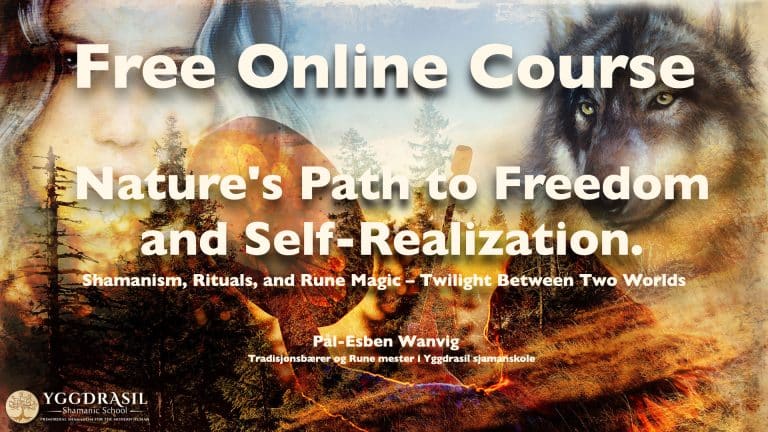
Nature’s Path to Freedom and Self-Realization
Curious about what primordial shamanism really is, behind the mystique and the misconceptions? In this short online course I tell the story of my own path from skeptical engineer to teacher of primordial shamanism, and give you a first introduction to what I teach: what shamanism and primordial shamanism are and are not, how rituals and rune magic are used in practice, and why the longing for growth matters so much for a good life.
The lessons are recorded in Norwegian; the English version will be ready in November or December 2026. Leave your email on the course page, and I will tell you when it is.