Episode 45 – Everything Moves in Cycles – How Do We Meet a Changing World?
When the thermometer in Pål-Esben’s office in Germany passed 30 degrees this summer, he didn’t wish the heat away. He decided to install air conditioning. Amina, who once disliked sunny days and worried about bills, learned to ask herself whether she could live in a tent if she lost her flat, and found that she could.
In this forty-fifth episode, Amina and her teacher and guide, Pål-Esben Wanvig, talk about the long cycles of nature and how to live in step with them. They explore the 100,000-year cycle seen in the ice cores, the first chakra syndrome that turns people with other opinions into enemies, how to meet a warmer world without fear or suffering, and simple tips for the hypersensitive, from slow breathing to citrine. It is part of “The Journey to Self-Realization”, a podcast about the bravest journey a human being can set out on: the journey home to yourself.
This episode is an English translation of our Norwegian original, voiced by the digital avatars of Pål-Esben and Amina.
In this episode
- Opinions as tools rather than identity, and why the climate debate splits people into friends and enemies
- The cycles in nature and in the body, the solar cycle, the wobbling spinning top and the 100,000-year cycle seen in the ice cores
- The first chakra syndrome, the construct and the false identity, and how imprinting makes us identify with our opinions
- Mother Earth’s blueprint rhythms versus our rowdy music, and why the small rhythms come before the long cycles
- Facing the fear of change, Amina’s way out of anxiety, and practical adaptations to a warmer world without suffering
- Becoming a master of change, AI and robots, and riding the crest of the wave with Laguz and Wu Wei
- Tips for the hypersensitive: slow breathing, Bach flower remedies, aromatherapy oils and a cleansed citrine
- Why the right help makes you independent, and a cliffhanger about the next topic
This podcast is for you if you:
- Seek real depth in your spiritual practice
- Want to understand yourself on a more fundamental level
- Are curious about shamanism but tired of superficial “new age” spirituality
- Have taken many alternative courses but still feel that something is missing
- Feel an inner longing for freedom, love and wholeness
In a time when so many get lost in external methods and promises of quick fixes, this podcast invites you back to the only place where true answers can be found: your own heart.
Listen above, or read the full conversation below.
Transcript
A warm welcome to the podcast “The Journey to Self-Realization”, a primordial shamanic journey of development back to your true nature. This podcast is a collaboration with our favourite magazine, the health and lifestyle magazine Medium, and is devoted to exploring the bravest journey a human being can set out on: the journey home to oneself. We follow Amina, a student at the Yggdrasil Shamanic School, as she goes through a deep primordial shamanic process of development together with her guide and teacher Pål-Esben. It is a raw, unpolished journey of discovery towards true joy in life, deeper meaning, and a life that truly feels good to live.
This episode is an English translation of our Norwegian original, voiced by the digital avatars of Pål-Esben and Amina.
Pål-Esben: A warm welcome to a new episode, Amina.
Amina: Thank you so much, and likewise, Pål-Esben.
Pål-Esben: Thank you, Amina, and a warm welcome to you, dear listener. Today we’re going to continue a little with the topic we opened in the previous episode: a pretty harsh topic that many people have emotional views about. Namely, that the global warming we’re experiencing now, and the extreme weather we’re experiencing now, isn’t mainly man-made. The warming has only been brought forward by a hundred or two hundred years through human beings and their carbon dioxide emissions. And that’s a pretty radical statement in the society we live in today. Isn’t it?
Amina: It is. Yes, especially when we’re so preoccupied with the idea that we’re the ones who have destroyed the planet, and that we have to do everything we can to save it. And as we touched on last time, it’s a good thing to do everything we can for Mother Earth. But everyone thinks that everything is our fault.
Pål-Esben: Yes. And it’s the same with the claim, in Norway at least, that electric cars are more environmentally friendly than diesel cars. Research doesn’t quite show that. But we’re not going to touch that topic, because then we’ll be completely swamped with negative comments here. Because you’re not allowed to say that.
Amina: Not yet, at least.
Opinions as tools, not identity
Pål-Esben: Not yet. But let’s skip that topic, because it’s very controversial. In our podcast we share our thoughts on this and that. That doesn’t mean our thoughts are what’s right, but we have our experience and our ideas, based on the experiences a shaman gathers when going into deep contact with Mother Earth and nature’s healthy rhythms. That’s what we’re trying to discuss here, and now and then our ideas or opinions are controversial. And that’s OK.
I think that as a society we should perhaps be a bit more open to other people’s thoughts, and not condemn them out of hand if they’re different from our own. Unfortunately, in our society we’re far too identified with our opinions, instead of seeing them as a tool. I think our society would be much more peaceful if we could discuss our opinions with each other in a healthy and loving way, instead of what we often experience today: that you’re either a friend or an enemy, depending on whether you share my opinions or not.
Last time we stirred up the first hornets’ nest, when we talked about how the extreme weather we have today is of course connected to the temperature in this world rising and rising. I don’t think any researchers contradict that particular point. When the Earth’s temperature rises, one of the consequences is that the weather often becomes more and more intense and more and more extreme, in temperature as well as in storms, hurricanes and rain.
Everything moves in cycles
Pål-Esben: What we discussed and started on last time was this: Is it man-made? And as we see it, the human part is only a tiny part of why we’re starting to get higher and higher temperatures. To understand what we mean, we need to see that everything moves in a cycle. When we as shamans observe Mother Earth, we see that absolutely everything has a cycle. If we look out at nature, we see that it isn’t winter all year round. We have winter, spring, summer and autumn, and everything moves in a cycle, over and over again.
If we look into ourselves as human beings, our bodies are also continually moving in cycles. We have the female cycle, which is one of the most archetypal cycles, but we also have cycles in our chemical and biological systems. Some are very, very short and last a few milliseconds, as in our nervous system. Others take a bit longer and have to do with insulin and sugar and balance. These short rhythms, the ones shorter than 24 hours, are called ultradian rhythms. Then we have the ones we perhaps know best, the circadian rhythms, which last about 24 hours: the cycle of day and night, which repeats itself all the time. And then we have longer rhythms, infradian rhythms, which can stretch from a day and up to millions of years.
And as an astrologer, you also know the longer rhythms we’re subject to. Could you say a little about these longer cycles and rhythms that the planet and humanity are subject to?
Amina: I’m not quite with it on this one.
The solar cycle and the spinning top
Pål-Esben: Then we’ll help each other. In astrology, for example, we know that there’s something called the solar cycles: how the sun’s energy and radiation vary over about 11 to 12 years, from massive radiation down to a minimum. That’s what we call the solar cycle. And of course we human beings here on this planet depend on the intensity of the energy radiating out from the sun. It follows what’s called an 11-year cycle; the length perhaps varies between 10 and 12 years. Of course that affects us too. It affects our environment, how much light and energy plants and grass receive, the growth of our crops, and so on. That’s something everyone knows.
Then we also have longer rhythms, and one of the most interesting is the one we talked about last time: the cycle of about 26,000 years. We talked about the spinning top. When you set a spinning top going, it starts to wobble towards the end of its cycle. That cycle lasts about 25,800 years, which we simplify to a cycle of about 26,000 years. It has to do with this spinning top, which also affects how much and how intensely the sun affects the planet. And in astrology it’s called, what’s it called again? Axial precession, is that what it’s called?
Amina: I think so.
Pål-Esben: That’s the dyslexic in me. I never remember these names.
Amina: No.
The 100,000-year cycle and the ice cores
Pål-Esben: So that also plays a part in affecting the temperature and the environment on this planet, and there’s nothing esoteric about it. But last time I think we used another name, and that cycle isn’t 26,000 years; it’s 100,000 years. It’s connected to the elliptical orbit the Earth follows around the sun. The shape of that ellipse slowly changes, and one complete cycle takes about 100,000 years. At one point in the ellipse we’re closest to the sun, and at another we’re furthest from it.
Through ice drilling, where researchers drill in Antarctica and in large glaciers, they can now go back several hundred thousand years, to when the ice was formed. There they’ve found that the cycles affect the temperature in this world. And many have come to the conclusion that it’s mainly the 100,000-year cycle plus the 26,000-year cycle that make our planet swing between ice ages and extreme temperatures.
I find that very interesting to observe. If we human beings and everything in our nature move in cycles, from the hormonal system to the seasons, it would be strange if there weren’t cycles in larger contexts too, affecting our lives quite extensively. And when you look at the figures taken from these ice cores drilled deep in glaciers, you see a very, very interesting relationship between how much carbon dioxide there is in the atmosphere and the temperature. The curves show that roughly every 100,000 years we have a peak in heat and carbon dioxide. Then it goes down towards the ice age and becomes freezing cold, and there’s much less carbon dioxide. And then the carbon dioxide and the temperature rise again, for seemingly magical reasons. They really aren’t magical at all, since it’s first and foremost the 100,000-year cycle and the 26,000-year cycle that are in charge. That’s how the cycle of about 100,000 years goes. There’s absolutely nothing esoteric about this, because all you have to do is go on the internet and look for these ice cores, which cover the last 800,000 years, and you’ll see it.
Which leads: carbon dioxide or temperature?
Pål-Esben: Another interesting thing we see in these curves is that carbon dioxide normally lags a little behind. These samples show that first the temperature rises, and then more and more carbon dioxide appears in the atmosphere. In our society now we’ve turned this around a bit. Because humanity, especially in the last 100 years, has considerably increased the carbon dioxide in our atmosphere through its emissions. So what we’re seeing now is that carbon dioxide, for the first time in at least 800,000 years, is rising a little before the temperature follows. That means the only thing humanity has done through its emissions is to bring the warming process forward by perhaps 100 or 200 years.
These things are very easy to check. If you go on Google, or use your AI or whatever you have, all these figures will come up. That’s why I wonder when I see the discussions in society today, where large groups insist, en masse, that human beings are the only reason the temperature in this world is rising. And they get so heated towards everyone who says: “No, humanity is only a small reason why the temperature is rising now.” Now, I’m not on the internet following these things, but you’re a bit more up to date than me?
Amina: I may be a bit more up to date than you, but I don’t dive down all those rabbit holes any more either. But of course I pick up a bit of this and that. Not that long ago I was on a course that runs four times a year, about what’s happening in nature. There was a big focus on this there, also in connection with bird species that are disappearing, and all the impact human beings have on the Earth. So there I got an insight into it. The marine biologist who spoke was working on something called ecophilosophy, or something like that. It was very exciting. He was very focused on the idea that human beings are really parasites on the Earth. We’re not really needed in the ecosystem, but we think we rule and can steer and arrange and destroy everything we want. And of course there’s a grain of truth in that, in the fact that we rule and steer and arrange and plunder. Or, not plunder, but not everything we do is all that kind to the Earth.
The divide in the climate debate
Amina: There was also a big focus on climate change, and we had a visit from a very active climate activist, so of course I got involved in it too. But I’ve also thought that I can’t throw myself into every battle. I have the things I’m working on, so there’s a lot I don’t know about these things. But I know that it creates so much division, as you touched on earlier: I think this, I think that. I noticed that in the room too when the climate came up. People didn’t like each other after a discussion, because they identify so much with what they think.
But it’s about being open to the possibility that it may be a little different, and asking yourself: Why do I really think what I think? Do I think it because I read something somewhere once? Did someone tell me? Is it an imprint from my upbringing? I often ask my children that when they have very strong opinions about political parties or something or other. Why do you really think that? “Well, no, it just is.” Yes, but who told you? “Well, it was Dad, or it was my aunt, or it was the teacher.” Yes, but maybe dive into the topic and see what you yourself think, to form your own opinion. But there’s probably a lot of exciting stuff out on the internet that I haven’t dived into.
Pål-Esben: Yes, that applies to all of us. But it’s part of the discussion we’re having now: Why do we see others who have different opinions from ours as enemies? Why on earth do we get so worked up when others have different opinions from ours? We have no problem with people believing that the only reason the temperature is rising in this world is human beings. We have no problem with that. But that isn’t quite what reality is like. And it’s actually very easy to prove that it isn’t reality, through physical evidence like these ice cores. What’s more interesting is why this is so controversial, why this keeps getting so aggressive.
As we talked about last time, we fully agree that we have to take care of Mother Earth, that pollution must stop, that we have to clear nature of plastic and rubbish, and try to live more ecologically and more in step with nature and Mother Earth. That’s a fundamental part of our basic philosophy. It doesn’t contradict what we’re discussing here: that the main reason for the temperatures we have now, which are rising and will become more and more extreme over the coming years, lies in the cycles. It rises until we reach the peak in a certain number of years, when the weather will probably be very, very extreme, and then it turns downwards. Through this 100,000-year cycle we glide further away from the sun, and the tilt of the Earth, this wobble, works together with it. Then it simply turns, and it automatically gets colder and colder, no matter how much human beings have put into this atmosphere. It’s just part of the rhythm, because this has been going on for millions of years, since long before human beings were even thought of.
When opinions become taboo
Pål-Esben: So it’s about accepting that you can hold an opinion, or see it this way, while still saying that the environment is important. And that’s how it is with many topics for us human beings. We just touched on electric cars here, which I didn’t want to go into this time, because then people around us might become completely hysterical, and we don’t want that.
Imagine, for example, saying something negative about vegans: that you know a great many vegans, and that most of them get ill when they live as vegans over time, simply because they can’t get the right nutrients. Then it ends in hysteria and fury. We find the same thing in religion. If you have a religion that you know a lot about, and suddenly come across someone who has a different religion, it’s war, because you have different views. And that’s what I find sad.
Amina: Yes, there’s even war within the same religion, even when people just believe two slightly different things. There’s almost a bigger war between different branches of Islam than between a Christian and a Muslim. That’s pretty outrageous. And not least this thing that has been in the media a lot, not now, but earlier: journalists and others who have been killed because someone drew a caricature of the Prophet Muhammad, for example. That’s pretty insane.
The first chakra syndrome: friend or enemy
Pål-Esben: It’s pretty radical. And in esoteric terms you can call this the first chakra syndrome. The first chakra is connected to the very bottom of our tailbone, the very bottom of the spine. It typically has to do with survival, and everything necessary for survival: protection, flight and so on. When the first chakra isn’t quite in tune, not radiating in a fully healthy way, a human being will almost automatically have problems relating to opinions that differ from their own. So the first chakra syndrome is when a human being puts people in the friend box or the enemy box, depending on whether those people agree with them or not.
If we look at our society today, it’s full of the first chakra syndrome. Almost no matter what topic you come across, people put you in the friend box or the enemy box, depending on whether you agree and share the same opinion and view as them. And when we enter a profound primordial shamanic process of development, which is really the main topic of this podcast, we look at these things very, very early. Because they belong in the category of self-regulation, together with the 7 Golden Keys, a topic we’ll take up on another occasion. All of this comes before the 9 Pillars for Finding the Path of the Heart. Because if we don’t clear up and work through certain fundamental topics, it becomes terribly difficult to start being a forgiving human being, for example.
And it isn’t a person’s fault that they have a first chakra syndrome, that they put people in the enemy box or the friend box depending on what those people think. It’s something that has been imprinted and has become part of the human being through the society we live in, and through how we’ve grown up and experienced our lives. So it isn’t a person’s fault that they have this first chakra syndrome. But when someone starts a profound primordial shamanic process of development, we need to look at these things that create constant suffering in a human being’s life. And here there’s one thing that definitely creates a lot of stress and suffering: when this first chakra syndrome runs on autopilot, and you just react without thinking about these things. How do you then think you’re going to become a master of forgiveness, for example, if you don’t clear these things up first? And for that there’s a process you go through.
First, you need to become aware of why this is a problem: why we human beings have been trained to identify with our opinions and thoughts, and why there’s this constant conflict in society between different groups with different opinions. Then you have to make up your mind. Do you think that living a life like that is a good and loving and peaceful life? Or do you want something else for yourself? Do you want to have peace, and to recognise that other people’s opinions, and your own, are only a tool, and nothing you need to identify with?
And that’s the problem here. The problem isn’t that people have views, opinions and belief systems, but that people on autopilot identify with their belief systems and opinions. That means that if someone says something negative about my opinion, they’re saying something negative about me. That’s the problem here. And that’s how a human being is imprinted into their false identity and the construct. We talked a great deal about that in earlier episodes, when we talked about the primordial shamanic path to oneness and spiritual enlightenment. And it’s this identification that’s the problem.
And just try this, dear listener, if you’re feeling a little brave. Notice over a day or two or three, when you come across people or situations and react negatively, and think it through: Was something said that contradicts my belief system? If so, why do I identify with that belief system? Why do I think that belief system is me? Questions like these are the beginning of dis-identifying from your opinions and your belief systems. Instead you can do what the ancient Greeks did when they discussed things. Their opinions were a tool they brought into a discussion, where the goal was to create an even better tool. That is, even better opinions. What do you think about this, Amina?
Amina: First and foremost I think that for the ordinary man in the street who wants to dive into this, a question can quickly come up: “OK, if I’m not my thoughts and opinions, then who or what am I? And how do I keep working with that?” Because that’s where you might get a bit stuck, perhaps?
The construct and the false identity
Pål-Esben: Yes. And if you’ve been with us in the episodes where we talked about Atman and Brahman and the construct, this is a typical example of how the construct shows itself in humanity’s daily life. The construct consists of the intellect, of what we identify with, of our ego, our memory, our experiences, our traumas, everything we carry with us. All of this we call the construct. When we come into this life, when our soul comes into our mother’s womb, and when we pop out, we’re still very close to our soul. Our true identity, which is connected to our soul, is still very accessible to us. That’s true even though our brain hasn’t yet developed to the point where it can share with other people what we feel and experience; that comes later. And then what happens? Well, Mum and Dad and auntie and uncle and everyone around us begin this fantastic process of imprinting.
A little coffee break
Pål-Esben: Thank you very much, my wife. I’m lucky enough to be served coffee here, so I don’t fall asleep. I’m only joking. The imprinting starts very, very early. But now and then I need a little organic coffee. A very special kind of coffee that I use, which doesn’t have any, what’s the word again? Is it mould?
Amina: Mould, yes.
Pål-Esben: The problem with most of the coffee you can buy isn’t the caffeine, but that it often has a lot of mould in it, which spreads in the body. So I’ve found a very special coffee that’s free of mould.
Amina: What’s it called, then?
Pål-Esben: It’s lovely. It’s called Danger Coffee.
Amina: Danger Coffee?
Pål-Esben: Yes, Danger Coffee. A guy called Dave Asprey made it, the man behind Bulletproof and the Bulletproof Diet. But this Danger Coffee, you see: whole beans, which you grind yourself.
Amina: Wow, so … Does your pulse go up?
Pål-Esben: My pulse doesn’t go up. With other coffee my pulse goes up. No, this one is completely balanced. So I have my little cup. Look at this, now we’ve wandered completely off track.
Amina: Yes, yes, but it’s quite nice to have a coffee break.
Pål-Esben: It’s so lovely. With a little stevia.
Amina: With a little stevia, yes.
Pål-Esben: In the morning I have a little cup like this, and I get a happy little shiver down my spine. It’s so lovely.
How the construct is trained
Pål-Esben: OK, so we were talking about the construct. We’re not going to discuss the whole theory of the construct, but it begins to be trained when your parents, uncle, aunt and the people around you start saying: “That’s a man, that’s a woman. That’s good, that’s not good. This is how we do things in our family, this is what we don’t do. That’s a friend, that’s an enemy.” That’s when this construct begins to be trained, with opinions and belief systems. Gradually we begin to identify with that belief system, which is really our false identity. And as this is imprinted, the human being believes they are their false identity. They believe they are their construct, they believe they are their thoughts, their feelings. This is what leads to the enormous problem of identification humanity has with its opinions, thoughts and belief systems. And I’m talking about humanity here, since pretty much everyone in modern culture has had a very warped construct imprinted. Compare that with how this was done in indigenous cultures like the Aboriginal Australians, who were still in close contact with the natural rhythms and cycles. They stayed in step with them.
Then we come to our modern human being, who has this construct. They believe they are their thoughts, what they think and feel. And when someone else says something different, they explode. They go completely bananas, like a proper monkey, and then they get on Facebook and write all this drivel. That’s the modern primate, which is what we human beings are. That’s why this gets to develop the way it does. Because a developed human being, if we’re to use such a simple word for it, has come to the point where they grasp that they are not their thoughts and opinions. Those are just tools that change all the time, as we learn more, understand more and develop more. And you come to understand: if someone has other thoughts and opinions, it has nothing to do with you, and nothing to do with the other person either. It’s the construct that has some ideas. And when you get a bit further in this and observe how the constructs argue with each other, you learn to take a step back from the madness, which just gets worse and worse.
Mother Earth’s blueprint rhythms
Pål-Esben: But this is what we as shamans keep coming back to, and it’s the main reason I think every human being ought to learn more about what shamanism really is. And understand what Mother Earth really is. And understand what these rhythms and cycles really are. And gradually begin to live in step and in rhythm with them. We had an episode earlier in our podcast, at the start, where we talked about the cycles of the seasons and about observing Mother Earth cycling from winter to spring, summer and autumn. And we thought about how it is with us human beings, who have arisen from Mother Earth. Because everything you are, the water you consist of, the carbon atoms you consist of, everything you’re built from, hasn’t come out of thin air. It has come from Mother Earth, Maha Terra. All the building blocks you consist of, that is, all your rhythms, have arisen from Mother Earth. And that’s what we as shamans learn to see. We observe Mother Earth’s blueprint rhythms. And we understand that if our rhythms are to become healthy, if we’re to become happy, if we’re to become joyful, we need to learn to move in step with the natural rhythms again.
That means moving away from our rowdy music and our rowdy rhythms, which bring illness, depression, aggression, fanaticism and everything else that buzzes around in human beings. I describe it metaphorically as rowdy music blaring out of people, music that has nothing to do with healthy rhythms. It’s definitely no symphony orchestra. But when you go out to Mother Earth, out to the universe we live in, out to our solar system, out to our galaxies, out to these smaller and larger rhythms, and learn to move in harmony with that music, then life changes radically. Then your thoughts change radically. We gave an example, I think, in the episode where we talked about how people today want summer all day long, every day. Full throttle from morning to night. But what happens when you bring a little winter into your everyday life, a little spring, a little autumn, and the rhythm changes? Very fascinating. I find this hyper-fascinating to observe, but also so joyful when you reach the point where you can move in step with it. We notice it in our students, who often come to us with very chaotic music. As they go through the process of development, we see that the music and the rhythms change so radically and become more harmonious, which in turn means the person feels better. They don’t have so much anxiety, fear and aggression any more. Then you get more and more meaning and joyfulness in life. That’s connected to the rhythms and cycles we’re talking about now.
Amina: Yes, it’s been a steep learning curve for me too, understanding that everything is rhythmic, everything moves in cycles, and not least that everything is music. Seeing what situations I put myself in, what I eat, where I am in my cycle: all of this has an effect. But making contact with the healthy rhythms quite simply changes your life.
Pål-Esben: Yes. And to be able to step into the healthy rhythms, so that they become part of us, we first need to become aware of them. We first need to know that they’re there. Most of the people I come across who have nothing to do with these things look at me a bit oddly when I start talking about nature and healthy rhythms and music. They have no understanding or grasp of it, and they think it’s a bit loopy, that I’ve probably been smoking something: “What’s he talking about?” But when we bring them into the first experience, through forest bathing, for example, or through an utiseta meditation, where they begin to experience these things through our experience-based process, then suddenly they start saying: “Aha. Through my own experience, I’m now beginning to get an idea of what you’re talking about.”
And when we look at the rhythms that govern us, it isn’t only Mother Earth’s rhythms we’re subject to. We’re also subject to the rhythms of the planets around us, of the sun, of galaxies and so on. And there are more layers beyond our galaxies, and all of that has cycles and rhythms. Some cycles and rhythms are much more intense for us in the short term. Some run over the long term, like this cycle where the Earth moves in an ellipse around the sun, over hundreds of thousands of years. It doesn’t affect our lives straight away, but it affects our lives radically over time.
How do we relate to the long cycles?
Pål-Esben: And then the question comes up for people, as I see it: “OK, I understand how we can get in sync with the natural rhythms, spring, summer, autumn and winter. I have an idea of what it might look like when I bring that into my life. I have an idea of what the natural rhythms of Mother Earth and the forest are. I have an idea of what happens to me when I sit out in the forest and make contact with them. But Pål-Esben and Amina, how am I supposed to relate to a 26,000-year cycle and a 100,000-year cycle? We’re now beginning to feel their effects, as the temperature on our planet rises and more extreme weather and extreme temperatures appear. How am I supposed to relate to that?” That’s what I’d like to talk a little about today.
Amina: Over to you.
Pål-Esben: Did you just say “over to you” to me?
Amina: Yes.
Pål-Esben: We’re only joking here.
Amina: Yes, yes.
Pål-Esben: So how do we do it in practice? As I see it, and you can come back with your ideas here, Amina, it somehow starts with an understanding of what reality is. How are we supposed to handle our own first chakra syndrome, this friend-or-enemy syndrome, if we don’t know it’s there? The first job we have to do is to investigate a bit ourselves. And see: Is it really like that? Is there such a thing as a 100,000-year cycle? Is that how it is with these 26,000-year cycles? Do they have any effect on temperature and so on? Then you’ll find enough information, with these ice cores, to say: “Yes, there’s probably something there.” So that’s where it starts.
And then the question is: How do we come into harmony with these longer cyclical rhythms and adapt to them? It’s very difficult to adapt to and get in sync with bigger, longer rhythms, like the 100,000-year cycle, if we’re not in step with the small rhythms that run over 24 hours and a year, the ones we find in Mother Earth. So the work always starts with the smaller, more immediate rhythms of the Earth, and with seeing how we fall into step with them. And once we’ve begun to fall into step with them, the next question is: How do I keep in step with a world that’s becoming more and more chaotic in terms of temperature and weather, as a result of increased carbon dioxide and temperature? How do I relate to that? That’s our question here. How do you relate to it, Amina? What do you think about it?
Amina: The first thing I think of is perhaps buying some lighter clothes. That could be nice if I live somewhere where it gets very hot. A bit of humour there. But for my part, I feel that I have more and more trust in life, through my own process. I feel that I’m somehow in the right place at the right time. And I feel more and more that everything is OK. But that isn’t something you can just pass on to the ordinary man in the street. So maybe you have some tips and tricks there?
Facing up to fear
Pål-Esben: It’s an unavoidable part of a primordial shamanic process of development that you end up in the state you’re in now. But it requires a process of development where you’ve begun to touch the timeless and spaceless in yourself, and begun to uncover what you really are. Because then there’s absolutely nothing to fear any more. Then you know that everything is really perfect as it is. But you can’t say to the people you meet at the supermarket: “Everything is perfect as it is, so you can just relax and enjoy what is.” It’s meaningless. It won’t make any difference.
So the first thing we have to face up to is our anxiety and our fear that things aren’t the way we want them to be. Here’s an example. You think: “Oh God, now things are really going wrong with this planet. Everything’s falling apart. And now it’s getting hotter and hotter, what am I going to do? Because suddenly it’s 50 degrees Celsius even up in Norway, and then it gets so hot, and then everything’s a problem. Then things stop growing, and we’re hungry and have no food, and all these things.” That’s what you have to face up to first: this eternal uncertainty and fear that our construct, our false identity, has when things aren’t the way we want them to be.
It’s not much use wishing that this world won’t get warmer. It would be like spray-painting over rust. It’s like The Secret: sending a wish out to the universe that no, now we’re going to hold the temperature steady, and it’s going to go down. That’s meaningless, of course. Because the temperature in this world will rise much more than it has risen so far, until it reaches its peak. And there’s nothing we human beings can do about that. Of course we can bring this forward by 100 years, 200 years, and we can perhaps hold it back by 50 to 100 years if we make radical changes in how we deal with emissions and the environment and so on. Of course. But we’re only talking about 100 to 200 years here that we can influence. It’s coming regardless.
And once you acknowledge that, what you wish for doesn’t make much difference. However much you want the summer to be like this all the time, because “I like summer, I like swimming, I want it to be summer all year round”, you know that whatever you want, autumn comes, and after autumn comes winter, always. And spring definitely comes, and only then does summer come again. Whatever you think or feel, whatever you want, reality is reality, with its rules, its laws, its rhythms, its systems. And it’s only when we embrace them and accept them and make peace with them as they are that we can really begin to live a life that moves in step with them, and to live well and joyfully alongside them.
So the first thing is to look at your anxiety and your fear that things aren’t the way you want them to be. Now I’m talking specifically about temperature and weather and those things. War and all other things are a different topic for a different day. But let’s stick to extreme weather and temperature now. So number one is to look at your fear, and gradually understand where the fear comes from. The fear comes from the thought that things are going wrong, and from being afraid of that. That means you’ll be in an eternal struggle and an eternal fear as the temperature rises with every year that comes. So that’s the first thing we look at. When we start a process of development, we’re very observant in identifying where there’s fear. Because fear holds the heart back. It’s the clamp around the heart, it’s the prison of the heart.
Amina’s way out of fear
Amina: Yes, I’ve worked a great deal with these things. I’m someone who has had an extreme amount of fear, an extreme amount of anxiety. I had an incredibly strong resistance to change. Just four or five years ago, perhaps, I had a strong resistance to changes in nature too. I was someone who liked winter. When the sun started coming out: “Oh no, I don’t like sun, I don’t like summer.” Summer is nice, but it’s just too bright for someone who’s clinging on to the darkness, the destructive darkness inside. And a lot of fear around meetings or bills: fear about surviving in a great many aspects of life.
And I’ve worked a great deal on accepting the worst possible outcomes. That has worked for me, at least. I don’t know if it’s something you can advise others to do, but it has worked for me. Like this: “OK, if I can’t keep my flat, because I can’t keep up the mortgage, well, then I’ll have to live in a tent. Is that OK? Could living in a tent be OK?” It actually can. And here I’ve also had very great support and help in the primordial shamanic process of development, which has really helped, with the different rituals, the different forms of healing, with the runes and everything we’ve talked about before. So I’m probably very privileged on my path, having had so much good help and support, and not least from you.
But there’s also the fear of death: Can it be OK to die? But that’s taking it a step deeper. So the fear of change: Can that change be OK? There you could perhaps start with the small things in your life. You don’t need to start with the biggest natural disasters, but with the small things in life. OK: “Oh, I forgot to buy milk at the shop, it’s a crisis.” But can it be OK? Can we make a different sauce? Just a trivial example. But starting with the small things in your life might be a good way to begin.
Pål-Esben: Yes, definitely. And for the bigger things it’s always wise to have someone who helps: a therapist, or a guide, a teacher, a mentor, who knows what they’re talking about, and who can guide us through. Because one of the most challenging steps in a human being’s process of development is handling this anxiety and fear of uncertainty. We’ve talked before in our podcast about primal anxiety, where everything starts. But that’s the first thing we look at: handling the anxiety that things aren’t the way I want them to be. Handling the anxiety about uncertainty, that you don’t know what it will be like next year, or in five years or ten years. The truth is that not a single soul can know what this world will look like in a year. Or in ten years. Or in a hundred years. Absolutely no one. It’s something that will play out on the basis of the choices humanity makes, both individually and in groups.
But what’s also important to see is that humanity and human beings in themselves are incredibly inventive. In the previous episode you asked, I think: “What happens when there’s an ice age? Do all the people die?” Well, there have been groups of people on this planet, and we’ll come back to them later, who survived the ice age without any problems. We’ve survived extremes, extreme tsunamis and so on, by living in underground cities and in the mountains. We’ve had cities with more than 10,000 inhabitants, the lot. So humanity is fantastic at surviving if we just use our energy on things other than war and oppression. So I always have hope on behalf of humanity, since we’ve seen before, a long, long time ago, that this is possible.
Practical adaptations without suffering
Pål-Esben: When it comes to us individually: How do I relate to it getting hotter and hotter? Here in Germany it was baking hot this summer. When it starts getting to 40 degrees and more, it’s no longer enough that I live in a house of oak and clay. After a week the temperature rises in here too. Then it was more than 30 degrees in my office, and I sat there panting. Then I thought: “OK, that’s fine, Pål-Esben. So what do I do to find a solution to this?” Well, I install air conditioning.
Amina: Have you done that now?
Pål-Esben: No, things take a bit of time. But I’ve made the decision that even in our house it’s now time to start planning air conditioning. A heat pump, which both heats in winter and cools in summer. A practical thing. I have to deal with it, because it’s definitely not getting any colder. Another thing, which we touched on last time: Maybe you don’t settle near a river that floods regularly. Maybe you go a bit …
Amina: Or buy a holiday cabin there.
Pål-Esben: Or buy a holiday cabin there. If you’re going to move and live somewhere, maybe you focus a bit on thinking: “OK, what happens when the water rises a metre or two? What happens when this floods extremely? How do I live in a smarter place, for example?” And so on. What do I need to do to adapt to what is, without suffering from it? We’re talking about taking active steps here. Because if you’re passive about this, you’ll just be dragged along and often suffer from what’s going on. But if you’re active in your choices, you ask: “How do I first relate emotionally to what’s happening? Do I accept what’s happening? And what practical choices do I need to make to relate to what’s happening, without having to suffer from it?” Because nobody says that you have to suffer from the changes that are happening.
Amina: Yes, because what’s going to happen is going to happen, whatever it is.
The art of becoming a master of change
Pål-Esben: Correct. That’s the point here. Whatever you want or don’t want, it will happen. The question is: Are you willing to adapt and live in step with the changes that are happening? That’s why, as far back as 20 years ago, I began teaching my students the art of becoming a master of making changes, and a master of adapting to developments that happen, for example in society. The problem, if you’ve never learned how to make effective changes and effective adaptations, is that our false identity and the construct and the ego and co. say: “Oh no, I’m holding on to what is, at any price, because I fear change. I fear adjusting.” So I think a human being who understands these things thinks: “Wow, if I become a master of making effective changes and adaptations, that could of course mean a great deal for my life.” That was the reason I ended up writing the book on the 7 Golden Keys. It describes exactly, in a way you can read in a couple of evenings, how you can become a master of making these changes in a joyful and meaningful way. And even today, all that time later, I see that this is still the most important skill a human being needs to learn, in my eyes. And it’s actually very simple to learn; it isn’t anything complex. Perhaps we’ll have an episode a little later, when we’ve finished answering all our listeners’ questions, where we go into exactly this: how, in a practical way, you become a master of making changes.
Because in the society we live in today, there’s a need for a completely different kind of process of change and adaptation than a hundred years ago. Today everything is changing. If you’re an accountant or a lawyer today, or have another profession like that, you have to expect that in five or ten years AI will do all these jobs. And if you have an office job like that and aren’t already actively learning how to use AI as support in your work, you’ll come to a point where you fall behind and have a big problem. It’s an enormous process of adaptation and change that people have to go into. Whether they want to or not. If they don’t want to, they’ll have a problem. Those who actively do it will always be the winners in this.
And AI isn’t something negative. It’s something that can help humanity. But with the development, and the new technology that’s coming, we’re now very close to robots becoming available in people’s homes. Then you get a sense that certain things will change much more radically than in the last 10 to 15 years. And what happens when the robots come out into society, when they start taking over much of the manual work people have done? I’m looking forward to having a robot gardener here. That must be my dream: a Tesla robot on its knees in the garden pulling up my weeds. Or coming in here and serving me coffee when I need it. My Danger Coffee.
Riding the front of the wave
Pål-Esben: But I have a brain and a pattern in me that sees development and change not as something negative, but as an opportunity. I try to seize the opportunities, and then I keep trying to adapt to the opportunities life reveals to me. Ever since I started teaching when I was little, and especially when I was 16 or 17 and became a taekwondo instructor, I’ve constantly tried to become a better educator. A better guide. I’m always looking at how I can help my students and clients get even faster and better results in less time. That has been in my head all the time, and it means I develop as an educator, teacher and guide, continuously and radically fast, month by month.
Because it’s part of me. In the old days it was done the hard way: dragging people to weekend seminars, at hotels. Once a month they had to travel and spend money, and then they sat in a hotel or a seminar room while you talked to them, which is one of the most ineffective ways of teaching anything. And then you think: “There must be a more effective way of helping people in their process of development. It must be possible to do it better than this.” It’s pure Stone Age. I remember that already back in 2001 I had my first telephone conference from the bonnet of my Mustang in Los Angeles, after I’d been at a big event where I stood and spoke in front of ten thousand people. I sat there with a GSM phone, as it was in those days, with some kind of audio conferencing system, because video didn’t exist yet, and people back home in Norway had dialled in. That was my first experience of doing such a big broadcast by audio conference.
And by then I’d already worked with Telenor, the Norwegian telecoms company, on connecting several homes in the ISDN system, so that I could teach my students. As early as 1997 I was sitting with several ISDN phones linked together, six, eight, up to sixteen of them, and taught. And at the start of the 2000s came Voxwire, the first video conferencing system I had. I started teaching with it as early as 2004 or 2005, I think. Then I sat there with my ISDN lines, four ISDN lines I connected together, and taught my students between the live seminars. And I saw how much more effective it was to prepare people with exercises beforehand, and then we met and practised at the live seminars. Over time it has developed so that today we have pre-recorded modules, which the student goes through at their own pace, and where you and I, as guides, and the other teachers at the Yggdrasil Shamanic School guide the person through them. It’s definitely the most effective way I’ve ever seen to bring people through a process of development at lightning speed. And I’m already five years ahead of my time in what I’m doing and running now.
Amina: Yes, so what do we do then?
The river of life, Laguz and Wu Wei
Pål-Esben: Well, we can wait and see. But it has nothing to do with me being a better person or a smarter person. It’s because, for as long as I can remember, I’ve been in contact with these rhythms we’re talking about. For me it’s like a feeling, in how I teach, as a teacher and guide and mentor. Also when I created the companies I had before I started with shamanism, I always had a feeling for what it’s like to be at the front of the wave and surf at the front of the wave. I’ve always been exactly at the front of the wave, whatever I’ve done, through a feeling I’ve had, an inner state. I’ve never been behind the wave or ahead of the wave, but right on the crest, on my surfboard. It’s a feeling for timing that comes from being in deep sync with the natural rhythms. And you notice that in your life too. In our tradition we call it the river of life, and it’s deeply connected to Laguz and to the Taoist concept of Wu Wei, which we’ve talked about. It’s a feeling for timing, flowing with these natural rhythms. And when we human beings learn to flow with these rhythms, in this river of life, in Wu Wei, in step with Laguz, dharmic synchronicity arises. Then things are arranged for us in the most perfect way, in ways we often couldn’t even dream of before we did this.
That’s how I’ve lived my life since I was 16. Along the way I had a couple of rounds of burnout, because my construct and the primate took over and led me into it. But even then I was in sync with these rhythms, in terms of being in the wave; the construct just took over a bit too much and got a bit too much power. I wanted success and wanted to earn lots of money, all those things we dream of when we’re young. We all wanted to be millionaires, the whole gang. And gradually, of course, when I grew up and began to understand things, it became completely meaningless; it hasn’t had anything to do with my life for the last 20 years. But that’s how it once was.
So what we’re talking about here, Amina, is this: when we learn to get in sync with these rhythms, which are so many and so fascinating, radical changes also happen in life as the process of development unfolds. Isn’t that so?
Amina: It is, definitely. I notice it myself more and more, how much smoother life is to live, and how things fall into place more. Not necessarily from the intellect’s point of view, but the waves get smaller anyway. It isn’t so challenging to ride them. I’m still in a process myself and learning more and more about this with every day that passes, and I’m definitely not done learning. But what I can say is that it’s a pretty joyful way to live. And I notice that in the periods when I can really surrender to the rhythm of life and these waves, and not resist it, I live much better. Whereas the times I resist it and try to fix and steer and arrange things, I end up suffering. So there’s been a lot of wisdom I’ve drawn from those periods of suffering too, which has been important.
Pål-Esben: Yes, there’s a lot that’s important there. However we’ve lived our lives, our experiences are important. And no time is wasted; from the soul’s point of view, no time is wasted. But we can all come to the point where we ourselves take the helm and control of the sail in our boat. That’s what we’re talking about here. Instead of just drifting with the boat on the sea and letting the winds and currents steer where you end up, which is following the construct on autopilot, you take back more and more of the power over your own life. And then you can increasingly design this meaningful and joyful life we’re discussing. So, I think I’ve been very enthusiastic today, and when I am, I talk very fast.
Amina: It’s fantastic.
The perspective we choose
Pål-Esben: But this is something very close to my heart: being able to help people experience these rhythms and learn the process of moving in harmony and in step with them, instead of fighting against them. That goes whether we’re talking about the rhythms of the seasons, or about hundred-thousand-year rhythms, or whatever rhythm we’re talking about. Because the rhythms and cycles are what they are, whatever we want or don’t want. And I think that if we learn about them, and learn how to find their music and bring it into our lives, it makes an exceptionally big difference to how we experience our lives, and not least how we experience the world we live in.
I experience the world we live in as the most beautiful and fantastic place of all places. I’m proud every day I get to wake up and smell the grass and touch my birch tree, and I’m totally thrilled to get to live in this wild, exciting and beautiful world we live in. That’s one perspective to see it and experience it from. And then you can experience it like others do: “Oh God, there’s war and strife and all this, everything is terrible, it’s all going to hell.” It’s a very specific life you live with that way of seeing it, compared with a life like the one I live. Does that mean I ignore that there’s war? Does that mean I bury my head in the sand and say I don’t want it to be like that? No, it is what it is. And there’s nothing I can do about it. What I can do something about is inspiring those who want to listen to me, and spreading my light to Amina, and to you, dear listener, and everyone else. That’s what I can do. That’s what I focus my attention on. And that’s pretty joyful in itself: seeing those people wake up.
I just had a conversation with one of my students. Once a year we have a retreat called The Primordial Shamanic Path to Oneness and Spiritual Enlightenment, which we hold in the mountains for a few days. And this student was there for the first time, and has just started on this primordial shamanic path to oneness. For me, having these conversations with people experiencing this for the first time is so wild and exhilarating. I get goosebumps all over seeing how radically life changes, almost overnight: how they see their life, how they experience the world and their family and all these things. And it happens time after time. So for me there can’t be anything more meaningful to do than being who I am, for better or worse, and trying to inspire as many people as possible. And I think the same goes for you and me. It makes us happy.
Amina: Yes, really. There’s nothing more joyful than exactly that: seeing people blossom.
Pål-Esben: And what I was getting at here is this: everything depends on the perspective from which we ourselves choose to see life, the world and the reality we live in. We can see it from a constructive, uplifting perspective, or we can choose to see it on autopilot from a very destructive perspective. And the good news is that you can choose your perspective yourself. But you can’t just change from the perspective of fear to the joyful perspective overnight. That’s what we call the first part of this primordial shamanic, profound process of development.
Tips for the hypersensitive: the breath
Pål-Esben: So, right at the end, I thought we’d say a few words to those who are hypersensitive. Because in the previous episode we touched on some of the challenges of being hypersensitive in this chaos we live in. And we thought we’d give you a couple of tips, if you, dear listener, are very sensitive and hypersensitive, or someone you know is. Now we’re talking a great deal about what has to do with emotional hypersensitivity, and what we can also call ESP hypersensitivity, that is, extrasensory perception. For example, you may have trouble being with people or sitting on the bus, you feel people’s energy, their thoughts, their feelings, and you feel weighed down by these things. Those are examples of hypersensitivity. And what’s the first tip we can give someone struggling with this? Because quite a few of our students come to us with these challenges. And if we’re just going to give a few short tips, and not go into a process around it: What’s the first tip, Amina?
Amina: Oh, right.
Pål-Esben: Something you can start doing today.
Amina: Something you can start doing today, if you’re hypersensitive? The first thing I think of is grounding, as part of it. And of course, I have several tools I could point to that I carry in my toolkit from the primordial shamanic process of development. Among other things, I’ve used citrine, the crystal citrine.
Pål-Esben: Yes, not to mention how we use the runes and all these things. But if you don’t have any of these tools: one of the things that makes you lose control in your hypersensitivity is that you’re not in balance with yourself. That goes without saying. So practising how to find your centre and balance is something everyone can start working on. How do we practise coming into our centre and into balance and becoming more coherent in ourselves? Well, we can practise that in different ways, and one of my favourite ways is learning to use the breath. One of the most effective ways of bringing ourselves back to centre, when we’re out of sorts, in an uncontrolled emotional state, is to use the breath.
You’ve probably heard that in the old days, if someone hyperventilated, if they slipped into hyperventilation, people used a paper bag held over the mouth and nose, so that they took in more carbon dioxide and almost passed out. That’s of course a meaningless way of dealing with hyper, hyperbreathing …
Amina: Hyperventilation.
Pål-Esben: Hyperventilation. No, that’s not how you do it. The simplest way, if you have someone struggling with hyperventilation, is to go over to them and ask them to put one hand on the lower part of their belly. Then you put your hand on top of their hand, and you ask them to breathe in time with your hand as you slowly move it in and out. Slow, balanced breathing, guided by you and the other person together, is the simplest way to bring them back out of this extreme state, out of the hyperventilation. But if you struggle with it yourself, not hyperventilation, but being unstable, then it’s about learning to use deep, slow breathing. In India, in Sanskrit, it’s called pranayama: how you use the breath for different things.
And here’s the key with slow, deep breathing. I mean a maximum of 70 percent; you don’t draw in 100 percent, but a maximum of 70 percent of your full capacity. When you breathe deeply and slowly, you activate the parasympathetic part of your nervous system, mainly the vagus nerve, which makes the whole system calm down. And to activate the vagus nerve with the breath in the best and simplest possible way, the key is to breathe out a little longer than you breathe in. They’ve found that this activates the vagus nerve and the parasympathetic, relaxing part of the body.
So here’s how you practise breathing through the day. You start by practising drawing the breath in for perhaps three seconds, and then breathing out for four or five seconds. You can do that at any time during the day. You can stop and breathe in, right up to where the breath naturally stops, and breathe out a little longer. Gradually you get up to breathing in for six seconds and out for eight seconds. With practice over a few weeks you breathe in for 15 seconds and out for 30 seconds. And experts do one cycle of breathing in and out per minute. If you’ve got up to 15 seconds in and 30 seconds out, you’re pretty much an expert. And then just a couple of breaths like that are enough to bring you into your centre and back to yourself.
But you have to practise this a bit. You simply start by lying down on the sofa, and then you breathe in and out, perhaps put your hand on your belly, and then you count one, two, three, four in, and one, two, three, four, five, six out. And then you practise gradually. And if you’re willing to practise and get good at these things, it’s one of the simplest, cheapest, easiest and fastest ways to bring yourself back to yourself and your centre. So that’s the first tip, which everyone can do something with. And you’ve probably noticed yourself what happens when you get control of your breathing. Most people breathe and hyperventilate in their chest all the time. Roughly how long is your natural breathing cycle now?
Amina: I don’t know. But I know that it has got much better, and that using the breath in that way works very well for me, not least if I’m lying on the grass or in the forest. Connecting to Mother Earth at the same time is a turbo boost for me.
Pål-Esben: So I’d guess your cycle is perhaps around a minute, in and out within a minute, and then you’re there. You don’t need to go to two or three minutes and things like that; that’s for the extreme ones. Some go even further, but that means training your lungs in some way, and that’s not what we’re after.
Bach flower remedies, aromatherapy oils and citrine
Pål-Esben: So number one is controlled breathing. Number two, which also has a very centring and balancing effect, is for example using Bach flower remedies, and especially Rescue Remedy. If you really have challenges with these things, you put a couple of drops of Rescue Remedy in your water bottle, or a couple of drops on your tongue. Or there’s also the Bach flower remedy Walnut, which is also very centring for the third chakra. Because uncontrolled hypersensitivity is also a third chakra problem. The third chakra is responsible for saying no and setting boundaries on these things, and it’s the guardian of the heart. That’s also something many people have had positive experiences with. And there are also aromatherapy oils, if you like them, organic oils of really high quality, like Young Living and doTERRA. I don’t mean the kind of stuff you buy at the petrol station, but proper oils, like lavender and this and that, which can help calm you down.
You talked a little about it at the start. A stone that has a very centring effect, especially if you hang it in front of the third chakra, that is, in front of the solar plexus, is citrine. And it’s spectacular. Then you need to get hold of a citrine that’s real citrine, since a lot of cheap citrine on the market is irradiated citrine, which isn’t citrine at all. Often when you go to an alternative health fair and buy a cheap citrine, a citrine for about 4 euros, I can almost guarantee you that you don’t have real citrine. Because citrine is one of the most expensive crystals you can get hold of; a small stone often costs several dozen euros. And you don’t need a gigantic citrine, but you do need one of very good quality, one that’s real citrine.
What you do is cleanse the citrine stone. And there are many ways of cleansing it. You can hold it under cold running water from the tap for about a minute; that will be a very good cleansing of the stone. You can lay it in the sun for a day, or under moonlight for a night, or you can bury it in the earth for a day and a night, or you can do energetic cleansing rituals for the stone. There are many ways. They have to be cleansed.
Amina: Will the different ways of cleansing it give a different quality of cleansing?
Pål-Esben: Yes, of course. But you use what you have available. And over time you’ll learn how to really do a deep, energetic cleansing of this; there are methods you learn. But to begin with, cold running water for about a minute is enough. And the stone has to be cleansed every day in the same way, since it absorbs a fair amount of low-frequency energy. Then you hang it in front of the third chakra in a cleansed, and preferably activated, state. Because normally rock crystals and ordinary crystals, which you buy in your crystal shop or from all the places online, are of course uncleansed, but they’re also in a dormant state.
Amina: How do you activate it, then?
Pål-Esben: Then you need to go into a shamanic process of development. At the Yggdrasil Shamanic School, for example, we have our own ways of awakening the crystals to their full potential. But for that you need an initiation process, and that’s a different matter altogether. So when you start with this, it’s important that you cleanse the crystal. If you have a real, pure citrine crystal, preferably of AA or AAA grade, and cleanse it, you can hang it in a pouch in front of the solar plexus. That will help balance this third chakra, and also take up some of the low-frequency energy coming towards the system, so that it doesn’t get straight into your body. So that’s a tool that can be used, as an example. And of course, as you said at the start, everything to do with grounding, hugging trees and all the grounding methods out there can also help. But the methods we’ve talked about now are ones anyone who wants to start experimenting with this can begin with straight away.
Seek help that makes you independent
Pål-Esben: And here I’d also like to encourage you. If you struggle with hypersensitivity and you suffer from it, there’s no shame in seeking help from a qualified healer, shaman and so on. But I recommend that you find someone who can teach you how to fix this yourself, and not someone who’s going to fix it for you. Because then suddenly you’re dependent on someone fixing it all the time. You have a problem, and then you have to go back again and again. Then you’re not independent. So find someone who can help you with how to do it yourself. That’s how I see it, at least. And if someone talks about protection all the time: we’ve talked about that before, and protecting yourself all the time only makes you weaker and weaker. That’s something we definitely don’t recommend here. We need to train our system so that it becomes strong enough, centred enough, balanced enough to stand like the oak in the storm. Then we’re there. So that was to close the loop on the previous episode, by giving you some tips as well, since we opened the topic of hypersensitivity last time.
Closing, and a cliffhanger
Pål-Esben: Well, this has been an exciting episode, as usual. We think it’s exciting, at least, and incredibly, incredibly important. So I hope, dear listener, that you’ll think a little about these things and ponder them a bit. Because it definitely makes a big difference to a person’s life whether they move in step and rhythm with the cycles, or see them as an enemy and a problem. That’s how it is. Do you have any words of wisdom to finish with, or anything else on your mind?
Amina: I’m thinking that in these last two episodes we’ve talked about how we’re in the middle of big processes of change, and how we take on these changes as best we can, and also understand why it’s so difficult to change. Here I’d really recommend ordering The 7 Golden Keys and starting to read it, because it can be a really, really big help in standing more firmly in yourself as a human being in the times we live in now, and in general, really. So that’s a recommendation to finish with.
Pål-Esben: And next time we’ll change rhythm again, and then we’ll get into a completely different topic, which many people will find both exciting and wild. Yes. Or shall we keep them waiting? I think we’ll leave it hanging as a cliffhanger. But then you as a listener might think that Wanvig and Amina have gone a bit nuts. Because then we’re going to move into a field that’s more spectacular and wild.
Amina: Yes, you can say that again.
Pål-Esben: I think it might provoke a few reactions. But it’s an incredibly exciting topic.
Amina: Yes, very, very.
Pål-Esben: It isn’t a heavy topic like the one we’ve been talking about now, which is a bit heavy. It’s a bit more of the wild and exciting kind.
Amina: Yes, we need a bit of that too.
Pål-Esben: Yes. And if you have questions you’d like us to take up in the podcast, we always appreciate getting them. Because next time we’ll start with the next question we’ve received from listeners who are wondering about this, let me say, very fascinating topic.
Amina: Yes, and with the questions we get from you, and requests for topics, we open up completely new areas. So here we can really go all out. We still have room to spend more episodes on questions you have, or topics you’d like to know more about. So feel free to write it as a comment on Spotify, or you’ll find us on Instagram and Facebook, or you can send it via our website, wanvig.no.
Pål-Esben: And Amina asked me not that long ago: “Pål-Esben, are there limits to what you want to discuss, or are you willing to discuss absolutely anything?” And I said to Amina: “Here the gloves are off.” I’m willing to discuss whatever it may be, as long as it lies within reasonable ethical bounds, of course. But I’m willing to discuss what my thoughts and feelings are. And so are you, Amina. So let’s shift gear next time.
Amina: Yes.
Pål-Esben: Then we’ll shift gear, and we’ll see how it turns out. Thank you so much for staying with us all the way, dear listener. We really appreciate your feedback, and a five-star rating on Spotify helps our podcast reach more listeners. And thank you so much for being here with me, Amina. I really appreciate it.
Amina: Likewise, Pål-Esben.
Pål-Esben: Thank you for being with us, dear listener. I hope you’ll join us again in the next episode. And until then: have a truly wonderful day, evening, night or morning, wherever you are listening from. Take care.
Outro
Thank you so much for listening to this episode of “The Journey to Self-Realization”, a primordial shamanic journey of development back to your true nature. We hope Amina’s story has inspired you to explore your own journey of self-discovery and development. Remember that the path from suffering to self-realization can be demanding, but with courage, patience and support from a competent guide, mentor, teacher or therapist, almost anything is possible. We wish you all the best on your journey, and we’ll talk again in the next episode.
The Journey to Self-Realization
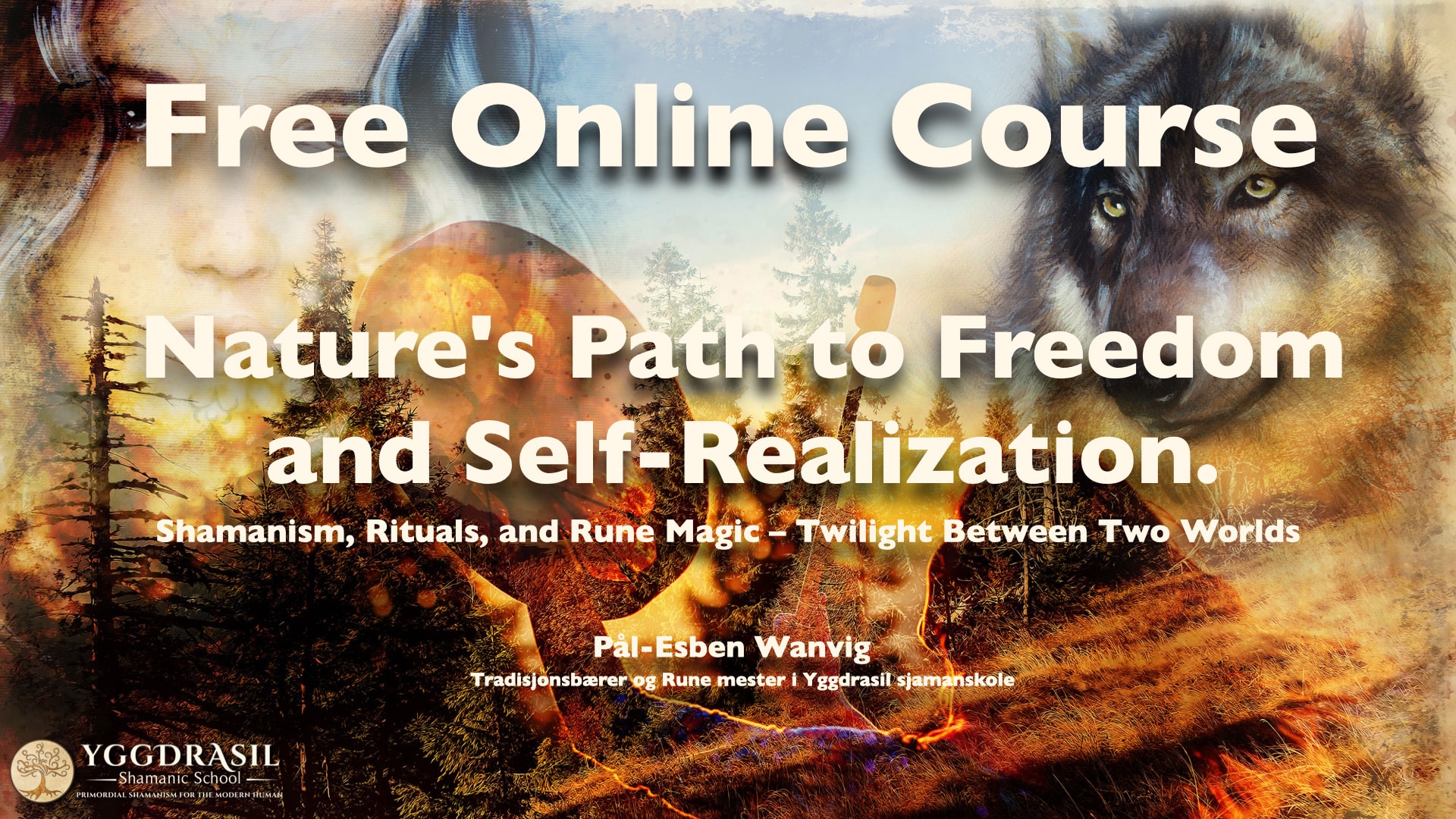
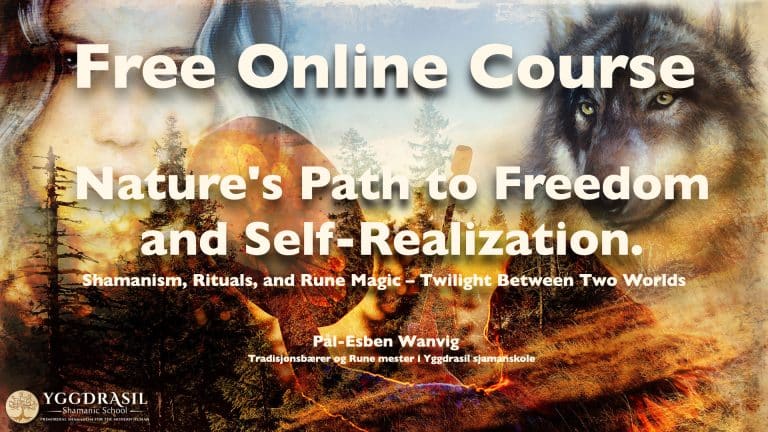
Nature’s Path to Freedom and Self-Realization
Curious about what primordial shamanism really is, behind the mystique and the misconceptions? In this short online course I tell the story of my own path from skeptical engineer to teacher of primordial shamanism, and give you a first introduction to what I teach: what shamanism and primordial shamanism are and are not, how rituals and rune magic are used in practice, and why the longing for growth matters so much for a good life.
The lessons are recorded in Norwegian; the English version will be ready in November or December 2026. Leave your email on the course page, and I will tell you when it is.