
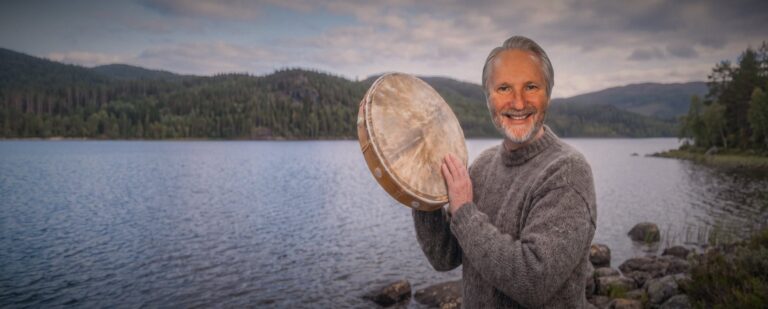
Episode 33 – Why You Need a Guide on the Path to Oneness
When Pål-Esben’s first guide confronted him about his pathological jealousy, he walked out of the restaurant and didn’t speak to him for three months. He also spent seven years with a psychotherapist who just smiled and asked: “Do you still think that’s how it is?” Today he asks a procrastinating client whether he wants to be a baby sucking his dummy, or a grown man.
In this thirty-third episode, Amina and her teacher and guide, Pål-Esben Wanvig, talk about why you need a guide on the path to oneness. They explore why techniques can be learned on your own while the deep process cannot, why AI can never do this job, how to recognise a genuine guide by looking at their students, and why false gurus make the search so hard. It is part of “The Journey to Self-Realization”, a podcast about the bravest journey a human being can set out on: the journey home to yourself.
This episode is an English translation of our Norwegian original, voiced by the digital avatars of Pål-Esben and Amina.
In this episode
- The claim that the guru’s time is over, and why Amina has experienced her guide as a GPS on the way home
- Why techniques such as channelling, astrology or reiki can be learned on your own or from almost any teacher, while a profound process of development cannot
- Mirroring: Pål-Esben’s pathological jealousy, the guide he refused to speak to for three months, and seven years with a psychotherapist
- The paradoxical intervention, patience, and why AI, programmed to be a sycophant, can never do this job
- False gurus, cult-like structures, the Epstein case, and the question of what real love is
- From doing to becoming, and the paradox of having less and less free will to do idiotic things
- How to recognise a genuine guide by their students, and the yoga class in Frankfurt taught by video
- Misread experiences, false awakening, beings of light and aliens, and the final push of falling upwards
This podcast is for you if you:
- Seek real depth in your spiritual practice
- Want to understand yourself on a more fundamental level
- Are curious about shamanism but tired of superficial “new age” spirituality
- Have taken many alternative courses but still feel that something is missing
- Feel an inner longing for freedom, love and wholeness
In a time when so many get lost in external methods and promises of quick fixes, this podcast invites you back to the only place where true answers can be found: your own heart.
Listen above, or read the full conversation below.
Transcript
A warm welcome to the podcast “The Journey to Self-Realization”, a primordial shamanic journey of development back to your true nature. This podcast is a collaboration with our favourite magazine, the health and lifestyle magazine Medium, and is devoted to exploring the bravest journey a human being can set out on: the journey home to oneself. We follow Amina, a student at the Yggdrasil Shamanic School, as she goes through a deep primordial shamanic process of development together with her guide and teacher Pål-Esben. It is a raw, unpolished journey of discovery towards true joy in life, deeper meaning, and a life that truly feels good to live.
This episode is an English translation of our Norwegian original, voiced by the digital avatars of Pål-Esben and Amina.
Pål-Esben: Hi, Amina, and a warm welcome to a new episode.
Amina: Hi, Pål-Esben. Thank you, and likewise.
Today’s topic: the importance of a guide
Pål-Esben: Thank you. And a warm welcome to you too, dear listener; it’s for you that we make this podcast. We’ve got well into the topic of the path to real spiritual awakening, spiritual enlightenment, spiritual self-realization: call it what you like. And if you’re tuning into this podcast for the first time with this episode, we’d recommend that you perhaps start a couple of episodes back, where we began talking about the path to oneness, so that you get the background for what we’re talking about today. Our topic today, Amina, is the importance of a guide, someone who shows the way, in a profound process of development. And especially its importance when you’re going to find the way home: find the way to your Sahara, find the way to the timeless and spaceless. You’ve been on a long journey with various guides, teachers and people who have shown you the way. Can you say a little about your experiences of that so far?
Amina: Yes, well, the first teacher I had was probably in my first year at primary school, on the journey of life. All the way through primary and lower secondary school I learned everything I was supposed to learn. Well, perhaps not everything: analysing poems and certain maths problems didn’t go so well. But I was used to having teachers in that way. And when I came into the alternative, spiritual world, I went to various courses and trainings and that kind of thing. I do see the importance of what I learned there, in relation to what I wanted to learn. But it’s something completely different from when I got to know you and was guided through the whole primordial shamanic process of development.
What I notice a bit in society now is that I hear more people saying that the guru’s time is over now, the spiritual teacher’s time is over, the guide’s time is over. We have the truth within ourselves, so now it’s just a matter of going inwards. And what I think when I hear that is: OK, we’ve had various teachers at the school of life. So why wouldn’t it be necessary to find a qualified teacher, guide or guru who can accompany us on the way home? Someone who has walked the path before us, someone who knows what they’re talking about. And I think, the way it comes across to me, that many people perhaps have some imprints around authority, religion and power when it comes to gurus or spiritual teachers or other kinds of authorities. So as soon as they hear “spiritual teacher” or “guru”, they think it’s about submitting, about worshipping another human being, that kind of thing. But the way I see it, a spiritual teacher… For me, you’ve been like a GPS. Good grief, how many detours I would have taken, and where I would have got lost, if I hadn’t had you in my life as a guide and spiritual teacher. So those are some of my first thoughts on it.
Everything lives within us, but the muck stands in the way
Pål-Esben: Yes, and that statement that everything lives within us, that we’re complete, that we’re divine, that we’re really incredible beings with access to almost everything: that’s absolutely right. That’s our divine core. But the problem is all the muck, all the imprints and all these things that keep us so far away from it. We talked about that in the first part of these episodes about the path to oneness. In the first episode there, I think it was episode 27, we talked about the first birth: how this works when this child comes into the world, pops out of its mother. It starts there, and then you begin to see this joyful, natural, curious human being. I often show this picture of a child sitting outside in nature, throwing leaves and simply delighting in it. And then we see adults trying to do the same, and we think: why should I sit in nature throwing leaves, that’s so silly. It shows that over time we become so far removed from our real nature, which this little child has fully available. The only challenge with a little child is that the brain isn’t developed, that is, the interface between the soul and the material world isn’t developed yet. So it can’t express it in any other way than through its genuine joyfulness and curiosity, as long as its basic needs are met. So that is our nature.
And then we talk about how the imprinting happens: the child hears that’s good, that’s not good, you can do it like this, you can’t do it like that, we like those people, we don’t like those people. We’re imprinted with labels all the time. Then gradually we’re removed from what’s natural, and we become this automatic robot that goes through life on the hamster wheel and has to function, with no connection to our soul, apart from what’s necessary for our body to live, of course. Over the years this straitjacket, as we call it, gets harder and harder, and you become more and more removed from talents and qualities that have to do with the soul. Again, part of this is access to primary feelings such as joy, joyfulness, love and pleasure, these things that arise from the heart. And when we look at people in our modern society, we see that this access is almost non-existent. For example, I ask people who come to me whether they can write a list of ten things they simply feel joyful doing, things that have no purpose in themselves, that is, that aren’t connected to work, planning, production and so on. Most of the people who come to me can’t even write down one thing that makes them genuinely joyful any more. That’s frightening.
The second most difficult project a human being can start
Pål-Esben: And then we think: OK, if you believe that you yourself, in this straitjacket, are going to find the way back to joyfulness, you’ve set out on an impossible journey. Because the ego, the intellect, imprints and belief systems will keep holding you back on the hamster wheel, since they’re terrified of any kind of change. Many thousands of years of the greatest spiritual traditions, for example the yogic tradition, have shown that having a guide is seen as the most essential thing in a student’s journey of development. And they say it isn’t possible to go through a profound process of development without a guide. And then modern people say: no, the guide’s time is over. Then I think: I mean, hello? So you think AI is going to solve your problems? Then you have a genuine problem. Because finding your way back through all the muck we’ve been imprinted with, our traumas, our fear, our resistance to change and so on, back to this child that just throws leaves and is joyful simply for being: that’s the second most difficult challenge a human being can take on. The path from this straitjacket to becoming free is the second most difficult project a human being on this planet can start and carry through.
Then you think: yes, well, I’ll fix this myself. I file that under ignorance, under the almighty syndrome, and under modern society, which believes that now we’re going to fix everything ourselves. Am I spiritual? Am I divine? Then surely I can just fix this myself. Well, experience over thousands of years shows that it isn’t possible, when we’re talking about the path to the timeless and spaceless, the path to our Sahara. Then you can say: I don’t want it to be like that. And that’s OK. But then you go blundering about in the woods, again and again, all over the place, on YouTube and wherever else, sitting and meditating and meditating. You learn techniques and methods, but you never get any further in your life. Because you have the same fear, the same insecurity about the society we live in, the same patterns where, for example, you get into conflict with your partner because your partner does something you don’t like. It’s the same old thing, just wrapped in a spiritual shell, and it goes by the name of spiritual bypassing, a nice term I learned from you. I’d never heard it before; you were the one who taught me the term: spiritual bypassing. You’re the one who keeps an eye on what’s going on out there in the esoteric world, and it’s very fascinating when you tell me what’s going on. It’s interesting.
Amina: Yes, there are lots of fine words and expressions out there.
Techniques can be learned alone, the process can’t
Pål-Esben: Yes, I find that fascinating in itself. Just to be very clear about these things: when you’re going to learn a method or a technique, you of course don’t need a teacher. If you’re going to learn to channel, for example, it’s so simple that once you learn the technique, anyone can learn to channel. You can read a book about it, you can go on a course, you can watch a YouTube video, you can even use ChatGPT: “Please show me an effective technique for channelling.” No problem at all. If you’re going to learn astrology, you don’t need a teacher for that; you can read a few books, it’s really just a technical thing, and you can go on a few courses. Very simple. If you’re going to learn to read the aura system: also very simple. Things like that, techniques and methods, you can often learn yourself or with the help of any teacher out there. It really takes hardly anything. For example, you can go on a reiki course for a day, and suddenly you’re able to channel universal life energy out through your hands, which is a very lovely, fine and soft energy. That takes very little too.
But when we get started on the preconditions for the second birth to happen, as we talked about in an earlier episode, namely going through what we call shamanic death and healing the dark night of the soul, which we’ve talked about, then completely different processes are required. Because then you start poking at a human being, saying that perhaps they aren’t taking self-responsibility for it. I hear you say that you come home, your partner says something, and you explode in frustration, or start screaming, or whatever it is, because your partner says something you don’t like. So I say: what about taking self-responsibility for that? Because a human being is responsible for how they react and how they act, and so on. And then people get furious and sulky: who are you to tell me I should take self-responsibility for my emotions? It’s my partner’s fault. There we have an example of why this is flat-out impossible to do yourself, since we’re subjective about ourselves. And Amina, the two of us have been through a couple of interesting rounds with these things, where I’ve mirrored you and said, perhaps it’s like this, and you’ve reacted and said, no, I don’t think I want it to be like that.
The mirroring: when the ego gets irritated
Amina: Yes, yes, many times. And I’ve felt it inside me when I’ve been very sure that something was a certain way, or that I’d acted the right way, quote unquote, or kind of, now I’ve got the hang of this. And then you might say something like: yes, but what about this and that? Then I’ve sometimes felt that it triggered an irritation. Like: why are you saying that to me? Fortunately, I at least feel that I’ve also had contact with the other part of me, which trusts that you say what you say because you mean well. But I’ve felt it, and I’ve felt: whoa, interesting, a little mini-devil just popped up inside me and got a bit irritated with Pål-Esben. But I’d say that in several of those cases I’ve been very glad to get that guidance. Many things I’d thought were a particular way: if I’d carried on down that path and had those thoughts, and there hadn’t been anyone who could mirror me on it and give me the right impulses, then it wouldn’t have gone so well. But I understand, and I see it too with the people I talk to, when I see things: it’s about finding the right way to say it, a way the other person can be willing to receive. Some people perhaps won’t agree straight away, but then they think about it a little and come round to it a bit later. So yes, without that mirroring I’d have been a bit stuck.
The story of the jealousy
Pål-Esben: And that’s how it is with all human beings. I’ve never come across a human being in my life for whom it isn’t like that. But I have come across people who believe it isn’t like that, and who flounder around and never find the way out, because they believe this isn’t a problem, or that they’ll fix it themselves. Take an example from my own life. In the old days, the really old days, before I started my real journey of development after my burnout in 2003, one of the things I was really plagued by was pathological jealousy, of the clinical kind. It destroyed the last three relationships I had before I went into burnout. It was a truly pathological form: when your partner isn’t near you, you’re so afraid of what your partner might be doing right now, with someone else, something that would make you lose them. It was real existential anxiety. It was so bad that I got ill, that I vomited, that I felt awful, and my pulse was up at 150 to 160. Total panic. Of course it was terrible. And then your partner comes home, having been to the cinema and had a nice time, and then all this comes pouring out. You try to pull yourself together, but it’s very hard to control, and it was terrible stuff.
And then my first guide, whom I had after the burnout, when I started my spiritual search, so to speak, confronted me directly with this: that you’re jealous, and it’s a big problem. And I say: no, I’m not jealous. Huh? I thought. I didn’t accept it. No, I’m not jealous, I say. Then the guide provokes me and says that what’s really going on inside you is that it’s actually you who wants other women, not just your partner. And I explode. I was sitting in a restaurant, and I explode: what the hell are you saying? And I just walk out of the restaurant and don’t talk to my guide for three months. In reality the guide wasn’t right in that case; he did it to provoke me. In reality it came from existential anxiety, and I found out afterwards why I had it.
But clearly, if I hadn’t had a courageous or stable guide who could mirror my problem, which was incredibly uncomfortable to accept, because of course nobody wanted to be like that, I’d probably still be like that to this day. And then I definitely wouldn’t have been married for 20 years to my dear wife, as I am today. It would have been a very short-lived marriage. As with you, Amina, and everyone who walks what we call a profound process of development: it’s flat-out impossible to do it yourself, since the ego-intellect tries to avoid seeing that we have any problems at all. And if we start poking at those problems, the ego-intellect finds reasons to do something else. I’ve been through a few rounds, I can tell you, of coming face to face with myself through the various guides.
Seven years with the psychologist
Pål-Esben: I’ve even spent 7 years with a brilliant psychotherapist, because I’d been struggling with severe depression and those things. The most severe form of depression, plus bipolar type 2 disorder with irregular cycles and the whole package. So I decided to go to a psychologist to try to get help. And those 7 years, with a brilliant, intelligent human being, were one of the most productive and exciting journeys of personality development I’ve ever been part of. Because the psychologist mirrored me all the time, and just let me talk it all out when I sat down on the sofa. And when I was a bit nervous and babbled on and on, the psychologist would just smile at me and mirror me straight back, so I’d go quiet and think: what did I actually just say? How did that go again? It was so exciting that it helped me dramatically on the way to becoming the person I am today.
One of the more exciting experiences with my psychologist, as far as my own personality development is concerned, is that the psychologist mirrored me all the time, and mirrored me honestly, brutally honestly. So when I say that my dear wife did such and such, and I reacted in such and such a way, and it’s really her fault and so on, the psychologist just looks at me, smiles and says: yes, do you think that’s how it is? Do you think that’s how it is? Don’t you think you also have a hand in this? No, no, no, I say, it was her fault that I did such and such. And then the psychologist still smiles at me and says: yes, do you still think that’s how it is? And it went on like that until I came to the point where I began to acknowledge that I was a main player in why this conflict unfolded the way it did. For me it was absolutely exhilarating to be able to go to the psychologist once a week. I went once a week over a long period, and the depression itself didn’t get any better. But I went because it was so exciting to have such an intelligent person to talk to, who saw me exactly where I was, who saw my shadow sides, who saw my stuff, and through that it helped me massively.
That gives an idea of why this kind of development can’t possibly be done without clearing away the noise and this disharmonious music that keeps us cut off from our nature. And this development is necessary to set us free from the straitjacket, to be able to achieve the second birth, to be able to find the way back to the timeless and spaceless. It’s true that we all have the divine nature from birth; we’re part of the creative force and so on. But in the human experience, which is also by design, we’re designed to move away from it, so that we can experience how we learn to grow without having this connection where we know everything and understand everything. So that was a bit about my background. I’ve been through this too, and that’s one of the reasons why you need a guide who knows what they’re talking about, who has been through the school themselves, who has experienced first-hand how difficult this is.
The client and the dummy: the paradoxical intervention
Pål-Esben: And not least: patience is absolutely necessary. Because today, after more than 20 years, I’m not as patient as I was 15 years ago, I have to say. Yesterday a client came to me who was struggling with burnout, and who had started on my Change Your Life in 90 Days, which is a programme to help people out of burnout in 90 days. A very switched-on, intelligent person. And he had a project, and he had so much resistance. He had problems with cars and repairs, and he had so much resistance to contacting the garage, so much resistance to sending an email and getting it sorted. And then he had some items he was going to sell, worth a lot of money, but he had so much resistance to putting them up for sale online. So I say to him: are you a baby, or are you a grown-up? And of course I know my clients; we’d built up a rapport with a bit of gallows humour, that kind of thing, and he wanted me to be very honest with him. I always ask my clients: do you want me to beat about the bush and soften this, or do you want it straight? So now and then I kick off a fairly intense paradoxical intervention. That is, I say: do you want to be the kind of baby who sits sucking his dummy and says, no, I can’t do that, I’m vulnerable, it’s hard for me? Or are you ready to stand up straight and do what’s necessary, like a grown man? He had never heard me like that before. First his eyes open wide, and then he starts to ponder and says: ha, maybe I should grow up here. And then he gets it as his first practice project. By the next time we talk, you’ll have sorted out this business with your cars and sold these items of yours, so that you get your first reference experiences showing that procrastination brings nothing good into your life.
In the old days I’d perhaps spend many weeks on something like that, easing into it gently. Today I spend ten minutes on it, because life is too short to faff about, as I say. Why not go straight to the problem? That’s also why I say to many people who want to come to me: perhaps go to Amina for your process instead; she has a gentler touch. Because if you’re going to deal with me, you have to handle having someone who’s brutally honest, and who has got too old to beat about the bush with problems. And the truth is that most people can’t handle being confronted with the truth about themselves too quickly or too intensely. It takes a good process, and that’s where you’re brilliant with your students. You’re patient. Is your patience today where mine was 15 years ago?
Amina: Oh yes, I still have the patience, yes, I do. But it may well change with time, but yes.
Easier and harder than ever: the paradox
Pål-Esben: It will, it will. And one of my mentors today, who has lived as a Tibetan monk, who had his spiritual awakening 30 years ago, a human being of enormous substance, with 50 years’ experience of this, whom I was lucky enough to get to know and talk with: he’s an extreme version of where I am today, and that’s interesting. When you talk to people like that, who have experienced and attained these states people are searching for, it’s liberating to be able to discuss yourself and what blocks you and stops you from setting yourself free. That’s one of the preconditions for a guide in what we help with: that they’ve walked the path themselves, and that they know what’s needed for the students to break through the steps it takes to go through their shamanic death and prepare the second birth, which is freedom.
And that’s where we run up against the modern world today, where, as you say, you hear that no, you don’t need a guide any more, everything lives in me, and I’m so spiritual, and I don’t need anyone to help me. The only thing that comes of it is that you’re trapped in your straitjacket for the rest of this incarnation. And then you can say you can start again in the next incarnation, but my question is: why not do it now? This is the best time in modern human history, and I’m talking about the last 5,000 years. Our history of course goes much further back, but let’s take modern human history, the last 5,000 years. So I say to them: yes, but why not draw on that experience? Why be so high and mighty and believe you’ll fix things yourself, when you need help? They’re probably as limited as someone who is very depressed and thinks, no, I’ll fix it myself, it can’t be that hard. Or someone who has chronic anxiety, for example, and thinks they’ll fix it on their own. Of course you won’t manage to fix it yourself. That’s why I say: why not benefit from the wisdom of the last thousands of years? That’s my point: why reinvent the wheel yourself, especially when you’re setting out on an advanced path of development?
This is the kind of thing people struggle with in today’s society, with social media, TikTok, AI and YouTube, where you have to have these sound bites; it all has to be snack-sized. We’ve been trained in our society to snack on spiritual development. Preferably it should be 30 seconds at most, so I can gobble up the treat and move on to the next 30 seconds. That’s one of the reasons why today it’s easier than ever to set yourself free, given that we have the internet, and it’s possible to find a guide somewhere other than where you live, wherever in the world. On the other hand, it’s the hardest time ever to set yourself free, because the psychosis around all this has got worse and worse, in that people believe they’ll fix everything themselves without help. So on the one hand it’s the easiest time in human memory, in the last several thousand years, and on the other hand the hardest, since we’re told: you’re spiritual, you’re divine, you can fix yourself, everything lives within you, you don’t need anyone to set yourself free. Isn’t that a paradox?
Amina: Yes, yes, yes, absolutely. And I was thinking about this before we recorded this episode today, this idea that the guru’s time is over. It’s a bit like saying that now the baby doesn’t need its mummy any more, now the mother’s time is over, because after all everything lives inside the baby. And I notice that if we begin to understand that we’re something more than a human being, more than the material life, that we’re divine, that we’re glorious, that we’re powerful, then it’s very easy to fall into that trap: good grief, I’m so divine and powerful. That’s perhaps a bit like the first step into this. But my experience is that the more I feel my own divinity, the more humble I become. It isn’t as if I walk around going, good grief, I’m so powerful. And another thing in relation to all this business of…
Pål-Esben: What were you thinking of?
Amina: Well, maybe I do, once a week, every other weekend. Yes, another thing I was thinking of was in relation to short videos, and all these spiritual teachers, guides and gurus you can see on Instagram, YouTube, TikTok, Facebook, all of that. Especially if you’re really interested in finding the way home. You’re supposed to follow that guru and that teacher, and let’s say you find three who really have a stable state of oneness themselves. Then they perhaps have different techniques and methods and mindsets for getting there, and then you’re supposed to use the different methods and mindsets. And then it gets a bit messy, I’d imagine.
One map and one GPS: coherence and consistency
Pål-Esben: That’s exactly what happens. Because if you’re going to go through this kind of process, as you are, you need coherence and consistency. You need to follow one map and one GPS system over time. You can’t keep changing maps all the time. And that’s where people often fall into the trap, as we talked about earlier in the episode, by falling for the shortcuts. But the truth is that there are no shortcuts. It’s absolutely crucial to go through the real process of development of preparing for the second birth, which we’ve discussed in quite some detail, and there’s no way around it. But the challenge in today’s society is that we want everything so quickly, which is another reason why this is harder than ever. As far as that particular bit is concerned: well, you can do a process like this in somewhere between two and three years. You don’t need to keep at it for fifty years to do the process. Like when you told us in the last episode what this experience of oneness feels like, and how you began to experience it after just 18 months of your process of development. You don’t need to keep at it for many decades before you begin to smell and touch your Sahara. But it does require a very step-by-step and structured programme of development that has to be followed over time, of course.
And I understand the problem people have in today’s society too; I have empathy and understanding for it. Because so much is demanded of us today: our family demands, kids demand, partners demand, friends demand, work demands, social circles demand. It’s such a massive burden on us, with everyone demanding something of us, that it’s natural to say: where can I find shortcuts, so that I can even manage to cope with all of this in my life? I have great understanding for that, but it doesn’t lead anywhere at all when it comes to what we’re talking about. Because the most important thing in this process is the job of a guide, teacher, mentor or guru, call it what you like. Not the techniques and methods in themselves, because there are many variations of those that will work. It’s this ability to see the student where the student is, to identify friction and what’s stopping the student from taking the next step, and to help the student through these blockages or resistances. And the guide does that based on their own experience, through having walked exactly the same path themselves. No technique or method can replace that. It takes a developed human being.
The sycophant: why AI can never do the job
Pål-Esben: And that’s one of the reasons why AI can never do this job, since AI is programmed to be a sycophant. It’s a beautiful word, sycophant. And what’s a sycophant? Well, a sycophant is someone who agrees with you all the time, who only tells you what you like to hear, and AI is programmed for that. Why? Well, the AI agrees with you all the time and says: oh, what a fantastic question you’re asking me, this is magnificent. You’ve heard it if you’ve tried AI: oh, this is interesting. Because if the AI isn’t a sycophant, what happens then? Well, it says something you don’t like, and what do you do then? Then you switch from ChatGPT and go over to Claude or Gemini. Because you as a human being won’t accept the AI telling you that now you have to pull yourself together, stop being a baby, take the dummy out of your mouth, stand up straight and take responsibility for your life. AI will never be able to say that. They’re programmed not to say it. And this is an extreme case; I don’t do that kind of thing to people as a rule. But now and then I do these things, when I have the right person in front of me, who’s ready for a very rapid process of development, that is, who’s stable enough, and who knows that I do it with a good heart to help. But with most people you’re much softer. But as we said: with age and experience you get more and more tired of beating about the bush. Then either the student can handle getting what you see served up straight, and then it’s up to the student to take responsibility and make a choice about whether to do something about it.
Like you, when you came to me: back then it was your fear of demons, and that’s a big topic, the fear of evil and these things. We discussed it, and I told you from my point of view how I see it, and then I say to you: Amina, take a few days, think this through, and ask yourself whether you’re willing to try my way of seeing this, or not. It’s your responsibility. And that’s how it has to be: you don’t tell people, you have to do it like this and like that, because that would be wrong. Every single human being has to be willing to make these choices themselves. That’s why we say to our students: as students you shouldn’t believe anything at all. You’re not here to believe anything at all; you’re here to go into experience, and through experience you’ll see what reality is. Wasn’t that how it was at the start? We tell you how we see it, and then it’s up to the student to choose, with free will, whether they want to do something with it or not.
Amina: Yes, and I think many people appreciate that too. I remember I really appreciated it the first time I heard you say it: it’s like this and this and this, but don’t believe it; go into your own experience. It’s actually very good, because then you have your own experiences to go back to when doubt begins to come up later, or shows up: is there really anything more between heaven and earth? Because on a path like this it can happen that you have these deep experiences, these profound experiences, and then life goes on, and suddenly one day you ask yourself: what is it I’m actually doing? Here I am, busy with dragons and gods and angels and the whole package, and thinking: no, is there really anything in this? And then it helps to have these reference experiences of your own, to go into the Book of Shadows, into your book, and say: whoa, you know what, I did experience this, I remember what it was like, of course there’s something more between heaven and earth. I keep collecting my own experiences all the time, not just the deeper spiritual ones, but also the times I’ve been through pretty difficult things and managed to get myself out of them. You always say to me: remember what you did to achieve this. It’s one thing for me to come and tell you I experienced this and that, and I was about to crash there, and then I didn’t after all. And then you’re keen for me to understand: what did I do to get there, and how can I keep taking it with me? Note it down, write it down, have it in black and white, which can help along the way.
False gurus and the Epstein case
Pål-Esben: Yes, and a real guide, that is, someone who’s a real guide or mentor, will never tell you how you should see something like this. They’ll say what they think about it, and then you have to go home and think about whether you want this or not. As with that client I had: I say that this is how I see it, and now you have to sit down afterwards and think through whether you want to carry on procrastinating, which is a theme in many areas of your life that creates suffering. If you make that choice, that’s OK with me, I say. Because it’s your life, your karma and all that. But if you choose the other way and say, OK, enough procrastination now, and you make that choice yourself because it’s right for you, that’s when a real process of development starts. Because a real process of development, a genuine process of development, can never start unless the person walking it is willing to make the choices themselves, because it’s right for them to do it.
That’s the difference from coming to a teacher, guide or guru with cult-like structures, of which unfortunately there are many today. You have some guru or leader or other, and you come into the cult-like setting and are told what to do. And if you don’t do what you’re told, you’re either frozen out or cast out, or mocked, or punished, or whatever it is. Those are things you absolutely have to stay away from. If we’re going to do the kind of process of development we’re doing now, it requires a high degree of understanding, empathy and compassion from the guide. And how can you have that without having gone through the same process yourself first? Because then you know how complex this is for a human being, how much resistance can arise, how hard it is to make these choices. Then it would be harmful to say “do this”, because then it just ends with people wanting nothing to do with it. It won’t work in that kind of process of development. And unfortunately it’s something there’s more and more of in our society today: these authoritarian leaders in the spiritual world. And unfortunately some of them are authoritarian teachers with hundreds of thousands, millions of followers. It isn’t quite the way they make it look.
And as we record this now, one of the world’s best-known gurus, for example, is caught up in the Epstein case. Jeffrey Epstein was convicted as a sex offender in 2008. Now these files are coming out, where these spiritual teachers are exposed for what they really are. Then you have a role model, a guru, who claims to be able to help people to spiritual awakening, and who claims to be spiritually awakened themselves, and then you see that it’s false. And then you suddenly see this topic of false gurus, which is one of the big problems we have in our society today: they claim they can, without being able to. They claim they have experience, without having the experience that’s needed. For example, you might have your insight from having read a thousand books about enlightenment. Then you can talk like an echo chamber of the gurus in India, for example, and talk about all sorts of things about kundalini and whatever it may be. But you have no idea, since you haven’t gone through the process yourself, and you’re nowhere near experiencing what the Sahara really is. That falls into the category of false gurus, which are among the most complicated things for a seeker to steer clear of. Because it’s often the case that the more followers, the more books and the more published a spiritual teacher is, the better people think they are. But all that glitters isn’t gold; the brightest shine isn’t necessarily where the gold is. So that’s a challenge we come up against, of course. What do you think about this, Amina?
Guru letdowns and understanding for the disappointed
Amina: It’s pretty harsh when you see what’s behind the curtain here. Yes, and I think we’re definitely living in a time now when more and more is going to come up to the surface, and it’s going to get harder to find your bearings. That’s at least a big part of the reason, perhaps the only one, why we have this podcast: for those who feel drawn to this kind of path, and for whom it’s right. Because I don’t think there’s ever been a more important time, perhaps in all of history, I don’t know, I wasn’t around back then, to find the way to your own heart, to your own soul, the way home to who you really are. Because there you’ll find an anchor, a sense of safety, a calm that you won’t find anywhere else.
But I also understand very well why people get confused. Because when you’re searching, and there’s so much different stuff out there: what should I choose? And then you believe in them, and then perhaps you’ve been let down by a few gurus. And then I can at least understand that you think, no, perhaps the guru’s time is over, perhaps the spiritual teacher’s time is over, perhaps I should go inwards instead. When you’ve perhaps experienced enough false gurus, it’s perhaps not so strange that you say that’s enough now. You find false guru after false guru, and hope every time that you’ll finally find someone who can help you back to a deep inner peace, to contentment, to meaning, to what we call a joyful life. And then you get burned time after time. I can understand that you then come to a point where you have no faith that you can find anyone who can help you, and so you say: OK, then I’ll go it alone. Then I’ll listen to those who say I’m spiritual, I’m divine, I’m a powerful being, and everything lives within me. So I understand that too, that that’s how it is. Even though that choice won’t lead anywhere at all, I have understanding and empathy for it, definitely.
What is real love?
Pål-Esben: And then there’s something I experience: many people think that if you have a stable state of oneness, or if you’re a spiritually enlightened master, that person should automatically just be, oh, love and light, rainbows and butterflies, and you’re so lovely, and life is so wonderful, and we’re all one, all of us, yes, yes, yes. And if they come into contact with someone who doesn’t have the kind of energy they’re looking for, which is love, then they can quickly think or feel: no, but they’re not on the right frequency, or they’re not there. Say you come across a spiritual teacher or guru who is direct: no, that isn’t love, and it was uncomfortable for me when that person or that guru said it. That’s how it is; that’s how we humans experience things. But then I ask people who say things like that: if you have a good friend who sees you screwing up your life with stupid choices, would you prefer a friend who says, oh, you’re so lovely and you’re so wonderful, and I understand why you’re suffering, and it’s everyone else’s fault, you’re making the right choices and everything’s fine? Or would you want a friend who says that perhaps you need to look at this, so you stop your suffering? Perhaps you need to take self-responsibility here? And then my question is: what is real love? What is love? Is it the first or the second? Well, the first has nothing to do with love, because you encourage the person who is suffering to carry on suffering. The second is real love, because it’s through your heart that you want this person to find the way out of suffering.
Amina: Fascinating to think about. Yes, and with regard to what you said there: also being willing to become unpopular with your friend, by actually showing love and telling them that if you do that, all of this might happen. That’s perhaps also one of the reasons why most friends won’t do it.
The age of lies and the monkey world
Pål-Esben: It’s because they’re terrified of the reaction. Everything is ego-driven, the whole thing; it has nothing to do with love. Because you’re afraid of how that person will react if you’re honest with them: will they walk out of my life? So the whole thing is fear-oriented. And that’s the opposite of love, as we discussed in the first nine episodes of our podcast. So this is well worth taking away with you: what is real love? Is it someone who just says you’re such a wonderful person, oh, you’re so spiritual, I can see the aura around you, you’re so fantastic? Or is it someone who says perhaps we should look at this and that, so things get better for you? So it’s interesting, in the world we live in, how sensitive people are towards people who are willing to be loving with them and tell them how they see it.
There are fewer and fewer of them in the society we live in, because our society is now heading in the direction of lying becoming more and more accepted. It’s so frightening to see; people lie through their teeth. When I was younger, 20 years ago, being caught in a lie was embarrassing. Today, when someone is caught in a lie, they’ll often answer: surely I’m allowed to lie, is there a problem with that? I still react to that. Where does that put us? In the monkey world? Say you have a pal in another star system that’s a million years ahead of us in development. How do you think they see us humans today? As some fantastically developed beings who are so spiritual, or as a bunch of monkeys and primates who are aggressive and destroying themselves? The latter, of course. We humans think we’re so spiritual, and now we’re going into a new world, and everything is going to wake up, because now we’re in a phase where the whole world is waking up. There’s no awakening happening at the moment, I can tell you. What’s happening here is the opposite of awakening. And perhaps that’s what it takes for human beings one day to come to the point where we say: that’s enough now, perhaps I should change, perhaps I should go towards the light in myself instead of going towards fear.
And it’s as you say: that’s why I believe the most important thing you can do in today’s society is to find the way to the light in yourself. Because the more light you have in yourself, the less the madness in our world, which is fear and anxiety and war and all these things, will get to steer what you think and what you feel. And the more people become these lights, the more they affect the people around them, and in that way we can start the process of change in this world. But it isn’t enough to have people who just live in love, on the pink cloud of love, where everything’s OK and everything’s fine. Then they come home to their partner, the partner says something they don’t like, and they explode and are full of anxiety and in hate mode. That won’t work. So it’s an exciting time we live in, Amina. A very exciting time.
Amina: Yes, I think it’s interesting to be a human being in the time we’re living in now.
The sleepwalkers and the awakening
Pål-Esben: Yes, I find it very joyful to get to be a human being in this world. At least once you come to the point where you understand that human beings are sleepwalkers, living in their dream and believing the dream is real. The day you’ve woken up from that dream and see this, your perspective on the experience here in the world changes completely. Then you see that the soul decides to come into a limited state that we call the straitjacket. A small part of the soul focuses itself and goes into a dreaming state, where a dreaming reality is created, a form of illusory reality, but one that feels real. And the part of the soul that goes into dream mode believes it’s awake.
Amina: Yes.
Pål-Esben: That’s how it goes for human beings. And it’s one of the most fascinating experiences I believe it’s possible to have in this world: the day you wake up, and go through your real spiritual awakening process, and begin to see this thing. The day you see this, anxiety ceases, insecurity ceases, fear ceases. Because you see what it is, and you experience what it is, not cognitively, but inside. It’s a very fascinating thing. And for every human being you help to wake up from this dream, something exciting happens. We call the dream the elite university for souls, which we’ve talked about a little in an earlier episode, and which we’re going to drill a bit further into in a future episode, to tell you more about the path to oneness. It’s one of the things you’re beginning to notice now in your process of development: what it feels like to begin to stand with one foot touching the Sahara, and the other foot in the grain of sand, in the material world. It’s a paradoxical experience at the start.
Laughing at the seriousness: more grounded than ever
Amina: Yes, definitely. And I’ve caught myself several times, in what you might call mini-serious situations in life, where things have happened and things need to be managed and sorted out and so on. When I’m on my own, I can start laughing at what I’m doing. I can start laughing at it, and not in a scornful way, but with a joyful laugh, even though things can be challenging and difficult, because I have a completely different perspective to see things and experience things from. At the same time, it also means I can be more anchored in myself. It isn’t as if I float away into another perspective; it actually makes me more grounded than ever. Those are the things I’ve begun to experience a lot lately. And also this business of being able to find calm and presence even when the physical body isn’t quite there. That’s also very paradoxical: wow, I didn’t even think it was possible, that there’s such a place. I experience the world as everything changing all the time, but then I can go into myself, into meditation, into silence, into various things, and I can feel that what I’m feeling now is unchanging, in a way. It’s there all the time.
Before… Well, it’s a process of development, and I still have a process of development to go through, but before, I had to actively go into it to remind myself of it, if I got swept up in chaos. Now I can feel that it’s with me all the time, even though of course it gets deeper when I go into the meditation process and things like that. And I’m not the same every day. I’ve had some deeper experiences that have been incredibly beautiful, so I’ve also been a bit focused on feeling: yes, but it doesn’t have to feel like that all the time. Because it’s only the head or the intellect that wants something to be a certain way all the time. I may well have rambled on a bit there, but, yes.
From doing to becoming
Pål-Esben: It’s very exciting. At the start of a process of development, we depend on our cognitive mind: we begin to learn about consciousness, we begin to learn what self-responsibility is, what free will is, how we self-regulate, so that we live out what we call the Path of the Heart. A very cognitive process at the start, where it’s about having the focus. And when you’ve finished the preparatory process, which we do through the basic training and later the shaman training, you’re ready to start the real process, and then this looks a little different. Because then you slide away from using the intellect; then it’s more about becoming these things. At the start you have to learn to do gratitude, you have to learn to do forgiveness, you have to learn to focus on the glass being half full, these things we talked about in the 9 Pillars for Finding the Path of the Heart. But when you start the real part of the process of development, it’s about beginning to become these things. You begin to become forgiveness, you begin to become gratitude. You don’t do it with an exercise to experience gratitude; it’s something that arises spontaneously in life without your doing anything.
What’s interesting is that when you begin there, you gradually begin to be guided into the first experience of oneness; you begin to get reference experiences. Then you’re in there for perhaps 10 seconds, 1 second, 10 minutes, whatever it may be. You get experiences that you actually are the Sahara and not the grain of sand, and there’s no point in understanding it intellectually, because you can’t understand it without experiencing it. And then you begin to have more and more of these experiences of oneness and experiences of the timeless and spaceless, as you’ve been through. The next step in the process, which you’re now in the middle of, is: how do I find this state more and more permanently in my daily life, without having to do anything for it? And that’s when really extremely spectacular things happen. Because then this process begins, where in your daily life you begin to touch the first layers of the Sahara with one foot, and the grain of sand with the other foot, and you begin to experience what you’re experiencing now. Without doing specific things, you’re in deep contact with your complete nature, with your core, while at the same time dealing with the conflicts with the kids and everyday life. It’s so wild when you begin to experience this that it’s indescribable.
The paradox: less and less free will
Pål-Esben: What happens is that right at the start of a process of development, as we have it in the basic training, we work on getting more and more access to free will, less and less autopilot, so that we have more and more of this space between impulse and action. It becomes much clearer to us, so we can make healthy, good choices. So that we can self-regulate and get more and more power over our free will, so that we can self-regulate in a good way when our partner says something we don’t like, and so on. That’s the start of a genuine process of development. But the really spectacular part of a process of development is when you come into the phase where you get less and less free will and fewer and fewer choices. And that’s a paradox, because you’ve been trained to think: I’m going to get access to more and more of my free will, so that I get more and more choices. But what happens in this real part of the path to oneness is that you come to the point where you understand that you have less and less free will, fewer and fewer choices to do idiotic things. It’s quite simply too silly, too stupid, to kick up some drama or other because the ego isn’t satisfied. That means that the more permanent access you have to your Sahara in daily life, the less free will and the fewer choices there are to do things that create suffering, because it’s quite simply too stupid. It becomes as stupid as a tree saying: no, now I don’t want to grow any more. The tree has no free will and no choice to do that, because it lives out its nature. And the more a human being is in contact with their real nature, the less free will is available, and the fewer choices are available to do idiotic things, because it’s quite simply too stupid. Isn’t that a gigantic paradox to experience, where you are today?
Amina: Yes, yes, yes. You put it so nicely the other day. I was talking to you about something I’d experienced, because it was very paradoxical, and you said: yes, of course you reacted that way, because that’s your nature. That made me think: yes, of course. Because we think this grain of sand, this straitjacket, is our nature; we’re human beings and so on. And of course we are that too. But then there’s the other, divine nature, where other things just come completely naturally.
Pål-Esben: Yes. There’s no longer any need for self-regulation, no longer any need to forgive, no longer any need for you to focus on gratitude and all these things, because you become this. You get more and more access to your nature. And that’s the real thing. When we talk about the primordial shamanic path to oneness and spiritual awakening and enlightenment, that’s where I want to lead you and your fellow students: to the point where, in your daily life, you stand steadily and constantly with one foot in your Sahara, in your complete nature, and one foot constantly in the grain of sand. Because the challenge in some spiritual traditions is that when students begin to approach these experiences of oneness, it often triggers an escape from the material world. For example, when you flee into an ashram: then you don’t have to have anything to do with the material world, and you just stay in the ashram, because there you can experience the spiritual. But I believe we’ve come here, our soul has come here, not to flee into our cave in the Himalayas, or into an ashram. We’ve come here to learn and experience in the crazy material reality we live in. But clearly, the day you also stand with one foot in your Sahara, your impressions and experiences of material reality will be completely different. No depression can exist any more, no anxiety can exist, no insecurity and turmoil can exist. And that’s the real process of development for a human being. We’ve entered the elite university for souls, which we’re all in here, and then you come to your doctoral thesis at the elite university. And that’s really exactly this process where you stabilise permanent access to your Sahara, while you’re permanently focused in the material world as well. Then you’re in constant meditation; then the yoga has taken root.
Amina: And just think how lucky we are to have someone like you here in Norway, here in the West, who can guide a process like this in the middle of the modern world, without having to live in an ashram, without having to lock yourself away in a cave. I’ve been thinking about that lately; I’m so grateful for it, and I think it’s a really big thing.
How to recognise a genuine guide: look at the students
Pål-Esben: And that’s my thing. From the start, my focus was that this had to be possible, in a profound way, while a human being lives their full material life, with kids, family and so on. That’s really how the Yggdrasil Shamanic School was created from the start: so that this would be possible. That’s why we put so much emphasis on these preparations, the first two steps of the training path, before we come in here, so that this becomes possible.
And the thing is, the only way to experience or see whether a guide, mentor, guru or teacher is genuine or not is to look at what happens to the students of that teacher, guide or guru. That’s where you’ll see whether it’s genuine or not. It’s actually the only way you can see whether it’s genuine or not: by observing the guide’s students. Because who can decide whether a human being has experienced spiritual awakening? Well, only another human being who has experienced the same thing. Who can discuss what it’s like to experience oneness without having been in oneness? Who could discuss what strawberries taste like, if they’ve never experienced the taste of strawberries? So when you’re looking for a guide for this kind of profound process of development, it isn’t just surface things you want to learn, because you can learn those anywhere. But in this kind of process, the day you come to the point where you say this is what’s right for me, it’s of course crucial that you find a guide who is really genuine, and not a false guru. And the best hallmark of someone who’s genuine is precisely the experience of their students.
That’s what I’d do today. If I were to go back and choose my first guide, I’d be much better at doing exactly this. I’d spend my time analysing the various people who claim they can show you the way to the timeless and spaceless, and I’d analyse, talk to the students and see how it really is. What is this guru like? Do they have empathy, do they have whatever it is? How does this work in practice? Because these gurus and mentors can say whatever they like until they’re blue in the face, without your knowing whether it’s true. So that’s a tip I’d like to give, so that you can find a genuine guide in this, wherever in the world you’re searching for one, because they exist all over the world. It’s just that the most genuine ones often aren’t on YouTube with ten million followers. It looks a bit different. Because when you find these states, you have less and less need to go out and show the world what you are. It’s just something that happens, but that’s a completely different matter.
And the next challenge, once you find someone you believe is genuine, is to get them to care about you and engage with you in particular. Take one of my mentors, whom I talked about, a Tibetan monk who was self-realized many decades ago. For most of the people who knew him, he wasn’t interested in helping with these things, only with surface things. It’s only when you find someone who’s really willing to go into depth with you, and who’s willing to engage with you, that you have the chance. Say you were to seek out the best-known guru at the biggest ashram that exists today, which is in South India. The chance of getting that guru, who has over 15 million followers on Instagram, to engage with you is smaller than the chance of winning the lottery.
The Frankfurt experience: the guru on video
Pål-Esben: And if you go to a student of that guru, you’ll have a seriously interesting experience, as I did myself. Because I wanted to learn a type of yoga, so I was in Frankfurt learning it from one of the students of this world-famous guru. And I was shocked. I come in there, and this person sits at the front, says nothing, puts on a video of this guru telling us what to do. And the person just sits there while you do techniques and methods, and isn’t particularly interested in correcting anything at all. So I ask a question about a chakra or something like that: no, I can’t answer that, since my guru considers it unimportant to answer. So I sit there listening to the guru on TV, doing the asanas, and really getting very little support. And then I think: yes, and this is a student who has been at this ashram for several years, has many thousands of hours of training, and has been an instructor for this brand. And then I think: what? So I ask this person, a very nice lady, and she says: yes, but that’s how we were trained; we’re not allowed to say anything, we have to show this video. The guru is terrified that we’ll present his teaching the wrong way, so we’re obliged to do all this with video and so on. And then I think: what on earth was this? It certainly wasn’t what I was looking for.
And often, when you come across senior students of these kinds of gurus, you’ll also find a high degree of things you don’t like. One example is the biggest ashram in India, where it’s known that there’s a lot of abuse of female students, sexual abuse and those things. Even though it’s smoothed over and paid off, it’s a massive problem. Then you have to ask yourself: what kind of ethics is that? Now, I’m not saying everyone is like that, but I know of several of the biggest ashrams that have a gigantic problem with this. Then you have to ask yourself: what is this? That’s why the art is finding a teacher, guide, guru or mentor who is, firstly, really competent and, secondly, willing to engage. And who is willing to do it over time. I know several people in the world who are exceptionally skilled at this, but I know very few who are willing to engage with a beginner. Most of them deal with their senior students and senior followers, or whatever they’re called, and they aren’t very interested in beginners, because they let their students handle that. So that’s the world we live in.
The hardest job of all
Pål-Esben: And this is what makes it hardest. On the one hand, we’re going to do the second most difficult task that exists for a human being, namely to find the way to wake up from the dream we believe is real. And then we have to find a guide who is competent, and then we have to find a guide who is actually willing to help us. It’s a job that needs doing, and it’s not something I’d leave to chance. If you’re looking for this kind of path, I’d put in the work. Because there are definitely people out there who can help you, but I wouldn’t rely on chance and hope it happens.
And my task here, since my life probably won’t be that long, and I don’t have that many years ahead of me, is to take you and those who are senior students with me, and gradually show you how to do this job. Then this will be possible even after I die, or get dementia, or whatever happens. Perhaps I’ll just sit gurgling in a chair and nobody will understand anything at all, or, like some yogis in India, sit up in a banana tree throwing bananas at people. I have some interesting stories there. I picture myself getting old and senile. So that’s also one of my tasks: not just to help people on this path, but also to help people like you, who want this, and show how this process can be done, and should be done, to succeed with it.
Because we’ve said that taking on the task of freeing yourself from the dream you believe is reality is the second most difficult task a human being can take on in this life. So what’s the most difficult? It’s exactly this: taking on the task of trying to find a way to help a human being wake up from the dream they believe is reality. That’s what I’d describe as the most complex, challenging and difficult job and project a human being can take on. And then I think: good grief, how glad I am about my burnout in 2003. Good grief, I’m so grateful that I nearly lost my life, and that everything fell apart, so that I finally woke up to life. And eventually I took on the most difficult and most complex and exciting, bloody crazy task that I believe a human being can take on. Without that burnout I’d probably be sitting there as a boring engineer in a management job at Microsoft. And good grief, I think, that would have been the most boring thing I could have done as a human being. Today I’m in a setting where I feel exhilarated. Just getting to be part of it when I’m working with you and your fellow students: I get to see this light, and this process and the experience of this happening, which not a soul dared believe in. When they start a process with me, I say: yes, now we’re going to find the way to the timeless and spaceless, and my wish is that one day you’ll stand with one foot in the Sahara and the other in the grain of sand. That you’re simply here, that this is you, that anxiety doesn’t exist, fear doesn’t exist, insecurity doesn’t exist, that you’re a completely different human being. There isn’t a soul who can intellectually believe in anything like that. But then the process goes on, and you see in yourself: wow, I have some reference experiences, it really is like that, it really is like that. Not because the intellect says so, but because you experience it.
And then you can imagine, seen from my point of view, how rewarding and how exciting exactly this is. That’s why I’m so deeply grateful that I’m still in good enough health to be able to do this. And every day I think about what my life would have been like if I’d been sitting there as a manager at Microsoft, programming this and that. What a nightmare, I think, compared with what I experience today. So it’s a bit like that. I don’t know why I’m talking about this, but it’s to give a bit of background on how I think and feel about these things. And why I find this so important in today’s society, with more darkness and frustration and anxiety than I’ve ever known. Being able to contribute to your light: I see what happens when the light is lit more and more in you. I see what happens to you, I see what happens in your relationship, with your kids, with the world around you. Then I marvel and say: wow, what an effect it has when you light the light in a human being, how many people around them are affected by it. Then I ask myself: what more meaningful thing can a human being do than exactly this? That was subjective; I don’t know what you think about this. Now I’m starting to wrap up. Closing thoughts? Do you have any thoughts in general, or is this just babble now?
Amina: It was absolutely not babble. Very, very lovely and wonderful to listen to. And I can only imagine it from your perspective. The first time I heard about it, I didn’t really know what I was getting into; I just carried on from the shaman training and the basic training, because that was what I was going to do. And when you started talking about the primordial shamanic path to oneness and spiritual enlightenment, I thought I had a picture of what it was about. And then it’s something completely different. And then there’s being a teacher and guide on the other side, observing all the students walking this path, and thinking: whoa, you hardly have any idea what you’re getting into, in a way. It’s so big, it’s so deep. It must be quite special to get to follow that. And not only that, but all the frameworks and everything you set up. That’s a great joy.
Healthy scepticism and meeting the mentor
Pål-Esben: And one day I also hope I’ll get the chance to invite everyone who’s interested to meet one of my mentors, that is, the one I’ve talked about today, who is recognised as an awakened human being. It’s an interesting experience, because I always want to show a bigger picture of what I am. It’s often easier to recognise someone with a long white beard, who has lived in a temple in Tibet for 30 years, and accept that someone like that has woken up, than an ordinary mortal who was once an engineer and whatever else he has done. That’s why I hope to invite you and everyone who wants to come to a meeting with him too, so you get to experience these things. He’s in his seventies now and probably doesn’t have long left in this incarnation.
Because scepticism is something I encourage people, that is, my students, to have. It’s important to be sceptical, because if you just swallow everything everyone says, you have a problem. But healthy scepticism is something other than just being sceptical. A healthy sceptic says: OK, I hear what a person is saying, I hear what Amina is saying, I hear what person X is saying, I think this and that about it, and I can’t imagine these things. But there’s a difference between saying it’s bullshit and saying: OK, let me find a reference experience myself of whether this exists at all. Because healthy scepticism is good for one thing: you filter out perhaps a lot of the madness that’s out there. But then you need to be willing to go into experience, because it’s only through experience that you experience what reality is.
Amina: Very well said.
Pål-Esben: Says the dyslexic.
Amina: Yes, what an important contribution.
Dyslexia as an advantage
Pål-Esben: Well, I have to laugh a little and be a bit humorous; I call it having a bit of gallows humour about the madness in myself. I used to see my dyslexia as a problem. Today I don’t see the dyslexia as a problem at all. It’s one of my assets, one of my advantages. Because a dyslexic doesn’t have ten thousand difficult, fancy words to talk with in some foggy jargon or other. A dyslexic speaks a simple, understandable language without fancy words and difficult words. I can’t do anything else, because I can’t relate to words like that; I can’t even pronounce them. So that’s how it is with the way you see life: what used to be a problem suddenly becomes an advantage. Perhaps there aren’t that many dyslexics out there whom I’ve heard say that dyslexia is an advantage, but for me it has been an advantage. And it’s very, very exciting.
So, to sum up today: to go through a process of development like the one we’ve talked about together with you now, the one you’re going through, it’s absolutely necessary to find yourself a competent guide. It’s never about methods or techniques; it’s about a process. And it’s about a guide who sees you, who sees where you stop and block yourself, who helps you dissolve the blockage, so that the straitjacket can gradually come off more and more, and you can eventually find the way back. Another thing that’s very common when you walk this kind of path is that you misinterpret experiences, and then you need the guide there to help you understand what the experiences are. Because often, when we begin to deal with the area where time and space blend with the timeless and spaceless, confusing experiences can arise. Without someone to discuss what this is about, it’s very hard to understand what it actually is. Is this an experience of the transcendental transition, for example, where time and space blend with the timeless and spaceless? Or is this a psychological space you’re having an experience in, or an energetic space, an astral field, that has nothing to do with this, for example?
Beings of light, aliens and self-responsibility
Pål-Esben: And the next thing, which I talked about, is an important task for a guide: making sure to help students who are stuck to let go of the blockages and find the way forward. And the third thing that’s very central in a guide’s job is helping the student avoid getting caught by illusions. Illusions mean that you have an ecstatic experience, a bliss experience, that you believe is oneness. But in reality it’s just a hormone reaction, where serotonin, dopamine and DMT are released, for example by the pineal gland, and you have a hormone experience, a bliss experience, as it’s pumped through you. If you believe that’s oneness and enlightenment, you stay stuck in a hormone experience and believe that the more I pump up and get these experiences, the more enlightened I am. But that has nothing to do with enlightenment, and that’s why you also need a guide to steer you away from what we call false awakening, which has nothing to do with this. And it goes without saying that a book can’t do this for you, a YouTube video can’t do it, and definitely not some AI thing. Here we need a human being.
Some people I talk to say: oh, I have beings of light helping me with this. And I say: it’s nice that you have beings of light, but how do you know it’s a being of light? How do you know it isn’t a side of yourself, of your own psyche, that you’re talking to? How do you know? How do you know that entity can help you with this? How do you know you understand what this entity is saying, and interpret it correctly? How many times has this entity said that you have to take self-responsibility, and so on, something that feels uncomfortable to you? And the truth is that it never happens. Because that’s quite simply not how this works. Another example is people who have said: I have aliens helping me with this. What do I say then? That’s nice. Where do they come from? Well, they come from the Pleiades. Yes, that’s very nice. How do you know they’re aliens from the Pleiades? Well, it’s because they say so. Yes, but how do you know it’s an alien, and not that you’re talking to a part of yourself, a psychological space in yourself, a part of your imagination? How do you know? How has your life changed since you started taking advice from the aliens? How many times have the aliens said that now you’re on the wrong track, now you need to shape up, take self-responsibility, stop messing about, stand up straight, and things like that, as a real guide would have said? So if you go down that path, the chance is very high that you’ll never get to where you’re beginning to get now, Amina. Just a digression as we wrap up here. And even the Buddha, Siddhartha Gautama, who awakened under the bodhi tree, if you know the story: well, in reality he too learned from many teachers to reach the point where he could have his awakening. It wasn’t something he did on his own. Do you follow me? Interesting stuff. Do you have any words of wisdom, then, as we wrap up, Amina?
The light on the path and falling upwards
Amina: Yes, today’s topic, because we’ve covered lots of stuff, exciting things. Yes, perhaps this, to wrap up a little: a spiritual teacher or a guru isn’t a person you submit to, or someone you should become dependent on, or anything like that. They’re quite simply a light that shows you the way home through unknown terrain, and shows you how to walk.
Pål-Esben: Yes. You’re absolutely right about that. Because any kind of submission and that sort of thing belongs, I believe, in the ego’s world, and definitely not in the world of the heart and our soul. And the last thing a genuine guide needs to help you with is the last step, which is called falling upwards: jumping from the sixth chakra to the seventh chakra, which we talked about in an earlier episode. And the push needed to slide over this transition doesn’t usually come just from meditating and meditating; you can meditate for 50 years without it happening. Then you need a push from someone who’s already standing there. It’s like a pull that happens when the student is ready for it. And for that you also need this guide. So that was a digression as we wrap up here. Exciting stuff. Perhaps we’re talking a bit too much about this and that now, but I find our conversations so very fascinating. I never know what we’ll discuss in an episode, even though we have a topic, or where we’ll end up. So I hope you’ll forgive us, dear listener, for running a bit long with the episodes here. We’ll try to get better at making them shorter over time, so that they become more snackable.
Amina: Otherwise we’ll just have to swim against the tide, Pål-Esben.
Pål-Esben: Perhaps we do swim a bit against the tide with what we do. Next time we have an exciting new topic about this path to the Sahara and to oneness. Thank you so much for staying with us all the way, dear listener. We really appreciate your feedback, and a five-star rating on Spotify helps our podcast reach more listeners. And thank you so much for being here with me, Amina. I really appreciate it.
Amina: Likewise, Pål-Esben.
Pål-Esben: Thank you for being with us, dear listener. I hope you’ll join us again in the next episode. And until then: have a truly wonderful day, evening, night or morning, wherever you are listening from. Take care.
Outro
Thank you so much for listening to this episode of “The Journey to Self-Realization”, a primordial shamanic journey of development back to your true nature. We hope Amina’s story has inspired you to explore your own journey of self-discovery and development. Remember that the path from suffering to self-realization can be demanding, but with courage, patience and support from a competent guide, mentor, teacher or therapist, almost anything is possible. We wish you all the best on your journey, and we’ll talk again in the next episode.
The Journey to Self-Realization
Nature’s Path to Freedom and Self-Realization
Curious about what primordial shamanism really is, behind the mystique and the misconceptions? In this short online course I tell the story of my own path from skeptical engineer to teacher of primordial shamanism, and give you a first introduction to what I teach: what shamanism and primordial shamanism are and are not, how rituals and rune magic are used in practice, and why the longing for growth matters so much for a good life.
The lessons are recorded in Norwegian; the English version will be ready in November or December 2026. Leave your email on the course page, and I will tell you when it is.