Episode 8 – Become a Master of Understanding and Living Out Nature’s Healing Rhythms
Amina used to draw the curtains against the summer, and as a teenager she sulked whenever she got her feet wet. Today she can sit down by a tree and ask it for advice. Pål-Esben once had a student so anxious that she began by stepping outside her front door for a single minute. A year later she celebrated by spending the night in a hammock in the forest.
In this eighth episode, Amina and her teacher and guide, Pål-Esben Wanvig, talk about the eighth of the 9 Pillars for Finding the Path of the Heart: becoming a master of understanding and living out nature’s healing rhythms. They explore why we get sicker the richer we get, what forest bathing really is, and the inner and outer compasses we are all born with. It is part of “The Journey to Self-Realization”, a podcast about the bravest journey a human being can set out on: the journey home to yourself.
This episode is an English translation of our Norwegian original, voiced by the digital avatars of Pål-Esben and Amina.
In this episode
- Pillar 8, nature’s healing rhythms: Amina’s resistance to summer, and the tree she can always ask for advice
- Why we get sicker the richer we get, and how losing touch with nature leads to chronic stress and inflammation
- Mother Earth’s blueprint rhythms, the circadian clock, and why we are the only creatures that can ignore our own nature
- What forest bathing really is, what to do when the silence feels stressful, and the student who began with one minute outside her door
- Why people relapse when they stop doing what made them well, and how to deal with the fear of ticks
- The inner compass, the upa-guru, and the symphony orchestra versus the rowdy street band
- The moon phases and the female cycle, and the outer compass that nature shows us
- Why even advanced students keep coming back to the foundation, and the white-belt techniques of Pål-Esben’s taekwondo master
This podcast is for you if you:
- Seek real depth in your spiritual practice
- Want to understand yourself on a more fundamental level
- Are curious about shamanism but tired of superficial “new age” spirituality
- Have taken many alternative courses but still feel that something is missing
- Feel an inner longing for freedom, love and wholeness
In a time when so many get lost in external methods and promises of quick fixes, this podcast invites you back to the only place where true answers can be found: your own heart.
Listen above, or read the full conversation below.
Transcript
A warm welcome to the podcast “The Journey to Self-Realization”, a primordial shamanic journey of development back to your true nature. This podcast is a collaboration with our favourite magazine, the health and lifestyle magazine Medium, and is devoted to exploring the bravest journey a human being can set out on: the journey home to oneself. We follow Amina, a student at the Yggdrasil Shamanic School, as she goes through a deep primordial shamanic process of development together with her guide and teacher Pål-Esben. It is a raw, unpolished journey of discovery towards true joy in life, deeper meaning, and a life that truly feels good to live.
This episode is an English translation of our Norwegian original, voiced by the digital avatars of Pål-Esben and Amina.
Today’s topic: the eighth pillar
Pål-Esben: A warm welcome to a new episode, Amina!
Amina: Thank you so much, Pål-Esben. Likewise!
Pål-Esben: Today we’re going to talk about something very exciting, and now we’re going to start moving a little into the realm of the shaman. So far in our episodes we’ve focused on the groundwork, that is, the foundation for the fantastic journey of development you’ve had, and now we’re going to dive into the first “shaman topic” of our podcast. It’s the eighth pillar for finding the Path of the Heart. We’ve talked about the seven before it in earlier episodes, and this one is becoming a master of understanding and living out nature’s healing rhythms. What is this, Amina? What relationship did you have with nature’s healthy and healing rhythms when you started your journey of development a few months ago?
Tossed about between the rhythms
Amina: Well, you may well ask. I don’t think I even understood what nature’s rhythm was. We had summer, we had winter, we had spring, we had autumn, and I was perhaps at the mercy of the outer rhythms, at least, and of course especially of my inner ones. But it’s a bit interesting: many people want it to be summer all year round: joy, full of energy, full speed ahead. I’ve been like that, but at the same time I’ve been the person who shied away from the summer outside. I’d draw the curtains; I didn’t much like it. Many people don’t like it, because that’s when the dust in the flat, the dust bunnies, really show up. I don’t know, but I’ve always had a kind of resistance to summer. And on the other hand I’ve been a person who has had to be active all the time.
So, at the start of the training: I remember when I watched the first module, module 0, Change Your Life in 90 Days, where you talked about nature’s healthy and healing rhythms, how we are nature, and how we can turn to nature for answers. And then you had this, what do you call it, this image you kept coming back to. What’s the word?
Pål-Esben: A metaphor.
Amina: Yes, well, it was a metaphor, anyway. And I remember I was so fascinated, because I thought: “Wow, that makes sense. Of course we’re part of nature.” I was so fascinated and so motivated to go out into the forest, take forest baths and bathe my senses in the forest. Over time I also began to see how my inner rhythms were absolutely not in tune with nature’s healthy rhythms. And this business of looking for answers in nature is very fascinating. I’ve used nature a lot on my path to look for answers, in some periods more than others. But I know that if I have a challenge, I can always go to a tree or out into nature, look at the tree and ask: “What would you do in this situation, dear tree?” And the thing is, I get such direct answers. Nature shows that things aren’t really that difficult. So that’s the short version.
Why do we get sicker the richer we get?
Pål-Esben: Yes, that really is an insight, because it’s much less complex than it seems. But first we should perhaps say a few words about what this actually is. Because it can sound a bit airy-fairy: you just go out into nature and ask a tree a question, and suddenly you have the answer. Perhaps not everyone quite follows how this can fit together. It sounds a bit odd.
Let’s start right at the beginning, with the rhythms in us humans. Now and then I’m asked: “Pål-Esben, why do illness and suffering exist in our society to a more extreme degree than ever before in history, even though we’re the richest people ever, at least in modern times on this planet?” How can it be that we’re a rich society, while depression is increasing exponentially, along with anxiety, ADHD, chronic illness, burnout, exhaustion, whatever the illness may be? Pretty much everything is exploding, and we just get sicker and sicker as we get richer and richer. That just doesn’t add up. Because if we look at the pharmaceutical industry, it has never been better equipped than it is today. Billions upon billions are poured into research to cure cancer and everything else, but illness just keeps exploding in society, whatever we do. Why is that?
Well, seen from a shamanic point of view, the way the two of us see it, it comes from the fact that people, especially over the last hundred years, have moved further and further away from living in contact with nature and in harmony with nature. In the old days we were much more dependent on what nature was like. When it was winter, we couldn’t run around outside all the time; we had to take things a bit easy. In spring we had to pick up the pace a little, because that was when the sowing had to be done. In summer there was more action, in autumn there was the harvest, and in winter things slowed down a bit again. So we were forced to be in step with nature, to be part of nature, understand nature and respect nature. It was simply survival, a hundred years ago, five hundred years ago, a thousand years ago, before modern times.
And what has happened, especially over the last fifty to a hundred years? We’ve distanced ourselves more and more from nature as a whole. We shut ourselves away in our bunkers of steel and concrete, we have artificial light, and we sit in front of the TV, the computer or the mobile phone pretty much all day. And we’re supposed to be all yang: activity and full-on action from first thing in the morning. If you have a family, you have to get up in the morning, feed the kids, drive them to school or kindergarten, then go to work, then home and do the shopping, then drive the kids to football, then you’re supposed to see friends, and then you have to be somewhere else. All of it takes its toll. It’s an insane pace, where many people hardly get a chance to catch their breath. In modern society we’ve become so disconnected from nature that our own rhythms, the way we live our lives, are running on more or less a hundred percent stress. That in turn leads to a massive production of stress hormones, and even modern medicine accepts that these create inflammation in the body. And at least in functional medicine, the most important cause of many, many chronic illnesses is that there’s too much inflammation in our body.
The steady rhythm of indigenous cultures
Pål-Esben: Then you have a vicious circle, which, from the shaman’s point of view, we humans have created by removing ourselves more and more from nature, more and more from nature’s healthy, natural rhythms. If we go back to an indigenous culture such as the Aboriginal people of Australia, you find that before the white man came and began to destroy everything, they had no word for anxiety. Depression didn’t exist. None of the chronic illness we have today existed. Stress, what was that? I don’t think they even had a word for stress. They lived in close contact with nature and nature’s healthy rhythms. In indigenous cultures like these we can see how it works when human beings live in close contact and in step with nature’s healthy rhythms. And in our modern society we see the consequence of human beings having removed themselves almost completely from nature.
I see it with my students who come to the beginners’ seminars, as you did too: now we’re going to teach them to take forest baths. Here we have to teach an adult human being to understand the value of walking in the forest, breathing and being with the forest without any agenda. That’s the level we’ve reached in the world we live in today. And that really says it all. And when you, Amina, got these impulses, you became very motivated and inspired by this business of rhythms and using the forest and nature, so that nature’s healthy rhythms would begin to rub off on us more and more. Because that’s what happens when we begin to make contact with nature again: nature’s healthy rhythms begin to affect us, not just through our lifestyle, but also at the hormonal level and in every other biological process. After all, we come from these rhythms; we’re created by them. What were your thoughts at the start, when you began to reflect on this?
“I thought I’d understood it”
Amina: At first I thought I’d understood it, this business of going out in nature. Walking in the forest. So I walked in the forest, and there I was in the forest, and I burned a few calories at the same time, which was quite nice, so I killed two birds with one stone. Over time I understood that there’s a bit more to the picture than just walking in the forest. And I notice it in the people I talk to today too: a great many people misunderstand what being in nature really is. People think they can walk the dog or listen to something on their headphones, and that’s all well and good in its own way, but it isn’t what we’re talking about here.
If I think back to one of my first deep experiences with nature, where I had my biggest aha insight, the one I remember best today, it was when I did utiseta and sat against a tree and breathed deep down into my belly. Every time a thought came in, I said, “Hello, hello, dear thought,” and let it go on its way. And then something happened. In that moment I didn’t quite understand what was happening, but it was as if space and time stopped, and I became one with something. It didn’t last very long, but what I experienced afterwards was: wow. It was like a cocktail full of happiness, a shot of pure joy. But it was a kind of happy peace that came from so deep within. I couldn’t quite understand it then, the way I do today, but it made me realise: “Whoa, there’s something here.”
And I began to understand more about the environments we put ourselves in. Because why is nature so nice to be in? I began to see: when I’m in that environment with these people, I feel like this. When I’m in a shopping centre, I feel like this. When I’m in nature, I feel like this. For me it has been a very beautiful experience to get to know nature again, because I’ve had a lot of resistance to nature, to being outdoors, a lot of resistance to having to put on outdoor clothes. I was the teenager who sulked badly if I got my feet wet.
But the way I see it today, I’ve got to know nature better and better as I’ve gone along the path, and I see that there are countless ways of getting to know nature better. Bringing it into my daily life has also been important: bringing in the seasons, and especially rest, and making room for that. But sometimes you can set things up so that everything runs like clockwork, and then suddenly surprises come along, sudden events: something happens with a child or a neighbour or one thing or another. At first I found that a bit frustrating, because after all I’d made room for nature’s healthy rhythms and brought in winter and the whole package. Then I realised that a storm can suddenly come in nature too, a volcano can suddenly erupt. I began to recognise that as well. And of course I’ve taken a few knocks on my path with nature’s healthy rhythms, but I’ve learned a great, great deal from them.
The knocks: the soul’s path is no excuse
Pål-Esben: Tell us about a couple of your knocks, then.
Amina: Oh, OK. Well, one of my knocks has been believing that I must be following nature’s healthy rhythms simply because I’m walking a primordial shamanic path of development: I have clients, I have students, so it’s fine if I work a bit extra and do a bit too much, because I’m walking my soul’s path. And then I see: “Oh yes, but there’s something more here. I’ll burn out if I carry on like this.” It makes no difference that this is a spiritual calling that gives me goosebumps; I still have to relate to nature’s healthy rhythms. So I’ve had challenges with doing too much, and with finding out how much is too much.
Another knock I’ve taken a few times has been trying to control my natural rhythms, or trying to override them: not accepting what’s happening, not accepting the state I’m in, the shape I’m in, or not accepting that I’m not perfect, that I’ve taken a knock. We’ve had a few conversations about that, you and I, where I’ve sat afterwards and thought: “Oh yes, I actually tried to override my natural, healthy rhythms there.” There are probably more that I can’t think of right now, but I’ve learned a great deal. When I look in my Book of Shadows, where I write down my ups and downs on the primordial shamanic journey of development, I also see how valuable it is to take those knocks and make a bit of a fool of myself. They come with so many lovely insights, and after the insight I can dive deeper into myself.
Pål-Esben: Yes, in our tradition we love making mistakes, because they’re our best teacher. But we don’t need to make the same mistake every time.
Amina: No.
Mother Earth’s blueprint rhythms
Pål-Esben: We talked about that last time, when we talked about perfectionism. What’s interesting when we talk about these natural, healthy rhythms that Mother Earth shows us, seen a bit from a meta-perspective, is that all human beings have arisen from Mother Earth. Your mother ate apples and vegetables and other things from Mother Earth, and what she ate gradually became her, became flesh and bone. And as she ate a few apples and a few carrots from Mother Earth and became part of it, you came out as a direct result of Mother Earth, that is, our planet. That’s why it’s fascinating that we modern people don’t understand this: everything that exists on the surface of this planet, including us humans, has arisen and been created on the basis of our planet, which we call Mother Earth. That means the rhythms of Mother Earth are our fundamental rhythms. The music and vibrations Mother Earth plays are our healthy rhythms and vibrations. That’s why we call this the blueprint for healthy rhythms.
And we humans are the only creatures on this planet with so much free will that we can consciously ignore our own nature. No other living being on this planet is capable of ignoring its nature. A tree lives out its nature fully and completely. A baboon does the same. But with us humans, no: we have an intellect and an ego and a free will to say: “Rest isn’t something I need, because there’s so much that needs doing. I have so many clients, so many students, I have to fix my house, I have to do this and that. Rest is something I don’t have time for,” says the modern human being.
The circadian clock
Pål-Esben: And then there are the choices we make that go against the natural rhythms, consciously or unconsciously, because this is also part of the unconscious behavioural pattern we’ve been imprinted with. Take day and night, the best-known rhythm, the circadian rhythm. Three researchers got the Nobel Prize for it in 2017 or thereabouts, for their research on our internal clock, our 24-hour clock. When we live out of step with the circadian rhythm, which is one of Mother Earth’s blueprint rhythms, our internal circadian rhythms, the internal 24-hour clock between sleep and rest and day and night, gradually get muddled and disrupted. We see it at its most extreme in shift workers. If you work shifts, these things change: people stop sleeping, and the illnesses that often arise in shift workers come along, such as cardiovascular disease, diabetes and so on. So when we humans use our free will, consciously or unconsciously, to make choices that lead our rhythms into unhealthy rhythms, we take a step away from Mother Earth’s blueprint rhythms, and that leads us into illness.
That’s why, when we begin to train shamans, both you and I, right at the start we try to bring modern people, who often have completely warped rhythms, back to the planet, to Mother Earth and to the forest. Those warped rhythms show up in everything from chaos in the hormone system to sleep rhythms and whatever else it may be. The motivation is that we want to put modern people back in resonance, harmony and contact with the natural rhythms. And when people gradually begin to make contact with these rhythms, our experience is that more and more of them rub off on the modern human being, so that they can come back to their healthy and natural rhythms again.
Forest bathing without an agenda
Pål-Esben: Of course it doesn’t work at all well if you think it’s about going for a walk in the forest with the dog, or going for a jog with music in your ears. That has nothing to do with forest bathing. In Japan they’ve done a great deal of research on what we call forest bathing; there it’s called Shinrin-yoku. Several universities have carried out documented research on the consequences of bringing modern people back into contact with nature, without an agenda. No phone, no earbuds, no dog, no working while you walk, but you yourself being present with nature. You shouldn’t jog or exercise, but walk at a slow pace and try to be in contact with nature. Sit down on a fallen branch, by a tree, by a stream, make yourself comfortable for a while and simply be with nature, as if nature were a friend. That’s forest bathing. And the research in Japan on Shinrin-yoku shows that it lowers stress levels considerably, that diabetes and insulin problems go down, that cardiovascular disease goes down, that depression and anxiety go down. A massive amount of research has been done on this, and I’ve written an article on my blog about forest bathing where you’ll find references to this research. So that’s what we do in practice when we talk about forest bathing: bringing modern people back into contact with nature. Basically, it’s sad that it has to be this way, but that’s how it is. There are people who live in bunkers and hardly get out into the fresh air any more. Sorry, go on?
When the silence is stressful
Amina: Oh, I just got to thinking that this is actually very simple, but often so hard for some people to get started with. I talk to people who find it uncomfortable to sit down in nature, either on a bench or by a tree. They find the silence uncomfortable, or the forest uncomfortable. Many say it awakens some kind of fear. Many find the thoughts whirling round and round uncomfortable. What’s your advice to those people, Pål-Esben?
Pål-Esben: The first thing is that it’s completely natural for it to be like that. It shows how sick modern people have actually become: that we sit down in nature and our hearts start racing and we get stressed because it’s so quiet, and the birds are singing and the stream is trickling. It stresses us. That in itself is sick, but it’s a consequence that modern people carry with them from the way of life in our society today. So when you experience this, it’s something many people feel when they start the process of making contact with the forest again. It can be the forest, the mountains or the sea; we’re talking about nature. The trick is to start small: start with five minutes, start with ten minutes, and see this as a process of cultivation. Of course it’s much easier with a teacher or guide who can help you through the processes of development you need to go through. Because change isn’t always that easy. Modern people have an aversion to change, consciously and unconsciously. And going out to sit in the forest is a change in itself.
One minute outside the door: a student’s journey
Pål-Esben: I’ve had students who were in sheer panic about leaving the house at all. One of my students, who is also one of your fellow students, and whom I’ve interviewed on my blog, had massive social anxiety, anxiety about everything, the worst form of depression you can have, self-harm, many diagnoses. She was really, really ill and chronically exhausted. I remember that when she got in touch with me, we started with one minute. All she had to do was step out of the door for one minute, and then back in again. Gradually we increased it to five minutes, where she went out onto the lawn. That’s how bad it was. That’s how much anxiety it caused her. After a few weeks she could be outside for ten minutes, and eventually she could walk over to the letterbox like anyone else. After a few more weeks she could just about begin to walk over to the forest, and after two or three months she was able to walk in the forest. And after one year she celebrated by lying in a hammock in the forest all night.
And the healing she got from all her illnesses was nothing short of extraordinary, in the year she came more and more into contact with the natural rhythms and let them become part of her. Today she lives a life that was unthinkable back then. That’s an example of doing this in a healthy way. Not everyone has it as hard as she did, but simply being stressed by going out into the forest without a phone is, unfortunately, what’s normal. And it’s simply a matter of practice. The results can be extraordinary if you commit to 90 days of forest bathing on a daily basis. Then we’re talking about half an hour in the forest every day for 90 days, without a phone, without another soul around, without a dog, without anything at all, just with yourself. Then I’ve very rarely seen a miracle not happen.
The 90-day experience and the relapse
Amina: Yes, I remember right at the beginning of my time on this journey, when I actively walked in the forest for 90 days and felt so good. And then I forgot about it for a while. Other things became a bit more important, because by then it didn’t seem so important any more. That has happened a couple of times on my path, and it has been an important experience too: this business of doing the things that are good for us until we “don’t need them any more”, quote unquote, and then you see why you needed them, when you stop doing what you need in order to feel good. It’s very fascinating. So I know very well what it’s like to stop, and to see how an inner discomfort slowly but surely begins to eat away at you again when you stop doing what’s good for you, in this case forest bathing.
Pål-Esben: That fascinates me too. Over the last two decades I’ve had a number of students: you help them get much better, and then suddenly, once they’re well, they forget everything they did to get well, and then they wonder why things are bad after six months or a year. If we don’t keep doing what keeps us healthy, we get ill. It’s as simple as that. But it’s fascinating how we humans tick when it comes to this: that we think once we’ve come out of burnout, there’ll be no problem for the rest of our lives. Well, there’s a reason why a great many people who go down with burnout and “get well”, or can go back to work again, end up back in burnout within one to two years at the most. It’s because, first, they haven’t understood why they ended up in burnout the first time, and second, they haven’t learned routines to avoid doing the same stupid things again, so that they can stay healthy. For example, a lack of healthy, loving boundaries between work and private life.
I see it with forest bathing too, the way we began with it. After 90 days it’s: “Oh yes, it’s so exciting! Now I can sit down, now I can be out in the forest for 45 minutes, an hour, and I can do this utiseta meditation,” which is a shamanic method for coming into deep, deep contact with nature’s healthy rhythms that you learn on the beginners’ course. “I’m so in contact, and I feel this deep calm and presence in myself and in what’s around me, and it has meant so much for my private life. I relate to my kids in a different way, my health is better, I have more energy.” Again and again I hear this. And suddenly, after a few months, I talk to the person again: “How are things now?” “Oh, I’m so stressed, oh no, there’s so much going on, and I feel so drained of energy.” So I ask: “It’s been a long time since you were out in the forest now, hasn’t it?” And then I say: “OK, let’s try again.” Because there too it’s OK to make this “blunder” you talk about: you learn something, get better, and then you walk into the trap again. And what I think and say then is: “Brilliant that you’ve done this, because now we can learn from it, if you’re open to it. Then we can understand that, aha, you can’t just stop being in contact with the natural rhythm, because then the autopilot takes over. Now we’ve understood that, and now we can grow with it and become a better version of ourselves.” As long as you’re willing to discuss it. Like you, the first time you came to me with this, thinking you’d been a bad student, not good enough, and then you come to your teacher, and I say: “Congratulations!” That’s great. What do you think?
Ants, ticks and taking responsibility for yourself
Amina: Yes, and speaking of ticks and other little creatures: I remember a short period when I gritted my teeth while ants bit me and crawled all over me, and I didn’t dare ask about it, because then I might be a bad shaman. I thought: “How does everyone else do this, when they take forest baths and sit against the tree?” So I remember asking in some video conference or other: “Hey, am I a bit of a bad shaman now, since I don’t like being bitten by little creatures?” Then you said something about how, no, this is about taking responsibility for yourself: wearing the right clothes, using the right repellents and so on. So I got quite a lot of advice. It’s a trap you can fall into, this feeling that you’re a bad shaman, or that you’re not managing it the right way. But my experience is that when you ask and are open about it, there’s always an explanation, and a solution.
Pål-Esben: There is. And this business of ticks, since we’re talking about ticks: that’s something I very often hear as the main reason many people in Norway don’t want to go into the forest. They’re terrified of ticks, and in some places in southern Norway there are massive numbers of ticks too. But you can choose whether to let fear steer your choices, or whether you find a solution. Because you know that ticks aren’t a problem as long as you’re wearing the right clothes and seal the gaps between your socks and trousers, and perhaps wear gloves and seal the gap at your jacket cuffs. If you wonder how to do that, you can watch a couple of prepper videos on YouTube that explain exactly how to dress to avoid tick bites. It isn’t really all that complex; the problem is being steered by your fear, which limits the choices you can make. So what I recommend instead is to think it through: what do I want steering my choices, and to what degree am I going to be master of the choices I make? I prefer not to be steered by my fear, but to find solutions. I understand that being bitten by ticks is of course a problem; I’ve been through Lyme disease myself, and the problems that can come with a Lyme infection. But that doesn’t make me afraid of going into the forest. I don’t dress any differently at all; I go out into the forest and lie on the grass. But when I get home, I check myself for ticks: I take off all my clothes and check my whole body and my head. I do that every day in summer when I’ve been outside, before I go to bed. That goes without saying. But I certainly don’t recommend paralysing yourself with fear of things like that. That was a digression. It’s nothing to joke about, but nothing to be afraid of either, if we take our precautions.
The rhythms behind the rhythms
Pål-Esben: So perhaps we should take a step further here, with the natural rhythms. We’ve talked about healthy and natural rhythms, and our existence, our nature, consists of a good many different rhythms. We’ve talked about circadian rhythms, the rhythms of day and night. Then you have ultradian rhythms, which go even faster, and rhythms that run over a longer time, for example the cycle of the year and the rhythms of the planets. In addition we have rhythms connected to karmic rhythms, and rhythms connected to our soul’s themes for this incarnation. So many, many different rhythms that we’re part of, and that are part of us. And nature is one of the great teachers that can help us come into contact with the most tangible, basic layers of these rhythms, so that we can live a healthy and good life on this planet.
The inner compass: the upa-guru
Pål-Esben: But when, at the start, we’re going to help people find their way back to their path and their rhythms, their healthy music, we talk about two different compasses that we’re really born with into this incarnation. We have one compass called the inner compass, and one called the outer compass. The inner compass is closely connected to the sixth chakra, and to what lies behind and is linked to the sixth chakra, which is called the upa-guru, our inner guide. Some people may recognise it as a deeper part of our intuition. But intuition isn’t always intuition: we have “intuition” that is driven by fear and anxiety, and that has nothing to do with this intuition. We’re talking about the deeper intuition that lies within us, which is connected to the primary feelings and not to anxiety. It’s the kind of feeling we all know: when a deep, deep longing arises in us, when we feel that this is the right thing to do, and we see that there’s no fear in the picture. Then we can be almost certain that it’s the upa-guru, our inner guide, saying: “This is it.” I take it you’ve experienced this quite a lot?
Amina: Yes, I’d say so. With this inner compass you’re talking about now, it’s much easier to have trust, to live in trust, and easier to work out what’s right and wrong when I listen to it. I notice it especially in the periods when I have plenty of time to walk in nature, for silence and meditation; then I have much easier access. When I follow the natural rhythms, it’s so much easier to understand what’s intuition and what’s illusion or fear. It’s much easier to tell them apart when I’m in contact with nature and the silence, at least where I am today.
The symphony orchestra and the rowdy street band
Pål-Esben: Yes, because you mention the foundation: contact with the upa-guru and this part of the intuition requires us to have a quiet enough mind. As long as chaos reigns in us, as long as stress and stress hormones reign in us, it’s the secondary feelings, the ego, the intellect and the karmic memory, that steer most of our behaviour, consciously or unconsciously. That has absolutely nothing to do with the upa-guru or a person’s real intuition. Then there’s chaos, and then you’re deaf to the subtle, deep impulses that come up from the depths, and that you just feel: wow. Everyone must have experienced this. But what we’ve all also experienced is that when we’re stressed, irritated, frustrated, when we’re always chasing higher, further, wider, longer, there’s little contact with this voice in us. To cultivate access to the inner compass you need to cultivate a quieter mind, and at the start we do that through utiseta meditation and using nature, the way we’ve described. Right at the start. Later on there are of course more advanced ways, and there’s also a meditation process for a quieter mind that goes with it. That’s also part of the utiseta meditation you learn, where you connect to the different facets of nature. And we cultivate this gradually. It doesn’t happen overnight; you need a few weeks, but not many years. You could say that three or four weeks after you’ve started, you’ll notice a really big difference. Quite a few people notice it after the very first week.
And when you find a higher degree of calm in everyday life, it’s much easier to make contact with the upa-guru and this intuition, which is also connected to the heart and our divine essence. Then it becomes much easier to make good choices connected to what we really need, and not what the ego and the intellect need. That’s the first compass, the inner compass, a particular form of natural, healthy, innate rhythms that we all have. But the more racket your own orchestra makes, the less you can hear this soft, deep bass, this lovely symphony that the upa-guru and this part of the intuition are in deep resonance with. I usually show this picture at beginners’ seminars, with two orchestras. I have the lovely symphony orchestra playing fantastic classical music: that’s the upa-guru, the intuition, its vibration. And then I have another picture, a rowdy street band that howls and shrieks and bawls: that’s the intellect, the ego and the karmic memory. The more your orchestra bawls and carries on, the less contact you have with the symphony orchestra of the upa-guru and the divine essence, which in turn is connected to your Sahara, which I touched on in an earlier episode. I actually find this very spectacular: how simple it really is, and how far modern people have drifted from something that is their very nature. It’s no wonder there’s so much suffering in our society today, when the ego, the intellect and the karmic memory decide most of what we do, think and feel.
Children and the natural rhythms
Amina: Yes, you see it quite early on in children, how out of step they are with the natural, healthy rhythms. And it isn’t easy either, in a society where we’re so far away from nature’s healthy rhythms. As a mum, all I can do is inspire, because children have their own path. But it’s sad to see. Very often I can see in my children, for example, that there’s a lot of frustration; I feel and see that we’re far away from the natural, healthy rhythms. Whether there’s been too much gaming, or too much sugar because there’ve been birthdays, Christmas and Easter all at once, whatever it may be. But I always notice, when I take them out into nature: often they don’t want to go, but little by little they begin to run and jump and dance, and they get really happy.
The moon phase and the feminine rhythm
Amina: But there’s another thing I’d like to say a few words about before we finish, Pål-Esben, about the different rhythms: karmic rhythms, dharmic rhythms, nature’s rhythms and all of that. Something I’ve dived into especially over the last year is the feminine rhythm, the female rhythm, the menstrual cycle, that is, a woman’s moon phase. Over the last year I’ve really made a point of getting to know it, and I notice that I’m not the same every week. It’s completely unnatural for me to feel exactly the same and have the same energy level every day, every week. Not long ago I talked to you about this. I’d set up my schedule nicely, I thought, and I said to you, a bit frustrated: “I can’t plan my life around my menstrual cycle. That’s not how life works.” And then you said: “Yes, of course you can. Why can’t you?” Then I thought: “Yes, why can’t I, instead of getting frustrated every month in that week because I have too much to do?” So it has been very, very interesting to see who I am in the different phases, and not work against my nature. Not trying to decide that “this is how you’re supposed to be, because I want you to be like this”. That’s another facet of the picture again, for women. I also know that women, especially in the alternative, esoteric world, have begun to explore this business of the cycle more, and that we have a different cycle from men.
Pål-Esben: Yes, and it’s incredibly exciting. Unfortunately there are also a great many women who are out of step with their healthy cycle, the natural, healthy rhythms of their cycle. My dear wife works with a lot of women on this theme. And of course it’s sad that illnesses connected to women and women’s cycles can be directly or indirectly connected to being out of step with the natural rhythms of the cycle. There the moon phase is very exciting to look at: how the tides, the ebb and flow, work, since most of our body is water, 55 to 60 percent. Women find this much easier than men, but men are affected too. The problem with us men, and now I’m talking about the moon phase, is that men are often much less attuned than women to the subtle, natural rhythms. They’re often much more out of step with the natural rhythms than a woman. Because a woman is almost forced, through her own cycle, to be more or less in contact with nature, while we men often have an ambivalent relationship with rhythms in general, since we aren’t forced into direct contact with the rhythms through the moon. So it’s a bit more challenging for us men.
But think about what happens when we begin to engage with these rhythms, and here I’m talking especially about the moon phases, the ebb and flow: the water, the blood, the biochemical substances and the energy in Ida and Pingala and our nadi system all move in waves in step with these rhythms. See this as a symphony orchestra of its own, playing beautifully. It’s such powerful music. But as long as too much rowdy music is being played, heavy metal, death metal, stress and focus on material things, you have less contact with it. When men too begin to quieten the mind and come more into contact with this form of rhythm, it’s spectacular, for a man as well. You can feel the difference in the different phases, whether it’s a full moon, a new moon, a quarter moon, a waxing or a waning moon, once you start paying attention to it. When you’re able to make contact with it, it’s spectacular stuff. But most people are deaf and blind to these things, since we live in a society with far too much noise.
We talked about young people, and it’s one of the saddest things happening in our society: young people, especially teenagers, who are completely out of step with the natural rhythms, who sit gaming in the evenings, don’t sleep at night, and have big problems with their circadian rhythm. I don’t know what percentage of teenagers in Norway are struggling, but it’s quite a lot. It’s yet another example of what happens to human beings when we get out of step with the natural, healthy blueprint rhythms that Mother Earth shows us, and that we’ve actually arisen from.
The outer compass
Pål-Esben: That was the inner compass. And then we have the second of the two compasses: the outer compass. We’ve talked about it; it’s what nature shows us. What the forest shows us, what the trees show us, what the sea shows us, what the animals show us, with everything from the cycle of the seasons, with autumn, summer, winter and spring. We gave another example earlier: the wisdom trees can show us about our own nature. If you go to a tree and ask, “Well, tree, why do you grow from the time you’re born until you die?”, the tree just looks at you blankly; it doesn’t understand the question. Of course not, because that’s its nature. It’s only we humans who aren’t in contact with our nature. Because you see it in people who have stopped growing, stopped developing, stopped learning new things, stopped being fascinated: they get greyer and greyer, angrier and grumpier, duller and duller. It’s only we humans who don’t understand these things. So the outer compass is Mother Earth and nature. That’s the first thing we begin to relate to in a primordial shamanic process of development: learning about it, coming into deeper contact with it, understanding all the facets around it. And then we gradually move across to the inner compass. Once we’ve begun to work with the two compasses, we have the foundation for the further journey of development that you’ve been part of. That’s a bit of what I think about the natural rhythms and nature’s healing rhythms, and why it’s so important to become a master of understanding them, and in time living them out, which is the eighth pillar for finding the Path of the Heart.
Amina: Yes, it’s fantastic. And this is just the start of the rabbit hole.
The white-belt techniques
Pål-Esben: Yes. We’re in the process of laying the foundation for our rabbit hole, or for the descent into the shamanic rabbit hole. But the foundation, which we spent the first episodes talking about, is of course extraordinarily important. Because if we try to carry out a profound primordial shamanic process of development without a good, stable foundation for our house, there’s very little we can build on top of it.
It may sound as if this is complete beginner’s stuff, but I remember from the old days, and this is the last story from my side now: when I talk about beginner’s stuff, I think of my taekwondo master back then. As a teenager I started training in martial arts and taekwondo, and in time we became black belts. Our taekwondo master, a brilliant, brilliant human being, then trained us, month after month, in beginner’s techniques. Sitting stance, front kick, walking stance, front kick, sitting stance. At every single training session he practised these white-belt techniques with us. We got more and more frustrated, and after two or three months we couldn’t stand it any longer: “Why can’t we train the real stuff? Why can’t we train advanced black-belt stuff?” He just looked at us and said: “What advanced things do you think I can teach you before you’ve mastered the foundation? Everything advanced that lies ahead of you depends on your having a near-perfect foundation.” That was one of the foundations that allowed him to train many world champions in taekwondo over the years. He understood the importance of coming back to the foundation and perfecting it, even when you’re starting to become advanced. Or perhaps we shouldn’t use the word perfecting: we cultivate the foundation continuously. Because without a good foundation for a process of development, everything else becomes very, very limited. Those are my thoughts on just that.
Amina: Yes, fantastic. And I talked a little about it in an earlier episode, about where I came from when I started with you: I was high up in the clouds, and you were sort of supposed to bring us down to earth, and I thought: “Good grief, I don’t need to learn about this, this is all so basic and earthbound.” I thought I’d understood everything in the world. I still haven’t, but I’ve understood that the foundation is very, very important, and how much, even today, I can go back to the very basics of the training and still learn something new. Not believing that I’ve necessarily always understood it, but being able to go back, and not thinking you should just hang out at level 10, whatever that is; that was a really bad example. But being open to the idea that the beginner’s stuff, this business of nature’s rhythms, this business of forest bathing, isn’t something that’s “not for me any more” because I’m supposedly advanced. So yes, very, very important.
The lunch spot in the 342nd dimension
Pål-Esben: Yes, it’s an easy trap to fall into. “Can you teach us something advanced here now? Can you help us with quantum jumping? Can you help us into the 342nd dimension, where the admirals of this galaxy have their special lunch spot?”
Amina: Special lunch spot?
Pål-Esben: Didn’t you know? Where I had lunch… No, no, that was just meant as a metaphor. There are many people who want to learn such advanced things without having any groundwork at all to build on. And in your case, where you stand today, we’re working with the process of cultivation for finding your way back to spiritual enlightenment and oneness, that is, the timeless and spaceless aspect of yourself, in the complete Sahara. To get stable access there, we need everything we’re talking about now. Without this foundation there’s definitely no stable state there, I can promise you that. You’re noticing it now too, as you begin to have your first real, deep experiences of oneness: you notice how important this foundation is for being able to relate to it in a stable way.
Amina: Absolutely. How am I supposed to get to know my true nature in the Sahara, as it were, if I don’t know my true nature as a human being, as a grain of sand? We need to find the way back in a stable way, in time and space, in the manifested part of our existence. Otherwise I just end up somewhere up in the clouds.
Pål-Esben: And I’m a believer in always creating a rock-solid foundation for an advanced, profound journey of development, like the one you’re in the middle of right now. So, yes. Do you have any words of wisdom to wrap up, Amina?
Words of wisdom to wrap up
Amina: Well, I can only really recommend, and encourage you, to go out into nature over the next 90 days. And, I almost said: if nothing happens, you’ll get your money back. You haven’t bought anything here, but… Really: invest 90 days, half an hour every day, for the next 90 days, and see what nature can do for you, and what you can do for nature, I almost said. Really try to do it wholeheartedly, and see what happens. Do you have anything to wrap up with, Pål-Esben?
Pål-Esben: I don’t have many words of wisdom, but read my articles on forest bathing to get inspired. There you’ll also find the research, so you don’t just have to believe what I say, but can read up on it and go into the research yourself. I have references to a great many research sources on this, so that it’s brought down to earth and doesn’t just become a shamanic idea, a mystical idea about some rhythms, but something that’s also very practical and pragmatic in the material world. In our tradition we like to connect the two, because then we stand on much firmer ground. And I hope that you as a listener enjoy our conversation, because we’re doing this for you: to inspire you to look more closely at alternative paths of development and shamanism, to come back more deeply to your true nature, to become a happier human being, to find more meaning, and not least to become more joyful. I think the world we live in today has a very great need for these things we’re talking about, Amina. Thank you so much for staying with us all the way, dear listener. We really appreciate your feedback, and a five-star rating on Spotify helps our podcast reach more listeners. And thank you so much for being here with me, Amina. I really appreciate it.
Amina: Likewise, Pål-Esben.
Pål-Esben: Thank you for being with us, dear listener. I hope you’ll join us again in the next episode. And until then: have a truly wonderful day, evening, night or morning, wherever you are listening from. Take care.
Outro
Thank you so much for listening to this episode of “The Journey to Self-Realization”, a primordial shamanic journey of development back to your true nature. We hope Amina’s story has inspired you to explore your own journey of self-discovery and development. Remember that the path from suffering to self-realization can be demanding, but with courage, patience and support from a competent guide, mentor, teacher or therapist, almost anything is possible. We wish you all the best on your journey, and we’ll talk again in the next episode.
The Journey to Self-Realization
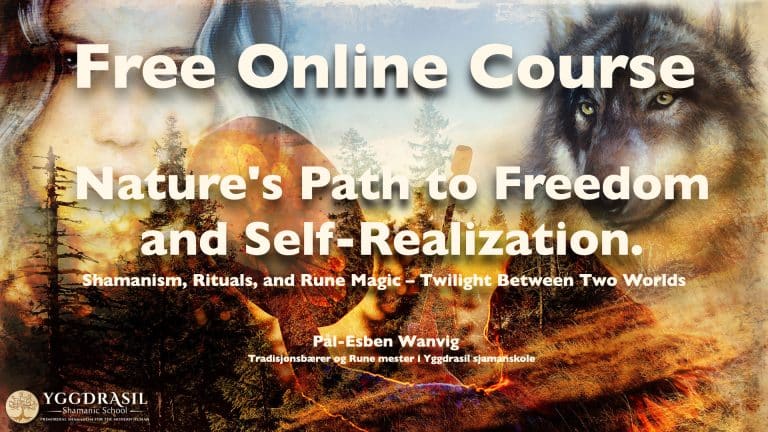
Nature’s Path to Freedom and Self-Realization
Curious about what primordial shamanism really is, behind the mystique and the misconceptions? In this short online course I tell the story of my own path from skeptical engineer to teacher of primordial shamanism, and give you a first introduction to what I teach: what shamanism and primordial shamanism are and are not, how rituals and rune magic are used in practice, and why the longing for growth matters so much for a good life.
The lessons are recorded in Norwegian; the English version will be ready in November or December 2026. Leave your email on the course page, and I will tell you when it is.