Episode 26 – The 8 Primordial Shamanic Seasonal Rituals – Nature’s Path to Deep Transformation
When Pål-Esben asks burnt-out clients to sit for half an hour a day doing absolutely nothing, most of them can’t manage more than two or three minutes before they’re climbing the walls. And a baroness in burnout, a client of his wife’s, only began to calm her chaos once she had one phone for her children’s group chats and a five-minute daily limit on social media on her private phone.
In this twenty-sixth episode, Amina and her teacher and guide, Pål-Esben Wanvig, talk about the eight seasonal rituals and how their tradition uses them, not only as cultural celebrations, but as magic for deep personality development and spiritual development. They explore nature as the blueprint for healthy rhythms, the being of each season, and the wheel of the year from Samhain to Samhain. It is part of “The Journey to Self-Realization”, a podcast about the bravest journey a human being can set out on: the journey home to yourself.
This episode is an English translation of our Norwegian original, voiced by the digital avatars of Pål-Esben and Amina.
In this episode
- Nature as the blueprint for healthy rhythms, and why the chaos music of modern life makes us ill
- Forest bathing as the first step, Amina’s first awkward attempts, and the art of doing absolutely nothing for half an hour
- A simple tree exercise with threads of light, and finding the kind of nature that suits you
- From cultural celebration to magic: two to five life themes carried through a whole cycle of the year, and Amina’s primal fear
- The music and the being of each season, and what Amina experiences when she makes contact with it
- Resistance, choice and the help of a guide, and the baroness who got a second phone
- The wheel of the year from Samhain to Samhain, the balance of yin and yang, and a simple ritual for letting go at the autumn equinox
- What separates entertainment from real change, and how the seasonal beings relate to Mother Earth
This podcast is for you if you:
- Seek real depth in your spiritual practice
- Want to understand yourself on a more fundamental level
- Are curious about shamanism but tired of superficial “new age” spirituality
- Have taken many alternative courses but still feel that something is missing
- Feel an inner longing for freedom, love and wholeness
In a time when so many get lost in external methods and promises of quick fixes, this podcast invites you back to the only place where true answers can be found: your own heart.
Listen above, or read the full conversation below.
Transcript
A warm welcome to the podcast “The Journey to Self-Realization”, a primordial shamanic journey of development back to your true nature. This podcast is a collaboration with our favourite magazine, the health and lifestyle magazine Medium, and is devoted to exploring the bravest journey a human being can set out on: the journey home to oneself. We follow Amina, a student at the Yggdrasil Shamanic School, as she goes through a deep primordial shamanic process of development together with her guide and teacher Pål-Esben. It is a raw, unpolished journey of discovery towards true joy in life, deeper meaning, and a life that truly feels good to live.
This episode is an English translation of our Norwegian original, voiced by the digital avatars of Pål-Esben and Amina.
Pål-Esben: Hi, Amina, and a warm welcome to a new episode.
Amina: Hi, Pål-Esben. Thank you, likewise.
Pål-Esben: A warm welcome to you too, dear listener. Today we’re going to talk about a very interesting topic that has to do with the eight seasonal rituals. Yes, we’re going to discuss how we use the seasonal rituals in our tradition in connection with deep personality development and deep spiritual development, as an important part of this profound primordial shamanic process of development we’ve been talking about since episode 1 of our podcast.
And we’ll try to explain a little about the difference between the ordinary use of the seasonal rituals and the magical use of them, which is truly spectacular. And we’ll hear some experiences, Amina, of what has happened when we begin to engage with these things.
Nature’s rhythms as the blueprint
Pål-Esben: But perhaps we should start by talking a little about rhythms in general. The seasons are, after all, the most powerful rhythms we humans observe on this planet. We have summer, autumn, spring, winter, the whole cycle, and they’re very archetypal rhythms that nature shows us through a year and a cycle of the year.
Right at the start of a shaman’s process of development, at least yours, we begin to talk about the rhythms in nature, and about nature showing us the blueprint for the healthy rhythms. And what does that mean? Well, through our imprints, through our traumas and through our ways of living, we humans have moved further and further and further away from these natural rhythms. And that’s the reason we’re stressed, that we’re depressed, that we’re burnt out, that we have illnesses, and whatever else it may be. Our body and our psyche no longer swing with the natural, healthy, healing rhythms that nature shows us.
And as a shaman, you learn from the start that nature has the answer to most things. The art is to learn to understand how nature has the answer to most things, and not least to learn to make use of nature, so that you yourself can create that understanding and that healing.
Forest bathing: the first encounter
Pål-Esben: So when we start out in our tradition, right at the very beginning, the students are invited to begin using the forest. We call it forest bathing, Shinrin-yoku. And that was a bit of a challenge in itself at the start, wasn’t it, Amina? Just something as simple as going out into the forest without a phone, without talking to anyone, without an agenda, just being present with nature. That was a bit difficult at the start.
Amina: Yes, absolutely. I remember the first few times I tried it. I’d started using nature when I began at the Yggdrasil Shamanic School, but not in that way. Back then it was more mountain hikes and walks with friends and that sort of thing. But when it came to actually being with nature, being fully and completely present, I found it a bit uncomfortable.
I didn’t know what to do, I didn’t know what to look for, I didn’t know what to feel. I also remember having a kind of autopilot. As I walked, I’d suddenly just have to check where my phone was, that automatic thing: now I have to check the time, now I have to check this, now I have to check that. And not least all the thoughts that started coming when things were quiet. Because here I am, about to make contact with nature, make contact with the forest, and then I’m sitting there thinking about what to have for dinner, and then I realise that’s not really what I’m supposed to be doing.
It was a bit tiring. But I’m very glad I didn’t give up, and that at some point I simply accepted: this is how it is right now. This is how it is right now. I think that was also part of what helped me, and, for my part, using a bit of discipline at the beginning, until it became more of a longing to go into the forest: now I want to go to the forest. Now nature is calling me.
And the experiences you have from being in nature, being with nature, sitting against a tree, walking in the forest, are terribly hard to pass on. You really have to try it yourself. Because it can be really life-changing.
The art of doing nothing
Pål-Esben: Yes. And it’s very curious to observe the modern human being: how far removed we are from what’s natural, how far removed we are from nature itself. We shut ourselves up in our bunkers and sit under artificial light, and we’re so far from the natural rhythms in nature: the autumn, when we begin to let go; the winter, when we slow down; then comes the spring, when we gear up a little again; and the summer, when there’s full action; and then we’re back to letting go, and then into rest.
The modern human being runs flat out all the time. Flat out, constantly. And when you do stop for a moment, you’re scrolling through your feed on TikTok or Instagram. Just getting a modern human being who comes to me, for example in burnout, to sit for half an hour a day and do nothing is very, very difficult. They often get very irritated with me: “Yes, but then I’m wasting half an hour. I can’t do anything in that half hour. Am I really just supposed to sit there, Pål-Esben, staring at the wall and doing nothing?”
Yes, exactly. It’s called chilling out. Teenagers are experts at it. So if you have teenagers at home, you can study them. They know what chilling out means.
Amina: Yes, but I don’t think I’m ready for that, Pål-Esben.
Pål-Esben: No, you’re to sit there and do absolutely nothing. That means you’re not to think, you’re not to plan, you’re not to do anything at all. You’re not to listen to the podcast, you’re not to watch TV. You’re just to sit there and do absolutely nothing. That’s one of the tasks I give them. And most of them can’t manage more than two or three minutes before they’re climbing the walls. Many have reached the point where they’re really furious with me, because I tell them that this is so important for getting back on their feet and getting well again.
So that says something about how ill the modern human being is, and how far we are from nature and the natural rhythms. We humans did, after all, arise from nature. Without Mother Earth, and everything she gives us, from minerals to carbon and so on, our body wouldn’t exist. We couldn’t have existed without Mother Earth. The building blocks in us humans, that is, our physical body, come from Mother Earth. And when we die, the building blocks go back to Mother Earth and are recycled, and something new arises.
We come from harmony
Pål-Esben: So we can say that we come from a place where the rhythm is harmony and is perfect. And what are perfect rhythms? Well, it’s very easy to observe when you walk in a healthy forest, for example, or in a healthy landscape. You see how the landscape exists in harmony with itself. You never have a tree thinking: oh no, I don’t like that other tree over there, so let me try to finish it off and elbow it out of the way. No, they live in harmony with each other, they live in symbiosis with each other. They’re nourished by each other’s rhythms, and this is a harmonious interplay.
And then we look at the modern human being in our society, where it’s the exact opposite. And then people wonder why they’re ill. Why are we physiologically ill? Why are we psychologically ill? Why are we stressed? Why do we have anxiety? Why do we have depression? And so on.
From my point of view, the main reason is that we’re so far from the natural rhythms. Our internal rhythms are like a kind of chaos music. It’s what you might call death-metal chaos. And when you walk in nature, you have the harmonious music, the vibration, like a symphony orchestra.
The core rhythm and the chaos music
Pål-Esben: And then there’s our core rhythm, which we’re born with into this world when we come in as children. We’re like that picture you may have seen of joyful children, so closely connected with their soul in the first months of life. That core rhythm, the basic vibration we’re born with, which is connected to our spiritual heritage and connected with our soul, is close to 100 percent genuine. Close to 100 percent symphony orchestra. Close to 100 percent in tune with the rhythms that Mother Earth and nature show us.
So that’s where we’re perfect. We have a full connection with what we are, even though our user interface, that is, our brain, isn’t yet developed enough to interact with this and understand the world. But that’s another matter; it comes gradually as we grow up.
Then we go through our childhood, and we get imprinted. Our parents say: that’s good, that’s not good. This is how you should do it, this is how you shouldn’t. No, we don’t do that in our family. And then we run into problems with events that make us create compensatory mechanisms. In other words, parts of ourselves are suppressed by our surroundings. Our parents, for example, don’t give us enough love or attention, and then our own process of suppressing parts of ourselves begins, compensatory mechanisms begin, and eventually it’s mostly just tangles and chaos rhythms that come out of it.
That’s the reason we live in a society that’s ill, with all these illnesses and all the madness we have. If we look at a society or a culture that’s closely connected with Mother Earth and the natural rhythms, if we look at the older cultures, the indigenous cultures, such as the Aboriginal peoples a few thousand years ago, before the white man came in and destroyed the whole thing, we find that words for anxiety and depression and these things don’t exist in a culture like that.
So it’s connected to this: when a culture and a human being are in harmony and in step with the natural rhythms that nature shows us, illness can’t exist. Mental illness, emotional illness, anxiety and so on can’t exist. That’s the main problem of our world today.
That’s why, as shamans, one of the important foundations we work with is learning to use nature, so that we can bathe in the natural rhythms and gradually let more of them rub off on us and replace the chaos music in us. Just to put it very simply.
How did you experience it, Amina? Going from having this chaos music, which we’ve talked about throughout the podcast, to gradually beginning to make peace with nature: making peace with being in nature, making peace with being able to sit for half an hour with a tree and be with a tree. How did this affect the chaos in you?
Amina: To a very, very great extent. I noticed that it became easier and easier to centre myself in myself during the day. Getting that little break, or that presence with myself, also meant I quickly noticed that I had more stamina. I could get more done, or rather, I had more to draw on, more petrol in the tank, and not least more of that inner peace.
And not least, I remember at the beginning, in those situations where I felt: oh, this is a bit much now, it’s been a bit much lately. Then I knew I could go and sit down by a tree, be with a tree and settle there. So for me it’s been hugely important, a hugely important resource, and you really mustn’t underestimate the effect of it.
Because I also notice, when I talk to people and suggest that maybe we should try using nature a bit more, walking in nature a bit, I get answers like: “Yes, yes, but we all know fresh air is good for you.” Then I have to explain that, OK, we’re actually going deeper here. No, that’s not what we’re talking about; it’s so much more than that. It’s a kind of inner calm, inner peace, presence. You simply feel recharged.
We’re very preoccupied with stimulants and things that can make us feel good. The best medicine I’ve tried is actually nature. Now it’s starting to sound a bit like a revival meeting, but it really is like that.
The counterweight: an hour in nature
Pål-Esben: Yes, at any rate it’s the simplest way to create a counterweight to the chaos. In the world we live in today, chaos is part of it, and it’s only getting stronger and stronger. Take an example: we watch the news several times a day. What kind of chaos do you think arises in you when you see this chaos in the world, with war and conflict, which creates unrest and fear? It creates tremendous chaos in the music going on inside a human being.
Another form of chaos we expose ourselves to, often for hours a day, is scrolling through our feed on Instagram and TikTok, which gives us brain rot and other chaos in the emotional system, which in turn creates even more chaos music in us.
And then you make a choice, because it’s a choice you have to make here, perhaps to cut down a little on what you spend a great deal of time on, the news and the scrolling and these things, and to take an hour a day from that time and try to start using nature as a counterweight. And then it’s a matter of understanding how we use nature. It isn’t about going out to get some fresh air or taking the dog for a walk, because that will give very, very little of the effects we’re talking about.
You need to be alone. You need to sit still, or walk calmly: walk slowly and be present with nature. And through that, as you practise this connection with nature and with the grass and the stones and the trees, it gradually begins to rub off on you more and more.
At the start it’ll be the way it was for you, won’t it: you go out, and you get a reset. You calm your whole system down. And then you go back to the chaos again. And then a few weeks pass, a few months, until you begin to think: hm, when I’m out in the forest, I feel this incredible calm. What can I actually do in my daily life to bring more calm with me into it? And that’s when the exciting process begins in a human being.
Amina: Oh yes, absolutely. I really recognise myself in that. And gradually I notice that I’m becoming more of that calm myself. It isn’t like: oh, now I have to run out into nature. I can more easily shift into the feeling of what it’s like to be out in nature, what it’s like to sit on the mountain where I sit. The calm becomes more a part of me in everyday life, yes.
How to do it in practice: the tree exercise
Pål-Esben: And just as an example, if you as a listener are wondering how to do this in practice: it’s really very uncomplicated. First of all: wear enough clothes so you don’t get cold, at least if it’s autumn or winter. Leave your mobile phone and all those things at home, and if you feel you need to have your phone with you in case something happens, then at least switch on flight mode, so it’s disconnected, and put it in your rucksack.
And then you find yourself a place in the forest, or in nature. It could be on the smooth rocks by the shore, it could be by the sea, it could be in a forest or by a stream, whatever it may be. But it should preferably be a place where nature is reasonably healthy. Sitting in a part of nature that’s unhealthy, unhealthy because of toxins, poisoning, acid rain and that sort of thing, won’t work very well. Sitting in a part of the forest that’s dead won’t work well, for example. It won’t work. So we need a place with reasonably healthy nature. It can also work in a park, for example, if you live in the city. And ideally, of course, it’s in a forest, or a little away from where people live and go about their business.
And then you just go in until you find a place where you feel: this is where I want to sit down. It could be by a rock, by a stream, or perhaps by a tree you find. Feel free to bring a camping mat or something similar. If it’s a tree you sit by, you sit on the camping mat. Comfortable, perhaps with a cushion or two. There’s nothing wrong with making this comfortable for yourself. It doesn’t all have to be about discipline. If you like bringing a camping chair, you can put it in your rucksack. Whatever it is: make it comfortable for yourself.
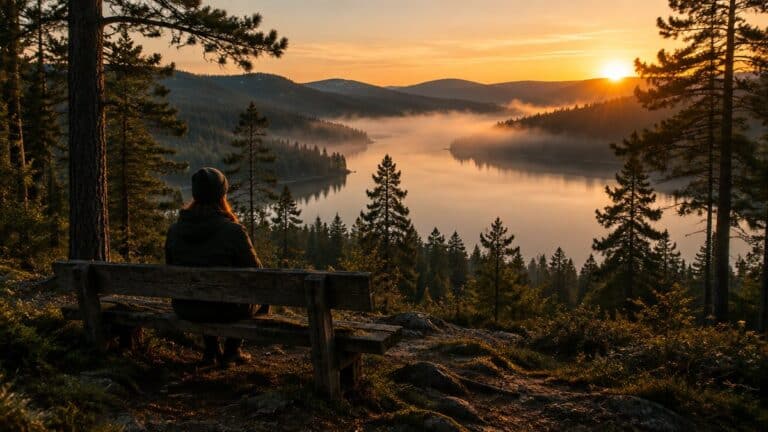
So take this example: you sit down by a tree, with your back against the tree. Then you close your eyes, focus your breath in the lower part of your belly, and feel how you breathe comfortably and slowly in and out. You calm your system down and try to come back to the here and now.
And when you’ve perhaps sat there for a minute or two in this setting, you can imagine small threads of light going out of your body, out of your energy system. Many, many thousands of small threads of light. They go towards the tree, into the tree. They go into all the grass around you, into the stones around you, into other trees around you. You connect yourself with nature where you are, and with the nature around you.
And when you visualise these small threads of light going out of your body, and you have the intention of making contact with all the leaves, all the blades of grass, the soil, the stones and the trees around you, then after a very, very short time you’ll feel a very pleasant kind of connection and calm arising.
And when you’ve sat there for four or five minutes, and you feel that you’re present with the grass, with the trees, with the wind, with the sun and everything you have around you, all the elements, then you can picture yourself focusing on the tree you’re sitting by, and directing your attention towards going into deep resonance with the tree. You feel the tree enveloping you more and more, filling you with its grounding, centring, healing energy. And perhaps after a while you experience disappearing into the tree and becoming part of the tree, for example.
This is a completely basic way of making contact with nature. And it simply can’t happen when you’re wandering about to get some exercise, or walking the dog, or walking along with music in your ears. It can’t happen. It has to happen in this kind of setting. And that’s what you did, isn’t it? Wasn’t it something similar you did at the start?
Finding the right natural atmosphere
Amina: Yes, absolutely. I had a favourite tree that I became good friends with, and it was really, really lovely. That’s how I began. And it wasn’t easy at the beginning. I noticed that for some people it’s easier to make that contact than for others. But it wasn’t easy. But as I mentioned earlier, I didn’t give up. And I think that was absolutely decisive for me: that I at least didn’t give in to the thought that this isn’t for me.
And then, of course, some people prefer the sea to being in the middle of the forest, and so on. Some people like mountains. So it’s about finding the kind of natural atmosphere that suits you.
Pål-Esben: Exactly. Some people like swimming. Some swim outdoors all year round; I have several students who swim outdoors all year round. Impressive stuff. It isn’t my thing. I like the sauna, I like warmth. So I’m actually living in the wrong place here. I wish I lived somewhere even warmer than here. Perhaps later in life.
So anyway: you find a place where you can do these things. And with a bit of practice, my experience through many, many years with several thousand students is this: everyone I’ve seen who really does this has had mega results, with a deeper calm in their life, more of a handle on whatever triggers fear and anxiety and unrest, and many, many other positive side effects.
The research and the water crystals
Pål-Esben: And the Japanese have studied this a great deal, and they call it Shinrin-yoku. Within Shinrin-yoku a lot of research has been done on what happens to blood pressure and the immune system and ADHD and all sorts of things. I’ve written an article on my website about forest bathing, where I give all the references you can follow up.
It’s absolutely wild what happens on the day a human being really learns to make use of nature in connection with the healthy, vital rhythms that nature shows us. And then it’s easy to understand: the more you do this, the more of these natural, beautiful blueprint rhythms will begin to rub off on our own rhythms, and the less chaos music there will be.
It’s like when you look at the pictures by Masaru Emoto, where he photographs water crystals, ice that’s melting, right at the moment of melting, and you see what the water crystals look like when it’s fresh water, perhaps from a spring, or water that someone has treated with love, compared with water that’s unhealthy or has been exposed to very negative emotions. It’s almost frightening.
And then we can think: what do you think the water crystals inside us look like when there’s chaos? Not beautiful water crystals; that’s very easy to understand. They look like those dark, black lumps in the pictures. And if you, dear listener, haven’t seen these pictures by Masaru Emoto: search on Google, and you’ll see them. Very, very exciting, and also frightening.
Because we consist of about 70 percent water, after all, and if our water crystals look as if death metal has been played to the water, perhaps it’s not so strange that we’re not laying the foundation for being healthy, happy, joyful beings.
The seasons as archetypal rhythms
Pål-Esben: So that’s the basis, that’s the foundation for what we’re talking about now that we’re going to start discussing the seasonal rhythms, the seasonal rituals. Because you need to have a good idea of these things before you start engaging with the seasonal rituals, at least in our way.
Because the power of the seasons, as we touched on at the start, is that they show the archetypal, basic rhythms that nature changes with through a cycle of the year. And if we look at this from the eagle’s perspective, we see that what we’re built from, what we come from, what has created our physical body, that is, Mother Earth and her healthy rhythms, cycles continuously between activity, rest, regeneration and letting go. An important part of nature.
Take autumn as an example. Then things begin to slow down a little, and we begin to think about nature letting go of the leaves and those things. And what does that mean for us? Well, that we sit down and think: what do I need to let go of? Typical clearing out: what do I need to throw out of the attic? What do I need to let go of when it comes to my negative belief systems and those things?
And then we come into winter, when nature and the trees rest and regenerate. For us humans, that means we slow the pace and seek regeneration and calm. After that, nature begins to wake up again, and we have spring: the leaves begin to burst out. Then we have summer, when there’s full action, when the plants and trees explode into fruit and so on. And then we have autumn, when we harvest, when the trees and nature give up their grain, their apples and so on, which we can use. And then we begin the autumn by letting go.
That’s nature’s cycle.
The modern day
Pål-Esben: And how is it with us modern humans? At least the ones I’ve met; I don’t know how it is for you, Amina. But most of the people I’ve met over the last two decades are so far from these natural rhythms. They’re so far away.
Because this is how it is: you wake up in the morning, involuntarily, to the alarm clock at six o’clock. Then you have to make sure the kids get up, then they have to be fed, and then they have to be driven to nursery or school. It’s often a logistical nightmare in the morning for many parents. Then we have to go to work. After work we have to bring a bit of work home with us, because of course that’s natural in our society. And after work, once we’ve done a bit of work, we have our social activities: we go to sports practice, we go to the gym, we play golf, we do whatever it is. Then we have to have time for friends and family and partner and the whole lot. And then we collapse into bed at eleven o’clock again, and then the whole treadmill starts up once more. And on top of that, we have to fit in four hours of Instagram and TikTok and YouTube, which also creates chaos in the head and the system.
And then we ask ourselves why the modern human being has problems with their health and their psyche. We’ve come so far away from this cycle that nature shows us, which is the blueprint for what health is, what being well is, what healthy rhythms are.
And through our society we’ve drifted further and further away, until we have summer more or less around the clock. Of course that means we have trouble sleeping. We have trouble getting deep sleep. Our sleep cycles are very, very poor, so we don’t regenerate at night, because there’s too much stress and chaos music. And then we wake up completely wrecked in the morning and start the round again. And that’s how it goes, again and again, week after week, month after month, year after year, and then people ask why they get ill. Hello?
From cultural celebration to magical use
Pål-Esben: So when we’re going to inspire people to break this cycle, we start with these things: forest bathing and getting to know nature. And when we have advanced shamans, only then do we begin to look directly at the seasonal rituals.
Because the seasonal rituals are something we’ve had through our culture, and the cultures of the world, for thousands of years. Humanity has celebrated these festivals, summer and autumn and spring and so on, as important social and cultural events, where people have harvest festivals, where people come together and make contact with their ancestors, and so on. It’s something that lies in our culture.
We call that the social and cultural way of celebrating these rituals, which has been important for human beings for a very long time. But we, at least in our tradition, go much further here. We’re not so very focused on the cultural aspects; we’re focused on the magical aspects of each season. We use that in radical forms of personality development and spiritual development.
And you’ve begun to experience these things. When I say radical steps of development: when you connect the understanding with the season, and with the magic that lies behind the season, which the season shows us, and which we can talk a little about later, it has a gigantic impact on a human being who goes through it.
Amina: Yes, definitely. And when I talk about this, I don’t quite know where to start. Because understanding is one thing. I’m now completing my second seasonal cycle with the seasonal rituals together with you, and I’m now starting on my third. And I notice that every time I’ve thought I’ve understood what this season is about, there’s so much more there. It’s so much deeper.
For me there have been real aha moments, where I’ve got to see and experience how nature actually mirrors us. We can see ourselves reflected in nature, in the form of the healthy rhythms, in the form of: what does it really mean to let go? What does it really mean to rest? What does it really mean to be joyful? Those things.
So it has given me a deeper foundation, a deeper understanding of what this is really about, and not least of where it hits home in my own life. Today I can feel that if I make contact with a season, with a seasonal being, I can often see very clearly where I’m perhaps not quite in step with it, and where I am in step with it. It works as a very good mirror for me, and it’s something so deeply rooted in nature. It’s incredibly magical.
And not only that: there are also these big life themes that I carry with me through a whole seasonal cycle, and I really see them. I was thinking about it yesterday: it’s the themes we bring into the seasonal ritual, the magic we do, that give me a real focus on these big life themes through nature’s healthy rhythms, through the very essence of nature. And I don’t think there’s a single theme I’ve worked with that hasn’t come to fulfilment, if you can put it that way. But it has also taken work. We’ve worked through these themes over a whole year, a seasonal cycle.
The cycle of the year as a pulling force: the themes
Pål-Esben: Yes. And in shamanism there are many ways of celebrating seasonal rituals. Normally people gather, and then they form a circle, and then they drum a bit, and then they sing a bit, and then perhaps they talk a little about the season. And then, for example, they give up whatever they need to give up during the ritual, and seek to receive what they need. Completely standard.
But in our tradition it’s about something else. What we use the seasonal rituals for with advanced shamans, who have understood the foundation of what we’re talking about, and who already have a connection with nature through what we’ve discussed so far, is this: we use a seasonal cycle, from Samhain, which is around 1 November, to the next Samhain the following year, as a tremendous pulling force for our own profound process of development.
That means we use it actively in connection with a process of development over twelve months. When we start at Samhain, around 1 November, the students are told to pick out two to five important, important themes they want to engage with through a cycle of the year: themes that are important, and that they’re really ready to engage with.
Can you give an example of a theme you’ve carried with you, or that has been important to you in such a cycle of the year?
Amina: Lots of important themes. But when you ask me now, it’s definitely the help I’ve had in healing my primal fear. Those who know my story know that I’ve carried an enormous fear with me that has been completely paralysing. And it’s been a bit of a rollercoaster, up and down: OK, now I’ve felt I’m on track, and then I wasn’t quite. It’s been something I’ve struggled with a great deal, and that I now feel, wow, has really landed.
So that’s been one of the most important things. But there have been several other important things too: calming down, and always having contact with this anchor of mine throughout the day. That has also been a very important theme for me, and today I actually have this anchor, and my fear no longer takes hold of me. So that’s been one of the most important for me, but I’ve worked with several things as well.
Pål-Esben: As examples: some people bring themes about their health. Some bring themes about a relationship they have, or a relationship they want to create. Some bring themes about financial stability. Themes that are important to the person, materially, but also spiritually and emotionally.
So that’s the first thing you need to spend a few weeks on: finding out what I’m ready for and want to commit myself to over the next twelve months, in the next cycle. That’s the foundation the shaman brings in here. And when you look at this from the eagle’s perspective, when you connect with these tremendous forces that show themselves through the season, you get a massive boost through a twelve-month cycle of the year, in connection with, among other things, the themes you bring in with you.
Deeper contact: the music of the season
Pål-Esben: That’s the first thing we have. The second, which is a little challenging at the start, is finding a deeper contact with nature. And here I’m talking about the nature we have around us: a deeper contact with the season.
Let’s take autumn as an example. It’s one thing to have an intellectual idea that in autumn the trees let go of their leaves, and that this means: aha, perhaps I should think through what I’m going to let go of. That would be a very intellectual, cognitive way of relating to this, which of course has a small effect, but nowhere near the power that’s possible.
So how can you experience these letting-go forces in nature? After all, it’s only through experiencing something that we can really begin to understand it. We can read a hundred books about strawberries and the taste of strawberries, but it’s only when we sink our teeth into the strawberry that we really understand what it’s about.
So then the student, or the shaman, is inspired to be out in nature often enough around the season to observe with their body what’s happening. Not just that the leaves fall and the colours change, but how do the vibration and the music of the trees and nature change? Because a musical change of vibration takes place in nature, which changes gradually through the whole cycle of the year and the seasonal rituals we have.
That’s the next step we’re talking about for advanced shamans, who already have a connection with nature through forest bathing and those things. Then you’re sent out on a quest: to begin listening to this music, getting to know this music, going into resonance with this music. In addition, you let the leaves and the colours become part of you: how they fall from the trees, how they change colour, and so on. You bathe actively in this, but you also need to become more and more observant of this feeling of vibration and music, which in this case is archetypal for autumn.
And it’s a bit tricky at the start, isn’t it, Amina? I told you about this in the first cycle. What did you think then?
Amina: Well, I thought that I’d got well under way with forest bathing and that kind of thing, so I walked in nature and thought I’d understood it. But that’s how it is at the beginning, and it almost has to be like that, also so that you can see your own gradual development. So I actually think it’s quite beautiful. Even though I joke a bit today: whoa, I thought I understood something two years ago. I don’t say that in a mocking way, but in a rather sweet way, because it’s a beautiful process.
I remember going out into the forest and sitting down by a tree, and: oh, now the leaves are falling. And as you said, they change colour, and when they let go, what can I let go of? And it felt very right there and then. I did the best I could, and thought I’d really made deep contact. And I had made as deep a contact as I could at that point. But I really see the development since then; today I feel it in a very different way.
Putting it into words is terribly difficult, but it makes me reflect in a completely different way, as I touched on a moment ago. It allows me to get in sync in a completely different way. And it requires you to be willing to do that, and not just go out and do it to get something back, a bit like: whoa, what can you show me now, what can I grab for myself here? But also to try to become friends with nature, to become friends with the season.
At any rate, that’s been very important for me: that it hasn’t just been something I’m going to grab, but how we move in step together, how I can see myself reflected in this season, and what the season can show me, something that goes much deeper than just letting go. I don’t know if that makes sense, but some things are very difficult to explain, Pål-Esben.
The being of the season
Pål-Esben: They are, they are. And what we’re talking about here now is what nature offers us, and it’s really insanely far beyond the imagination of the modern human being. You can imagine: OK, I hear what you’re saying, sitting down by a tree and letting the threads of light go out and feeling calm. You can imagine that. But what we’re talking about now is very hard to imagine, because it requires experience. We need to experience it as well.
We’re fumbling for words a bit here, trying to get it out as best we can, and we’re beginning to move into an area that’s hard to describe. But the simplest way to describe it, intellectually, is that the vibration and the music of nature change quite considerably with each season.
And that’s really what Amina is talking about here: when you begin to make deeper contact, you go into a deeper harmony and resonance with the unique vibration and the unique music, we’ll use that word, which in this case autumn radiates, the trees radiate, nature radiates.
And what happens then is something magical. Because then something opens up: the contact with the being of the season. And that’s something beyond spectacular. Because when we talk about a being here, it isn’t about a being of light or power animals and that sort of thing. It’s a completely different kind of being: a very archetypal being, a tremendously powerful being, which you almost get sucked into once you’ve found this rhythm. And that power is beyond tremendous.
And when the shaman has begun to get contact with this force field, this being that’s connected to autumn, and has begun to get reference experiences of it, then you can begin to bring these vibrations and this music and this power into your own rituals, which are connected to your themes for the year. And that’s when it starts to get really interesting.
Then we begin to drift far away from the cultural and ordinary aspect of a seasonal ritual or a season. Then we begin to drift into the more powerful magic that each season really shows us, if we go from being blind to beginning to see.
And this process isn’t something you can do intellectually. It’s something you do through a tailor-made process of development, which we use in our seasonal rituals, and which guides the shaman into the inner states that are needed to find the frequency and the vibration and the music of the season and the being of the season, in this case autumn.
So how do you experience it now, when you have some experience? When you go out in autumn and sit down by a tree and are simply tuned in, you’ll notice something different from what you noticed at the start, when you began forest bathing. There’s a pulling force, a kind of gravitational force, which can feel tremendously intense. Isn’t that so?
Amina: Yes. When I make contact with the seasonal being now, it’s like being sucked into a completely different world.
Pål-Esben: I’m really glad you can put this into words, Amina.
Amina: Because this is hard to explain. But something quite spectacular happens: really becoming one with something so subtle, so deep, so beautiful, but at the same time so powerful. And all of us humans have this within us. Everyone has access to it. That’s what’s so beautiful. As I explain it now, it almost sounds as if I picked some mushrooms on that walk. No, I didn’t. I’ve just really, really made contact, and I wish everyone could get to feel it.
Right in front of our noses
Pål-Esben: And the magical thing is that it lies right in front of every human being’s nose. The way to becoming well, the way to becoming content, the way to becoming happy, the way to becoming joyful lies right in front of our noses. All we have to do is open the door, go out and learn how to connect ourselves back to what’s natural.
Then you’ll experience what we talked about in an earlier episode about the soul: the elite university for souls, which is what this planet is. The soul and our higher self come here to learn in a state where you aren’t what you are: where you’re blind, where you’re deaf, where you have none of the senses you normally have in a state of soul and higher self.
That means we come into a straitjacket: one of the most complex places in this universe for a soul to incarnate, since we don’t have access to the resources we have in our free state.
But the soul isn’t foolish and stupid. It doesn’t put itself in a setting that’s hopeless. It puts itself in a setting where the solutions to the straitjacket actually lie right in front of our noses, continuously. In addition to all the helpers we have around us: guides and power animals and soul family and all these things around us, thousands of them.
So we’re not here alone. You as a soul don’t dump yourself in here, blind and deaf and mute, without any contact whatsoever, without there being resources to help you out of the straitjacket.
It’s just that the modern human being is so confused, so chaotic, so far from their beautiful symphony orchestras. They’re playing death metal in their system all the time, chaos music. Because people stress their way from one thing to the next, and in between, while they’re sitting and eating, they have to go through their TikTok feed and turn into a complete zombie. Watching the modern human being eat a meal or sit in a restaurant today is frightening. And many sit on the toilet and have to scroll while they do their business, so to speak.
Well, but I’m a bit removed from these things, so I have neither TikTok nor any of the rest of it. I switch on my mobile phone once a month, or perhaps every other month. That’s a choice I’ve made; you survive without a mobile phone too. But that’s extreme, of course.
So I find it very fascinating when I observe people: families sitting and eating, where every one of them is sitting on their phone, scrolling while they eat. And then I think: how sick is this? And then people wonder why they’re sad and ill and stressed and have anxiety and don’t sleep at night and those things.
The choice and the resistance
Pål-Esben: So it’s time for the modern human being to begin to wake up, in my eyes. Because the solution to all this hell and all these problems lies right there in front of our noses. But what makes it so difficult is that we aren’t willing to make the choices that are necessary. Because we have so much to do, you see. Sitting down for half an hour and doing nothing? No, that’s impossible. Then I get aggressive and anxious. And that’s a fact.
I’ve seen so many who come to me in burnout, whom I’ve given this exercise, just sitting down and doing nothing for half an hour, and I say: try doing this before we next talk. And when we next talk, say in two weeks, they’ve tried it, and then it’s very rare that they’re not stressed or furious with me. “How can you give me a task like that? This was terrible, this was awful, I didn’t want to. How can you tell me this is necessary for me?” And then people slip into a very aggressive mode, and there you see how ill they really are.
But some are willing to make the choices, and say: enough is enough now. Enough is enough now. Just as you did. You made a choice: enough is enough with this chaos. And then you begin gradually, slowly, to reunite with nature, through forest bathing and what we talked about at the start.
And if you then, for example, go into a profound process of development like the one you’ve been in, you’re gradually guided into what the season is, what the being of the season is, how we do magic with it, how we relate to Ouroboros and Jörmungand, which hold time, and so on. How you relate to these seasonal beings and these magical aspects and these incredible things, and bring them into your rituals, into your process of personality development and spiritual development. And then you have a turbo engine in your process of development. It’s like being pulled forward by a powerful locomotive.
Why should we make this so difficult for ourselves when it doesn’t need to be so terribly difficult? But to do it, we have to make the choice to begin to reorient ourselves: how do we want to live our life, and what should life be like? And that’s the hardest thing of all, in my experience of working with people. It isn’t understanding things; most people can do that. But making these choices, really making the choice and doing something other than what you’ve done so far, which has created chaos: that’s what’s difficult. Isn’t that so?
Amina: Yes. And I’m wondering whether it was about a year ago, a year and a half, I don’t quite remember, but you talked on a video conference about this business of resistance. Because very often we can feel: yes, well, but I have so much resistance, I don’t understand this resistance. And then you came down a bit like Thor’s hammer and said: but the truth is that you don’t want to.
And there I really caught myself. It’s something that has genuinely helped my life since that video conference, which really was a blow to the head, and to my understanding. Because every time I feel a bit of resistance: OK, you don’t want to, so be honest, then. Because very often this not-wanting-to is very hidden, very unconscious. But here I caught it: OK, Amina, you don’t want to. I really took that with me and began to look at it more closely, and not to let my resistance to what’s good for me steer me. Putting on my grown-up trousers and straightening my spine, the way you inspire us to, Pål-Esben, and actually making a choice. Because we can actually choose in so many more situations than we think.
Help along the way
Pål-Esben: And then you have to remember that you’ve also been in a setting where you’ve constantly been getting impulses. You’ve been getting impulses all the time because you’ve been in a training process. You get help from the guide.
Trying to do this process yourself is very, very difficult, since you reach the point where you come up with all the excuses: no, it’s so difficult for me, no, I haven’t got time for that, no, it isn’t possible for me, and so on. And the intellect and the ego and all the rest of it, and the straitjacket, the gravitational forces, are what more or less completely take over. It’s difficult to break out of on your own.
That’s why you go into a process of development together with a guide or teacher or mentor, who makes sure to give you the impulses you need: the knowledge, the motivation, the inspiration, the understanding. And then you get help to deal with your resistance when you reach that point and say: no, I can’t do this. I don’t want to do this. This is too much for me. No, I have so much to do. Then you get help to break through the barriers, and that’s what makes a profound process of development like the one you’re going through actually possible.
And you have to remember this too, if you’re sitting there now, after what we’ve talked about today, thinking that this sounds very difficult: yes, it can be difficult if you try to break out of the straitjacket yourself, out of the chaos music yourself. Because the chaos music has been there for more or less your whole life, from somewhere between the ages of 7 and 14, and then the chaos music plays tremendously loudly, on autopilot. And then it doesn’t matter how much of the blueprint is right in front of your nose.
Then it’s smart to put yourself in a setting where you get this help. In our tradition it goes like this: in the first cycle of the year, you go in and begin to experience these things through the basic training. And when you go further, into the senior shaman training, you’re linked into the seasonal rituals, and guided into what Jörmungand is, what time is, and what the relationship is between the four-dimensional world we live in and what lies beyond it.
And you’re connected to the path, to nature, to the deeper layers, to the beings and to the power and the magic that makes it work. You’re taken by the hand and guided into this. You don’t have to reinvent the wheel yourself. That’s the easiest way to do it.
Is it possible to do this yourself? Well, you can certainly try. It’s right in front of our noses, after all. The problem is that even though it lies right in front of our noses, nature and nature’s rhythms and all these things, it’s the chaos music, the stubbornness, the intellect and the fear that make it difficult. And then there’s the fact that it isn’t very easy to make choices about something that can be uncomfortable at the start: spending time in nature instead of being on TikTok.
It can be a gigantic thing for a person who’s addicted to their feed simply to leave their mobile phone at home for an hour. Just that is beyond difficult for most people, and it can be a main reason why they won’t even try. It’s an addiction mechanism, in the same way as when you’re addicted to drugs or alcohol or the like. The addiction mechanism is exactly the same, psychologically.
That’s what’s difficult here. Not that we don’t have the answers, but reaching the point where we’re able to push ourselves far enough that we’re willing to let go of our phone for an hour, as an example. To seek freedom where the natural, healthy rhythms are.
And you know this, of course. You have a mobile phone and use it, don’t you?
The phones: a true story
Amina: I do, I do. Guilty! It’s a good example of trial and error, and then some. I have phone-free pockets of time and days, but then you get forced into the system, especially when you have children. You have to be in the Facebook group, because that’s where they post all the updates. There’s football, there’s boxing, there’s the school band, there’s the parents’ evening, there’s one class, there’s the other class. And then you really get put to the test: not giving in to the temptations once you’ve gone in to check.
We live in a society where it’s voluntary in name but compulsory in practice, in a way. “Oh yes, well, no, I don’t have notifications switched on on my phone.” And then you’ve missed that your children suddenly have a trip tomorrow, that kind of thing. So it isn’t that simple. But it is actually possible too: to catch yourself and realise we don’t need to scroll all the way through, even if we have to pop in.
Pål-Esben: Of course. And right here there’s a rather fun story. My wife is a psychotherapist here in Germany and works a great deal with couples. She has couples ranging from top politicians in Germany to barons and baronesses and the whole lot. And it’s interesting to see: it’s mostly the same kinds of problems, whatever place you have in society. Whether you’re a pensioner or a student or a baroness or a top politician makes no difference. Same thing.
She has a couple here who are a baron and a baroness, so very high up socially, and they live in their castle outside where we live. They come in with their standard problems, which everyone has. And she, the baroness, was totally chaotic all the time, because she was so stressed. Burnout, typical burnout, and she had to be everywhere, with her phone and all those things.
And then my dear wife says: we need to switch this off. If you’re going to get well and come back to yourself now, you need to switch this off. And the baroness says: “Yes, but that’s not possible, because my children are there, so I have to be on WhatsApp and Facebook there to communicate with the kids.”
OK, says my dear wife, I understand that. So what you do is buy a cheap second-hand phone, and on it you install WhatsApp and whatever you need for your children. Then you have one phone for the children, where you communicate with other parents and whatever’s needed. And then you have your private phone, where you set a limit of five minutes a day on Instagram and TikTok and the rest.
At first she reacts very negatively, because she suddenly sees that there’s a solution that she doesn’t want. But she’s smart enough, and willing to try. I don’t think they bought a second-hand phone; they bought a new iPhone for her, and the old one became the phone for communication around the children, which is only used for those groups, and which she looks at in the morning and in the evening to keep up to date.
And for her it worked wonders. She could never have reached the point where she began to calm the madhouse in her head, her chaos, with the set-up she’d had until then. So that’s why I also say to parents: it is possible to have a healthier relationship with this, if you want to.
Amina: That was really inspiring. I hadn’t even thought of that myself. I’ve thought that, OK, maybe I should get myself one of those old phones without apps. And Erik, my partner, tried it the other day, and then he came home after a long day and was just: “It was impossible! I couldn’t park there, and then I had to go there, and there was an app for that too, and everything was on the phone I’d left at home. No, this doesn’t work.”
So I thought: that was a very good suggestion. Because then you have the phone where you go into the apps and whatever you have to do, perhaps you have to do marketing at work and that kind of thing, and check the apps, and then you have the other one, which is a bit like: here I can call and send messages. The important stuff, in a way: the phone for the people close to you. That was a very good tip.
Pål-Esben: So it does make it possible. The point is that it’s possible. And my dear wife deals with a lot of chaos in relationships, and it’s very striking when I hear the stories of what creates chaos for people. But this is something that comes up very, very often, especially among those who have kids, and it’s a handy trump card for saying it’s impossible to cut down on these things.
But I believe that to be able to get well, we need to do it. To get out of the problematic rhythms we’re in, which create the problems and the chaos, especially in our emotional system, we need to be willing to make choices.
And perhaps you do it, and then suddenly you have a couple of hours to spare in the day, if you stop scrolling mindlessly and making sure your brain rots. Because it actually does, literally, from scrolling through the TikTok feed and the like. I’ve just written an article about it, it’s called brain rot, about how the brain rots from using these things. Frightening stuff. The most up-to-date research shows that this is really destructive for the brain and the emotional system of a human being, and many experts say that this is one of the biggest problems we have in modern society, promoting mental and emotional illnesses. Frightening.
So when we make choices like that, if we’re willing to, we suddenly have an hour to spare, and why not invest it and begin to explore nature?
The wheel of the year: from Samhain to Samhain
Pål-Esben: And begin to explore nature in such a way that you also explore the season. If it’s autumn: go out and be fascinated by autumn. See how the leaves fall, and think: OK, if nature’s natural rhythms are about letting go just as much as about action, just as much as about rest and so on, then how is it with me? How good am I at letting go? And so on.
And gradually, once you’ve gone through the cycle of the year: you’ve experienced Samhain, which is the death ritual, the ending of the Dagaz of the previous cycle, but also the conception of the new cycle, where this child is conceived. In our magic, that’s where we conceive the process with our seasonal themes, and we bring in and manifest a part of our higher self that’s connected to the seasonal themes, which shows itself through a special kind of power animal that we relate to.
Then we move towards the winter solstice, towards Christmas and 21 December, when the sun turns. There we go through our eight holy nights, when we reflect on the runes we draw, which are connected to each of the major seasons ahead. And then we go into the winter solstice. This whole process is a process of maturing for what has been conceived, as we go deeper and deeper into calm, deeper and deeper into yin, which we experience to the maximum at the winter solstice, when Jörmungand and Ouroboros almost come to a complete standstill, and when, in our tradition, Freyja’s boar from Norse mythology, Hildisvíni, gives Jörmungand, the world serpent, a push again. And then the wheel of the year begins to move towards more and more yang.
Then we have Imbolc, which is around 1 February, when what has been conceived and matured has begun to grow: it comes up to the surface and is born. Then we go through the spring equinox, when the maturing kicks into action, and the growth kicks into action. Then we go through Beltane, which is really the most joyful and sensual ritual, when the growth is almost in top gear, and it reaches its zenith at the summer solstice.
Then we go through Lughnasa, which is the first harvest, when you begin to harvest from your experience and insight: harvest from what life has offered, what nature has offered. And then we come into the autumn equinox, where we have the great ritual for letting go, which is the last harvest ritual.
And that’s a very special point in time, because then yin and yang are exactly equally strong. And as for the moment when yin and yang are equally strong, it works like this: yin is at its maximum around the winter solstice, maximum yin, and then yang increases through Imbolc and on towards the spring equinox, there’s less yin, and when we come to the spring equinox, there’s exact balance between yin and yang. And in that period, when there’s balance between yin and yang, the veil between the metaphysical and the material is very, very thin, so it’s possible to do very special kinds of rituals around that time.
Then it becomes more and more yang towards Beltane, in May. You have maximum yang and minimum yin at the summer solstice, and that’s where everything turns the other way again, when there starts to be less yang and more yin. And then we come to the autumn equinox, when there’s again exact balance between yin and yang, and when the same kind of magic is possible as at the spring equinox. And so on.
And there are many, many, many facets to this cycle of the year, when we see it mystically and magically, which are totally spectacular once you begin to understand it. Because it gives opportunities for a kind of pulling force for finding your way back to the life we want to live: a pulling force that’s mega-powerful and really out of this world once you begin to get a grip on it.
Amina: Yes, it’s super, super exciting. And we’ve really only scratched the surface here. This is so exciting, and not least how you take us, your students, through every single seasonal ritual, but also the cycle: the depth of Samhain, the depth of the summer solstice, the depth of each individual season and each ritual. I’ve been in the so-called spiritual sphere, the esoteric sphere, but here you’ve served up so much on a silver platter that it’s just, well, very exciting.
Deeper into the rabbit hole
Pål-Esben: Exciting, and also important. Because it means the shaman has reached the point where it’s necessary to go deeper into the shamanic rabbit hole, deeper into the understanding of and contact with nature and what lies behind nature. It’s a natural part of a shaman’s process of development, in my eyes.
And of course, during each seasonal ritual we have a gigantic ritual that we do together, which I lead the shamans through in our tradition, and which connects into these force fields, which of course makes it all go even more smoothly. That’s how we do it in our tradition. And now you as a listener have an idea of what we mean. Seeing this socially and culturally is one thing. You can read on the internet what the autumn equinox stands for and what Samhain stands for, and the cultural meaning of it.
But these seasons offer so much more. They offer so much more that can help a human being find their way back to better health, to a better emotional state, to more joyfulness, to more meaning. It’s like when the tyre hits the tarmac and the acceleration kicks in at full power. That’s how it feels.
This was meant as inspiration: inspiration to really begin to use nature and connect with it, wholeheartedly. Because it has so much to offer. Besides its fruits, its leaves, the trees and the grass, it’s what lies behind all this that’s more exciting and rewarding than words can say, once you begin to get a grip on these things. Then you also begin to get into more advanced shamanism, which advanced shamans need to learn to master, wherever they are. As you’re doing, more and more.
Amina: Yes, this really is a spectacular journey, a spectacular process of development. The rabbit hole just gets deeper and deeper, and more joyful. I can only vouch for that: if you go to Pål-Esben’s website, you see a joyful child throwing leaves up into the air, fascinated as they fall down. And it actually is possible. Really. It’s absolutely fantastic.
A simple ritual to start with
Pål-Esben: That’s how it can feel, isn’t it. So if you’re completely new to these things, dear listener, I’d recommend beginning to observe nature a little more closely.
Take an example at the autumn equinox: go out and observe a little. See how the leaves fall and the colours change, and think to yourself: OK, what do I need to let go of in my life? Of routines, of thoughts, of behaviour, of odds and ends, of the time I spend on social media, or whatever it may be.
Then you sit down and write down perhaps two or three points you’re ready to let go of, and then you can start with a little ritual for yourself. If you have a fire pit or something like that, you can light it. If you don’t have access to a fire pit or this kind of fire, you can light a candle. And then you do this ritual by yourself, and perhaps you ask your guides to come and help you with the ritual. Because even if you haven’t been involved in shamanism and learned about it, you have your guides, you have your guardian angel, you have your helpers around you, whom you don’t see, but who are there.
Invite them into the ritual, ask them to help you. Read your list of what you’re ready to let go of, and ask the guides around you to help you let go. Picture yourself breathing it out, into the candle or the flame, actively letting go of it, as the first part of the ritual. And then you ask your guides to help you receive what you need to receive, in order to be able to let go, in order to be able to do these things. And then you picture the energy coming from the candle or the fire pit, into your heart, and filling you with this light and this power.
That can be the simplest way to do it, at home in your living room or your garden, to begin this process of getting closer to the season and to nature. You don’t need to make it very complex at the start. I think the most important thing is that you start.
Amina: Yes, that’s how I started too: burning slips of paper, and with the full moon and the new moon and that kind of ritual. It was a very good way to start. So it isn’t all or nothing. You do the best you can with what you have, and yes.
Pål-Esben: That’s what you do, isn’t it. Because it would be a bad choice to stay stuck, paralysed in the paralysis, and say: “Oh, I don’t know anything about this. Oh no, I wish I knew as much as Amina does now, and since I don’t understand what Amina does, it’s better not to do anything at all.” Start now by taking the first step instead. That’s the thing here: start by taking the first step, by beginning to use nature.
Perhaps you go to my website and read the articles I write about forest bathing, where you get recipes and the research that’s been done on it, for inspiration. Then you take the first steps, and then you take an hour a day in which you invest in a walk in nature, and then you’ve started a good cycle. Because it isn’t that difficult to start with. And remember: you weren’t where you are today either when you started.
Amina: No, not at all. Not at all.
What separates entertainment from real change
Pål-Esben: It’s a process of development we need to go through. And with the seasons, which we’ve now talked about a little on the surface: there’s a power in this that’s beyond anything a human being can imagine before they begin to experience it.
It’s an incredible power that can be used and harvested if you understand the magic behind it: harvested into your own rituals, harvested into everyday life. That means you can deal with people in a better way, and draw on the resources of the seasonal being and of nature in your everyday life: when you deal with your kids if that’s difficult, when you deal with a choice you have to make, when you deal with the meetings you have at work, and when you deal with your health situation. There are so many things this opens up possibilities for, which make the whole thing much easier than if you had to do everything manually.
So it’s well worth engaging with. And I love this: when I take my students into these cycles, and see what happens with you, and really with all the students who engage with it authentically. Because you can take part in this as entertainment, and then nothing happens, except that you’re entertained. But you can also engage with it authentically. And every single one of the students who does that gets incredibly good results, which I don’t think would be there without this form of magic and power, which you learn to harvest from the depths of these seasons.
Amina: That was poetically put.
Pål-Esben: Very poetically put, but is it important and true? At least as I experience it, and as my students experience it: what shows whether something holds water, or whether it’s bullshit, is how the person’s life changes in an objective way. That’s what separates quackery from the real work.
You can carry on with energy work and bang your drum until you get cramp. But if nothing changes in your life, if you don’t become a better human being, a more heart-centred human being, if your relationship doesn’t change for the better, if your health doesn’t change for the better, or if your relationship to anxiety, to fear, to depression, to joyfulness doesn’t change, if nothing changes objectively in your life, then what you’re doing is pastime and entertainment.
And there’s nothing wrong with entertainment; we all like entertainment. It’s good to go to the funfair now and then, and perhaps to Tusenfryd, the amusement park outside Oslo. But then you know that it’s an experience that’s joyful; going to Tusenfryd every day won’t help your life at all. So there’s nothing wrong with being entertained, or with doing something exciting and fun. But what we’re talking about is how a human being’s life can change for the better in an objective, practically measurable way. That’s what I define as the real work, and everything else is pleasant and fun, but counts as entertainment. That’s my opinion on it.
But it may well be that I’m more of a Stone Age type, without a mobile phone, and perhaps a slightly quirky Yoda figure, whom you don’t need to take all that seriously.
Amina: There’s a lot of wisdom in Yoda, though.
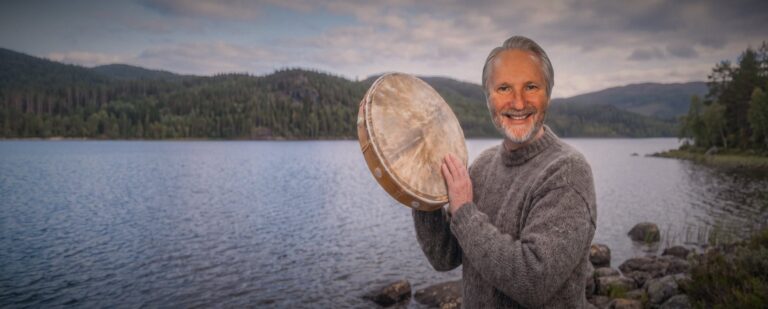
Pål-Esben: Exactly. I see myself more and more as that green fellow, because he’s quirkier. So you don’t need to take everything I say all that seriously. The quirky man from Trøndelag has probably banged his drum a bit too much; perhaps he’s spent a bit too much time out in nature.
Amina: Yes, that has happened.
Pål-Esben: So, as inspiration, I’d really encourage you, dear listener: if you haven’t begun to test these things, it’s well worth testing them for 90 days and seeing what happens in your life.
Amina: Yes.
Mother Earth and the seasonal beings
Pål-Esben: Anything else, Amina, that we ought to talk about?
Amina: I think we’ve covered the most important things around this. But there’s something I’ve been thinking about. The way we talk about Mother Earth: Mother Earth is here, Mother Earth holds us. How do the seasonal beings relate to Mother Earth?
Pål-Esben: They’re part of Mother Earth. Mother Earth is a gigantic being in her own right, just as all stars and all planets have their living beings, which allow them to be what they are. It’s the same with Mother Earth: a very, very ancient being, who is right under the soles of our feet, and who entirely makes possible the nature we have, the biology we have, and the diversity we have here. That’s her.
When we talk about Mother Earth as the forest, that isn’t quite right; the forest is part of her. She’s a very, very ancient, powerful being, whom the seasonal beings are part of and relate to directly.
So as you descend deeper into this rabbit hole, you’ll begin to experience that what you have your feet on when you stand on the grass is something extra, extra, extraordinary. And it’s through the seasonal beings, when you begin to get to know them and can go into resonance with the music they play, that you can also go into a much, much deeper resonance with this being that many call Mother Earth, Gaia. Terra is another ancient name.
And then of course completely different things and other possibilities open up, for both insight and magic, for a shaman. Because it’s raw, unrestrained stuff, really, which we wander about on top of unconsciously in our everyday lives, with our phone in our hand and the feed rolling as we walk to the bus.
So I think it’s time for the modern human being to begin to wake up, and to begin to acknowledge and engage with Mother Earth and her nature. Because that’s where we came from, after all. That’s where our body came from, that’s where all the building blocks came from. And then our soul has found a place in this temple, which is created by Mother Earth.
It’s well worth exploring, and the rabbit hole here goes very, very deep, and is very, very exciting. But we have to start somewhere. And I think that’s the most important thing: to find a place to start with these things.
Words of wisdom to finish
Pål-Esben: Do you have any words of wisdom to finish with, Amina?
Amina: No, I think I’ll go along with your words of wisdom. Explore nature. Start somewhere. Explore the seasonal cycles, and feel free to write a bit in your book. Begin, whether it’s at the autumn equinox, Samhain or the winter solstice, whenever you begin. Write down a little about what you’ve felt when you’ve been out in nature in each seasonal cycle, and then you can go through it again next year and see whether anything has changed. What more have I felt and understood of nature than I did last year? That can be really exciting. I see it myself when I leaf through my book, my Book of Shadows: that this is very, very exciting. Reflecting a little, contemplating a little, writing it down.
Pål-Esben: Yes, I simply want to encourage that. And the cultural aspects of all the seasons you can just look up on Google, and you’ll find all of them. That’s the reason we haven’t talked about them today: because you can just search for that on the internet.
The purpose of this discussion was to inspire you to look more closely at nature and the seasons, and to give an insight into the fact that there’s something that goes much deeper than the cultural aspect of these seasonal celebrations, something that can be truly rewarding to explore. And there’s no shame in seeking help. We don’t need to reinvent the wheel ourselves all the time. And Amina, it would have been very boring if I’d had to stand here on my own, droning on in a monologue. I don’t think I’d have had the energy for that either. I delight in every episode we make, because I find this rewarding, and I enjoy our conversations, Amina. Thank you so much for staying with us all the way, dear listener. We really appreciate your feedback, and a five-star rating on Spotify helps our podcast reach more listeners. And thank you so much for being here with me, Amina. I really appreciate it.
Amina: Likewise, Pål-Esben.
Pål-Esben: Thank you for being with us, dear listener. I hope you’ll join us again in the next episode. And until then: have a truly wonderful day, evening, night or morning, wherever you are listening from. Take care.
Outro
Thank you so much for listening to this episode of “The Journey to Self-Realization”, a primordial shamanic journey of development back to your true nature. We hope Amina’s story has inspired you to explore your own journey of self-discovery and development. Remember that the path from suffering to self-realization can be demanding, but with courage, patience and support from a competent guide, mentor, teacher or therapist, almost anything is possible. We wish you all the best on your journey, and we’ll talk again in the next episode.
The Journey to Self-Realization
Nature’s Path to Freedom and Self-Realization
Curious about what primordial shamanism really is, behind the mystique and the misconceptions? In this short online course I tell the story of my own path from skeptical engineer to teacher of primordial shamanism, and give you a first introduction to what I teach: what shamanism and primordial shamanism are and are not, how rituals and rune magic are used in practice, and why the longing for growth matters so much for a good life.
The lessons are recorded in Norwegian; the English version will be ready in November or December 2026. Leave your email on the course page, and I will tell you when it is.