Episode 27 – Spiritual Enlightenment – What It Is, and What It Is Not
After her first real experience of oneness, Amina went for a walk in the mountains, saw a stone and burst into tears because it was so beautiful. As a teenager, Pål-Esben could bend spoons without touching them, and years later, after his burnout, he still dreamed of becoming famous as the spoon bender, until his first teacher asked him whether that would really make him happy.
In this twenty-seventh episode, Amina and her teacher and guide, Pål-Esben Wanvig, talk about spiritual enlightenment, what it is and what it is not. They explore why someone who calls themselves spiritually enlightened probably isn’t, the grain of sand and the Sahara, and why the bliss of a kundalini awakening is not the same as oneness. It is part of “The Journey to Self-Realization”, a podcast about the bravest journey a human being can set out on: the journey home to yourself.
This episode is an English translation of our Norwegian original, voiced by the digital avatars of Pål-Esben and Amina.
In this episode
- Why “spiritually enlightened” is an impossible word, and why anyone who claims it deserves healthy scepticism
- The grain of sand and the Sahara, and the strawberry that no book can describe
- Amina’s first big-toe experiences: coming home, the stone in the mountains, and struggling to come back down to earth
- The pre-feelings behind our emotions, enlightenment sickness, and why careful preparation matters
- Becoming something else: the relationship circus, the first chakra, and the mentor who asks Pål-Esben why he still helps people
- The first birth, the Bardo, learning themes, and the choices of a soul that has set itself free
- Life after enlightenment: fetching water from the stream, Chiron, and the ashram versus the middle of everyday life
- The siddhis, the spoon bender, why a kundalini awakening is not enlightenment, and why the path is possible for everyone
This podcast is for you if you:
- Seek real depth in your spiritual practice
- Want to understand yourself on a more fundamental level
- Are curious about shamanism but tired of superficial “new age” spirituality
- Have taken many alternative courses but still feel that something is missing
- Feel an inner longing for freedom, love and wholeness
In a time when so many get lost in external methods and promises of quick fixes, this podcast invites you back to the only place where true answers can be found: your own heart.
Listen above, or read the full conversation below.
Transcript
A warm welcome to the podcast “The Journey to Self-Realization”, a primordial shamanic journey of development back to your true nature. This podcast is a collaboration with our favourite magazine, the health and lifestyle magazine Medium, and is devoted to exploring the bravest journey a human being can set out on: the journey home to oneself. We follow Amina, a student at the Yggdrasil Shamanic School, as she goes through a deep primordial shamanic process of development together with her guide and teacher Pål-Esben. It is a raw, unpolished journey of discovery towards true joy in life, deeper meaning, and a life that truly feels good to live.
This episode is an English translation of our Norwegian original, voiced by the digital avatars of Pål-Esben and Amina.
Pål-Esben: Hi, Amina, and a warm welcome to a new episode.
Amina: Hi, and thank you, likewise, Pål-Esben.
A mouthful of a topic
Pål-Esben: Thank you, and a warm welcome to you too, dear listener. Today we’re going to talk about a very interesting topic: spiritual enlightenment and spiritual self-realization. That’s a mouthful in itself, Amina.
Amina: Yes, it’s no small thing. And I think there are also a lot of misunderstandings and thoughts and ideas around it. That’s why we want to talk about it.
Pål-Esben: Yes, and this is the episode that introduces the topic, and then we’ll have more episodes later where we go into the different aspects in more depth. And of course, when we talk about this topic, there are a great many misunderstandings, and I thought we’d look at them a little first. First we’ll say a bit about what this is, and then we’ll talk a little about the misunderstandings around it, what it absolutely is not. And then we can see how this whole story starts with us: how we’re close to it when we’re born, how we move away from it as we’re imprinted, and how we find our way back again, as the greatest, most important and perhaps hardest of all the tasks a human being can have in their life. So that’s the start of this.
Why “spiritually enlightened” is an impossible word
Pål-Esben: So what is enlightenment? First of all, spiritual enlightenment is a slightly silly word, or a silly expression to use for this. If you hear someone say they’re spiritually enlightened, you should be very sceptical, since it’s probably a sign that they aren’t. Because someone who has experienced spiritual enlightenment, that is, experienced being one with the timeless and spaceless, which we’ll come to later, will never call themselves spiritually enlightened.
Why not? Well, if there’s such a thing as being spiritually enlightened, being in contact and one with the timeless and spaceless, what we’ll come to call your Sahara, then there are also people who aren’t enlightened, and then you have a polarity. You stand on one side and say you’re spiritually enlightened. But that means you’re saying you’re in a polar existence. In the timeless and spaceless, what we call the Sahara, where time and space don’t exist, there’s no polarity, because there you experience being one with everything. And so it’s interesting to call yourself spiritually enlightened, because it means you’re in polarity, which means you’re definitely not one with everything. So it’s an impossibility. That’s why “spiritually enlightened” is a very tricky word, which is really a misunderstanding of the whole thing. But we simplify our language by starting to talk about spiritual enlightenment.
In reality, when we talk about spiritual enlightenment, we mean experiences of oneness in a realm where time and space don’t exist: where you’re bathed in oneness with everything that exists in our multiverse, and with what lies beyond our multiverse. There and then you’re one with absolutely everything, and there’s no polarity. So it’s better to call this process towards oneness a process of development towards the timeless and spaceless, where we learn to become one with all that is. That’s a more exact description.
So we simplify when we talk about it, otherwise the sentences get so long, and we say it’s spiritual enlightenment: a human being who has cultivated and practised in such a way that they’ve broken out of their straitjacket, broken out of the limitations of time and space, which most people believe is everything. They’ve broken out of it and begun to see what lies behind the curtain, which is already well described in quantum mechanics: that there’s a potential lying behind everything that is matter. Matter is only a tiny part of our existence, but what lies behind it, which isn’t connected to time and space, is gigantic. So we use the word spiritual enlightenment as a description of this process you go through to reach the state where you’re one with absolutely everything that is.
It may sound a bit like hair-splitting to begin with, but we’re trying to avoid misunderstandings at the start. And again: if you hear someone say “I’m spiritually enlightened”, you should definitely be very sceptical. That person is saying they’re in polarity, and that simply doesn’t add up. So, what do you think about that, Amina?
Amina: The first thing I think, and I think a lot, but the first thing I think is this: what would a truly spiritually enlightened person say? How would he or she describe themselves? How would he or she act and interact with life, compared with someone who says he or she is spiritually enlightened?
Manipulation and the pedestal
Pål-Esben: First of all, someone with deep, permanent access to and experience of the timeless and spaceless would understand that claiming to be spiritually enlightened is meaningless, quite apart from what I talked about a moment ago. Because then you’re saying you’re something the person in front of you has no idea about whatsoever. You throw out a word, spiritual enlightenment, but someone who hasn’t experienced contact with the timeless and spaceless has absolutely no basis for understanding it. So you’re just throwing out some words.
It can also be used as manipulation, to persuade people. You say you’re something mystical, something special, and the people standing in front of you have no idea what you’re really talking about. People do that to manipulate others, for example, or to put themselves up on a pedestal, where others say he or she is spiritually enlightened without having any idea what that is. Because you can’t have any idea what it is to bathe in a state of oneness, where time and space don’t exist, that is, our Sahara, without having been there.
That’s why someone who really has these experiences won’t talk about what they are, but about how they guide people into these states. Or they’ll talk about how they themselves experience these states, which is also very hard to describe. Because our vocabulary, the way we use words, is learned in a space where we have time and space. Our life is limited by time and space, and we have linear time. Our vocabulary and our use of language are made to describe, for example, a stone, or that now I’m going to travel from Trondheim to Oslo. It’s a linear language, based in time and space. And when we come into the timeless and spaceless, into oneness, it isn’t possible to use a linear, local language to describe what you experience. It’s as if you’ve learned Norwegian, and then you come to a completely different place where you can’t use that language, and you just have to try to use Chinese instead, which you don’t know. You simply can’t find the words for it.
The grain of sand, the Sahara and the strawberry
Pål-Esben: Take a human being who has experienced these states, which are so exceptionally transformative and life-changing in every area of life. The day you come across your true nature, what you really are, you understand that the physical body and the physical mind are just a tiny speck of dust. That’s why in our tradition we call it the grain of sand. That is, your physical life, your emotions and your energy body, what’s based in and linked to time and space: that’s the grain of sand. And your real existence, what you really are, which is connected to your soul and to what lies behind your soul, this gigantic thing we’ve talked about in earlier episodes about the soul: that’s what we call the Sahara.
And of course, when you’ve been brought up on, and are used to, language connected to the grain of sand, and then you dive into this gigantic Sahara, you’re hit by a massive flood of impressions that are impossible to describe in words. You can try, and that’s why it’s so hard to talk about these topics. The only way I know to give someone an idea of what happens in the timeless and spaceless is either to use poetry, or to use metaphors and images, so that people get an idea of what it’s about.
Take an example we use: you can read a thousand books about a strawberry, about the taste of strawberries. You can talk about strawberries; there’s so much to say about a strawberry. But it’s only when you taste a strawberry that you understand what a strawberry really is. And it’s the same here. You can talk about this, discuss it, make metaphors and images, but you’ll never be able to describe how the strawberry really tastes. So what we’re trying to do through these episodes is to talk a little about these strawberries: what it’s like to find strawberries for the first time, and what it’s like to taste strawberries for the first time. But you can’t find exact words for it. It’s as if we’re gurgling; I call it gurgling something out. This babble that comes out is a very poor version of what you experience.
So, back to your question. First of all, a person who experiences this, and who has stable access to the timeless and spaceless, wouldn’t call themselves spiritually enlightened, because that would mean they hadn’t understood a thing. They’ll talk about it and try to give hints, with metaphors and images, of what this can feel like, and specifically of what happens to a human being’s life when you touch your Sahara with your big toe. And that’s something you’ve already experienced, Amina. Already, this early in your process of development, you’ve begun to experience dipping your toe into this Sahara. We’ll have an episode later where you go much deeper into the experiences and what they feel like. But could you give us a little foretaste of how you experienced the first genuine, conscious touch of the timeless and spaceless, your full existence, where for a few moments you’re one with all that is? What happened?
Amina’s first big-toe experiences
Amina: Yes, I’ve now been lucky enough to have a few big-toe experiences with the Sahara, and I have to say straight away: it’s absolutely not what I thought it was, absolutely not what I imagined it was. Put it this way: I thought I knew what it was about, but I didn’t.
Pål-Esben: So what did you think it was about?
Amina: I think I’d bought into the theory that we’re all one, that we all come from the same source, that we’re all everything at the same time. I’d formed an idea of what it was, and then I’d embodied my own theory in such a way that I was convinced I knew what it was. It wasn’t that I went around saying I was enlightened, but I thought a bit: “Yes, but I understand what this is.” And of course I understood I was no guru, but I thought I’d had a taste of it through theory and through various guided meditations, where you get these good feelings and the heart opening and all those things. So I thought I knew what it was about. But at the same time I also had this longing for something more, which in itself says that I had neither embodied nor experienced what it was really about.
The feeling of coming home
Amina: And here I really have to gurgle the words out: the feeling of being more whole, the feeling of coming home. Not as ecstasy, but more like a very calm, subtle power, and at the same time stronger than the biggest storm. I remember the feeling of all the cells in my body opening up to something they already knew. It wasn’t “oh, there you are”, but “yes, of course that’s how it is”. I felt a deep inner peace and calm. And just the words peace and calm, and the word home, are far too poor to describe it; I really wish we had more words. They were truly profound experiences, and I was showered with emotions and feelings that I didn’t quite know how to handle.
And I’ve had help from you with that too. After my first experience I really struggled to come back into my body, to daily life. Things began to make less sense straight away, because I’d experienced something that was so much deeper and so much bigger. All these everyday problems: why do we stress about this, why do we flounder around in the chaos, why do we suffer? And then I also began to feel a bit: “Yes, but can’t everyone just get to experience this, and then everything will be fine?” So there were a few things I had to go through after the first time to really come back down to earth again. I also remember that I struggled a bit with direction, because nothing made sense, because everything made sense. It was quite a big integration process I went through.
And my second experience was more powerful, but I came back with something else, and we’re going to record an episode about that a bit later, where we go into more detail. But I’d say that’s what has changed my life the most: how I handle myself and other people, how I look at life, and how I meet others in conversations. It gave me a more open heart, this business of being in love with life. And perhaps you can help me explain that feeling of being in love. And then there’s this business of really having a heart that just overflows, while at the same time I haven’t lost myself in it. Now I’m fumbling for the words, because it’s so hard to say. But it’s certainly something I never thought I could experience: that sense of belonging. Everything’s fine. It’s going to be OK. There’s nothing to stress about. There’s probably so much more I could say, but yes.
The pre-feelings behind the emotions
Pål-Esben: I think you’re doing this very well, and anyone who has experienced these things knows exactly what you’re talking about. The words are of course incredibly poor. What we’re talking about here are emotions we experience in these states, and they’re a completely different kind of emotion from the ones we’re used to in our daily life, what we call primary feelings: joy, joyfulness, gratitude and that kind of emotion, and love, for that matter.
What you come across here is what lies behind these emotions, what they’re built from. And it’s many, many times more intense to experience what lies behind than what gets filtered up into the grain of sand, into our physiological reality, where it’s mainly activated and triggered by hormones. The feelings you experienced, the ones you’re talking about now, aren’t hormone-generated. They’re what the real feelings actually are. And “feelings” is again a silly name to use for it, but we’re doing our best with our gurgling here; let me call them the pre-feelings, or what lies behind. A human being who begins to touch them, and who also experiences how gigantic they themselves really are, compared with this little grain of sand they used to think was everything, naturally begins to put things into perspective.
Enlightenment sickness and the preparation
Pål-Esben: But what if you aren’t well prepared? In our tradition we prepare the students very well to be able to handle this kind of experience. Because that’s the challenge: something may pull you into these experiences without your having prepared, practised and strengthened the muscles it takes to keep you in balance after an experience like that. That’s when you get what the yogic tradition, for example, calls enlightenment sickness: people who slip into these states and never manage to reintegrate back into the body, and who depend on others to take care of them, change their nappies and feed them, as you find in many ashrams in India. And that’s the last thing I want for my students, for them to lose contact. So when a guide is going to lead students into a setting like that, a massive amount of groundwork is required to be able to stabilise this, so that you don’t end up unable to relate to material life afterwards. It’s an art we’ve spent a great deal of energy on, and we’ve covered a great many of the preparatory aspects of this in all the earlier episodes of our podcast, from episode 1 to episode 25 or 26.
So now we’re talking a little about the preparation students have to go through before they’re ready to start handling these things. Because we want this to be done in a safe and secure way. And that’s what you experience: when you come across these states, it’s like a shock to the system the first time. Ego, intellect, identity, everything you thought was reality: it’s like Thor’s hammer striking, it’s lightning striking, and you realise you haven’t understood a thing. Everything you think you’ve understood about what life is about and what life is: in a single moment you realise you haven’t understood the first thing about it. It’s like being shaken to your roots: your whole world view changes in a millisecond when you consciously touch this.
And when we talk about genuine experiences of oneness, it’s almost impossible not to set off a massive echo that lasts for days, often weeks, afterwards, with exactly what you’re describing: everything feels a bit strange. A typical example after an experience like that, at least the first few times, until you start getting used to it, is that you get a different relationship with time. You come back and don’t quite have control of time, and space can be a bit strange; it’s a bit odd, isn’t it? You can’t quite relate to it in the usual way. That’s why you need at least a week after an experience like that, in real peace and quiet, where you can integrate: walk in the forest, sit with a tree, and gradually begin to come back again. And those are muscles that get built up through practice too. That’s how you experienced it the first time as well, wasn’t it?
The stone in the mountains
Amina: Yes. And I had so many reactions to life afterwards that shocked me too. I remember after that first big ritual: everything was over, and I went out for a walk in the mountains. Then I see a stone, and I’m so moved. I’m so moved by that stone, and I just cry and cry and cry. And I remember Erik, my partner, asking me what was happening, and I said: “I don’t know, it’s just so beautiful.” I couldn’t quite put it into words, but there was that love and that belonging.
And something else that really shocked me: I’d always thought that things come either from the intellect or from the intuition, while here I experienced that it came from a completely different place. There’s something other than that. People very often think, in everyday talk, that the spiritual comes through the third eye, the intuition, wisdom, things like that.
Pål-Esben: The chakra system, the light body?
Amina: Yes. But here I experienced something completely different, which I haven’t managed to put into words, and still can’t really put into words.
Pål-Esben: Of course, because it lies beyond our ESP antennae, beyond our chakra system, beyond our third eye, beyond everything that’s energetic and metaphysical. It’s a truth that lies somewhere else entirely, and that’s so immensely more powerful than anything else you’ve experienced before, no matter how many guided meditations you’ve done, or how many retreats you’ve been on. Because this is something else. The day you genuinely and honestly touch this Sahara, really touch the timeless and spaceless, life changes. And it often changes quite extensively, not just in what we’re talking about now, with an intense experience that shakes you to your roots and turns your whole world view upside down.
It’s as if you have a finished jigsaw puzzle, and then someone shakes it. That’s what it feels like: you gradually begin to put the pieces back again, because you see material life, the grain of sand, from a different perspective. And that perspective has nothing to do with sight; it has to do with what’s deep inside us: experiencing and sensing, in a very different and clearer way, what reality really is.
The illusion the soul projects
Pål-Esben: We humans believe we have five senses, and that what we can see and hear describes reality. But that isn’t how it is. Because what we live in is an illusion: a projection created by the soul and the higher self, which we talked about in episodes 9 to 11, when we talked about the soul and how this works. We live in a projection or illusion created by the soul, that is, not by a computer, mind you, but by your soul. Some people believe a computer created us. When you begin to touch these realms we’re talking about now, you understand quite deeply that it isn’t a computer doing this; it’s something completely different. It’s our soul that projects this and creates this illusion of material existence, so that it can learn and experience in a setting where it isn’t what it really is: where it doesn’t have its senses, and where it’s limited by time and space. Then a completely different kind of learning and growth can happen than if the soul is in a free state with all its abilities.
And when you come into these states, you experience this. You don’t understand it, but you experience it. I often put it like this: when you touch oneness, it’s like touching all the information and all the experiences that have existed since the beginning of this multiverse we live in. Not just this universe, but what lies before the universe, all the way back to the source, the creative force, where everything comes from and began to experience itself. How everything really started could be a story for a later episode. May I tell a fairy tale here?
Amina: Oh, that’s fun!
Trillions of terabytes: the metaphor
Pål-Esben: When you dive into this and experience it, you come across, if we’re to use an image and a metaphor, a thousand trillion quadrillion trillion quadrillion times 500 quadrillion terabytes of data. You dive into unimaginable trillions of terabytes of data, and you’re one with it: for a moment, a second, ten seconds, five minutes, ten minutes, as long as the experience lasts. It’s so overwhelming that there and then you don’t stand a chance of understanding anything at all, and that isn’t the point either. But it’s a big shock. Yes, it’s a shock, a positive shock. And when this is taken into life afterwards, you begin to observe and think about your life in a different way; it’s impossible not to if you have the genuine experience.
First of all, you’ve experienced that what you used to think was life is a grain of sand; you’ve touched your Sahara. And then you begin to think things through, just as you say. Why do I go around getting worked up over little things? Why do I go around being afraid of this and that? Why do I go around being afraid of dying? Why do I go around being afraid of war? There simply isn’t any reason for it any more, especially once you begin to have these experiences again.
Amina: That was well put.
Becoming something else
Pål-Esben: Yes, especially when you begin to repeat these experiences, and go from dipping your big toe into the timeless and spaceless to diving into the Sahara and having experiences that shake you even harder, this becomes more and more permanent in your life. A human being who experiences this begins to change. You begin to become something else. And that’s why, when I say this is the most effective personal development it’s ever possible to do, there’s nothing that comes close.
After a genuine experience like that, you become something else. An example: you’ve had conflicts in your relationship for years, and you shout, and you cry, and you scream, and you don’t feel seen, and you’re vulnerable, this whole circus that exists in at least 80 percent of all relationships. After an experience like that, as long as it’s conscious, you come back, and once you’ve come back to yourself, it simply becomes abnormal to react the way you did before. It has to be a conscious experience, and that also has to be practised through a process of cultivation; we’ll talk about how we begin to cultivate this in a later episode. When your partner says something you would previously have screamed and yelled about, or got bad feelings from, you just observe it: “I see, so that’s what my partner is saying.” You see no reason to react negatively to it.
And practising a quality like that step by step often takes a very long time and requires a great deal of energy. We have to go through the Interrupt Handling Technique, through self-responsibility and consciousness and all the 7 Golden Keys, and we practise and practise, and we fall into traps, and back and forth. After an experience like that, when it’s deep enough and conscious enough, you instead reach the point where you observe the circus and the madness for what it is: the grain of sand, my image of our material existence. It’s a big kindergarten where little children learn to play. Perhaps we should say elite university instead; that’s a bit more respectable. But it feels very much like a kindergarten. Let’s call it the elite university that souls have come to learn at. You experience these situations with your partner, or your kids, and think: “Yes, but this is interesting.” But you no longer react destructively. That’s just a banal example of what can happen.
As you go deeper into this, more radical changes happen in the personality: you begin to observe the grain of sand more and more permanently from the Sahara’s perspective. And the day you’ve gone deep enough, anxiety, suffering, fear, insecurity, all forms of self-pity and victim mentality cease, in an instant. Because none of this can exist in the Sahara. The more of the perspective from the Sahara, from the timeless and spaceless, you carry with you into your life, the less turmoil you experience in life. That’s one of the spectacular, practical consequences of walking a cultivated path to oneness.
One foot in the Sahara: anger and the first chakra
Amina: And you’re helping me with that. Totally spectacular, and I’m looking forward to what comes next. I’m thinking a bit about this business of having one foot in the Sahara and one foot in the material world. How do you experience that? Do you experience anger and frustration, and can you feel those feelings?
Pål-Esben: Of course I can. I’m a primate, like you. And we primates genetically have a first chakra. When the first chakra is triggered enough, say someone hits your tailbone with a hammer, or something extreme happens, whatever it may be, the system reacts. When the first chakra is activated strongly enough, fight-or-flight mode kicks in, which is genetically programmed into the primate in us, in the lower brain stem. And then a secondary feeling comes up, which can be fear or aggression or extreme vulnerability, or whatever it may be. That’s something that happens, let’s say, once in a blue moon, and the emotion that comes up isn’t there for more than perhaps a few seconds before it’s gone again.
In the old days, when someone did something I didn’t like and this first chakra was triggered, it could take weeks before I came back to myself, if it was serious enough. We talked in an earlier episode about ex-partners who have done things and been unfaithful and the whole thing; then you go around feeling awful for months. I was like that before too. Today? No. Today, and I don’t know whether I dare be completely honest here, I literally experience the grain of sand, our material existence, as a circus. A very fascinating circus, but still a circus.
I’ve noticed that people very often get worked up, and they’re very afraid. They fear that now Putin is coming to take Europe and Norway, and now Trump is going bananas, and now there are economic crises coming, and then suddenly politicians in Norway are losing it, and then there are the electricity prices. None of that touches me any more. It’s just clouds drifting by, and it’s nothing I’m associated with. I’m dissociated from these things; I’m associated with life itself. And then you observe and experience our material existence very differently.
The mentor’s question: why do you carry on?
Pål-Esben: And my mentor, who is also my friend, who has lived in temples in Tibet and China for several decades, and who became self-realized more than 30 years ago, asks me: “Why do you carry on doing this, helping people?” Because he has reached the point where he’s had enough. He’s a bit older than me, and he’s had enough of the circus, had enough of sticking his head into other people’s rubbish bins. Because that’s how it feels: when you have someone in front of you with lots of problems, as most people have, and you go in and help them, it feels as if you’re sticking your head into a rubbish bin that stinks, and then you have to stand in there and wade around in it and help them. He’s had enough of that. So he asks me: “Pål-Esben, why do you still help people?”
And I answer that it’s purely out of compassion. Because when our souls come into this world, onto this globe, into this biosphere, I picture it as an elite university, one of the hardest places in the universe for a soul to incarnate. There are a couple of other places that are a bit trickier than here, which don’t have green trees and oceans, but this is one of the three hardest places in the universe for a soul to incarnate. And the soul chooses to come to a place like this, where it’s blind, deaf and mute, where it has none of its senses, no direct relationship with the timeless and spaceless, no direct relationship with its skills or its knowledge, and it comes in here as the primate we humans are and tries as best it can. And all of us humans try as best we can.
I look at that with compassion, and that’s why I want to help people find the liberation and the freedom I experience myself, and which more and more of my students are now beginning to experience. You’re one of them, in the middle of the process. That’s why I do this. Have I needed to do it? Of course not. Is it tiring at times? Of course it is. Because you constantly have to deal with these straitjackets modern people have, where the intellect and the ego and the karmic memory and the false identity, imprinted throughout life, really have full power. And then you have to deal with these very rigid straitjackets, which is of course challenging. Take just something as simple as what you learn as a complete beginner with us, when we start talking about self-responsibility: a human being needs to learn to take full self-responsibility for their life. 100 percent self-responsibility for how they think, how they feel and how they act. You’ve been through that process yourself and see how incredibly complicated it is to go through a development like that and reach the point where you take self-responsibility for your life and don’t blame others for the problems you have, or for the way you feel. That’s how hard something so banally simple is, the thing we started with right at the beginning. So that’s the challenge: relating to these straitjackets. And you have to do it by being very, very patient. A master of patience.
The engineer who thought he was happy
Pål-Esben: But one day I was there too, in my straitjacket, where I thought I’d understood everything. I was the engineer who thought he’d got the point, and hadn’t understood a thing. Then I crashed into burnout, and that’s when I began to understand that I hadn’t understood very much. I thought I was happy; just before the burnout I thought I was a happy person who had everything. I had what people would call a career, I had lots of money, I had a flashy car, I had a penthouse flat, I had lots of people around me. I thought I’d got the point. How hopeless can you get? So I was there too. And for me it took a serious burnout, where I nearly lost my life, before I began to wake up from my ignorance, from my arrogance, from my almighty syndrome, where I thought I’d got the point. Only then did I begin to understand what humility is. But I had to nearly die first.
And that’s why, if you walk the yogic path, the yogic tradition, you’ll very often hear that the first step when you start the path towards oneness, just to be able to think about finding the way there at all, is humility. Without it, it isn’t possible. And here’s an example of how hard it is with these straitjackets and imprints of ours. That’s the challenge we face, and one you’ve also had to feel quite considerably through this process.
Amina: Yes, my goodness. This hasn’t been an easy path, but a wonderfully joyful one. And skipping all the steps you’d like to skip doesn’t work. You really have to look at yourself in the mirror and really make some choices, and just experience again and again, in my case, that it isn’t always the easiest way out.
Pål-Esben: No, nothing is easy. And we haven’t come here for anything to be easy, or to stand alone. We’ve come here to help each other. None of us has to manage alone; we can seek help, as you do today, as I do today, and as you probably also do in your way, dear listener. We try to help the people around us as well as we can. That’s one of the lovely things about this grain of sand we live in: we often have many people trying to help, in all sorts of areas. So if we stand together as a team, this can go very well. It’s about using our strengths together, trying to be a team and helping each other. Look at my group, for example, where my students help each other with things. I think that’s so lovely, that people support each other.
The ego’s terror: losing its power
Pål-Esben: But one of the big challenges on a path like this is how much resistance this straitjacket and the intellect and the ego have to it. Because remember that the Sahara, the timeless and spaceless, is the intellect’s and the ego’s greatest terror. The day a human being begins to touch the timeless and spaceless, that human being understands that the intellect and the ego have had far too much power, and that means the intellect and the ego will be stripped of their power. Do the intellect and the ego know who we really are, or what we really are? No, they don’t. But they fear any form of change where they lose their power.
The first birth and the pure mind
Pål-Esben: We come into this world completely pure. We can call it our first birth, and we can call it our original, pure mind. We come in as a blank canvas of consciousness, completely blank, without thoughts, without imprints: only joy, joyfulness and vitality, the way it shines out of a child who comes into this world healthy and has their basic needs met. And there you’re very close to your soul, which in turn is in very close contact with the timeless and spaceless. When we’re born, we have this close contact, and that’s what we call the first birth.
We come in almost as free as a bird, except that we bring our karma with us. We bring our learning themes and our dispositions, which we talked about in episodes 9, 10 and 11, and the imprints come gradually, of course. But basically we’re fundamentally joyful human beings, without an agenda, without thinking “I can’t do that” and “I have to do this”. We’re free. And for most people, the first birth, when we come into this world, happens in an unconscious state, governed by the soul’s dispositions and karma.
What does that mean? Well, when a human being dies without having reached a state where they’ve set themselves free through deep access to the timeless and spaceless, their real existence, they glide on after death and move on to the Bardo. And then, based on their karmic tendencies, they pop almost straight into the next life. In between, they briefly touch base with their soul, but the soul has an incarnation theme, an incarnation cycle it wants to go through, so they don’t go permanently back to the soul. They touch it, a new higher self is popped out, and then they merge into the next incarnation with their karma and continue their learning tasks, until they reach the point where they manage to set themselves free. That’s the ultimate learning task for a soul, namely what you’re doing now.
The Bardo, the choices and the learning themes
Pål-Esben: The day you reach a permanent state of oneness, that is, you’re one with the timeless and spaceless in a permanent way, you can take yourself through a death ritual when you die. By permanent I mean that you have the state whenever you consciously want to slip into it. We often call it having one foot firmly planted in your Sahara, permanently, and one foot firmly planted in the grain of sand, permanently. And when you come into the Bardo, you have choices. You have a choice about whether you want to go on to the next incarnation. You have a choice about whether you want a stint as a guide for other people here in the biosphere we live in, as an energetic guide, as an angel, or however you picture it. And you can also choose to say: “OK, now I’ve gone through my learning tasks, now I’ll go back to my soul, and then we’ll do something else exciting.” For example, we could incarnate somewhere where we have all our abilities, so we don’t have to be deaf, blind and mute one more time. You can incarnate in the Pleiades, for example, as an alien in the Pleiades. I’m only joking. But then you have a choice.
And as long as you haven’t gone through the soul’s learning tasks and integrated, understood and learned them, you’re reincarnated and incarnated until you’ve gone through your learning tasks, understood them and grown out of them. Because that’s the whole purpose of your soul choosing to create this illusion that our life is: to learn and experience on the basis of particular themes. A particular cycle of themes is called an incarnation cycle, and a particular larger cycle is called a meta-incarnation cycle.
Amina: Does that mean, then, that if you reach a stable state of oneness, or enlightenment, call it what you like, with one foot firmly planted in the physical and one foot firmly planted in the metaphysical, the learning themes then automatically cease?
Pål-Esben: First of all, oneness has nothing to do with the metaphysical.
Amina: Right.
Pål-Esben: The metaphysical is what isn’t physical, and by that we mean our energy system, and what lies behind it: angels and power animals and astral realms, different forms of astral worlds, different forms of dimensions. That’s the metaphysical. But the timeless and spaceless, or oneness, lies far beyond that. So: one foot in the timeless and spaceless, and one foot exactly here. And what was the question?
Amina: The question was whether the learning themes you have then automatically cease. Because you say that when you’ve reached that state and have a stable state in oneness, you can choose what you want to do when you die. But are you then finished with your learning themes?
Learning to knit once
Pål-Esben: But look, Amina: if you’ve learned to knit, why should you learn to knit again? Once is enough. Once you’ve learned to drive a car, why should you do it again? Of course it becomes meaningless to do the same thing. When you’ve gone through what your soul, that is, you, wants to learn, experience and develop, there’s no reason to repeat it. And it isn’t as if you put in a tape that’s played for every life. That isn’t what your soul is like. It isn’t sadomasochistic, with a pre-recorded tape that has to be played, so that everything happens on autopilot and you have no free will. That isn’t how it works. Definitely not.
What happens is that you choose to do other things. You may also choose to go back so that you can guide other people on the same path.
Amina: As a human being? That you go back as a human being?
Pål-Esben: Yes, as a human being. And that has its built-in challenges: when you come in as a human being, in most cases you’ll also lose your memory for a little while, until you pick it up again. Sometimes you have it fully from the start, but sometimes it takes a little time to pick it up. But you can choose that too. It requires A, that you’ve completed your themes, and B, that you’ve done your last big learning theme, which is liberation from the straitjacket, fully and completely. Then you have a choice about what you want to do. The soul can always choose, but your soul won’t pointlessly stop an experience-based process halfway through. It would like to finish this, no matter how many incarnations or games of chess there are to play. Because everything really happens at once, so there’s an infinite number of possibilities. It’s a bit strange how this all fits together.
But the most important thing for me, when I guide people on this path, is to help people and my students with this liberation process. Because I know that the day you begin to stick your nose, or the tip of your toe, or the soles of your feet into the Sahara, that’s when the real transformation begins to happen in life. And when you reach the point where you’re liberated, you of course have other choices and other possibilities in how you live your life. But there are many misunderstandings around this too.
Life after enlightenment: the stream and the water
Pål-Esben: Some people believe that when you’ve reached a permanent state of oneness, or what some call spiritual enlightenment, illness no longer exists. No. If you look at the wise people in the Asian traditions, whether the yogic, the Chinese or the Japanese, you find the old Zen masters who say: life after enlightenment is the same as life before enlightenment. Before enlightenment I had to go down to the stream and fetch water, and after enlightenment I have to go down to the stream and fetch water. It isn’t as if you’re suddenly rich, suddenly have no illnesses or problems, suddenly don’t have a difficult partner, or kids who create a bit of chaos now and then. That isn’t how it is. Life is exactly the same before as after. It’s just that you live it out, experience it and interact with it from a completely different perspective than before.
And sometimes illness is something we can’t change. Because sometimes the soul brings certain learning themes with it, and one of them may be, for example, a particular kind of health situation, particular health challenges, which the soul itself has put there for us to deal with, and which help us in a certain direction. Take me as an example: I’ve actually been very ill since I was born. I was born ill, and then I muddled through fairly well, up until my burnout. After that I got really serious, life-threatening health problems, which took me a long, long time to get to the bottom of. And of course, when you experience this, it’s really bad. But gradually I understood: if I hadn’t ended up in this situation, if I hadn’t experienced my burnout, if I hadn’t had these illnesses that were almost impossible to get to the bottom of, I’d hardly have stayed on track and kept my focus the way I have all these years. I’d hardly have engaged with and learned about all kinds of spiritual traditions and all kinds of healing: reiki, shamanism, acupuncture and homeopathy, traditional Chinese medicine, meditation, feng shui and so on. I’d hardly have engaged with that fully and completely, because in the first years the focus was on sorting out my own problems.
So it isn’t always the case that everything can be fixed, and that isn’t the point either. It’s just that after you consciously reach these states, the illness becomes less and less of a problem. It’s a bit like Chiron in mythology: half horse and half human, shot with a poisoned arrow by his good friend, and he couldn’t be healed. He devoted his life to finding out how he could get well, and the story goes that he couldn’t get well whatever he did. But he became the most skilled healer in the Greek pantheon, the master healer of them all. And in fact, when we walk a path of development like the one we’re talking about now, it’s very important to get to know and identify our own Chiron.
Amina: Yes, definitely.
Pål-Esben: So it’s incredibly exciting. Very rarely is it the way we imagine it, just as you yourself had lots of notions and thoughts about what this is.
Amina: Yes, and I have to say this too: even though I now know more about what it is, I’m pretty sure I don’t have the whole picture.
Three years: the path in the West
Pål-Esben: The best lies ahead of you, Amina. You started this part of your process, how long ago was it, 18 months or so?
Amina: Yes, this part, yes.
Pål-Esben: We call it the primordial shamanic path to oneness, and you’ve now come so far in your process that with a couple more proper nudges, you’ll be able to get there. And how long has it been, all in all, since we first met?
Amina: On 6 December it’ll be three years since I first spoke to you and was initiated into, what was it, the 90-day programme? Yes, Change Your Life in 90 Days, and that’s where my journey began.
Pål-Esben: So it’s less than three years, and that’s the time it has taken you to begin reaching states that very few people can ever reach. Like here where we live, in Norway, Europe and the West… it is the West we live in, isn’t it? We live in the West.
Amina: Yes, I’m not that good with north and south and east and west.
Pål-Esben: It depends on whether you see it in relation to our planet or to the galaxy. We live in a very exciting quadrant of the galaxy. This’ll make a nice little clip: “Yes, Amina wonders whether we live in the West.”
Amina: Well, we’re good at lots of other things.
An ashram or the middle of life
Pål-Esben: Yes, we who live here in the West very often think that these are states we can never reach. Many people associate it with having to live in an ashram, be with a guru down there and do nothing else. And there’s a very big difference between doing this in the middle of the material world in the West and doing it there. In a way the ashram path seems a bit easier, because you don’t have to deal with being triggered in and out of the straitjacket, back and forth, and getting all these tests all the time. On the other hand, there are some muscles that we who walk the path in the West get, and that those who live in an ashram don’t.
And there are paths through the greatest traditions in the world: Buddhism has schools, the yogic tradition has schools, Zen has schools and Sufism has schools for bringing people into these states, and they’ve existed for many thousands of years. Some take a very long time; the yogic tradition has some of the longest and most complex paths there. So you can choose to go into an ashram and stay there for 15 to 20 years and go through the processes there, in a safe framework, without interacting with the world around you.
But I believe, at least the way I see and experience it, that our soul has come here to live in this material world, and not to hide away. Otherwise it wouldn’t have incarnated in this exciting chaos we live in, on this lovely planet. It hasn’t incarnated here to hide away. It has come here to deal with the lack of its senses, deaf, blind and mute. And it has come here to deal with its learning themes in exactly a setting like this, and in the end to find freedom. The way we do it, we focus on the fact that it’s just as important for the soul to experience and interact with the grain of sand, since the most important learning themes lie in the integration and the relationship with the grain of sand. That’s why in our tradition it’s very important to stand firmly with one foot in material life, with your family, your friends and your job, and then we cultivate the other foot so that it stands firmly in the timeless and spaceless.
That way you can experience the grain of sand and your life in a much more spectacular way than if you weren’t in that state. That’s our way of doing it, at least. But it’s also the slightly harder way, because it demands more of the student. In an ashram you can go in, and then you’re woken at four in the morning, and then you meditate for two hours, and then there’s a light breakfast, and then there’s yoga, and then perhaps some theory, and then there’s lunch or brunch, and then more yoga, more meditation, and then six to eight hours out working in the fields, and then you’re in bed, and then up again at four o’clock. It’s a cycle. And you could say it isn’t really that demanding, since you aren’t met with all the challenges we’re met with in our lives. You’re at peace there; you’re protected from the world.
But if you do this process inside your grain of sand, in your ordinary life, you’re triggered all the time, you come across challenges all the time, and you come up against material life and its challenges all the time. So it requires much more self-responsibility from the student: you have to be willing to do the process of cultivation, which we connect to finding the Path of the Heart, which we talked about in the first episodes of our podcast. You have to be willing to do that. You’re spared that in an ashram, because there you’re part of the group and go through your cycle. But when you do this in your ordinary life, and have to live your ordinary life in parallel with developing yourself and cultivating the path to the timeless and spaceless, more self-responsibility is required. And we’ve described that well through our podcast: the kind of self-responsibility you’ve had to be willing to take, and which hasn’t always been easy.
Amina: No, definitely. It hasn’t always been easy, but it has been unavoidable too: seeing all these sides of yourself, all these parts of yourself, everything that lies in the dark in the subconscious, what you’re not aware of. And along the way understanding everything you haven’t understood, in a completely different way, dealing with it, and making the choices that are really uncomfortable. Because this ego-intellect just won’t let go. It gets cleverer and cleverer, this ego and intellect, as you begin to know more of life and the world and existence and all of that. Good grief, it’s really smart. I’ve been fooled so many times.
Pål-Esben: Yes. And if we’re to sum up what we’re talking about now: this is an episode where we talk a bit off the cuff about this topic, a bit back and forth. So if you, dear listener, feel you’re following a thread here, there is no thread; we’re just trying to talk a bit back and forth and give some impressions of what this is about. In the next episode we’ll start being a bit more structured, I’ll try to, and then we’ll try to describe the process you need to go through to be able to free yourself from the straitjacket.
And this is something that doesn’t have to take 50 years. When you see how short a time it has taken you and many of your fellow students, it actually is possible to do in a reasonably short time, and that’s a miracle in itself. The day you begin to experience these states, it’s impossible for life not to change for the better. That’s one thing that’s guaranteed. It’s impossible, because how could it turn out any differently? If you’re pulled in and experience your complete existence, what you really are, and how gigantic you really are, as a soul and what lies behind the soul, this incredible being that you are, then when you experience that, even if only for a moment, of course everything will change. Then you understand how misunderstood this material world is, how you’ve misunderstood everything. Why, for example, would you get wound up about anything at all? I mean, hello: it’s a grain of sand we’re dealing with. You know that you are that gigantic being, and that a little grain of sand of this being, which is your body and your mind, is playing in the sandpit here and doing its learning tasks.
It’s the same as an adult getting worked up and furious with a five-year-old who doesn’t do what the adult wants. Perhaps that’s how it is in society, but really, it’s a five-year-old we’re dealing with. Instead, you have a bit of empathy with the five-year-old, who hasn’t quite understood the boundaries yet, and you try with your heart to help this five-year-old understand what it’s about. But would you go out and think: “Oh no, this five-year-old doesn’t like me, I feel so bad, I feel hurt that the five-year-old doesn’t like me”? That’s what you begin to experience: you see the meaninglessness of getting worked up about this, about the five-year-olds running around in society, adult five-year-olds who think they’ve understood everything. There’s no reason to get wound up any more. You chuckle at the madness. That’s how it is for me: I chuckle at the madness, and sometimes there’s an awful lot of madness, so then I withdraw a little. It becomes a different way of relating to it.
The siddhis: the spoon bender
Pål-Esben: And that’s one of the bonuses of going through a process of cultivation like this, which of course can’t be done by sitting and listening to a guided meditation, or by watching a YouTube video and doing a couple of asanas to trigger the kundalini energy, and all that. There are so many misunderstandings around this. For example, people believe you first have to activate your kundalini energy, and that you’re enlightened once the kundalini is activated. No, that isn’t how it works. You don’t even need to activate any of your kundalini energy at all to experience oneness. That’s something that comes from the yogic tradition, which has so much focus on this. Completely unnecessary.
And another kind of misunderstanding that’s often around is that you get extraordinary talents and qualities when you experience these states: that ash pours out of the palms of your hands, that you can levitate, that you can teleport yourself. No, that isn’t how it happens. Because if it does happen, there’ll definitely be no access to oneness. Why not? On the path towards the timeless and spaceless, in the process of cultivation, certain siddhis can be triggered. A siddhi is a supernatural quality, a supernatural ability: for example levitation, or being able to channel ash out through the palm of your hand, or other things. But the point is that the human being who experiences a siddhi like that on the path towards oneness, in their process of cultivation, is finished there and then. Why? Because the ego takes over completely: “Oh, I can channel ash out through the palm of my hand, good heavens! Now I’m only going to focus on that!” Then it’s over for this incarnation.
That’s also why gurus I know in India push the siddhi back when they see one starting to come up in a student in the process of development. They know that if the siddhi comes up to the surface and the intellect and the ego get hold of it, the path is over. Because then the intellect and the ego take over completely, and you turn into a zombie, go bananas and start monkeying about. And that nearly happened to me too, in the old days. That was before my burnout; I’d already begun to experience things. The first siddhi came when I was only ten, and I won’t tell you about all of them now, but one of them, which came when I was around 16 or 17, was that I could bend spoons without touching the spoon. And I was fascinated by it. When I came to my first teacher after my burnout, I said to the teacher: “I can bend spoons! Yes, now I’m going to show everyone that I can bend spoons, and then lots of people will come to my seminars, and I’ll be so well known and so famous: the spoon bender!” And the teacher smiles at me, looks at me and says: “Do you think that will make you happy, Pål-Esben? And how many people do you think you’ll actually help by doing that?” Then I understood. You push these siddhis back where they belong, in their box, so that you can engage with and focus on the process of cultivation.
Kundalini is not enlightenment
Pål-Esben: So there are quite a few misunderstandings around extraordinary abilities and siddhis and these things. And then there’s the kundalini; there’s so much focus on kundalini. Well, the day you activate your kundalini potential, that is, Ida and Pingala in the spine, of course a tremendous rush of energy surges through the body. But no experience of oneness comes directly from that, because there are a couple of steps that have to be taken after that. In the yogic tradition they often talk about something called energetic enlightenment. But that has nothing to do with enlightenment in reality, which is being completely one with the timeless and spaceless. It’s just a powerful yang activation of the kundalini energy, which can feel blissful: you experience bliss, or joyfulness, or ecstasy, whatever you call it. But that bliss has nothing to do with the kind of bliss you experience in the timeless and spaceless.
Amina: And it’s a bit short-lived, isn’t it?
Pål-Esben: No, it can last a long time. I had my first kundalini awakening, which knocked me out completely, more than 20 years ago, at one of the first rituals I took part in here in Germany. We went through some extreme stuff, where we used our bodies in a very special way over several hours, and I collapsed completely. It exploded in my spine, I lost consciousness, and the week afterwards I couldn’t manage anything; I needed help with everything. It was an extreme yang experience, a bliss experience you might think has to do with these experiences. But once you begin to experience the real access to the timeless and spaceless, which is most easily reached through a process into the depths, though of course it can also be found through yang, you discover that the bliss there is something radically more powerful than this yang bliss you feel when you get the kundalini energy to explode. That’s also something that’s often misunderstood out there, and there are many misunderstandings around this.
Possible for every human being
Pål-Esben: So this is an incredibly exciting topic, and I’m looking forward to continuing to sink my teeth into it when we go into a bit of the process in the next episode. This time the purpose was to give you a first feel for what this is, and what it isn’t. And again: it’s impossible to fully explain what it is. I hope, dear listener, you’ll forgive us our gurgling; we’re doing our best. I hope you’ve got a little idea of how incredibly cool this really is, and it’s actually achievable for every human being. You don’t need any special qualities to do this, you don’t need special talents, and you don’t need so-called innate healer talents. You may have been a bit sensitive all your life, Amina. But there are other students in the group who have been completely numb, who haven’t had access to their primary feelings at all, and who haven’t been able to see anything or experience anything of the metaphysical. They learned to have contact with power animals earlier in their shamanic process of development, but they saw nothing, and they felt nothing: it was a complete blank. And even they manage to achieve this through a process of cultivation.
So it’s possible for every human being. And I believe, at least the way I see it, that this must be the most important process of cultivation a human being can go through. Because the more people who reach these states, the more peaceful this world becomes. That’s my contribution, my impulse to the world, to create a better and more peaceful world: not saving the whole world at once, but helping one human being at a time to free themselves. Because a liberated human being can’t be destructive, can’t be damaging, can’t be manipulative, can’t be what we experience as controlling, and all these things. Then you’re so close to what we can call your heart, which is in close vibration with this field in the timeless and spaceless, that it’s very hard to be destructive, go to war and create chaos. That’s also what motivates me to help you and your fellow students: we can’t make this world a better place unless we start with one human being at a time. Each person needs to become a better version of themselves, and through that we also get a better world. Those are my thoughts on this.
Amina: Yes, fantastic. I’m certainly eternally grateful for the journey you’ve guided me on and are still guiding me on. Wow, really grateful. And now it’s starting to get exciting. When people come to us, they start at the beginning of the primordial shamanic path of development, the profound process of development we’ve talked about in this podcast. And at the start it’s incredibly exciting, because you come in, and then you learn spontaneous healing at the first seminar, the beginners’ seminar. With spontaneous healing you can heal another person without touching them, even if they’re somewhere else entirely in the country. It’s totally mind-boggling, super exciting. Then you learn astral travel, and you learn about the runes, and you learn about magic, and you learn about all of this. It’s totally, insanely exciting. But when you come into what I’m doing now, it starts to get insanely exciting on a completely different level. It’s totally insane, if you’re going to use a word like that.
Pål-Esben: Yes, really. And it’s exciting and profound in a completely different way from the first years at the Yggdrasil Shamanic School. I’d happily say yes to all of it, but this is really something else. Here the human being changes overnight. Something that might have taken 10 to 15 years to practise step by step through personal development happens spontaneously overnight. You become something else, as we talked about with these examples. But without what you’ve been through in the basic training and later the shaman training, which is our preparation process for the primordial shamanic path to oneness, this wouldn’t have worked either. Then you’d have been building on sand. Do you have any closing words, then, any words of wisdom to wrap up, Amina? How wise are we feeling today?
A recommendation: “Your First Birth”
Amina: I can offer a recommendation, then.
Pål-Esben: Is that worth as much?
Amina: It’s worth exactly as much. I recommend reading Pål-Esben’s article “Your First Birth: The Original Pure Mind”. I think that’s what it’s called, if I remember rightly. It’s very good to read, at least after you’ve listened to this episode.
Pål-Esben: Yes, because it perhaps goes through what we’ve discussed today in a more linear way, step by step. You’ll find it on my blog, wanvig.no, as one of the first articles there, because I’ll make sure to publish it before this episode comes out. So that’s great, Amina. Now we’ve set the expectations for the next topic we’re going to talk about, on enlightenment, and then we’ll go deeper into the subject. We have many exciting discussions ahead of us. I hope this has been interesting and fascinating for you too. And I delight every time, Amina, in getting to talk with you and do this podcast with you. Thank you so much for staying with us all the way, dear listener. We really appreciate your feedback, and a five-star rating on Spotify helps our podcast reach more listeners. And thank you so much for being here with me, Amina. I really appreciate it.
Amina: Likewise, Pål-Esben.
Pål-Esben: Thank you for being with us, dear listener. I hope you’ll join us again in the next episode. And until then: have a truly wonderful day, evening, night or morning, wherever you are listening from. Take care.
Outro
Thank you so much for listening to this episode of “The Journey to Self-Realization”, a primordial shamanic journey of development back to your true nature. We hope Amina’s story has inspired you to explore your own journey of self-discovery and development. Remember that the path from suffering to self-realization can be demanding, but with courage, patience and support from a competent guide, mentor, teacher or therapist, almost anything is possible. We wish you all the best on your journey, and we’ll talk again in the next episode.
The Journey to Self-Realization
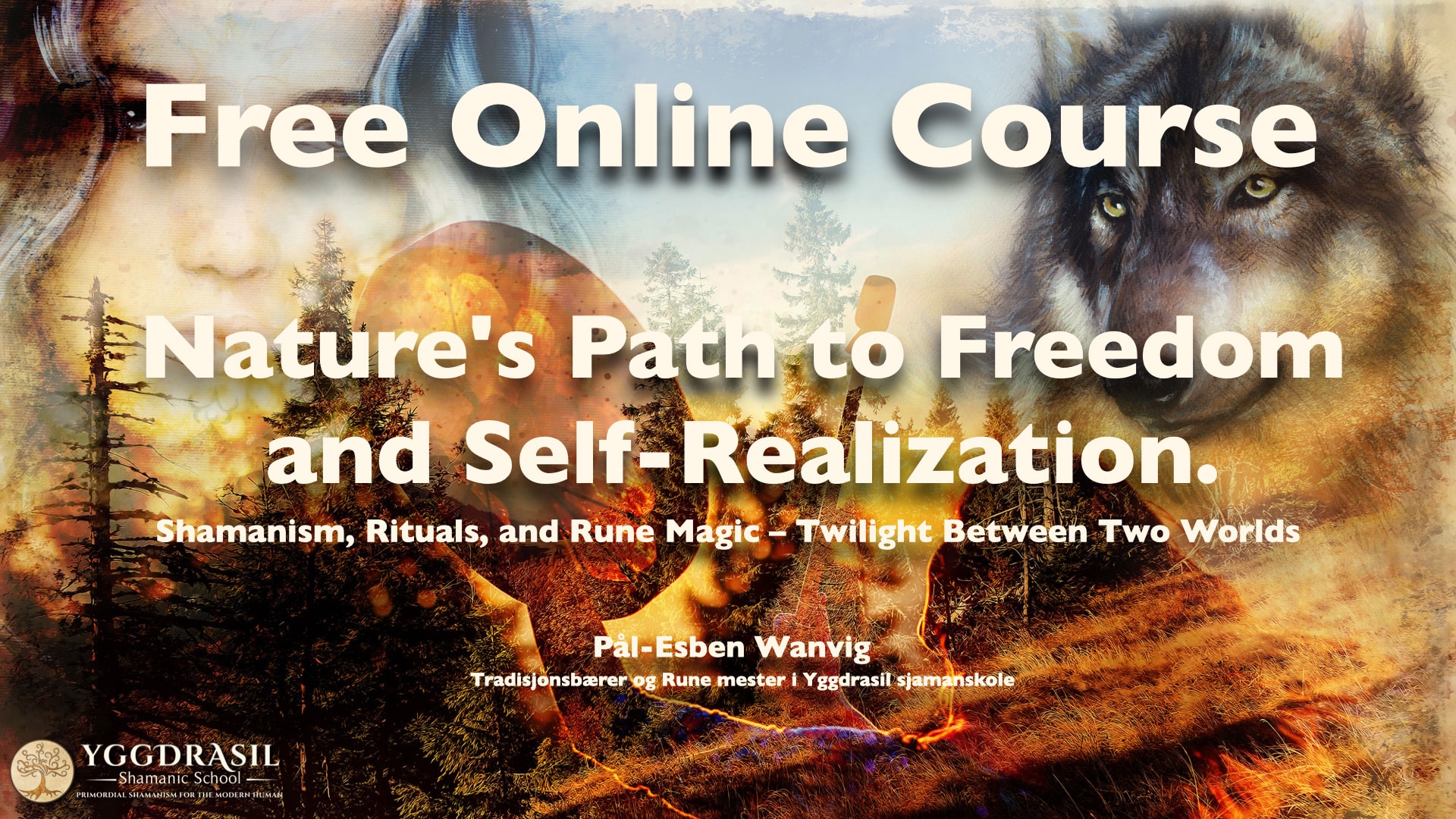
Nature’s Path to Freedom and Self-Realization
Curious about what primordial shamanism really is, behind the mystique and the misconceptions? In this short online course I tell the story of my own path from skeptical engineer to teacher of primordial shamanism, and give you a first introduction to what I teach: what shamanism and primordial shamanism are and are not, how rituals and rune magic are used in practice, and why the longing for growth matters so much for a good life.
The lessons are recorded in Norwegian; the English version will be ready in November or December 2026. Leave your email on the course page, and I will tell you when it is.