

Episode 19 – Alchemy Between Two Worlds: When the Shaman’s Magic Meets Modern Science
The first time Pål-Esben had a reiki session, the healer stood shouting and shaking with his hands held over Pål-Esben, and the engineer in him got quite a shock. Even so, he felt much better for a few days, so he began travelling from Trondheim to Oslo twice a month for more. At the end of June, Amina felt deeply betrayed by some of her friends. Not long ago she spent time with them again, and there was no bitterness at all.
In this nineteenth episode, Amina and her teacher and guide, Pål-Esben Wanvig, talk about why combining modern psychology and medicine with ancient shamanic magic works like an emulsifier that keeps oil and water mixed. They explore compensatory mechanisms, what forgiveness really is, and why neither shorts on social media nor AI can lead you to the answers inside you. It is part of “The Journey to Self-Realization”, a podcast about the bravest journey a human being can set out on: the journey home to yourself.
This episode is an English translation of our Norwegian original, voiced by the digital avatars of Pål-Esben and Amina.
In this episode
- Why the podcast now turns to shamanic magic, and Pål-Esben’s search for someone to fix him, from reiki in Oslo to an angel seminar in New York
- Oil, water and the emulsifier: why the ancient makes modern methods work faster and last longer
- The demons Amina was convinced she was possessed by, and why understanding them cognitively wasn’t enough
- Compensatory mechanisms, why endlessly digging into the past often makes things worse, and how to make peace with it
- What forgiveness really is, the four shamanic heart guides, and the betrayal Amina went through in June
- The informed client, the placebo effect, and why understanding turns the brain into a driving force
- Shorts, algorithms and one-armed bandits, and the 30-day complete stop on news and social media
- Why AI can never lead you to spiritual enlightenment, and why there are no shortcuts
This podcast is for you if you:
- Seek real depth in your spiritual practice
- Want to understand yourself on a more fundamental level
- Are curious about shamanism but tired of superficial “new age” spirituality
- Have taken many alternative courses but still feel that something is missing
- Feel an inner longing for freedom, love and wholeness
In a time when so many get lost in external methods and promises of quick fixes, this podcast invites you back to the only place where true answers can be found: your own heart.
Listen above, or read the full conversation below.
Transcript
A warm welcome to the podcast “The Journey to Self-Realization”, a primordial shamanic journey of development back to your true nature. This podcast is a collaboration with our favourite magazine, the health and lifestyle magazine Medium, and is devoted to exploring the bravest journey a human being can set out on: the journey home to oneself. We follow Amina, a student at the Yggdrasil Shamanic School, as she goes through a deep primordial shamanic process of development together with her guide and teacher Pål-Esben. It is a raw, unpolished journey of discovery towards true joy in life, deeper meaning, and a life that truly feels good to live.
This episode is an English translation of our Norwegian original, voiced by the digital avatars of Pål-Esben and Amina.
Pål-Esben: Hi, and a warm welcome to a new episode, Amina.
Amina: Thank you so much, likewise, Pål-Esben.
An important topic: measurable change
Pål-Esben: A warm welcome to you too, dear listener. Today we’re going to talk about a very important topic, at least if the goal is to make objective, measurable changes in your life. Whether it’s about health, physical and mental, about finances, about your relationship or any other area of life you want to improve, what we’re going to talk about today is extremely important to understand.
Because this is also the introduction to a slight change of theme from what we’ve talked about earlier in our podcast. In the first episodes we talked a great deal about the Path of the Heart, and then we’ve had some episodes where we talked about problems and challenges connected to the primordial shamanic path of development. We’ve talked about darkness, demons, evil and resistance. Now we’re moving on to something a little more pleasant, namely shamanic magic: different forms of shamanic magic, and how they can help us humans find our way back to the life we deserve to live.
Is that cool, Amina?
Amina: It’s the coolest thing of all, if you ask me. If you ask me, this is so raw and so intense and so cool once you understand what it’s about, and once you’re able to separate the wheat from the chaff.
Pål-Esben: We don’t talk about shamanism in general in our podcast, because there are many, many kinds of shamanism out there, and we don’t know them all. But we know our own tradition at the Yggdrasil Shamanic School, and we can tell you exactly how we see it. We’re not exactly super-shamans claiming to know everything about shamanism, but we know a great deal about what we do ourselves, and not least why our students so often get such very, very good results in a fairly short time.
That’s what we talk about in the podcast, and not least your journey, Amina. Because it’s about how you went from everything being dark, when you were desperate, full of fear and had big health problems, as we’ve talked about before, to finding your way back more and more to your real self as you’ve gone through the process of development. And that was pretty joyful in itself.
Amina: Yes, absolutely. This has been the path that suited me perfectly, and it resonated straight away. I saw that this isn’t just about a feather and a bit of incense; this goes very, very deep into personality development. So I love this combination, and I see it with my own students too, who get fantastic results.
Hoping someone else will fix it
Pål-Esben: Yes. And here’s the challenge. We assume that you as a listener are interested in the esoteric and the alternative, or at least open to the alternative; otherwise you probably wouldn’t be sitting here listening to this podcast. And the challenge in the esoteric world is often that you start learning about angels, for example, or whatever it may be, and then you hope it will fix your life.
That’s how I was when I started. More than two decades ago, after my burnout, when I almost lost my life and Norwegian doctors couldn’t help me, I decided to find solutions myself. That was when I began to search in the alternative world, and I was very, very sceptical. I had big prejudices: this was a bunch of fools, and it was scary, especially the shamanic part. I also had certain stereotypes about the people in the esoteric world. But out of sheer desperation, when nothing worked with the doctors, I swallowed my pride and began to seek help.
And then, probably like many others who start their search in the alternative world, I was looking for something that could fix my problems. So I travelled almost all the way around the world to find healers and methods and techniques that would fix me.
The glimmers of light that didn’t last
I started in Oslo, with a gentleman called Jan Jacobsen, whom I also write about in the book. That’s where I had my first reiki session, and it was very, very exciting. It was a shock for me. He was a skilled, skilled gentleman, but he stood there shouting and shaking while he held his hands over me. I thought: “What’s going on? What’s happening?” And then the engineer in me kicked in. It was a shock.
But what was so cool was that in the days afterwards I felt much better. Then I thought: “Wow, this is it! This is it!” Forget the doctors who couldn’t find solutions to my problems: here, there were definitely solutions. So I travelled from Trondheim to Oslo twice a month to get a session with Jan. And each time I got a little better. Only for a few days. It was like a glimmer of light, and then it came back.
Then I thought: Why should I travel to Oslo every other week when I can learn this myself? And so began the journey of learning reiki and everything else I learned along the way. What I noticed was that when I learned this, I felt a little better, but the root of my problem didn’t go away. I found the best healer, who gave me healing, and it felt better there and then, but after a few days the same crap and all the symptoms came back.
That was my first experience of hoping that others would fix my problems for me. And it’s natural, when we feel bad, to look for someone else to sort out our problem. You’ve experienced that a couple of times in your life too?
Amina: A couple of times, or four, yes.
Pål-Esben: Maybe five?
Amina: Absolutely. Maybe five.
Coming home in the esoteric world
When I came into the esoteric world, the alternative world, all these things that are, quote unquote, weird, with ceremonies and jumping and dancing and incense and all that, it was like coming home for me. I wasn’t frightened by it. This was like coming home.
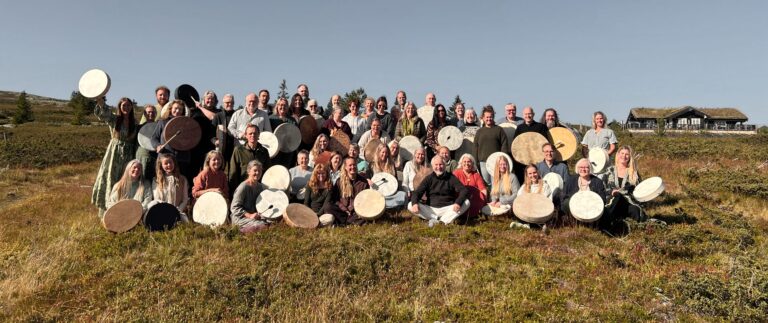
I remember the first time I went up into the mountains at Spidsbergseter, a mountain hotel in Norway, to the first ritual lasting several days. After the first day you asked me at breakfast whether I’d had a culture shock. And I thought: No, I’ve done loads of stuff before, so this was fine.
But to pick up on what you’re talking about: the good feeling I had when I took part in these ceremonies and rituals and got to know what angels and guides were, I really thought that feeling would stay with me for good. There wasn’t much talk about how you could cultivate this afterwards, or how you could take it home with you, at least not in what I experienced back then. Now I think perhaps more people focus on it. But everyday life was more or less the same, and then there were these bright spots, the gatherings, the things I signed up for, the retreats, which were the glimmers of light.
But when I came into Yggdrasil shamanism, I felt, and I still feel it to this day, that there’s a common thread running through it all. It’s about how we bring what we learn and experience into our daily lives. That’s where the truth shows itself: how much you’ve understood, what you need to work on, what’s going well and what’s going badly. I really missed that common thread back then.
The angel seminar in New York
Pål-Esben: Yes, and it isn’t so easy to find your bearings in the esoteric world, because there’s so much exciting stuff there. I remember the first angel seminar I attended; it was in New York, of all places. I was pretty new to it then; it was only a couple of months after I’d started my alternative journey. And at a retreat like that, with only alternative people, it’s completely fascinating: very strange, but also cool.
There I am at my first angel seminar, having my first experience with a being of light, that is, an angel. It was so spectacular that I could feel this being around me. I’m so fired up, and the teacher says: “Now all you have to do is ask the angels to sort out your lives. Here are the rituals you’re going to use. Ask Archangel Raphael or Michael, ask them for help, and they’ll help you sort out your challenges and problems.”
And of course I did. I asked the angels again and again and again: Help me with my health problems, my pain, all these things. But nothing got better. And gradually, after testing a fair bit of this, I realised it would never be able to get me to the finish line.
The eureka moment: the best of both worlds
That was when I had this eureka moment: Why not combine the best of the engineer’s world, modern medicine, modern psychology, neuropsychology, behavioural psychology, hypnosis, everything modern that exists in our world today, with the mystical, the ancient, what I was learning here? That had to be the answer.
It’s almost two decades since I got that idea into my head, after failing for a while. Then I began to combine these things, and it started with a massive study of the modern: I studied several forms of psychology, NLP in great depth, and modern functional medicine, acupuncture and so on.
And when I began to understand how it fits together, and more of how the alternative works, let’s say the parts that have to do with beings of light, shamanic rituals and so on, when I began to combine these two things, the results began to come, and in a pretty extreme way.
Oil, water and the emulsifier
What I understood afterwards is that when we mix these two things together, they don’t just reinforce each other; it’s like an emulsifier, like an enzyme. To explain it: say we work only with psychology, for example. We go to a behavioural psychologist, or to a doctor, or to a coach, or whatever it may be, and work only cognitively. We can picture that as the oil. And the results are the water. When we begin to mix oil and water, it gets a little better at first, and then the crap comes back again. Because the oil and the water separate very quickly, and then we have to shake this bottle all the time for the oil and water to mix. And then we relax a little, and it separates, and then our problems come back.
What I gradually found out was that when we’ve combined the Western and modern with the ancient, the ancient can act as an enzyme or an emulsifier between oil and water, whether it’s shamanic rituals, work with beings of light or other things. If we put the emulsifier into the bottle with a little oil and a little water and shake it, the oil and water stay mixed all the time. Then there’s no separation any more; it doesn’t separate, and it stays mixed without our needing to shake it any more. That’s how this works.
I understood that I could combine, for example, Western behavioural psychology or neuropsychology with a shamanic ritual, or with work with certain shamanic sources of power. When this came together, the ancient acted as this emulsifier, which made the results come faster and become more permanent.
The ancient gym and the state-of-the-art gym
I usually compare this to being at a gym. You and I both have experience of gyms, Amina. When we want to train our body, just as an example, we naturally look for a gym that has the machines and the help and everything we need to do it as efficiently as possible. But we can also choose to go to an ancient gym. I remember being at Jan Jacobsen’s in the old days, at his gym. It smelled a bit musty when you came in, and there were a couple of weights and a couple of dumbbells.
That’s what it’s like to focus on only one side: either the modern, where you only go into some form of therapy, or only the shamanic. But when we combine, it’s like going to a state-of-the-art gym that has every kind of machine and every kind of help. They have a cryosauna, an infrared sauna, everything that helps us recover quickly afterwards, and which of course gives much faster and much more permanent results.
Just sitting and working on personal development, watching a few videos or going to a seminar where everything feels warm and lovely for the next few days, only to be back in the same old muck a week later: that’s the old gym.
But when you combine, for example, methods and techniques from personal development, say to break an addiction to smoking, with a shamanic ritual, or with soul hunting to integrate suppressed parts of yourself that have led to the addiction, then you have the modern gym, where you actually get results fairly quickly, and they become more and more permanent. That’s why in our tradition we focus so strongly on combining the modern with the ancient: to create objective, measurable results as quickly as possible for our students.
When the demons ran deepest
And that’s how it was at the start with us too, dear Amina. Do you remember one of our first conversations, maybe not the first, maybe the third, when you began to share your challenges with being possessed by demons and evil?
Amina: That’s hard to forget, Pål-Esben.
Pål-Esben: Yes, yes, absolutely. And you were convinced that you were possessed by these things. Imagine that you’d had nothing to do with the ancient, and had tried to solve that problem with psychoanalysis, a psychotherapist or an ordinary coach and so on. How do you think that would have worked?
Amina: I definitely don’t think it would have worked as well, or at all, because this was lodged extremely deep in me. Several times I thought that what you shared was logical, the way you explained why this wasn’t real and why I was going through these things. And this is where I thought I had to open up to the possibility that it might not be the way I thought it was. But it was still stuck fast in my body: the autopilot, my experiences.
So I hardly dare think where I’d be today if I hadn’t had that combination. At least in this case, I think it would hardly have been possible without energy work, if you can call it that, together with the practical side: understanding why this has happened, and what it takes to change it. The practical steps are my part of the task, in addition to the rituals we did on the theme.
Cognitive understanding is not enough
Pål-Esben: It’s difficult when we identify with something, as you did in this case. You identified with it: this was how things were; it was reality. You can then talk about things and create understanding around them, that is, use methods from modern psychology, to reach the person so that they understand that what they’re experiencing is irrational in relation to reality.
But it becomes a cognitive understanding. That’s important in itself, because without the cognitive understanding, the results the shamanic can give become very limited. So we need understanding: why it’s like this, where it comes from, what you need to do in practice. But my experience is that if you only create the cognitive understanding, you can of course grit your teeth with discipline and say that’s just how it is. But that will be like chasing your own tail, and the problems will come back massively after a few weeks or a few months.
After we’d talked this through, I shared a model that explains how this works and how things fit together. We discussed it in the first episode, and we went into it in depth five or six episodes ago. You accepted that model, because it was fairly logical.
Karma clearing, forgiveness and soul hunting
And then we combined the Western, modern way with rituals such as deep karma clearing, that is, deep trauma work, to let go of the traumas you had in childhood, which had actually caused this anxiety to arise. We’ve discussed it in detail earlier in our podcast. We went about that very deliberately, with special shamanic methods of ours, erasing the trauma and the underlying traumas, the causes of the trauma, without you having to go back into it.
And when we’d resolved that, we needed to carry out a certain methodology for deep forgiveness: deep forgiveness of yourself, for being in the wrong place at the wrong time, and then deep forgiveness of the others involved in the situation. That’s what made it possible for you to let go of the link between painful emotions that arose in the past and how you feel in the present. There are specific rituals in what we call the ancient approach. In addition we had to go through a couple of soul hunting sessions to integrate suppressed, split-off parts of your personality back into you, parts that had come about as a result of the trauma.
The echo from the past
And only then was it complete. Only then could you begin to sleep better and more peacefully, and gradually let go of this more or less completely. These days the echo of it can surface now and then, perhaps when you’re physically unwell, perhaps under stress, perhaps when you’ve had a really bad day, as we’ll discuss in an episode on setbacks and adversity in a process of development. But it’s only the echo. The echo is very easy to handle.
Amina: Yes, absolutely. I see many people who have worked on their traumas and felt they’ve put them behind them, and when this echo comes, a great many of them are keen to dive into it. You think: Whoa, is there perhaps another layer?
I made a decision about this quite early on. Now, what we learn from you, Pål-Esben, is far more than you’d learn from a psychologist or specialist when it comes to everything in the head: the cognitive side, the intellect, all of that. So that’s very, very good. But my point is this: when this echo comes, I don’t need to convince myself that it isn’t true, or think: oh no, now I have to do something about it. I don’t get frightened in that way. It’s an echo, it’s part of what I carry with me in this life, and that’s OK.
Pål-Esben: Yes, because that’s a challenge. If you go into therapy, it isn’t that often the psychologist tells you the psychology behind your problem. It’s “How are you?”, and then perhaps some advice on how to digest things and process things. But it’s very rare to get a detailed description of the complete psychology behind why things are the way they are.
Compensatory mechanisms
And that’s something I find very important, since we’re talking about traumas now. Traumas can lead to many different problems. One of the things traumas can lead to is what I call compensatory mechanisms. Examples of compensatory mechanisms: it can be workaholism, it can be good-boy or good-girl syndrome, it can be low mood and depression, and so on. That means our unconscious mind tries to compensate for the consequences of the actions that caused the trauma. That’s a compensatory mechanism.
If, as a small child, you were never seen and treated with love by your parents, that little child will try to find ways to compensate. They’ll constantly try to prove themselves and be good, to get recognition from their parents. It’s a survival mechanism. And through these experiences growing up, of not being seen by your parents, a compensatory mechanism can be created. It’s really a trauma, but I call it a compensatory mechanism, where as an adult you constantly try to do everything to get positive feedback from everyone. You’re desperate to be seen, desperate to get positive feedback. And when someone doesn’t see it, or gives you negative feedback, your world falls apart. That’s one example of a compensatory mechanism.
It’s very rare for people who come to me with burnout not to have one or more of these compensatory mechanisms, and they’re often the main cause of the problem.
So what do you do when you have to deal with these things? Well, there are many different approaches to resolving the cause of this kind of compensatory mechanism. You can of course, as many say is a good thing to do, go back to when you were young, dig into the events that led to the trauma, and dissect it again and again and again, not just for a week, but for months and years. And you can believe that going back to the past, getting to know it better and better and dissecting it, will lead to solutions.
My experience is that it will often just make things worse. And I see this again and again. People come to me who have been taught to focus on their past and find the causes there of why they have problems today, whether it was with their mother or father or others. They often get stuck in the past, looking for answers to why they’re having such a hard time today, instead of turning their main attention to the here and now, where, after all, the solutions are to be found.
Now, it can be important to find out where the problem comes from. If, for example, you’ve been subjected to abuse, a professional therapist is needed to find out what happened. But we’re not talking about that now. We’re now talking about workaholism, which may have come from not getting enough attention or recognition from your parents, or whatever it was.
So our way, or my way, of doing this is to explain how it fits together, based on the most modern knowledge there is in behavioural psychology and neuropsychology: how traumas are created, and how traumas are dissolved. So I recommend that my students go through the three-hour trauma training I’ve made, and you do the same with yours. In those three hours I give a compact explanation of how the whole thing fits together.
And why is that important? Well, because it also shows the solutions to the problem. You get to know the psychology: how this compensatory behavioural mechanism has been created, why it runs on autopilot, and that it isn’t the person’s fault. It’s just something that was created by the child being imprinted and experiencing certain things they perhaps shouldn’t have experienced, and then an automatic pattern has developed. And when you understand the connections, how this was created, from a modern psychological point of view, it’s very easy to understand the solutions.
Making peace with the past
And the solutions are what we combine with the ancient. Because one of the things that has to happen for us to break free from this kind of compensatory mechanism is to make peace with the past, so that the past can no longer steer the present. This feeling arose in childhood, because you didn’t get recognition, didn’t get love, weren’t seen. And every time your parents or other caregivers didn’t give you the attention a little child needs to feel safe, this pattern kicked in. And when you experience something similar in the present, the same emotions kick in.
So there’s a link between emotions and feelings from the past and emotions and feelings in the present. And we need to cut that connection between past and present, as far as the negative emotional links are concerned. We can’t do anything about the past. What has happened has happened. You can’t go back and change what has happened; it isn’t possible, since we live in linear time, at least the way we experience it here and now. Reality is perhaps a little different, but we humans experience linear time. In reality everything happens at once, but we’ll talk about that in a later episode.
And then it’s about how we cut the emotional link between past and present. You can work on that through ordinary methods in behavioural psychology, in personal development, in NLP or in tapping, TFT or whatever they’re all called. But it’s almost impossible to get rid of this link that way; it’s there all the time. With methods within the ancient for deep trauma healing, it’s actually possible to erase it.
And you’ve experienced it, and so have all your fellow students and everyone who works with these methods: how sexy this really is. You use the magic of shamanism in this way, as an enzyme, as an emulsifier, in the healing process and the process of development. And that means that things that are very sluggish and almost impossible, or very difficult, suddenly become possible.
And that’s the challenge when we humans have opinions about things. Either the modern is the only thing that counts, and everything alternative is just quackery and bullshit. That’s how I was before. Or else we have the other side: No, everything is the esoteric and the alternative, that’s where all the solutions are, because that’s where the angels and all the ascended masters are who can fix everything. Neither of these will lead to the most effective result. Only combining these two things in a sensible way does that, at least in our experience and my experience.
The forgiveness that wouldn’t come
And you’ve probably also had experience with forgiveness, of trying, for example, to forgive and forgive and forgive without it working, even though you wanted to forgive?
Amina: Yes, and this business of forgiveness is interesting. Several times I’ve found in myself that I thought I’d forgiven, sort of cognitively. Then I think: Oh, I’ve forgiven, there’s nothing more to be done about it. But it’s been more of an intellectual decision: I’ve decided to, because after all it’s the right thing to do, and I understand that I have to do it to move on. But when I’ve then been triggered by the person or the same thing, I feel: OK, not quite. I haven’t quite let go of this.
And what you’re talking about, this business of not digging around in the past all the time, but that it’s important to get to know it: I was in treatment at a DPS, a district psychiatric centre, for a few years. The woman I saw there was keen on the idea that we couldn’t do anything about the past; we had to look forward, and look at the reactions I had here and now, when I lost my balance, and so on. The way I see it now, that’s one right way of doing it, but back then I hadn’t dived into my childhood, dived into the traumas, to get a holistic understanding. So the way I see it today, we went a bit too fast there, so I was still carrying a lot of it with me.
And I remember the aha experience I had when I watched your course on trauma, addiction and compensatory mechanisms, when I got to see the models you drew and explained. I got some very clear pegs to hang things on, so that when I experienced it in my daily life, it was: Oh yes, that happened now. Oh yes, that happened now.
And a bit like what I talked about earlier: the help and the tailwind you get from doing shamanic magic is quite incredible. And your question to me now was about forgiveness. I’d say that when I’ve wholeheartedly committed to working on it, it has worked so extremely fast for me: real miracles. I don’t really feel I’ve worked that much. I have worked, of course, but with many of the things I’ve healed and moved on from, it doesn’t feel as if I’ve worked on them as hard as I would have had to otherwise, or I might still be struggling with them today.
What forgiveness really is
Pål-Esben: Yes, because now you’re talking about when we combine the primordial shamanic with the modern, in terms of how we can understand, for example, what forgiveness is. Because I come across many people who try to forgive but can’t manage it. They try to forgive because they think it’s logical that they have to forgive, but then it doesn’t work. Then they grit their teeth harder and harder, and more and more painful feelings come. And then they’re in that hamster wheel: they can’t let go.
Our experience is that the student needs to get access to information about how it fits together: what forgiveness really is, what has to be present for forgiveness to happen at all, how to distinguish between objective and subjective wounds, and all these things. You need to understand what this is.
Once you understand the main points that govern how the grudge was created, and what it takes for the grudge to loosen its grip, only then do you have enough understanding to make a genuine choice about whether you’re willing to let go. Because many people try to forgive because they hear that you shouldn’t go around carrying a grudge. But when I talk to them, there’s very rarely a genuine, real decision behind it to truly make peace with their past, the situation, the people, and to be genuinely willing to let go.
To get to the point where we’re genuine about it, we need to understand the background, the psychology, the context. In other words, our cognitive self needs to understand this to be able to make a choice. And then there’s some preparatory work that needs to be done, some writing work, to prepare for the real forgiveness.
Because let’s say you’ve made this choice. You’ve understood the psychology behind it, and above all you’ve understood that forgiveness isn’t about accepting what has happened, that forgiveness is something we do only for ourselves, to set ourselves free, and so on. And you’ve come to the point where you’ve genuinely made the choice and are ready to let go of the painful feelings towards person X or situation Y. Then we can start the shamanic work.
Because if you try to go on from that choice and say “now I’m going to let go, now I’m going to let go, now I’m going to forgive”, you can keep at it until you drop without it getting any better. Because the grudge sits much deeper in the unconscious than your cognitive mind is able to reach. Even if you have the best discipline and can pull yourself together, this will just build up in your pressure cooker, because the cognitive, your intellect, isn’t able to reach the areas where the grudge has settled and often set like concrete.
The four shamanic heart guides
And that’s where combining with the ancient comes in: the method we have for deep forgiveness from the depths of the heart, with the four shamanic heart guides. We use four specific guides that you get access to after a shamanic initiation and a specific ritual. These heart guides actually erase the ties that lie deep in the unconscious, the ones you can’t reach with the cognitive, as we talked about, so that you can actually let go fully and completely.
And that’s where the brilliance comes in of combining the modern and the ancient in a sensible way, so that clients and students get fast, lasting results with the themes they’re working on. Because in my view it can be pleasant to sit out in the forest drumming on your drum and talking to the draug. There’s nothing wrong with that. But your relationship doesn’t get better from it, your finances don’t get better from it, your health doesn’t get better from it, and your relationships at work don’t get better from it.
There we need something completely different. There you need a system where you combine the primordial shamanic, the methods, techniques, rituals and so on, with the very best of modern psychology, medicine and so on. And when you weave it together, the results really take off.
I’ve experienced so many times that people come to me in deep despair because they can’t manage to forgive. Because they want to forgive, they want to forgive, but they can’t manage to forgive. The same grudge keeps coming back, and life is often very hard to live. Perhaps the people involved are important to them, or there are people in the present they can’t trust because they were once hurt by someone else, which creates chaos, for example in a relationship. And then they go through the theoretical part and understand the context, and are willing to make the real choice and do the preparatory work, and then get going with the shamanic methods. When they do, in my experience it very rarely fails to work within four weeks. You let go of it, and can actually meet the people who may have hurt you without getting painful feelings. That doesn’t mean you have to be with them.
Amina: No.
Pål-Esben: No, but it means you can be neutral about it. Because that’s the proof of whether you’ve managed to forgive or not: when you come near that person, if you react negatively then, the forgiveness is definitely not complete.
The betrayal in June
Amina: And I have a little experience there that I’d like to share, because I’ve worked a lot on forgiving people in my past. And yes, I can bump into an X or Y who has done one thing or another, and just think: Oh well, that’s just someone at the shop. A very, very nice confirmation of the work I’d done.
And of course I also work a lot with this; we’ve talked about the 9 Pillars for Finding the Path of the Heart. Where I am today, I’m working hard on making this more than just a technique or a method. It’s what you’ve often talked to us more advanced shamans about: How do you become forgiveness? How do you become gratitude? And I really thought that with forgiveness I was pretty close. If someone hurts me now, it passes very quickly.
But at the beginning of the summer, at the end of June, I experienced quite a big betrayal by some friends of mine, a very big betrayal, as it felt to me inside. It was also a period when a lot was happening in life; my energy system perhaps wasn’t quite ready, my body perhaps wasn’t quite ready to take this in. And then I felt how this really hit my innermost self. Then I felt: OK, this will take a few days, but I know what’s happening, and I have the tools. I saw it as an opportunity for growth. Because the feelings I had those days, that week, were pretty strong towards these people who I felt had really let me down.
And what I experienced here was that I didn’t need to dive deep, that is, do lots of rituals and soul hunting, which we’ll talk about a bit later, and cut ties and so on. I could use the easily accessible tools: runes, our personal shamanic Othala, which perhaps we can talk a bit more about later, things like that. It went much faster than I’d first thought. Because in my head it was: “Good grief, now I’m back there, and I can’t manage to forgive.” And then just: Hold on a minute. OK, centring. You have the tools here; you don’t need to lose your way in the woods.
So I worked on it. And I was with these people, and we had a proper, good talk and all that. I was with them again not so long ago, and I noticed afterwards: Whoa, there was no bitterness, there was no grudge, there was nothing. And I hadn’t quite believed that at the beginning, even though in a way I’ve worked with these things for so long. And that also showed me: oh, you know what, how lucky I am to have access to these tools, that combination of my practical steps and runes, that is, energy work, things like that.
Pål-Esben: Yes, and it gives a completely different dimension and completely different possibilities in life. Things can be done; things become possible that might otherwise have been very difficult. And of course it also gives an extra dimension of excitement and joyfulness. Because it’s pretty cool that we’re now going to start diving into the magic of shamanism and the mystical, and what’s to be found there. That’s totally spectacular in itself.
So I can’t understand why people would sit in one camp and say the other camp is just nonsense, or sit in the other camp and say the first camp is just nonsense. Why not go a few rounds with our ego and ask: why not take the best of both worlds and combine it in a good way, quite simply to help ourselves and those we love? That’s my attitude to these things.
From coach to guide: the informed client
And it’s quite interesting with clients; a good many come to me seeking help with burnout, for example. In the old days I guided people through the process of understanding why things were the way they were, and it was a very slow process. You have to do everything manually: hour after hour you have to explain this and explain that, and then you have to give them an exercise, and then they have to do it.
Today I do this in a completely different way. Today I’m no longer a coach or a counsellor; I’m a guide. And my first focus is to teach my clients so that they understand their problem, so that they understand the background to their problem. When you then give them a method and technique based on that understanding, they get dramatically fast results.
That’s how it is today: if a client comes to me seeking help with burnout, they first have to go through some online courses, which they have to complete beforehand, before we even start talking. Then I have an informed client in front of me, a client who has knowledge and understanding of the background to their own problem. Then I can start straight away, and give direction for what we need to do as a first step and a second step. That means that in one guidance session I can do what I used to need ten or fifteen guidance sessions for.
And that’s the way you combine it: instead of having to believe in something or just talk about things, you understand the background and how it fits together. And by that I mean both the psychological side and physical health, but just as much the mystical, shamanic and magical: that you also understand intellectually and have an idea of why and how it works. When the intellect has that information, it doesn’t put a stop to the process. But if you have to believe in something, or simply trust that someone will guide you safely through the process, the intellect is uncertain all the time.
And that’s why I’m a believer in teaching my clients just as much as I teach my students, because then you can solve most problems yourself. After all, that’s what we want: for you to become self-reliant, for you to get tools and understanding so that you can handle your own things without having to seek help later.
Amina: Yes, because you can’t call the therapist, the guide or the psychologist every day either. So having it easily accessible is really important.
Pål-Esben: Yes. And that’s the difference between just having a technique you’re supposed to do and having a deep understanding of the psychology behind it: why the technique is the way it is, how it works, and what result comes out of it.
The placebo effect and the power of the brain
We can look at the placebo effect in medicine, for example. We know that at least 50 percent of a doctor’s results are based on the placebo effect, and not on the work the doctor does or the medicine. That’s been proven over and over. That means our brain has a fantastic ability, a massive power. When the brain really believes that the pill the doctor gives you is having an effect, the placebo effect shows that this belief has a big self-healing effect, even if what you got was a sugar pill. We see that in double-blind studies, where half get real medicine, that is, allopathic medicine from the doctor, and 50 percent get sugar tablets. And there you see that the result is often the same.
That means that when you really understand things, and it’s logical how things fit together, the brain also has a massive power to help in the process with all the development that has to be done. Apart from it being exciting to understand how things fit together, it also has an effect on the brain. It becomes a driving force in the process, instead of a sceptical observer, so to speak, that tries to resist all change. That’s the other side.
So I find all this incredibly, incredibly exciting. And of course it’s even more exciting when you see the results, when students and clients are drawn into that kind of model and the results come out of it. You have a lot of experience of getting feedback from students who’ve been through it: “Good grief, I did this, and then that happened, and then that happened.”
Amina: Yes, I’ve been so lucky to get to see that over the last year, as I’ve followed my students. “Goodness, I did that energy work, or the ritual, or the meditation, and then it just happened, and then it just came to me, and then I just managed to do it that way.” And it’s such fun.
The hunt for quick fixes
Pål-Esben: Yes, it’s fun, and it happens again and again and again. And I can’t understand why not everyone does this. But the problem in the world we live in today is that we’ve been taught to look for quick solutions to things. That’s just how it is: people look for solutions on TikTok.
Amina: Yes, you’re up to date.
Pål-Esben: I’m up to date. I’m not on TikTok myself; I’m not anywhere. I think it’s you who posts things on my Instagram channel.
Amina: So if people don’t get an answer from Pål-Esben, it’s because he isn’t there?
Pål-Esben: I’m not there. I never read anything that’s on social media. I’m starting to become ancient.
We humans have been taught by the society we live in that things should happen fast, and we’re on the hunt for quick solutions. And on top of that we have an attention span on a par with a goldfish, of between three and five seconds, so we’re constantly making sure we feed ourselves with shorts: videos of between ten and sixty seconds. Well, that’s challenging, of course, since it does things to the brain and our emotional system that are actually very harmful, but that’s a completely different matter that we can talk about another time.
But people are constantly on the hunt for solutions out there, perhaps out of sheer desperation, on TikTok and Instagram and YouTube and whatever other social media there are. And of course AI: “I’ll get the AI to tell me how to do things”, which may be fine as far as it goes. But what people experience then, at least the ones I talk to, is a frustration that builds up, because they get these sound bites, that is, short, positive bits of input from TikTok or wherever. Nice slogans, or good mottos, or wise words, and perhaps the odd person who says: “Do this, and all your problems will be solved.” And you try and you try, and get more and more frustrated, because the more you watch and the more you do, the more you see that it leads nowhere. It only ends in frustration, and in getting lost in the woods.
And it isn’t their fault. It’s part of how we’ve been taught in this society, and the imprinting we’ve received, and how our autopilot has been created. But after all, we’re the ones responsible for switching off this bullshit.
30 days without news and social media
And I think I talked about it in an earlier episode too: when I get new students, and also when you came to me, I ask them to do a complete 30-day stop on all forms of news and social media surfing. That is, a real, complete stop: switch off the apps and really go cold turkey. And when I take people through a detox process of that kind, I’ve never seen miracles fail to happen within 30 days. You notice that you calm down, you notice that you’re not so irritable any more, you don’t have so much anxiety, you’re not frustrated, you have more peace with yourself, you communicate better with your partner and kids, you feel more energy, you feel more peace, you feel more joy in life, and so on. Just by going completely cold turkey on social media and all forms of news for 30 days.
And that’s one of the big challenges we have in our society today, with people getting lost and becoming more and more desperate and not finding solutions. They’re trapped in a hamster wheel, and they have to reach a point where they’re willing to switch it off. And very few are willing to do that, because it’s like alcohol, it’s like drugs at the beginning. Of course it generates dopamine all the time, but on top of that it flattens out the emotional system and creates more aggression, anxiety and so on.
But it’s about getting to the point where we understand this: understanding what TikTok does to your physical brain, and what it does to your emotional system, which is then taken from anxiety to happiness within 30 to 60 seconds, continuously. Over time it makes you emotionally flat; you have trouble feeling things, and more and more aggression comes in.
And perhaps one day I’ll explain the whole background to this, because it’s something I’d do with a client or a student. I explain the psychology: what actually happens when you watch two, three, four hours of shorts every day, what happens to your brain, what happens to your emotional system and so on. And when you understand the psychology and the physical aspect, what happens to your neurons, then you have the foundation for making a choice.
And then you can make that choice, and get help to make it if it’s difficult, with, for example, a shamanic ritual, or a shamanic journey with a vision quest, or whatever it may be: Stop this bullshit, so that you have the chance to find your way back to yourself.
I may sound a bit radical here, but I really am radical about these things, because it’s highly harmful. And I see it again and again with my clients and students. And of everyone who’s willing to go cold turkey for 30 days, so far I’ve never seen a single one who didn’t get huge results.
And what happens once you’ve gone cold turkey for 30 days? Well, then you can cautiously open up again, but then you put app blocks on your phone. You only have five minutes of Instagram available a day, five minutes of TikTok and five minutes of YouTube, and you have to go to your partner to get the code to unlock the block. And then you think long and hard before you go to your partner and say: “Can I have the code, so I can watch more TikTok?” And that’s when you begin to take back power over what’s right for your own health and your own well-being.
And I can understand: “Yes, but what about my kids? I have to keep an eye on what they’re doing”, and so on. Yes, yes, I understand that. But I’m talking about when you want to make a bigger improvement in your life, whether it’s health-wise or whatever it is. Then there are certain choices you need to be willing to make. And how are you going to make the choices without understanding why the choice is important to make?
And you’re the TikTok queen, after all, or the Instagram queen. So what do you think about this, then, coming from a radical shaman sitting on this side?
Amina: Well, that’s being a shaman in 2025 for you. It isn’t easy. It isn’t easy, but it’s important. And that’s how I notice it myself. Erik, my partner, and I had a conversation about this the other day. Because I’ve had these pockets of time for social media. I use them for marketing and that kind of thing, and then you’re sort of supposed to reply and like and engage a bit with your followers.
But I’ve noticed how easy it is to go beyond that scrolling limit, especially when you talk about shorts. You have them on TikTok, you have them on Facebook now, you have them on Instagram. Suddenly you land on one, and then you scroll on. And I just felt, not long ago: I can’t stop. I don’t want to stop, but I’m not enjoying it. And then I felt: Wow.
And Erik and I talked about this the other day too, because during the summer holidays we’ve noticed some days with a bit of a vague unease. A bit like: What’s going on? Well, we’ve scrolled a couple of minutes too many, I think. And it’s good to also see what it does to you, and to get the actual aha experience. Because these addictions come in so many forms. You often think addiction is alcohol and drugs, but no, it comes in so many forms, and you can so easily catch the bug.
So it’s an important thing, this business of scrolling and conscious pockets of time. And a very good suggestion from Pål-Esben, getting the password from your partner, because then you don’t feel like going and asking for it.
The algorithms that know you better than you know yourself
Pål-Esben: No. And remember that we’re talking about consumption here. We’re not talking about those who run a business and have to go out and put up their posts and reply and so on. We’re talking about mindless consumption. And you know what: once you’ve started, you don’t stand a chance.
Because here’s the problem: the algorithms of TikTok and co. are so brilliant today, driven by AI, and they know you better than you know yourself. They know exactly what they need to show you to keep you on that social media platform, so that you don’t disappear. Because the only goal of social media, at least the big ones, is to keep users on the platform, since that’s how they get the advertising revenue.
So you can imagine: they’ve produced algorithms that make this worse than gambling addiction. And how does gambling addiction work, when you go to a casino in Las Vegas, for example, or any casino at all? I don’t know whether casinos are even allowed in Norway. But these one-armed bandits beat everything else hands down.
And there you also have the algorithms, which make sure they activate dopamine production in the player’s brain. And most of the dopamine is created through the expectation that something good is going to happen. The algorithms in the one-armed bandits are such that you play and play and play, and then you win a little. And once you’ve won a bit of money, you start to think: wow, more money might be coming. And then you play perhaps 20 more times, and then you win a little again, and then you play 30 more times, and then you win a little again. And all the time dopamine and expectation are being produced, and you’ve been hacked.
And it’s exactly the same thing on social media. You haven’t a hope, because the algorithms are much smarter than your brain and your prefrontal cortex. And the challenge when you get hooked on this, when “ten minutes a day” turns into hours, is what happens to our neurons, our neural network, and not least our emotions.
Because when you go on TikTok or other social media, the algorithms work like this: they show you something that’s spread all over the place, that is, very well known. When it goes viral, I think.
Amina: Yes, viral.
Pål-Esben: Viral. So they show you one of those viral things that you feel is good. And then they show you something that isn’t so viral, but that takes the emotional system from ecstasy to anxiety. And they keep switching between these all the time, and they manipulate your neural network and your emotional system, so that you’re lured into this.
The blunted emotional life
And as I said before, that’s one of the biggest problems that happens to a person’s emotional system: it gets blunted, because you go from one extreme emotion to the other extreme emotion and switch all the time between the two. Over the course of 30 to 60 minutes you keep going back and forth. Of course that isn’t natural for a human being; in our daily life the shift between emotions happens much more slowly, and that’s what our genetics is built for.
Amina: Is it the same with films?
Pål-Esben: No, that’s much slower. Remember that here it happens within perhaps 60 to 120 seconds, continuously: your emotions switch back and forth, up and down, and you get more and more hooked. You get furious that people write one thing, and then you’re over the moon when someone shows their cat, and then it goes back to the war in Ukraine, where the suffering is, and you feel the pain of it. And then, would you believe it, along comes a baby grinning in front of you, and you think: Aww. And that’s how it goes, back and forth, continuously. It screws up our whole emotional system. And the way I see it, that’s one of the biggest challenges our society has today: shorts.
Amina: Yes.
Pål-Esben: And what happens to people. Now I’m getting carried away with this, and we’re supposed to be wrapping up, but it’s an important topic for me. Because what we’re talking about here now is: How do we break out of what’s stopping us from setting ourselves free? How do we break out of what’s stopping us from becoming a happier human being, a healthier human being, from getting more financial abundance, from getting a better relationship?
And one of the things luring people into the hamster wheel today, massively, is social media, really all forms of social media. And today people go on TikTok and YouTube and whatever it is to do spiritual development, for example. Mind you, it’s fine to watch YouTube in itself; it isn’t as if I don’t use YouTube. If I have a garden problem or a carpentry problem, or the washing machine goes haywire, I have YouTube videos that tell me how to repair it and how to fix it. That’s totally brilliant. But what we’re talking about now is something else.
So now that we’re wrapping up: the focus in this episode is how helpful it is when we combine the modern with the ancient in a good and sensible way, which gives these objective, measurable results. That’s been our main theme. And then at the end we got onto something we perhaps should have talked about another time, but it’s the biggest obstacle to setting yourself free at all.
Once you’re trapped in the algorithms of social networks and their AI, it can take over your brain. And we see that in those who sit scrolling for more than half an hour a day, every day, and especially among young people, for four, five, six hours. Think what that does to the brain.
So it’s important to be aware of these things when we set out on a process of development we want to go through, whether it’s about becoming a happier human being, about becoming enlightened, or whatever the goal is. You need to bear in mind that there’s very little chance you’ll find the solutions to that process on social media. Because it’s a more profound process that has to be gone through, and what will help you solve it isn’t a sound bite here and a clip there and other things that motivate you. That’s my experience.
And that’s why in this podcast we focus on the profound primordial shamanic process of development you’ve been through, which shows what happens when you’re willing to engage in a process over time. Then miracles can happen. Try doing it with TikTok, and you’ll be at it for the rest of this incarnation. Those are my thoughts on it.
So I find social media, at least mindless use of shorts, one of the most harmful things we have in our society today. That was my last word on it. So what are your closing thoughts on what we’ve talked about today, Amina?
Both, please
Amina: Well, I think it doesn’t have to be one or the other. Both, please: the best of both worlds. And I feel it’s good to mention, as we wrap up, that you can also look at your website here, Pål-Esben, with all the students giving feedback on how well it has worked for them. And that’s what really says something. So: both, please. The best of both worlds.
Pål-Esben: Yes, and that’s the motto here. Why not? If you’re really looking for a bigger change in your life, why not engage and do it fully and completely? Why go on TikTok? That’s the last question I’ll ask.
Why AI can’t give you the answers
And we’ll come back to AI in a later episode, for example to why AI, as it is today, can never lead people to spiritual enlightenment. Why it’s flat-out impossible. These days it’s more and more popular to believe that you should go to AI to do your spiritual development, and in my eyes that’s just as problematic as TikTok and co. But we’ll come back to that a bit later in an episode of its own, since I find this very serious. It stops people from setting themselves free.
People fall into one of the traps humanity has fallen into again and again, and the last big trap was The Secret. You were supposed to wish for things from the universe, and then the universe would just present them in front of you, as long as you learned to wish in a very, very special, secret way. But perhaps we should learn a bit from these things now that we’re being told that AI is going to fix everything, and AI is going to help you to enlightenment. AI is going to talk to your dead grandparents, AI is going to communicate, all these things. In my eyes it’s madness, and it leads people into an area where they get lost in the woods and don’t find their solutions.
AI is also very manipulative, and is becoming more and more manipulative, since your AI is starting to know you better than you know yourself, and knows exactly what it needs to say to you for you to believe it.
Amina: Yes, that’s the new thing: many people think they’re talking to their spiritual guides through AI. So it’s… well, I’m lost for words.
Pål-Esben: And the problem with that is that people believe they’re talking to their spiritual guides through the AI. And then they believe it more and more, since the AI spits out what it knows they like, in the same way as the algorithms on TikTok and co. And then you start to believe things, and you believe more and more, the more wise words the AI says. And gradually you come to believe that the AI can talk to this guide. But the problem is that you’re only talking to a program, and not to the fantastic beings of light who are around you, jumping up and down waiting for you to finally reach the point where you’re willing to listen to them.
But the challenge is that people want this to be so easy. They don’t want to go through the process of development it takes to be able to communicate with their real spiritual guides themselves.
Amina: Yes. And the way I see it, I think AI can play to our ego big time. Like: “You’re here in the new world as a lightworker, you’re really from the Pleiades”, and then out comes a light language, and then you feel special. So it’s frightening.
Pål-Esben: I don’t think the problem with AI, as it is now, is that it will take over the world and that there’ll be a new Terminator and all those things. But I think this is one of the most important problems with AI: how it’s a master at manipulating people.
Remember that the AI has access to everything that’s been written, access to absolutely everything that’s been posted on social media, absolutely everything you’ve shared about your life, absolutely everything about you and those closest to you, at all times. On top of that it’s dramatically more intelligent than you, and knows exactly how to talk to you so that you come to trust it.
And of course that’s a choice. But it isn’t a choice that will bring you closer to your spiritual guides. It isn’t a choice that will bring you closer to your soul, your spirit. It isn’t a choice that will bring you closer to your true nature, oneness and so on. It’s a delusion beyond belief.
And that, at least, is my hope in saying these things: if we thought The Secret was the key to getting everything in our lives, we now know, 20 years on, that it isn’t like that. And now we have exactly the same thing with AI. So how many years do people need to keep falling into that trap before they understand that this can’t work like that? A program can’t work like that, as things stand.
Later on, humanity will develop other kinds of AI that have the capacity of our brain and work very much the way our brain does, so that a spirit and a soul can incarnate in the AI. And that’s something else. Then it will be exactly the same as with a human being when it comes to being able to communicate with these beings. But that lies many, many years ahead of us, probably several thousand years, at least several hundred years, if humanity is lucky enough to still be here in a thousand years. That is, if an asteroid impact hasn’t come along, or other things. It could of course happen faster, but this is how it is today: today the AI is a program that has access to all the information the world has to offer.
Amina: Yes. Many people think you can communicate with your guides through AI in the same way as you get answers through tarot cards, astrology, the I Ching or a pendulum. So why doesn’t it work through AI?
Pål-Esben: Communication with tarot cards goes via you and your own inner portals, which are timeless and spaceless. The same with runes, the same with the pendulum and so on. That isn’t something a program can do, a program that has more information than a human being can dream of having, that has read all the books and all the information that exists in our material world. It’s an expert in what I call the grain of sand.
The AI today is an expert in the grain of sand, which is connected to our material existence. But the grain of sand here is so smart that it can manipulate you into believing that it understands everything about your Sahara and your full existence. And what happens then? Well, you block yourself completely from finding freedom. That’s the consequence of falling into the trap with AI.
No shortcuts
So we come back to the same thing again and again: there are no shortcuts. That’s the big problem of modern human beings. They’re constantly looking for easy solutions, shortcuts and so on, but nothing like that exists. You’ve taken the shortcut, the way I see it. It took you six months before the revolution began to happen in your life; after three months big improvements began, and after six months there was a complete revolution. I don’t know of a shorter route than that. But it also means engaging and doing what it takes in those months, which you did fully and completely, and which you’ve described throughout our episodes.
So this is something you need to be aware of: a warning from me to people out there who are searching for a way back to a happy life, liberation and freedom. Neither social media nor AI will get you there. It’s a job each person has to do with themselves, because the answers are in you, deep inside you. Inside your core you’ll find absolutely all the answers you ever dream of having. But we have to do the cultivation it takes to gain access to that core, to that truth, to that omniscience that lives inside us.
Why on earth should we use AI for something that can’t give us any answers, but can only manipulate us into believing something is the way it isn’t? Those are the thoughts I have about modern human beings today.
But then, it may well be that I’m too far out in the forest here, too far from civilisation. I live in my own little world, in my old, old house here, and don’t have much contact with people any more. So it’s almost like an old spiritual teacher who moves up to the top of a mountain in the Himalayas and becomes a bit odd, and perhaps a bit semi-senile.
Amina: You’re becoming a sort of Yoda type.
Pål-Esben: So, dear listener, if you feel irritated and provoked by what I’m saying, it isn’t meant that way. Then you can see me as a slightly half-senile fool on a mountain, trying to grunt something or other to help people, because that’s my wish here: to be able to help people away from these pitfalls, which are so obvious once you have a quiet enough mind and can see things from a meta-perspective, a bird’s-eye view.
So that was enough ranting. Important ranting. Now you get the closing words here. We weren’t meant to talk about any of this, but for some reason I feel it’s so important that we discuss it. There has to be a counterweight to the madness, in my eyes.
Amina: Yes. When things don’t always go as planned, and you perhaps say more than you meant to say, there’s bound to be someone who needs to hear it. Hopefully someone will sit down and think these things through and ask themselves questions about them, and then come to their own conclusions. Because after all, each of us has to make our own choices, but each of us also has to take the consequences of the choices we make.
Pål-Esben: That’s the beauty of free will.
Amina: Yes, absolutely.
The road ahead
Pål-Esben: Good. Anything else before we finish, Amina?
Amina: No. I think we’ve been through quite a lot today. Perhaps there’ll be a longer episode one day about the internet and AI, but I think we’ve covered the important things today, and talked about why the combination of the Western and the ancient is so powerful and can work so well.
Pål-Esben: Yes. And now, in the next episode, we’re going to start going into shamanic magic. In the next episode we’ll talk about what shamanic magic is, and then we’ll go into the runes and rune magic. Then we’ll have a couple of episodes on karma: what it is, and how we deal with it. Then we’ll go a little into talking about soul hunting, and we have many, many exciting things in store for the episodes ahead. Then we’ll leave the ranting behind and go all in on the extraordinarily exciting stuff: the mystical, shamanic magic: why it works, how it works, and what happens when we combine it with the modern, as we’ve discussed today. And there you’ll share many, many interesting observations and experiences of your own.
Amina: Yes, I’m looking forward to it.
Pål-Esben: So am I. And I hope you’re not all hot under the collar now, dear listener, but that you’re laughing a little at the madness instead of perhaps getting irritated or frustrated. Remember that these are my opinions, my thoughts about things, my experiences, and nobody needs to agree with what I say. Nor should they. Make up your own mind about what we talk about, and ask yourself whether it might be time to try at least 30 days on the wagon when it comes to all forms of news and consuming shorts on social media. Try it for 30 days, and see what happens to your life. Thank you so much for staying with us all the way, dear listener. We really appreciate your feedback, and a five-star rating on Spotify helps our podcast reach more listeners. And thank you so much for being here with me, Amina. I really appreciate it.
Amina: Likewise, Pål-Esben.
Pål-Esben: Thank you for being with us, dear listener. I hope you’ll join us again in the next episode. And until then: have a truly wonderful day, evening, night or morning, wherever you are listening from. Take care.
Outro
Thank you so much for listening to this episode of “The Journey to Self-Realization”, a primordial shamanic journey of development back to your true nature. We hope Amina’s story has inspired you to explore your own journey of self-discovery and development. Remember that the path from suffering to self-realization can be demanding, but with courage, patience and support from a competent guide, mentor, teacher or therapist, almost anything is possible. We wish you all the best on your journey, and we’ll talk again in the next episode.
The Journey to Self-Realization
Nature’s Path to Freedom and Self-Realization
Curious about what primordial shamanism really is, behind the mystique and the misconceptions? In this short online course I tell the story of my own path from skeptical engineer to teacher of primordial shamanism, and give you a first introduction to what I teach: what shamanism and primordial shamanism are and are not, how rituals and rune magic are used in practice, and why the longing for growth matters so much for a good life.
The lessons are recorded in Norwegian; the English version will be ready in November or December 2026. Leave your email on the course page, and I will tell you when it is.