Episode 36 – Different Paths to Oneness and Spiritual Enlightenment
Pål-Esben knows a woman who sat in a tent outside the gate of a Zen temple for weeks to prove she was worthy of being let in, and his mentor slept outside his first mystical temple in Tibet for weeks before they even opened the gate to him. Years ago a counsellor convinced Pål-Esben that his mother was to blame for his burnout. It took him three years to see through it, and then he apologised to her.
In this thirty-sixth episode, Amina and her teacher and guide, Pål-Esben Wanvig, talk about the different paths to oneness and spiritual enlightenment. They explore why not every path leads home, why psychedelics and kundalini bliss are not oneness, the hard paths of yoga and Zen, the demons that live inside us, and the structured primordial shamanic path. It is part of “The Journey to Self-Realization”, a podcast about the bravest journey a human being can set out on: the journey home to yourself.
This episode is an English translation of our Norwegian original, voiced by the digital avatars of Pål-Esben and Amina.
In this episode
- The misunderstanding that every path leads home, and the new war in the alternative world over whose truth counts
- The spade and the egg: why a truth only proves its worth in practice, and why we are 99.9 percent on autopilot
- Hallucinogens, energetic enlightenment and kundalini: glimpses and bliss, but no stable state of oneness
- The documented hard paths: years of asanas in the ashram, the Zen master’s stick, and weeks outside the temple gate
- Sufism, Christian mysticism and real tantra, and why shamanism is religio, not religion
- Why the demons live inside us, how golems are created, and why exorcism has always been good business
- The primordial shamanic path: a structured process in the middle of an ordinary life, and how long it takes
- Full self-responsibility: the counsellor who taught Pål-Esben to blame his mother, and why blaming the past keeps you stuck
This podcast is for you if you:
- Seek real depth in your spiritual practice
- Want to understand yourself on a more fundamental level
- Are curious about shamanism but tired of superficial “new age” spirituality
- Have taken many alternative courses but still feel that something is missing
- Feel an inner longing for freedom, love and wholeness
In a time when so many get lost in external methods and promises of quick fixes, this podcast invites you back to the only place where true answers can be found: your own heart.
Listen above, or read the full conversation below.
Transcript
A warm welcome to the podcast “The Journey to Self-Realization”, a primordial shamanic journey of development back to your true nature. This podcast is a collaboration with our favourite magazine, the health and lifestyle magazine Medium, and is devoted to exploring the bravest journey a human being can set out on: the journey home to oneself. We follow Amina, a student at the Yggdrasil Shamanic School, as she goes through a deep primordial shamanic process of development together with her guide and teacher Pål-Esben. It is a raw, unpolished journey of discovery towards true joy in life, deeper meaning, and a life that truly feels good to live.
This episode is an English translation of our Norwegian original, voiced by the digital avatars of Pål-Esben and Amina.
Pål-Esben: Hi, Amina, and a warm welcome to a new episode.
Amina: Hi, Pål-Esben. Thank you, likewise.
Many names for one thing: today’s topic
Pål-Esben: And a warm welcome to you too, dear listener. Today we’re going to talk about a slightly tricky topic. We’re continuing our discussion of the path to real spiritual awakening, the path to oneness, the path to our Sahara, the path to enlightenment. It goes by many names. We started it in episode 27, and now we’ve reached episode 36, the tenth episode on this path to oneness.
So far we’ve discussed what this is about, and what has to be done as a minimum: that you have to go through your second birth, and that before it you have to have gone through your ego death and put the ego in its place as the soul’s adviser. We’ve talked about shortcuts that don’t work, and about how experiences of oneness feel; you told us about that in episode 32. Today we’re going to focus on the different paths you can take to find your way back to your full nature: to your Sahara, to the nature that isn’t bound by time and space.
The misunderstanding: every path supposedly leads home
Pål-Esben: There are a lot of misunderstandings out there. For example this one: we’re all spiritual beings, we’re all divine, so we all have our own path to oneness, and we just need to follow our heart and we’ll get there. To that I say: absolutely not. We’re all divine, we’re all created by what we call the creative force, and we all carry this divine core and our full nature within us. But to say that whatever we do, whether we read books on astrology or smoke marijuana or meditate, it’s the same path: that’s a misunderstanding that keeps you going round and round in your hamster wheel, never reaching the place your longing points to.
We’re going to discuss these things in quite some detail, the way we see them, so that it becomes easier for you, dear listener, to find your bearings in this terrain if you have a longing to find your full nature. A nature that will definitely revolutionise your life and turn upside down how you experience yourself, the world and life.
We’ve talked about what the process has been like for you and your fellow students. What happens is extraordinary: anxiety, fear, existential insecurity and frustration with life disappear more and more as you walk this path, and in the end you come to a point where they no longer exist. Imagine living in complete peace, in complete love, without anxiety, without control, without manipulation. What a gift we can give ourselves. On top of that, we get access to the resources that belong to our whole Sahara, not just the grain of sand that we humans believe is reality.
The grain of sand is in reality the soul’s dream, and most people believe their dream is real. It’s an illusion the soul creates in order to have experiences it can’t have in its free state: love, anxiety, fear, heartbreak, the taste of strawberries, goulash, whatever it may be. That’s why it comes in here, to learn, experience and develop in an area limited by time and space. That’s where we’ve got to so far.
So, Amina: you’re connected to the esoteric scene. I really have nothing to do with the esoteric; I practically live in a cave somewhere and do my own thing, so I don’t know much about what goes on out there. That’s why I’m grateful that you can tell me: what’s going on out there when it comes to paths to oneness and enlightenment? What do people on the esoteric scene think about this?
Amina’s view: the war in the alternative world
Amina: I find this a slightly difficult topic. On the esoteric scene, in the alternative world, we come together and share thoughts about life and existence. On the surface it can seem as if we’re talking about the same things, and then I find that, whoa, we’re not. The difficult part is having to say “no, what we’re doing isn’t the same”, at least when it comes to the primordial shamanic path to oneness that I’m walking, without it sounding as if I’m doing the right thing and you’re doing the wrong thing. Because that isn’t what it’s about. We’re simply talking about different things.
When I look out over the alternative world, a lot of people are preoccupied with the idea that nobody holds the truth: Sarah has her truth, Karen has hers, and Tom, Dick and Harry have theirs. We’re supposed to accept all truths and validate every path home. And then there are some who say: “No, that’s not how it is, you can’t talk to your soul through AI.” And then there’s war out there. War, yes, really: people who have wanted to break out of the hamster wheel and the straitjacket, and who have begun to experience that there’s more between heaven and earth, end up in a new kind of war.
So I find this difficult to discuss, because many people might say: “But I do that too. I’ve had an experience like that too.” I could certainly have said that myself a few years ago, when I thought I knew what this was about: of course, we’re all one, and I’ve felt what it feels like.
Plant medicine and the feeling of being on the way
Amina: Something I notice in particular is that people who are fond of plant medicine, or cannabis, can be triggered by hearing that you don’t get all the way home with it, that you don’t reach a state of oneness. Because from their side it can look like this: I become calm in my body, I make contact with my senses, I’m present here and now. When I smoke cannabis, I reach a state I wouldn’t reach in everyday life, and it brings me closer to myself. So I must be on the right path; I must be in contact with the source.
What’s interesting about new age spirituality, whether it’s astrology, human design, plant medicine, meditation or mindfulness, is that everything can be good for something, but not everything leads to the place we’re talking about now. They can be useful aids along the way, and it’s possible to talk about it without being categorical. At the same time, something that has helped me a lot since you introduced this big topic is the reassurance of looking to the oldest spiritual traditions and how they’ve done it all these years. Even though the framework is somewhat different, there’s something reassuring about coming back to that.
The spade and the egg: subjective truth meets reality
Pål-Esben: Yes, and it’s no wonder people are confused. Because as you say, everything can be good for something. But is anything good for everything? Definitely not. And that’s the challenge in this discussion: we have to move away from “I’m right and you’re wrong”, and instead discuss logically why certain things are suited to certain purposes and not to others, so that people can reflect for a few days and make their own choice. Because every human being must be free to make their own choices.
So yes, every human being has their own truth. But a spade is still a spade and an egg is still an egg. Every human being has their subjective perception, and in that sense their own truth, but it doesn’t help much to dig the garden with an egg. You need a spade. If you think an egg is a spade in your world, that it’s your truth, then all I can say is: well, good luck with that. There’s not much I can do about it.
You can have as many opinions, illusions and personal truths as you like; every human being has a right to that. But whether the truth you carry is really worth anything only shows when we practise it in reality. Do you then get the results you think you should get? Everyone who has been out in the garden knows that if you think the egg is a spade, it works really badly in physical reality.
A working hypothesis, not reality
Pål-Esben: It may sound a bit strange, but that’s how I experience it. I’m getting close to 25 years on the shamanic path of development, and I’ve had many students and clients who have been helped back to a life that feels very different from before they came. Whether it’s about health, burnout, spirituality or the path to oneness makes no difference: it’s only when what you’re talking about has a practical, objectively measurable effect on the people you show it to, or on yourself, that you’ve actually got hold of something real.
If, on the other hand, you have an idea from a book, or something you’ve dreamed or experienced in an astral world, and believe it’s the truth, well, then you can have it as a working hypothesis. Only when you practise it do you see: does my life change? Does my relationship get better, my health better, my experience of the world better? Only then can you say something about your own subjective opinion. Engineers and researchers have working hypotheses, but they call them hypotheses, not reality. Then they set the research project in motion and check whether the hypothesis works in reality: do I get the chemical reaction I expect? You can relate to a process of development in the same way: in a structured way.
Five thousand years of documented paths
Pål-Esben: The paths to real spiritual awakening, enlightenment, oneness, the Sahara, as we call it, have been thoroughly documented for at least five thousand years. Especially in the yogic tradition, in esoteric branches of Buddhism, and in esoteric branches of Zen, which builds on Buddhism. Everything really started with yoga. Everything started with tantra; we’ll come back to that. If we look at the mystical traditions within Islam and Christianity, they’ve documented their paths for at least two to three thousand years. So we’re talking about the esoteric, mystical branches of the religions.
If we look at what they do, there are certain things that characterise each of these branches when they set out to lead a seeker towards oneness. And there’s definitely no path there that says: just sit down and smoke a bit of marijuana, then you’re so relaxed, and then you’re one with everything. That’s the psychosis of the modern human being: the belief that whatever I do, I’m going to experience what Amina experiences, what people who have walked a real path have experienced. Nothing happens by snapping your fingers and having a joint or a dose of hallucinogens.
Hallucinogens: glimpses without a state
Pål-Esben: In episode 30 we talked a lot about shortcuts that don’t work, including why hallucinogens don’t lead to where we’re talking about. People take psilocybin from liberty caps, magic mushrooms, or DMT, which is smoked, or ayahuasca, or mescaline from the peyote cactus, or LSD, the chemical psychedelic. And then they believe that the experiences they have are the full, complete experience of oneness. To that I say: perhaps you get a brief glimpse. But most of what goes on has to do with completely different things: with the deep parts of our own psyche. You have exciting experiences that can be life-changing. And if you’re lucky and take a high enough dose, where everything shuts down and you have a deep experience, you may touch the Sahara. But what good does that do in your daily life?
An experience of something much bigger than ourselves can be very good for depression and anxiety. Psilocybin has been used since the sixties, and a lot of resources are being put into this, for example at Imperial College in London, where psilocybin is part of treatment programmes for people with severe depression. MDMA is used for PTSD, and ayahuasca is also used for PTSD, with very good effects, when it’s done in a therapeutic setting, with preparation, ritual and months of follow-up work with the therapist.
But how does the modern human being use this? In their busy everyday life: “Now I’m going up to the mountains on an ayahuasca retreat this weekend, and then I’m going to have these experiences.” Then you go back to everyday life, and the next weekend you do the same. That will never lead to a stable state of oneness. It can give glimpses, but how are you going to use a glimpse to build a state in your daily life? Because that’s what this is about: the goal in every real process of development, yogic, tantric, Buddhist, whatever it is, is to reach the point where we have stable access to our Sahara, our enlightened nature, continuously throughout everyday life. As we say: one foot firmly planted in the Sahara, and the other foot firmly planted in the grain of sand, at the same time.
That will never happen through psychoactive drugs or marijuana, which actually work the opposite way: marijuana dulls you. Yes, the body relaxes, but you also become dull and numb. And what every real path of development does is to undo the numbness in a person, so that they really begin to feel what is.
The straitjacket: the pen that isn’t a pen
Pål-Esben: And this business of “I’m spiritual, oneness is within me, I have the full divine nature available”: that’s a hundred percent correct. Every living being has it, and so does every stone. It’s our fundamental nature. But as we’ve discussed in these episodes, that’s exactly why the path is so challenging, one of the most difficult tasks a human being can take on. It takes a very complex process for this insane straitjacket to let go, a straitjacket made of many decades of imprinting, with the ego, the intellect and the karmic memory, where we believe that this is a pen.
But who knows that this is a pen? Why do you believe that grass is grass, and that grass is green? Grass is green, but what you’ve been told is that this vibration is green. In reality it’s completely different, but you believe a hundred percent that grass is grass, a tree is a tree and the pen is the pen. A human being who believes that completely, consciously, unconsciously and in all the deeper layers, has set like concrete inside the straitjacket. Then you understand how challenging it is to get a human being to acknowledge that what they believe in is in reality only a dream. It wasn’t easy, was it, Amina?
Amina: No.
Pål-Esben: You started there too: completely convinced that material existence was real.
Amina: Yes. That’s how it feels, after all, that’s how you experience it. It’s one thing to buy the idea that it isn’t really like that; it’s a bit exciting, and something in me resonates with it. But it’s strange to hear that a pen isn’t a pen. If a pen isn’t a pen, what is a pen, then? And when you say the grass isn’t green, what colour is it, then? And if we move into the spiritual sphere, along you come and say that the first chakra isn’t really red either. And then it’s like: “Oh, are you going to take that away from me as well?” No, no. But what we believe is real isn’t quite like that. So it’s a process of getting used to it, a process of experience.
Pål-Esben: Correct. And when I say that chakras don’t exist, people get frustrated. My mentor, who had his real spiritual awakening 30 years ago, after 20 years in a temple in Tibet, and who went through the really heavy process, says: chakras are for hippies. “Chakra doesn’t exist, you know.” If you say that to someone, it can feel provocative. And what we’re talking about here isn’t meant to provoke; it’s how I experience this. When I say that a pen isn’t a pen, that can also be frustrating.
But the point is that what the human being believes is reality has terribly little to do with the real reality. The real reality is infinite. What is infinite is real; everything that has cycles and isn’t infinite is an illusion. The intellect can’t relate to this: “But I have this pen, I write with it. Who are you to say it isn’t real?” And that’s exactly the problem when we’re going to break out of the straitjacket.
We all know that a very young child, when its physiology is fine and its basic needs are met, is joyful by its very nature. It doesn’t take much to make it grin and laugh. Pull a face at a little child, and it shrieks with laughter. Try the same on an adult, and the adult thinks you’re being silly.
When the soul begins its dream, that is, when we pop out of our mother, we still have a close connection with what we are. The brain, the interface between our divine nature and the material world, isn’t developed yet, so we can’t communicate it. But we see it in children’s eyes, in the way they shine. It takes nothing at all for a little child to be joyful, like the image we used in episode 27: the child sitting in nature, throwing a leaf up into the air and shrieking with delight. An adult doesn’t even see the point of sitting down in nature and throwing leaves. Something so silly, a waste of time.
Then we pass through the ages of 7 to 14 and become more and more disconnected from our divine nature. For most of us, the memory of it is gone. We slip into the hamster wheel and the autopilots, with the imprints: that’s a woman, that’s a man, that’s good, that’s not good, this is how we do things in our family. Then the labels are put on, and gradually the artificial belief systems are built, which among other things give birth to all of a person’s opinions, which they then take to be who they are. You identify with your opinions. Then you’re fully inside the straitjacket and the hamster wheel, completely on autopilot, while you believe you have free will.
99.9 percent autopilot
Pål-Esben: In reality you have minimal free will. 99.9 percent of all thoughts, feelings and all behaviour are part of the autopilot. That’s where a process of development starts, right at the beginning, where you started together with me. There you were faced with this picture: Amina, the way your life is today, you’re 99.9 percent on autopilot, with 0.1 percent free will. What did you think then?
Amina: I was very fascinated. For me it was: “Hmm, don’t I have free will? Interesting. Why don’t I have it?” I probably wasn’t the most stubborn mule you’ve come across, because I’ve always been more fascinated than provoked. Then I took the theory I learned from you into everyday life and thought: “Whoa, shit, I actually don’t have free will.” But it’s when I begin to experience that I don’t have free will that I begin to gain it, or to be able to use it. That’s when you get more power over your own life. So I’ve reflected a lot on this: people go around believing they have free will, but they don’t. We’re victims of our own autopilot, our own software, until we become aware and take the steps to change it.
Pål-Esben: Yes. And then some people say: “That’s just something you say; I don’t believe that.” But it matters little what I believe and what you believe. The question is what is real. How can I say this has to do with reality? Then I like to refer to a couple of books. Bruce Lipton has written The Biology of Belief, very good and easy reading, research-based, not esoteric, where he describes in detail why it’s like this: an ordinary human being has at most 0.1 percent free will; the rest is the same cassette tape playing over and over again. If you read Dr Joe Dispenza, who has written several books on this, he proves medically why it’s like this. He says that human beings really have 0.0001 percent free will. He takes it further, but I like 0.1 better; that’s frustrating enough.
At the start this is hard to take in. Many people simply get irritated when I say it: “Who are you to say? I decide what I’m having for dinner, thank you very much!” Yes, but what do you really think you’re deciding? Then you begin to learn about the unconscious and the subconscious, and about how the brain works. One of the brain’s two main systems is survival; we understand that well. The other is saving energy, and that’s also connected to survival: everything the brain can put on autopilot saves processing power, energy that can be used to develop the brain and keep it healthy. It’s part of our genetics, the way Homo sapiens is designed. In my book, The 7 Golden Keys, I describe this in detail, with many references to modern research. It’s the first book I give a new student. Because you can’t just come out with a claim that this is how it is; you have to be able to back up why, preferably with serious sources.
The space between impulse and action
Pål-Esben: So at the start you got this: aha, 0.1 percent free will. And then we talked about how you develop free will. You need to develop the space between the impulse, what happens, and your action. We widen this space, and that’s what we call the space of your free will. Say your partner says something you don’t like. You press the pause button, think through what the impulse was and how to handle it constructively and lovingly, and only then press play and act. The more time that passes between the impulse and the action, the more you flex the muscles of your free will. That was right at the start, at the kindergarten stage of our process of development. That’s where we have to begin.
And that’s how it goes on. Then you understand how wrong it is when someone says: “I’ve smoked marijuana, so I get to the same place as a human being who has gone through the painstaking process”: loosening the straitjacket, putting the autopilot on pause, moving the ego to the role of the soul’s adviser, getting to know the soul’s language that comes from the heart. It’s a massive job, and we find it again in all the documented traditions: yoga, tantra, Buddhism, Sufism, Christian mystical traditions, Taoism. They just use different names and different processes.
The challenge with the modern human being is that everything has to go so fast. People aren’t motivated to do work on themselves; better to take a pill than to go through blood, sweat and tears, the way you did at the start, Amina. The first six months took their toll. You’re faced with yourself and with what you believe is real, with your ego, your anxiety, and, in your case, the belief that it was the demons that were steering you. It isn’t easy, but the first six months are a revolutionary process of development.
Amina: Yes, it’s definitely not easy.
Pål-Esben: But the prize, what you get in return, is absolutely mind-blowing. One of the reasons we’ve talked in such detail throughout the whole podcast is precisely to give you, the listener, an idea of the steps it takes to get to where Amina is today, a completely different place from where she started. It’s a structured process of development.
The yogic path: tuning body and mind
Pål-Esben: If we look at the biggest traditions, take the yogic one, which both Buddhism and Zen build on, we find highly structured processes. In yoga it’s done through the body, with various forms of asanas, where year after year you’re trained to tune your asanas exactly. When you manage to tune your asana exactly, you click into place in a kind of music that begins to flow, which you connect to. It’s an attunement, a process of tuning.
The yogic tradition, at least as it’s based on the last five thousand years, with Patanjali’s Yoga Sutras and what came after, describes this in great detail. Over years, with a suitable guru, you practise tuning the body by placing the asana a hundred percent correctly. That way you tune the body to this field, so that the transition to the timeless and spaceless becomes as frictionless as possible. It takes many years with a guru, and it’s almost impossible outside an ashram, where this is corrected every single day. The way yoga is often taught in the Western world, with stretching and bending and gymnastics and a few spiritual sweets on the side: that won’t work.
But if you go into a real ashram, not the fake guru ashrams, of which there are plenty, but to a real guru with a method for the path to the timeless and spaceless, then in the first years you’re faced with a great deal of hard work on your asanas. And when it clicks exactly into place, the transition begins. As well as the body, there’s hard work on making the mind a tuning mechanism, through meditation processes for a quiet mind. You meditate for one to three hours, one to three times a day, in addition to yoga two or three times a day, and of course hard slave labour in the fields for eight hours so that the ashram can earn money.
Ashram life: up at half past three every day
Pål-Esben: So that path is for the tough ones, those who are really fit for it. Not for the likes of me; I’ve never been much good at ashram life. But if you’re fit for it, and young enough to stick it out: you’re woken at half past three in the morning. First yoga or meditation, then process work, then breakfast, then a lecture or satsang with the guru, then eight hours out in the rice fields. Then more yoga, more meditation, bed at nine or ten o’clock, and up again at half past three. Every single day. That process is intensive and hard, and it takes several years. Count on around ten years before the tuning is so good that you consciously slip across into what we call oneness, or the Sahara.
Energetic enlightenment isn’t oneness
Pål-Esben: But I’ve also studied certain ashrams in India, among them the one with the best-known guru, who has millions of followers. After 40 years the guru is asked: “How many in your ashram, with millions of people all over the world, have come to a real spiritual awakening?” And the master answers: none. Because the master there says that if you slip across to that place, you die. What they’re talking about is energetic enlightenment: the kundalini energy is triggered, which is also a form of tuning of body and mind, and the energy surge that follows can give a very ecstatic state of bliss. But it has absolutely nothing to do with what we’re talking about in this podcast. It’s an energetic yang experience that triggers hormones and gives an incredible bliss. The bliss you experience when you meet the Sahara, the timeless and spaceless, is something completely different.
Amina: Can I ask something here? Today there are people offering kundalini activation, life-force activation and that sort of thing, and it’s described as a way of reaching a state of oneness. Is that what you’re talking about now?
Pål-Esben: Yes and no: there’s a lot of energy involved, in a way an energetic oneness, but it has nothing to do with oneness. It’s life energy being pumped up so that you become ecstatic and have an insane experience. You find the same in guided meditations, for example from Joe Dispenza, where you learn to use the breath in a special way and push the energy up through the spine and into the pineal gland, so that it’s activated and produces DMT, which is a hallucinogen. Through that you can experience bliss, but it has nothing to do with true, real awakening. They’re two completely different things, and that’s one of the reasons for all the misunderstandings. There’s nothing wrong with feeling bliss; every human being in this strange world deserves that. But it isn’t the form of oneness we’re talking about, the real process of spiritual awakening.
When I discuss this with one of my mentors, who has been working with these things for more than 50 years, it’s fascinating to listen to him. He’s in his seventies and very direct, and we talk about this esoteric madness, which he wants nothing to do with. He withdraws in frustration, to the point where he no longer wants to talk to people. He says: “I have no need for this.” He often speaks harshly about these things. My point is that we have to separate the wheat from the chaff, the spade from the egg, and not believe that everything is the same.
Kundalini: potent and dangerous
Pål-Esben: Activating kundalini energy is no prerequisite for a real experience of oneness. You can do a kundalini rising, but there’s still one more step before you come into oneness, and that’s a completely different process. There’s a lot of misunderstanding here, with kundalini yoga for example. A guru who was my teacher in India long ago, and I’ve been part of a lot of strange things over the years, told us that kundalini yoga is the most potent of all the yogic forms. If you do one kundalini asana a hundred percent correctly, the kundalini energy shoots up immediately. The reason it’s the most potent, and at the same time the most dangerous, is that an uncontrolled kundalini rising can make you psychotic: you lose your grip on the world and have to be looked after in an ashram where they change your nappy, wash you and feed you. It has to be done with an exceptionally trained guru to be safe.
And then you have all this in the Western world, where kundalini yoga is offered here and on YouTube there, and nothing happens. That is to say: it’s done inexactly. Because when kundalini yoga is done exactly, the kundalini shoots up immediately. That’s why the guru was so clear that kundalini yoga requires a guru who really knows their craft, and who takes care of it if it happens uncontrollably. And then along we come in the West: “Oh, kundalini yoga is so potent, I’m going to learn that, because then I’ll become enlightened.” So you learn it on YouTube, try and try, perhaps feel a little energy flowing, and believe that this is how oneness is experienced. No. That’s not how it is.
Esoteric Buddhism and Zen: the stick and the dot on the wall
Pål-Esben: Of the paths to oneness, I think the yogic one is the best documented, all the way from the Vedas, from the Bhagavad Gita, and especially from Patanjali’s Yoga Sutras. Patanjali was the one who summed up all the branches and wrote his Yoga Sutras, which are very poetic in form and take great effort to begin to understand.
Other branches we find in Buddhism, that is, esoteric Buddhism, not the religious kind, which is something completely different. One of my mentors, the one in his seventies, was in an esoteric Buddhist temple in Tibet and also in China for over ten years, and he explains the difference: religious Buddhism has its rites, rituals and worship, but that has nothing to do with this. Esoteric Buddhism, the mystical form, which exists in several branches, is only interested in development, so that you eventually break through the transition to the timeless and spaceless. Perhaps one day I’ll tell the stories my mentor has told; what they get up to up there is absolutely insane, beyond almost anything. Perhaps we’ll have a special guest on the podcast one day.
Amina: That would be fun.
Pål-Esben: Along with Taoism, where we also stick to the esoteric part, you then have Zen, where the path towards oneness is very well described. But it’s perhaps the hardest path you can take, and it demands almost inhuman discipline over many years. My dear wife spent more than ten years with a Zen master and was trained by him, and she has told me what it involved. It wasn’t for softies and wimps. It’s for those with a will of steel and stamina. And in the long run it doesn’t work outside a Zen temple either; it’s no use watching a YouTube video and trying for yourself. You have to have a Zen master.
She told me how you sit on the floor, on a thin mat, staring at a dot on the wall for hours, while the master walks around with his stick. In Japan they use a stick, and when the master sees that the student isn’t a hundred percent present with the black dot on the wall, the stick cracks across their back. Extreme pain. That’s how you learn the consequence of losing focus. My wife experienced the version where someone walked around with a long, rolled-up newspaper and slammed it across your back. It doesn’t hurt, but it’s the frightening sound: whack. And you sit for hours, sweating.
It’s one of the most important exercises, alongside the disciplinary exercises, what you could see as slave labour, and the begging, going out to collect money, the way it’s done in a typical Zen temple in Japan. It’s brutally hard, for those with nerves of steel and endurance. But it’s a documented path to real awakening. Just don’t think it happens in the first ten years. And as a rule you don’t even get in to the real masters; you have to go through a long process before they’re willing to let you in.
The test outside the gate
Pål-Esben: I know a woman who had to sit outside the gate of a Zen temple for weeks to show discipline, endurance and a will to learn from the master. For many weeks, I think it was eight, she sat there all day, in a tent outside, and the local people brought food to the seekers. That’s how the seekers show that they’re qualified to be taken in. Do you think Norwegians are willing to do that? I don’t know any who are.
Amina: No, it sounds extremely brutal. And at the same time I feel that it’s a little beautiful too, without quite being able to describe why. Perhaps it’s the real devotion: “I really want this.” That’s the little bit of beauty in it.
Pål-Esben: Yes, that’s the test. The same with my mentor: he sat outside his first mystical temple in Tibet for several weeks, sleeping outside, before they even opened the gate. And when you get in, you’re put to slave labour for a year or two to show that you’re serious. Then you may be lucky and they begin to train you, if they haven’t thrown you out by then. That’s how it is. And then we softies in the Western world think: “We’ll watch a YouTube video, learn a bit of Zen meditation, and then things will be fine.” No. There’s a reason this is designed as a structured process of development, developed through thousands of years of experience.
That’s where the misunderstanding lies in the Western world: that it’s so easy, a bit of Zen meditation there and a bit of yoga here. It can be good for your health, but it’s definitely not enough to break through one of the most difficult tasks a human being can take on: waking up from their dream, which they believe is real. And this isn’t Pål-Esben channelling information or having dreamed something. It comes through experience: first-hand experience, which I’ve talked about, and second-hand experience from these masters, what I’ve heard from my mentor about what it was like, and why it’s like that.
Sufism, Christian mysticism and real tantra
Pål-Esben: You find the same in the mystical branch of Islam, Sufism. They do it in a slightly different way: there the path to oneness goes through extreme ecstasy, extreme yang. Very different from us, where we find the path through extreme yin. I won’t go any deeper into that. Then you have the Christian mystical traditions. Even in Christianity, which we think is only dogma, there are groups of mystics who aren’t interested in the religious dogmas about God and Jesus and what’s written in the Old and New Testaments. That’s of no interest to them. For them it’s about what the real God is, the real creative force, not the man in the clouds that humans invented, complete with a specially designed hell and all the other quackery found in religion.
And of course tantra, one of the coolest things there is. But there too we have challenges with what people think tantra is today. So what did you think tantra was?
Amina: Group sex in a classroom. Done, case closed. That’s the picture that used to pop into my head whenever I heard the word tantra: positions and orgies and partner swapping and the hippie movement. And quite a lot of people still have that idea: that it’s based on sex and everything around it.
Pål-Esben: Yes, and especially in the Western world this is pretty distorted. Nothing wrong with sex, but people think that’s tantra. Among other things, that comes from mistranslations from Sanskrit; everything that comes from India and the Vedas has been translated by academics, and as a rule very badly mistranslated. What is tantra really? It’s really where everything starts. Tantra is when you learn to combine the field of vibration with the manifested: between mantra and yantra. Mantra is vibration, yantra is the physical form, and tantra lies in between, in how you move this back and forth.
What tantra really is, is actually what all shamanism is built on: working with the healthy rhythms, understanding them and bringing them into the material world, so that our false rhythms can become more like the healthy rhythms Mother Earth shows us. People think that’s shamanism, but this is what tantra is really about. I don’t call what we do tantra, because then people think it’s group sex and orgies we’re up to; that’s why I don’t mention it at all. But real tantric magic is the most powerful magic that exists in our biosphere, second only to the magic of a woman giving birth to a child, which is number one. If you go through the real form of tantra, there are clear directions to real enlightenment there too. But not by reading Western tantra books about which position to use to hold back your orgasm. That’s not quite how it works.
Amina: Yes, there are a lot of misunderstandings out there. And when you mention mystical traditions in Islam: when I think of Islam, I don’t think of anything spiritual at all. But recently I’ve seen a few videos about this and thought: “Whoa.” A man talked about how all the stories in the Koran are really about everything that lives inside us. You are the devil, you are all these things. It was very spiritual and very interesting, because I didn’t know about that.
Religio, not religion: the demons live in the human being
Pål-Esben: Yes, and that’s the difference between dogmatic systems and a lot of shamanism. Religion is the dogmatic belief system: rules that have to be followed. There are even people who call shamanism a religion, and it has nothing to do with religion. Shamanism is religio: how you experience nature directly, without intermediaries. Calling shamanism a religion is as wrong as it gets. Well, perhaps with the exception of the kind of shamanism that is fear-driven and controlled; that’s where the link to what you said comes in.
So, Islam: I’ve never read the Koran, but you’ve read it, you know it, after all you were once Korean, no, sorry, you were once…
Amina: I was once a Muslim.
Pål-Esben: Once a Muslim, yes; we talked about that in the first episode. And here you see it: the Sufis, the mystical part of Islam, say in their writings that what’s written in the Koran isn’t about external forces. It’s about what goes on inside the human being. Demons live in the human being: not external entities that take us over, but simply the devilry Homo sapiens carries around. The evil in us. Every real branch will say that, and we’ve talked about it in many earlier episodes: why demons and evil, the way they’re usually described, don’t exist. But that’s how dogmatic belief systems are built, because there you need an external enemy.
Amina: Yes.
Pål-Esben: An external enemy: the devil, demons, fallen angels. External sources that cause me problems. If you go to a Christian, they’ll say: “We have to beware of the devil, because if he whispers in your ear, you’ll do problematic things.” I mean, hello? And that’s what people believe. Billions of people are indoctrinated into this belief system: that external factors make me do wrong things, make me wicked, give me problems. That’s obviously a gigantic problem. Of all the mystical branches we’ve talked about, every single one I know of says that all of this lives in the human being, and that this is what the human being has to learn to let go of. That’s what we call the straitjacket: the ego, the intellect, the karmic memory, which steer us on autopilot.
Amina: Yes. When I’ve read the Bible and the Koran, not cover to cover, but large parts of both, I’ve always thought: on one side everything is wonderful and all is well, and then: “No, it isn’t well, there are demons and hell.” I never managed to understand why. Make up your mind: what does it actually take to get to heaven? But the way I see it now: yes, the darkness lives in you, but so does the light. You can choose for yourself what you act from, and it’s about you. It isn’t anything external; it isn’t that the devil whispered in my ear. There was a lot of that big dramatic stuff around in my years in the Middle Eastern community.
Pål-Esben: And we find exactly the same thing on a massive scale in shamanism. Just start reading The Way of the Shaman, the best-known of all the books in shamanism, and you’ll see this crap: that it’s dangerous, that being a shaman is only for very special people, and that there are so many dangerous forces and demons you have to learn to protect yourself from. Exactly the same thing: shamans with external enemies.
I had a student a long time ago who had been on an ayahuasca retreat in the Amazon. Completely wrecked in the third chakra: he couldn’t relate to the world, was babbling away in a fog and couldn’t go to work. Completely destroyed. Someone sent him to me, and I spent a year getting him back. He told me that the old shaman, the medicine man who led the ayahuasca retreat, was always talking about demons and casting out demons. And then Western people come home after hearing the older shaman talk about demons, and believe there are demons here, there and everywhere. But these older, real shamans are always talking about internal demons: the ones we’ve created ourselves through our choices, through how we live, through how we treat people. Am I loving, or am I manipulative? Am I empathetic, or am I trying to punish people? Do I hate people, or do I love them? Those are the inner demons they’re talking about.
But over the last couple of thousand years modern shamanism has distorted this and moved more and more into the dogmatic system of external problems: we need protection. It’s the neighbour sending negative energy to me, it’s the demons latching onto me, the demons steering what I think and feel, the demons making me ill.
Amina: Yes. And it does get a bit like that, if we’re talking about having experiences: when you go into your inner world, you can of course see these demons, and it becomes very real. This is how I learned it on my path: all these unpleasant experiences in my inner world, whether they were figures of demons or nasty spiders, I gradually learned to see like this: “OK, this is just an energy that represents a fear. I see it as a demon or a spider, but it’s really my own fear.” If we take away the images: what is that energy actually telling us?
Because I’ve had the discussion with several people who have come up to me at alternative health fairs, without knowing my history, and who talk about entities. And then I’ve made the mistake of opening up about the fact that I don’t really think they’re demons. Now I’m more aware of who I’m talking to, because it’s a discussion you don’t always have the energy for. People are so sure: “You can’t tell me there are no demons; I’ve met them!” And then I want to say: “I’ve met them too. But it isn’t them.”
Golems, and exorcism as good business
Pål-Esben: Yes. We’re indoctrinated into a dogmatic faith, which develops dogmatic belief systems that run on autopilot in us. If you go to a devout Christian and say that the devil is just an invention of the church, they’ll become aggressive and frustrated. You won’t get through with any argument. We find the same in esoteric branches, in shamanism too. Try saying to someone who feels possessed by demons: “There are no demons. You’re the one creating this. They’re your golems.”
We had a whole episode where we drilled into this: how golems, not from The Lord of the Rings, but from the Jewish tradition, are created by human beings. You start from the field of fear, which you mould like clay, and form the golem: the images that arise, demons for example, which you really believe are alive. You believe you’re possessed. That’s one of the reasons exorcism has always been good business, both in religion and in the esoteric world. When I started out in the old days, exorcism was very popular, taking demons out of people. Good business.
Amina: Did you believe in it back then, right at the beginning?
Pål-Esben: No. That wasn’t my experience. I’ve actually always had little interest in the esoteric; I potter about in my own world, and the engineer in me was very sceptical. I didn’t believe in anything. It was only when I had my own experiences, objective, measurable experiences that gave me a better life, that I took it on board. But unfortunately this is still good business: people believe they can go to shamans who take away their demons, and then everything will be fine. But it comes back straight away. It’s created in you yourself.
The primordial shamanic path: a structured process
Pål-Esben: Back to the different directions towards the Sahara, towards real spiritual awakening. It can be reached through many forms and directions, more than the ones we’ve mentioned. But what characterises all of them is a very structured way of carrying out the process, and it always demands something of the seeker. You won’t find any of these paths saying: “Here’s the magic pill; take it, and you’re there.” There’s no easy way to the goal here.
In our tradition, the primordial shamanic path to oneness and spiritual enlightenment at the Yggdrasil Shamanic School, the path is designed from the start, from the first seminar in the basic training, so that it prepares the seeker for what you’re now experiencing. It’s very structured. The preparatory process takes somewhere between 12 and 18 months, and for the fastest, like you, it goes even quicker. If you really engage, the first real experiences of oneness begin to come after only about 18 months. That’s reasonably fast, but it’s a job that has to be done. And in my experience, at most 1 in 100 is willing to do that job: to experience their full nature, where everything problematic in life, in terms of thoughts, feelings and fear, ceases, while at the same time they stand in direct contact with their full potential and observe the world, which is in dreaming mode, from an awakened state.
That process needs a lot of preparation, and we’ve covered it in this podcast through your story. Not everyone will crash the way you did, but everyone has to go through this kind of preparation for the second birth. And then this comes: you open one eye from the dream and see: “Wow, I’m dreaming.” Then the eye closes again: “OK, now I’m safely back in the grain of sand.” Then the next experience comes, and the eye opens fully: “What?” Gradually it becomes more and more stable, and in the end you manage, consciously, throughout the whole day, to stand with one foot in the Sahara and one in the grain of sand. Then the truly exhilarating part of life begins: a completely different way of experiencing life, living life and observing the world. So that was a brief outline of our direction, the one you’ve walked, and which we’ve tried to explain in as much detail as we can throughout the podcast.
Amina: Yes, my experience has been blood, sweat and tears, and joyfulness in between, and I wouldn’t have had it any other way. Because so many insights have come, and a completely different way of experiencing life. It’s as you described: you open your eye a little and think: “Whoa, shit, I’m dreaming.” There’s nothing else but trust, nothing else but this being, this consciousness. And then you have to take it with you back into the grain of sand and juggle both. But what you carry back with you is the part where you really realise that the demon isn’t even an issue: you come back and experience that the only battle is with yourself. Nothing else.
Belief systems on the chopping block: a path based on experience
Pål-Esben: Yes, exactly. And to get that far you have to make a number of leaps, since we’re imprinted the way we are. One of the biggest challenges holding a human being back is the belief systems running on autopilot. The stronger the belief systems, the more challenging it gets. The more you believe that it’s demons, evil forces or people putting a curse on you that make sure you have a bad life, the harder it is. Because then you first have to be willing to look at your belief system. And most people aren’t even willing to touch it: “The devil exists, because that’s what I believe. Evil forces exist, because that’s what I believe.” As long as you aren’t willing to look at your opinions, belief systems and structures, you don’t stand a chance. Then you stay in the hamster wheel, whether it’s called religious dogma or shamanic dogma.
It’s one of the most difficult parts of a process of awakening, whatever the path: reaching the point where you’re willing to accept that you don’t understand the first thing about anything. That’s where my path started. As an academic you come in and think you know much more than you do, about things you really have no idea about. You’re taught to be almost arrogant. The longer the academic education, the worse it is, in my experience. The worst are those who come with a doctorate; they’re very challenging in their almighty syndrome. Not all of them, of course, but the more academic education, the bigger the challenge. The more religious dogma, the bigger the challenge. The more fanatical the belief system, the bigger the challenge.
And I was no better many years ago. I went around in my own world and thought I knew things I didn’t know. But quite quickly, as I began to experience things, I came to the point, as you did too, where I understood that what I believed about reality wasn’t true, or was only partly true. Then I said to myself: “OK, I’m willing to start with a clean slate.” And the day I accepted that I don’t really understand anything, the real learning began. Until then we limit ourselves with the patterns and the dogmatic ways of thinking. That doesn’t mean we’re wrong about everything, but the question is: am I willing to put it on the chopping block? Am I willing to question it? Am I willing to open up to something new?
It’s one of the mantras in our tradition at the Yggdrasil Shamanic School: nobody is here to believe in anything at all. You’re encouraged not to believe what I say as a teacher, and not what you say as a teacher. This is a path of development based on experience: we can give you hints, information and knowledge, but it’s only when you go into the experience and feel how it works on your body and your psyche that you can say whether something is real. That’s why you shouldn’t believe anything at all, but let yourself be motivated to go and experience it. On top of that, we don’t walk around with sticks hitting people on the back when they’re not good enough. We think instead that we’re all human beings who make our mistakes, and that every human being will do things that are less than optimal. If we make a blunder, we take the experience from it and try to become a better version of ourselves tomorrow.
Amina: Yes, I think that’s much nicer.
Pål-Esben: Yes, it’s much nicer. And another nice thing about this tradition is the joyfulness, the qualities of the second chakra, which make this a joyful journey. We don’t need to lie outside the door for weeks before we get in. Definitely not. Three weeks is plenty.
Amina: Yes, that’s very good, and something I appreciate.
Pål-Esben: And I think it’s good that there are many different directions for finding your full nature. There’s a direction for every human being. Some will feel it’s right to take what I call the hard paths.
Amina: Yes.
A completely ordinary life, with full access to oneness
Pål-Esben: And some will try paths like the ones we offer, where you can be at home and live a completely ordinary life: family, partner, kids, job, and, in time, full access to oneness as well. The way I see it, that’s the only meaningful thing. Because our soul decides to come into this existence, focuses in on its own centre and goes into the dream state, which we believe is awake and real, in order to create experience in the illusion the soul has designed, or really the metasouls, but that’s another story.
And I think that’s the whole point here: not to run away from anything, not to run away into caves in the Himalayas, but to learn and experience in the setting the soul came to learn and experience in, namely our life. Nothing in my eyes is more fulfilling: we’ve gone through the standard learning, completely disconnected from the soul, learning inside the hamster wheel. And when a human being feels the inner longing grow so strong that a real search begins for what can fill the emptiness, and finds a real path to liberation, then life gradually feels better, more or less from day one. Every week things get better. You don’t need to wait ten years; it happens immediately.
Admittedly the start is a challenge, when we come up against our own stubbornness, our almighty syndrome, our dogmas and belief systems, and have to ask: does this help me in life? It’s a bit difficult. But as you walk the path authentically, you begin to touch your Sahara, first in single experiences, and gradually more and more. The way you’re doing now: you hit these states more and more often in everyday life, and more of it is available all the time. Where you stand today, I’d say you’ve come to the point where you can really understand what life is about, and you have more or less free will to decide how you want to design and live your life from here on. You’re not in the hamster wheel any more. Of course you have moments where you peek into it, when the first chakra is triggered and fear stuff kicks in; then we all become monkeys. But it’s very easy to get out of it.
That’s what I believe is the ultimate path to a fulfilled life: not running away from anything at all, but understanding that the soul needs the grain of sand, and that you, through your longing, gradually notice that the soul has just as great a need to come home. When we acknowledge that both are equally important, then we’re there. People who reach states of oneness without being prepared often tend to run away from the grain of sand, and I don’t think that’s the meaning of it. But if you’re prepared and understand that both are equally important, then you’ve fulfilled your life, in my eyes. That’s the place you’re well on your way to, Amina. Isn’t that deeply joyful?
Amina: Yes, it is. It feels like it’s been a long time coming. I can’t quite find the right words, but it’s like this: we’ve struggled and done so much, in so many lives and incarnations, even though it’s all happening at the same time. And then you begin to feel: “Ah, this is what it’s about. All is good.” Then you can relate to everyday life, to the kids, to life and everything that goes on, in a completely different way.
The path is the goal
Pål-Esben: Finally, I’ll briefly touch on two questions many people ask. The first: how long does it take? We modern people are taught to reach goals. So the question becomes: how long will it take before I’m spiritually awakened? Well, the question itself is a problem. As long as you’re talking about goals, it’s always the intellect and the ego talking. You have an idea of reaching oneness with ideas that come from the intellect and the ego; you’ve already caught yourself out just by asking the question.
The art is to learn what many wise people have said throughout human history: the process is the goal in itself. The path is the goal, not an external point we have to get to. The goal isn’t to drive from Oslo and reach Trondheim in five or seven hours. I’ve done it much faster than that, but we won’t talk about that; that was when I was young and stupid. It isn’t about getting there as fast as possible, but about learning to love the drive itself: the scenery I pass, and what I experience along the way. That’s one of the things that’s challenging for us human beings.
Amina: Yes.
Pål-Esben: And when you get so far that you love the process in itself, and that takes a bit of time, then it’s just a snap of the fingers before you’re there. But to love the process we have to learn to love the ups and downs of life, that is, to love our path in this incarnation. And that’s a bit tricky. So, how long does it take? I can’t speak for other traditions, but in our tradition, for a student who engages authentically and wholeheartedly, it normally takes 17 to 18 months before the first experience of oneness comes. At 2 to 2.5 years, access to oneness begins to stabilise in your life. It’s a long process, because we can’t do it too fast; then the relationship with the grain of sand runs into problems, so we have to adjust all the time. And that applies to those who are wholehearted. If you’re quarter-hearted, it takes forever, whichever path you choose.
And the last question, which is a good question: can I become enlightened? The answer is simple: the divine lives in all of us. The Sahara lives in all of us; it’s your nature, so of course everyone can. The question is whether you’re willing to do the work of cultivation in a coherent, unambiguous and structured way. Or is it like in the rest of the scene, where they just chill, smoke marijuana and sleep in, and then believe that’s what we’re talking about here? No. It isn’t that simple. And I actually think that’s a good thing. Do you have any thoughts to wrap up, dear Amina?
Amina: Thoughts to wrap up? I think that when you begin to question the reality you believe is real, you also get a greater opportunity to experience the real reality, if that makes sense. Questioning reality, without becoming completely psychotic and saying that nothing is real; you have to do it in a grounded, healthy way: what is reality really, and why do I believe what I believe? Do I really know? That’s how I started. So: opening up to it a little more, perhaps.
Pål-Esben: I completely agree: you start by asking yourself questions. Perhaps not the biggest questions straight away; “what is reality?” is a very big question. Or: why is this pen not a pen? All I know in the grain of sand is that this is a pen. But what is this outside the grain of sand? What is this in the Sahara? And what is this in the transition between the potential, the Sahara, and the manifested, in the transcendental transition? Those are fascinating questions to ask yourself once you’ve come some way on the journey.
Otherwise I think it’s about asking: why do I take my opinions and belief systems so seriously? Why do I believe they’re real? Is it time to question the belief systems, opinions, thoughts and behaviour that create the suffering and the limitation in my life? If you’re afraid of something, it’s time to ask why, and to seek help to let go of it, not superficially, but at the root causes. That’s where everything starts: with a human being’s willingness to look at the constructs that have been drilled into us through life, and to question them.
The story of my mother: full self-responsibility
Pål-Esben: That’s where I started too, and as long as I wasn’t willing to do that work, there was no progress. Then I came to the point where I was ready: “Now I’m starting with a clean slate as best I can, and questioning every opinion and every belief system I have.” I began to discuss things with people who were further along than me. Some were, and some gave me advice that made things worse.
For example, in the old days I had a counsellor who kept discussing why I had burned out. The counsellor told me that the cause was my mother: how I grew up, how she punished me when I wasn’t good enough, how she tried to make me a functional human being. The counsellor said: “You have to understand that it’s your mother who is the reason you’re burned out and ill.” He was rhetorically convincing, and at the time I trusted him. And then I began to hate my mother. I didn’t want to talk to her; she was desperately trying to get in touch, and if I did talk to her, I was aggressive. It took three years before I saw through the bullshit. Of course it wasn’t my mother who was the reason I became ill and ended up in burnout. It was me, through my choices. We all have imprints from childhood, but I’m the one who makes the choices. I was the one who chose to sit at work for 18 hours every day for 12 months without a holiday. Was that my boss’s fault? Definitely not. My mother’s? Definitely not. It was me.
And we often find this again in the esoteric world and in armchair psychology: you’re supposed to blame your ancestors, your mother and your father for the fact that as an adult you make decisions that create suffering. I find that highly problematic. When I understood that I had to do something about myself, I also understood my mother: she grew up during the war, the Germans took over the farm, her mother had no food, and it was hell for several years. They were in survival mode. Someone who hasn’t experienced war in that way has no idea what it means to live in a setting where you have to survive. Then nothing is about being happy and skipping around in a flower meadow; it’s about survival. And that’s what my mother passed on to me. Not out of malice, not to torture or manipulate me, but simply because in her own way she wanted to make sure I could survive in the world, the way she herself had had to.
When I understood that, I had my own thoughts about the counsellor who had stuffed this bullshit into my head and made me hate my dear mother. I got in touch with my mother, apologised and told her everything. It was a very intense experience, for both of us. And notice this: if someone puts things into your head that you believe, and that are wrong, they aren’t the ones to blame. It’s us, who take in the ideas, believe them and live them out. It was my responsibility that I swallowed what the counsellor said; it wasn’t even his fault that I began to hate my mother. Do you get the picture? Instead of blaming everyone else, the first thing a human being needs to learn is to take full self-responsibility for their life, for what they think, what they feel, and how they live out their life.
How I ended up on exactly this subject, I have no idea, but I just want to show that I also started somewhere and had to go through my things, the way you did, Amina, and the way you, dear listener, probably have experience of too.
Taking the bait: blaming the past
Pål-Esben: And it isn’t easy, when so many people out there, in books and podcasts and on YouTube and Instagram, say over and over again that your mother is the cause of your problems, or your father, and that now you have to work your way through the past for years for things to get better. No. My experience is that nothing gets better that way. It only gets better when you say: the past is the past, and now it’s my responsibility how I react, act and interact. The exception, of course, is extreme trauma, such as abuse; then a psychologist and processing are needed. But in my eyes, 99 out of 100 have no need for that. They need to take responsibility for how they react and act, and that takes a bit of learning.
If you take the bait and start your journey of development by blaming the past, you stay stuck in the hamster wheel, often for years. I know adult, intelligent people who say that the reason they shout and scream at their partner is what they experienced with their mother and father when they were five. With that belief system, nothing gets better. Modern psychology has moved further and further away from Freud’s psychoanalysis. Admittedly, 80 percent of all psychologists in Norway are Freudian psychologists, who work with the past year after year. But modern neuropsychology more or less says that the past is irrelevant; it’s about how we learn to deal with things here and now. That’s where I started, so I’ve had my path to walk.
Amina: Yes, I believe that.
Pål-Esben: The circus I’ve been through! And what’s good now is that you don’t need to make all the mistakes I’ve made, and that your students don’t need to make all the mistakes you’ve made. That’s the advantage of an experienced teacher.
Amina: Yes.
Pål-Esben: Words of wisdom to wrap up, before we finish?
Amina: I did mine earlier: that thing about reality, and not getting too hung up on what’s real, and pens and so on. So that was mine.
Pål-Esben: Fine, words of wisdom to wrap up. We still have a couple of episodes left, and we’ll take up more topics on the path to oneness. In the next episode we have yet another, hopefully fascinating, topic. Thank you so much for staying with us all the way, dear listener. We really appreciate your feedback, and a five-star rating on Spotify helps our podcast reach more listeners. And thank you so much for being here with me, Amina. I really appreciate it.
Amina: Likewise, Pål-Esben.
Pål-Esben: Thank you for being with us, dear listener. I hope you’ll join us again in the next episode. And until then: have a truly wonderful day, evening, night or morning, wherever you are listening from. Take care.
Outro
Thank you so much for listening to this episode of “The Journey to Self-Realization”, a primordial shamanic journey of development back to your true nature. We hope Amina’s story has inspired you to explore your own journey of self-discovery and development. Remember that the path from suffering to self-realization can be demanding, but with courage, patience and support from a competent guide, mentor, teacher or therapist, almost anything is possible. We wish you all the best on your journey, and we’ll talk again in the next episode.
The Journey to Self-Realization
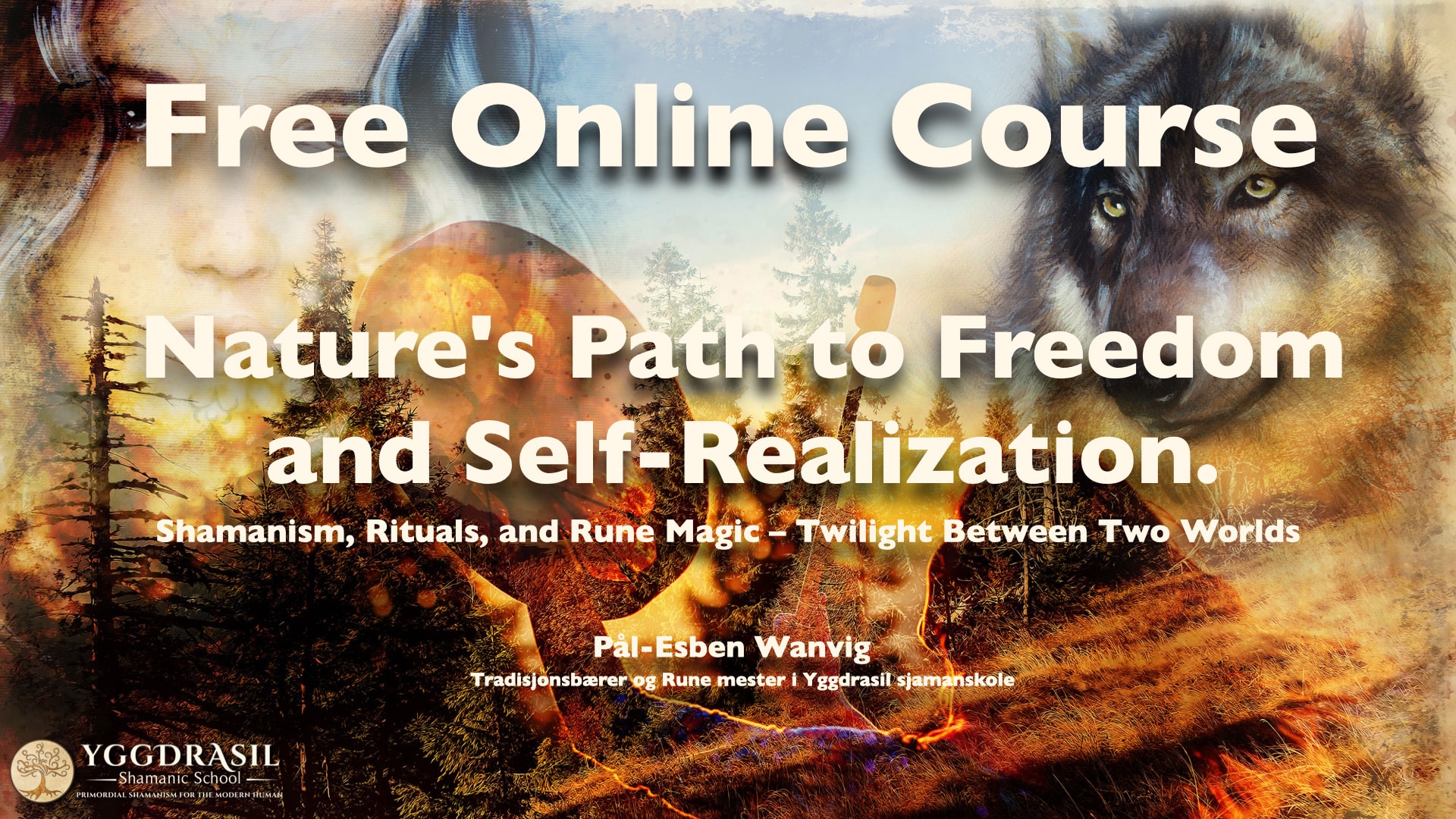
Nature’s Path to Freedom and Self-Realization
Curious about what primordial shamanism really is, behind the mystique and the misconceptions? In this short online course I tell the story of my own path from skeptical engineer to teacher of primordial shamanism, and give you a first introduction to what I teach: what shamanism and primordial shamanism are and are not, how rituals and rune magic are used in practice, and why the longing for growth matters so much for a good life.
The lessons are recorded in Norwegian; the English version will be ready in November or December 2026. Leave your email on the course page, and I will tell you when it is.