


The Ego’s Last Stand: When the Ego Turns Spiritual

Part 9 of the article series “The Path to Spiritual Enlightenment”, published in Norwegian in the magazine Medium and on wanvig.no.
The longer you have walked the spiritual path, the harder the last trap is to see. In all real spiritual development, the work with the ego is regarded as decisive, and after several years many believe that this work is done. Few are prepared for something far more demanding: the moment the ego stops fighting back and instead dresses itself in spiritual clothes. Not because you are dishonest, but because at this stage the ego no longer feels like the problem. It feels like wisdom.
In the article series on the path to spiritual enlightenment and real spiritual awakening, we have followed a single thread from the beginning.
We started with the first birth, the pure mind we all came into the world with. The joyful child who knew nothing of achievement, comparison, or fear, and a mind that was simply present, open, and whole.
We also looked at what happens when life shapes us: how the ego grows as a shield against pain, and how, over time, it takes over the controls. We went into shamanic death, the healing of the dark night of the soul, and the deep inner transformation that is a prerequisite for finding the way back to our original true nature.
We have explored why the search for Unity should be the most important work of your life, followed the journey of the chakras from the root chakra to the crown chakra, and met Gaia as the soul’s place of learning. And we have looked at the nine most common reasons why most people never arrive.
At every step along this path, one pattern has repeated itself: What stops us is rarely what we do not know. It is what we think we already know.
Now we have arrived at something very few people talk about openly. A trap that does not wait for you at the beginning of the journey, but after you have worked long, honestly, and seriously. After something has truly loosened, and you begin to feel that you are on the right track.
That is when the ego mounts its last and most refined defense. Not as anger, fear, or a need for control, but as something that looks deceptively like wisdom.
The man who knew everything
Thomas had been meditating for more than five years when he contacted me. He had read all the right books and spoke fluently about consciousness, about presence, about freedom from the ego. And he spoke a lot. A great deal.
During our first conversation he told me how far he had come on his inner journey. He explained what the others in his meditation group had not yet understood, and described his own path of development as one of the deeper ones he had seen among the people he knew. There was no arrogance in his voice, but something quieter: a calm, self-evident conviction.
I listened. After a good while I asked him a simple question: “Who is it that is telling me all this?”
He stopped. His gaze grew uncertain. A pause. Then he began to laugh, but it was not a comfortable laugh. It was the laugh of someone who had just seen something he did not expect to see.
That question opened something in him, and it became the beginning of what turned out to be the real work. The work he had actually come to do, without knowing it when he contacted me.
The ego does not disappear. It changes masks.
Many assume that the ego disappears as we grow spiritually, and it is an understandable assumption. We begin to meditate, read about consciousness and inner freedom, feel something loosening inside, and start to believe that we are about to leave the ego behind. But that is not what happens.
Nor is it what we should wish for. The ego is not the enemy. The soul depends entirely on the ego to function in this world, because it is the ego that keeps track of practical tasks, sets boundaries, and gets us through everyday life. Without it we could not manage.
The real work is not about killing the ego or getting rid of it, but about changing its role. Moving it from being the ruler of the soul to becoming the soul’s advisor. In shamanism, this is called the real shamanic death: not physical death, but the death of the old identity in which the ego sits at the head of the table and decides everything.
It is deep and demanding work, and the resistance to it comes in three phases that become harder to detect with each phase.
The real work is not about killing the ego or getting rid of it, but about changing its role. Moving it from being the ruler of the soul to becoming the soul’s advisor.
Pål-Esben Wanvig
Phase 1: the obvious ego
In the first phase the ego is open and direct. It seeks pleasure, recognition, control, success, and security. It resists everything that feels foreign or threatening, reacts with anger, fear, or withdrawal when it does not get what it wants, and readily projects its own unprocessed weaknesses onto others, usually without our being aware of it.
These traits are easy to recognize. We see them quickly from the outside, and with a little practice and a willingness to be honest, we begin to see them in ourselves. It is uncomfortable, but it is a good place to begin, because it is clear enough for us to take hold of.
Most people who set out on a conscious path of development start here. They discover the ego’s obvious patterns and work with them. They read, reflect, and meditate, and slowly the rough edges are ground down. Something opens, something lightens, and it is real progress.
But at exactly the moment things begin to lighten, the ego puts up a new defense.
Phase 2: the ego behind the convictions and the sacred cows
The second phase is more hidden, and therefore more demanding to work with. Here the ego no longer identifies primarily with visible needs, but with thoughts, opinions, and belief systems. It defends its own convictions as if they were sacred cows that must not be touched, and filters all incoming information through a web of preconceived assumptions that were formed long before we began the conscious process of development.
This happens through three psychological patterns we all use, almost without knowing it.
The first pattern is deletion. We automatically notice information that confirms what we already believe, and filter out what challenges it. A person who has decided that she is never good enough at work rarely notices the times she actually performs well.
The second pattern is distortion. We interpret new information so that it fits what we already know. Critical feedback is read as confirmation that one will never be good enough, and a friendly comment is read as false. Reality is bent to fit the inner map we have drawn of it.
The third pattern is generalization. One difficult experience becomes a universal truth. A relationship that went wrong becomes “all close relationships end like this for me.” A failure at work becomes “I am not the kind of person who succeeds at things like this.”
These three filters are the theory, but they are easier to understand in practice.
One of my clients, Gerd, came to me after having worked on herself for many years. She had been in therapy, read a great deal of self-development literature, and attended retreats. What she had not seen was that she consistently chose guides and groups that confirmed the worldview she already had. Every time someone challenged one of her fundamental views, she found a reason why that person “did not quite understand.” The information was deleted, or it was twisted to confirm what she already knew. Gerd was not stupid or dishonest, she was completely ordinary. We all do this, all the time, on autopilot.
Cognitive biases: the brain’s hidden filters. In addition to these three patterns, we all carry many cognitive biases, inner filters that automatically color everything we see and hear. Psychology has documented more than 180 of them. Here are four of the best known.
Confirmation bias makes us seek information that confirms what we already believe and overlook what challenges it. We read the articles that prove us right, remember the conversations that confirm our view, and unconsciously sift out the rest.
The Dunning-Kruger effect makes us overestimate our own competence in fields where we actually know little. Those who know the least are often the most certain.
The bandwagon effect makes us adjust our opinions and behavior to what the majority does or thinks, without critical reflection. We believe we are thinking for ourselves, but as a rule we are simply following the current.
Status quo bias makes us cling to the familiar even when it harms us, because the unknown feels dangerous.
All of this is the ego’s line of defense in the second phase, and it works extremely well, precisely because we rarely experience it as a line of defense. We experience it as reality.
That is also why these patterns are so hard to work with on your own. We are subjective toward ourselves, and the ego sees its own patterns but does not want you to see them. It hides behind convictions, opinions, identities, and old reaction patterns, and calls it reality. That is why a qualified guide, therapist, or coach can make a decisive difference. Not because you are weak, but because you need a view from the outside that sees what you cannot see yourself.
Phase 3: the ego’s last and most dangerous trick, when the ego turns spiritual
Many who have worked long and seriously on their inner development experience a strange transition. Something shifts inside. The rough edges from the first phase have been worn down, the obvious defense patterns from the second phase have been identified and partly dissolved, and it begins to feel lighter, more open, more free.
And this is real. It is not imagined, but the result of honest and sustained work. But it is also exactly here that the trap is set.
Instead of saying “I want success,” the ego begins to say “I want freedom.” Instead of chasing power, it chases stillness. Instead of comparing achievements, it compares spiritual understanding and depth.
This is the ego’s last and most dangerous trick, because the ego is now no longer experienced as the problem. It is experienced as the one carrying out the practice, as the seeker of truth itself.
The seeker begins to think things like this: “I am really making progress now. I am closer to enlightenment than most people in my group. I have understood something very few people see.”
It is a sign I always notice in my conversations: The more someone tells me about their spiritual progress, the stronger, as a rule, the ego’s grip. True inner development does not need to show itself off, it is not preoccupied with its own progress, and it does not put its insights on display.
The closer one comes to the truth, the quieter everything becomes. No more excitement over breakthroughs, no more pride in understanding, no more feeling of having achieved something exceptional. Only simplicity. And that simplicity needs confirmation from no one.
False awakening
I call this phenomenon false awakening. It gives a feeling of having reached a higher state of consciousness, without the inner development actually having taken place.
The signs are recognizable: a strong conviction of one’s own enlightenment, a need to show oneself as spiritual, often wrapped in seemingly humble phrasing, and a quiet but clear sense of superiority toward others who “have not understood it yet.” There is often a distinct unease or irritation when someone questions the spiritual path one has chosen, and a certain impatience with everyone who is still preoccupied with everyday worries.
The paradox is that the more someone talks about having let go of the ego, the stronger, as a rule, the ego’s grip. The words serve the ego, not freedom.
Pål-Esben Wanvig
The irony is that precisely these traits reveal that the ego is as alive as ever. It has merely changed its mask and put on a far more appealing costume that is much harder to recognize. And it is far more difficult to question a spiritual identity than an obvious ego identity.
The paradox is that the more someone talks about having let go of the ego, the stronger, as a rule, the ego’s grip. The words serve the ego, not freedom. The ego has not been overcome, it has simply been given a new and more inviting face.
The triangle of suffering
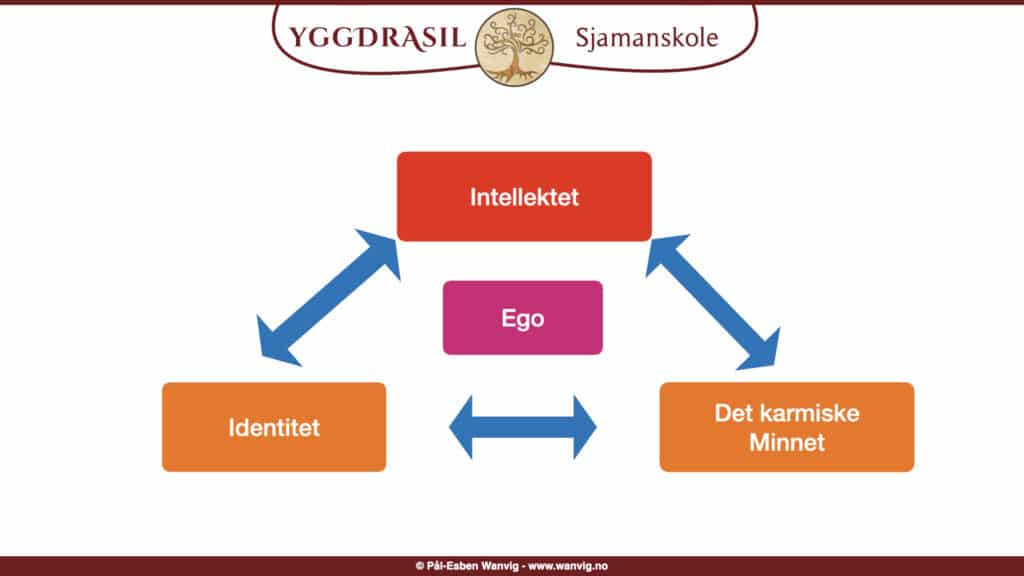
To understand what drives false awakening, it helps to look at what the ego is actually built of. In my work with students, I often use the image of a triangle with the ego at the center, surrounded by three layers.
The first layer is the intellect, the brain that analyzes, sorts, and judges. The intellect is a brilliant tool, but dangerous to leave in charge. When the intellect is put in the service of the ego, it produces arguments for our own spiritual development that are almost impossible to refute, and it can justify almost anything in a way that sounds deep and insightful.
The second layer is the identity: who we think we are, the roles we play, and the stories we tell about ourselves, including the spiritual stories. “I am a seeker.” “I am someone who has understood.” “I am someone who works on myself.” These identities can feel valuable and true, but they are still identities, and the ego lives in them just as readily as in any other identity.
The third layer is what we may call karmic memory, the stored reaction patterns from the past. Reactions we do not choose, but that simply happen: the automatic irritation when someone rejects something we believe in strongly, the automatic pride after a spiritual breakthrough, and the automatic withdrawal when someone asks a question that shakes our spiritual self-image.
The ego sits at the center of these three layers and directs the defense, and the more spiritual facade we have built up, the more invisible this interplay becomes.
The questions that expose it
The best tool I know for working with this is also the simplest. It is not about analyzing yourself more, but about asking a direct question where we usually ask no question at all.
Who is it, really, that is doing this?
Who is meditating? Who is seeking enlightenment? Who is feeling progress? Who is feeling stuck? Who is feeling more enlightened than others?
When we really search for this “who,” we find something surprising. We find no fixed, unchanging core that owns all of this, only thoughts, feelings, and stories that all flow back and forth. None of them is the fixed core we were looking for.
And it is exactly here that something opens.
The ego cannot survive being fully and honestly seen through. It is not a matter of beating it down with force, but more like turning on the light in a room that has always been dark. The darkness does not disappear because we fight it, it disappears because the light is there.
These questions are not a technique, they are an exposure. And the ego cannot survive being seen fully and completely.
The ego cannot survive being fully and honestly seen through. It is not a matter of beating it down with force, but more like turning on the light in a room that has always been dark.
Pål-Esben Wanvig
One thing is important here: Ask these questions without expecting an answer. The ego loves to answer and is very good at it. It will immediately hand you an explanation, an analysis, a new identity to put on. The point is not to arrive at an answer, but to see what happens in you at the moment the question is asked. Notice the small pause, the uncertainty, whether a faint unease appears. That is where you work.
Many find that these questions are more useful than months of analysis. Not because analysis has no value, but because analysis is always the ego’s own project. The question reaches toward something deeper than the intellect can reach on its own.
What real development looks like
It can help to know what you are looking for. Real inner development is rarely dramatic. It does not look like a guru sitting in perfect calm, but rather like a person who reacts a little more slowly than before, who notices their irritation without acting on it right away, and who can bear to hear something unpleasant without having to defend themselves.
It is the small things that reveal it. Take the person who can sit with the discomfort for ten minutes after a meeting where she was criticized, without going on the defensive. She is further along than the one who can talk for hours about consciousness and freedom from the ego, but who reacts sharply when someone rejects one of her views.
Real development is recognized by less need to be right, a greater capacity to bear not knowing, less need to explain oneself, and a quiet presence that does not demand confirmation.
It is not spectacular, but steady and calm, and it grows stronger with every honest encounter with yourself.
Real development is recognized by less need to be right, a greater capacity to bear not knowing, less need to explain oneself, and a quiet presence that does not demand confirmation.
Pål-Esben Wanvig
The way forward
Thomas and I continued working through many conversations, and it took time. But the turning point came when he stopped explaining his progress to me and began asking honest questions instead.
“I noticed that I got irritated when someone else in the group got more attention than me at the last meeting. What is that?”
That question was far more important than all the reflections on consciousness he had shared in the first conversations.
This is what it looks like in practice. Not necessarily great breakthroughs, but a gradual willingness to see yourself honestly, even where it is uncomfortable.
One of the most important things you can do at this stage is to find a person outside your own spiritual circle who can mirror you honestly and objectively. A guide, therapist, or conversation partner who is not caught in the same system as you, and who will not confirm your spiritual self-image uncritically, but ask you the questions you would rather avoid.
Loneliness can also reinforce these patterns. A closed spiritual circle where everyone confirms each other’s insights and no one asks demanding questions is a place where the ego’s spiritual mask thrives. That is not an argument against community, but an argument for choosing community with care, and for seeking what challenges you as much as what carries you.
If you recognize yourself in some of what I have described here, there is no reason to lose heart. The fact that you can see this pattern in yourself is in itself a sign of honesty, because the ego loves to remain invisible and thrives in the dark. It is demanding work to see it precisely where it hides best.
In my experience, confusion, frustration, and disappointment on the spiritual path are often a good sign. They may mean that the ego’s last mask is about to fall, and that is not a defeat, but a step closer to honesty. And honesty is always a good sign, even when it is uncomfortable.
Three questions to take with you
Feel free to end your next meditation, or a quiet moment during the day, with these three questions. Not to analyze your way to an answer, but to see what is actually present right now.
Who is seeking right now? What does this seeker need to prove? Can I observe this thought without becoming it?
You do not need an answer. You only need to see.
What I have experienced, both in myself and in my work with students, is that these questions work more strongly the less you push. Ask them once and let them rest. The answers do not come through effort, they come when you stop searching.
There is no goal you have to reach, only a gradual willingness to see yourself a little more honestly, a little more often. That is actually more than enough.
Stillness is not achieved. It is what remains when you stop striving.
Do you want to go deeper? In the podcast “The Journey to Self-Realization” (in Norwegian), Amina and I walk through the same terrain in conversation: episode 37, “Egoets siste skanse, når egoet blir spirituelt” (The ego’s last stand, when the ego turns spiritual). On my blog you will find more articles on the path to Unity. See also “The 9 Biggest Obstacles Blocking Your Path to Spiritual Enlightenment” (Part 8) and the article on shamanic death, “The Prerequisite for Your Second Birth” (Part 2).
If you want to walk the path yourself, it begins at the Yggdrasil Shamanic School with our free online course on primordial shamanism: Nature’s Path to Freedom and Self-Realization – Shamanism, Rituals, and Rune Magic – Twilight Between Two Worlds. No path could begin more simply. How far it reaches is up to you.
Nature’s Path to Freedom and Self-Realization
Curious about what primordial shamanism really is, behind the mystique and the misconceptions? In this short online course I tell the story of my own path from skeptical engineer to teacher of primordial shamanism, and give you a first introduction to what I teach: what shamanism and primordial shamanism are and are not, how rituals and rune magic are used in practice, and why the longing for growth matters so much for a good life.
The lessons are recorded in Norwegian; the English version will be ready in November or December 2026. Leave your email on the course page, and I will tell you when it is.