
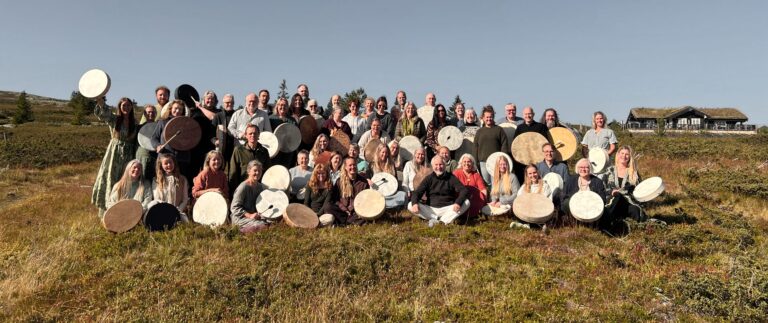




Who Are You If You Are Not Your Thoughts?

Part 10 of the article series “The Path to Spiritual Enlightenment”, published in Norwegian in two parts in the magazine Medium (nos. 5 and 6, 2026).
There is a discovery that can change a person’s life overnight. It does not require you to travel to India, to sit in a cave for ten years, or to believe in anything at all. It requires only that you are willing to look closely at something you have taken for granted your whole life: the assumption that the voice in your head is you.
That assumption is wrong. It costs you dearly every single day, and it can be seen through. The way there runs through modern brain research, thousands of years of Indian wisdom, Norse mythology, and perfectly ordinary everyday situations: the quarrel at the dinner table, the comment from a colleague that hurt you, and the nightly churning of thoughts that keeps you awake. And it ends in concrete exercises, so that you do not merely read about this, but can begin to experience it yourself.
For this cannot be understood intellectually. It can only be experienced. The words here are a map. The terrain you must walk yourself.
The mind you were born with
But let us begin somewhere completely different from the brain: in what you were before any of this began.
The day you were born, you had a shining, pure mind. No words, no opinions, no beliefs, no story about who you were. No regret about yesterday, no fear of tomorrow. Only awake, open awareness, and a joy that needed no reason. Look at a small child: It squeals with delight at a sound, a color, a face that appears. It is not happy because something in particular has gone well. It is happy because it has not yet learned to be anything else. This is your basic state, life as it feels before everything else settles on top of it.
This pure awareness did not disappear. It is easy to believe that the innocence of childhood is something we grow out of and lose for good. But it is still there, beneath everything that was built afterward. That is what we are going to find the way back to. Not by becoming a child again, but by discovering that the one who saw the world back then has never left you.
The researchers who looked for the boss in the brain
But what happened to the pure mind, and who is it, really, that can catch sight of it again? To approach that, we must visit an unexpected place: neuroscience.
For years, brain researchers have searched thoroughly for the “I” in the brain. They wanted to find the control room. The boss. The central authority that runs it all, the one who thinks the thoughts and makes the decisions. There ought to be such a place, they reasoned. After all, everyone experiences that someone is sitting in there, in charge.
What they found was nothing.
No central controller. No control room. No boss. The neuroscientist Michael Gazzaniga, one of the pioneers of modern brain research, sums it up in his book Who’s in Charge? (2011): There is no boss in the brain, and you are certainly not the one in charge there. The brain consists of millions of local processes with no one at the top. What they did discover was something best described as a kind of open space where thoughts, feelings, and sensory impressions arise and vanish again, like clouds drifting past. They come, they change shape, they are gone. And no one is at the helm.
This leads us to a question most people never ask themselves in an entire lifetime:
If no one is in charge, who is it, then, that is watching this dance?
Who is it that notices your thoughts? Who is it that observes a feeling coming and going? Who is reading these words right now, behind your eyes?
This question is not new. Humanity has asked it for thousands of years, and the oldest spiritual traditions we know have answered it with a thoroughness that makes modern research look like a newcomer to the field. The yogic tradition. Zen Buddhism. The Upanishads of India. They all arrived at the same answer, each in its own way, through millennia of inner exploration:
That which watches is not the thoughts. It is something else entirely. Something that has always been there. We call it the observer.
But before we get to know the observer, we must get to know the one who makes all the noise. For there are two completely different things in you, and the way forward depends on your learning to tell them apart.
That which watches is not the thoughts. It is something else entirely. Something that has always been there. We call it the observer.
Pål-Esben Wanvig
The voice in your head: the inner commentator
You know it well. The voice that always has something to say. The one that comments on what you see, judges the people you meet, replays yesterday’s conversation and plans tomorrow’s. The one that tells you who you are, what you should have done differently, and what the others are surely thinking about you.
This is the inner commentator. And it has three basic modes that it switches between all day long:
Narrator mode. It describes and interprets everything that happens around you and in you. I like this coffee. That guy seems grumpy. It’s late again. I am a person who does not like large gatherings. A steady stream of descriptions, opinions, and labels, from the moment you wake until you fall asleep.
Critic mode. It judges you, often mercilessly. Am I good enough? Why did I say that? Everyone else manages, just not me. The inner critic can be so harsh that you would never have accepted another human being speaking to you that way. But from the inside you accept it, day after day.
Cheerleader mode. It praises and encourages you. That was well done! Now I finally get it! It often shows up to calm the critic down, like an internal fire brigade.
These three modes are never silent. A human being buzzes between them all day, jumbled together, up and down, back and forth. In Buddhism there is an apt name for this: the monkey mind. A monkey that leaps from branch to branch, from thought to thought, without pause and without plan.
The inner commentator is shaped. It is not innate. It is built up through your whole life, by your childhood, your culture, your fears, and your desires. The definitions it gives of you change all the time. What you defined yourself as at five is something completely different from what you defined yourself as at twenty, and something completely different again from today. The commentator is as fleeting as the thoughts that drive it.
But it is not your enemy. The more you train good patterns of thought, the milder and wiser it becomes. But however wise it gets: It is not you. And to understand why, we must look at the larger structure the commentator is part of.
The construct: your false identity
The inner commentator is only the voice. Behind the voice lies a whole machinery. I call it the construct.
The construct is your false identity. It consists of several parts that work closely together:
The intellect. Your thinking apparatus. That which analyzes, compares, plans, and reasons. An indispensable tool, and completely dependent on information to function.
The ego. The feeling of being a separate “I” that must be defended, promoted, and protected. That which is hurt when someone criticizes you, and flattered when someone praises you.
The identity. The story of who you are. Your name, your roles, your opinions, your taste. My name is this, I live there, I am that kind of person, I believe in this and that.
The karmic memory. All your imprints. Everything you have learned, experienced, been hurt by and shaped by, stored as patterns that govern how you react, often without your noticing.
The identification. The very glue in it all: the deep, unconscious conviction that all of this is you. That the thoughts are your thoughts, that the feelings are you, that the story about you is who you are.
And the name is no coincidence: This whole structure is constructed. It was built, piece by piece, after you were born.
Remember the child we began with: the human being before the construct has taken shape, without a single label on itself.
Then the imprinting begins. The child learns: That is good. That is not good. This is how we do things in our family. Boys don’t cry. Good girls sit still. The child learns to think, and it learns how it is supposed to think. It learns to express feelings, and which feelings are allowed. Layer upon layer is built up: thoughts, opinions, fears, strategies, a whole personality. And somewhere along the way, gradually and imperceptibly, the decisive thing happens: The child begins to believe that this structure is who it is.
There you were born into the illusion. Not because anyone wished you harm. Your parents did the same, and their parents before them. That is how it works for practically every human being.
Why the construct is created
If the construct is false, why does it exist at all? Is it a mistake? Something that ought to be removed?
No. And this is a point where many spiritual movements go wrong. The construct is not a mistake. It is necessary.
What you most deeply are, what we will soon call Atman, is pure, still awareness. It observes. It does not think, it does not hold opinions, it does not intervene. But try to imagine a life as only that. If you were only a pure observer, what could you do in this world?
Nothing. You could not hold a conversation, because conversations require language and thoughts. You could not have read a book, solved a problem, laughed at a joke, or tasted strawberries exploding on your tongue on a warm summer day. You could only watch. Pure observation, without participation.
To take part in life, to experience, learn, love, fail, and grow, you need an interface. Something that can speak, think, remember, feel, and act. That is the construct. The construct is the tool that makes it possible for what you truly are to take part in this world.
And as a tool it is brilliant. With the construct you can become a skilled professional, learn to play an instrument, build a house, raise children, earn a doctorate, or become a caring partner. There is nothing wrong with the construct.
The problem is not that you have a construct.
The problem is that you believe you are it.
The problem: you believe the construct is you
Almost every human being on this planet lives their whole life inside a fundamental misunderstanding: they believe that their thoughts are them. That their feelings are them. That the story of who they are, the opinions, the fears, the preferences, and the karmic memory, that all of this is who they are.
It is like an actor who has played the same role for so long that he has forgotten it is a role. He goes home from the theater in costume, answers to the character’s name, defends the character’s opinions, and suffers the character’s sufferings. Not because he is stupid, but because no one ever told him there was something underneath the costume.
And what power this gives the construct over a human being.
When you believe your thoughts are you, you must take every single thought seriously. If a dark thought comes, you become a dark person. If an anxious thought comes, you become afraid. Your thoughts can keep you awake at night, ruin a vacation, poison a friendship. They have full power over you, for one single reason: you believe they are you.
When you believe your feelings are you, you are tossed around like a cork on the ocean. Anger, shame, envy, and fear: Everything that washes through your system, you take personally, because you believe it is you.
Your thoughts can keep you awake at night, ruin a vacation, poison a friendship. They have full power over you, for one single reason: you believe they are you.
Pål-Esben Wanvig
When you believe your identity is you, you must defend it tooth and nail. Every time someone challenges an opinion you hold, it feels like an attack on your very existence. For if my opinion is me, and my opinion is wrong, what is left of me?
The pattern is the same every time: The construct has power over you only through identification. Your thoughts can rule you only as long as you identify with them. Your feelings can sweep you away only as long as you believe you are them. Your opinions can be wounded only as long as you believe they are you.
All of this can be summed up in a single sentence: Suffering can arise only through identification.
All psychological suffering, all brooding, all grudges, all bitterness, and all worry: it arises the moment you identify with something happening in your construct. Without identification, a thought is just a thought passing by. A feeling is just a wave washing through. With identification, the thought becomes you, the feeling becomes your crisis, and the drama is under way.
This is not a claim you should believe. It is something you can investigate for yourself in your own life. And the consequence reaches into every single conversation and experience you have.
When constructs talk to constructs
Think of a perfectly ordinary conversation. Two people talking. Perhaps a discussion at work, perhaps a quarrel at home, perhaps a comment that hit you right in the gut.
What is actually going on there?
In the vast majority of cases, it is not two people meeting. It is two constructs talking to each other. His intellect, ego, identity, and karmic memory produce words, which hit your intellect, ego, identity, and karmic memory, which produce a reaction, which hits his construct again. Two automatic systems exchanging signals, both on autopilot, and both convinced that they are the one speaking.
When your colleague makes a snide remark, who is speaking? It is his construct. Shaped by his childhood, his fears, his bad night, his need to assert himself, his imprints. The remark says, in reality, mostly something about the machinery that produced it.
And who is it that gets hurt? Your construct. Your ego registers an attack, your identity feels threatened, your karmic memory digs up every similar wound from the past and stacks them on top of one another. And there you go: You spend the rest of the day gnawing on a sentence.
But what actually happened? One construct, which is a learned, automatic structure, sent some words to another construct, which is also a learned, automatic structure. Two roles playing theater together. And you, what you truly are, the still observer behind it all, were neither struck nor harmed. It cannot be struck. It never could be.
Why on earth, then, should you take to heart what someone says to you?
The question is meant sincerely. When someone wounds you with words, it is their autopilot talking to your autopilot. Their imprinting colliding with yours. It is not the truth about you that is being spoken. It is the contents of their construct becoming visible. A person who speaks disparagingly to others is only showing you what is stored in their own system. It is almost frightening, once you see it: There stands a human being reading aloud from their own wounds, believing it describes you.
This does not mean that words are irrelevant, or that you should put up with anything. You can still set boundaries, speak up, and choose whom you spend time with. The difference is that you can do it from calm instead of from wounds. You can respond instead of react. For the one who has seen through the game, words lose their power to define.
A person who speaks disparagingly to others is only showing you what is stored in their own system. It is almost frightening, once you see it: There stands a human being reading aloud from their own wounds, believing it describes you.
Pål-Esben Wanvig
This also affects the ability to forgive. As long as you are full of identification, forgiveness is almost impossible. You identify with what you hate, you identify with the fact that another person has done something you do not accept, and the grudge sits as if cast in concrete. But the moment you see that it was construct against construct, autopilot against autopilot, two sleepers who stumbled into each other, the grip loosens. Not because what happened was all right, but because you no longer need to carry it as part of who you are.
Most conflicts in the world, from dinner-table quarrels to long-running family feuds, are constructs quarreling with constructs about things neither of them actually is. Once you see this, you can never look at a quarrel the same way again.
The observer: the one in you who has never changed
So if you are not the commentator, not the thoughts, not the feelings, not the identity: Who are you, then?
Everything else about you has changed. Your body: Your cells are replaced, the face in the mirror is a different one from twenty years ago. Your opinions: You have held views you shake your head at today. Your taste, your habits, your fears, and your dreams: everything has been in constant motion. The person you were ten years ago is, in every measurable respect, a different person.
But something is exactly the same.
The one who noticed the world when you were five years old is the same one reading these words now. Not similar. The same. It has not grown older. It has not grown tired. It has not been damaged by anything you have experienced. In other words, there is a part of you that is untouched by time, unaffected by trauma, immune to every story your mind has ever told you.
This is the observer. The witness. The still awareness that watches thoughts come and go, watches feelings rise and fall, watches the inner commentator carry on with its business and never intervenes. It does not need to intervene. It already knows that none of this defines you.
The observer does not think. It does not analyze. It does not react. It only sees. Always still, always present, always untouched.
And it has been described by many names in all the great spiritual traditions. In Hinduism and Vedanta it is called Atman, the eternal self, the silent witness. In yoga philosophy it is called Sakshi, the witness, and Drashta, the seer. In Tibetan Buddhism: Rigpa, the primordial, naked awareness. In Zen one speaks of your original face, the one that was there before all imprinting. Eckhart Tolle calls it conscious presence. The psychiatrist Arthur Deikman even gave it a name of its own: the observing self.
Thousands of years, widely different cultures, and yet the same discovery. It is not a passing fashion. It is one of the most consistent discoveries in human history.
Atman and Brahman: the wave and the ocean
In the Indian tradition, more precisely in the philosophical school of Advaita Vedanta, this question was taken all the way to the bottom. Advaita means “not-two,” and Vedanta means roughly “the end of the Vedas,” the deepest interpretation of India’s oldest scriptures. The core of the teaching can be stated simply:
There is only one reality. It is called Brahman: the infinite, universal consciousness from which everything springs. Not a god sitting somewhere in charge, but the very ground of consciousness that carries everything that exists. The world, individuals, time, and space are not false, but neither are they the deepest truth. They are like waves on the ocean: real enough, but never separate from the water.
And Atman, the observer in you? The answer this tradition gives has been pondered by human beings for millennia:
Atman is Brahman.
The silent witness in you is not a piece of the universal consciousness. Not a copy. Not a spark that resembles it. It is the universal consciousness itself, seen from inside an individual mind.
An image often used in this tradition: Think of the sun and its reflection in a glass of water. The reflection is not the sun, and yet it is the sun. The water and the shape of the glass give the impression that it is something of its own, something small and bounded. But the light is the same. Such is the relationship between Atman and Brahman: one consciousness experiencing itself through countless windows. One of the windows is you.
The consciousness that is watching your thoughts right now is the same consciousness that is watching mine. The same that is watching your neighbor. The same that looks through the eyes of the monk in the Himalayas, and of the person daydreaming on the subway in Tokyo. What differs is the content: the thoughts, the memories, the experiences passing through each window. But the space that notices it all? It is identical. It is one.
This also casts new light on the constructs quarreling with each other. Behind both constructs, behind your opponent in any conflict, it is the same consciousness looking out. You are, at the deepest level, the same being that has forgotten itself in two different costumes. That does not make the disagreements disappear. But it does something to the hardness in them.
The consciousness that is watching your thoughts right now is the same consciousness that is watching mine. The same that is watching your neighbor.
Pål-Esben Wanvig
Tat tvam asi: That is you. You are that
This insight is gathered in three words of Sanskrit, from one of the oldest and most important collections of texts in human history: the Upanishads, written in India two and a half to three thousand years ago.
Tat tvam asi. “That is you. You are that.”
Every word carries weight. Tat, “that,” points to Brahman, the infinite consciousness that cannot be fully named, only pointed toward. Tvam, “you,” points not to you as body, not to you as thoughts, not to you as identity or role, but to the deepest layer of you: the observer, Atman. And asi, “are”: not “resembles,” not “stems from,” not “is a part of.” Is. Identical.
In the Chandogya Upanishad it is told how the sage Uddalaka teaches his son, Shvetaketu. He asks his son to dissolve salt in water. Then he asks him to taste the water: from the edge, from the middle, from the other side. Everywhere it tastes of salt. But the salt is invisible. It is there without being seen, everywhere, in every single drop. Thus says the father: Brahman is in everything that exists. Invisible, but present everywhere. And then comes the mantra: Tat tvam asi. That which you cannot see, but which is everywhere: That is you.
You can understand this intellectually in a second. But to truly realize it, not as a thought but as a direct experience, is something else entirely. That is why this mantra is meditated upon. It is not meant to be understood. It is meant to sink in so deeply that the division between you and everything else begins to crack. To realize it as direct experience is the very state of real spiritual awakening and spiritual enlightenment.
The Norse parallel: Önd and Ginnungagap
Perhaps you think this is distant, Eastern philosophy. But our own ancestors here in the North pointed toward the same thing, with their own images.
In Norse mythology it is told that when the first human beings, Ask and Embla, were created, Odin, Vili, and Vé blew the breath of the gods into them. This breath is called Önd: the divine spark in the human being, that which connects you directly to the origin. Where the Indian tradition says that the witness in you is Atman, the Norse says that the divine lives in you as a breath. Önd is the Norse counterpart to Atman.
And the counterpart to Brahman? Norse tradition points toward Ginnungagap: the gaping primordial space from which all creation sprang. Not an empty nothing, but the source everything comes from and everything rests in. Together with the notions of Wyrd and Örlög (Anglo-Saxon and Norse), the web that connects everything that happens and the deepest, unshakable layers of reality, the Norse tradition approaches the same thing that Advaita Vedanta describes with Brahman.
The interesting thing is that different maps, drawn by different cultures at different times, point toward the same terrain. That is exactly what one would expect if the terrain is real. Mythology is never the terrain itself, it is a doorway and an illustration. But when Indian, Tibetan, Greek, and Norse doors all open onto the same room, it is worth going in.
The Sahara and the grain of sand
I like to use my own image for all of this.
Picture an endless desert. The Sahara, but without borders: sand farther than any thought can reach, still, timeless, without beginning or end. This Sahara is an image of what you most deeply are: the boundless, the timeless, that which was there before the story about you began, and which is there when it ends. Your Sahara is your own, direct entrance to what the Upanishads call Brahman.
And now picture one single grain of sand in this desert.
The grain of sand is your life. Your body, your name, your history, and your construct. One tiny grain of sand in an endless desert.
Most people live their whole lives with both feet in the grain of sand, firmly convinced that the grain of sand is all there is. All their fear, all their striving, and all their suffering play out within this one grain of sand, while the endless desert of their free and complete nature lies quietly around them, unnoticed.
The goal is not to leave the grain of sand. The grain of sand is valuable: It is where you can taste strawberries, love, laugh, learn, and experience. The goal is to arrive at a place where you stand with one foot in your Sahara and one foot in the grain of sand at the same time. Anchored in the infinite that you truly are, and at the same time fully taking part in the small, precious life you are living. Then you can experience everything the grain of sand has to offer, without drowning in it. And then you discover something strange: The grain of sand itself becomes more beautiful. The structure, the details, the beauty of getting to experience anything at all, come forward in a way you never saw when you believed the grain of sand was everything.
The choice you have in every single moment
You have a construct: intellect, ego, identity, identification, and karmic memory. It is necessary, useful, and valuable. But it is not you.
You are the observer: the still, timeless awareness that sees it all. And this observer is, at the deepest level, the same consciousness that carries everything that exists.
Out of this springs a choice. A choice you have in every single waking moment, even though you may never have known about it:
You can identify with the construct. Then you are inside the film, with everything that entails: the joys and the flavors, but also the suffering, the drama, and the chaos, all of it experienced as you.
Or you can observe the construct. Then you are sitting in the cinema, watching the film on the screen. The film runs its course, the thoughts are thought, the feelings are felt, but you know all along that you are not the screen. You are the one watching.
No one masters this from day one. You are going to be pulled into the film a thousand times, forget everything you have read here, and wake up in the middle of a quarrel or a spiral of worries. That is completely normal, and it is not a defeat. My best advice for those moments: Laugh at it. When you catch yourself being completely identified with your circus, do not reach for the whip. Smile at the madness instead: What a circus! There I went, straight into the trap again. How good that I saw it. Humor and gentleness bring you back to the observer far faster than self-criticism, because self-criticism is, as you now know, only the commentator in critic mode, that is, more of the same circus.
But the day a human being fully acknowledges and realizes that they are not their thoughts, not their feelings, not the inner commentator, a radical change takes place in how life is experienced. For then chaos can no longer have power over you. Chaos can have power over you only as long as you identify with it. Thoughts can torment you only as long as you believe they are you. Other people’s words can wound you only as long as you believe their construct describes you.
This is not a theory for enthusiasts only. It is, I dare say, the most practical insight there is. It changes how you sleep, how you argue, how you forgive, how you meet adversity, and how you die.
But it cannot be understood by reading the words. It must be experienced.
Exercises: from reading to experiencing
Everything you have read so far is a map. The exercises below are three ways to begin walking in the terrain. They require no prior knowledge, equipment, or belief.
Exercise 1: who notices this thought?
This is the simplest and perhaps most exciting entrance to the observer. Set aside 5 to 10 minutes.
- Sit comfortably. Back upright, but not tense. Close your eyes.
- Take three calm breaths. Do not control the breath. Just notice it.
- Let a thought arise. Do not look for it. Just wait. It will come, it always does.
- When the thought appears, ask yourself silently: Who notices this thought?
- Do not answer in words. Any answer in words is just the commentator chiming in again. Instead, notice the small moment of stillness that arises in the wake of the question.
- Stay there. Let the next thought come. Ask again.
The small glimpse of calm, wordless presence you notice between the thought and the question: That is the observer. The first time, it may last half a second. That does not matter. You have just met the part of you that has never changed.
Exercise 2: questions without answers
This exercise can be done anywhere: in the bathroom in the morning, on a walk in the forest, on the sofa in the evening. It rests on a simple principle: The intellect lives on answers. The observer shows itself in the space where the answer does not come.
Ask yourself a question, and deliberately let it stand without hunting for an answer. Good questions are those the intellect cannot answer:
- Who was I before I became something?
- What am I without my memories?
- Who is it that sees, when I see?
- What is left of me when all the stories are taken away?
The art is this: Ask the question, and let it go. You are not after the answer. You are after the empty space that arises after the question has been asked. Analytical thinking stops here, because the question has no answer it can find, and in the space that then opens, something completely different from thinking can come into view. If you notice the intellect starting to look for an answer, smile at it and ask the question again. Do this regularly, as a small habit, and stay open to what happens.
Exercise 3: the construct view in everyday life
This exercise takes what you have learned about constructs talking to constructs out into real life.
The next time someone says something that stings, a snide remark, an unfair comment, a criticism, try the following, preferably afterward if it goes too fast in the moment:
- Ask yourself: Who was speaking there? Picture the other person’s construct: the imprinting, the fears, the bad day, the karmic memory that produced exactly those words.
- Then ask yourself: Who was hit? Notice that it was your ego and your identity that reacted: your construct, not you.
- Remind yourself: What was said was one construct speaking to another. The observer in me was not touched. It cannot be touched.
- Then choose, calmly, what you actually want to do: respond, set a boundary, or let it lie. The difference is that you now choose from clarity, not from wounds.
Here are some questions for reflection you can take with you, preferably in writing:
- What is the difference between thinking a thought and noticing that you are thinking it?
- Can you remember a moment when you were completely still inside? What happened in your body then?
- Who are you, apart from the stories your mind tells about you?
- What do you think happens to the inner commentator when you stop taking it so seriously?
- If the consciousness in you is the same as in everyone else: What does that do to the way you look at conflicts?
In the end: what you have always been
The brain researchers never found a boss in the brain, because there is no boss there. There is a construct: a learned, necessary, and impressive machinery of thoughts, feelings, ego, and memory, which makes it possible for you to take part in material life. And there is an observer: the still, timeless, infinite awareness that sees it all, and which spiritual traditions have pointed to for millennia as what you truly are. Atman. Önd. The witness. And this observer is not separate from anything at all: It is the one consciousness that looks through all eyes. Tat tvam asi. That is you. You are that.
The problem was never that you had a construct. The problem was that no one told you there was something more. So you did what everyone does: You identified with the role, defended the costume, suffered the character’s sufferings, and accepted other people’s constructs’ words as if they were verdicts on who you are.
You no longer need to.
The problem was never that you had a construct. The problem was that no one told you there was something more.
Pål-Esben Wanvig
You do not need to believe any of what is written here. On the contrary: Do not believe it. Investigate it. Do the exercises. Ask the question: Who notices this thought? And notice the stillness that answers, without words.
The stillness has been there all along. It was there when you were five. It is there now. It is untouched by everything you have been through, and it is not even waiting for you, because it has never been gone.
It is the same pure mind you came into the world with. The blank, awake, joyful presence you had as an infant, before the first word and the first label, was never lost. It was only covered over. Everything you have read here is, in the end, about scraping away the layers and finding again what was there from the very first moment.
You are not your thoughts. You are the one who sees them.
And that changes everything.
The way forward: what meditation really is
Everything you have read here is insight. But insight alone is not enough. You can understand that you are the observer, that Atman is Brahman, that the wave was never separate from the ocean, and still go on living exactly as before. What changes a human being is to experience it in the body, once, unmistakably: that the thoughts race along over there like seagulls behind a fishing boat, while you yourself remain in the stillness. The first time you observe a thought without thinking it, it can turn life upside down.
The way there has a name, and it is one of the most misunderstood words there is: meditation. In the next article, “It Is Impossible to Meditate,” we clear up all the confusion around the word meditation. Why it is, strictly speaking, impossible to “meditate,” what a meditation process really is, and how you yourself can find the way into the still eye of the storm, the point of stillness in the middle of the churning thoughts. There we also go a step deeper into Atman and Brahman, not as something to understand, but as something to experience directly.
The observer is not a concept you need to learn. It is a place in you that you are going home to.
Do you want to go deeper? In the podcast “The Journey to Self-Realization” (in Norwegian), Amina and I walk through the same terrain in conversation: episode 38, “Atman, Brahman, meditasjonsprosess” (Atman, Brahman, the meditation process), and episode 35, “Sjelen drømmer, og du tror det er virkelighet” (The soul dreams, and you believe it is reality). On my blog you will find more articles on the path to Unity. See also “The Ego’s Last Stand: When the Ego Turns Spiritual” (Part 9).
If you want to walk the path yourself, it begins at the Yggdrasil Shamanic School with our free online course on primordial shamanism: Nature’s Path to Freedom and Self-Realization – Shamanism, Rituals, and Rune Magic – Twilight Between Two Worlds. No path could begin more simply. How far it reaches is up to you.
Nature’s Path to Freedom and Self-Realization
Curious about what primordial shamanism really is, behind the mystique and the misconceptions? In this short online course I tell the story of my own path from skeptical engineer to teacher of primordial shamanism, and give you a first introduction to what I teach: what shamanism and primordial shamanism are and are not, how rituals and rune magic are used in practice, and why the longing for growth matters so much for a good life.
The lessons are recorded in Norwegian; the English version will be ready in November or December 2026. Leave your email on the course page, and I will tell you when it is.