

Episode 38 – Atman, Brahman, the Meditation Process
Before she began her process of development, Amina thought meditation could be almost anything: someone in the lotus position on a mountaintop in the Himalayas, someone knitting, or someone busy with their tarot cards. Pål-Esben’s starting point in this episode is that it is impossible to do meditation at all. And when brain researchers went looking for the control room, the boss who is really you, they found nothing.
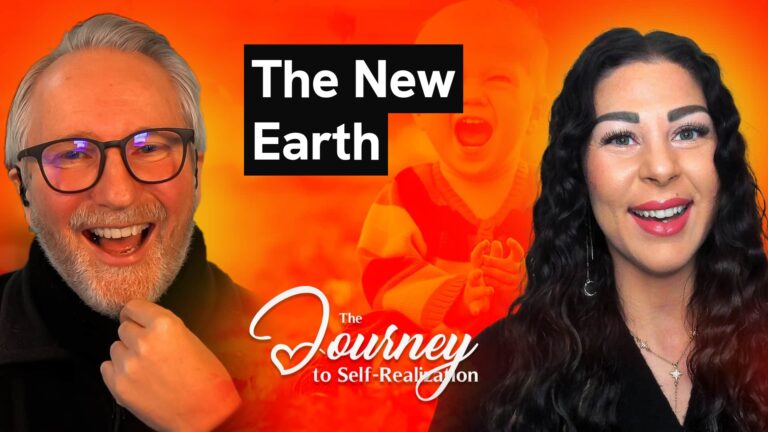
In this thirty-eighth episode, Amina and her teacher and guide, Pål-Esben Wanvig, talk about the difference between meditation and the meditation process. They explore the inner commentator and the observer, Atman and Brahman, and how you can begin a meditation process yourself, from cutting out the chaos to the still eye of the storm. It is part of “The Journey to Self-Realization”, a podcast about the bravest journey a human being can set out on: the journey home to yourself.
This episode is an English translation of our Norwegian original, voiced by the digital avatars of Pål-Esben and Amina.
In this episode
- Why meditation is a state and not something you do, and how spiritual words get washed out until they mean everything
- The brain researchers’ search for the self, and the observer as one of humanity’s greatest discoveries
- The inner commentator’s three modes, and the shock of experiencing for the first time that you are not your thoughts
- Amina’s first taste of the still eye of the storm, her way through the fear of death, and the master who helps people see that they are not their illness
- Atman, the Norse Önd and Brahman, the ocean and the waves, and why the leap from Atman to Brahman demands great stability in the depths
- The knowing that arises when thinking falls silent, the sleepwalkers, and Pål-Esben’s five months a year of time alone
- How to start: cut out the chaos, bring the body into yin, practise focus to get out of goldfish mode, and practise the still eye of the storm
- Why you need a competent guide, and how the Primordial Dragons help students into the state of Atman
This podcast is for you if you:
- Seek real depth in your spiritual practice
- Want to understand yourself on a more fundamental level
- Are curious about shamanism but tired of superficial “new age” spirituality
- Have taken many alternative courses but still feel that something is missing
- Feel an inner longing for freedom, love and wholeness
In a time when so many get lost in external methods and promises of quick fixes, this podcast invites you back to the only place where true answers can be found: your own heart.
Listen above, or read the full conversation below.
Transcript
A warm welcome to the podcast “The Journey to Self-Realization”, a primordial shamanic journey of development back to your true nature. This podcast is a collaboration with our favourite magazine, the health and lifestyle magazine Medium, and is devoted to exploring the bravest journey a human being can set out on: the journey home to oneself. We follow Amina, a student at the Yggdrasil Shamanic School, as she goes through a deep primordial shamanic process of development together with her guide and teacher Pål-Esben. It is a raw, unpolished journey of discovery towards true joy in life, deeper meaning, and a life that truly feels good to live.
This episode is an English translation of our Norwegian original, voiced by the digital avatars of Pål-Esben and Amina.
Pål-Esben: Hi, Amina, and a warm welcome to a new episode.
Amina: Hi, Pål-Esben. Thank you, and likewise.
What did you think meditation was?
Pål-Esben: Thank you, and a warm welcome to you too, dear listener. Today we’re going to have a joyful, exciting and insightful conversation about a topic that is beyond interesting, and that has been a topic in the spiritual world for thousands of years. We’re going to get into the practical side: what a seeker not only needs to understand, but needs to do on a daily basis. From the moment you start the search for your Sahara, for oneness, for spiritual awakening, call it what you like, there are certain things you need to practise every day. They run through every great spiritual tradition with a few thousand years of experience behind it: the yogic tradition, Zen, Buddhism. We’re even going to go through an exercise, so that you can start practising on your own right away.
We’re going to discuss the meditation process, but also what it requires, so that you understand what meditation is, what a meditation process is, and what we need to watch out for. We’re not talking about learning a form of meditation for a quiet mind when there’s a lot of stress, and we’re not talking about guided meditation either. We’re talking about something very specific that we need as seekers on the path to oneness, and it’s important to understand just how precisely defined this is. So, Amina: when you heard the word meditation for the first time, before you started your process of development, what were your thoughts about meditation?
Amina: To begin with, I thought several things were meditation. The first was someone sitting on top of a mountain in the Himalayas, perhaps in the lotus position, closing their eyes and going inwards, whatever that meant, because I didn’t really understand what it meant back then. But then I also heard people say: “I meditate when I knit,” or “I meditate when I’m working with my tarot cards.” So I had a broad understanding of what meditation was, everything from complete silence to going into a kind of flow with whatever you’re doing. I did realise it wasn’t playing football, though. And not least guided meditation: that’s where I first started using the word meditation about something I actually practised, and it felt really good. I also counted inner journeys, dream journeys and visualising as meditation. I lumped a whole lot of things together under the meditation umbrella. That’s where I started.
Washed-out words: when meditation means everything
Pål-Esben: Yes, and that’s one of the challenges when we talk about the path to real spiritual awakening, to our Sahara, to oneness. Many of the words used in this setting have been washed out and distorted. They don’t really mean anything, since they mean everything. One of the biggest challenges is that people say: “Yes, I do that too.” Then I say: “You probably don’t.” And that isn’t because people are stupid, but because the words in society, and especially in the esoteric world, have been washed out to such a degree that one word means a thousand different things. “I meditate,” people say. That can mean anything from sitting knitting in a kind of flow state and feeling meditative, to going for a walk in the forest, or being out on a meditative dream journey or a guided meditation. Very few of the people I come across can tell me exactly what meditation really is. They reel off a whole list of things they’ve done that they associate with meditation.
That’s a generalisation, which we discussed in the previous episode along with the mechanisms of the autopilot. So when we begin our real search on the path to oneness, there’s one thing we need to learn from the start: to become exact in our definitions, in what we do, in what we say, and in the words we use. Because if your brain is unclear and associates meditation with ten thousand things, it’s very hard for the brain and the intellect to understand exactly what you need to do in relation to the path to oneness. Then you think: “I hear Amina talking about doing a meditation process, but I do similar things, so I’m doing the same as Amina.” That’s one of the biggest challenges. The intellect, the karmic memory, the identity and the ego trip us up, so that we think we’re already doing it when we neither understand it nor do it. And as long as we think we’re doing it, we’re inside our own subjective hamster wheel, completely blocked.
Meditation is a state, not something you do
Pål-Esben: When I talk to my students about the path to oneness and the gateway into it, I try to be as exact as possible, even though oneness can’t be described in words, as we’ve discussed before. The first thing we need is a simple definition of what meditation is. And when we begin to study this, we come to the conclusion that it’s impossible to do meditation.
Amina: What? It’s impossible to do meditation?
Pål-Esben: Yes, because meditation is a state. You’re meditating when you’re in deep oneness with what is, with the consciousness that is. Until then, you’re doing some form of meditation process to get to the point where you’re meditating. Then everything is still. Then you’re separated from your karma. Then you experience Atman and Brahman, which we’ll say a few words about later today. That’s the first thing we need to understand. There’s no such thing as “I meditate”, because that would be something you do. It’s “I’m going through a meditation process to get into meditation”, meaning the state of meditation. Of course it’s clumsy to use the word meditation process, and people even just say meditation, but that’s for those who understand what we’re talking about. In our episodes I’ll be very careful about how I express myself when it comes to what meditation is and what a meditation process is.
So right at the start, when you had finished laying the groundwork in module 0, which is the foundation for the path to oneness, you were introduced to these concepts of mine. What started buzzing around in your head? Was the difference between a meditation process and meditation hard to relate to at first?
Amina: Yes, of course. I made myself a picture of what it was and thought I’d understood it. Over time I’ve realised that I hadn’t, of course. But you do the best you can with the theory you’re given, and then it’s lovely that you can move into experience over time, which means you really understand more of what it’s about. For me it made a lot of sense. So much of what you’ve shared in the seminars has just resonated deeply in me without my really understanding why, and this was one of those things. In theory it also made sense, the difference between a meditation process and meditation, because of course it has to be that way. So I made myself a picture of what I thought it was, and then I moved into experience.
The search for the self: what the brain researchers found
Pål-Esben: And that’s what’s important here, dear listener, if you want to begin this search. By that I don’t mean a search at random, but a search through cultivation, with coherence and clarity in the path you follow. At the start you won’t have a clue what meditation is, since it can’t be understood until you begin to experience it. So what you need at the start is some form of meditation process, where we cultivate ourselves, train and practise to find the state called meditation. You often hear that it’s important to find a quiet mind, and of course it’s important to settle your mind. But what is this stillness? What is it we’re really trying to reach? And what am I? In psychology, in neuropsychology, brain researchers have spent years looking for what you might call the self. Who am I? Who is the one doing the thinking? We’re all thinkers, and most people identify with being the one who thinks. These researchers are working to find the control room, the boss: who is it that’s really you? And the curious thing was that they searched and searched, and they found nothing. Absolutely nothing. No central boss, no central control. What they found was a kind of void where thoughts, feelings and sensory impressions arise and disappear again, just like waves on the sea. And the question they then asked themselves is this: who is it that actually watches this dance of thoughts, feelings and opinions?
The observer: one of humanity’s greatest discoveries
Pål-Esben: It’s a question humanity has been asking for many thousands of years, and it’s very well documented, especially in Asian, esoteric spirituality: the yogic tradition, Buddhism, and the traditions that come from the same roots. If we read the Vedas, there are hundreds of pages describing this, in a very complex way. What these traditions arrive at is that the one watching this dance of thoughts and feelings is something called the observer. It has been described by many different names across traditions for thousands of years, and it’s definitely not a product of neuroscience and modern times. It’s one of the most exciting things humanity has discovered. And that’s what we’re going to discuss today, as the start of why this exact meditation process is absolutely necessary to find the path to oneness. Isn’t this fascinating stuff, Amina? Nothing less than fascinating.
Amina: Yes, it’s hugely fascinating. But when we say that we’re all one, would you say that it’s the same observer in everyone?
Pål-Esben: Yes, ultimately it will be, but the observer has two different perspectives, and that’s what I’d like to say a few words about today. The misunderstanding modern people have is that they think it’s them doing the observing. But when you say “I think this, I feel this, I believe this”, it has nothing to do with what you really are. It’s part of the endless chatter inside ourselves, which also goes by the name of the inner commentator. Here we need to make a distinction, and the more aware and clear we are in our minds about this, the easier it is to understand why we carry out the meditation process every day. We need to distinguish between two concepts. One is the inner commentator, which most people think is them. There are very few people I come across who don’t identify with their thoughts and feelings. People think: “It’s me thinking.” But that has to do with the false identity.
The inner commentator: narrator mode
Pål-Esben: Let’s dissect the difference between the inner commentator and the observer, the one who watches. All these voices in your head want to have their say. They tell stories about you, they criticise you, now and then they praise you, and they’re always busy defining who you are. The problem is that the definitions change all the time. What you defined yourself as when you were five is very different when you’re ten, and very different when you’re twenty, and definitely when you’re sixty. The inner commentator has three basic modes. The first is narrator mode, what goes on while you sit there thinking: you describe and interpret everything that happens around you, you have opinions about this and that. “I like porridge, I like goulash, I like strawberries, I don’t like that person, I’m an astrologer,” whatever it is. That’s the inner commentator’s narrator mode, and it has nothing to do with your true nature. But it is part of your intellect, your ego, your karmic memory and your identity, the triangle of suffering, which we talked about before. So, do you recognise narrator mode, Amina?
Amina: Never heard of it.
Pål-Esben: Oh dear, oh dear.
Amina: Yes, yes, yes, I think everyone can recognise that one. And gradually realising that you’re not that narrator voice, because that narrator voice can get pretty crazy in your head.
Pål-Esben: But wasn’t it the case, before you started your real process of development, that you also identified with it and thought it was you? That it was Amina in what you thought and what you believed?
Amina: Yes, yes. My name is Amina, I have two children, I live in Horten, this is my computer. You think you are everything you think and feel, that that’s who you are. Then life becomes very limited, and it can really bring you into suffering too. You have to fight tooth and nail for who you are, or who you think you are. And with that narrator voice you’re talking about, I’ve certainly felt: “God, what a terrible person I am for having those thoughts,” like when I see that person or that situation and judge them straight away. I think a lot of people hide things they believe and think, because if they said them out loud, it would sound pretty crazy. And many people can feel pretty bad about those things too, because this is me, this is how I think, this is what I believe. But yes, I thought it was me.
The shock that changes everything: you are not your thoughts
Pål-Esben: Yes, and that’s what the vast majority of people do. Perhaps some people are getting irritated and frustrated by what we’re saying now: “Who are you two to say that it isn’t me thinking?” Well, we two are definitely not the first to have said it. People much wiser than us have said it for more than 5000 years, and it’s very well documented, for example through the yogic tradition. And the point isn’t to believe us. But when you move into real experience, where you begin to observe this inner commentator and practise creating a distance from it, you see that these thoughts, these feelings, are not what you are. Then you’ve learned to separate yourself from your karma, which is a consequence of a genuine and well-designed meditation process. The first time you come to that moment where you recognise that you are not this inner commentator, not your thoughts, not your feelings, it’s a life-changing experience for a human being. Because then, for the first time in your life, you understand what false identity is. In that moment you’re shaken to your roots.
It’s as profound a shake-up as the first time you do a spontaneous healing, which we teach beginners as early as the first seminar. You stand ten metres away from a client, do a method, and see the client physically change, the body physically change, with the naked eye. You can even be in another town and get exactly the same result. When people experience that this power lives in them, that they can do a spontaneous healing of another human being without touching them at all, their world view and belief system are shaken: “Wow, I’m capable of doing this.” From having heard that healing is just nonsense, to seeing: “I do this for one minute, and the body in front of me moves without my touching it.” That’s the first big thing that gives everyone, at least in our tradition, their first big shock. Isn’t that right, Amina?
Amina: Yes, yes, yes. I’ve now had three rounds of the basic training where we’ve met in person and practised this on each other, and people are in shock: “Good grief, what on earth is this tool we’ve been given? This is completely insane.” And you measure several times and see that it’s the same measurement every time. You’re completely blown away.
Pål-Esben: And these shocks are really a shock to the ego, the intellect, the karmic memory and the identity, our false identity, which has been drilled to believe that certain things aren’t possible, and then they are possible. On the path of development we prepare many experiences like this. When we start the path to oneness, one of the most important stops along the way, in terms of reference experiences, is when seekers experience for the first time that they are not the inner commentator. You are not your thoughts, not the story you tell about yourself, not the voice in your head that chatters all the time. That’s an even more revolutionary experience than doing spontaneous healing for the first time. Because it changes everything. It changes the whole concept of life itself. It’s utterly spectacular.
Amina: Yes, yes, yes.
The still eye of the storm: Amina’s first experience
Pål-Esben: What happened to you the first time you had this experience, this distance between your karma and the real you, when you observed your thoughts and feelings and opinions like seagulls behind a boat, without thinking the thought, without holding the opinion, as if you were sitting in a cinema watching the film? What was that like for you?
Amina: I can feel myself getting very moved as you talk now, because it’s beyond words, really. I actually remember it. In the meditation process I’ve worked a lot with the goal of being the still eye of the storm. All the thoughts and situations are the storm, and I’m the still eye observing in the middle of this storm. There was a lot of frustration at the start, because suddenly I was the storm, and then I was the eye, and then I was nothing, and then I was everything, and where’s this stillness now? But I remember the first times I experienced what you’re talking about now: noticing, after a while, that I was just the one observing. I wasn’t in the thought, not in the storm, not in the feeling. And when I realised that, I slipped out of it. But it was one of the biggest and perhaps most important experiences right at the beginning: “Whoa, shit, I’m not all this.”
And then it started to get really fun, because my everyday life began to change. I could be standing in the kitchen doing the washing-up, maybe a bit stressed by the children, or thinking about what to have for dinner, and begin to live more in a state where thoughts, situations and feelings happen through me, and I’m not all of this. That has been so incredibly revolutionary for my life. You don’t get so carried away by everything that happens. Of course I’ve had reactions over the last two years too, but you see it in a completely different way. Because you hear that you are not your thoughts, not your feelings, and it resonates, and there’s a bit of hope in it too: maybe I’m not all this chaos. But when you really begin to experience it, that’s something else entirely.
Pål-Esben: Yes, it is. Because far too many people theorise about these concepts: “I’ve heard this, I’ve heard that, that’s just how it is.” But understanding it isn’t worth a thing, because you can’t understand it; you only have a theoretical idea about it. It’s only when you have a suitable process, which includes a meditation process that brings you into this state, that you can really experience it. When seekers experience this real separation from their thoughts and feelings, where they observe the thoughts and feelings but are not them, as if they were sitting in the cinema watching the screen where the film is playing, and genuinely and truly experience this for the first time, I dare say it’s one of the most revolutionary moments in a person’s life. Because that’s where the real change begins to happen.
As you get skilled at separating this, you stay in the stillness, with your attention turned towards the stillness, while thoughts and feelings whirl around you like seagulls behind a boat. Or like when you’re sitting on a train reading a book: the countryside, the mountains and the rivers go past as the train moves, but you don’t notice, because your attention is on the book you’re reading. What happens then is that a great deal changes. You see that you are not your anxiety. You experience that you are not your depression, not the bipolar part of yourself, not the schizophrenic part. It’s impossible to overstate how explosive this is for a human being. Because the more you experience this, the deeper you go down this rabbit hole, the more you experience that this isn’t reality, and the less turmoil you have, the less fear, and the less stress about war breaking out and whatever else is going on in our society. Because you experience that you are something completely different from your thoughts, your feelings, your mental illness, your physical illness.
The illness you are not
Pål-Esben: One of my friends, whom I’ve talked about in an earlier episode, grew up in a temple in Tibet from when he was a very young child, and had his experience of real spiritual enlightenment more than 30 years ago. He’s one of the greatest spiritual masters of modern times. He works with a great many mentally ill people, people with serious mental illnesses: schizophrenia, deep depression, bipolar disorder, personality disorders of whatever degree. He’s an expert at bringing people into meditation, so that they experience that they are not their illness. And as he says: when people experience for the first time that they are not their illness, a healing that in psychology might have taken 20 years begins to happen in no time at all, as long as the seeker, or the person who is ill, is willing to practise and find the way into meditation. He tells me the most incredible stories about this. But it’s also my experience with my own students. I’ve seen people with serious problems, like social anxiety or depression, begin to recognise: “Wow, so I’m not my illness. And I can always come back to this state of meditation to experience exactly that.” The more you experience this, the less identified you become with the illness. So this moment has far-reaching consequences for a human being. And dear Amina, I’d like you to help me promote the importance of the meditation process here, because we want to put some meat on the bones of why we need to carry out a meditation process to find the way to meditation. It perhaps has the greatest impact of all for a seeker in the first phase of the primordial shamanic path to oneness and spiritual enlightenment in our tradition.
From fear of death to stillness
Amina: Yes, and I’d like to say something about what you just described, Pål-Esben. My life has consisted of much more than the polished picture people might see from the outside: an incredible amount of darkness, anxiety, fear of death, fear. For me the meditation process was perhaps a bit harder at the start than for most people, because I was met by extreme fear, extreme anxiety, before I realised, as you say: “Wow, I’m not all this.” And how it then stops. It didn’t take long to get from being deep in fear and suffering and fear of death, thinking “why am I even doing this?”, to the whole thing turning around, when I started experiencing that I could be the still eye of the storm. I’ve had so much fear of the dark, fear of the silence, fear of being stuck inside myself, fear of going into the depths. And I also talk to people who have a lot of fear themselves, and I know how terrible it’s been for me, and I think: if I can do it, anyone can, at least those who struggle with that kind of thing. And it’s as you say, you begin to observe: “Whoa, I’m not what I think I am.” Then this distance is created between the karma you’ve built up and who you really are. It actually didn’t take long before the shift happened, when I began to observe that there’s no point in being afraid of the dark. What’s the dark going to do, anyway? After all, the dark stands for death and things like that.
Critic mode and cheerleader mode
Pål-Esben: Yes, and these are natural side effects when you do a real meditation process to find the way into the state of meditation. But to achieve this we need to be exact, exact, exact. We’ll come back to how we start later in the episode, so that you as a seeker can begin correctly from day one, without picking up lots of bad habits, which is so easy to do. We’re working with the inner commentator, and we’ve talked about the first of the three modes, narrator mode: that you describe and interpret everything that happens around you.
The second mode is critic mode, which I’m sure you’ve heard of too, Amina. That’s when you judge yourself, often very harshly. Am I good enough? Am I clever enough? Are others cleverer than me? The inner critic is also part of the inner commentator. And the third mode we can call cheerleader mode: “Now I did well, now I had a breakthrough, oh, how great, wow, now I’m on the right track.” The inner voice that says: “Oh, well done.” A human being flits constantly between these three modes, often mixed together. And especially if you haven’t understood how serious it is to watch short videos on social media. We’ve talked about the topic of brain rot, how the brain actually rots and wastes away. If we watch these clips continuously, more than half an hour a day, a serious degradation of our brain begins. Then you switch constantly between the modes, the inner commentator is in uproar and in complete chaos, and the whole system is numb, as we talked about earlier.
How the false identity is imprinted
Pål-Esben: This inner commentator is shaped by your past, by your imprints, by your childhood, your culture, what you want, what you don’t want. It’s designed through the imprints we talked about before, how our false identity is imprinted, especially after the connection between our soul and ourselves has been cut, between the ages of 7 and 14. We’ve talked about this child who comes into the world. If it’s healthy and has safe surroundings that meet its basic needs, it’s naturally joyful, for no reason at all. You only have to pull a face at a little baby, and it’s delighted and shrieks with joy. It doesn’t need a reason. But then life happens, we’re imprinted and imprinted, and we drift further and further away from this real connection to our soul. This is where the inner commentator, the ego, the intellect, the karmic memory and the identity are drilled and trained and imprinted, until we think we are this false identity, this false personality, which has nothing to do with our real nature.
And it has many, many names. Eckhart Tolle calls it the egoic mind, others call it the Narrative Self, the one that tells these stories, or the Inner Critic. Freud called it the superego. And in Buddhism they call it the monkey mind, which is my favourite. A total monkey: it really does run completely out of control.
Amina: Yes, that’s a nice one.
The observer never intervenes
Pål-Esben: The second concept is the observer, also called the witness. And that’s something completely different. Because the observer doesn’t think, doesn’t analyse, doesn’t react. It sees the inner commentator, it sees your thoughts and your feelings, but it never intervenes. That’s the one we’ve talked about today, when we sit in the cinema and observe the whole jumble, this monkey mind buzzing about on the screen. The observer is always silent and never comments on anything at all; it just sees. That’s why we call it the observer, or the witness. Someone who has never experienced this has no basis for believing in it. But when you experience the observer for the first time, you just think: “Good heavens, this is something different from what I’ve believed my whole life. What I really am is so far from what I thought I was.” And that’s when we begin to see and experience from the observer’s perspective. Isn’t that lovely?
Amina: Oh, it’s fantastic.
Atman: the eternal self
Pål-Esben: And across cultures, through thousands of years, this observer has been given so many different names. The best known is from Hinduism, where it’s called Atman. It’s the eternal self, the silent witness to all experiences. In Hinduism they have a very good description of Atman, and Zen and Buddhism have their own ways of describing it. We won’t go through all of that now, because then it gets long-winded. We could spend half an hour on the different traditions and names, and on why it’s really exactly the same thing, but there’s no point in that where we are now.
Önd: the Norse breath of the gods
Pål-Esben: What’s interesting is that in Norse mythology we also have a concept that comes somewhere close to what Atman is, and that’s the Norse word Önd. That’s Önd: O with two dots over it, N, D. If you know a little about Norse mythology: at the creation of the universe, the three aspects of Odin arose, Odin, Vili and Vé. The story goes that they were walking along a beach and saw two trees. One tree was called Ask, and the other they called Embla. Then Odin, Vili and Vé breathed on these trees, what we can call the breath of the gods. They blew into Ask and Embla, and human beings came into being. Ask became the first man, and Embla became the first woman. This breath symbolises the divine spark in every human being, what is truly divine, what you really are, which we also encounter in every chakra core. When we talked about the journey from the first to the seventh chakra on the way to enlightenment, we talked about the chakra core in the middle of each chakra. It also symbolises this breath of the gods from Norse mythology, the fundamental divine spark in every human being. It’s what connects us with the origin, with what truly is. So that’s the Norse way of approaching the concept of Atman. It isn’t quite exact in the Norse material, since we’d then have to discuss concepts like Wyrd and Örlög, which would make the discussion far too complex. So it’s much easier to use Hinduism here. We’ll stick with Atman, this witness, the observer, whose perspective you look out from when you’re in meditation. Are you with me so far, Amina?
Amina: I’m with you. Yes.
Pål-Esben: And this is a part of you and me, and of you, dear listener, that has never changed. The ego, the intellect and this monkey mind of ours change all the time. But this part of us was the same when you were a child, it was the same when you were a teenager, and it’s the same in you now. Nothing changes over the years. It’s the same one you were born with, no matter how old a person is. That is Atman. It’s something that doesn’t change.
Brahman: the ocean and the waves
Pål-Esben: So what we’re talking about is this: what is a human being really? And the answer is, yes, it’s Atman. But is there something more? We need to discuss one more concept before we get to exactly why we meditate. Atman is the observer as you experience it individually, the consciousness sitting in you observing your thoughts, the personal witness. But then we have something called Brahman, also from Hinduism, which describes what consciousness actually is. Consciousness is what gives life to absolutely everything that is, the complete universal consciousness. It expresses itself through what they call Brahman, and Atman is the individual window this consciousness expresses itself through in every being. The first step in a real meditation process to get to meditation is to experience from Atman’s perspective: this individual window that the complete consciousness looks at the world through, through your eyes, your experiences, your thoughts, your feelings. When you had the first feeling of meditation, where you distanced yourself from your thoughts and feelings and could observe them like seagulls behind a boat, or like the countryside going past while you read your book, that was Atman. It’s the complete consciousness, which has created everything, experiencing itself through your window. Isn’t that poetic?
Amina: Very poetic. I’m starting to… So what’s the difference between Atman and the soul, then?
Atman, the soul and the transcendental transition
Pål-Esben: That’s a very good question. Our soul, by its very nature, experiences this far more directly, since it has no ego, no false identity, and isn’t limited by time and space or by opinions. Your soul experiences Atman and Brahman directly, without doing any meditation process. It’s part of its nature. Brahman is the complete consciousness. We’re not talking about being aware of something, not about cognitive awareness, but about life, what everything has arisen from, a divine core. Atman is the observer, the witness, seen from within, from a human being: the silent consciousness sitting there observing your thoughts, the personal witness. Brahman is the universal consciousness that expresses itself through all human beings, through all beings, through what is called Atman. Here’s an image that can help: if we think of the ocean and waves, Atman is the waves, and Brahman is the ocean. The wave thinks it’s separate, but in the end it’s the same water as the ocean.
When we start a real process of development towards real spiritual awakening, we eventually need to tell these things apart. That’s the background for why we begin doing a meditation process on the way to meditation. In your case this experience came after a few months. For someone who does the meditation process correctly, in a system suited to bringing you into this state, and that definitely isn’t every system out there, I believe this is something most people will experience within six months: the first moment where you experience Atman, the unique mirror and expression of the complete consciousness through your thoughts and feelings. You sit in the cinema observing the thoughts and feelings on the screen, and you know that you are not the screen. You are Atman. And Atman and Brahman are really exactly the same, because everything is the complete consciousness, but Atman is the personal expression, the personal mirror, unique from individual to individual, since your thoughts are your thoughts. Consciousness, Brahman, observes your thoughts, but does so through Atman.
So the first step in a real meditation process is to get to the point where you experience Atman. But that’s only the first step. The real step, a notch deeper, is where you experience that you are not Atman, but Brahman. That takes longer, because it’s even more complex, and it belongs to the last steps of the real process of awakening. The first couple of years are about coming more and more into contact with Atman, in this stillness you experience, where thoughts and feelings buzz around like the storm, or like the seagulls behind the boat. You need to stabilise yourself there, and find the state more and more directly in daily life too, without doing a meditation process. That’s where you’re beginning to get to now, Amina, where we gradually begin to practise: how do we find Atman in our daily life? And that’s where it starts to get beyond exciting.
Amina: Yes, definitely. And I can say that I experience it very often. Not all the time, because sometimes I get a bit more carried away by things, but very often I experience everyday life as if I’m the one observing, and I simply act from there, so there’s more flow in it. It doesn’t really demand that much of me. So that’s also why I can say something about the difference between when I experience it and when I don’t.
Stillness is only the first step on the staircase
Pål-Esben: Yes. And to get to where Amina has got to, you need a couple of years. At the Yggdrasil Shamanic School we reckon on around 18 to 24 months from when you’ve started the active process of development before you can bring this actively into daily life without a special process, that is, without having to sit down and do the meditation process for 30 minutes to get there. By then you’ve had enough reference experiences in a deep enough meditation to have genuine experiences of what it’s really about. Not false experiences, like the ones we find through false awakening, where people sit and meditate and meditate and think that stillness is the whole point.
Stillness is only the first letter of the alphabet in what we’re talking about here. Stillness is necessary, because the more chaos there is in our heads, the harder this is. But stillness is only the first step on a long staircase, a prerequisite for the other things we’re talking about. If you think the whole point is stillness, you won’t get further than the first step. Gradually, when you can slip into the state without doing a special process for it, we begin what we’ve been talking about: standing with one foot in our Sahara and one foot in the grain of sand, as we discussed in the previous episodes about the path to oneness. In that process too there are several steps; you go deeper and deeper into it. When these states begin to be reasonably stable, we begin the process of identifying and discussing Brahman. Because without a stable state and experience of Atman, you can just forget about moving on to Brahman, because it’s even more complex. Last time we talked about how the ego fools us all the time, the ego’s last stand, when the ego becomes spiritual. That last stage is much more complex, but that’s where you’re going to begin, and that’s your process from here on. So that’s the background for why a well-designed meditation process is absolutely necessary for the path to real oneness, for the path to our Sahara, for the path to a real spiritual awakening. There’s no getting round it.
Amina: Do experiences of oneness lie in Atman or in Brahman?
From Atman to Brahman: stability in the depths
Pål-Esben: That’s a fantastically good question. Then we have to start talking about how Atman and Brahman are really the same. When we move down into the depths, we start with our consciousness, then we have the unconscious, then our subconscious, and then the deeper part of the subconscious. Some people switch the order of the terms, but it doesn’t matter. Then you go further into collective consciousness, which we’ve talked about, and into the deeper part of individual consciousness. The deeper down you go, the closer you come to what we call the transcendental transition, where time and space begin to mix with the timeless and spaceless. By that point, if not before, the separation will have happened, and you begin to taste Atman. When we go deeper and begin to hit our Sahara, we begin to touch Brahman. But to experience Brahman fully, we need to get deep enough into our Sahara. Then we need to be completely disconnected, yet at the same time a hundred percent present. That’s the biggest challenge in this leap from Atman to Brahman: it requires incredible stability when you’re in the depths. Because there it gets more and more intense, and it gets easier and easier to drift off into cloud cuckoo land, to lose focus on the here and now. Suddenly you get pulled into a stream of energy, or an angel turns up, or you slip into some psychological space or other. It gets so intense in the depths that it’s hard to be present. And when we get far enough and begin to touch our Sahara, it’s an exceptionally intense experience, as we talked about in an earlier episode. When you hit the uppermost layer of your Sahara, you’ll normally be out of action for one to four weeks after an experience like that.
Amina: Yes.
Pål-Esben: It’s a shock to the commentator and to your false identity, your ego, when you have these brutal experiences of oneness, and that’s why the integration process takes one to four weeks. The deeper you get into the Sahara, the harder it is to be a hundred percent present, and the easier it is to doze off into cloud cuckoo land. You go in and suddenly don’t remember anything of what you’ve experienced, or you fall completely asleep physically and only surface again after two hours without being able to account for what it was. That’s why I say that when we move on to Brahman and the deeper aspects of the Sahara, you need to have trained and cultivated an exceptional inner muscle to be able to stay present here and now in the stillness, however intense the experience is. And you have quite a bit of experience of how easy it is to get carried off into cloud cuckoo land, as I call it.
Amina: Oh yes, heavens, there have been a few detours into cloud cuckoo land and astral realms, and they really send me spinning. Figures and images, those psychotic kinds of experiences and whatever else. And then many people think that’s what it’s all about, because then they’ve seen the light.
Pål-Esben: No, that’s just the ego doing it, unfortunately.
Amina: Yes, and I’ve talked to people who believe they’ve experienced oneness because they’ve sat in this light, and that light can feel very, very pleasant. My experience is that the better I’ve been at presence and focus, the more creative this gets, whether you call it ego or intellect. I can call it ego-intellect.
Pål-Esben: Let’s use slightly kinder words for it: we then get lots of so-called spiritual experiences.
Amina: Yes, and these spiritual experiences just get more and more creative. So I’ve also been on that journey where my attention keeps getting pulled here and there: here, here, here. But this is where I’ve really trained that muscle, and I’ve noticed how important it is to take care of the body: calm, what you eat, whatever it is for you. The more calm I have in my body and nervous system, the easier it is to hold on to that focus. At the same time I’ve noticed that it gets easier and easier to get into the meditation process, into presence and focus. Before, I had to do a great deal beforehand, whereas now it comes more easily. Even when I’m just sitting waiting for a doctor’s appointment, I can close my eyes and simply be present with what is. Or when I go to bed, it feels as if I slip into the same process. It’s become a bit like a new kind of autopilot. It’s something I’ve done for many years, so my body recognises it and wants to go into that pattern, very often.
The knowing: when thinking falls silent
Pål-Esben: Yes, this is very fascinating stuff I’m sharing with you. And gradually something very curious happens: you think less and less. It often creeps up on you. One of the things I sometimes notice about myself is that I don’t think any more, or only very rarely. I observe. The constant thinking from before, thinking and analysing, that isn’t me any more. Because the more you become these things, the more you are Atman and Brahman. You no longer think the thoughts; you observe them. And what happens then is something else that’s beyond exciting. A bubble of something new arises, which is called the knowing. Knowing and knowledge are two different things. Knowledge is something you acquire cognitively, but this knowing is something that arises from Brahman. The more you’re in states connected to Atman and Brahman in daily life, the more direct access you have to this knowing. That means you no longer need to think, because what’s needed will always be there.
An example: over the last 20 years, when I prepare for what I’m going to say, when I’m going to hold a seminar for example, what needs to arise keeps arising, since I’m with Brahman and Atman. I don’t have to memorise anything, I don’t write a single note, I don’t read a book. What’s needed in my special field, which has to do with my soul’s prism and lies in the field we’re discussing now, is simply there at all times. I can explain the same concept in a thousand different ways. I just need to find a perspective that suits Amina or others, and speak from that. All the thousand ways are available, not because I’ve memorised books, but because this knowing is available, strengthened by experiences of being Atman and Brahman. How liberating do you think that is? Of course you sometimes have to think. Say you have to deal with a problem in your life that needs structure, like a financial problem. Then you have to think in a structured way: “OK, I need to cut spending here and there, so that I’m back in the black.” In some places you have to think in a linear way, and that’s the inner commentator and the ego and company. Nothing wrong with the ego, as we talked about in the previous episode, because I need it. But becoming more and more this is so fascinating that it’s impossible to put into words. I sit and gaze for hours without thinking.
Amina: Do you?
Pål-Esben: Yes, and it’s fascinating.
Amina: With your eyes open?
Pål-Esben: Eyes open, it doesn’t matter. I can walk around experiencing from Atman and Brahman, and that’s one of the consequences of cultivating this. And imagine the moment when you stop needing to think.
Amina: Oh, that sounds lovely. That’s a nice carrot.
The sleepwalkers and time alone
Pål-Esben: It’s liberating, but it’s also an unavoidable consequence of the process of development you’ve chosen to engage in. Because the more experience you get with Atman, and eventually Brahman, and the more you can bring this into your daily life without having to do methods and techniques, the more you become this. And then you understand what we’ve talked about: that our soul creates a dream because it wants to have experiences in a limited setting, and that dream is what that human being thinks is reality. Human beings are sleepwalkers who think their dream is real. When you begin to experience reality from Atman and Brahman, you no longer experience from the dream. You see that the dream is a dream and has nothing to do with reality. The challenge then is being around sleepwalkers, who are fully identified with the inner commentator and the ego identity, and who fight tooth and nail for their opinions and what they believe. That takes a bit of patience.
That’s why you prefer what’s natural, and if you study history, you’ll see it: the more permanent contact you have with Atman and Brahman, the more you seek time alone, where you don’t need to say anything, where you don’t need to do anything, where you’re a hundred percent content and happy just to be. That’s why I take many months of holiday a year, five months a year in fact, when I have nothing to do with students or anyone else. That’s my time. Then I don’t need to do anything at all; I can just be. And I can tell you that’s something completely different from the chaos that was in me in the time before my burnout in 2003. It was a terrible chaos; that was monkey mind, you know. So I hope, dear listener, that you recognise that what we’re talking about might be very good for you too, because it will definitely change the way you experience life. So shall we say a bit about the practical side of how to start this, Amina?
Amina: Yes.
First tip: cut out the chaos
Pål-Esben: Let’s give some tips on how you, dear listener, can start the meditation process. Because you can start it on your own. When you begin to get your first Atman experiences, you absolutely need an experienced guide, someone who has experienced this before you and can guide you further, but until then you can start this process yourself. And what does it require? We can do this in a very complex and heavy way that takes forever, or in a way that’s much simpler and more joyful. Personally I prefer the simple and joyful way: dharmic synchronicity instead of karmic synchronicity, which we’ve talked about in an earlier episode. So what do I recommend to seekers who are truly authentic, genuine and wholehearted, who long for Atman and Brahman and say: “I am ready”?
First of all, I’d recommend that you turn down the chaos around you and within you. The less chaos, the easier it is to take the first step on the staircase, which is stillness. What I recommend to my own students, and again, nobody has to do anything at all, is to cut out social media, news and everything that creates chaos in our heads and our emotional system, and to cut it out completely. Then many people say: “Yes, but I want to look at Instagram.” You do what you like, but you can make this path very heavy and complex for yourself, or much simpler. If you want to take the simple path, it’s an absolute necessity to cut out this input, and to minimise the input from outside that creates chaos in you. Social media is designed to create chaos in you and to create addiction, because that’s how the social media platforms make money. It’s AI that is a thousand times smarter than you, manipulating you left, right and centre all the time. So the first tip I give is this: cut it out, uninstall the social media apps, cut out all forms of news, try it for 30 days, and see how peaceful it can make you.
Amina: Can I ask a little question here? We live in a world where many people are self-employed and use social media as a platform to reach people. What can they do, when they can’t delete everything, as it were?
Pål-Esben: Good question. What I’m talking about here is mindless scrolling and swiping to fill the empty spaces in life with hits of dopamine, like addicts constantly chasing the next dopamine hit. That’s the problem. Those who are professionals and run a business have to do their thing: post, comment and so on. But that’s business, not mindless scrolling and swiping. It’s targeted, it’s focused, and if you have a business, you perhaps do it once or twice a day. For example, you have half an hour in the morning and half an hour in the afternoon, when you go in with a clear aim to post, comment and build relationships. And ordinary mortals who don’t have a business can put locks on the apps and give them perhaps ten minutes a day to communicate with the people they need to, or they can use other communication platforms for their friends. What I mean is the mindless scrolling on social media, the mindless consumption of YouTube videos where you feed yourself information again and again, and this intake of news that’s just mayhem and stress. Most of the news you’re served has nothing to do with reality, but it stresses you out like crazy. You experience that once you’ve gone cold turkey and been on the wagon for a month. Then you experience how brutal this is, and how much more easily this inner calm becomes available.
So that’s for those who want the simple path. And if you say, “No, I don’t want that,” then you can take the heavy path, and then I say good luck. Because what we’re talking about now, the path to Atman and Brahman, is close to impossible that way. Simply because your nervous system is constantly stressed and restless all day long, and then you expect to be able to just sit down and do a meditation process and calm down the chaos. I’ve never come across a human being who’s able to do that. I’m not saying it isn’t possible, but I’ve never come across it. So that’s the one tip: go cold turkey, go on the wagon, abstain from this input. That’s number one, and it helps you find the first step on the staircase, which is inner stillness.
Bringing the body into yin
Pål-Esben: The second tip is to find a way to calm your body down before you slip into some form of meditation process. Ask yourself: what does my body need to feel balanced? What does my body need to be in a parasympathetic state, where the vagus nerve is activated, that is, where the body is in rest mode? As long as you feed your body coffee and Red Bull and Monster and sugar, or eat food with gluten if you have a gluten intolerance, you’re stressing your body. So that’s the next step, thinking it through: what can I do to make it easier for my body to find this inner calm in itself? Now I’m not talking about the mind, but about the body. How do I bring the body more actively into a yin state?
Amina: I just want to say a few short words about that, because I’ve been doing the meditation process for two years now, but since I stopped gluten, dairy, sugar and caffeine in mid-November 2025, it has taken my meditation process to completely new heights, or depths, or whatever you want to call it. So here I have a very spectacular reference experience.
Pål-Esben: Yes, and then, dear listener, you can ask yourself why it took Amina a year and a half to come to that conclusion. Well, Amina is also a human being, like you and me, and some of these things take time. From day one I’ve talked to Amina and to my students about these things, and it’s like water on a Teflon pan: it doesn’t even land, it just slides off. The thinking goes: I’ve got to have my pasta, haven’t I? Who are you to tell me to stop eating pasta? It’s my favourite, mac and cheese. And then it takes a year and a half before you get to the point of thinking: “Perhaps I should try to bring my body more actively into a parasympathetic state, instead of slogging away all the time with breathing exercise after breathing exercise to bring me into yin before I start doing the meditation process.” But we all need our own time. So don’t feel bad, dear listener, if you say: “No, I don’t feel like trying this, I want to eat whatever food I like.” Then I say: be my guest. It doesn’t mean you’ve failed. The most important thing is that you start, and today. I say this loud and clear to my own students, so that from day one they get a chance to avoid all the missteps and heavy going that make this much slower than it needs to be.
And then you might say: “Yes, but time doesn’t matter.” Then I say: I completely agree, time is an illusion. But as human beings we still have to deal with the time we have, our hundred years or however long we have. In that time we have the opportunity to learn what we’re here to learn, and experience what we’re here to learn. And for some of us it’s also about making it through the elite university for souls, starting the doctoral thesis and taking on the last big undertaking, where we wake up from the illusion of the dream. If you have that pull in you, I’d encourage you to make this path simple and not complicated. Now and then a bit of masochism about it all is surely fine too, and I observe everything with fascination, including the madness of the monkey mind. But we can make this very accessible for ourselves, and for that we have to be willing to make some decisions. Everything we can do to bring our body more naturally into yin helps us find the first step on the staircase, this stillness that’s so often talked about.
There are other things you can do to bring your body into a suitable state before the meditation process, so that it doesn’t take so long to get to meditation. One example is stretching the body, if you’ve learned yin yoga. In yoga you have several asanas that stretch the longest muscle groups, where you hold the stretch for one to two minutes, which is very effective for bringing the body into a yin state. I think these yin postures, also from medical yoga, have a similar effect, but I love yin yoga. I’ve learned several types of yoga. From the age of 18 I began learning the first form, a Tibetan form, from a Tibetan monk I met, who also taught me tai chi at that time. It was a very interesting form of yoga. What I’ve found suits me is yin yoga: few asanas, but long stretches, because that brings me exactly into the states I’m looking for. So what works for you? In our tradition you also learn special ways of breathing to balance the nadi system, where we also use a certain form of shamanic energy work to make this work very quickly.
Pål-Esben: And yes, there are several things out there. What’s your experience, Amina? What brings your body into a suitable yin state before the meditation process?
Amina: I’ve tried the various things we’ve learned, everything from alternate nostril breathing to AUM. But what has become my favourite is what we call The Microcosmic Orbit, with The Violet Light. That has been my go-to this past year. But not always, either. Sometimes I tune in a bit to what my body needs. Sometimes I just breathe beforehand, or put on a song that brings my body into calm, into presence, into opening the heart. I can tune in to everything I’m grateful for; that’s what’s important for me. And we have so many different things when it comes to rituals too, like the North Star ritual, for example. And not least nature: being out in nature before I go into a meditation process, and simply having been present with nature. So there are lots of different things, but I see the importance of doing something beforehand to prepare the body, and of taking plenty of time over it. Not like: “Oh, now I have to hurry up and do it.” It’s also been a bit challenging on the days when I have a set window of time to meditate: “OK, I’ve got an hour,” or “I’ve got two hours.” I’d really just like to say that I have the whole day, but then we do have everyday life and time we have to deal with. So there’s been a development in that area too, allowing myself to relax completely in that period of time. It’s gone much better as I’ve gone along the path.
Pål-Esben: Yes, so it’s really the different rituals and the paths we’ve shown you.
Amina: I’ve used a few different things along the way, but when you ask me, what comes up is The Microcosmic Orbit and The Violet Light. We’ve used the Merkaba, and not least recently, and now I’m getting really excited, we’ve used the Primordial Dragons’ Flower of Life meditation process. That has really been good for me recently.
Pål-Esben: Yes, and in our tradition at the Yggdrasil Shamanic School we give the students variety. Because doing the same thing every time makes it so easy to slide into the commentator-ego world, where you repeat and repeat. So we make this a bit more joyful, which is actually much more effective too. You have different gateways to meditation and the meditation process, several gateways to finding physical calm in the body, and several to finding the mental calm you need. Several of these methods are built up through shamanic energy work and with initiation structures, so you get into those states radically faster. But you don’t need that to start. The first thing is to think about what can calm your mind down more permanently, and what can calm your body down. The better prepared you are, and the calmer your body and mind are before you start the meditation process, the more smoothly it goes. That’s the whole point.
Focus: out of goldfish mode
Pål-Esben: The next thing is that we need to practise focusing and holding our attention on one thing. That’s one of the biggest challenges for modern human beings, who have an attention span of between one and three seconds, like a goldfish. The focus shifts all the time, because it’s been drilled in, and one of the causes, the villain of the piece, is social media and news, because there we’ve been drilled to shift focus and attention all the time. People today can’t hold their attention for more than 30 seconds, and if we’re going to get modern people to read a book, it’s almost impossible for them to get through it, because it requires attention over a longer time, and it feels boring. Just communicating with people today is hopeless, because they’re sitting with their phones. Look at restaurants today: people are having dinner, and every one of them is on their phone, aren’t they? They find conversations boring, so they constantly have to get their dopamine hits by keeping up with things. That’s why the ability to focus is one of the biggest problems today when you’re going into a meditation process, and it’s something we need to practise.
There are many ways to practise focus. One of the simplest is to take an object, a stone for example, and put it in your hand, or put it on the table in front of you, preferably on a neutral surface that’s either white or black, or that has no pattern on it. Then you sit down and move your attention to the stone, and that’s the only thing you have your attention on. As soon as a thought comes, you go back to the focal point. You can focus on a candle, you can focus on a dot on the wall. In Zen the master walks around behind you with a rod, or a stick, and whacks you if you lose your focus. They have slightly harsher, rather masochistic ways of doing it there. I prefer the encouraging way. Every truly genuine tradition that has a path to oneness has a way of practising this focus, and we have countless ways in our tradition; these are just a couple of the introductory ones. But you need to practise every day to build up a longer span of focus on something. What was your attention like? Was it like a goldfish’s when you started?
Amina: Yes, it really was like a goldfish’s, good grief. It was like TikTok brain.
Pål-Esben: TikTok brain, yes.
Amina: It’s TikTok brain on steroids. I’d rather do several things at once: write an email, and maybe check that, and maybe do this. It’d get boring halfway through an email, so maybe I’d check that message on Instagram, or go and get myself some water. So I’ve struggled a lot with focus, and it’s also been very frustrating to stare into that candle flame, you know.
Pål-Esben: But practice makes practice, or something like that; there’s a saying there that I can’t remember right now. Anyway: practise, and you become a master. So it’s about not giving up when things get challenging.
Amina: Yes.
The still eye of the storm in practice: how to start
Pål-Esben: And that’s one of the reasons we have a guide, a competent guide, in this process, since there are so many factors to find your way through. OK, so let’s say we’ve found a good way to prepare for the meditation process itself. How do we do it? In different traditions there are countless ways of doing the meditation process to find the way into meditation: focusing on the tip of your nose, on your breath, on a mantra, depending on which tradition you’re in. As a beginning and an introduction, I prefer that we teach a very specific meditation process, where we imagine that we’re going into a kind of tornado, a storm, and in the middle of the storm it’s completely still. It’s called the still eye of the storm. We sit down, focus our attention on a part of our belly, for example, and breathe deeply in and out a couple of times to get in contact with our body, with the stillness and the calm. The shoulders drop, the body relaxes, and then we visualise with our inner eye that we’re standing in the middle of one of these hurricanes. We see the clouds going round us in a circle, and in the middle of the circle, in the still eye of the storm, it’s utterly, utterly still. The storm going round us represents our thoughts, our feelings, our opinions. The art of this first form of meditation process is to build up this distance between thoughts and feelings and the stillness, what we really are. That’s the key to finding Atman.
When you’re in the still eye of the storm, you have your focus and attention directed there, and nowhere else. And while your attention is there, you can observe the storm without letting your focus waver: the thoughts and feelings buzzing about, like seagulls behind a boat at sea, or like the countryside going past while you sit reading your book on the train. Then we see how we go deeper and deeper down into our consciousness, or deeper and deeper down into the stillness, and drop into the subconscious, the unconscious, on the way to the transcendental transition. That’s all. That’s the simplest way you can start. As soon as a thought comes, the focus moves from the still eye of the storm into the cloud around that thought. Then the thing is simply to let go of the thought and move your focus back to the stillness. This is often what’s most frustrating at the start, because the thoughts keep coming all the time. It’s monkey mind deluxe, the inner commentator, which always wants to have its say. You move your attention to the stillness, and then you feel: “Yes, but how long do I have to sit like this?” And then you’re in the cloud. Then the thing is to have the presence of mind to say thank you, send the thought on its way, like the seagull behind a boat, and then you move your attention back to the stillness, and drop deeper and deeper. That’s all. That’s where we start, right at the beginning. This wasn’t easy at the start, was it, Amina?
Amina: No, it wasn’t easy at all. I’ve been hugely frustrated at not finding this stillness, and at getting caught by the storm and caught by fear and situations and images that suddenly came up. That’s where I really faced one of my biggest trials in the meditation process. It’s been one of the hardest things on this path, but that also has to do with my background and my traumas from childhood. And once that had settled, it was this thing with focus: keeping my focus away from the storm, back to the focal point. So it was really hard. But it’s as I say: if there’s hope for me, there’s hope for everyone.
The guide, the Primordial Dragons and the way forward
Pål-Esben: Yes. And the challenge is often that people get impatient. If they start this on their own and don’t get any results in the first few weeks, they give up. That’s also the reason most people ought to have their own guide, or a structure to be part of, where you discuss this topic and get help, because this can be challenging. And remember that in the first phase of this meditation process, it’s mainly about finding the way into this stillness, the first step on the staircase towards the Sahara. Once you’ve found the stillness and can be in it, at least to the point where perhaps half a minute goes by before a thought comes and takes over, you begin to get better and better, and then you drop deeper and deeper. And at some point you can then experience this revolutionary thing: the separation between the inner commentator, the thoughts and feelings, and your divine nature, your Atman.
When you really experience this, it’s like a shock to the system, and you’ll probably need a bit of time afterwards to come back to yourself. The day you experience it is the very latest point to look for a suitable, competent guide to help you further; that’s my tip. In our tradition we start there, and gradually we extend this to something we call the shift meditation process, which is a bit different. Then we make this more and more accessible, and on top of that we get help from the new Primordial Dragons, which means our students get results very quickly, since you have tremendous beings of light helping the students into this Atman state. So it isn’t just something you need to do yourself; you have massive help from experts around you in this. Through initiation processes and the way you learn the methodology, this is made very accessible for the seeker, without it having to take many, many years. That’s where the advantage comes in of doing this through a shamanic path of development, and not just sitting and slogging away at a meditation process that can take forever. So the question is: shall I take the simple path, or do I want to take the heavy path? In the yogic tradition, for example, there are other ways of doing these things, but then it’s smart to join an ashram, where you get support from the guru and the setting there. That’s a much harder path, because then you can’t live an ordinary life, the way you do, Amina. If you’re going into that scene, you really need to be tough as nails, with stamina, endurance and exceptional discipline at your disposal. We’ve talked about that in an earlier episode, about paths you can follow to find oneness.
That was an introduction to where we start the practice. Pretty much every path in the various traditions starts with some form of meditation process, with the aim of finding first focus, then stillness, and eventually this moment where you experience from Atman, and where you separate yourself from karma, thoughts, feelings and identity. And then the path continues as we come into our Sahara and begin the second step, where these are the prerequisites for being able to come into oneness. Not so complicated, really.
Amina: No, it doesn’t have to be.
Pål-Esben: Do you have any words of wisdom, or other things we need to bring up about this as we wrap up? We’ve given the motivation for why the meditation process is so important, and we’ve given an introduction to how you can start a real meditation process.
Amina: Yes, we were supposed to be in another conversation six or seven minutes ago, so that’s at the back of my mind a bit.
Pål-Esben: Well, time is a concept we don’t take all that seriously, Amina. I bet the people sitting waiting for us are meditating a little and mulling over the mysteries of life, don’t you think?
Amina: Yes, and here you’ve got me still thinking, you know.
Pål-Esben: Let’s stop there as we wrap up, Amina. I hope that you as a listener have been inspired by this episode, and really by all of them. If you’ve got to this episode, you’ve probably listened to the previous ones too. And you should, so that everything hangs together. But I hope you’ve been inspired to start your own meditation process. And if you do, send us a message on Instagram and tell us that you’ve done it, or started, or write to us on Spotify in the comments. It would be so much fun to see whether we’d managed to inspire someone out there.
Amina: Yes, and this is the start of freedom, and it isn’t so complicated if you do it in a smart and joyful way.
Pål-Esben: So I wish you good luck, dear listener. I hope this has been exciting; it certainly was for us. And I wish you lots and lots of exciting experiences in this process. Insights, not least. And one day you’ll come to the ultimate insights about what your thoughts and feelings really are, and that’s where the next phase of your life begins. It’s for you that we do this, and in the next episode we’ll continue the topic of the path to oneness with another interesting perspective that we want to discuss. Thank you so much for staying with us all the way, dear listener. We really appreciate your feedback, and a five-star rating on Spotify helps our podcast reach more listeners. And thank you so much for being here with me, Amina. I really appreciate it.
Amina: Likewise, Pål-Esben.
Pål-Esben: Thank you for being with us, dear listener. I hope you’ll join us again in the next episode. And until then: have a truly wonderful day, evening, night or morning, wherever you are listening from. Take care.
Outro
Thank you so much for listening to this episode of “The Journey to Self-Realization”, a primordial shamanic journey of development back to your true nature. We hope Amina’s story has inspired you to explore your own journey of self-discovery and development. Remember that the path from suffering to self-realization can be demanding, but with courage, patience and support from a competent guide, mentor, teacher or therapist, almost anything is possible. We wish you all the best on your journey, and we’ll talk again in the next episode.
The Journey to Self-Realization
Nature’s Path to Freedom and Self-Realization
Curious about what primordial shamanism really is, behind the mystique and the misconceptions? In this short online course I tell the story of my own path from skeptical engineer to teacher of primordial shamanism, and give you a first introduction to what I teach: what shamanism and primordial shamanism are and are not, how rituals and rune magic are used in practice, and why the longing for growth matters so much for a good life.
The lessons are recorded in Norwegian; the English version will be ready in November or December 2026. Leave your email on the course page, and I will tell you when it is.