Episode 28 – The Second Birth
When a friend proudly asked Amina to come and admire the decking he had built, she was irritated, because she felt it was only his ego wanting praise. Pål-Esben’s advice was simple: go and celebrate that decking. He learned the same lesson the hard way himself, when he felt like an alien among the lads and his guide told him he would end up a very lonely person if he carried on down that road.
In this twenty-eighth episode, Amina and her teacher and guide, Pål-Esben Wanvig, talk about the second birth. They explore the dream we sleepwalk through, the difference between conditional and unconditional love, what awakening is and what it is not, and why the second birth, unlike the first, has to be made consciously. It is part of “The Journey to Self-Realization”, a podcast about the bravest journey a human being can set out on: the journey home to yourself.
This episode is an English translation of our Norwegian original, voiced by the digital avatars of Pål-Esben and Amina.
In this episode
- The grain of sand and the Sahara, the first birth, and why life in the material world is a dream we sleepwalk through
- Why the soul puts us in the straitjacket, the longing that begins to make itself felt, and Amina’s turning point
- Dharmic synchronicity, the many doors out, and why your favourite colour is not free will
- The aggressive Teflon pan, why every human being is a miracle, and the guide who stands between dream and waking
- What the sleepwalker thinks love is, the on-off love, and unconditional love as two free birds
- What awakening is and what it is not, full self-responsibility as the first step, and learning to be happy on different football pitches
- Kundalini, Shaktipat and the enlightenment syndrome, and why awakening has to happen gradually
- The dark night of the soul, the soul’s epic journey, Bardo, and the second birth as a conscious choice
This podcast is for you if you:
- Seek real depth in your spiritual practice
- Want to understand yourself on a more fundamental level
- Are curious about shamanism but tired of superficial “new age” spirituality
- Have taken many alternative courses but still feel that something is missing
- Feel an inner longing for freedom, love and wholeness
In a time when so many get lost in external methods and promises of quick fixes, this podcast invites you back to the only place where true answers can be found: your own heart.
Listen above, or read the full conversation below.
Transcript
A warm welcome to the podcast “The Journey to Self-Realization”, a primordial shamanic journey of development back to your true nature. This podcast is a collaboration with our favourite magazine, the health and lifestyle magazine Medium, and is devoted to exploring the bravest journey a human being can set out on: the journey home to oneself. We follow Amina, a student at the Yggdrasil Shamanic School, as she goes through a deep primordial shamanic process of development together with her guide and teacher Pål-Esben. It is a raw, unpolished journey of discovery towards true joy in life, deeper meaning, and a life that truly feels good to live.
This episode is an English translation of our Norwegian original, voiced by the digital avatars of Pål-Esben and Amina.
Pål-Esben: Hi, Amina, and a warm welcome to a new episode.
Amina: Hi, Pål-Esben. Thank you, and likewise.
The grain of sand and the Sahara
Pål-Esben: And a warm welcome to you too, dear listener. Today we’re going to continue the topic we started on in the previous episode, number 27: talking further about the path to what some call spiritual enlightenment, and last time we talked a little about what that is. The path to oneness, the path to the final awakening, where you understand and experience that the life we live in the material world is a dream, an illusion, and that what lies behind it is actually something completely different and far more gigantic. Last time we used the metaphor that if this material life we live in is a grain of sand, then our full existence is the Sahara. When you heard this for the first time, Amina, what did you think?
Amina: I pictured a Sahara, and then I thought: “OK, I’m a grain of sand in the Sahara.” And then I thought: “Yes, that makes sense, I get that.” And then I gradually realised that, whoa, I didn’t understand all that much after all. But it’s a very good metaphor, because we need an image for it. And for me it was also nice to get a different word for it, a different explanation from the ones I’d been given before, especially in the esoteric, spiritual scene, where people talk about this oneness, that we’re all really one. So it was nice to get this image for it too, and of course with much more context and theory than what we go through here. For me it felt partly like information I already knew, and partly like: “Whoa, I’d love to know more.” A mixture of the two.
Pål-Esben: Because it’s very difficult when we’re going to talk about this and say that we’re all one, that everything is love. People who are still dreaming can’t relate to that, and we’re going to talk a little about the dream today, about what it is. We need images. Other traditions use the drop of water in relation to the ocean. But I think this grain-of-sand version with the Sahara is very good, so I like to use it. But it’s really the same thing we’re talking about.
The first birth and the dream
Pål-Esben: Last time we talked about the first birth, that is, when we come into this world: this joyful child, which is so connected with its soul, so connected with its Sahara, so connected with its total existence, except that the user interface hasn’t developed yet, that is, the brain, which we use to deal with this world. And then this child gets imprinted. It goes through its traumas, it goes through its labelling: “That’s good, that’s not good, this is how it should be, this is how it shouldn’t be.” And so this artificial identity of ours gets imprinted, and gradually it runs on autopilot. Somewhere between five and fifteen, a human being normally loses more or less full contact with their true nature, their soul and their higher self, because of this imprinting.
And then we go through our lives, and that’s what’s called the dream. You believe this material existence is reality, but in reality you’re living in a dream. You’re a sleepwalker, because you’re no longer connected with your reality, that is, the Sahara. And that’s how the world we live in is: pretty much all people are sleepwalkers, and they believe they understand a great deal, and they try to live this as reality. And then comes this chaos we experience as human beings today, with everything from stress to anxiety to war to complete chaos, which we believe is reality. But in reality it’s something completely different. This is a dream, and it’s a dream designed and created by your soul and your higher self, which is a part of your soul and has popped you out as you are, so that you can have experiences in this dream. And the question many people ask, and which you’ve probably asked yourself too, is this: “Why do I have to experience this life, if reality is something completely different?”
Why do I have to experience this life?
Amina: Yes, I’ve thought about that many times, especially in periods of my life with a lot of suffering and a lot of hopelessness. And it was perhaps extra difficult after I started diving into the more esoteric and spiritual side of things, because then it became a bit like: “Oh, why does it have to be like this, when the truth is really something else? I can’t possibly have chosen this myself. I can’t possibly have chosen to lose that partner, or lose that job, or sit here suffering now. I can’t possibly have chosen suicidal thoughts myself, chosen abuse myself, and all these things.” So for a while things became a bit more meaningless, when I started buying into the idea of the bigger picture around who we really are. But today I see it in a completely different way: perhaps I don’t always understand there and then exactly what I’m supposed to learn from it, but I always carry with me the knowledge that it will become clear. It has always become clear to me before, so it will become clear now too. That’s the inner knowing I carry with me: that there’s always a bigger reason behind all the things we experience.
Pål-Esben: Yes, there is. And just remember: your soul and your higher self have never chosen for you to suffer. Never, ever. They have placed certain challenges on your path, in what we call the corridor, which we’ve talked about in earlier episodes, where we talked a great deal about the soul’s journey. And it’s we, as sleepwalkers, who have to make choices about how we deal with what happens to us and what happens in us: how we think, how we feel, how we act around it. That’s where most of the learning themes lie that the soul and the higher self want to experience, in a state where they’re in a straitjacket, where they don’t have access to all their senses, its insight and its knowledge. It’s as if the soul and the higher self are blind, deaf and mute, without any kinaesthetic feeling and without smell, completely disconnected from their senses.
And my soul and your soul, and your soul, dear listener, have put us into this setting by design, into what we call the straitjacket, or the dream. Because the soul wants to learn, experience and grow in a setting where it isn’t what it really is. For in the soul’s free state, if we can say such a thing, the soul is a gigantic entity, very connected with all that is. Not absolutely all that is, but a great deal of what is, a great deal more than people living in the dream, at least. And in that state it’s impossible to learn what fear is. It’s impossible to learn what heartbreak is. And it’s also impossible to experience the taste of strawberries. That lies beyond it.
That’s why the soul comes into this fantastic world we live in, and gets to experience and grow with its learning themes. And after around 7 to 15 years, it’s also by design that the soul becomes more and more disconnected, and that our senses become more and more disconnected from what we really are. That way, for a period of our lives, we have the full opportunity to experience, learn and grow in this dream, in this sleepwalking state, which is what it really is.
The longing that makes itself felt
Pål-Esben: And then we humans come to a point in life where something starts to happen inside us, at least for most of us. You start to notice that there’s something or other you’re longing for. There’s an emptiness, or something indescribable inside us, longing for answers, longing for something more, longing to understand. And that’s what you experienced very early in your life. Normally this happens somewhere between 40 and 60, when it really starts to make itself felt in people who actually have everything: they have a house, they have a job, they have children and a family. It often happens when they reach midlife, or just before: you notice that you actually have everything, but you still feel this emptiness. In your life it happened at a much younger age. Can you tell us a little about how it started, how you began to get this feeling, and what it’s like? Because that’s actually the start of the preparation for the second birth, which is the main topic for today.
Amina: Whoa, yes. I can’t really put an age on it, because it happened very gradually. I’ve been in many destructive relationships, and what comes back to me now is the last violent relationship I had, where I started to feel that there must be something more to life than this, more than just running on the same autopilot all the time. Surely I’m not meant to live like this. Because back then I was very much on autopilot and ended up with the same type of men and the same type of situations and the same type of hopelessness, desperation, confusion and anxiety. I’ve had a lot of fear of death, many times that real, overwhelming terror of dying, which for me came especially at night.
And I remember always lying there thinking that there must be something more than this, more than me just suffering. And all the way through, and this is quite interesting: even when it’s been pitch dark, in the end it’s been so dark that I’ve seen a small light. I didn’t understand back then what this light was, but it was something I held on to, something I couldn’t quite put into words. I was very much searching for it, and so I dabbled in religions and thought: “This must be it, this feels good.” But my life didn’t get any better; I actually felt I was being filled with more fear than hope. There was hope at the beginning, because I thought: “This is it, I’m choosing for this to turn out well.” But then I realised that it wasn’t that either. And whatever I did, whatever choices I made, whichever people I chose to be with and whichever things I chose to study, I was never quite fulfilled; something was still missing. Then I started to be drawn very strongly towards the spiritual side of things, and at that time also a lot towards self-development. Back then I thought they were two completely different things, but today I understand that they go very much hand in hand.
But the turning point was when my ex-boyfriend strangled me; I think I’ve mentioned it in earlier episodes too. I don’t know whether I was about to die, but at least I believed I was about to die, and I came to my senses and thought: “Now. I’m not going to die like this. There’s something more here, and I’m going to find it.” Then I made a real choice to make some drastic changes in my life, and that’s when I got on the right track and got more involved in the esoteric scene, and after perhaps 8 or 9 months I found you and the Yggdrasil Shamanic School. Because by then I had really understood that there’s something more for me out there, and that the way there is the spiritual path; my soul was crying out for something more. So I was spared a great many detours, because many people do take them: you come across lots of spiritual teachers, guides, mentors and courses, and you think: “Oh, this is it, now I’ll be fulfilled, and this will be good.” I tried out a few things, but I was spared carrying on like that for years and years.
A strong wind to follow
Amina: And I remember that just before I started with you, the choice was between starting with you and another intuitive school. I remember thinking: “Oh, which of them should I choose?” And I didn’t really know about you, and I hadn’t really read much on your website. At an alternative health fair in Tønsberg I’d met some people who had studied with you, and I asked where they had studied, and that’s how I got your name. I didn’t really read your website before I wrote to you; it just felt very right: “This is what I’m going to do.” It was like a very strong wind that I simply followed. And then I had the first conversation with you, and I felt: “Yes.” I didn’t understand it then, but I understand it today. What I felt was: “There you are. Now let’s take the first step on the way home.”
Pål-Esben: Have you ever thought about the fact that this is by design?
Amina: In hindsight, yes, I’ve thought that: that this is part of my life’s path, that it was meant to go that way. And it’s very interesting to wonder what would have happened if I had resisted; I’ve thought about that many times. Would I have got here then? Could it have looked completely different, or would I have suffered so much that I would have found my way to you and the Yggdrasil Shamanic School anyway? I’ve thought about that many times.
Dharmic synchronicity: the doors that are always there
Pål-Esben: Yes, it’s fascinating. In an earlier episode we talked about dharmic and karmic synchronicity, and of course that depends entirely on us choosing it. Because one thing is certain about us humans: we constantly have so many choices about which direction to take. And no matter how much your soul and your higher self have tried to steer you into this corridor we’ve talked about, which we could also call real destiny, it’s your choice, as a human being and as a sleepwalker; it’s always your choice what you choose. And every choice has a consequence, a karmic consequence, and the more karmic consequences we have, the more karmic synchronicity happens. At the same time, our existence is set up by design so that everything that’s necessary, everything we need to take the next step home, to our true home, is always right in front of our noses. That’s called dharmic synchronicity. It’s there continuously.
Because it isn’t the case that the soul is a sadomasochistic entity that puts us in the straitjacket, takes away all our senses so we don’t understand what we are, and puts us into this dream where we’re sleepwalkers, without having a continuous exit plan. There are so many exits, so many doors out, continuously lined up throughout our whole lives. But we have to choose them. The straitjacket, this sleepwalking state, the hamster wheel, it goes by many names. And the challenge there is this: we’re so imprinted and so conditioned that most of our actions run on autopilot, according to our artificially imprinted identity, our imprints and our belief systems. So we think we have control over our choices, but very few people have any control at all. They don’t have free will available to them. It’s just a rehash of the autopilot.
A classic example: what’s your favourite colour, Amina?
Amina: Green.
Pål-Esben: Yes, and you think it was chosen by you, out of free will. It has nothing to do with your free will. It was already imprinted in you while you were growing up, through experiences and events. And so people go around thinking: “Yes, that’s my favourite colour, because I decided it myself.” You definitely didn’t. It’s part of the sleepwalking, part of this dream.
The aggressive Teflon pan
Pål-Esben: And that’s one of the challenges you have as a guide: when you start talking to a sleepwalker who, mind you, isn’t ready to begin their awakening process. Talking to a sleepwalker who isn’t ready to start their awakening process is hopeless. It’s like talking to a Teflon pan, except that here you’re dealing with a very aggressive Teflon pan. Because you say things like: “Perhaps it’s time you started taking a little self-responsibility, and stopped blaming your partner for the fact that you go around irritated and furious all the time.” If it had just been a Teflon pan, nothing would have happened. But this is an aggressive Teflon pan, which gets aggressive: “How can you say that I should take self-responsibility? It’s my partner’s fault!” And God forbid you start talking about Viktor Frankl, who experienced the greatest horror in the Nazi concentration camp, and who said: “They could take everything from me, they could kill my friends, they could kill my family, they could torture me, but they could never take from me the power over what I feel and think, and how I act on what happens to me.” Then you have a triple-aggressive Teflon pan, if you say things like that.
So of course it’s a challenge when you approach people and try to help them become more aware, which is a step in the awakening process. You come across a great deal of irritation, frustration, aggression and projection: “Who are you to say something like that to me?” But in your case, as in many others, you had yourself chosen to be ready to seek what truly is, whether through an event, or through having felt that inner state and said: there must be something more. You don’t even think clearly about what it is you’re really searching for, but you have a pull inside you towards finding out what the truth is, if we’re going to use such a silly word for it. And that’s when the real awakening process starts. Because then you can talk with a guide who is competent, and you don’t get furious at every word the guide says that the ego doesn’t like. It was a bit challenging at the start, though, as it is for everyone, when the ego is confronted with what it doesn’t like: “Amina, perhaps you need to think about whether you’re really that angry with that person; perhaps you should look at what this mirrors in yourself.” That wasn’t so pleasant at the start, was it?
Amina: No, it’s never pleasant. But I do like to think that I’ve taken it better than perhaps many others, because I’ve had the ability to think: “Ouch, that hurt, and I didn’t like that, but it’s not about Pål-Esben, it’s not about this or that, it’s about me. How can I meet this in a different way?” And at least with you, when you’ve been very direct with me, it’s probably also helped that I have great trust in you and in what we’re doing, and that I know it comes from good intentions. But it has hurt sometimes, and I’ve definitely felt projections and transferences. The difference is that I’ve seen them for what they are. I haven’t got lost in them, and a great many people do: they think it’s about that person. I’ve also talked with people who have gone through the same things, where the reaction at first was: “Oh, I didn’t really like that, perhaps I didn’t quite agree with that.” And then they thought about it for a couple of weeks, and came to their senses a little: “Yes, OK, perhaps it was like this and that.” But you’ve probably got many more interesting experiences of different reactions, projections and transferences when it comes to helping people, since you’ve been doing this for so long. And it can perhaps be a bit difficult at times: you’re really there to help someone on their way home, and you see the bigger picture, and then you see how they sabotage themselves, or won’t accept it, or come at you with transferences. It can be a bit of a thankless job at times.
Every human being is a miracle
Pål-Esben: Thankless it isn’t. Challenging now and then, of course, because you’re dealing with a sleepwalker who has come to the point where they’re seeking to start waking up, and that’s always a very challenging phase.
Just remember what we talked about in an earlier episode, in episode 10: the world we live in is the elite university for souls, one of the most complex places in this universe to incarnate in. Every soul I have in front of me, every sleepwalker, is a miracle to me. Just the fact that the soul has chosen to come in and do one of the most difficult things in this universe is a miracle. That’s how I see it: every human being I have in front of me is a miracle. I see the soul, I see what lies behind it in this human being, and that makes me incredibly understanding of the fact that this is difficult and hypercomplex. Because you’re dealing with this ego and your identity, which has been imprinted to such a degree with dogmas and labels, and has led to the autopilot. So even if you have a wish inside and say that you want to be free, 99.9 percent of you is saying: “No, no, no, we don’t want that.” So this is a challenging, tricky process, and you need talent to guide a human being through a process like this. You need to be talented, because you have to know where the limits are.
At the start I’m very soft around the edges, because that’s when we build trust. We need a period where we build trust, and where we start to make progress and get reference experiences showing that the path of development is real, because it gives you a better life. But gradually you have to move on from secondary school to university. Then you have to set the boundaries a little more clearly and be a little more direct with the student, so that this doesn’t take an endless amount of time, and so that it becomes possible to get a foothold in the process of development: so that it starts to accelerate. You can create a very slowly rising curve, a linear one, by being very considerate and soft all the time, but then you have an endless process, and you’re unlikely to reach the goal in one lifetime. So from my side as a guide, this is a progressive process of development, where I start very, very slowly, but make sure that my student gets the necessary reference experiences, which means experiencing in their own life that it gets better, objectively speaking. And through that, the trust is built that “my guide wishes me well”. Because the ego has to be able to see that this guide standing in front of you, who sometimes says things that perhaps aren’t so pleasant, wishes you well. And it can see that because you yourself have the reference experience that life actually gets better.
And this is an art: being able to do these things without, A, the student having to keep going for ever in their process of development, and B, it becoming too much, so that the student falls apart completely and says: “No, I’m stopping my whole process of development and going back to cloud cuckoo land.” The esoteric cloud cuckoo land, where you start studying everything that can save you: how an angel can come and save you, how an alien can come and save you, how you can become part of the new world, and everything will be rosy and lovely. Well, the truth is that nobody is coming to save you. Nobody will ever come and save you, like a knight on a white horse. And that’s a bitter pill to swallow for many, because they’re suffering, they’re having a hard time, and they want an easy, simple solution to their problems. And to meet that demand, a gigantic esoteric market has sprung up, to satisfy the ego’s wish for simple solutions, so that everything will be fine. It’s also called spiritual bypassing: you use spirituality, which is the ego’s last stronghold, to manipulate your way onward.
The guide between dream and waking
Pål-Esben: And it’s challenging. When we’re dealing with a genuine path of development, it’s challenging to be a student, since this path of development is progressive, and it increases in gravitational force and acceleration. Gradually you’ll get to where I have no filter any more, and where it just comes straight out. With a good heart, of course, but the truth comes straight out. Sometimes it comes out in a moment where afterwards I think that perhaps I should have kept my mouth shut and had all the filters on. But that’s how it is, and that’s what makes this not a form of suffering for me, or something difficult and negatively charged. For me this is a gift: getting to inspire a human being who is ready to begin their awakening process to take the next step.
And to stay sane, I need space in the year where I can just be with myself. I have phases like that: I have two months in the winter where I hibernate and slip into my hermit state, where I have nothing to do with man or beast. Then I have a month in the spring, and then I have two or three months in the summer. Because my preferred state is to be silent. Not to say a single word. When I sit here talking to you now, I have to use energy trying to describe something that’s actually very difficult to describe, that is, when we talk about oneness and these things. And I hear myself gurgling and saying that I can’t possibly describe what I experience. Then I think: “What is all this gurgling?” I’m fascinated by it, but I try as best I can. My preferred state is to be silent and not say anything at all.
But my task, like the soul’s task, isn’t to be silent. It isn’t to withdraw from the grain of sand, or to withdraw from the sleepwalkers into some hermit’s cave or other and just keep to yourself, be silent all day and just be connected with all that is. Our task is to be this being, this human being, what I call the entity, who stands between dream and waking. In the previous episode we talked about having one foot planted firmly in material existence, and the other foot placed firmly in what we call the Sahara, in the waking state. And my life, my incarnation and my soul’s path in this incarnation, at least for the rest of my active years, will be to stand as this entity between dream and sleepwalking and the waking state, to be able to inspire and help people who are ready to start their awakening process. That’s my thing, for as long as I can do it.
What the sleepwalker thinks love is
Pål-Esben: But it isn’t easy, because you constantly have to go into the sleepwalkers’ world, where nothing has anything to do with reality. Just take one example: love. When I talk about sleepwalkers, that’s most people, who live their lives and think this is reality. Love, for example: most people think they know what love is. But in reality they have no idea what real love is. Because the love these people are used to often comes from fear and from needs, and it’s 100 percent connected to hormones. When a human being experiences love for a partner, it’s pretty much 100 percent driven by hormones: hormones like oxytocin, serotonin and dopamine, what we call our happiness hormones. It’s a hormone cocktail that gets activated, and in it you experience something you think is love.
And how is it with people in today’s society? Well, we live in a relationship not because love governs it, but because a need governs it. I need someone so I feel good. I need someone so I feel safe. I need someone so I feel seen. I need someone so I can be secure. I need someone who satisfies me enough times a week. I need someone who says what I need to hear. I need someone so I get what I need. It’s 100 percent conditional love: if you give me what I want, I’ll love you. If you don’t give me what I want, conflicts arise. And that’s how most people experience love. It’s not because we’re stupid or silly or malicious. It’s just how we’re imprinted. It’s how we’re conditioned, right from when we were small: conditioned and imprinted by our parents and our society. That’s just the way it is. And then we’ve had these fears implanted in us, from our very first years of life: that the world we live in isn’t safe, that we have to make sure we’re secure. We’re even genetically programmed for it, so that we can survive physically: genetically programmed to have an aversion to fear and to seek security.
And in the end it becomes massive: everything we experience as love is conditional love. And I notice that clearly, since we’re talking about love and relationships here; I notice it very clearly in relationships. You’ll see that most of what goes on there, if you’re brave enough to look behind the curtain, is conditional. Take an example: when someone gets engaged, you can say: “Yes, an engagement out of love, because I love my partner.” But what often lies behind it is security and safety. “Now I’ve bagged that man, or that woman. Now I have to put them on a lead; it’s like having a dog.” And that’s why we’re going to get engaged, then we’re going to get married, then we’re going to move in together. Because if I get my husband, or my wife, or my partner to get engaged, get married, move in together, and God forbid, have kids together, then I’m safe. That’s what the sleepwalker thinks love is.
It’s something we were programmed with through our lives, which makes us so locked into seeking safety, into having an aversion to what’s unsafe, and into making sure we create everything in our lives that makes us safe: that there’s enough money, that there are enough people around me, that there’s a partner, that there’s a dog. It’s an eternal hunt to become safe and secure. And that’s just one example of how the sleepwalker experiences their life. Well, the love you feel is experienced and felt as real. But if you look behind it, as someone who is awake, you often see something completely different. I don’t know whether you recognise these things?
The on-off love
Amina: No, not at all, that’s not really me… 100 percent! That’s how I’ve lived my whole life, and I was chronically on the lookout for the one who would save me, because then everything would be fine. And not only that, but this on-off love, quote unquote: I love you when you make me feel good, and when you make me feel bad, for whatever reason, whether it’s that you haven’t taken the rubbish out, or breathed wrong, or that you haven’t helped me with this or that, then I don’t like you. So I’ve felt a great deal of that on-off love: “Yes, but I love you, but now I don’t love you any more, because of this and that.” Very much 100 percent conditional.
And I remember, because all my life I’ve often changed partners, since it never worked; the love went away. It’s perhaps six, seven, eight years ago now: a friend of mine was heartbroken over someone, and a few months went by without her moving on. So I said to her, because this was what I did myself: “Can’t you just switch and put that love into someone else?” And she just answered: “What? You can’t do that.” And that was because I carried on like that myself: “Yes, but it didn’t work with Frank, so now we hate Frank, and then I’ll put the love into Isak instead”, for example. All the time. In the end I was forced to realise that there actually isn’t anyone on a white horse coming to save me. And that was something I had to realise in order to find that love in myself too. And on an even deeper level in the spiritual development on the way home, I’ve realised it again: you can get help, you can have a guide, you can have someone who gives impulses and encouragement, but there actually isn’t anyone coming to save me. I’ve gone through that one several times during the process: “Whoa, shit, I have to do this myself.” Even though I can have a good network around me, I have to get through this myself.
And I remember that module very well, that seminar where you talked about what love really is. Because you’d had a seminar earlier where someone had said to you that, no, there hadn’t been much love in that seminar, because people were confronted with their own fear, their own ego, their own projections and transferences onto you. So you said: “OK, let’s break it down. What is love?” And then you explained the different kinds of love: what hormonal love is, what conditional and unconditional love are, and what the actions of a genuine, loving human being who wishes you well are. It isn’t saying “Yes, go on, do it” when you’re crossing the road and see a car coming at 100 kilometres an hour; then you say: “Don’t do it.” But the point is that I had a real aha moment then about what we go around thinking is love and what isn’t, conditional and unconditional love. And it also made me reflect on giving to someone with and without expectations. Because often you can give to someone and have an expectation, and then you can get very hurt and sad. Then you’re helping conditionally. It made me reflect a lot on which of my actions are conditional and which are unconditional. So, yes, now I’m perhaps going off on a bit of a tangent, but that’s where it led.
Unconditional love: two free birds
Pål-Esben: That’s very exciting, because most people feel uncomfortable and feel provoked when you talk about things like this. Because you want something feel-good, and when someone says something that isn’t feel-good, we jump to the next TikTok or Instagram, or whatever it is. We’re constantly hunting for people to please us. But a good friend who dares to be honest with you, even when it’s uncomfortable, is showing you love. A good friend who isn’t honest when you’re screwing up your life isn’t a good friend at all. Because then he’s just standing there watching you suffer, inside this chaos. So it’s a very interesting topic to think about and ponder: conditional and unconditional love, and what it really means. What does it really mean to give something without an agenda? “Oh, now I gave this and that to them, and then I got it back.” Why is that?
And you see it in relationships too, even good ones, that is, good sleepwalker relationships. I notice it especially in what I do: I’ll have a student who wants to start studying real shamanism, because they have this pull inside them, because it’s something important. And then they hear from the partner at home: “No, you can’t do that. No, I don’t like that. That’s not how we spend money.” And then you see how conditional that love is.
Because what does it mean, unconditional love? What does love mean once you’ve woken up and aren’t a sleepwalker any more? First of all, you experience love in a completely different way. It’s something brutally more powerful, and at the same time much more subtle, which we talked a little about last time. You experience what binds everything together, which is really what love is: what binds every atom and every subatomic particle together, what lies between everything and binds our existence together. Some call it universal love, and there are many beautiful words for it.
So when you meet a human being, you meet them the way one bird meets another. You fly together for as long as you make each other blossom. And then perhaps you come to a point where you don’t make each other blossom any more, where the song doesn’t create harmony any more. I’m not quite sure how to explain it: when two people sing together, overtones and undertones arise, a much fuller sound. That’s what I call the blossoming. And when you can’t blossom together any more, you fly off in different directions. So you don’t meet a human being in order to have something, in order to feel safe. You meet a human being who is waking up, and who is in the same mode. You can’t do this with a sleepwalker, since the sleepwalker is fully and completely in their own world. But when two awakened human beings meet, both blossom together in a natural way. Everything is natural; it becomes completely different. There’s no compulsion any more. It isn’t a case of “you can’t do this or that”. There’s complete freedom.
But it’s absolutely taboo in the sleepwalker world we live in, because there we’re supposed to control each other. And so we even have a virtue that’s written in the Bible, since we have a jealous God in the Christian Bible: that jealousy is proof that you love a human being. What? That’s the religious imprinting you have. You experience awakened love as so much fuller, so much more genuine, so much more complete. You experience it with a human being you’re married to or have as a partner, but you experience it in the same way with a friend, with another human being: deep, deep connections, which lie far beyond what we as sleepwalkers know as love.
Amina: Yes. I’ve really got to feel both sides of that. I remember how relationships were before: “You’re not allowed to do that.” “Yes, but then you’re not allowed to do that.” So you have these limits on each other. “No, I don’t like that you want to go to the mountains that weekend, because I want you to be here with me.” Just a small example. But when there’s a deeper love, you’re free. You’re free to do what you want, when you want. And you know for yourself what’s right and wrong. You don’t need the other person to put limits and restrictions on you. It’s something completely different. It’s like two free birds choosing to be together without compulsion.
Pål-Esben: And this question of what real love is, is just one of many, many topics that are part of a human being’s awakening process. And what we were about to talk about here was shamanic death, which is really one of the main topics we’re going to talk about today.
Amina: Yes!
What awakening is, and what it isn’t
Pål-Esben: We’ve already started giving an example of what I call an awakening process. Let’s talk a little about awakening before we go on to the preconditions for the second birth, and a little about what the second birth is. We’ve planned to talk a little about the dark night of the soul, and not least shamanic death. Now and then we go off on a tangent, but it’s important that we can also discuss these things, even though they’re difficult, because they have everything to do with the awakening process on the way towards your Sahara. And let’s say a little about awakening, because there are many misunderstandings about it in the esoteric market. What are your thoughts on it, Amina?
Amina: I’ve had many thoughts about it. I remember, quite early in my spiritual process of development, getting a message from a friend, and he’d written out the different stages of awakening, and then he wrote: “Where do you think we are?” As if we were the same person. That’s when I started to reflect and think: “What actually is awakening? Well, perhaps awakening is when you’re at stage number 10”; I don’t quite remember what it was. I’ve pondered it a great deal, because there are so many people who talk about this awakening, but they’re so different, and many of them seem to have very different foundations, very different thoughts, very different ways of seeing life. So how can that one label mean awakening? There’s also a lot of talk about us living in a time when people are waking up, when many are waking up. Then I also started to think: “But surely it can’t only be spiritual awakenings we’re talking about here.” People are perhaps starting to wake up to the fact that society isn’t quite what they thought, and that food contains more of what isn’t good for us than they thought. There are so many kinds of awakening, I’ve realised on my path. So I think it’s really good that we clarify this. So let me ask you, Pål-Esben: what is an awakening, and what isn’t an awakening?
Pål-Esben: Yes. When people say “I’ve had my awakening”, as if it’s a singular thing, “I’ve had my awakening”, I can say with certainty that it has nothing to do with what we’re talking about in relation to the Sahara and oneness. Because a human being who has had their real, final spiritual awakening will never, ever say that they’ve had their awakening. Any more than you’d say that you’re spiritually enlightened; we’ve talked about how meaningless it is to say that you’re spiritually enlightened. No one who has had their real awakening and is in full contact with oneness, and who comes in and observes how the sleepwalkers are in the world we live in, will ever call themselves spiritually enlightened. So it has nothing to do with that.
But in the esoteric world, people get ideas: certain sleepwalkers who believe they have certain abilities, and who claim they have certain abilities, try to wake up other sleepwalkers. But that’s not possible. Because you can’t wake anyone up with metaphors, and you can’t wake anyone up because you’ve read 300 books on enlightenment or on shamanism. You can only wake up someone who, A, has asked to be woken up, and B, only if you yourself already radiate that you’ve woken up. You have to be there, otherwise you can’t wake up a sleepwalker. A sleepwalker can’t wake up another sleepwalker. And that’s where the esoteric market gets inflated, with people claiming that they’re spiritually enlightened and spiritually awakened. It’s the same as someone in their sleepwalking, for some reason or other, out of their ego, trying to wake up someone else who’s asleep. It doesn’t work. It isn’t even theoretically possible.
The first step: full self-responsibility
Pål-Esben: So clearly an awakening process, if we’re going to use that word, is a process that goes in many thousands of steps and many thousands of stages. Saying that there are five stages to awakening is an attempt to oversimplify through theory, by using the intellect to simplify things. Take an example. The first awakening a human being can have in a process of development is waking up to the understanding that you have full self-responsibility for your life. If we just take the first, most fundamental step in an awakening process, it’s number one: that you understand and accept that you have full responsibility for your thoughts, your feelings and how you act. And I very rarely see that in the esoteric world: people who take full responsibility for how they think, feel and act in relation to their heart. So that’s the first step in an awakening process.
Because how could you go through a genuine process of development without first being willing to take self-responsibility for your life, and not project blame onto others? It isn’t even theoretically possible. Then you’re in some quasi-development thing, where you say: “No, I’m not taking self-responsibility, I project blame onto my partner, I project blame there; everyone else is the reason this is problematic. But I want to learn to be in this pink energy, because then there’ll be so much lovely energy that I’ll gradually feel so good, and that’s my awakening.” No. That’s a false awakening. It has nothing to do with awakening. It’s about you experiencing something, but you don’t become what you experience. A genuine awakening process is about us becoming this thing, not having a theoretical idea about it.
I think many people perhaps also misunderstand this themselves, in that they think this is spiritual awakening. I can talk with people who say: “I had a spiritual awakening in 2011.” I think many people think that spiritual awakening is about, well, not everyone, but some think it’s about the time they started dabbling in the spiritual or the esoteric. And that makes these concepts go back and forth so much that in the end you ask: “What’s actually what here?” That’s why all of this becomes more and more meaningless, because each person has their own definition of what it is. If you look at what spiritual awakening means in its original, deeper sense, for example, that’s something completely different from calling the time you started learning about the angels your spiritual awakening. It has nothing to do with that, but the words get misused just as much as “spiritual enlightenment”, because the words get thrown around, and you get confused since others use these words. “The first time I started seeking an angel, that’s my spiritual awakening”, right?
So there you have to separate the wheat from the chaff in the words that get used, in this gurgling we try to describe things with. That’s why I very often try to say exactly what I mean by what I’m saying, instead of just using the words; I try to define things as much as possible, as well as a dyslexic possibly can. Words aren’t my strength; they whirl around in my head and play leapfrog all over the place, so for me just gurgling anything out at all is a challenge in itself. So I hope you’ll bear with me, dear listener. I laugh at my own circus, but anyway: I try as best I can.
Playing on different football pitches
Pål-Esben: But what we mean when we talk about a spiritual awakening process is the final step to waking up fully: that you see and experience, first of all, what it’s like to be one with all that is. And when you are, you’ll also see the dream, you’ll see the sleepwalking, you’ll see all the functions, thoughts, feelings, projections and agendas, everything that governs each human being. And that makes it a bit challenging at the start to deal with the sleepwalker world we live in. Because when a human being talks to you, it’s someone who’s asleep, a sleepwalker talking with you, with all their autopilots, and you have to try to deal with that. It’s a very big challenge at the start. That’s why at the Yggdrasil Shamanic School, in our tradition, we have people practise dealing with this very early in the process of development. Even early in the basic training you notice that you start to get a greater understanding of nature, its cycles and nature’s healthy rhythms, and you get more understanding around the topic of self-responsibility.
And when you talk with ordinary people who don’t have this, you come across ignorance, and perhaps you come across ridicule and bullying, whatever it may be. Then it’s about learning to be happy in a process of development like this, and not ending up as a hermit who just lives in their cave and can’t have anything to do with the material world. That’s one of the big challenges traditionally, when we talk about spiritual awakening, or the path to spiritual enlightenment and oneness: people become incredibly disconnected and lonely, since they can’t have anything to do with the world, because they simply can’t bear the chaos and the circus. That’s why I find it important, as we do it in our tradition, that right from the very start of the process of development, no matter how much you want to wake up, you learn how to create a happy existence in the dream world, even as we gradually start to wake up.
That’s what I call learning to play on different football pitches, which you heard about very early, and which I had to learn the hard way at the start. Because when I started this process and came home to the lads, it was just babble: it was football and beer and women and all the stuff people talk about. I felt like an alien, and then I tried to hint at what I was experiencing, and they just looked at me; it was completely unacceptable in that setting. Then I went to my teacher and guide at the time and said that I didn’t want anything to do with the lads: “They don’t accept me for who I am, they think what I do is weird, I think what they get up to is lame, and the whole social chat is completely meaningless.” Then he chuckles at me and says: “Yes, if you carry on down that road, Pål-Esben, you’ll become a very lonely person.” And that’s when this idea and thought struck me, and I found words and images for it: being able to learn to be happy and play on different types of football pitches, with different types of costumes, social rules and so on. It’s an art, and we start practising it with our students very early in the process of development, so that they can be happy in their process of development while they live a good material life, and still have the social setting they depend on, right until the final awakening process is complete. Then you no longer need it, but then you choose it. In my case I choose it because I have the mission of being this guide who stands between sleep and waking. How was it for you, when we started talking about learning to be happy on different types of football pitches, with different rules and costumes? How was it for you at the start?
The decking that deserved a celebration
Amina: I have several different experiences of exactly that, and it’s quite interesting to look back on them in relation to where I’ve been in my process of development. I remember the first time I heard about the different football pitches; it was actually quite early in my process of development, in the basic shamanic training, and it was actually quite sweet: I thought I’d understood quite a lot about how things fitted together. And then there was a friend of mine who, good grief, was so proud because he’d built some decking, and he wanted me to come and look at his decking. And I’d started to see a lot behind the curtain: what is ego, what is soul, what’s this and what’s that, and I thought I’d understood everything. And I was so irritated, because it was only his ego that wanted me to come and say: “Oh, what lovely decking you’ve made.” I had real resistance to the whole thing and real distaste for it. Then I remember talking with you about it, and you said: “Well, go and celebrate that decking, then! Can’t you make something nice out of this?” You said a lot more than that, and that’s when you started talking about the different football pitches. That was the first time I realised: “Yes, of course, OK, I can go and celebrate that decking.” And it’s helped me with several other things too, because I’ve always felt like an alien at parents’ evenings and things like that, so I started putting this idea of different football pitches into practice.
But then it started to get a bit more difficult again over time, especially after the first experience of oneness at Spidsbergseter in the mountains, when I came back to my ordinary life and felt: “But I don’t want to talk to people; I really just want to live in my cave.” And then I had to have a serious talk with myself: “OK, Amina, you have to remember why you’re here, and your mission; this isn’t what it’s meant to be.” Then I came back to myself a bit again. All along the way I’ve had periods when I’ve had resistance to the different football pitches. But today I feel that I can sit and enjoy the conversation with these people who talk about things I don’t really care about, whether it’s everyday topics, or biscuits, or redcurrants or berries or things like that. And then I can have the other conversations elsewhere. My point is that it doesn’t irritate me any more. I’ve dropped the resistance, and that means I can sit and enjoy the conversation. I’m not a person who loves small talk about the weather, but once I’m in it, I can be fully in it, and not suffer my way through it. And it’s quite exciting when you can go in and out of these different worlds and situations, and start to appreciate the full life of simply being human, instead of: “No, now I’m spiritual, now I can only talk about spiritual, deep things.” Because that’s very limiting.
Why awakening has to happen gradually
Pål-Esben: Absolutely, and this is an art, and it’s important. The traditional way of doing this is well described in Zen and in Buddhism, that is, the mystical part of Buddhism, and of course in the yogic tradition, which is based on Hinduism: there are steps you have to go through. You have to go through a process where you disconnect from everything and distance yourself from everything, so that you can go through your process; it can take several years. That’s why you go into an ashram, where you distance yourself from this world; that’s the system they’ve built up for this. And I decided very early on that I don’t want that, because I don’t find it meaningful. The soul hasn’t come here to distance itself from the sleepwalker world, or from the material world. The soul has come here to be able to learn and experience in this world we live in, in this slightly chaotic setting.
And that’s why, in my eyes, it’s important to acknowledge this, and to inspire you and the people around you to acknowledge it. Because if you don’t have a solidly anchored relationship to it, then the deeper you get into your experiences of the one, where everything is one, the timeless and spaceless, the more a tendency will naturally arise to resist going back into the sleepwalking: relating to the dreaming people who live in the material world. That will be natural, since you experience what you experience. Awakening should, in a healthy way, happen gradually, and I’ll tell you afterwards why it needs to happen gradually. And when you gradually start to wake up, and this tendency starts pulling you away from everything that is this chaotic world we live in, then there’s real danger, and you have to react. Because if you carry on with the awakening process and don’t steer against this, and don’t understand why the soul has come here, to do what it came for, not to run away, then gradually you’ll disappear. In the worst case you’ll disappear into cloud cuckoo land, and end up in a tipi in the mountains, or in a cave in the Himalayas, or in some spiritual social setting where you have nothing to do with the world. And that’s definitely not why most souls are here.
Kundalini, Shaktipat and the enlightenment syndrome
Pål-Esben: So it’s important to understand how serious this is, because a genuine awakening process is a serious business if it isn’t done the right way. For example: you can do an awakening process like this through a single asana, a single yogic posture. It can be done that simply, if you have the right guide. That’s if you really find yourself a guru who is a master of kundalini yoga, which is the most potent and most dangerous form of yoga that exists, as far as I know. And I’m not talking about the kundalini yoga that’s taught in the Western world; it’s a joke compared to the real kundalini these masters in India know, and which they actually very rarely teach, since it has such big consequences. Because there the kundalini energy can shoot up, with an asana done exactly right, with the guidance of a guru who is already there, in the timeless and spaceless. And if you aren’t prepared for the echo of the kundalini energy, it can lead you into a setting where your ego goes completely berserk, since it gets such a big shock that it can’t deal with the world any more.
It’s also called enlightenment syndrome: having too rapid an awakening. When the kundalini has been triggered, there’s still a next step that has to be taken to experience oneness; just getting the kundalini up gives no oneness. You experience a form of bliss, which some gurus in India call energetic enlightenment, but it has nothing to do with real enlightenment. It’s just a tremendous energy rising up, where you can feel a very special form of bliss; you can become really blissful. The problem is that your identity and your ego get hit by a missile. Kaboom. You start to experience something you have no relationship to from before. And that shock to your identity, your ego and your intellect can lead to a short circuit. Then and there you can’t deal with the world any more, and you need an ashram where someone feeds you, takes care of you and changes your nappy, or you end up in a psychiatric institution, because you’re simply not able to function.
And I’ve personally seen people who have done this, because I live next door to Europe’s biggest ashram and yoga centre. I’ve been there, so I speak from experience. It’s the closest you can get to a madhouse. On the surface it looks very nice and sophisticated, but when you get inside, you see the madness: people running around naked, howling that they’ve dissolved, reduced to zombies. It’s like a bloody circus; you can’t even imagine what goes on there. And you have so many people there who claim they’re so spiritual, but when you see what they do: they go behind each other’s backs, sling mud at each other, kick each other and destroy each other. Fully ego-driven, the whole thing.
So I’ve experienced what this is like when it gets triggered too intensely, too early, without going through a healthy process. And that’s why it’s absolutely mandatory, A, to have a qualified guide when you do this, so that you’re prepared for all the steps, and don’t end up somewhere where you say: “Let’s go to India, to a guru who offers a Shaktipat to make my kundalini energy rise. It costs me 5,000 euros, and it’s done in three days.” That’s what modern human beings want: quick fixes. And it can turn into an absolute crisis if you actually find a competent guru who really is able to trigger your kundalini energy with a Shaktipat. That’s a form of energetic transmission, an initiation, an attunement, where the guru takes their vibration, their risen kundalini vibration, and presses it brutally into the spine of the student, or the disciple, standing in front of them. It exists, and you should be very careful with it. That’s one of the challenges in the modern world we live in: people want everything so fast, and they aren’t willing to do the work that’s necessary. Here you definitely need a preparation process, especially if you want to be happy in the material world while you’re spiritually free, if we’re going to use a word like that: when you’ve had your full awakening.
It’s an art, and you have to keep your wits about you. And you know yourself how easy it is, when you start to have these experiences, to start withdrawing.
Amina: Yes, absolutely. And it isn’t healthy at all, because you can really think that this is how it’s supposed to be too. But at least for my life, it isn’t supposed to be like that.
The games of chess and the doctorate
Pål-Esben: That’s of course a choice each person makes. If you choose it, you have to handle the consequences of that choice. And my point here is this: whatever you choose, you have to take responsibility for the consequences of the choice. As long as you do that, you can choose anything at all, because we can play this game we play as sleepwalkers an infinite number of times. Diplomatically, I call it the games of chess we play.
Our soul comes in here, and with the higher self it puts us into this straitjacket, because we’re here to learn. There we play our game of chess. Then we die, spend a brief moment back with our soul, and, almost on autopilot, with our karmic tendency, we get popped out into the new life again, and then we start playing our new game of chess all over again. And we can do this an infinite number of times, since time and space don’t exist; everything really happens at the same time. So yes, we have very many games of chess we can play. But the way I see it, the way I think: why should you play an infinite number of games of chess? Once is enough. Why not take the last game of chess, which is about these awakenings, about doing the doctoral thesis at the elite university for souls? That’s why I’m here: to be able to help people who have come to that point and say: “Wow, now I’m ready to wake up.” Not because I’m tired of these games of chess, because they’re very fascinating, but simply because I have a feeling inside me that the time is right. And then what I call the soul’s epic journey begins. Then the dark night of the soul is over.
The dark night of the soul and the soul’s epic journey
Pål-Esben: The dark night of the soul is a term used in many settings: that you go into big existential crises, that you get big problems with your faith, or whatever it may be. But we use the dark night of the soul for the time from when you get disconnected from your soul, somewhere between 7 and 15, until you reach the point in your life where you have a pull inside you to seek the truth, if I can use a word like that, to seek what is more, to become complete, because of the feeling of incompleteness that has arisen along the way. And you have this pull: my search needs to begin. And when you get this feeling, you have to say: “Now it’s my time, now I’m ready to start this search wholeheartedly.” You’re done with your spiritual tinkering, with snacking on spiritual sweets: watching a bit of TikTok and a bit of YouTube, and going on a course here and an online course there. You know it doesn’t lead anywhere. You’re ready to make a firm decision and seek a truly competent teacher, or guide, or mentor, call it what you like. Then what I call the soul’s epic journey begins.
The epic journey runs from the day you really make up your mind and say “Now it’s my time”, until you reach the point where you’ve woken up. That’s the epic journey. And all human beings, absolutely all human beings, no matter how much of a sleepwalker they are or aren’t, have the opportunity to do this at any time. Your dharmic synchronicity is perfectly set up for you to be able to do this at any time: in any second, in any minute, you can make the choice to take the first serious step. The masters in Asia often say: “Enlightenment is right in front of the tip of your nose.” Well, in reality it’s right behind the tip of your nose, of course. It’s right there, but we’re blind. We’re asleep, we walk in our sleepwalking, and we think the dream is reality.
The deep resonance
Pål-Esben: But when you come to that point, you say: “This. This is something that resonates with me.” That’s what I often say to you and your fellow students: when I say something to you, don’t take it for granted, don’t believe it, don’t just tune out, but feel what the resonance is like deep inside you. Not how the ego resonates with you, not how the intellect does, but this deep voice, this deep, deep intuition of yours, which is the real intuition from your core. “How do I react to this? Am I drawn to what’s being said, or do I have an aversion to it?” Of course, you first have to learn to tell the difference between your voice and the ego’s voice.
Amina: Yes, I have some experiences of exactly that. Because there have been times, when you’ve talked about the truth, about what lies behind the dream, when I haven’t understood things theoretically, but it has awakened something so deep in me that I’ve just started to cry, and felt very much in resonance with what you’re saying, without perhaps being quite able to retell it. But it touches me on such a deep level: through the heart, the soul, the light, everything. For me that experience is much more recognisable than anything on the physical plane. A resonance arises, and when you pick up that resonance, it’s been very easy to expose what’s bullshit and what’s real.
Pål-Esben: And when you have this feeling, you’ll notice that most of what you see on YouTube, Instagram and TikTok has nothing to do with this. It’s sleepwalkers claiming they aren’t sleepwalkers, trying to wake up other sleepwalkers. That’s most of what’s out there. When you’ve got this feeling, and have learned to separate what is the intellect and the ego from this feeling we’re talking about, you can notice through your inner resonance, when you hear someone talk, whether this has to do with real things, or whether it’s bullshit. And then you learn to filter out the intellect’s interest.
The intellect perhaps gets terribly interested when someone talks about you having been an alien in the Pleiades in an earlier incarnation, and about your family being there. Then it’s the intellect saying: “You were a queen in the Pleiades, or a king or queen in Egypt.” Then it’s the intellect and the ego that are delighted. But that has nothing to do with what I’m talking about here. You have to learn to separate it, and then you’re a truth seeker yourself. Then you know the difference between what gives deep resonance and what doesn’t. That’s the feeling I try to encourage my students and you to develop. And that’s why I say: when you come to me, it isn’t to believe anything at all. Belief is dangerous. Belief means you don’t know. You come to be inspired, and to learn how to listen deep inside yourself to what’s real and what isn’t real. And then I encourage the following: if the voice in you says that this isn’t real, then raise it with me, so we can discuss it and create clarity about it. You have to develop that in all this. Because the most dangerous thing there is, is a spiritual guide who tells you to believe in him.
Amina: Yes.
Bardo: the intermediate realm
Pål-Esben: Yes. So we’ve come to the dark night of the soul, and what we really thought we’d dive into now is shamanic death. I’d like to say a good deal about shamanic death, but we’ll take that in the next episode. What we’ve done in this episode is to put a little meat on the bones of this awakening process: what it is, what it isn’t, and what it takes. And of course, that’s what it takes for us to complete what they in India call our second birth. They have a special word for it, dvija, which means twice born. In their tradition, the twice born are the people who are what’s called spiritually awakened, or, to use another of these gurgled words, spiritually enlightened: who have reached the real awakening.
And your first birth, which we talked about in the previous episode, happens for most people on autopilot, through the karmic pressure, the karmic tendencies. It isn’t done consciously. You die, and for some it takes a minute or two, and then you’re out in the next life. Others have to go through weeks or months in Bardo, and some go through years there, if they have a lot to process.
Amina: What is Bardo, for those who don’t know?
Pål-Esben: Bardo is an intermediate realm. When you die, you go into what the Tibetans call Bardo, described in the Bardo Thödol, the Tibetan Book of the Dead. It’s this intermediate realm we go into after we die, where we have to go through an integration process before we move on. And the more peace we’ve made with our life, with what we’ve done and haven’t done throughout our life, the easier the integration process goes. The more grudges we hold against ourselves and against all and sundry, the more aggression and fear and all these things we carry, and the more fanatically religious we are, the harder it is to make peace with our material life, and the longer we stay stuck in Bardo.
In the worst case you can be so full of fear that you create your own hell in Bardo. That’s where the real hell is. It isn’t the kind of thing the Catholic or Christian church has portrayed, a place you go to because you weren’t good enough. It’s something you create yourself, by getting caught up in your own aggression and your hatred and your fear, so that you aren’t able to turn around towards the light. The light is always waiting for you, where beings of light and guides and other beings who help you through the transition are waiting. But they can’t do anything until you turn towards them, having first made peace with the life you’ve lived, and open your eyes and reach out your hand. In the worst case you stay caught up in this for many, many years. And especially with suicide and things like that, what happens is pretty harsh. Nor is there any shaman who can go in there and fetch someone who has taken their own life out of this hell, which they’ve often created for themselves. You can be there and inspire, but those who are in their hamster wheel, in their hell, in their chaos, in their fear, won’t even be open to getting help from a shaman or others in Bardo. Because as a shaman you can go into Bardo, seek out these souls and help them, but as long as they’re wearing blinkers, they’ll just experience it as external fear, and that creates even more chaos. It’s a complex thing to be in, and it’s driven by fear.
The more a human being is connected to their heart, and the more they’ve made peace with their dying process, the more they accept that death isn’t an end, but just a continuation, just the start of something new. Death is something that doesn’t really exist for our soul. The soul is like an in-breath and an out-breath: it breathes out, and you come into this life, into this dream. And when it’s over, it breathes in, and you’re briefly back with the soul, before it breathes you out again. For most people this happens unconsciously, through the karmic tendencies.
But someone who has managed to reach their full awakening will, when they’re in Bardo, be able to choose for themselves how they move on. Then it isn’t the karmic tendencies that govern. Then you can choose to say: “OK, that’s enough now. I’ve completed my doctoral thesis at the elite university for souls, and now I’d like to do something else.” And you don’t do it because you’re afraid, or because you didn’t like what you’ve experienced, but because it’s simply right to say: “OK, now I need new challenges.” So that’s a little about how this works, and I don’t quite know how we got onto this, but anyway: we got onto the second birth.
The second birth is made consciously
Pål-Esben: So, the second birth. For most people, the first birth is something that happens unconsciously: you pop out of your mother, and then the whole thing starts over again, a new game of chess. The second birth is something that’s done 100 percent consciously in a lifetime. It’s when a human being says: “I feel it’s right for me now to start my real awakening process.” You find a suitable mentor and guide who is competent, and then you go through the awakening process itself. And when you reach the final point where you’re fully awakened, you have completed your second birth. That’s how it is. But before you can reach your second birth, you have to have gone through your shamanic death, which we’ve just touched on today, and which we’ll go into in detail in the next episode.
Amina: Yes, that’s going to be very exciting. I’m already looking forward to it.
Pål-Esben: I’m sure you are. Do you have anything else to wrap up with, Amina? Questions, thoughts or closing words about what we’ve talked about today?
Amina: Yes, I have lots of thoughts about the second birth and shamanic death, so we can take that next time. But apart from that, I hope we’ve managed to bring out some new perspectives for the listeners around the different kinds of awakening and what spiritual awakening really is. Perhaps you can recognise a little of it in your own thoughts, or in people around you, and perhaps you can get a new perspective on these concepts.
Pål-Esben: Yes. And for my part, I hope we’re a beacon for people, showing that when you come to the point where you’re ready to make a firm decision, you don’t need to be a special human being with special talents, with special innate qualities and all that bullshit people talk about. Because everyone is complete. Everyone is amazing, seen from the soul and the higher self. You have absolutely everything that’s necessary, at all times. So absolutely everyone can go through this awakening process if they’re ready for it. And only each person knows when they’re ready for it. When you are, it’s absolutely necessary to find a qualified guide, teacher, mentor or guru who can help you personally through the process. Because this is a very individual process that has to be gone through. Of course there’s a lot you can do in general for a group, but most of it has to be done on an individual basis, since we’re all unique individuals.
So I hope you’ve been inspired, dear listener, that you find this exciting, and that you feel what the voice that lives deep in there is saying. Feel a little what the ego has said in relation to what we’ve talked about. Let this bring you into the night, or into your day, or into your evening, with a little reflection and contemplation around these topics, about where you stand in your life. In the next episode we’ll continue this discussion, and then we’ll come to the preconditions for the second birth to be able to happen at all in a healthy way. Any words of wisdom to wrap up, Amina?
Amina: My mind’s gone blank.
Pål-Esben: A blank. Fantastic.
Amina: In nothingness lies everything.
Pål-Esben: Yes, perhaps that got a bit too deep.
Amina: Those were my words of wisdom.
Pål-Esben: Thank you so much for staying with us all the way, dear listener. We really appreciate your feedback, and a five-star rating on Spotify helps our podcast reach more listeners. And thank you so much for being here with me, Amina. I really appreciate it.
Amina: Likewise, Pål-Esben.
Pål-Esben: Thank you for being with us, dear listener. I hope you’ll join us again in the next episode. And until then: have a truly wonderful day, evening, night or morning, wherever you are listening from. Take care.
Outro
Thank you so much for listening to this episode of “The Journey to Self-Realization”, a primordial shamanic journey of development back to your true nature. We hope Amina’s story has inspired you to explore your own journey of self-discovery and development. Remember that the path from suffering to self-realization can be demanding, but with courage, patience and support from a competent guide, mentor, teacher or therapist, almost anything is possible. We wish you all the best on your journey, and we’ll talk again in the next episode.
The Journey to Self-Realization
Nature’s Path to Freedom and Self-Realization
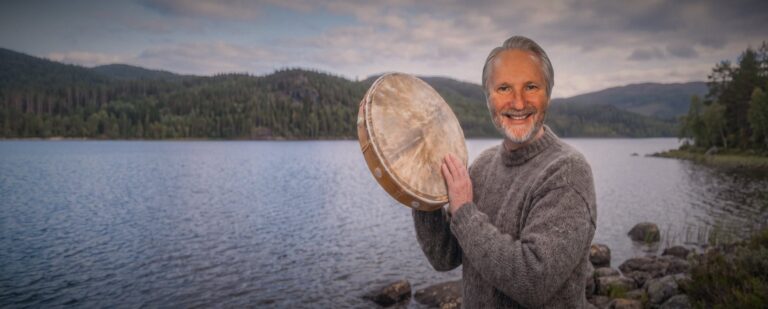
Curious about what primordial shamanism really is, behind the mystique and the misconceptions? In this short online course I tell the story of my own path from skeptical engineer to teacher of primordial shamanism, and give you a first introduction to what I teach: what shamanism and primordial shamanism are and are not, how rituals and rune magic are used in practice, and why the longing for growth matters so much for a good life.
The lessons are recorded in Norwegian; the English version will be ready in November or December 2026. Leave your email on the course page, and I will tell you when it is.