Episode 21 – Runes and Rune Magic – Our Hidden Magical Heritage
Amina’s cat had stopped eating, and she had already booked him into an animal hospital a boat ride away. She gave him a healing with the runes, started packing, and 25 minutes later he sprang up and went to his food bowl. More than two decades ago, Pål-Esben performed one of his first rune rituals in the castle where he lived, and his friend came running down the corridor to ask why the lights were going on and off.
In this twenty-first episode, Amina and her teacher and guide, Pål-Esben Wanvig, talk about the runes and rune magic. They explore why the runes are far more than an alphabet, how the Nazis’ misuse still colours many books about them, and why there are no dangerous runes. It is part of “The Journey to Self-Realization”, a podcast about the bravest journey a human being can set out on: the journey home to yourself.
This episode is an English translation of our Norwegian original, voiced by the digital avatars of Pål-Esben and Amina.
In this episode
- Amina’s first encounter with the runes, and why they are 24 archetypes of creation rather than an alphabet
- The Nazis’ misuse of the runes, Guido von List, and why there are no dangerous runes
- The morning rune, the strawberry, and the difference between knowledge and knowing
- Nauthiz and the need-fire, the 90-degree change, and why so many fear change in the runes and in astrology
- Why the Elder Futhark runs from Fehu to Dagaz, and why the runes are older than the Vikings
- Spontaneous healing with the runes, Amina’s cat, and the initiation into the runes’ power sources
- Structural magic, the rune ritual in the castle, and the feeling that “this is part of me”
- The Viktor Frankl muscles, the Yggdrasil Gym, and why Pål-Esben recommends a guide rather than books on the runes
This podcast is for you if you:
- Seek real depth in your spiritual practice
- Want to understand yourself on a more fundamental level
- Are curious about shamanism but tired of superficial “new age” spirituality
- Have taken many alternative courses but still feel that something is missing
- Feel an inner longing for freedom, love and wholeness
In a time when so many get lost in external methods and promises of quick fixes, this podcast invites you back to the only place where true answers can be found: your own heart.
Listen above, or read the full conversation below.
Transcript
A warm welcome to the podcast “The Journey to Self-Realization”, a primordial shamanic journey of development back to your true nature. This podcast is a collaboration with our favourite magazine, the health and lifestyle magazine Medium, and is devoted to exploring the bravest journey a human being can set out on: the journey home to oneself. We follow Amina, a student at the Yggdrasil Shamanic School, as she goes through a deep primordial shamanic process of development together with her guide and teacher Pål-Esben. It is a raw, unpolished journey of discovery towards true joy in life, deeper meaning, and a life that truly feels good to live.
This episode is an English translation of our Norwegian original, voiced by the digital avatars of Pål-Esben and Amina.
Pål-Esben: Hi, Amina, and a warm welcome to a new episode.
Amina: Hi, Pål-Esben, thank you, likewise.
Pål-Esben: And a warm welcome to you too, dear listener, because it’s for you that we make this podcast, not for ourselves, even though we really enjoy talking together, Amina. We have lots of exciting discussions.
Amina: Yes. Off camera too.
Pål-Esben: Yes, yes. Not everything gets recorded.
Amina: No, thank goodness for that.
A favourite topic: the runes
Pål-Esben: What we’re going to talk about today is one of my real favourite topics, a topic I love, and that’s the runes. I’ve been in love with the runes since day one. As we’ve gradually gone deeper into them and understood more and more about them, this has turned out to be an utterly spectacular field to look at and learn about. And not least, in time, to be able to use to create a better life for yourself and others.
So what was your relationship with the runes, Amina, before you really started learning about them?
Amina: When it came to oracle systems and that kind of thing, I was more into tarot cards. I used them in readings and so on. Runes were something I associated with Vikings, and I didn’t know you could use them in healing, or really as an oracle. But that was also because I didn’t have much knowledge about the runes. I thought they were just something people used as a written language, or that they were a kind of alphabet.
And that’s something I recognise, for example, in the people who ask about the runes at fairs. I do fairs together with my dear, good friend, fellow student and colleague Linda, and we give rune readings and so on. Then a great many people come over and ask, because they’re a bit curious about what the runes are. People are starting to be drawn to the runes, and also to a lot of Norse mythology and the Viking Age and things like that. Runes are very old, of course, but as a system in use they’re also a bit new in today’s society. So what they want to know is: what is this, where does it come from, how can it be used? And most of them are shocked when they hear that we can use them as an oracle, and not least for guidance and in healing. I’ve had some pretty magical healing experiences with new people at fairs, which I may get into a bit later in the episode.
But I was starting from scratch; I didn’t know what the runes were. And when I learned this framework, I found it very exciting. I tore my hair out a bit too, because I’m someone who likes to learn everything at once. I want to be able to do it perfectly straight away. So many times I’ve come into contact with my inner brat, who just goes: “No, I don’t understand a thing, I want to give up.” But in the same moment there’s been a part of me that has said: “No, you know what? I want to learn this. I want to master this.”
And I’ve had some conversations with you about this too, where I gradually began to settle more into patience. It requires me to have my own experiences, and not just look at this checklist, where that rune means this and that rune means that, because then it becomes very static and rigid. I have to go into my own experiences through the runes from different angles. And not least, as we may come to later, I have to visit the powers, that is, the spirit of the rune, to get to know it better. Or the being of the runes. So that’s a bit of my background.
Much more than an alphabet
Pål-Esben: OK, and that’s how it is with most people I come across too. They have an understanding of the runes, since in Norway, at least, we learn about the runes in primary school and lower secondary school, and learn about the Norse world. There we learn that the runes are an alphabet, and that there are mythological legends and stories, like the ones in the Hávamál, about Odin and company gaining access to certain rune powers. But it’s seen as fairy tales, and the conclusion is that this is a written language.
Well, the runes actually have terribly little to do with written language. That’s not even the surface of them. The fact that they’re a written language is a tiny, tiny fraction of what the runes represent. And that’s what makes the runes so out-of-this-world exciting to study: this is a rabbit hole that goes pretty deep.
We’re going to talk a bit more about what the runes really are. In connection with the Norse world and Norse history, of course, but also about what lies before that, because the runes existed long before the first Viking was even thought of. This is something ancient. And what is it? Why and how can it be used as an oracle, as a book of wisdom, the way you’re used to from tarot cards, except that the runes are often much more direct and clear? How can we use it for healing, for example if you’re struggling with a behaviour pattern, a pattern of addiction, problems with a part of the body, physical illness and so on? And not least: how can you use the runes for very advanced structural magic, which we touched on briefly in an earlier episode, when we talked a little about magic?
So the runes are more than out-of-this-world exciting to study. And the challenge when we approach the runes is that there are many beliefs about them, and many of those beliefs are driven by fear. When I meet people, they often have associations like: “Oh yes, the runes, that’s the one with the dangerous runes, isn’t it?” And then we know that the Nazis misused the runes, and in the neo-Nazi scene they use runes like Sowulo and so on, because they think they get power from it. The SS used two Sowulo runes on their emblems, after all.
So there are many, many beliefs about this, and I thought we’d start by clearing some of it up, so we can begin with a reasonably clean slate and get to talk about what the runes really are.
The misuse: the Nazis and Guido von List
Let’s take the misuse of the runes first. I don’t know whether you had any ideas about these things before you really started learning about the runes?
Amina: No. You mean about the misuse of the runes?
Pål-Esben: Yes, misuse: the Nazis, the war. There it was very much… Well, Hitler was absolutely obsessed with using occult magic, and especially the runes, to win the war, to gain power. He was completely obsessed and fixated on this, with Göring and company.
Amina: No, I learned about that when I started my training with you. I started from zero, so that was part of it too. But of course, after that I came across people who saw that “oh, you’re into runes”, and I noticed they were coming from that belief. And then it was easier to understand where they were coming from.
Pål-Esben: Yes, and of course that’s a bit sad. But everything throughout history can be misused. Look at Hitler and the Nazis’ misuse of the swastika, which is really an ancient sun cross. It represents the light and the background of the light, where the light comes from, which is the foundation of everything that exists in our multiverse. It was thousands and thousands of years old before Hitler came along, but he used these symbols because he wanted power. And it has nothing to do with the people who misuse it, because if you try to misuse this, of course you get no power.
And the challenge in the Nazi Reich was that they had a chief occultist called Guido von List, who ran and led the Thule Society. It was an occult outfit where many of the top Nazis were members, Göring and company, and there they learned occultism and magic about the runes from the chief occultist Guido von List. Naturally, he taught the runes for power: an ego-centred use of the runes, the idea that they’re to be used for power, used to get what you want, that they can be used to harm others and so on. And of course that has nothing to do with the runes.
But this permeated the Thule Society and permeated the Nazis, who believed it would give them superhuman power. Of course it doesn’t, as history also shows.
And what’s sad is that a great deal of what’s written about the runes in books today is based on Guido von List’s fear orientation, his orientation towards power and ego. So when you read a book about the runes today that talks about dangerous runes, for example, or about how to use the runes to get things your way, or to harm others, which of course isn’t possible, then it’s guaranteed to spring from Guido von List and this way of seeing it.
It’s the same thing we find, as we’ve talked about before, in fear-driven shamanism, which is often based on the idea that we have to protect ourselves against things, be afraid of this and afraid of demons, as we’ve discussed a lot throughout our podcast. Of course that isn’t how reality is. But when people believe it’s like that, they become afraid, and then they have these beliefs.
Unlearning: there are no dangerous runes
So when a student comes to me, I first have to help them unlearn all of this, so we can start from zero and begin to learn: what is this really? There are no dangerous runes. The runes can’t be misused by the ego. And the fact that some people have misused them throughout history of course has nothing to do with the runes themselves. It’s just that some people have misused them. And today people misuse pretty much everything, but that doesn’t mean that’s what the runes are.
When we begin to learn about the runes and understand what they really are, we also need to do some unlearning of what we learned at school, in Norway especially, where they say the runes are an alphabet. Of course, every rune has one or more letters associated with it. But that isn’t what the rune really is.
The 24 archetypes of creation
The runes are really the archetypes of creation. There are 24 fundamental archetypes that represent the creation of the multiverse we live in. And that’s a mouthful that needs chewing on for a while before you can begin to really understand what I’m actually saying. That was the challenge at the start, that you wanted to understand everything at once.
But when I began working with how the universe is created, with the 24 building blocks the universe is made from, the fundamental archetypes that have created everything that exists, you can put it like this: since the Elder Futhark we use has 24 runes, they are 24 archetypal tuning forks that represent the basic rhythm of the universe and the creation we live in.
And at the start that makes you frustrated, like you were, because you don’t understand what this really is. You understand that it sounds big. What were your thoughts when you heard it for the first time?
Amina: I don’t think I quite got my head round it. I think I had to put it on the shelf for a while back then. I had to focus on: OK, now I’m going to get to know the runes instead. But it was good to have it there in the background. I also began drawing connections to the tarot cards, to astrology, to different archetypes, and asked myself the bigger questions: do all other archetypes come from the runes? And then I began to reflect a bit on these things. And then it actually settled. It was OK that that’s how it is, and I wasn’t going to overanalyse it any more, but move on to actually get to know the runes and the powers of the runes, and have a personal relationship with them.
Pål-Esben: And there you see the key. Because we can talk till the cows come home about the mystery behind the runes, what they really are, but it’s impossible to understand cognitively. That’s why we in our tradition, at the Yggdrasil Shamanic School, are very focused on an experience-based path of development. We go into experience. In this case with the runes, you begin to experiment, you do the tasks you’re given to find these reference experiences, and then you discuss them with the teacher. Then, gradually, you begin to really understand what this is about, not in theory but through your own experience. And when you then connect the theory to your own experience, the knowing comes, and you begin to know what this is.
That’s one of the challenges when we learn the runes: it takes a bit of patience. It isn’t just a matter of reading a book and thinking: “Oh yes, now I’ve got the headings for each rune, so now I understand what the runes are.” No, no. This is a process of development that goes on over a long period, and gradually you’ll get deeper and deeper reference experiences. Of course, you have to use a specific system, a training system, that brings the students into specific reference experiences.
Ideograms and the being of the rune
Just to say a bit more about the runes first, before we talk about how we begin to learn them, at least in our tradition: we can also see the runes as ideograms, 24 ideograms in the Elder Futhark. An ideogram is a sign or symbol that represents an ocean of different things. Everything from practical things like a letter, a sound, a number, an element, an astrological planet, to deep things like metaphysical force fields and various kinds of beings of light. And in the depths lives a very special power source, which is the very core of the rune, and which we often refer to as the rune’s being. It isn’t a being in the way we’re used to, like a being of light or a power animal. It’s a completely different kind of being, which can’t be compared with any of the others. But we use the word being for it. And that’s what lies there and is the power itself, the fundamental archetypal power source of each rune.
The morning rune: today’s learning task
And at the start, to begin moving towards understanding what this is about, you learn a simple exercise, as you did too. But first, of course, you learn about each rune and what each rune is, and then, right at the start, you’re asked to go into a specific kind of experience. And that is…
Amina: Are you thinking of spontaneous healing now?
Pål-Esben: No, that’s too early. Before that. Before that, we started with you drawing a rune every morning with the question: what is my most important learning task today?
Amina: Yes.
Pål-Esben: Then you draw the rune, read in the manual what the rune is, take it with you through the day and try to match it against what happens. And when evening comes, you read about the rune again and think: what did I come across in life today that’s connected to this, that could be my most important growth task, learning task, challenge?
At the start you often don’t see the connections. But then suddenly one day it’s crystal clear, and you think: what? Then you have your first real reference experience of what the rune was about. That’s how it started for you, and that’s where you began collecting these reference experiences. Wasn’t that a bit frustrating at the start? Because you don’t always understand it every day. But as a few weeks go by, it begins to get clearer and clearer, doesn’t it?
Amina: Yes, absolutely. In the beginning I couldn’t work out where I’d come across this rune today, what I was supposed to learn from this rune today. But gradually I began to go into the different experiences and see them from slightly different perspectives. Instead of trying to make the rune fit into a template, I tried to see: OK, how can I be a bit flexible in how I read this?
And that’s part of the reason I’ve been able to get to know the runes, perhaps more holistically, up to where I am today. I still have a long way to go in getting to know the runes. But as far as I’ve come, I can see the different aspects of the rune, both the comfortable and the uncomfortable, but always the lesson that lies deep within it, whether it’s comfortable or uncomfortable. And that actually makes it easier to learn from the different experiences of everyday life, of daily living, where I see that there actually is a deeper meaning in everything I experience, comfortable and uncomfortable. That, at least, is something the runes have helped me with.
A spade is a spade, and an egg is an egg
Pål-Esben: So to get to know the runes, and now we’re talking about the runes as an oracle or a book of wisdom, that’s where the work of really getting to know what the runes are begins. But a misunderstanding here would be to make the mistake of thinking: “That rune means this for me, because I just feel that’s how it is.” Of course that’s meaningless. It’s like what we often hear in esoteric circles: “Well, that’s what it means to me, and that’s how it is.” No, simply no. A spade is a spade, and an egg is an egg. An egg never becomes a spade.
The rune has a very specific quality. Even though it’s a complex set of qualities, there’s a core to it all. So when you hear “well, this and that means this to me, that’s just how it is”, no, that isn’t how it is.
That’s what we’re talking about here: going into the reference experience and matching it against the core, against what this is really about, and seeing whether we find our individual link to understanding it. Because we can only understand through experience.
Knowledge and knowing: the strawberry
We can talk about and write 300 books on the taste of strawberries, but you can only understand the taste of strawberries by experiencing it and eating the strawberry. That’s called knowing.
There’s a difference between knowledge and this: the fact that you know. Norwegian has a rather limited vocabulary here, but English has a word for it: knowing, as opposed to knowledge. And the challenge many people have is that they think they’re hunting for knowledge. You read books here, watch YouTube videos there, talk at seminars over there, and try to feed your head with knowledge. But that isn’t what this is about.
Of course we need a certain amount of exact knowledge to be able to match our reference experience, which is this knowing. We need to have an idea of what strawberries are in order to go into an experience. We need to know where we find this strawberry. What do we do with it? We pick it up and stuff it in our mouth. You won’t get a suitable reference experience if you try to smear the strawberry in your hair. That’s where we need knowledge. But it’s only the start of everything.
When we’re going into what’s truly shamanic, the knowledge you gather is the headings. The real thing is that you know: that’s where I find the strawberry, this is how I pick it. I don’t put it in my hair to get experiences. I have to put it in my mouth, and then I need to chew. Through that I can get a reference experience. That’s what we need the theory for. But the reference experiences are the whole key to this knowing, to knowing what it is, to having the deeper insight that comes.
And that’s really how it is with everything to do with deeper, real shamanism, when you’re going to really get into the runes, and really with everything in my field: the theory is only there to lead the student to a place where the reference experiences can give value.
And back to this strawberry I use: I have a Tibetan friend who uses orgasm instead of strawberries. But I find it a bit more diplomatic to use strawberries here, because otherwise people might find it a bit icky. At least with the images I’m using here, you’d rather be standing there with the strawberry in your hair. So I tell her I want to be a bit more diplomatic than she is.
So, back to the strawberry, which is a very good image for this: we can read ten thousand books about a strawberry and have no idea what it’s about. It’s about going into the experience and tasting the strawberry. Then we have this knowing. And that’s what we work with through the runes when we begin to learn them.
Nauthiz: the need-fire that prevents need
Let’s take an example from the morning exercise. Let’s take a rune we can talk about, one of these runes that many people out there say is a dangerous rune. Let’s pick out Nauthiz, which means need. Oh, I’ve had many students come to me and say: “Oh, I’m afraid of Nauthiz, because it means need. Now everything’s going to hell. I draw a Nauthiz, and then need strikes. No, I don’t want a rune like that. I’ll just put it back in the rune bag and draw a new one.” And that’s fear-oriented.
Well, let’s talk about Nauthiz. What did you feel the first time you drew Nauthiz?
Amina: Well, and I think this also has a lot to do with the pre-framing you’ve done about the fear behind the runes: I took it on board very quickly that I shouldn’t be afraid. But of course I became very curious about what this means. So is need about to strike now, or what? Do I have to leave the country? Do I have to flee? And the rune does look a bit like a kind of cross too. So it’s a bit like: is someone going to be hung on the cross? What’s going on here?
But gradually I got to know Nauthiz much better through my own experiences, and I can come back to that. But of course, there was a lot of uncertainty about it, and I know many people are afraid of Nauthiz. I see that with my students too when we talk about the runes: Nauthiz is a bit of a “shit, what do I do now?” You don’t dare do anything, because what if something goes wrong.
Pål-Esben: Yes, and that comes through no matter how much we talk about this and pre-frame it by saying there are no dangerous runes. The runes are Divine Archetypes that represent creation. They are each their own unique tuning fork, and they have no positive or negative quality in themselves. I can talk about this till I drop without the students really taking it in, because there’s an inherent fear.
And you find that inherent fear again in pretty much every other oracle system and in astrology. Because when you come across an element, a rune, a planet, a transit, a tarot card, that signals that change now has to happen, that’s what people fear and hate like the plague. “Oh, Saturn, good grief.” And then there’s the eighth house, and Scorpio, all these things. People are scared to death and don’t want this, because it symbolises change. That is to say: you, as a human being, have to go into change. If you don’t go into change, you’ll have a problem.
Amina: Yes, yes.
Pål-Esben: Because that’s what Nauthiz, for example, is saying here, very superficially, of course. Nauthiz basically says need, but it doesn’t symbolise need in itself. It symbolises the need-fire, which is there to prevent need. In the old days these need-fires were lit between villages, for example, if something dangerous happened. Here’s an example for those who like The Lord of the Rings: there we have one of the scenes where this is shown very well, where they light the beacon fires and get help.
When Nauthiz comes, you can think that you’re now standing a couple of steps away from a steep slope, or a cliff, or something else that will hurt a bit if you carry on the same way. Nauthiz says that a change should happen. And we’re not talking about a one-degree change; we’re talking about a 90-degree change.
Imagine you’re walking in the forest, and in front of you there’s a steep slope. You look down: OK, if I go down here, I’ll get grazes, or break my leg, or it’ll hurt. Then I can’t just make a one- or two-degree change in the direction I’m walking. I actually have to make a 90-degree change, or I’ll go over the cliff.
And that, let me say, is the surface. It’s actually a bit silly to talk about the runes this way, because of course there’s so much more to them than this. But to give you, the listener, who perhaps doesn’t know the runes, an idea: you also have a clear message, a set of messages, part of the tuning fork, to bring you back into the natural rhythms. Here there’s a tuning fork that says: here we need to change things, we need to change direction. The river is really flowing in a different direction, but you’re busy paddling up the river, you’re busy digging tunnels, while the river is going in a different direction. Can’t you just begin to flow with the direction of the river? Which in this case means a 90-degree change. That’s the need-fire itself here, which is there to help you and say: wow, maybe we should go in this direction?
Saturn, transits and the fear of change
And what people often fear and don’t like is the word change. As an astrologer you find it again all the time, when you come to these basic archetypes that say change is needed here. Why should you fear Saturn transits? “Oh, now I’ve got this. Oh, it’s scary.” But all it’s saying is that there’s an energy of change washing into you from the universe, which gives you a potential and an impetus for change. Isn’t that right?
Amina: Yes, absolutely. And it’s as you say: people have gone through their chart and see that “OK, I’m in a Saturn transit, a Pluto transit. Good grief, what’s happening now? How am I going to manage to hold on to this rope, on this cliff?” That’s where I try to come in with: OK, let’s look at the reason you’re going through that transit. What is it the transit wants from you? What is it you need to change? What do you need to see from a different perspective to grow, to develop? Where are you still holding on to old habits, old things, old ways of doing something?
And then you often begin to have a little aha moment. But it can also be a joyful transit, if you’re willing to flow with that river. There’s an enormous potential for development in it.
Pål-Esben: Yes. In the old days, when I both used astrology and taught astrology, many years ago, I thought: wow, here I’ve got a big fat transit coming, whether it’s Saturn, or the eighth house, or Scorpio, or Pluto, or whichever of the big planets it is. Then I thought: yes, OK, so I’m getting a boost from these resources. For me they were resources that gave me a boost, an impetus and energy to make the changes I needed to make to create a better life for myself.
That’s what this really is, if you look at it. But unfortunately we live in a world that’s full of fear, and that hates change with a vengeance. “Change me? No, I don’t want that,” says the ego.
Today I’m not so very focused on astrology any more, and the reason is that I feel this. It’s a part of me, so I don’t need horoscopes or transits or anything at all, because I feel and experience these rhythms that are around us, including those from the planets. But of course it takes a bit of practice. Back when I did it, it was incredibly exciting, because then I could see it in my transit horoscope and say: wow.
And gradually, back then, I learned this: when these transits came, the reference experiences I had taught me to experience and know, that is, the knowing, what a Saturn transit is, how it feels, and how I can use the qualities these transits give me to help me in my life.
And that brings us back to the runes: same thing. We’re still splashing about a bit on the surface here, but this is the entrance to the spectacular world the runes offer us.
Activating the rune powers
Before I go off on too much of a tangent here, let’s go back to Nauthiz, so we finish that story. You ask a question in the morning: what is my most important learning task today? Then I’m thinking of the most important growth task, the most important thing I need to learn from and grow out of. Because that’s the perspective we have in a profound primordial shamanic process of development.
And then you draw Nauthiz. You say: OK, what 90-degree turn do I need to make today? It can be anything from small to bigger things you come across, and sometimes it can be so subtle that you don’t even notice it until afterwards. Then you go through the day and are a bit observant about these things. And gradually you’ll notice that you come across situations.
Just to take a concrete example: you come across a situation with a friend, or a family member, or one of your children, or the boss, or others, where you’re so driven by your own opinion and view, for example, that you’re too inflexible to listen to what the other person is saying, and that creates conflict and tension. It can be a very mild example. And afterwards, when you’ve become a few notches wiser, you’ll see that there’s another way of handling situations like that: being more flexible, having understanding for the other party. When your child wants to do something or other you don’t like, like sleeping over at a friend’s or whatever it may be, and you say it doesn’t fit your schedule, and you say “no, I don’t want that”, then we know what happens, because then tension is created.
Amina: Yes. And one of the most important things Nauthiz has taught me is that I’m also capable of making complete turnarounds. That, OK, now I’m standing here, and there’s a storm raging around me, and instead of being dragged into all this chaos, I just go: you know what, I can make a shift. Or where I feel: whoa, now I’m maybe starting to get dragged into the chaos. But then I can feel through Nauthiz: you know what, I actually have the power in me, inherent in me, to make this 90-degree turnaround.
Pål-Esben: Yes, and here comes the cool stuff. When we begin to get into and learn about the runes, in our tradition you’ll get a shamanic energetic initiation into the power sources of the runes, and the beings and the things connected to them. Then we can do a great deal more. We see that we have a Nauthiz here. We draw a Nauthiz in the morning, for example, and then you can activate the Nauthiz powers, so you get a boost from these powers through the day, so you become more flexible, more able to make these changes.
In astrology it would be like activating Saturn, which unfortunately isn’t terribly easy, and taking it into yourself, letting it fill you, envelop you, so you carry those resources and that power with you through the day. That opens up completely different kinds of possibilities.
And we’re still on the surface here. We haven’t even dived into the water. So, dear listener, now perhaps you understand why I’m so enthusiastic about these runes. Because what the runes are, what they stand for, and not least what they can do for our lives: it’s out of this world, when we learn to understand them and gradually begin to use the magic and the powers in them.
Why the Elder Futhark has 24 runes
Amina: I just have one question before we go on, Pål-Esben. We use the 24-rune Futhark. What’s the reason there are different systems in use for this?
Pål-Esben: That’s how it is with everything. You have thousands of different astrological systems, and you have many different systems in tarot. But the reason we in our tradition use the Elder Futhark, which has 24 runes, is that the 24 runes represent a system with a particular coherence. They represent the Divine Archetypes and the building blocks, but they also represent a life structure. A start of a life structure, an end of a life structure, and a beginning of a new life structure.
The only other oracle system I know of that works in the same way as the Elder Futhark with 24 runes is the I Ching. In the I Ching you have a system of 64 hexagrams.
From Fehu to Dagaz: the life structure in the Futhark
What do you start with at the beginning of a life process? Well, you start with the feminine soil that the seed can grow out of. The first rune in the Elder Futhark is Fehu, which is this soil, the rich soil that the seed, this life process, can grow out of. Then comes yang, which is Uruz, which gives life to it.
And then the runes go through this, and gradually the runes develop. For example from Uruz, which is the aurochs, the undeveloped masculine potential, that is, the masculine potential without wisdom. If you go through the process of development through the Futhark, we come to a rune like Mannaz, which is the developed masculine self, that is, yang power with wisdom. We find the same thing in the feminine, which ends up with Ehwaz, which is the developed feminine self. And then there’s Teiwas, the spiritual warrior, which is the oak itself. But it needs the wisdom of both Ehwaz and Mannaz to be able to be the spiritual warrior at all, whether male or female.
So it’s a system. Then we come to the end of the Futhark, and we find the same thing in the I Ching. There we have the second-to-last rune, the 23rd rune, which is Othala. That’s where things come to rest. It’s the step before the transition. Then comes the last rune, which has to be Dagaz: the greatest rune of transformation and change, where we go from one thing to something else, where we carry out the death process in this life structure, where you bring the life structure to a close. And what happens after Dagaz? Well, Fehu starts a new life process all over again.
So this is something ancient, which was here many, many tens of thousands of years before the first Norse Viking came into the world. And this is no coincidence. That there are variants of this, as there are of all sorts of things, is fine; that’s how the world we live in today is. For example, you’ll find a 24-rune Futhark that has Othala as the last rune and Dagaz as the second-to-last. That’s complete quackery and bullshit, because it doesn’t work. How are you supposed to come to the 23rd rune, right at the end of a life structure that’s to be brought to a close so that something new can start, and have Dagaz there, and then have Othala afterwards? It doesn’t work. It’s not possible. It’s not even logical.
So there are many, many reasons why the Elder Futhark with 24 runes is simply the way it is: Fehu first, Uruz second, Othala as the 23rd rune and Dagaz as the 24th. Because it describes creation itself, the process of development itself: all the way from the Big Bang, or the creation of the universe, through the Norse creation story. There we start with fire and ice, and then we have the gigantic Ginnungagap in between, with the potential. Then ice and fire begin to interact with each other, and Hagalaz is created, which is the seed of life. And after that comes kaboom, where the runes go from unmanifested states into manifested states, where we have yin and yang, where Odin, Vili and Vé are created, and the universe is created, and Yggdrasil is created, and so on.
When you follow this, and see where the runes come from, there aren’t that many variations possible if you’re going to mirror reality. That’s why it is like this: people can have beliefs about things, and that’s OK. People can have systems around things, that’s OK. But I know of no other systems where you teach a beginner, as we already do at the first seminar, to do spontaneous healing with the runes, where you can stand ten metres away from the person you’re treating and see how the body changes physically by using the rune powers. I’ve never come across that anywhere else. So that’s the difference between having something that works and having theories about things.
Older than the Vikings
And if we talk about everything that’s been written about the runes in Norse mythology: we know that a great deal of it is driven by fear. The runes have nothing to do with fear. But the runes represent change. They represent a process that is continuous change. And when you have cultures that are fear-driven, as the Norse culture was, you get a very particular, slightly warped way of talking about the runes. So what’s been written about the runes in the Norse world is interesting background information, but the real thing about the runes lies a long, long time before that.
An example: as far back as 7000 years ago there was a culture, the Vinča culture, and there you find many of the kinds of rune signs we use in the runes today. But there are things that go much, much further back than 7000 years, where the real stuff is. And I don’t think I want to talk about that today, because then we’d open up a gigantic topic that we’d need quite a few hours to dissect.
But the way we use the runes, how the true Elder Futhark is set up, with Fehu first and Dagaz last, is no coincidence. It’s a system, an ancient system that has existed. And if modern people have variants of things, they’re welcome to them, but they’ll never have the same effect or mirror the same reality as the ancient one. So that’s a bit of the background there.
Spontaneous healing with the runes
And what did you think at the first seminar you attended with me, where you were initiated into the healing powers of the runes and got homework to do spontaneous healing with them? What was that like?
Amina: I just have to say that I remember very well how much it did to me inside when I listened to the runes, that is, during the healing, when I heard the names of the different runes, without really understanding what it was about. It was as if it was completely magical. It did something to me.
The homework was spontaneous healing with the runes. I must have measured ten times or more, honestly. I didn’t trust the rune powers and my own power and the whole package, because it was just like: huh? How is that possible? It wasn’t that I had doubts when I was about to do it. But when I saw that it actually worked, I began asking myself how it’s even possible. I measured several times, tried it on several different people, and thought: no, maybe I’m doing the measurement wrong, if I do it a bit like this. But I got the same result, with the hip alignment, where we actually measure whether a change has happened or not, because this is very measurable. And I had to accept: whoa, you know what, this is actually something extremely powerful. And I’ve carried on with rune healing since, and had several more experiences.
But that’s also what I see now. I’ve had two cohorts of shaman students where we’ve met in person, and we always meet in person after module 0, starting with a spontaneous healing and then the rune powers. What I experience is that they get a real: “Wow, this actually worked! How is that possible?” It also gives them confidence that what they’re doing actually works. It doesn’t just become waffle and hope and belief, not just shadowy daydreams about what this might be. You actually experience it. And that helps with further healing and further use of the runes: you know what, I’m actually working with something that gives practical results.
Pål-Esben: Yes, it’s something exceptionally powerful. And just think: most people, at least more than half of Norwegians, believe healing is something pleasant, where someone lays their hands on you and you feel warmth and so on. But very few believe that spontaneous healing is something that can happen every single time, and hardly anyone believes it’s something they can do themselves. But I’ve been doing this for a couple of decades and have never seen it fail to work for a brand-new student who doesn’t have a clue about anything.
It shows what these powers can be at the start, and we’re only talking about the start here. Gradually, of course, you’ll be able to do much more dramatic stuff. But for that the shaman needs to grow up and embody more of these natural rhythms we’re talking about. You need to become more stable, with more backbone, more oak, more of the Path of the Heart, more wisdom. Then you slip even deeper into these powers. But then you need a stronger inner steering mechanism, so you use it in the right way for the right things and don’t go messing about. It demands more of the shaman.
But can you tell us a bit about your practical experiences with the runes, apart from getting a bit of a shock the first time you did a spontaneous healing like that? It’s an objectively measurable result, which you can achieve one metre in front of the client or 5000 kilometres from the client. It makes no difference, since time and space have no bearing on these powers.
The cat who started eating
Amina: Well, I could start by saying: where do I begin? We have several different healing set-ups, and you can also make individual set-ups. One of the standard set-ups I’ve used a lot is for regeneration and building up stamina: endurance, energy, life force.
I use it very often if I feel tired and need a bit of a lift, where I feel that maybe I’m starting to come down with something, maybe I’m a bit low, things like that. Then I can do a healing like that, and quite soon afterwards I feel that I’m beginning to come back to myself. And other kinds of healing with the runes as well: when I draw a rune and activate it and take it into myself, I notice the powers straight away, when I’m actually willing to work with the tools I’ve been given.
But I have so many experiences. One of the wonderful experiences is with my cat, a year and a half ago, I think. I was right at the beginning of the training. He had an inflammation in his body and hadn’t eaten for a few days. I took him to the vet, he got an IV drip, and began to perk up a bit. Then we came home, a day or two went by, and then he stopped eating again. He looked half-dead, you could say, so I got a bit worried. And we’d been given medicine and were giving it to him.
So I rang an animal hospital a bit further away, because they could admit the cat. I rang them, made the arrangements, checked the boat times, because I had to take a boat over there. And then I thought: I’ve learned healing with runes, after all, so why can’t I? It won’t do any harm to just do it. But one part of me inside was going: “Oh, sure, so that’s going to fix everything, is it?”
But then I did a healing on the cat, a basic healing with the basic healing runes first. Then I drew runes specifically for my cat’s problem areas. I carried out the healing, and the cat was lying there, and I began to pack, because we were going to take this boat to the animal hospital. And then suddenly, 25 minutes later, he sprang up, went to his food bowl and began to eat. And that was the very reason I was going to take him to the vet to be admitted: for an IV drip, because he hadn’t eaten.
So I rang the vet and said: “Hi, I told you I had a very sick cat here. You see, I’m a bit alternative, so I’ll say it as it is: I’ve done a healing, and now he’s standing there eating.” And she says: “Yes, OK, that’s good, but you’ll carry on giving him the medicine, won’t you?” “Yes, yes, of course. Here we have the best of both worlds, you know.” “Yes, yes, but that’s nice.”
So that was one of the first wonderful experiences where I could see it. It couldn’t have been a placebo effect, to put it that way. Because that’s something you can often think when it comes to yourself, and sometimes it’s a bit like: whatever works, works. But here I really got to see that this isn’t a placebo effect. Very exciting. Sorry, I’ve got a bit of a cold today.
Healing animals and people
Pål-Esben: It’s very exciting when you do this with animals, because then you can’t have the kind of placebo effect you’re talking about. We also have spectacular experiences with animals, with our dogs, but also with bigger animals, like horses, racehorses and the like. It’s utterly out of this world. Because the horses, at least the trotting horses, the ones that are very active, often have problems with their musculoskeletal system: their spines, their hips and so on. And our methods work incredibly well when it comes to helping large animals too.
I have students who’ve worked with trotting horses and get called in, because there’s a lot of money involved when you have a trotting horse. And it sort of mustn’t get out: none of them will admit they’ve hired a shaman to fix their horse. But they fix this horse, and get called back in again, and what happens is completely out of this world.
The same goes for people. As with everything, you can’t fix everything with runes and energy work. If you’ve been chronically ill for 30 years, you can’t just cast a rune and expect everything to be fine. That’s common sense, of course. But you can do a great deal to support a process of development and healing. What we talked about in an earlier episode about magic still applies: we have to be willing to take the self-responsibility that’s needed, and that goes especially for us human beings.
So I have very, very exciting stories from my students. People are often completely overwhelmed by the results they get when they begin to use it.
So now we’ve talked a bit about oracle work and the book of wisdom, we’ve talked a bit about healing, and we’ve talked briefly about the background of the runes, what it’s really about, without going too deep. And then we have a topic that has to do with structural magic. And that’s when things start to heat up.
The power sources and the initiation
Amina: Can I just add one thing before we move on? About healing with the runes, with the rune powers: that’s something people haven’t heard much about. Where does it come from, in the way we use it in this tradition? Has it been like that since the dawn of time?
Pål-Esben: It’s been like that since the dawn of time, yes. Each rune has what we can call a power source, an energetic power source. And with the runes this is very, very special. Until you’ve been shown the way into that power source, which we do through a shamanic initiation process, an attunement process, you’ll flounder about on the surface and work with the runes as letters. You can sing the runes, you can cast the runes, but nothing will happen.
It’s only when you’ve been shown the way into this power potential, and have a relationship with this power source, that things begin to happen when you activate the rune. Because when, after receiving this kind of initiation, you then trace the rune and activate it, you have direct contact with the power potential, which begins to flow through the rune. And that’s what creates this out-of-this-world magic and the changes we’re talking about here.
Because you can trace a rune and repeat its name 3000 times without anything happening. You’re just singing the name of the rune, and that’s nice enough, but nothing happens, because you have no connection with the power potential. Someone has to show you the way there. In our tradition we have a very special system for doing that early on in the process of development, which is why things happen so quickly. You don’t need to work with the runes for years before things begin to happen. It happens immediately. So it happens through the initiation processes we use.
Of course, you can do this the hard way, and try to find the way to these power potentials yourself, which can be a very, very long road, if you find it at all. Or you can take the shortcut. That’s the reason your students and mine get such fast and dramatic results with these things. And at the start you learn to make your own rune set, and there are a lot of cool things you do.
Anything else about this now, Amina, before we talk a bit about structural magic? Do you think it’s time to move on to structural magic?
Amina: Yes.
The rune ritual in the castle
Pål-Esben: I think I’ve told you in an earlier episode about one of my first experiences with a rune ritual. I did one at the Externsteine, but then I did one in the castle where I lived at the time. We talked about it; that was more than two decades ago. There we use the runes, we compose a special magical Galdr poem, and we have a process for this. It was also about an issue that was incredibly, incredibly important to me, and it was my first real Galdr poem, my first real ritual of structural magic with the runes.
And if you, dear listener, aren’t quite sure what we mean when we say structural magic, we’ve talked about it in an earlier episode. It’s about how we change the structure of a life process. For example, you have a relationship that’s about to come off the rails. That’s a life structure, and if that life structure carries on, you’ll have a divorce. But if you do structural magic, you can send an energy potential into that life structure, so you change the tendencies, provided the couple are willing to take their practical steps.
And it was a ritual like that I did with the runes, with structural magic, which is exceptionally powerful. I got going: lit the candles, lit the incense and did my thing in my living room. And as I got into it, the lights began to flicker. I thought: what? And it flickered the whole time, on and off, going up and down a bit, and I thought: what on earth is this? I noticed it was vibrating around me, and thought: this is my imagination, so I’ll just carry on.
And in the middle of my ritual my friend, who we shared the castle with and who lived in another part of the castle, comes running down the corridor and looks into my living room: “What are you up to in here? The lights are going on and off, and the whole place is shaking!” Then I thought: OK, this isn’t something I’m imagining. It’s something that’s happening. And I just pressed on and kept going.
After this we sit and talk about it, and I’m completely shocked, because he was completely new to the runes at the time, totally fresh. And I thought: wow. Because when I finish the ritual, everything calms down, and the lights are completely normal again. What?
Of course, things like that don’t happen every time, but it happened then. And the most important thing is the results that come. And the results came, dramatically: within a few weeks the results happen, and it’s as if things land in your life that you didn’t think were possible. The intention behind the ritual I’d carried out was fulfilled: I got a solution to the challenge and the problem.
So that was one of my first rune rituals. I told you about another one in an earlier episode, when we were at the Externsteine, where all the Germans got a real fright when this lad from Trøndelag bellowed his Galdr poem in broad Trøndelag dialect, so it rang out across the Externsteine. That was my start.
“This is part of me”
So it’s no wonder you get bitten by the bug when you begin to have these experiences we’re talking about now, and think: wow, so this is something more than what you learned at school. This is something more than just some alphabet stuff. This is something that goes deep.
And what I often hear when I talk about the runes with my students is that many of them say: “I feel that this is part of me.”
Amina: Yes, yes.
Pål-Esben: I think you said it too. “I feel that this is part of me. I’ve come across this before,” people often say. You have a feeling inside that this isn’t something unfamiliar.
Amina: Yes, it’s really interesting that you say that, because it’s something I felt right from the start, and something I also see in some of my students now: they feel it’s like coming home. “It’s part of me. I can’t quite understand why, but it’s such a big part of me.” That’s for those who open themselves to it. Very, very interesting. What’s the reason for that? Is it because that’s where we, in a way, come from: the building blocks of the universe, the multiverse?
Pål-Esben: They’re the building blocks of everything. They’re part of you. They’re the basic Divine Archetypes. And many of us have worked with this kind of energy directly in earlier incarnations.
If we’re going to use linear language about this: actually there’s no such thing as incarnations. Everything is really happening at the same time, but that’s a story for another day. So let’s talk very linearly and simplify this as incarnations. Then many of us have worked with these things before, again and again.
So when we come into contact with these things in the life we’re living now, we notice that we feel a fascination, a curiosity. And when you begin to take in the runes for the first time, you notice that something deep is going on in you. It’s a kind of longing, a kind of knowing, as we’re talking about: this is me. This is something that’s part of me. This is something I know, even if I can’t quite put it into words.
And that’s what we unfold as we go through the training. We’re really just unfolding what you already know, but we manage to put it into words, we manage to relate to it. We know: aha, so this is the taste of strawberries, that’s how it is. And then you learn to use it again, and then the ancient memories come up more and more. Gradually it becomes more and more: this is me, this is part of me. That’s the knowing we’re talking about.
There, knowledge is just the way into the strawberry: understanding the strawberry, how you’re going to use it, how you’re going to get reference experiences. But once you’ve tasted strawberries, you know this isn’t the first time you’ve tasted strawberries. You know this is something that has lain within you for a very long time. And then you understand more of why I think this is the most spectacular thing a human being can commit to learning.
So you can understand why I love the runes, and why you love the runes. And another exciting thing about the runes: you’re never done learning. It’s such a big rabbit hole, it’s so insane, that you’re never done learning, because it surpasses what your cognitive mind and your emotional mind, your intellect, can deal with.
But when you come into a state, and gradually get used to slipping into your timeless and spaceless nature, when you stand with both feet firmly planted in your Sahara, when you experience oneness, then another kind of knowing about these things will come, and it will expand. Not the cognitive knowledge, which is very limited by what our brain is capable of, but this knowing, the fact that you know. And that’s even more spectacular.
So this rabbit hole of the runes goes so deep, and it’s so exciting. I love it: both working with the runes and inspiring you and other students to commit, and showing you the way into how this is done in a very short time, instead of the 25 years it took to train a druid in the old days here in Germany, where I live, at the Externsteine. Today it can be done in one to two years.
Amina: Yes, it’s very, very exciting, very powerful.
The tools the runes give
Pål-Esben: So, dear listener, you’ll have to excuse us if we’re overenthusiastic about this, and you’re thinking: “Am I not going to get to learn about the runes now?” We can’t start teaching the runes here, because it’s a craft. It has to be done in a systematic way. But we’ve now tried to give a couple of examples of what the runes are, what they can be used for, and what they can mean for a human being. And then it’s up to each individual whether they want to commit and really learn about these things. That’s another matter.
The advantage is that you have a set of tools, if we’re going to use such a poor word for it, that can help us in our lives. For one thing, they give insight when we have to make choices: you draw runes on the question of what the consequence will be if you do A, B or C, see what comes out of the runes, and can use the runes as an adviser to make good choices and create a better life for yourself. You have an incredible set of tools for your own development, healing and process of change. And you have out-of-this-world tools when it comes to advanced structural magic. And then you have the biggest field of the runes, which goes beyond time and space. That’s the part that’s utterly beyond everything, which you’re on your way into now, and which we’ll begin to talk about in later episodes of our podcast.
And what I think is so cool today is that in the old days it took many years to help a student into this process. Today we’ve been at it for a couple of years, and you’re almost at the finishing line. That’s the miracle of living in the times we live in now: the miracle of the internet, the miracle of teaching systems that really work. It took me almost 20 years to build up this teaching system you’re part of. It wasn’t done overnight, but that’s why you get such fast results. And also that you’ve been willing to do the work, and willing not to give up, because it hasn’t always been easy.
Amina: No, it definitely hasn’t always been easy, not with the runes, and not with other things either. But when you share this, when you convey how powerful and wonderful this path is, it does sound a bit too good to be true. And it’s so hard to describe to someone what a process of development like this actually does.
One of my students sent me some written feedback along these lines: “I remember the first video conference with Pål-Esben, where he said this was going to change your lives. I immediately thought: oh, sure, I’ve heard that before. But wow, how it has actually changed my life.” And then several more things, several more aspects there. But it actually is as wonderful as it sounds. Sometimes I think: whoa, is that actually possible? Yes, it actually is possible.
And I’m deeply grateful that you’ve devoted your life to setting up that foundation, that structure, this magic. Really, I mean it.
The Viktor Frankl muscles
Pål-Esben: Yes, it has meant a great deal to me, and it has made my life joyful too. And being able to help people in today’s society… In today’s society there’s so much stress, so much darkness, so much frustration, so much anxiety. I think we need more and more points of light: that you can be a point of light and a torch for people, and I can be another. We need these torches that bring a little light into the chaos and darkness that this world is unfortunately overflowing with.
And here’s one of those points of light: every human being who is willing to commit to their process of development can take power over their own life and kindle the light within themselves. And what’s magical is that it makes no difference what happens around us, or what happens to us, because that doesn’t decide how we experience life.
It may sound strange, but that’s actually how it is. In the old days there was Viktor Frankl, a psychiatrist who was put in a concentration camp by the Nazis, and who famously said: “They could take everything from me. They could torture me, they could kill my family and my friends in front of me. But they could never take from me the power over what I think and feel and how I act on what happens to me.”
And he was my first hero. When I understood that, I said: wow, I wish I were like that myself. At that time I didn’t have these powers, which I call the Viktor Frankl muscles, because I felt like a victim of the world around me. When someone crashed into my car, I howled and screamed: “Why are you doing that?” As I write about in my book.
But when it became clear to me, I began to train these Viktor Frankl muscles. More and more I became someone who, no matter what happens to me, around me or in society, is barely affected in how I’m doing, how I think, how I feel, how I deal with myself and others. But again, it’s a process, a metaphorical musculature that has to be trained.
Most adults today are perhaps at one or two on the Viktor Frankl scale. That means you feel like a victim of your surroundings, as you partly did too. You were very reactive to everything that happened around you: to what people said and thought, to your fear and your imaginary demons, which you experienced as real. You had a world around you that actually decided how you felt and thought. Back then you were perhaps at one or two on Viktor Frankl’s scale.
Gradually I sent you to my special gym, where you began to work these muscles. You can get sore. You do get sore along the way, believe me. And today, through the process, you’re perhaps at eight or nine, where you more and more have the power back over your life.
That’s one of the miracles of going through a real process of development: you take the power back over your life, and you’re no longer dependent on what happens in the world, or on what input life offers you. You become more and more able to relate to it in a way you decide yourself, not the autopilot. And for that, the runes are a magically effective tool in this process, as part of the gym.
The Yggdrasil Gym
How do your muscles feel today?
Amina: Pål-Esben’s gym.
Pål-Esben: Pål-Esben’s liberation gym. I call it the Yggdrasil Gym.
Amina: Yes, the Yggdrasil Gym, let’s call it that. But you stand at the reception there and give us a very warm welcome.
When you walk this path, the way I’ve experienced it, you have these highs where you see: whoa, this works, and I’m standing much more steadily in my life. And then you might run into a storm, or whatever you want to call it, where you can get these little nudges: “Hey, you, remember what you’ve learned.” Then, from my experience, I can feel: oh yes, that’s right. And it doesn’t take much before I’m back on my path again, and remember. That’s a bit of the soreness. You have to tear a muscle down to build it up, after all. There I also see that I have the resources it takes in life to actually make these complete turnarounds, or to actually manage to be present with everything that is, for better and for worse.
And back to the runes: when you come across a Nauthiz like that in your life, you’re better able to handle it than before, because you’ve learned how it all fits together, and you’ve gained access to the resources. That’s the insight, the wisdom, but also the force fields connected to it.
Pål-Esben: Which means that… The hardest way to train up these Viktor Frankl muscles is to go to an ordinary gym and push yourself, where you learn ordinary personal development and are told: now you must think like this, now you must be disciplined like this, now you must do this. That’s a very exhausting way of doing it.
But there’s another kind of gym where, metaphorically speaking, you use the latest technology that works. You sit down in the chair and strap everything on, connected to the brain and whatever else, and then the muscle training happens. It happens in a highly advanced way that goes a hundred times faster than in the old days, when you sat with ordinary personal development, read 300 books on how to get a better life, tried to use discipline, and all these crazy methods that exist, which you feel aren’t getting you any further.
There’s another way of doing it, where you combine the modern Western model, its wisdom, technology and medicine, with the ancient part of our reality, where among other things we find the runes and the ancient ways. When you combine these, you’re sitting in the highly advanced gym, where of course things go radically faster in a process of development than if you’d chosen only one of the sides.
So now we’ve talked about the gym, Viktor Frankl muscles, runes, strawberries. I think I’ve said what I wanted to say. Is there anything on your mind, questions or thoughts we need to bring up?
The books that don’t exist
Amina: I think we’ve been through most of what I was planning to ask today. But what would you say to those who are interested in learning about runes and the rune powers? Are there any books to recommend? Any websites? I mean, where do you start?
Pål-Esben: Yes, that’s a problem.
Amina: Yes.
Pål-Esben: I often get that question: “What kind of books should I read, Pål-Esben?” The problem is that most of the books are fear-oriented: the runes as power, as control, where you learn so-called rune formulas that so-called rune masters used in Norse times, like the alu formula and all that. That’s Schwachsinn, nonsense, as we say in German. Because you can’t use a rune formula that one of the rune masters once used. It won’t work. The only reason the formula or the set-up for using the runes worked for the rune master is that the rune master was the rune. It comes from the rune master, not from a formula he or she used.
So I don’t have any books. At the start, 20 years ago, I asked the same question of my teacher at the time: “Can’t I read some books about the runes?” He answered: “Yes, there’s a problem with these runes.” But I’m a stubborn guy, so I said I wanted to read some books anyway. So I began reading books about the runes. I read three books. I won’t say which, but they were by very, very well-known rune authors. I sit there reading, and I find all this stuff about power, and scary runes, and danger, and control, and getting your own way, and those things. And I thought: what? Those were the last books I read about the runes, and that was 20 years ago too.
So I’m not well read on the runes, but I experience the runes. What I teach comes from experience, not from any of the books I’ve read. If you’re going to learn about the runes, you at least need to be very, very observant about what you read. As soon as you hear power, fear, control and things like that, you know it’s Guido von List and the like, and it has nothing to do with what the runes really are.
So if you want to learn what the runes really are, you need to find a suitable guide who can lead you through the process, someone who’s competent and qualified for the job. That’s the only way I know.
But I get the questions very often: “Haven’t you got any books I can learn from?” No, I haven’t. But finally now, as we record the podcast, I’m ready to make my complete rune training available, both online and through books and so on, where I’ll document my insight: how it all fits together, and why we get such good results. Because I think there may be a need for a counterweight when it comes to literature people can read. It’s a problem, a challenge, to learn what the runes really are in the rather chaotic esoteric world we live in.
Amina: Yes, I’m looking forward to that. The world is ready, Pål-Esben.
The contented teacher
Pål-Esben: Yes, whether the world is ready or not, I don’t know. I’m ready, that’s the most important thing. When it comes to this, I’m very self-centred. The most important thing for me is that the teacher is happy. It doesn’t matter so much whether you’re happy. Well, yes, it’s important that you’re happy too, that’s nice as well. But if I as a guide and teacher am not happy, I should stop doing what I do.
So I think all the time: the most important thing for me, when it comes to dealing with students, is that I can be happy with the student. That’s the reason I say no to a great many people. The most important thing is that I’m happy. If there are people who are just negative about all of this, I’ll find another teacher for them. I’m not interested. I’ve become a bit particular in my old age. That’s how it is. When you’ve done this for so long, with so many people, you gradually become a bit particular about these things.
Amina: Good thing you’re still so young, then, and tell everyone: yes, anyone can come to me!
Pål-Esben: To get to me, people these days have to jump through a lot of hoops to get into training at all. I have a very strong filtering process. Very few have the patience to go through it, but those who do get interesting things. So it has to do with being a bit particular in my old age. When you start getting very old, as old as the hills, you get somewhat different priorities: my quality of life is the most important thing, my time is the most important thing, and being happy with what I do should be the most important thing. Because I believe that a teacher who doesn’t love their job, and who doesn’t really enjoy relating to each individual student, shouldn’t be a teacher.
Amina: Yes, absolutely.
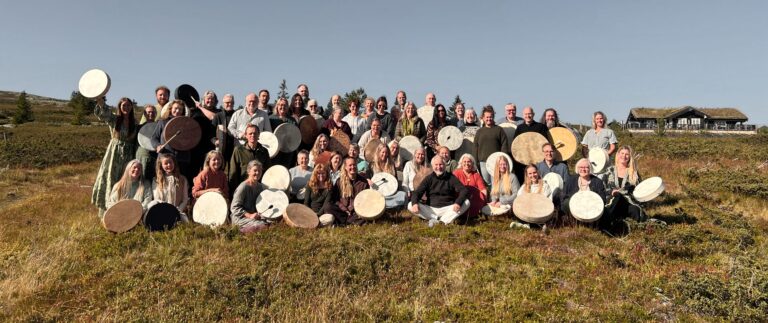
Pål-Esben: So from having lots of people at seminars in the old days, often 150 at each seminar, today I work one to one. And that makes me much happier than in the old days, when I had lots of people at seminars. Then of course I have a group of very advanced students, which you’re in, my most advanced students, where we do spectacular things together, including as a group in the mountains in Norway. That’s how it is today.
Words of wisdom to wrap up
So that was a bit about the runes, from my side. Do you have any words of wisdom to wrap up with before we finish?
Amina: I feel that if I’m going to come up with some words of wisdom now, it’ll be a bit forced. I feel we’ve covered quite a lot about the runes today. Do you have any words of wisdom to wrap up with, Pål-Esben?
Pål-Esben: My encouragement has to be this: if the runes resonate with you, dear listener, find someone who can guide you through this process of getting to know the runes. And when you find a guide or teacher, make sure they aren’t fear-oriented but heart-oriented. Because the runes have nothing to do with fear, nothing to do with ego, nothing to do with control and power. They are the basic building blocks that everything is made of. And that has nothing to do with ego. So that’s my tip to wrap up. I hope this inspires you to look more closely at the runes, because it can mean a great deal to your life if you embrace them and commit to learning about this. It’s utterly out-of-this-world exciting and rewarding. Thank you so much for staying with us all the way, dear listener. We really appreciate your feedback, and a five-star rating on Spotify helps our podcast reach more listeners. And thank you so much for being here with me, Amina. I really appreciate it.
Amina: Likewise, Pål-Esben.
Pål-Esben: Thank you for being with us, dear listener. I hope you’ll join us again in the next episode. And until then: have a truly wonderful day, evening, night or morning, wherever you are listening from. Take care.
Outro
Thank you so much for listening to this episode of “The Journey to Self-Realization”, a primordial shamanic journey of development back to your true nature. We hope Amina’s story has inspired you to explore your own journey of self-discovery and development. Remember that the path from suffering to self-realization can be demanding, but with courage, patience and support from a competent guide, mentor, teacher or therapist, almost anything is possible. We wish you all the best on your journey, and we’ll talk again in the next episode.
The Journey to Self-Realization
Nature’s Path to Freedom and Self-Realization
Curious about what primordial shamanism really is, behind the mystique and the misconceptions? In this short online course I tell the story of my own path from skeptical engineer to teacher of primordial shamanism, and give you a first introduction to what I teach: what shamanism and primordial shamanism are and are not, how rituals and rune magic are used in practice, and why the longing for growth matters so much for a good life.
The lessons are recorded in Norwegian; the English version will be ready in November or December 2026. Leave your email on the course page, and I will tell you when it is.