


The Journey Toward Unity and Enlightenment
Part 4 of the article series “The Path to Spiritual Enlightenment”, published in Norwegian in the magazine Medium (no. 6, 2024) and on wanvig.no. An earlier English version is on wanvig.no/en.
Most of us live in a prison we do not know we are in. A prison built by our senses. By our thoughts. By everything we have been told about who we are and what is real. We see the world through a dirty window and believe that what we see is the truth.
But it is not.
The physiology of the senses and the mystics point the same way: We perceive perhaps one percent of reality. The rest remains hidden behind layer upon layer of filters we do not even know exist.
The search to see clearly, to discover who you really are, free from all the distortions, ought to be the most important thing you do in your life.
The world is drowning in distractions. Social media. News feeds. Expectations from every direction. Emails that never end. Messages beeping in your pocket. A constant stream of information demanding our attention, every single minute of the day.
In the middle of all this chaos, we chase things we believe will make us happy. Prestige. Success. Recognition. The next promotion. The next house. The next vacation. The next car. The next Instagram picture that will show the world we have a perfect life.
But then something strange happens.
We get what we wanted. The promotion comes. The house is bought. The vacation is taken. And still we feel empty. Still there is an unease there, just beneath the surface. A feeling that something is missing. That life ought to be something more than this. That there must be a deeper meaning than just chasing the next goal, the next experience, the next confirmation.
Perhaps you recognize yourself?
I know this feeling well. As a civil engineer and businessman, I spent years chasing success in the outer world. I believed that if I only reached the next goal, I would finally feel satisfied. But it never happened. The unease remained, no matter what I achieved.
It was only after my life-threatening burnout in 2003 that I began to understand why. I had been looking for meaning in the wrong place. The deep meaning we seek does not lie in the outer world. It does not lie in more things, more status, or more money. It lies in an inner journey toward what we call spiritual enlightenment: waking up to who we really are.
But why should this search be your highest priority in life? Why should you spend time and energy on something that to many sounds abstract and intangible?
Every single day we are bombarded with an endless stream of information and stimuli. Our brain processes millions of sensory impressions every second. In this chaos, it is easy to lose sight of what really matters, of what lies behind all the impressions, behind all the noise, behind all the distractions.
Spiritual enlightenment is about waking up to the true nature of your own existence. It is a state of deep insight and unity with all that is. A state in which time and space no longer bind you, in which fear and worry lose their grip, in which you experience a peace deeper than any words can describe.
This is not an escape from reality. On the contrary, it is a release from the illusion we live in. A search for clarity, peace, and understanding, built on the realization that the reality we experience every day is often far from the deeper truth.
Over more than twenty years with several thousand students and clients, I have seen again and again how this realization transforms people’s lives. Not through magic or mysticism, but through a systematic process: seeing past the illusions and discovering what has always been there, your true nature.
Part 4 builds on the three preceding parts of the series: “Your First Birth: The Original Pure Mind,” “Killing the Ego Through Shamanic Death,” and “The Journey Back to Unity and Our Enlightened Nature.” Feel free to read them first.
We are nearly blind: healing our own distorted reality
The truth is uncomfortable: Our perception of reality is, for the most part, completely wrong.
That is not mysticism or new age talk, but something medicine, neuroscience, and physics can show. And it has great consequences for how we understand ourselves and the world around us.
From the moment you were born, you have relied on your senses to understand the world around you. Sight, hearing, touch, taste, and smell. These five senses have been your windows to reality. You have taken for granted that what you see, hear, and feel is how the world actually is.
But our senses capture only a fraction of what is actually happening out there. And even this small fraction is processed, filtered, and distorted by your brain before you experience it.
The illusion of sight
When you see something, for example a tree outside your window, what actually happens? Light waves are reflected from the tree and hit your eye. These light waves are only a small part of the electromagnetic spectrum. You do not see radio waves, microwaves, infrared light, ultraviolet light, X-rays, or gamma rays. All of this exists around you all the time, but you do not see it.
The light waves you can actually perceive hit the retina in your eye. There they are converted into electrical impulses that are sent through the optic nerve to the brain. Your brain then takes these electrical signals and constructs an image. An image of a tree.
This image exists only inside your head. What you “see” is not the tree as it actually is out there in the world. It is the brain’s interpretation of some electrical impulses. It is a construction. A model. A rendering.
And this construction is far from perfect. The brain fills in gaps in the visual information. It straightens out distortions. It adds colors based on context. It creates continuity where there are actually breaks. All of this happens automatically, without your being aware of it.
Sound is also a construction
The same happens with sound. When someone speaks to you, their vocal cords create vibrations in the air. These vibrations, the sound waves, travel through the air and hit your eardrum. The eardrum vibrates. This vibration is transferred to three small bones in the middle ear, then to the cochlea in the inner ear, where it is converted into electrical signals that are sent to the brain.
The brain then interprets these signals and creates what you experience as sound: a voice, music, birdsong, traffic.
But again: The sound you hear exists only inside your head. Out there in the world, there are only vibrations in air. “Sound” as you experience it is the brain’s construction.
And just as with sight, this construction is limited. Humans can only hear sound waves within a certain frequency range. Dogs hear sounds we cannot perceive. Bats find their way using ultrasound that is completely inaudible to us. Whales communicate with infrasound waves that pass right through us without our knowing it.
The sensory barrier
Between you and the true nature of the world stands a considerable barrier. You do not see or hear the world as it actually is. You experience the world as it appears after it has been filtered through several layers of processing.
You do not live in the world. You live in a model of the world that your brain has constructed from limited sensory data.
So how much of reality do you actually experience?
You do not live in the world. You live in a model of the world that your brain has constructed from limited sensory data.
Pål-Esben Wanvig
The answer is sobering: Very little.
Perhaps we perceive one percent of what is actually happening around us, and that is a generous estimate. Some believe it is far less. The sensory world you perceive every day is more like a virtual reality. It is constructed inside your head and adapted to the brain’s limitations and needs.
As a civil engineer, I found this fascinating when I first learned about it. Our brain is like an advanced computer that processes data and creates a simulation of reality. But the simulation is not reality itself. It is only a subjective map, not the territory.
This insight is the foundation of the spiritual journey. It is about penetrating these illusions. Experiencing reality as it actually is, not as your brain has constructed it.
Deeper layers of distortion: the filter of psychology
But it does not stop with the senses.
Beyond the physical filters, there are deeper layers that distort reality even more.
Your psychology, your ego, your belief patterns, your prejudices, your opinions, past experiences, and traumas, act as an extra veil. This veil shapes how you interpret everything you experience.
It is like a pair of glasses you never take off. These glasses color everything you see. They enlarge some things and shrink others. They distort shapes and distances. But you have worn them for so long that you do not even know they are there. You believe that what you see through the glasses is how the world actually looks.
Every single thing you experience is filtered through your intellect and your ego. Through the karmic memory you carry with you: all the experiences, decisions, interpretations, and emotional memories from your whole life, and even further back. All of this evaluates and categorizes your experiences automatically, without your being aware of it.
Picture yourself walking into a room where a group of people you do not know is sitting. Before you have taken three steps into the room, your brain has already begun to categorize. “This person looks nice.” “He seems arrogant.” “She reminds me of someone I did not like.” “Those two look like they are talking about me.”
These evaluations happen automatically and at lightning speed, based on past experiences, prejudices, and patterns your brain has learned. Before you actually begin to talk to any of these people, you have already formed opinions about them. Opinions that often say more about you than about them.
The same happens with everything you experience. When you see something beautiful, your brain immediately categorizes it: “This is beautiful.” But what is it that makes it beautiful? Is it something inherent in what you see, or is it something you project onto it based on past experiences and cultural conditioning?
When you see something you experience as unpleasant or threatening, the same happens: “This is dangerous.” “I do not like this.” “I cannot trust this person.” But again: How much of this is actual reality, and how much is your own filters and projections?
By the time the pure sensory information reaches your consciousness, it has been dissected, analyzed, compared with millions of past experiences, and reconstructed. It is far from its original form. You do not see the world. You see your own interpretation of the world, colored by everything you have experienced and everything you have been told.
This psychological filtering creates a heavily distorted version of reality. It is influenced by what we can call biases: conscious or unconscious preconceived attitudes that affect how we perceive, interpret, and react to everything we encounter.
Most people go through their whole lives without ever realizing that these filters exist. They believe the world is as they experience it. They mistake their subjective map for the territory.
The path to spiritual enlightenment is about recognizing these layers. And striving to see past them. It is an invitation to experience the world without judgment, without misinterpretation, without distortions. To see things as they are, not as we believe they are.
Does that sound impossible?
It is not. But it requires that you are willing to look at reality with new eyes. To question what you have taken for granted. To realize that much of what you believe is “reality” is actually a construction: a virtual reality inside your own head.
Most people live in a distorted virtual reality
Most people spend their whole lives inside their own heads.
They relate to a virtual reality constructed by their senses and all the psychological filters we have just talked about. This version of reality is far from the true nature of existence. It is a heavily edited, filtered, and distorted interpretation.
Every single day you wake up in your own private reality. A reality no one else can enter. A reality shaped by your unique experiences, your traumas, your joys, your fears, your hopes, your disappointments. Everything you experience is filtered through this unique lens.
When you talk to another human being, you do not meet that person as she or he really is. You meet your interpretation, filtered through all your preconceived opinions and past experiences. And the other person meets you the same way. Two people in conversation are really two private realities trying to communicate through layer upon layer of filters and distortions.
Is it any wonder that misunderstandings arise? Is it any wonder that we feel lonely even when we are surrounded by people? Is it any wonder that real, deep connection so often feels hard to achieve?
Two people in conversation are really two private realities trying to communicate through layer upon layer of filters and distortions.
Pål-Esben Wanvig
It is like seeing the world through a dirty window. A window where the glass is covered with old fingerprints, dust, dirt, and stains that have accumulated over years and decades. Some of the stains are from things you have experienced. Others are from things you have been told. Some are from traumas you do not even consciously remember. Others are from the culture you grew up in, from the expectations society has imposed on you.
Through this dirty window, you can see the outlines of what is outside. You can glimpse shapes and colors. But you do not see it clearly. You do not see it as it actually is. And the worst part is that you have seen the world through this window for so long that you do not even know the window is there. You believe that what you see is reality.
The path toward spiritual enlightenment is about cleaning this window. Step by step. Layer by layer. Removing the stains, the dust, and the dirt, all the old patterns, prejudices, traumas, and conditioning, until you can finally see the world as it really is, without filters and distortions.
At the beginning of my own journey, I experienced moments when parts of this window suddenly became clear. It is hard to describe in words, but it is like seeing the world for the first time. Colors become clearer. Details you never noticed come forward. A feeling of connection with everything around you that you did not know was possible.
And the good news? It is not reserved for a chosen few. It is available to everyone who is willing to do the work.
What is truth? The ultimate truth versus what we perceive
What is truth, really?
It is a question philosophers have asked for thousands of years. And it is a question with great practical consequences for how we live our lives.
The ultimate truth is the raw, unmediated reality that exists beyond all the distortions of our senses and our minds. It simply is. Unchanged. Unfiltered. Pure. Before the brain begins to categorize, interpret, and alter. Before the ego adds its evaluations and opinions.
But what we perceive day to day? It is far from this truth.
Take a guitar string. When someone strikes the string, it vibrates at a particular frequency. This vibration is the original event, the “true” sound, if you will. But by the time this sound reaches your mind, it has been altered several times.
First the vibration travels through the air as sound waves. The density, temperature, and humidity of the air affect the waves. Then the waves hit your ear, where they pass through the complex mechanics we described earlier. Finally the brain interprets the electrical signals and creates what you experience as the sound of a guitar.
What you finally hear is far from the original vibration of the string.
But it does not stop there. In addition to the physical processing, your brain adds yet another layer: interpretation and evaluation. “This is a beautiful sound.” “This reminds me of that song I heard when I was young.” “This guitarist is skilled.” “This music makes me sad.”
All these additional layers of interpretation and emotional response move you even further from the original vibration, from the ultimate truth of what actually happened when the string was struck.
So it is with everything you experience. Everything you see, hear, smell, taste, or touch has been processed and altered by your senses and your brain. What you perceive is not reality. It is a distant reflection of it. An echo of an echo of an echo.
The path toward spiritual enlightenment is about moving past these distortions. Seeking a direct experience of the ultimate truth. Not an interpreted, filtered, and evaluated version, but reality as it is, before the mind begins to manipulate it.
This requires that we expand our consciousness and strengthen the ability to perceive the world without interference from the filters of the senses and psychological conditioning.
It may sound abstract. But the results are very concrete. People who have experienced this, even in brief glimpses, describe it as life-changing. A feeling of deep peace. An experience of unity with all that is. An understanding that goes beyond words and concepts.
Human consciousness: your unused superpower
You have an ability that can perceive far beyond what your senses can capture.
This ability is called consciousness.
Consciousness is a mystery even to modern science. We know that it exists; you are experiencing it right now, in this moment. But we do not fully understand what it is or how it arises. What we do know is that it is fundamentally different from everything else we know of.
Unlike your physical body, which ages and weakens over time, your consciousness remains in its essence unchanged. Your body has changed dramatically since you were a child. Your cells have been replaced many times. But something in you, the one who observes, the one who experiences, the one who is aware that you exist, has remained the same.
Your consciousness is timeless. Boundless. And with the right cultivation, it can penetrate all the layers of distortion and perceive the truth directly.
The problem? In most of us, this consciousness remains undeveloped. Like a muscle we never use. It is there, it functions at a basic level, but we have not learned to use it fully. We use only a fraction of its potential.
Your consciousness is timeless. Boundless. And with the right cultivation, it can penetrate all the layers of distortion and perceive the truth directly.
Pål-Esben Wanvig
It is like having a powerful computer but only using it to write emails. The machinery is there, the capacity is there, but we do not make use of it.
In my experience, access to consciousness can be developed systematically. It can be trained, strengthened, and expanded, just like a muscle. And when it expands, the sensory and psychological filters lose their grip. You begin to perceive more of reality directly.
A real spiritual path of development offers methods for strengthening and expanding access to this consciousness. So that we can experience reality as it really is, not only as our brain constructs it.
One of the keys to spiritual enlightenment lies exactly here: expanding access to the timeless consciousness beyond the limits of the mind and the body. Those who have achieved this, those who have truly understood the nature of reality, have gone past the usual limitations. They see the world as it is, without the distortions of the ego or the processing of the senses.
This expanded consciousness gives them access to the ultimate truth. A state of clarity and understanding that remains inaccessible to those who are still caught in the filters of the senses and psychology.
And the beautiful thing is that this possibility lies in you right now. It is only waiting to be developed.
Saints and the halo: more than a symbol
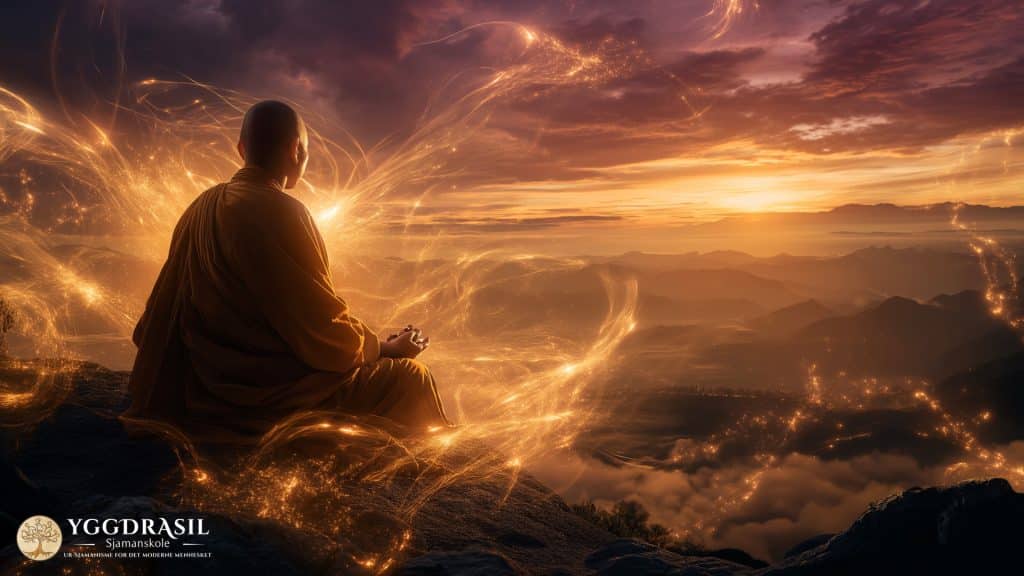
Throughout history, saints and enlightened people have been depicted with halos, luminous rings around their heads. You have seen it countless times: in church art, icons, and religious paintings from every era and culture.
Most people think of the halo as a purely religious symbol. A way of showing that this person was holy or special. But if we look more closely at the symbol, it works as a metaphor for something deeper: an expanded consciousness.
In spiritual traditions all over the world, in Christianity, Buddhism, and Hinduism and in shamanic cultures, the halo stands for the radiant energy of someone who has gone past the usual limitations of how we perceive the world. Someone who is able to see reality as it really is.
The consciousness of an enlightened person extends beyond the physical limits of the body. This makes it possible to perceive the ultimate truth that lies behind the illusions of the physical world. They see more than the eyes can see: with an expanded consciousness that perceives sides of reality that ordinary senses do not capture.
For those who have reached spiritual enlightenment, the halo is therefore more than a pretty symbol in a painting. It mirrors the ability to see the world without the distortions of the ego, without the limitations of the senses, without the mind’s constant categorizing and evaluating.
Saints and enlightened people throughout history have had access to a higher consciousness that let them experience the raw truth of existence. In this state, they perceive something most of us can only sense: the connection between all things. The underlying unity of all that is. The true nature of reality beneath all the illusions.
This expanded consciousness is the very hallmark of spiritual enlightenment. It is the very goal of the spiritual journey. And it is what drives me to write and teach about this: I know that the possibility lies in all of us, waiting to be discovered.
Experiencing your complete nature: from grain of sand to Sahara
For me, this is the most convincing reason why the search for spiritual enlightenment should be your highest priority:
You have the possibility of experiencing your complete nature. Timeless. Spaceless. One with everything that exists.
Material existence, limited by time and space, trapped in your distorted version of reality, can be seen as one single small grain of sand in your Sahara. A tiny part of your true nature. (More on this in the first part of the series, “Your First Birth: The Original Pure Mind.”)
You, the person you think you are, with your name, your story, your experiences, your worries, your dreams, are only a grain of sand. Only a tiny part of something much, much larger.
Most people go through their whole lives believing that this one grain of sand is all there is. That this is the whole of reality. That this is all life has to offer. They worry about the grain of sand. They defend the grain of sand. They try to make the grain of sand bigger, better, more successful, more recognized. They compare their grain of sand with other people’s grains of sand. They become jealous, afraid, frustrated, all centered on this one little grain of sand.
They have no idea that they are surrounded by an infinite desert of possibilities. That they are part of something boundless.
They are mistaken. And it is a mistake that costs them dearly: suffering, unease, fear, and a constant feeling that something is missing.
Experience, my own and that of countless people throughout history, from mystics and saints to ordinary people who have experienced moments of unity, shows that the day you touch your full existence, your Sahara, the experience of life changes completely.
When I myself first got a glimpse of this after my burnout in 2003, it was like waking from a long dream. Suddenly I saw that all the worries, all the fear, all the chasing after recognition and success, all of it was about the grain of sand. It was important within the world of the grain of sand. But in the greater scheme of things, it was so insignificant.
When you realize that what your ego has told you is reality is really just a tiny grain of sand that has been the soul’s straitjacket your entire life, then you experience a liberation that cannot be described in words.
I have tried many times to put this experience into words, and it is difficult. It is like trying to describe the color red to someone who has never seen.
Suffering, fear, frustration, meaninglessness, and hopelessness? They vanish like dew in the sun. Not because the problems in your life disappear, they may still be there. But because you see them from an entirely new perspective. You see that they are grain-of-sand problems. They are important within the world of the grain of sand, but they do not define who you are. They are not the whole of reality.
You gain new perspectives on what really matters in life. Things that used to stress you suddenly seem much less important. Things you ignored, such as connection, presence, nature, the simple things in existence, gain a new significance.
You become able to relate to the hamster wheel in an entirely different way. You can still take part in the world, work, have ambitions, solve problems. But you are no longer trapped in the wheel. You know there is more. You have seen the desert. And that changes everything.
The art of playing with your grain of sand
This makes it possible to play with your grain of sand. To play with your karma. And to meet life in an entirely different way.
When you know that you are the whole desert, not the grain of sand alone, everything changes.
You stop clinging desperately to outcomes. You stop being paralyzed by the fear of losing what you have. You begin to move through life with a lightness that seemed impossible before.
This does not mean that you stop caring. On the contrary. You care more deeply. But you care from a place of freedom, not desperation. From wholeness, not lack.
You stop clinging desperately to outcomes. You stop being paralyzed by the fear of losing what you have. You begin to move through life with a lightness that seemed impossible before.
Pål-Esben Wanvig
Picture yourself playing a game in which you know, truly know, that you cannot lose anything essential. In which every challenge becomes an adventure instead of a threat. In which setbacks become teachers instead of catastrophes.
This is what the mystics mean when they speak of liberation.
Not escape from life. But full, fearless participation in it.
You still feel joy and sorrow. You still meet difficulties. You still have a human life with all its mess and all its sides. But beneath all this there is an unshakable ground. A knowing that what you truly are cannot be touched by any circumstance.
From this place, life becomes play.
Sacred play. Meaningful play. But play nonetheless.
Illness does not disappear by itself. Practical challenges do not disappear. Life still has its ups and downs. But the suffering and the pain connected to all of this can cease, or at least be greatly reduced. Because you no longer identify completely with the grain of sand. You know that you are something more.
In such a state, you gain access to a source of knowledge and wisdom that is impossible to describe in words. This knowledge lies in the consciousness you were born with, the consciousness that existed before your ego was formed, before you learned to see the world through all the filters. It holds knowledge of everything consciousness has experienced since the universe came into being 13.8 billion years ago. And it is available to you.
That is what makes it so worth seeking. Not because you should blindly believe what I say. But because you can experience it yourself. It is not belief, but experience. And the experience is available to everyone who is willing to make the journey.
Can I become enlightened?
Perhaps you are thinking now: “This sounds great, but is it for me? Isn’t enlightenment reserved for a specially chosen few: monks, mystics in monasteries, people who have devoted their whole lives to spiritual practice?”
The answer is a clear no.
Spiritual enlightenment is not reserved for an elite. It is available to everyone who is willing to do the work. Everyone who is willing to develop their consciousness. Everyone who is willing to see past the illusions and discover their true nature.
Spiritual development is not mystical or irrational. It is a systematic process. It can be learned, trained, and practiced. The results can be observed and measured, perhaps not always with traditional scientific instruments, but certainly in how your life changes, how you feel, how you relate to the world around you.
Spiritual enlightenment is not reserved for an elite. It is available to everyone who is willing to do the work.
Pål-Esben Wanvig
Again and again I have seen that ordinary people, with ordinary jobs, families, challenges, and dreams, can reach deep spiritual insights. It does not require that you withdraw from the world. It does not require that you give up everything you have. It requires only that you are willing to look at reality with new eyes and do the necessary work.
In the end, spiritual enlightenment is about reclaiming your consciousness and using it to perceive the world as it really is. In the middle of the distractions, the suffering, the limitations, and the illusions, this is more important than ever.
It lets you break free from the limitations of the senses and the ego. See past the illusions. Experience the ultimate truth. And live a life filled with clarity, meaning, and deep fulfillment.
The path to spiritual enlightenment should be your highest priority in life because it gives you the possibility of seeing past the illusions of the physical world. Of experiencing the ultimate truth. Of living as your true self, not as the limited grain of sand you have believed you were.
By expanding your consciousness and breaking through the layers that distort reality, you can live a life of clarity, peace, and deeper understanding. The path can be demanding. It requires a competent teacher or guide, someone who has walked the path before you and can lead you around the pitfalls. But it is the most rewarding journey you can set out on.
It leads to the realization of the true nature of existence. And to lasting spiritual fulfillment.
It is not a goal you reach and are then done with. It is a continual unfolding, an ever deeper awakening, a journey that keeps revealing new layers of truth and beauty. But the first step, realizing that the reality you have believed in is an illusion, and that something far greater awaits, that step you can take right now.
The next part takes a closer look at which concrete paths you can follow to complete liberation and spiritual enlightenment: different traditions and methods, and what works in modern life for busy people who want to make this journey without withdrawing from life.
Do you want to go deeper? In the podcast “The Journey to Self-Realization” (in Norwegian), Amina and I walk through the same terrain in conversation: episode 34, “Hvorfor veien til enhet burde være din viktigste prioritet” (Why the path to unity should be your highest priority). On my blog you will find more articles on the path to Unity. See also “Learn How to Love Your Karma,” on the karmic memory we carry with us from previous lives.
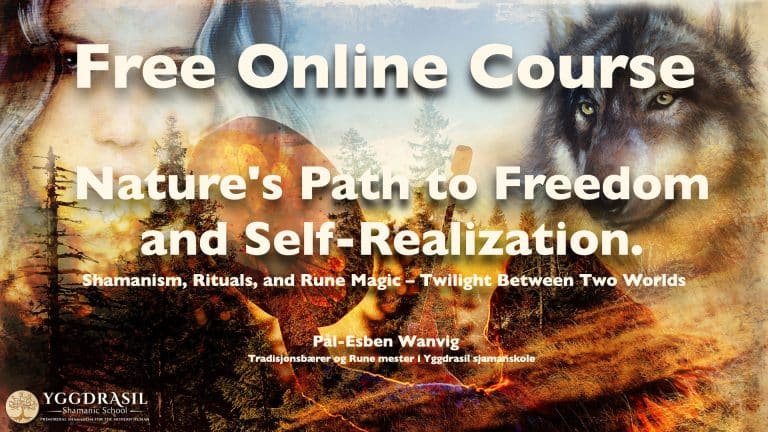
If you want to walk the path yourself, it begins at the Yggdrasil Shamanic School with our free online course on primordial shamanism: Nature’s Path to Freedom and Self-Realization – Shamanism, Rituals, and Rune Magic – Twilight Between Two Worlds. No path could begin more simply. How far it reaches is up to you.
Nature’s Path to Freedom and Self-Realization
Curious about what primordial shamanism really is, behind the mystique and the misconceptions? In this short online course I tell the story of my own path from skeptical engineer to teacher of primordial shamanism, and give you a first introduction to what I teach: what shamanism and primordial shamanism are and are not, how rituals and rune magic are used in practice, and why the longing for growth matters so much for a good life.
The lessons are recorded in Norwegian; the English version will be ready in November or December 2026. Leave your email on the course page, and I will tell you when it is.