
Episode 12 – How One Choice Can Change Everything – And Why the Heart’s Rhythm Is the Key to Freedom, Meaning and Joyfulness
Picture a small child who smiles, throws leaves up into the air and shrieks with laughter, for no other reason than that the leaves are so exciting. For most adults that state is very far away. Pål-Esben says the way back to it runs through the heart’s rhythm, not through a pink cloud, and when his students make a breakthrough, he asks them how they have celebrated it. Often the answer is a puzzled “Huh? Celebrate?”
In this twelfth episode, Amina and her teacher and guide, Pål-Esben Wanvig, talk about the journey so far, which for Amina began with a choice, and look back on the 9 Pillars for Finding the Path of the Heart. They explore why the heart is above all about rhythm, why gratitude is not a list, and why spray paint on rust never lasts. It is part of “The Journey to Self-Realization”, a podcast about the bravest journey a human being can set out on: the journey home to yourself.
This episode is an English translation of our Norwegian original, voiced by the digital avatars of Pål-Esben and Amina.
In this episode
- Amina’s journey so far: from anxiety, stress and chaos to a safe place within herself, whatever happens
- Why resistance is part of the path, and why one-to-one guidance takes a process of development deeper than seminars alone
- Amina’s own students: the magic of the rituals, the feeling of coming home, and experience before belief
- The 9 Pillars for Finding the Path of the Heart in review, and why the heart is above all about rhythm
- The heart’s torus field, heart-brain coherence, and the joyful child we were all born as
- Why gratitude is not a list, how it can become spontaneous, and why spiritual bypassing only builds pressure
- Spray paint on rust, the Book of Shadows, and why it matters to celebrate your own progress
- A partner outside the alternative scene, the shared sixth chakra project, and a 90-day challenge for listeners
This podcast is for you if you:
- Seek real depth in your spiritual practice
- Want to understand yourself on a more fundamental level
- Are curious about shamanism but tired of superficial “new age” spirituality
- Have taken many alternative courses but still feel that something is missing
- Feel an inner longing for freedom, love and wholeness
In a time when so many get lost in external methods and promises of quick fixes, this podcast invites you back to the only place where true answers can be found: your own heart.
Listen above, or read the full conversation below.
Transcript
A warm welcome to the podcast “The Journey to Self-Realization”, a primordial shamanic journey of development back to your true nature. This podcast is a collaboration with our favourite magazine, the health and lifestyle magazine Medium, and is devoted to exploring the bravest journey a human being can set out on: the journey home to oneself. We follow Amina, a student at the Yggdrasil Shamanic School, as she goes through a deep primordial shamanic process of development together with her guide and teacher Pål-Esben. It is a raw, unpolished journey of discovery towards true joy in life, deeper meaning, and a life that truly feels good to live.
This episode is an English translation of our Norwegian original, voiced by the digital avatars of Pål-Esben and Amina.
Today’s topic: summing up the journey so far
Pål-Esben: Hi, Amina, and a warm welcome to a new episode.
Amina: Hi, Pål-Esben. Thank you, likewise.
Pål-Esben: Today we’re planning to sum up and round off this first part of our podcast. And it’s quite something that we’ve come this far, Amina. Time has flown, and it’s been great fun and very exciting. I love this. And what we’ve talked about in these first episodes are the basic things and mechanisms behind this incredible development you’ve gone through in such a short time, what we call the primordial shamanic path of development, that is, a deep process of development. Could you just say briefly where you started, and where you are today? Then we’ll have an idea of what comes from working with the topics we’ve talked about in the previous episodes, and of what that means in practice for a person’s life.
Amina’s journey: from chaos to a safe place within herself
Amina: When I started at the Yggdrasil Shamanic School, I was in a place where I was very confused. There was a lot of chaos in my life. I’d been working on personal development for a few years, but not at the deep level of personal and spiritual development that I came to know when I got to know you and the Yggdrasil Shamanic School. I came from a place of a lot of anxiety, a lot of stress and a chaotic life. Before I started at the Yggdrasil Shamanic School, I’d learned a few techniques here and a few methods there, things like that, which helped me for a while. But I always slid back again, and I didn’t quite understand why.
Nature’s rhythms and energy work as a foundation
I got a foundation in my process of development when I got to know nature’s healthy rhythms, this business of bringing winter into my life. Because I’m a person who automatically seeks out stress, and who can’t take it easy, even though my body has been asking me to take it easy for so many years. So I got to know what nature’s rhythms mean, and that was one of the first important things for me. Also the importance of spending time in nature to find the calm there. At first I thought it might be enough to listen to a few nature sounds on my headphones, and you could say that’s a good second best if you don’t have the chance to go out into nature. But it was definitely something completely different to actually take my body out into nature and find the silence there.
Then we were introduced to very profound energy work and healing methods for letting go of the chains of the past. And what I experienced with that kind of energy work and healing work, unlike what I’d learned before on alternative courses, was the practical steps: that it was also really important to actually write down and reflect on what I’m going to do in the coming period to support the energy work. For me it was really good to get it down on paper in a practical way, where I could also see what I can do to help this energy work along.
The pillars and the golden keys in practice
I also got to know the 9 Pillars for Finding the Path of the Heart, where I got love down to a practical level. What does it actually look like? I got help translating what the power of love is really about, and how I can live the pillars out. And also The 7 Golden Keys, which is a fantastic book you’ve written, Pål-Esben, that goes very directly into personal development. It’s almost impossible not to get a better life if you do the things in the book.
These things, and more, mean that today I can go through difficult things and have a bad day, because I’m human, while a part of me is doing well at the same time. I see the bigger picture. I’m able to deal with myself and my feelings, my children’s feelings and my partner’s feelings in a completely different way from before. I feel much stronger and steadier in myself. And it shows in those situations, because I’ve definitely been put under pressure. I’ve been ill and in a bad way, and bigger life-changing things have happened to me during the training. I used to think that finding the light in yourself meant never having a bad day in your life. But today I’ve understood that that’s not what it’s about. It’s about how you deal with it, and what you learn from it. And I also see how it shines out onto my family, not least my children. When I’ve developed and found a foundation in myself, I can also meet them in a completely different way.
I could talk for hours here about everything I’ve experienced and how things look today. But if I’m to point to one thing that has been the most important for me, it would be that I have a safe place inside myself, whatever happens. Because I’m a very emotional person, and my emotions used to swing a lot. But today I can ride that wave of emotions without everything going pitch black, without wanting to take my own life. Whatever happens today, it isn’t hopeless. There’s always hope there. I know it will get better. It isn’t something I just tell myself, like a peg to hang my hope on. I truly feel that there’s always hope there. There’s always a greater meaning. And I wouldn’t have managed that, or found that place in myself, if I hadn’t gone through this process of development.
No snapping your fingers and calling on angels: what it really takes
Pål-Esben: Yes, it’s very exciting what can happen to a human being who engages in a profound process of development. And that’s really what we’re talking about in this podcast too. What does it mean, and how is a process like that done? What does it take for a human being to completely transform their experience of life within a few months? Because it’s definitely possible, as you show, and as pretty much all your fellow students show, since they have experiences similar to yours. But it does take some effort. It isn’t the case that you just snap your fingers and call on an angel, or do whatever it may be, and things simply change, just like that, without you yourself being willing to engage with these basic mechanisms that you need to learn to master in order to create the life you want to live. Because nothing comes by itself. But it isn’t difficult; purely technically, there’s nothing hard about it. But of course we humans have a great deal of resistance to change. That goes without saying. The ego hates change. But in this case you need to make certain changes, and engage with these fundamental things we’ve discussed in these first episodes of our podcast, with a specific focus on what we call the 9 Pillars for Finding the Path of the Heart.
Because that’s where the whole thing starts in a profound process of development like the one we’re discussing: it starts with the heart. And there’s a great deal of misunderstanding about what the heart is. People think the heart is about love, that you’re supposed to live in love, that it’s some kind of pink cloud you have to find your way into with special methods and techniques, and then you can just feel love, and life will simply be lovely to live. If you take that road, you’ll never find the solution. Because then you just get tangled up in a dense spruce forest, and you only get frustrated, because there’s no love in the spruce forest. You can slip into a meditation and feel calm, you can feel contemplative, as if everything is pleasant and peaceful. But you’ll never get a permanent state or a permanent situation in your life that way. And our thing here, which you’ve been through, is a process of development where your life changes in every area, whether it’s your health, your family, your children or your partner, or how you feel and things like that. That’s what we’re talking about here. And for that you need a combination: of course learning the mechanisms, which we’ve been through, and then, in this case, taking the self-responsibility that’s needed to bring these mechanisms into your life. And has it always been easy?
Resistance is part of the path
Amina: No, definitely not. I’m not really a unique example here. I see it in my fellow students who are walking this path too, the big transformations they’ve gone through. And I see it with my own students, how fast it can happen, how big the insights are that they get. The strange thing is that they don’t always notice it themselves, how big a transformation they’ve actually had from when they started to where they are today. But no, it definitely hasn’t just been easy. And I don’t think it’s supposed to be easy either. If it were easy to walk a path of development like this, or just to have a good life, everyone would simply do it. Then you’d just press that button. So my experience is that it’s through the things that aren’t easy that the greatest growth happens. That’s where the resistance is greatest.
Everything starts with a choice: that I choose to do this. And then you may feel resistance and so on. But what I’ve caught myself doing many times is this: when I’ve set out to change fundamental things about myself to get a better life, to change perspective and so on, I’ve tried to work on it for quite a long time. Or maybe not quite a long time: I can be a bit impatient sometimes, so a couple of weeks, then. And then I see that, OK, nothing’s happening here. Why is that? And then I see that there’s actually a part of me that doesn’t want to. I need to have a little chat with that part. Because if the two of us aren’t on the same wavelength, I can keep at it for ages. And that’s where the guidance sessions with the teacher come in, the conversations I’ve had with you: How can I see this from a different perspective? Which part of you is it that doesn’t want to? I see getting that guidance as really important. Otherwise I’d have lost my way so many more times.
From the seminar room to one-to-one guidance
Pål-Esben: Yes. And that’s also part of my experience over more than two decades now, in which I’ve taught shamanism and many other things: it’s one thing to take part in a seminar where you’re one of many. That can be very exciting too, of course, given the social setting, having fun and laughing. But what I gradually saw with my own students was that when you’re only in a class and going to seminars, weekend seminars and so on, only a certain depth of development can happen. Because you’re simply fed with information, methods and techniques, but it’s up to you to integrate it, to start using it and to start living it out. That’s of course a big challenge for most people, since it’s also about change.
Then came the day I started guiding my students one by one, the way we do it in our tradition: we have ready-made sequences recorded as video trainings that the student goes through, and then they discuss insights, experiences and questions with the teacher. That way the student gets the chance to tailor the content they’ve been through, at their own pace, to their own life. The day I turned things around and did it this way, my students, and you’re one of them, got dramatically better results than ever before. For the first 15 years I ran these seminars and came to Norway seven, eight, nine, ten times a year to hold seminars at hotels. It was very nice, very exciting, and the students loved it, since it was a very nice social setting. But during the pandemic travelling was no longer possible, and then I changed over completely: all the theory is covered in online trainings that you can go through at your own pace, and then I follow up personally as a teacher with personal conversations, all the time, every fortnight, every four weeks, every week, whatever the student needs. And then the results truly exploded. You’re one of the group of students who got the chance to do it this way, and my experience is that you, with the way you’re going through your process now, are doing things in a year and a half that earlier students may have spent ten years on.
And now you’re doing it with your own students. Can you tell us a bit about your experiences with them, guiding them through a process similar to the one you’ve been through yourself? How do you experience it, and how do the students experience it? Because it’s one thing to experience this yourself, but that doesn’t necessarily mean it can be copied.
Amina’s own students: the magic of the rituals
Amina: It definitely can’t be copied. I see many similar settings, I see many similar areas of challenge, but I also see the whole spectrum of unique, individual pictures: everyone goes through the same video conferences, seminars and content, but each student will need to focus on particular things, perhaps a bit more than others. I see that a great many are a bit hard on themselves and think they haven’t done enough, that it hasn’t been good enough: “I haven’t managed to do as much as I’m supposed to,” and so on. I’ve seen that this comes up again and again. But we’ve also talked about how you do it at your own pace, it’s good enough as it is, just relax. Because people really want to learn everything at once, and get through the material, and so on. And as I’ve told them several times: this isn’t the kind of content where you do a nine-month training programme and after that you’re fully trained. This is a lifelong journey. Even today I can go back to module 0, the most basic part of the Yggdrasil Shamanic School, and still learn something new from that content.
But what I see is that a lot of magic happens through the various rituals, methods and techniques. And when I say magic, it’s because the change that happens after the students have been through a few rituals is so spectacular. Whether you’re working with the heart, with forgiveness, or with particular themes in your life, when we talk about these things together, about what has come out of it, how you can keep working with it and what it can look like in your daily life, it becomes very tailored. What I also see is that the more layers they peel off themselves, the bigger and deeper the insights they get. They’re the kind of insights that come from a deeper place within them.
“Like coming home”
But perhaps the most magical thing… Well, it’s all magical, but perhaps one of the most magical things is that several of them say this is like coming home. It’s a difficult feeling to describe, and I remember that feeling and recognise it in myself too. It’s like coming home, it’s like landing somewhere, it’s like getting a foundation. You may have tried to still that longing somewhere else. We can have many addictions, or places we want to run away to because we think that’s home, but it’s never satisfying enough. This is what I experience with my students: that it’s like coming home, in addition to meeting your soul family, which we’ve talked about quite a bit in the last few episodes. Getting to know people who walk the same path. Several of them have also paid each other compliments: “Goodness, you shine so much more now, you’re so much more sociable now, you’re much more open, you’re much more confident.” It’s that kind of group. I’ve now started my second group, and I can already see it there at the start, after we’ve met for the first time.
Experience before belief
And what I think is really unique about this training, which the students appreciate, is that through the Yggdrasil Shamanic School and the seminars and video conferences, you give the intellect and the ego enough to chew on, so that they come along too. Of course they can rebel from time to time, but it’s logical. What you explain is logical. And another thing I see as very healing is something you also care about: “Don’t believe what I say; believe your own experiences.” In the beginning, with the first group, I noticed that some people voiced opinions along the lines of “no, this doesn’t really resonate with me,” and so on. But that’s completely fine. And then I notice that over time nobody talks about it any more, but you can see that it has become a more integrated part of them. It’s no longer about “I believe this, I don’t believe that”. It’s that they live out what they perhaps didn’t believe at first, because it has touched some parts of them, and because they’ve gone through the experience.
Pål-Esben: And I think that’s also something very important about the Yggdrasil tradition: you don’t depend on having to believe everything you learn, and that’s fine too. I’ve encouraged people not to believe. Believing is something you can do elsewhere. Here it’s about gathering experience, and through experience you see what reality is. And that’s quite exciting. Here in the podcast we’re trying to shed light on your journey from both sides, both from the teacher’s perspective and from the student’s perspective. And now you’re lucky enough to get experience from both the teacher’s perspective and the student’s perspective, and it’s quite spectacular to get to be part of a process like that.
The nine pillars in review
Let’s go back a little, since this is a summary of what we’ve talked about so far, and we’ve talked a great deal about the heart. And the heart is what we put a lot of emphasis on at the start of a profound process of development like this: understanding what the heart is, and understanding what the Path of the Heart is. For that we have the 9 Pillars for Finding the Path of the Heart, which we’ve now discussed over these episodes. The first pillar is becoming a master of gratitude. The second pillar is becoming a master of forgiving yourself and others. The third pillar is becoming a master of self-regulation, physically, emotionally and not least spiritually. And the fourth pillar is becoming a master of building a healthy value system and a strong and stable character, where you also find the spiritual warrior, whom we’ll talk about in a later episode. The fifth pillar is becoming a master of saying that the glass is half full. That means becoming a master of changing perspective and being able to see things from a constructive perspective, where you can see the possibilities even when things are difficult. The sixth pillar is becoming a master of healing your own almighty syndrome, which is definitely a problem in today’s society, where we think we know things we actually haven’t a clue about. But we think we know, and then of course we’re more or less completely locked into our opinions. And the seventh pillar is becoming a master of healing perfectionism, which we talked about quite a bit, and which is also a challenge in today’s society. The eighth pillar is becoming a master of understanding nature’s healing rhythms. And that’s where we really begin to enter the shamanic sphere, because rhythms are what everything is about. We’ll say a few words about that in a moment. But the ninth pillar is becoming a master of understanding and living out your soul’s desires and life mission, which we’ve spent the last three episodes on, where we talked about the elite university for souls and so on. This is a complex place to incarnate in, but there’s also a reason it’s like that, and we’ve talked about that in the previous episodes.
The heart is rhythm
But let’s go back to the heart for a moment and look at it: what is this heart really about? When we talk about the heart, Amina, what’s the first thing you think of when you associate something with the heart?
Amina: Love.
Pål-Esben: Love. And that’s what most people would say: it’s love. And then I say: no, love is just a consequence, a side effect of this. What is it really about? When we talk about the heart, it’s about rhythm. And the more harmonious that rhythm is in relation to what we call the natural rhythms, which we find in the nature around us, and in the universe for that matter, the more the heart is in contact with the soul and what lies behind it.
The torus field, coherence and the fundamental rhythm
Look at it in the simplest way: when our heart beats, it creates an electromagnetic field around us. Many people have probably seen this through the experiments done by the HeartMath Institute and others, where they have proven that when the heart beats, it creates an electromagnetic field shaped like a doughnut, like a torus. And the heart’s field can be measured two to three metres outside your body. What’s interesting is that when you and your heart are in a rhythm connected to primary feelings, such as gratitude, your rhythm radiates up to three metres around you. That means that when you’re in coherence, as it’s called, in harmony, it affects not only you, your body, your cells, your thoughts and your feelings, but absolutely everything around you in the room you’re in, and probably also what lies beyond the room you’re in.
So when we talk about the heart and the 9 Pillars for Finding the Path of the Heart, it’s about finding our way back to a harmonious heart rhythm. And I’m not talking about the pulse here, but about the rhythm that arises from what we think and what we feel. And it’s about getting our heart, and the rhythm of our heart, to beat more and more in time with what we can call the universal rhythm, or the rhythm connected to creation. In the yogic tradition we talk about the rhythm of AUM. It’s the fundamental sound that represents creation, what happens after the Big Bang. And the Big Bang is just what people believe happened. The reality is a bit different, but we’ll come back to that in a later episode. But let’s talk about the Big Bang here, in simplified terms. When the universe is created, according to what people and scientists say, a fundamental rhythm is created, a fundamental vibration, before anything at all has been imprinted, before any destructive human ego thoughts and feelings have even been thought of. It’s the pure, harmonious, creative fundamental rhythm of our existence. And you could also say that it’s the beats of the central sun of our universe that are really the point where this happens. But that’s also something we can talk about later, how it fits together.
So our task is to bring our heart back into harmony with these fundamental rhythms of our existence, of our universe, of our galaxy, of our solar system, and not least of Gaia, of Mother Earth. Because the more we bring our heart back into coherence and harmony with these rhythms, the more primary feelings we have available in our daily life: a feeling of gratitude, a feeling of joyfulness, a feeling of bonding, that is, love, and so on. And that’s what the 9 Pillars for Finding the Path of the Heart are about: bringing our heart back to its original, healthy rhythm. Through that, the doors open to our real existence, that is, our existence as souls and what lies behind it, which we talked about in the last few episodes. So the first thing I think of when people ask me what the heart is, is rhythm. But not just any rhythm: a rhythm in harmony with the fundamental vibration of the universe we live in, which is the foundation on which everything metaphysical and material is created. So that’s perhaps a slightly different way of looking at this.
The joyful child
And modern research shows, for example the HeartMath Institute’s research over the last 30 to 40 years, that when you bring your heart back to this rhythm, for example through deep breathing and slipping into a feeling and a situation where you feel deep gratitude, a coherence arises between the heart and the brain, a balancing coherence called heart-brain coherence. It shows up, for example, if you measure a person’s heart rate variability. Then you’ll see a very harmonious oscillation, compared with when the person is caught up in fear and hate and so on, where you have a very jagged, unpleasant, ugly oscillation. It’s totally spectacular how what we’re talking about can even be proven through modern research. And in the end it’s about how we find our way back to this harmonious rhythm that we were actually born with when we came into this world: the joyful child who smiles and just throws the leaves up into the air and shrieks and giggles, for no other reason than that they think these leaves are so exciting. For most adults that state is so far away. This rhythm is what it’s about. And by finding your way back to this rhythm, you can really begin the profound primordial shamanic process of development where this magic you’re talking about happens. And that’s what I call spectacular. That’s the reason we have these 9 Pillars for Finding the Path of the Heart: so that we have a practical way of approaching this, instead of someone just telling you to close your eyes now and float off on a pink cloud, and live in love. Things like that mean nothing at all in this setting. That’s what I call spectacular.
Amina: Yes, absolutely. We talked about it in an earlier episode, how many people in the alternative world are focused on the chakra system, and perhaps try to focus on one chakra a week, or on “where am I out of balance”, and so on. We’ve talked a bit about how the 9 Pillars for Finding the Path of the Heart also help the chakra system come into sync automatically, as you get going with the pillars and live them out. And you don’t need to choose a primordial shamanic process of development to get the benefits of the 9 Pillars for Finding the Path of the Heart. They’re quite easy to access. They’re on your website, and I think you’ve also written an article about them in Medium magazine, on the magazine’s website. It’s something anyone can get started with today.
Gratitude isn’t a list
Pål-Esben: Exactly. You don’t need to go overboard. You can start with the first pillar, that is, trying to become a master of gratitude. Just by starting that process… And here you can go back to the episode where we talked about gratitude, and where we also showed a bit of how to do it in practice. Because that’s one of the misunderstandings here, and it means you get no effect from it whatsoever: the idea that it’s just a matter of writing a list every day of what you’re grateful for. Of course that creates a certain focus, but it’s definitely not what we’re talking about here. Gratitude isn’t an intellectual thing. Gratitude is something that arises deep within us, deep in our heart, as a deep, primary feeling that comes up to the surface. That’s what we experience when we actually feel gratitude in our daily life, for example in your case when you had your children, that overwhelming gratitude, or when you found your partner and fell in love. This deep gratitude is always connected to a rhythm, and in this case to a primary feeling we all know. There’s probably none of us who hasn’t experienced gratitude at some point in life.
The problem is that as we grow up, we take things for granted, and we go around moaning about things that aren’t good, and forget that 90 percent of our life is actually very good, at least much better than for 99.999 percent of all the people on this planet. But we keep our focus on the one thing that isn’t good, and sour our lives by focusing only on that. And the gratitude exercise is about finding our way back to this rhythm of gratitude, so that this primary feeling of gratitude can come up and rub off on what goes on in our life, and so that we’re willing and able to see things from a more constructive perspective. And that doesn’t mean we should say everything is fine, everything is fine. A problem is a problem and needs to be solved. But which perspective do you see the problem from? Do you see it as if everything is a problem, everything is awful, everything is hopeless? Or do you see it from a perspective where you say: OK, there’s probably something I’m meant to learn through this, or at least it’s possible to gain insight through this, so let me try to find a solution. That’s a completely different perspective.
And that’s what we’re talking about here, because there are so many misunderstandings, especially in esoteric circles, about what gratitude is and how you cultivate it. And one of the few ways of cultivating gratitude is through what we discussed in the episode where we talked about gratitude: you find a situation from your past where you were deeply grateful, and learn how to step into that situation and relive all the sensory impressions in it. That way you can relive the rhythm and the emotion of gratitude and bring it with you into your daily life today. That’s how it works. Without that, it isn’t possible to become a master of gratitude, and certainly not in a way that can change your life quite radically. That only happens by engaging in it fully and wholeheartedly on a daily basis, throughout the day, for three or four weeks, during which life will feel different. In all the years I’ve worked with people, everyone who has engaged fully in this on a daily basis for two, three or four weeks has felt a big change in how they experience life. Without exception. And you don’t need to go through a training programme to learn this. It’s something you can start with today, if you want to.
Numbness and the way back to the primary feelings
It isn’t that it’s so complex, but you have to be willing to do it. The challenge is that most adults are completely numb: they have no access to their primary feelings, such as joyfulness and those things. They have a great deal of access to their secondary feelings, such as fear and hate and discomfort and so on. But most adults are completely cut off from this primary joyfulness and the other primary feelings. And we’ve talked in an earlier episode about why that is. So you need to go through a process to relearn this. Because everyone comes in joyful as small children, most of them anyway, and we need to find our way back to that, and that takes cultivation. I’ve had many students, I’d say perhaps eight out of ten of the students I have or have had, with big challenges in accessing primary feelings. Some of them can build it up very quickly through practice, while for others it takes a bit longer with active practice, because they go from being completely numb to actually beginning to feel this. And that’s the work. It isn’t technically difficult, but doing it yourself is the challenge. We lose motivation so easily. Nowadays, with social media, where we have an attention span of three to five seconds, it’s a bit challenging. And if there’s a reason for choosing a process of development and going through it with a teacher, it’s this: you recognise that doing these things on your own is such a big challenge. It takes so much discipline, so much courage, and there’s such a big chance that you give up because you come up against resistance. That would be the motivation for it. But you can do this on your own.
Amina: Yes, absolutely. And this is my experience with what you’re saying about starting with gratitude exercises: going back to a situation in life and feeling gratitude through interaction with another person, when you’ve given birth to your first child, got married, and so on. That’s something I did a lot at the start. But today I don’t need to do it that way, because I can automatically slip into a feeling of gratitude. I don’t need to attach it to a face or a situation. That’s another kind of magic again.
And about what you said regarding the people who have no contact with their primary feelings, those who struggle with gratitude: I have, among others, a student who can’t feel the primary feelings even at the big events in life, like giving birth and getting married and so on. Because there are people like that too. And then you can feel a bit ashamed, because you didn’t feel gratitude when you gave birth to your first child, since all women are supposed to feel that. She has worked with gratitude exercises, in a disciplined way at first, and now little glimpses of gratitude are starting to find their way into her life. And that’s where you see the magic of this. Because clearly, when you’re going through a process of change, yes, it’s supposed to be a joyful journey, a joyful process, but it isn’t always so joyful for the ego to have to come closer to the heart. So that’s an experience I have with myself, and that I also see with students: with some things we actually need a bit of discipline at first, before they become a natural part of us.
Mastery in gratitude
Pål-Esben: Definitely. And that’s the challenge of running a process of development by reading books or watching YouTube videos or whatever it is you do. Because most people are stopped by their ego as soon as they hear something the ego doesn’t like, or there’s a change that needs to be made. Then the ego finds very good excuses for not doing anything about it. But what you’re saying is very exciting, because that’s how it happens when you gradually begin to feel the mastery in gratitude. The day you’ve got there, which takes a process of cultivation, it will look like this: you wake up in the morning, you open your eyes, and you’re deeply grateful that you get to start a new day. You’re grateful that you get to breathe in fresh air. You feel grateful that you’re still here when your toes touch the floor or the rug. You feel gratitude that you have a toothbrush, which is probably electric. You feel gratitude for the food on the table, you feel gratitude that you have a place to live, you feel gratitude that you get to live at all in this very special world we live in, and so on. It’s nothing you control; it’s simply something you experience. That’s what comes after a wholehearted process of cultivation over time. Being grateful isn’t something you’re searching for. It’s something that arises spontaneously all day long, at any moment, without you needing to do anything at all. When you get there, life has changed quite considerably, because then you see things from completely different perspectives than you did before.
Spiritual bypassing and the masks
Amina: Yes. And if I go back to my own experience, and to friends and acquaintances from earlier who have learned or heard about this concept somewhere, read something, watched something on YouTube or been inspired by it, I see that it’s very easy to slip into this: “Oh yes, OK, I’m supposed to feel deep gratitude, I’m spiritual after all, so I have to wake up and be grateful for my partner, and then I have to be grateful that I exist, how grateful I am.” And then you’re not one damn bit grateful. This is where we get into what I call spiritual bypassing: you think it’s supposed to be like that, so you think you have to act as if it is. So here again: the importance of maturing. Everything is a process. It isn’t supposed to happen from one day to the next either. Of course there are probably always exceptions here and there, but I don’t know; maybe it’s more or less impossible for it to happen that way.
Pål-Esben: Yes, the process can go fast, but I very rarely see it go fast, because it’s a process of cultivation that has to be done. What you’re describing now, feeling that you just have to be grateful since you’re in a spiritual process of development, when you don’t really feel grateful, also creates tremendous stress inside a person, because you have to put on masks and radiate gratitude where you don’t actually feel it. And the longer you do it, the more pressure builds up in the pressure cooker, and that’s something I wouldn’t recommend to anyone. In the end it only creates frustration and suffering.
Spray paint on rust
In the book The 7 Golden Keys I talk about the concept of spray paint on rust. Take an affirmation like “every day things get better and better and better.” You go around repeating an affirmation like that all day long, every day, without doing anything at all to make things actually get better. And of course that’s meaningless. It’s as if I try to put spray paint on rust. You know, if you have a car that’s started to rust, and you think, now I’ll do a quick fix, let me just spray paint over this, it’ll still rust, and let me tell you, it gets worse and worse. There’s no permanent solution in that. So I’m not a fan of spray paint on rust, but a fan of doing the work it takes: sanding the bodywork right down, sealing it, that is, priming it. You can tell how much car painting I’ve done. In other words, doing the things you need to do for this to turn out well. And finally, when the surface is perfect, you put the paint on top. That’s the work we’re talking about here. And it’s no simple thing where you just need a special symbol, or a special meditation, or a special whatever it may be, and then you say hey presto, and things are fine. If you do that, you just build up stress and frustration in yourself, because you see that you’re trying to pass yourself off as something you aren’t. And sooner or later that comes back to bite you in the backside, often sooner, because of the pressure that builds up. That’s why I’m a fan of doing the work it takes, and that’s why I call it cultivating these things. By cultivating gratitude you eventually reach the point I’m talking about now, where you simply experience gratitude spontaneously in your life, without needing to do anything at all. So it’s the opposite of spray paint on rust.
The Book of Shadows and what’s coming
That’s our philosophy here when we talk about a profound process of development that transforms a person’s life permanently: no spray paint on rust. That’s what we’re discussing in this podcast: what this process of development really is, what it contains, the challenges we have with it and the results we have with it. And that’s why I’m so glad to have you on the team here, Amina, so that we can discuss both the good things and, not least, the problems that arise in a process of development like this. And that’s what we’ll start discussing in the coming episodes. We’ll start discussing where anxiety has come up in you, where the resistance has come, where you’ve collapsed, and where things have gone really wrong at times. And not least how we found the way out of it. That will be one of our focuses in the episodes ahead. Now we’re done with the basics, and now we’ll start dipping our toes in, so there’ll be a bit more action. And here you actually intend to be even braver than you’ve been before. You have your Book of Shadows, and you’re planning to read a few passages from it, both the good and the bad, because that can be very interesting. And it’s also really good to write down your whole process, your journey of development.
Amina: There’s a lot of exciting stuff in there. A lot like: “Oh, today I’ve felt so good, and this or that insight,” and so on. And then some time goes by, and then it’s just: “No, now I think maybe I need a conversation with Pål-Esben.” “Yes, today I had a conversation with Pål-Esben, and he said this and that, and then I understood this much better.” And then we get back up again, and the black hole isn’t as deep each time. So it’s magical.
Pål-Esben: Yes. And we don’t want to promote the idea that this process of development is just a bed of roses, that everything happens by itself, and that it’s all light. Because you run into the darkness in yourself, you run into your shadow side, you run into suppressed parts of your personality, you run into compensatory mechanisms, addictions, you run into belief systems, you run into fear, you run into primal anxiety, whatever it may be. And it isn’t always that easy. That’s what we now want to start shedding light on, after we’ve done the introduction and the basic things a journey of development like this requires: dipping into your Book of Shadows. And for those who aren’t sure what a Book of Shadows is: in our tradition we use it as a book where the shaman writes down their experiences in their process, experiences with the work they’re doing, experiences with their rituals, experiences with the whole process. We encourage the shaman, or whoever is in the process of development, to do this from day one. Nobody has to do anything at all. But what’s spectacular is that when you start looking back at what you wrote when you started, you see where you were, and then you see where you stand today. And that creates incredible pride and joy in yourself.
Celebrating yourself
Amina: Absolutely, absolutely. There’s every reason to be proud when you go on a journey like this, and to celebrate yourself, because you’re working incredibly hard. So it’s important to celebrate yourself. Few people do that today, celebrate themselves. Yes, so hooray for that!
Pål-Esben: Hooray for that! I often ask students and clients of mine, when they make breakthroughs and great progress in life: “What have you done to celebrate your progress here?” “Huh? Celebrate?” Then I think: OK, so we need to learn that too. Because if you go through life in a numb state, even when good things happen, how are you going to wake up your heart? You need a bit of action here, and you need to learn new things. I’d say that if you don’t have time to celebrate your progress, that’s a sad state of affairs. But here eight out of ten, or perhaps nine out of ten, actually have to learn this again, and start delighting in their own progress and celebrating it. When you’ve made a breakthrough, why not take your partner out to the kebab shop, or whatever it is you do, to a restaurant perhaps, and say: “I’m taking you out now, dear partner, to celebrate the progress I’ve made. I’ll tell you how I experienced that progress, and how I experience life now, and I want to invite you to dinner to celebrate me.” That’s so alien to most people.
And when you start doing these things, it’s very, very exciting what happens, especially for the people close to you, perhaps your partner or friends and so on, and for them there’s a paradox too: they see that you’re changing. But when you’ve sat down and said, now we’re going to celebrate me and my progress, and I’m going to tell you exactly what has happened, you also bring friends and family into your positive process, and then a virtuous circle is created. You get even more support. Because you run into a few challenges when you have a partner who doesn’t know what you’re up to, or a partner who, for example, has zero interest in doing anything about their own challenges and problems. And what has to be worked through in a process of development can also create challenges. What I encourage then is to find a solution to it: not to ignore it, but to try to find a way out of it, so that you can continue your relationship.
Your partner and the alternative scene: a shared sixth chakra project
Because in esoteric circles you often hear that if your partner isn’t interested in angels and the things you’re interested in, then your partner isn’t right for you. What a load of bullshit! You can be an esotericist, interested in the alternative scene and whatever it may be, shamanism or angels or whatever you do, without your partner needing to be in that world at all, as long as you have mutual respect for each other, and as long as you have a shared sixth chakra project for life that binds you together. And that’s what you need to figure out. If you have a partner who is just negative and puts you down, whatever you try to do, then of course everything becomes difficult. But I prefer to look for a solution, so that you can go on being happy in your relationship, even if your partner, for example, isn’t particularly interested in the alternative scene. That’s my attitude to these things.
Amina: Yes, and we went into this in depth in episode 3, I think, when we talked about the intricate things that can happen in relationships during processes of change. But when you say a shared sixth chakra goal, it can sound very spiritual. Because often in the alternative world, when people think of the sixth chakra, they think of all the impressions you can pick up, and things like that. Could you say briefly what you mean by a shared sixth chakra goal for the future?
Pål-Esben: Yes. The sixth chakra is connected to our vision. And the more actively it opens up the soul’s vision and mission in this incarnation, and the more developed the sixth chakra is, the more attuned you are to what you need in order to carry out this vision and mission. Those whose sixth chakra is well-functioning, if we’re going to use such a banal word for it, will often be able to attract what they need in their process of development, as long as they walk in harmony with the soul’s vision and mission. That might be, for example, finding a suitable partner, a suitable teacher, a suitable therapist, a suitable doctor and so on. That’s one side of it. But when we choose to live life together as partners, we also depend on having a shared mission and vision for our relationship. At the start, for example, the children might be the shared vision and mission. But when the children move out, you need projects that bind the partners together. Because if it ends up with one sitting in the east wing of the house and the other in the west wing, you have no interaction with each other and no projects together. Then you have no vision and mission together either. That’s what I mean by it. So in the old days, when I did couples therapy with people, we would gradually get into these things too, to see: OK, we have challenges; are they solvable, is it possible?
For example, if respect and mutual respect don’t exist, the flame of love has no chance to grow, and so on. So if we look at the theme of respect: what does it mean? I’ve never met a couple who could tell me in writing what respect means in practice in their relationship. It was always a big process. It goes: “Respect…”, and then out come lots of words. But what does respect mean in practice? Then we start working on other things, communication and so on, and then we get into themes about finding an active, shared vision and mission for the relationship, which people need in order to be happy together. Let me give an example here: one is very interested in esoteric things, in chakras and angels and power animals and devas. And then you may have a partner who is interested in art. How do you then find a shared project that satisfies both parties, that can make both happy when you do things together? Do you follow me? That would be a sixth chakra vision for two partners who may have very different interests. And that’s also something that can be cultivated. Because I don’t have much faith in just saying that if you don’t believe in angels, you’re not right as my partner. That’s a sad state of affairs, because it doesn’t need to be like that. The problem is if you have a partner who actively tries to destroy your path, who actively tries to run you down. Then of course we have a problem. My intention when I have students is to try to stabilise their relationship, and to help them learn within the relationship they’re in, as long as it isn’t very destructive, of course: to learn how to find solutions to their challenges and problems, how to find their way back to where they were when they were newly in love, and so on. I call that part of a process of development too, if the students want it, instead of taking this shortcut and saying: “No, my partner isn’t interested in angels, so I don’t want anything to do with her.” And that would be spray paint on rust, because then you’ll get the same problems next time, and next time, and next time, and so on.
Amina: Yes, I’ve tried spray paint on rust over the years. It took me 32 years before I tried anything else. But I’ve learned from that too. But how many times do you have to go through the same thing? In the end it has to get boring. But what you’re raising there is really important, this business of distinguishing: is this a partnership that’s fundamentally negative for me, because of psychological abuse, physical violence or a partner who keeps me down? Or is it just because I wish my partner were into it too, because now I believe in beings of light and angels and so on? Or other things. So it’s important to distinguish there. Because I’ve also talked with clients and students who have had those challenges, who are a bit like: “OK, but now I feel we’re going our separate ways, because I’m getting into shamanism or spirituality, and he isn’t really into that.” In some of the cases it’s a process of breaking free, because you see: “Whoa, shit, I have a partner who’s abusing me.” In other cases it’s more that you believe you can’t be together because you’re no longer alike. But as you say, and as you’ve inspired me to pass on: “Yes, but what do you have in common, then? What did you like doing together before? How can you open up more to the new version of each other?” And there’s something very beautiful in that too.
Advice at the end: start with the pillars
Pål-Esben: And there too, as we come to the end here: nobody needs to reinvent the wheel. You don’t need to master everything yourself, because there are many skilled people around us who can help, and it’s just a matter of finding a suitable guide, doctor, therapist, teacher, whatever it may be. And the better your sixth chakra functions, the easier it is to find a suitable helper. And that’s what’s a bit tricky in all of this: when it doesn’t function so well, people often find their teacher on YouTube and the like, and that can lead to ending up a bit lost in the spruce forest, getting many misconceptions about reality, and blocking yourself. So that’s the hard part.
If we’re going to sum up everything we’ve talked about in these episodes, my advice, my intention, my wish for you as a listener would at least be this: start engaging with the 9 Pillars for Finding the Path of the Heart. And when you start engaging with them, when you start studying them, when you start living them out… In more than two decades, I for one have never seen it fail to change a person’s life for the better, quite extensively and radically, within a fairly short time. And then we’re talking about perhaps four to twelve weeks once you start engaging with it. So that’s my tip at the end here, if we’re going to round off, Amina: there’s always hope, there’s always a solution to things, there’s always a possibility, whatever the situation, of becoming a happy and joyful human being. And it makes no difference whether we’re healthy or ill, rich or poor, or whether we live alone or in a family. There’s always a possibility, and that’s what I try to inspire people to do: to look for these possibilities to free themselves, so that they can start living the life they came here to live, namely a joyful, exciting life with meaning. Because that’s definitely the soul’s intention with this incarnation. So, Amina, do you have any closing words here?
The 90-day challenge
Amina: Yes, I’d like to pick up on what you said, this business of diving into the 9 Pillars for Finding the Path of the Heart over the next weeks and months. And feel free to write to us on our website, reisentilselvrealisering.no. Feel free to write about the experiences you’ve had, the highs and the lows, how it has gone; maybe you have some questions about things you’ve come across in yourself on that journey. Set yourself a goal, perhaps for the next 90 days, of going all in on the 9 Pillars for Finding the Path of the Heart. Send it to us. I get really inspired by hearing other people’s stories, and I know you do too, Pål-Esben, so please do that and send it in to us, so we can take delight in it too.
Pål-Esben: Yes, this has been terrific. And if you as a listener have questions, or things you’d like us to take up in our future episodes, feel free to send us an email, or use the contact form on reisentilselvrealisering.no, it doesn’t matter which. Just get in touch with us and say: “Oh, I’d like to know more about that, could you talk about it?” Because over time we’ll become much, much more focused on you as a listener, your needs and the interaction with you. We’re not doing this for ourselves; we’re doing it to inspire you and all the other listeners to find the way back to yourselves, and to find the way back to joyfulness again, and to meaning. And for that we’d love to have a two-way dialogue. Yes, good. So, words of wisdom to wrap up, Amina, before we finish?
Words of wisdom to wrap up
Amina: Words of wisdom to wrap up. Well, I feel like picking up on what you said again there, Pål-Esben: there’s always hope, there’s always a way out. I’d like to say to you as a listener that your life has so much greater significance than you might think yourself. The significance your life has, as a human being here on earth, is quite extraordinary. More people should know how meaningful they actually are, and how important they really are in the bigger picture.
Pål-Esben: And that’s a theme we’ll get into when we start on the primordial shamanic path to oneness and spiritual enlightenment. Then you begin to get a deep, deep picture and understanding of why that is. That will also come in a later episode. So in the coming episodes we’re opening the door to difficulties, problem areas and some spectacular, tricky topics that arise in a process of development. And we’re continuing with new episodes straight away, without a break. Thank you so much for staying with us all the way, dear listener. We really appreciate your feedback, and a five-star rating on Spotify helps our podcast reach more listeners. And thank you so much for being here with me, Amina. I really appreciate it.
Amina: Likewise, Pål-Esben.
Pål-Esben: Thank you for being with us, dear listener. I hope you’ll join us again in the next episode. And until then: have a truly wonderful day, evening, night or morning, wherever you are listening from. Take care.
Outro
Thank you so much for listening to this episode of “The Journey to Self-Realization”, a primordial shamanic journey of development back to your true nature. We hope Amina’s story has inspired you to explore your own journey of self-discovery and development. Remember that the path from suffering to self-realization can be demanding, but with courage, patience and support from a competent guide, mentor, teacher or therapist, almost anything is possible. We wish you all the best on your journey, and we’ll talk again in the next episode.
The Journey to Self-Realization
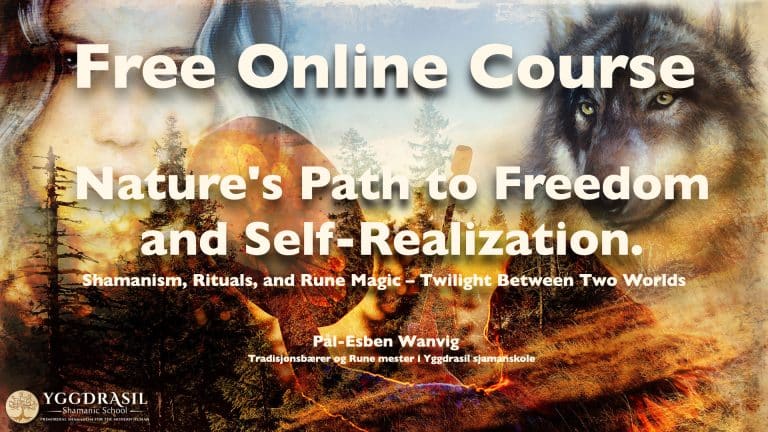
Nature’s Path to Freedom and Self-Realization
Curious about what primordial shamanism really is, behind the mystique and the misconceptions? In this short online course I tell the story of my own path from skeptical engineer to teacher of primordial shamanism, and give you a first introduction to what I teach: what shamanism and primordial shamanism are and are not, how rituals and rune magic are used in practice, and why the longing for growth matters so much for a good life.
The lessons are recorded in Norwegian; the English version will be ready in November or December 2026. Leave your email on the course page, and I will tell you when it is.