Episode 2 – The Healing Power of Nature and the Spiritual Foundation
Why is it so hard to do absolutely nothing for half an hour? Before she started at the Yggdrasil Shamanic School, Amina lived in a constant rush: chronic stress, one burnout after another, and an endless hunt for happiness through weight loss, cake baking and bodybuilding. None of it made her happy.
In this second episode, she and her teacher and guide, Pål-Esben Wanvig, talk about nature’s healthy rhythms: why we fall ill when we lose touch with them, how forest bathing can bring them back, and why a spiritual foundation has to be in place before the spectacular can begin. It is part of “The Journey to Self-Realization”, a podcast about the bravest journey a human being can set out on: the journey home to yourself.
This episode is an English translation of our Norwegian original, voiced by the digital avatars of Pål-Esben and Amina.
In this episode
- Amina’s hunt for happiness through a gastric bypass, cake baking and bodybuilding, and why none of it worked
- How illness arises, seen from a shaman’s point of view: stress, inflammation and a nervous system stuck in fight-or-flight
- Forest bathing, and how to bring winter into a busy everyday life
- The wheel of the year, from Samhain to Lughnasa
- The strawberry principle: why you need reference experiences in nature before you can find the same calm in a chair at home
- Why the spiritual foundation has to come before the spectacular, and why the soul chooses the straitjacket
- Seeing difficulties as challenges to solve, and whether calm is possible with ADHD
This podcast is for you if you:
- Seek real depth in your spiritual practice
- Want to understand yourself on a more fundamental level
- Are curious about shamanism but tired of superficial “new age” spirituality
- Have taken many alternative courses but still feel that something is missing
- Feel an inner longing for freedom, love and wholeness
In a time when so many get lost in external methods and promises of quick fixes, this podcast invites you back to the only place where true answers can be found: your own heart.
Listen above, or read the full conversation below.
Transcript
A warm welcome to the podcast “The Journey to Self-Realization”, a primordial shamanic journey of development back to your true nature. This podcast is a collaboration with our favourite magazine, the health and lifestyle magazine Medium, and is devoted to exploring the bravest journey a human being can set out on: the journey home to oneself. We follow Amina, a student at the Yggdrasil Shamanic School, as she goes through a deep primordial shamanic process of development together with her guide and teacher Pål-Esben. It is a raw, unpolished journey of discovery towards true joy in life, deeper meaning, and a life that truly feels good to live.
This episode is an English translation of our Norwegian original, voiced by the digital avatars of Pål-Esben and Amina.
Today’s theme: nature’s healthy rhythms
Pål-Esben: A warm welcome, Amina!
Amina: Thank you so much!
Pål-Esben: How are you today?
Amina: I’m fine. It’s nice to be out and to have some deeper insights today.
Pål-Esben: Exciting, exciting. Today we are going to discuss nature’s healthy rhythm, and how it can affect our lives for better and for worse. We will talk about how illness is created, seen from a shaman’s point of view, and of course about what the foundation is for becoming healthy and happy and finding a meaningful life. We find that in relation to what we call nature’s healthy rhythms.
Then we’ll see how it develops, depending on what is going on in you, and what questions and thoughts you have around it. It will be very exciting. Could you start by saying a few words about what your everyday life and your life were like before you began your process of development about a year and a half ago, which we talked about in episode 1?
An endless rush and the hunt for happiness
Amina: I was very far away from nature’s healthy rhythms. That was one of the first things I was introduced to in this training. When I woke up, I was chronically stressed in the mornings. I had to get the children out the door to school, one didn’t want one thing and the other didn’t want another, and there I stood with it all. Then I had to do my own things, and so I had an endless rush through the whole day. I didn’t even have time for the things I hadn’t done. It was constant stress, and I struggled a lot to rest.
Since I was 13 I have always had a job alongside school, and in my adult life I have always worked until I have burned out completely. I have worked a lot and burned out completely, because I have a fire in me that I just burn out completely. It really has been all or nothing. That led to periods, perhaps every other week, where I shut myself away completely in a dark room and just stayed there. Nobody could get hold of me. Those were the days when I didn’t have my children, because I have them every other week.
And when I had nothing to do, I always found something to do, even though my body really needed to rest. I have always had something I was hooked on, an idea that if I achieve that, I will be happy. Two months after I gave birth to my first child, I decided that I was really fat, and that if I became thin, then I would be happy. So I took off to Lithuania and had a gastric bypass, a weight-loss operation, and lost 40 to 50 kilos in six months. I wasn’t all that happy.
Then I thought that if I showed the world that I could achieve something, then I would be happy. I started baking cakes, was a complete perfectionist about how the cakes should look, took part in a baking show and got recognition. Still not happy. Then I thought that if I built muscle, if I became a bodybuilder, then I would be happy. That had to be it. And so I built lots of muscle and got recognition there too. Well, do you think that made me happy, Pål-Esben? Probably not. No, it didn’t make me happy.
When I got to know you and started the training, I got to know this thing about nature’s healthy rhythms. Today I see that at the beginning of the training I thought I understood it, and now I know that I definitely didn’t; I understand it better today. And that is rather exciting, because it means that I may be able to understand it in an even deeper way later in my development.
So I began by trying to find calm. I understood that I had to bring winter into everyday life, bring in the stillness. And that was torture, because I have an ADHD diagnosis, and my inner self couldn’t keep its focus on one thing, on the stillness or on nature. I struggled a lot with that. But today I do manage to find the stillness. Some days it is of course easier than others. And as I have said about a lot of this: if I can manage it, there is hope for most people.
How illness is created, seen from a shaman’s point of view
Pål-Esben: Yes, that is the challenge when you have diagnoses like ADHD: hyperfocus. We can come to that a bit later. But let us first define what nature’s healthy rhythms are, so that you as a listener have an idea of what we are talking about, and why this is so important. Let us look at how illness is created, seen from a shaman’s point of view, or at least the way we see it.
We human beings have all arisen from the earth. Since we are made of carbon and all the other building blocks, we have arisen from the earth, and we return to the earth when we die. The healthy, natural rhythms that Mother Earth shows us, and you touched on this, are the variation between summer, autumn, winter, spring and then summer again. Summer is full action all the time, winter is rest. What is healthy is the continuous variation between these states. And the question is how we bring it into our lives.
When we look at how we human beings have been imprinted, and what is expected of us by family, employer, society and ourselves, we are today a society in which summer is valued most, that is, action. You are trained to function, you are trained to produce. That was how it was with me too. I was a product of this. My mother said: “You have to achieve things, you have to survive.” She came from a very difficult time during the war, when the Nazis came and took the farm my grandmother lived on, and for a long time she lived with almost no money or food. So it was perhaps understandable that she focused on me having to function, have a career and earn money, and that being happy wasn’t so important. And wherever we come from, whatever the imprints are and wherever they come from: it makes no difference.
When we look at people in society today, we see a great many who rush from one thing to the next, and who are rarely satisfied when they achieve something. It should have been better, you should have gone higher, further, wider. Often you end up in burnout and chronic fatigue. As the sympathetic part of the nervous system is triggered, you end up in massive, chronic inflammation, which can eventually lead to physiological illness: everything from fibromyalgia to ME to worse chronic illnesses with difficult diagnoses. All of this is often based on the body having too much inflammation in it, so that the immune system becomes overstressed and cannot do its job of keeping us healthy.
And you were an example of this. For various reasons you had picked up the idea that you were never good enough, that you had to perform and that through this you could become happy. So you ended up running from one thing to the next and never becoming happy, fighting against the wall, banging your head against the wall all the time, from one thing to the next.
Richer than ever, sicker than ever
Pål-Esben: It is mainly this that has led to us living in a society today where chronic illness, stress, anxiety, depression and all these diagnoses, both physiological and psychiatric, have never been more widespread in the history of humanity. We are richer than ever, and we are sicker than ever. It is a paradox.
For us shamans, the main cause of the massive amount of illness in society today is that we have distanced ourselves more and more from the natural rhythm, further and further away from nature’s rhythms. The variation between winter, summer, autumn and spring is just one of many aspects of them. And the further we move away from the rhythms, the more we go into summer and stress, the more inflammation is created, the more we are in sympathetic mode, the more stress hormones are produced, and the bigger the problems we get with our thyroid, our hormone system and our brain, with brain fog and so on.
That was how it was with you. I remember when we started talking. I said: “Amina, what about cutting back a little, calming down a little? Why do you have to run from one thing to the next?” In other words, starting to talk about calming things down, and having periods of doing nothing.
The hardest exercise: doing nothing
Pål-Esben: It is perhaps the hardest exercise I have given modern human beings: setting aside half an hour a day where you do absolutely nothing. No thinking, no planning, no projects. You just sit and switch off. Teenagers are experts at this, but getting an adult to spend 30 to 60 minutes a day just doing nothing, absolutely nothing, and I don’t even mean watching TV or Netflix, that is something that almost gives people anxiety. And you were one of them.
Seeing the cup before it overflows
Amina: Yes, I was one of them. And I remember that one of the first tasks I got from you was to notice when I started to go too far. Because I didn’t notice it until it had gone too far, until the cup had overflowed and I was utterly exhausted. I sat there thinking: “I know it’s good for me to go out into the forest now, but I can’t. I can’t do anything at all.” Then you said to me: “OK, now it has gone too far. I want you to start noticing when you need to calm down a little, so that it doesn’t overflow. Now you need to take more breaks before it overflows.”
And then I remember the first time I mastered it. That was great fun, because then I began to feel that it was going too far, and I celebrated a little. Then I messed up the next time, because then it went much too far. So I began to think back: where could I have noticed it? I wrote it down and used it as a reference experience. That has helped me a great deal.
And I see today that I can still crash, but not the same kind of crash as before. At least it is easier to see: “Oops, OK, there’s a bit much on the calendar now. Here I actually need to take two hours and relax.” You gave me a tip about that the other day too, which worked really well: get out into nature and spend half a day there. Because sometimes you can forget what you know.
The hamster wheel and the autopilot
Pål-Esben: Definitely. You dig yourself into the hamster wheel, and when there is too much stress, the autopilot kicks in, and you fall into old habits. And none of this is simple. The technical side is fairly simple: it is just about learning to relax a little more, calm down a little more, become a little more human and a little less of a robot on autopilot.
When I have someone who is burned out, and I have many clients like that, one of the first things we have to talk about is how to find room for winter in your daily life. How do you find room for calm, regeneration and rest in a busy everyday life? It isn’t that simple. You have to get up in the morning, you have to make food for the kids, then perhaps the kids have to be driven to kindergarten or school. Then you go to work and are stressed all day, then you pick the kids up again, drive them to sport or whatever they do, and then you make dinner. And then perhaps you have a little time for yourself after eight in the evening.
Many people have a life like that, and think: “How am I going to bring winter into my everyday life? How am I going to do this in practice? I don’t have time for this,” they say to me. “I don’t have time to calm down in my everyday life.” That is how sick modern people have become: they no longer have time to sit down for ten minutes, half an hour or an hour and do nothing whatsoever.
Forest bathing: restoring the resonance with nature
Pål-Esben: As one of the first exercises in the training programme we introduce what we call forest bathing, in Japanese Shinrin-yoku, where we learn to begin to really use nature. Not walking the dog or going for a jog, but: how can I learn to come into resonance with nature again? Because the idea is that nature shows us the healthy rhythms we have arisen from.
When we were born, most of us were healthy. Then we have gone downhill as we have moved further and further away from the natural rhythm, as we have started eating fast food, where frozen pizza sits at the top of our food pyramid, and where we rush from one thing to the next. Then it is no wonder that we slide away from good health. And what do we do when we want to get back to good health again, at least the way we see it? Well: let us come into resonance with nature again. Let nature’s healthy rhythms embrace me.
We call it forest bathing: you leave behind your mobile phone, and the dog, and your partner, and the kids. They stay at home. You go alone, without an agenda of exercising, and without expecting to get anything special out of it. You walk for half an hour or an hour in the forest and simply are with the forest. Perhaps you sit down by a tree and enjoy yourself a little, and simply are with yourself and with nature. It perhaps sounds a little banal if you are not used to it. But that is where the two of us started: quite simply by introducing nature.
What do the healthy rhythms mean? If you observe nature, you will never find anything that has summer all the time, that has action continuously 24 hours a day. Only human beings have such ideas. In nature you begin to find the cycle between action and rest, action and regeneration. And when you are actively in contact with that field, and for example do forest bathing the way you have learned, you have the opportunity to experience what nature’s rhythms are.
Winter in the working day
Pål-Esben: Then there is the art of taking it with you into life. For some who have come to me with burnout, for example because of overwork, it means that when they go back to work, they are told not to work straight through until lunch, but to work for, say, 45 minutes and then take a five- or ten-minute break. Then you work for 45 minutes, then a five or ten minute break. They have to bring this calm, this regeneration, actively into their everyday lives.
Technically it isn’t complicated, but emotionally it is so difficult. “What will my boss say? I can’t just go and take a break once an hour. The others will look at me strangely.” Then I say: “Yes, but doesn’t your boss go to the toilet, and sit there and relax for five minutes once an hour? Or go and fetch a glass of water, and breathe?” And then we learn breathing exercises and all these things. That is where it started. But it wasn’t easy in the beginning, Amina.
The seasons within
Amina: No, not at all. And I have pondered this a great deal along my path. These seasonal cycles, autumn, spring, winter, summer, sun, snow: how do they show themselves in our inner emotional life? When it is autumn, we begin to let go. And winter was really that. Because as we talked about in the previous episode, this business of winter and darkness used to be very frightening for me, but now I see it as something fantastic.
Today, if I have a problem, I can go out into nature and ask nature, or a tree: “How can this problem, this challenge, be mirrored in nature?” Then I always get a very quick answer, and it is really banally simple. What is the point of holding on to something you can let go of? No tree holds on to a rotten apple; it falls down. It is very interesting when you begin to do these things. But would you say that you are meant to go through all the seasons in the course of a day?
Fight, flight and rest: the autonomic nervous system
Pål-Esben: No. In the beginning the most important thing is that you distinguish between winter and summer, that is, activity and rest, that you learn to become aware of it, and that you acknowledge how unfortunate it is to bring the body into activity continuously throughout the whole day. Because the body isn’t made for that. The body is also made to have rest in periods.
The challenge, seen from the point of view of Western conventional medicine, is this: when a human being is in summer mode, or active mode, all day, day after day, week after week, month after month, our autonomic nervous system goes into a very active, very sympathetic mode. Our autonomic nervous system is the part of the nervous system that controls the heart and pulse and blood pressure and organs, and that controls fight and flight, rest and regeneration. Sympathetic mode is fight, flight and activity; parasympathetic is rest and regeneration. And our autonomic nervous system is made to regulate itself, balance itself, between activity and regeneration. That is our nature: an equilibrium, a balance, a homeostasis between activity and passivity.
The challenge is that when modern human beings put themselves in a constant flow of activity over a long, long time, the nervous system goes into a chronic sympathetic state, a chronic mode of activity, fight and flight. And when it has been chronic for too long, and here we are perhaps talking about several years, then we have a genuine problem. It often leads to stress, and stress in turn leads to inflammation, which leads to many of the illnesses we have in our chronic disease spectrum today.
When we want to bring this back to its natural, regulated, balanced state, we need to introduce the component of winter. We need to teach our system, that is, our autonomic nervous system, to also go into rest mode. It is actually very easy to find out whether you are in a chronic state of flight and activity, that is, a sympathetic state, or whether you are in the opposite: through a 24-hour heart rate variability measurement. Then you see straight away how things stand. What I am talking about here is nothing shamanic, nothing esoteric, and it isn’t channelled either. It is real Western conventional medicine.
Bringing a human being back into regulation again, so that the body is able to regulate activity and passivity, activity and rest and regeneration, requires that we introduce winter into our lives. That means breaks, time for regeneration, time for forest bathing and for being in nature without an agenda, time for meditation and for breathing, where we learn to activate the vagus nerve, which is the most important part of our parasympathetic nervous system. We learn exercises, everything from breathing to forest bathing to other things, to bring the body into natural, healthy regulation again, so that these massive stress hormones return to a normal state, and the inflammation drops considerably. It is a must, in my experience.
The wheel of the year: from Samhain to Lughnasa
Pål-Esben: When you were introduced to this, I thought we would start very simply: how do we bring more winter in? But as you become more sophisticated, this is an exciting rabbit hole to dive into. Because then we begin to work with the seasonal cycle, which is also known in the shamanic medicine wheel, and we begin to get to know the seasons and the rhythms that belong to each season, where we have rituals and use nature in specific ways.
For example, we are now closer to Samhain, which starts a new cycle, and then nature shows itself. For those of you who don’t know what Samhain is: Halloween is another name that is used, around 1 November. Then nature has a very specific quality: it is darker, there is more calm, it is colder. Then nature changes after the winter solstice, and we have rituals and ways of getting to know that. Then we go on to Imbolc, where the light comes up again: a completely different experience of nature. Then there is the spring equinox, where the joyful energy comes, and then we have Beltane in May, where there is action, and yang comes in even more. Then we have the summer solstice, where yang is at its strongest, and we really have summer. And then we move towards autumn, towards Lughnasa and the autumn equinox.
When we begin to become sophisticated around this, when we have gone through such a cycle in the way I am describing now, you begin to feel the eight different fundamental qualities of the natural rhythms that nature shows. And once you have been through it, you can at any time close your eyes, go into a state that belongs, for example, to the winter solstice, wherever you are in the year, and bring that quality into your life. Then you take it to a new level. That is for the more advanced.
And then we have the even more advanced, where we go in and get to know the beings of the different seasons, and bring them into our lives, for help, insight and wisdom, and of course for shamanic magic, and obviously for other possibilities. So that is a bit of what you are talking about here. We start very, very simply, and then this becomes more and more exciting as the primordial shamanic development goes on. Because the natural rhythms, all the otherworldly things we find in nature, right in front of our noses: it is absolutely wild.
Standing by the tree without performing
Amina: Yes, I love this theme. And what you said about having been through a cycle of the year: I have just now been through a whole one. Because it’s one thing to hear about the seasons: now it is autumn, and the leaves fall; now it is winter, and there is snow. It’s another thing to go into the experience. What is it really? How does it feel in the body? I remember in the beginning, when I started with this, that I stood there: “OK, I’m standing here. Autumn. What am I supposed to feel?”
It is about being open to whatever comes, and accepting, at least in my case when I began to embrace nature, that it is fine that I don’t manage it straight away, whatever it is. Because you think it is something you have to perform, that you have to have this or that feeling. Then perhaps you have read a post on Instagram where someone has written: “Oh, I hugged a tree today, and it was absolutely fantastic.” And then you go and hug that tree, and it wasn’t all that fantastic, and you try anyway. It is about accepting that part too, and seeing that there is a part of me that has actually carried this body over to that tree. I am standing here; there must be a reason for that, even if you perhaps don’t get that contact straight away.
The chair at home or the forest?
Amina: I was thinking of another thing here: this thing about finding the stillness. Because at the beginning of the training, and through Change Your Life in 90 Days, which is a fantastic course you have, we are supposed to take a forest bath, and we are supposed to be in nature and go through nature as a sensory experience, find the calm, find the stillness. So what is really the difference between finding that calm and stillness on a chair at home in the living room, compared with walking in nature? Why is it so much better?
Pål-Esben: That is a very good question. A very good question. The challenge, which we keep coming back to, is that we modern human beings have distanced ourselves from nature to such a degree, especially in the last 50 years. We spend more and more time in our box, at home in our house, which through new building regulations and all these things is more and more completely insulated from nature: our concrete boxes. And when you are distanced from what we observe in healthy nature, both through imprinting and through behaviour, through stress, through the hamster wheel, then it is so difficult, because you are no longer in resonance with it. You are cut off, as if the umbilical cord had been severed, from the resonance and the healthy rhythms and vibrations that nature has, because you have lived a life that is the exact opposite, in sympathetic and stressed mode, where you really have very little to do with nature.
Many people say: “Yes, I’m out in nature, I go jogging every day.” But that has nothing to do with what I am talking about. “Yes, but I go out walking the dog every day.” That has nothing to do with it either. It is nice that you are out breathing fresh air, but it has nothing to do with this. It is an exercise and a process you have to go through to regain the resonance with the natural rhythms that nature shows us.
You can do that. If you have a few months, you can live in the forest, and then you quickly come back to the natural rhythm. And you don’t need months. Perhaps a few weeks are needed, where you really feel these vibrations: how nature plays, how nature changes, how nature speaks, the music of nature. Perhaps seven days, and preferably two or three weeks, and then you are back and really feel it. But who has two or three weeks to do that? We have so much to be getting on with. Who has three weeks to put themselves out in nature without a mobile phone, without internet, just with their tent and their rucksack? Very few.
The strawberry principle: no resonance without a reference experience
Pål-Esben: So the challenge is: how am I going to learn the taste of strawberries without touching strawberries? Without smelling strawberries, without tasting strawberries? I can’t just sit on a chair at home, never having tasted strawberries, while something tells me that strawberries taste like this, not like that. We would never come into resonance with strawberries then. Then we have to go out into the strawberry field and dig a little in the soil, or squat down, and pick strawberries, smell, taste. Only then do we have a reference experience of what the natural rhythms related to strawberries are.
So the reason why it is almost impossible for most people to just sit down on a chair at home, close their eyes and try to make contact with these rhythms, is that we have been disconnected, our umbilical cord cut, from this for such a long time. That is why modern human beings need to come back and actively seek out nature, so that you can once again begin to feel this and experience it and come into resonance with these rhythms that the trees show us, that the stream shows us, that the birds show us, that the wind shows us, that the grass shows us.
If you are not used to this, it perhaps sounds cryptic: what exactly am I supposed to do? Well, it takes a bit of practice, and you start with what we call forest bathing. On my blog I have written an article about forest bathing and Shinrin-yoku, which a great deal of research has been done on, among other places in Japan. The research shows how massive the positive health effects are of being out in the forest for half an hour a day or every other day. Without an agenda, without a mobile phone, without walking around planning and brooding over things, but simply being with nature. That applies to everything from the stress level to our hormones, to inflammation, to depression, to anxiety. In the article I give some of the references to the research that has been done here.
So it isn’t difficult to start with. The exercise isn’t difficult in the beginning, but over time you become more and more sophisticated, as you come more and more into resonance, that is, more and more into contact with the natural rhythms. We can’t do that without seeking out the strawberries. But once we have built up that resonance, once we have been there and done it a few times and have reference experiences, then we can close our eyes while sitting on a chair at home, and re-experience exactly the same as when we are out in nature. But it requires that we find the new reference experiences, that we restore the contact with the resonance and the music and the vibration of nature.
Then you can, just as you are sitting now, simply close your eyes, centre your breath and go into a state where you, for example, go back to, let’s say, the winter solstice, which is the deepest yin, the deepest calm. If you have had a difficult day, you close your eyes and go into the reference experiences, back to the last time you went through this in nature, that is, at the previous winter solstice. You relive an experience you had in nature there and then, and then you will come into direct contact and resonance with the rhythms of the winter solstice, with the deepest yin, with regeneration. And you will experience it in your daily life, even if you are in the middle of summer. Then it works. But not without first doing the work of restoring this resonance: first with nature itself, then with winter and summer, and then with the rest of the eight festivals. And what comes out of this is fairly spectacular.
I just have to ask you: is your experience the same as what I am talking about here now, with regard to the winter solstice? Can you tell us about one of your experiences with this?
Amina: With one of the seasons, you mean?
Pål-Esben: Yes. You have, after all, been in a situation in your life that perhaps throws you off balance a little, and then you close your eyes and feel that you go back and relive such a seasonal experience in nature, and bring those emotions, those vibrations, those rhythms into you, so that things calm down in your life.
Becoming a stone: the experience in the mountains
Amina: Yes, I actually have several to choose from. One thing is the times when it has been a long while since I was in nature; another is going into the experience when I am sitting at home on my chair and perhaps don’t have the opportunity to go out into nature.
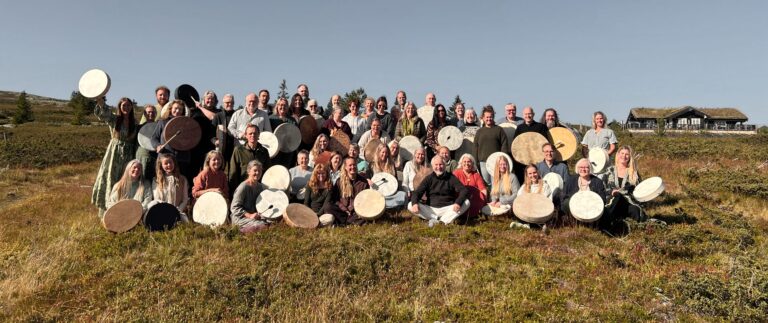
You guided us, your students, through such an experience when we were up in the mountains, at Spidsbergseter, a mountain hotel in Norway. We were to go out into nature and just sit on the mountain, sit with the stones, or whatever it was we had in front of us. And I had a very deep experience with that. It perhaps sounds a little strange, but I became a stone. It became so calm and so still that I simply became that stone, until I wasn’t that stone any more. And for me it was a stillness and a calm that I found there.
I found that calm again just a few days ago. I felt that my schedule was a bit tight, and that I needed to calm down a little. Because I have a fire in me that is always full speed ahead, and I do what I have to do, and I love what I do, but I also needed a little calm. So I went in, sat down on this chair here and felt into what it was like when I sat there on the mountain. Then it becomes almost as if you teleport yourself there in a way, the feeling of it.
The Paradise Hotel video: from resistance to joy in nature
Amina: But I also have the experience where I feel that it has been a long time since I was in nature. Because very often, when you start with things that are good for you, things get good and fine, and then you forget to do what made you feel good. And especially when it comes to nature. In the beginning, on the primordial shamanic path of development, it was almost embarrassingly easy for me to forget, and I still catch myself doing it. But I also see how easy it is to get back into it. Just the other day, when I went out into nature: I didn’t have anything I had to get to afterwards, because it is also important to me that I can use the time I need. Just lying there and just being there, just being present. That is something I could never have done before, just being present.
The first time I went on a proper walk in the forest, voluntarily, mind you, was during the coronavirus lockdown. My friend filmed me, and the video really looks like an audition video for the reality show Paradise Hotel. There I stand in my pink jumper going: “I need to pee, what am I going to do?” And: “No, I want to go home.” Because I have had great resistance to nature since I was little. The pandemic was negative on several levels, but when it comes to getting more contact with nature and yourself and insights, I definitely think the lockdown did a lot for many people, at least for me. I went for a walk, because it was like this: “The café is closed, the shopping centre is closed, what do I do now? Well, OK then, I’ll have to swallow my pride and go for a walk.” It was actually nice, so I went again, and then I went again. My friends wondered whether something was wrong with me, because I was in nature, right in the middle of nature. And that was when I felt: there is something here.
The human being cut off from nature
Pål-Esben: Yes. We modern human beings are so cut off from nature, as if our umbilical cord had been severed, that things like this can happen. You are describing one experience of it, but I experience it with pretty much everyone I deal with. Pretty much everyone who comes to me, whether as students, or as chronically ill, or with burnout or exhaustion: it is the same thing that keeps recurring. Very rarely do I meet people who have a natural and healthy relationship with nature.
Amina: Yes.
Pål-Esben: And that is a sign of our society today, and of how disconnected we are from this. From my point of view, it is the most important reason why we are ill today: why we are depressed and have anxiety, and are full of stress and performance anxiety, and also why we have chronic illness. Because if you study primordial cultures that were connected to nature, you will find no psychosis in them. You will not find depression, you will not find anxiety, you will not find all these personality disorders that modern human beings have. They don’t even have words for it.
Amina: No.
Pål-Esben: Why not? Well, because as long as you are truly connected to nature and in resonance with it in your daily life, these things cannot arise. They arise with the cutting of the umbilical cord, where we go into our chaotic, sympathetic fight-or-flight mode, where we have to perform and go higher, wider, further, have more, have a career, whatever it is.
Because we are still talking about what happened at the very start of your process of development: how we began this journey by starting to understand why nature plays such a big role, both in becoming healthy and happy and in creating a meaningful life. It is about taking on the rhythm, about letting nature’s blueprint of healthy rhythms become a part of me. Over time this of course takes off completely. But right at the start you need to understand why this is so important. You need a reason to begin a process, a good enough reason to begin to make contact with nature, because it will take time. And if you are short of time, you need to prioritise time. If you don’t have a good enough reason, you won’t prioritise the time to do what we are talking about here.
So that is the first thing we start with: understanding why this is so important for creating the life we want. Then comes the methodology itself, how you do it. There you can start with what I have written about in my article, the very basics of forest bathing. And then it is about prioritising time to actually do it on a more or less daily basis over a 90-day period. Because the key here is 90 days, where you invest about half an hour in nature and do exactly as it is described. Then you take this giant leap: you move away from understanding something theoretically, and begin to experience what we are talking about here. That is the key. Not believing in anything at all, not knowing the theory around it, but finding this experience: experiencing the calm, experiencing what healthy regulation really is, which nature is an expert in.
“The forest is nice, give me the rest”: the ego’s impatience
Amina: Yes, and the way I understand it today, starting there and having it as a foundation is extremely important for the deeper primordial shamanic development. That is something I realised in hindsight. Because, a little like we talked about in the previous episode, I wondered terribly why we didn’t talk about all the metaphysical things at the beginning of the training. That was where I thought I was, after all. “So we’re going out into the forest? Yes, the forest is nice. I’ve been in the forest before. Give me the rest.” In the end I understood that my ego had to calm down, even though I thought I had understood it all.
I have learned that through my own development here, and through the nudges you have given me, where I have seen: “OK, let me land here now. That’s fine.” And then I have let go of everything I thought spirituality had to be, or what shamanism had to be, and simply been here and now, where I am in the training, all the way. I have learned not to wait for what is coming, what is bigger and broader, what this ego just wants more of. The more I have managed that, the easier I think it has perhaps been for me to open up to everything that comes after it. Because it can be easy to think: “Is this really all that exciting?” But my goodness, how exciting it is! Once you have that in place, have that experience and that framework, how much deeper can you then go into your own spirituality and your inner self!
Sand and quicksand: the foundation first
Pål-Esben: Yes, that is my experience too, over more than two decades: if you don’t have this solid foundation and build your development further on it, you are standing in sand and quicksand. Then you can learn about angels here, and channelling there, and past lives there, and regression here, a little chakra there. “And aren’t we going to learn to travel in the morphogenetic field?” I mean, hello? Earth calling! It is the intellect, the karmic memory and the ego: they want the spectacular, they want more, they want power, they want these kinds of experiences. There is nothing wrong with them, but if you start with this before you have a good foundation, you end up lost in the fog.
If we are going to go through a deep, fundamental, profound process of development back to our full, true nature, we have to have a foundation. Because how are you going to come into contact with the deepest divine in yourself when you are fully bound in your straitjacket, in that madness, in the three-dimensional and four-dimensional space? How are you going to get in contact with your timeless and spaceless nature, where your full power, your full dispositions, your full talents are stored and available? As long as you are in the monkey world, where there is chaos, where you stress about one thing and another, where you are fully inside your hamster wheel and bound up in your straitjacket, 100 percent related to time and space, it is quite simply not possible.
And in our Yggdrasil Shamanic School I want to guide you and the other students to something more than just learning cool techniques and methods. Spontaneous healing, for example, is something you learn right at the beginning in our tradition: healing where you don’t need to touch a person, but where you see the body change when you do the method, without being anywhere near touching them. You learn that right at the start with us. But if you don’t have this foundation, it becomes very, very difficult to glide into what is really cool, what is really spectacular. Because it is definitely something other than what you thought it was.
Amina: Yes! I can vouch for that. And one of the things that gave me an aha moment was when you said to us, your students, something like: “How are you going to get to know your true nature properly, the metaphysical nature, your true light, if you don’t get to know your true nature as human beings first?” It was something along those lines, and it gave me an aha moment. Because in today’s world we are also trained to expect everything to happen so quickly. You are supposed to have the extreme so quickly, you are supposed to become enlightened overnight. You watch a YouTube video, and then you are supposed to get your kundalini energy, and then you become enlightened, and then everything falls into place. That is not how reality is.
The shamanic death and the Sahara
Pål-Esben: It is a misunderstood, let me say psychotic, view of reality, marked by the modern human being’s wish to have results quickly, without doing the work it takes. If we look at the ancient cultures related to the yogic culture, 5000 years of documented wisdom and insight, they would say that a path to enlightenment is a process of preparation. It is impossible to make progress on it without having completed what we shamans call the shamanic death: making the ego the soul’s adviser instead of the soul’s ruler.
That means that as long as you are driven by the spectacular, driven by what glitters and sparkles and all of that, you don’t get much further. Because then it is the intellect, the karmic memory and the ego that want experiences, that want power, control and all that. And then you block off your own real Sahara.
I usually say that our material existence, both what we see with our eyes, hear with our ears, the smells and what we experience in general, plus the metaphysical that we know, is our grain of sand. It is one grain of sand of our existence. But your real existence is your Sahara. So if you want access to your full power, to your full potential, you first have to guide yourself gradually out of this straitjacket, out of the hamster wheel. It is a very specific process you need to go through. And then the real journey of development begins, both towards insight and towards shamanic magic, where you relate more and more to the deeper layers of the transcendental. Eventually you come to your full, complete nature, and begin to experience your Sahara, your full existence, which is beyond time and space. Then we really begin to talk about what is truly spectacular.
And then you see that this hunt to channel your way there and talk to an angel here, and whatever it is, is completely unimportant. It is only a distraction, compared with a truly profound process of development, which is of a completely different calibre. And unless we start by laying the foundation we have talked about in this episode, by beginning to restore that contact and resonance with nature, we cannot build the next step of the foundation, and the next step after that. Because that is the first big step you take to free yourself from the straitjacket and the hamster wheel. It is the first important step. And when the foundation is there, then the spectacular begins.
Amina: Yes, you don’t get a good house without a foundation. Just try it!
A house of cards on unsteady ground
Pål-Esben: Yes, we have all tried building Lego and houses of cards and the like. But try building such a house, with any material whatsoever, on unsteady ground: it always collapses. And that is often one of the challenges in the esoteric world today. There is so much that is gold and glitters and shines, so much that is exciting, including both courses and seminars. If you go on YouTube, you have thousands of channels talking about everything from aliens and the Anunnaki to intergalactic wars and whatever else it might be. It drives you completely crazy. And then you find thousands of videos saying: “Do this asana, this yoga posture, and your kundalini energy will be triggered, and then you will become enlightened, and everything will be fine.” But it is a delusion to spend your energy and your attention on things that glitter, without being willing to build the foundation first.
And that is one of my mantras: yes, the shamanic can contain that, it is spectacular, and I would love for you to have the spectacular. But to gain access to the spectacular we need this foundation, and that may perhaps sound boring. “Nature’s rhythms? Can’t we talk about something more interesting? Going out and bathing in the forest? There must be something more spectacular here, you two chatterboxes sitting there talking.” But we are talking about this because it is what is important to start with, if you are looking for a profound process of development into the truly exciting rabbit hole. It has to do with everything from esoteric things, shamanic things, contact with beings, astral fields that you can use for insight, wisdom and healing, whatever it may be. There you will eventually understand what, for example, the Akashic Records are, what past lives are, what the cycles of incarnation are, what our learning themes are, what the meta-incarnation cycles are. Not in theory, but through experience. Because everything is about vibration.
And people who don’t practise this are numb. The modern human being is completely numb to these vibrations. We are so hung up on what we are supposed to have that we are completely numb, both to nature’s rhythms and to everything else that is around us. First we need to de-numb ourselves, so that we can begin to feel this again. And then you gradually learn what really gives access to these spectacular talents, which the two of us are working with at the moment.
Amina: Yes!
Pål-Esben: We will come back to that in a later episode, where we will follow you all the way to where you are today. So now I want to let you tell us about the journey from the start, which is what we are doing, and about what lies behind the spectacular things you experience today.
Trial, error and the need for a teacher
Amina: Yes, absolutely. It is a very, very important foundation. Because if I were just to start talking about what my life is like today, and what I experience: it wasn’t done overnight. It takes the right mindset, it takes effort, it takes trial and error, and it takes being where you are right now and accepting that along the way. I wouldn’t be without all these ups and downs and all these insights: “Oh, now I messed up.” “Oh, now I understand it.” “Oh, now I don’t understand it after all.” I wouldn’t be without it at all, because it has taught me so much. And it also gives me a greater understanding of my students’ process now, when they are at the beginning of the basic training, both with insights and with challenges when it comes to these things. It is worth its weight in gold to have in your rucksack.
Pål-Esben: Yes. And if you are going to do the kind of process we are talking about now, a profound process of development, you need a teacher. You can’t do it with YouTube videos and reading books. Then you need a teacher, because you constantly meet things that need to be discussed. You have experiences that need to be discussed, and you need clarity about things. Because as long as you move on the surface, you can go and take a course here and a course there, and learn a little about angels there and channelling there. But that is not what we are talking about now. What we are talking about here is a profound, real process of development, where we don’t just learn methods and techniques, but where we transcend ourselves from resistance, from suffering, from illness, from anxiety, from limitation, from numbness, from resignation, from emptiness, to a life that is literally meaningful and joyful.
Amina: Yes.
Why the soul chooses the straitjacket
Pål-Esben: That is what we are talking about here. That is what we are talking about. Because everything is connected with this: the way we see it, our soul places itself in this body when it comes into this life. The body is a straitjacket for the soul, which comes from a realm where there is no time and space, and then it comes in here, into you and into me. It feels like a prison, with so many limitations. Why does the soul put itself in such a situation? Is it because the soul is sadomasochistic and thinks we should experience it? Of course not. It puts itself in this situation because it is a unique way of learning and experiencing.
In its free state the soul cannot taste strawberries. It cannot feel what love is, it cannot feel what melancholy is, it cannot feel what grief is, it cannot feel what anxiety is, it cannot feel what joyfulness is. Because that doesn’t exist in the timeless and spaceless; there everything is one. So it comes into Amina, and into Pål-Esben, and into you who are listening, in this rather ingenious straitjacket. Not because it has sadomasochistic desires, but because it has come here to learn in a particular setting, where it is possible to learn and experience something that is not possible to learn and experience in the free state. That is our process.
And then we use the fundamental wish for evolution that the creative force has for us. If we study the universe, we see that everything is a process of evolution, everything from the Big Bang to how our planet has evolved. Everything is about evolution, and it is also about you and me. That is what we call this process of growth, where we have certain different learning themes. And when we use it as the driving force in the primordial shamanic process of development, we don’t end up despairing and depressed. We end up in a life that is literally meaningful and joyful.
That doesn’t mean that everything is a bed of roses; it isn’t for any of us. But even when things go wrong, we don’t go down for the count thinking: “Good grief, why do I have bad karma? I don’t deserve this.” We see the world, we see what we experience, we see our experiences from a completely different perspective, where we have learned to see the possibilities in what is being experienced.
The bathroom and the 17,000 euros
Pål-Esben: Like what happened to me this summer. We had our bathroom done twelve years ago, and then it turned out that there were water leaks and the whole package; the tiler had done a poor job. So we had to tear down the whole bathroom and build everything up again. Suddenly about 17,000 euros went out the door. Then I thought: “What? How can this happen?” Normally, in the old days, I would have become depressed: “Good grief, why me? This is terrible. How can this happen?” But with the perspective we are talking about here, it becomes: “OK, there is nothing I can do about it. It was good that we noticed this now, and not in three years, because then we would have had fundamental problems with the load-bearing structures. So it is good that we noticed it now. It just has to be done, so let’s get it upgraded to the bathroom we have dreamed of for the last few years.”
It doesn’t cost a calorie. You don’t spend a calorie on being negative and destructive. You see it as a challenge, you solve it, and that means that you can be joyful even in a situation where you experience these things. I know that you experience exactly the same kind of things, not with bathrooms, but with other things in life. The bathroom will perhaps come eventually too; not everyone needs that. It is a different way of seeing life, a different way of experiencing life, a different way of relating to life, where suffering and frustration become more and more non-existent, whether life goes up or down.
That is one of the most practical consequences that shows itself in life when you go through such fundamental, profound processes of development as the one you are going through. That is what I call transcending your life, literally, for the better. And that, for me, is the meaning, when I guide you through this process and see how your life changes. It is so meaningful for me to do this, to help you and the others through the process. I know that you are beginning to experience the same now that you have your students, whom you lead. What could be more meaningful, if you ask me? Showing a human being the way to transcend suffering, anxiety, frustration, hopelessness, resignation and emptiness, into fullness and joyfulness and meaning. I can’t think of anything more meaningful right here and now. It is quite simply wild.
The oak in the storm: when the people around you react
Amina: Yes, and you have really guided me to become more of this: this oak, this tree that stands steady in the storm, where I am not torn down by everything that happens in life. Because as you say: the bathroom can break, the car can break, you can get a nasty surprise on your tax bill, you can get one thing and another. Things happen, and it is very easy to think: “Oh no, why me? What have I done wrong? Is it my karma? Is there something I haven’t seen?” Instead I often think: has it ever not worked out? It always works out.
And that is perhaps something we can go a little deeper into in another episode: this thing about experiencing life for better and for worse, without going down for the count when difficult situations happen. You can also at some point feel a little schizophrenic. Because I remember at the beginning of my process of development that there were many people around me who said that I seemed so unfeeling. Apparently I didn’t care: “Why aren’t you losing it? Your car has broken down, your daughter said all that stuff, and then that happened. Hello, don’t you care?” Especially those who were close to me. Then I said: “Of course I care. I don’t think it’s fun to pay about 1,700 euros for the car. I don’t think it’s fun that my daughter puts me through these trials in the middle of a birthday party; I don’t suppose any parent does. But it happens, and I can’t do anything about it.”
That is also something that can be a little triggering for the people around you when you begin to develop. Because you begin to change, you begin to change who you have been. And that is probably something we can go into a bit later, which I have some experience with.
Pål-Esben: Yes, I think that is a good lead-in, and perhaps we will talk about it in the next episode: what happens, both with ourselves and with the world and the people around us, when we begin such a profound process of transformation. Because not everything is simply easy, especially not with regard to how other people react when you don’t react in the usual way you did before. When you suddenly don’t get furious and irritated about what you have always been furious and irritated about, it is actually other people who can get furious and irritated that you don’t get furious and irritated. It is very strange.
ADHD and calm: is it possible?
Pål-Esben: But I think we will end this episode with that. A last word here now: you said at the start that you have been diagnosed with ADHD and found it almost impossible to keep your focus. Now that you have come some way into your process of development: is it possible to relax, even if you have ADHD?
Amina: It is 100 percent possible. I have every sympathy for those of you who have ADHD and think that it is impossible. But it really is possible. I have gone from medication to no medication. So it is possible, it is possible in very many cases. We are not saying that everything is possible, but in my case it is at least nine out of ten.
Pål-Esben: We can perhaps talk about that in an episode of its own later on too, for those who are interested in other things, because it is very topical today, both for children and for adults. More and more adults are getting the diagnosis.
Thank you so much for staying with us all the way, dear listener. We really appreciate your feedback, and a five-star rating on Spotify helps our podcast reach more listeners. And thank you so much for being here with me, Amina. I really appreciate it.
Amina: Likewise, Pål-Esben.
Pål-Esben: Thank you for being with us, dear listener. I hope you’ll join us again in the next episode. And until then: have a truly wonderful day, evening, night or morning, wherever you are listening from. Take care.
Outro
Thank you so much for listening to this episode of “The Journey to Self-Realization”, a primordial shamanic journey of development back to your true nature. We hope Amina’s story has inspired you to explore your own journey of self-discovery and development. Remember that the path from suffering to self-realization can be demanding, but with courage, patience and support from a competent guide, mentor, teacher or therapist, almost anything is possible. We wish you all the best on your journey, and we’ll talk again in the next episode.
The Journey to Self-Realization
Nature’s Path to Freedom and Self-Realization
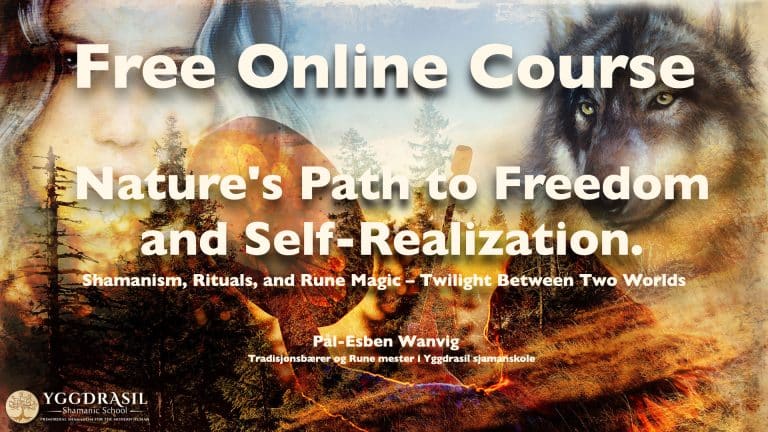
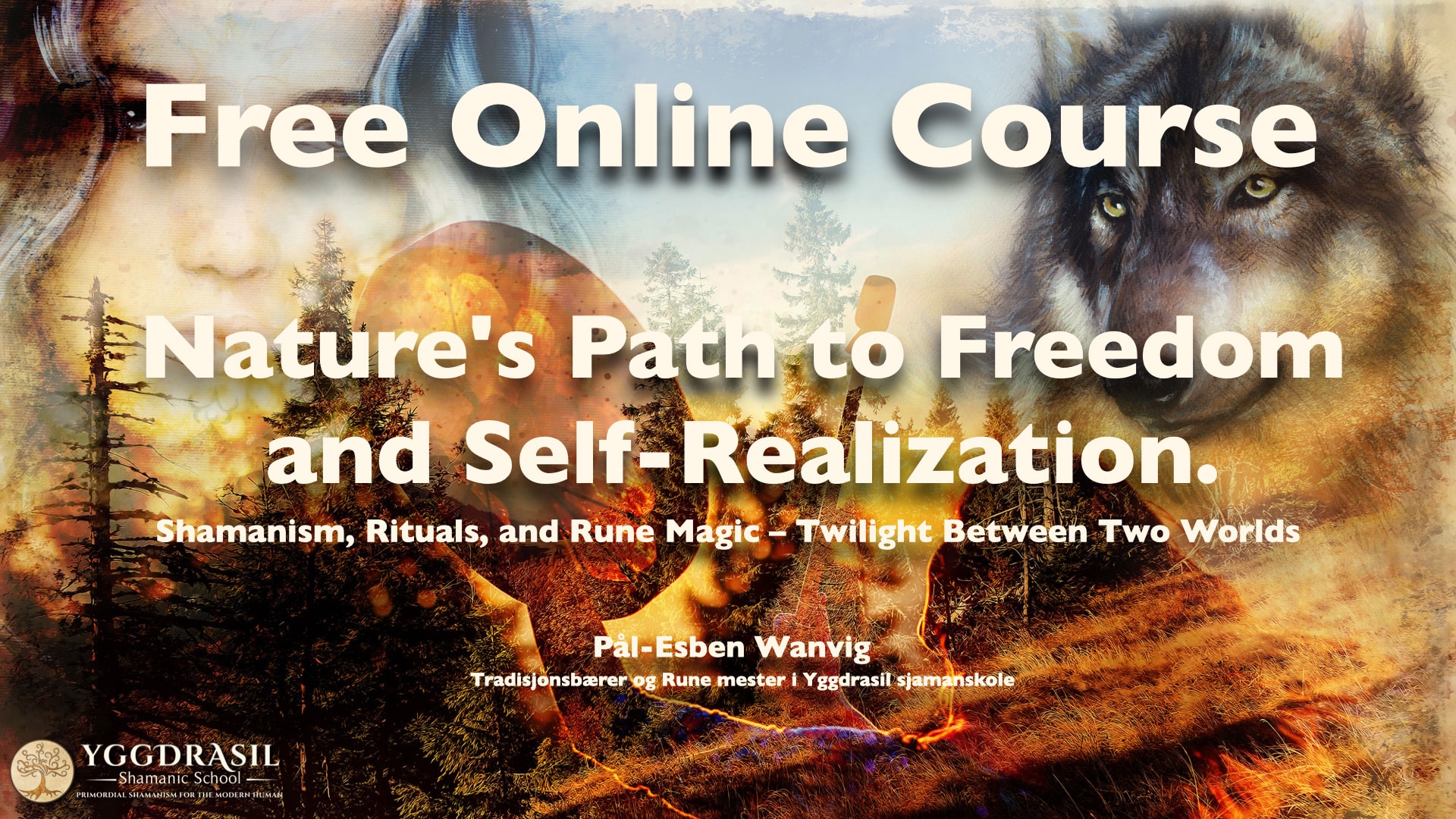
Curious about what primordial shamanism really is, behind the mystique and the misconceptions? In this short online course I tell the story of my own path from skeptical engineer to teacher of primordial shamanism, and give you a first introduction to what I teach: what shamanism and primordial shamanism are and are not, how rituals and rune magic are used in practice, and why the longing for growth matters so much for a good life.
The lessons are recorded in Norwegian; the English version will be ready in November or December 2026. Leave your email on the course page, and I will tell you when it is.