Episode 1 – Amina’s Transformational Journey – From Trauma to Freedom
What if the darkness you fear is not dangerous at all? Amina came to the Yggdrasil Shamanic School with a childhood marked by violence and fear, a borderline personality disorder and a head full of esoteric chaos. Six months later she no longer had the diagnosis.
In this first episode, she tells her teacher and guide, Pål-Esben Wanvig, how it happened: what it demanded of her, what she found when she met the darkness in herself, and why she now believes there is always a way out. It is the start of “The Journey to Self-Realization”, a podcast about the bravest journey a human being can set out on: the journey home to yourself.
This episode is an English translation of our Norwegian original, voiced by the digital avatars of Pål-Esben and Amina.
In this episode
- The deer on the road home from a fair in Tønsberg, and why it became Amina’s first shamanic experience
- Why a continuous process of development reaches deeper than single courses and weekend seminars
- Trust and resistance between student and teacher, when the teacher’s directness stirs up old wounds
- The fear of demons that followed Amina from childhood, and what a “demon” really is
- Why protection only makes us weaker, and why the key is to light the light within yourself
- The real shamanic death: making the ego the soul’s adviser instead of the soul’s ruler
- Love as something practical, self-responsibility and the way out of the hamster wheel
This podcast is for you if you:
- Seek real depth in your spiritual practice
- Want to understand yourself on a more fundamental level
- Are curious about shamanism but tired of superficial “new age” spirituality
- Have taken many alternative courses but still feel that something is missing
- Feel an inner longing for freedom, love and wholeness
In a time when so many get lost in external methods and promises of quick fixes, this podcast invites you back to the only place where true answers can be found: your own heart.
Listen above, or read the full conversation below.
Transcript
A warm welcome to the podcast “The Journey to Self-Realization”, a primordial shamanic journey of development back to your true nature. This podcast is a collaboration with our favourite magazine, the health and lifestyle magazine Medium, and is devoted to exploring the bravest journey a human being can set out on: the journey home to oneself. We follow Amina, a student at the Yggdrasil Shamanic School, as she goes through a deep primordial shamanic process of development together with her guide and teacher Pål-Esben. It is a raw, unpolished journey of discovery towards true joy in life, deeper meaning, and a life that truly feels good to live.
This episode is an English translation of our Norwegian original, voiced by the digital avatars of Pål-Esben and Amina.
Eighteen intense months
Pål-Esben: Hi Amina, and a warm welcome!
Amina: Thanks so much, it’s great to be here!
Pål-Esben: We are going to take the listener on a fantastic journey: the journey you have been through over the last 18 months. I looked through my email, and the first time you wrote to me was at the end of November 2022. At the beginning of December you started the basic training at the Yggdrasil Shamanic School, and that is where things began to happen.
Over these 18 months you have experienced exceptional things. You started at a point in life that was very difficult. Lots of challenges. Trauma. Fear. And you have gone through an extensive process of development. You have even become a teacher: right now, as we are recording, you have started your first group in the basic training at the Yggdrasil Shamanic School, to lead other people through the same process of development. And we have just come back from the mountains, where you had your first extensive experiences of oneness and spiritual enlightenment.
So 18 months have been fairly intense, Amina. What a transformational journey! Can you tell us a little about how it all started?
The fair and the deer
Amina: Yes, and then the question is where to begin. I was running a stand at an alternative fair in Tønsberg, I noticed some shamans who were doing healing, and I asked where they had trained. That was when I heard about you.
On the way home from the fair something special happened, which may sound brutal: I hit a deer with my car. Ever since I got my driving licence at 23 I had been afraid of hitting an animal. It was a big fear, because I didn’t know what I would do in a situation where an animal is suffering or about to die. But for me this became a great shamanic experience. I sat with the animal as it passed over into death and gave it healing. I wasn’t afraid, I was simply present. That experience became a great sign of what I was about to embark on. When I got home and had processed it, I contacted you and asked when you were going to start the basic shamanic training. It wasn’t quite time yet, actually, but we had a conversation, and I started fairly soon after that.
A turbulent history
Amina: The years before this had of course been extremely turbulent. I had a very unstable upbringing with a lot of physical and psychological violence, unpredictability and fear, heavily marked by religion. I struggled with my identity, and I was searching: I converted to Islam when I was 13, and later it was Christianity. I had a stepfather who liked to frighten me, so the darkness marked me early on, and I had little contact with my father. I developed a borderline personality disorder, which is extremely difficult to live with. I had children early, I became pregnant at 18 or 19, and my goal in life was to become an Arab housewife. I achieved that, but I quickly realised that it wasn’t the goal after all, and then came a small crisis. I started to question the religion and move out of it. Then followed some turbulent years with violent partners and a lot of destructiveness. Eventually I got help from the public health services to understand myself better, with tools for interrupting the patterns connected to borderline personality disorder.
But it was when I started the training and the guidance with you that the great leap came. One thing is everything I learned between our conversations, which I could bring into the guidance. Because I believe it was six months after I started at the Yggdrasil Shamanic School that I actually lost the diagnosis of borderline personality disorder. That is big in itself, because it is very hard to get out of.
So that is a bit of the background. But one of the biggest challenges when I started with you was that I was stuck in an esoteric chaos. I had tangled myself up in ideas that we are not really human, that we are not really meant to be here. And am I really meant to be here? If I am everything, why am I this? Learning many different spiritual and esoteric things from all sorts of sources created a great chaos in me. I remember that I needed your help to come back down to earth.
Pål-Esben: Yes, there was a need for sorting things out. You have a fairly harsh history, and this is of course only a mild introduction to something that is really very traumatic. When you say that your stepfather liked to frighten you, there are traumatic experiences in that: things that traumatise a child. It is no wonder that you become afraid of the dark and afraid of evil and the devil when you carry such an imprint from an upbringing no child should ever have been anywhere near. You brought baggage with you into adult life that was challenging and difficult, and that of course did something to your life. Can you tell us a little about what your life was like at that time? What did an ordinary day look like for you before we met, in the different areas of your life?
Life before: the stranglehold and the searching
Amina: Yes. About six months before I entered the training with you, my boyfriend at the time put me in a stranglehold. I was in a destructive on-and-off relationship of about a year, and in that moment I was, in a way, going to die. I realised that I couldn’t fight any more, so I surrendered to death. Obviously I didn’t die, but it became a very important experience, because more happened in me on a deeper level than ever before.
That experience made me search more into the spiritual. I felt a greater calling, but couldn’t put my finger on what and where. I took part in various women’s circles and moon circles, and I went to an ayahuasca retreat, where a good deal of trauma was torn open. That made me feel that there is something more here, but I didn’t know what. And I think many people do the same in this searching: you hear about such things and try them, and without the right guidance you get stuck. For me it actually became more chaos.
Pål-Esben: I understand that, and the same was true for me. When I started moving into the esoteric many years ago, I didn’t come from a chaos like yours, but from the standpoint of an academic, where you think you know everything and really know nothing: arrogant, with the almighty syndrome and the whole package, where everything alternative was nonsense. I was even a little afraid of this shaman stuff, with costumes and a look I wanted nothing to do with.
And what do you do when you have no knowledge of the alternative and the esoteric? Well, you start trying things. You try one thing after another, and I tried everything. I travelled to several places in the world to find teachers and learned everything from reiki to various forms of meditation and healing, drumming and shamanism, and became completely overwhelmed. My problem was an extensive burnout and really serious health problems. Nothing got better. You go from one thing to the next and hope that the solution is there, and there, and there. Then you reach a point where you are stressed and frustrated: why doesn’t what I am learning give an objective result, where my life actually gets better?
I remember the first angel seminar more than 20 years ago. Very exciting, very curious! I didn’t believe in any of it. It was a fantastic experience to be introduced to the angels and to healing with the angels, and to meet wonderful people. But then you come home and talk to the angels, and nothing happens with my health, nothing happens with my depression, nothing happens with my frustration, apart from the fact that you have learned something exciting. That was what was challenging for me in the beginning, in a landscape that was completely impossible to get an overview of. I jumped from seminar to seminar in the hope of finding something that could help me. And you have more or less the same experience.
A process, not single courses
Amina: Yes, and that is where I see the importance of a process of development. I definitely don’t think I would have had the result I have today if the primordial shamanic path of development had lasted a month and a half. I see the value of the process: trying and failing, learning through new insights, letting the wisdom play itself out, and being able to be where I am today.
My partner asked me the other day, when I woke up in the night feeling unwell and with pain in my body: “Are you feeling bad, or are you feeling good?” I answered: “I am feeling very good, it just doesn’t feel that way.” He said: “You mean that you know intellectually that you are fine, but your body isn’t quite fine.” And I answered: “No, it’s not like that either. I feel that deep down I am fine, even though I am ill, have pain somewhere, or am having an uncomfortable night.”
And I think: if I can manage that, other people can manage it too, because life will keep happening all the time. I think many people are looking for the one thing that will make sure nothing negative or difficult ever happens in life. I once believed that too. But I read a quote the other day: it is not about feeling better, but about getting better at feeling. That struck me.
Pål-Esben: Yes. And the difference is worth dwelling on: what separates what we did in the beginning from entering a deep process of development? In the beginning most people do as we did: a workshop here, an evening seminar there, a weekend seminar where you follow your intuition or whatever you find exciting. Those are two completely different things.
Firstly, a process of development isn’t done in a weekend or a month and a half. It is a continuous process in a definite direction. You can learn many exciting methods and techniques, but methods and techniques remain on the surface. If we want to go into the depths, we have to go into our own personality and clear up what prevents us from setting the heart free: what makes us full of resentment, frustration and anxiety. It is perhaps one of the hardest things a human being goes through, what we call finding the peace of the heart, because you meet harsh things in yourself. These harsh things are governed by the first chakra, the extension of the brain stem, our genetics. Suddenly the feelings of anxiety come up and feel uncontrollable. That often leads to particular kinds of behaviour: you are harsh with your children, you say things you don’t like when you get irritated, you go to battle against one thing and another. You live in your hamster wheel, I call it the hamster wheel, where the primate in us rules, more or less on autopilot.
Here it is of little help to learn one method or technique, or a hundred. You can learn ever so much about angels and drumming and NLP: it doesn’t help. The fundamental things that lie deep within us and control much of our lives on autopilot require a completely different approach in order to be resolved. For that you need a process of development with a teacher, and that means things can also be uncomfortable. At a seminar on angels or NLP or astrology it is pleasant and exciting, but you are never confronted with your deep shadow sides. If they were to be lifted off at a seminar, it would create complete chaos.
A human being cannot set itself free. That, at least, is my experience. You cannot, on your own, become a fundamentally happy person who finds meaning in what happens in everyday life, whatever it is, without going in and working through this. It is impossible to do alone, since we ourselves are governed by fear, ignorance and the almighty syndrome. What governs these things is subjective to us.
Teacher and student: trust and resistance
Pål-Esben: What was the most uncomfortable thing you experienced in the beginning with me? From the student’s point of view, a path of development is liberating on the one hand, and on the other hand it can be difficult. What was some of the hardest, where you perhaps got a little irritated with me?
Amina: There are several things that have been lifted up in me through this course of training, and “training” is really a poor word for it, because it goes much deeper. I have really been tested several times. The most important thing for me, when I have been triggered by something you have said, or felt a transference or a projection coming up, has been the trust I have in you: that I trust that whatever he says or does, it comes from a good place. And I have been able to experience that too. And I am a person who often, though not always, can see, when something uncomfortable comes up towards another person, that there is something here that isn’t about that person, but about me.
What has been most challenging with you, Pål-Esben … You are a little direct sometimes. In the beginning that could shake me, because I have experience with very aggressive, direct, manipulative men. You are not in any way a manipulative man, but I felt: here is someone with power, someone with steadiness, someone with good character. Those energies reminded me of men I have had in my life before. That was perhaps a little challenging, but also something I have learned a lot from: seeing that you can actually have a yang energy, a flame, a backbone and a steadiness, be a man with a capital M, without it being negative, and with a lot of love behind it. But that is my personal journey and what I have met in myself, in meeting you as a guide and teacher.
Pål-Esben: This is difficult, because you wrap it in a very flattering light, and it isn’t always that simple. In a deep process of development it is the teacher’s task to show you what is blocking you, and that isn’t always pleasant for the ego, which wants everything to be pleasant energy, light and love. Suddenly you meet yourself: you have an almighty syndrome, or perhaps you don’t treat the people around you in a loving way.
I have a sticky memory and remember most things, and one of the things that shook your tree in the beginning was a discussion we had about evil and demons. Just to give the listeners an example of how serious such a process is, both in setting yourself free and in its degree of difficulty: this is not for just anyone. You have to have enough courage to meet the darkness in yourself.
Amina: Yes, that is correct.
Pål-Esben: Let’s take that as an example, because it was hard. Things came up in you there where you didn’t agree with me in the beginning: you believed it was different. Can you tell us how this is connected to your past, and why you had this deep belief in evil and demons?
The demons from childhood
Amina: Yes. This was something I thought I had put on a good shelf when I entered the spiritual, alternative community: negative energies, demons, that someone can come and do something to us, that we have demons inside us.
When I was around seven years old, I moved to America with my mother. She had met a man there, and he liked to frighten me. He put on scary films, especially demon films like The Exorcist, where a girl gets a demon inside her and goes through an exorcism. Afterwards he could lock me in a dark room, put on masks and come out and scare me. This went on continuously for a year. He talked to me about how if I wasn’t a good girl, I would go to hell. I was extremely afraid that year. I slept alone in a room in a completely new country where everything was new, and I built up a great deal of fear.
After about a year I was sent back to Norway, alone on a plane. My mother was going to follow; she probably had a plan, I am not entirely sure of the details. When I came to Norway, I didn’t dare sleep with the light off. The first time I did that was perhaps two years ago. Throughout my whole childhood I was afraid that something in the dark would come and take me. Later I entered the religions, first Christianity, then Islam for about ten years, where there was also a lot about how the devil could get inside us, take us and make us do stupid things, about heaven and hell.
When I later entered the spiritual, which was really supposed to be a process of liberation, I was met with much of the same: negative energies. It could be as simple as: if you sleep with a person, you get all that person’s energies inside you, and the energies of everyone that person has slept with, and they will sit in you for nine months. So if you do something stupid, it isn’t really your fault, because it is the energies’ fault, and then we have to cleanse ourselves, the whole package. And in addition: that others can send negative energies, the evil eye, influence you that way.
When I started the training, one of the first things I met was fear: I saw unpleasant beings on my retina, and a lot was brought to light in me. Then we had conversations about this, where you said: “No, demons don’t exist.” And I answered: “But if angels exist, then demons must exist.” I had also had a hypnosis session shortly before I started with you, where a demon came out that sat in the first chakra: the demon from when I was seven. It spoke, it had its own identity, the whole package. At least I believed that at the time. What I understand in hindsight is that it really represents something completely different: these different parts we have inside ourselves.
But I struggled with it, and the reason was that on the one hand I trusted your knowledge and experience very much, and on the other hand I was experiencing something else. I had to look at it with new eyes. Through the training you have also taught us what goes on in the subconscious, the programmes we have, and how the intellect, the one we think we are, governs our experience of reality and identity. When I went through that, I thought: perhaps I have a deep belief system. When I acknowledged that and had new experiences with this darkness and these demons, it began to change. It didn’t disappear completely at once, but it changed. And I saw that when I take in new knowledge and believe in it, something expands in me, I don’t know what the right word is, so that these frames are not all there is.
Quite a lot of the darkness that lies within me has come up, and I have had to go through it. But the most important thing I have learned, and which I am deeply grateful for, is that the darkness is not dangerous. It is actually fantastic: think of what you can find there. The fear of the darkness is something I am passionate about conveying to those who want to hear about my experiences. But what is your experience around this, seen from the point of view of a teacher and guide?
The misunderstanding about external forces
Pål-Esben: I experience this very often in people who come to me. You have a fundamental fear based on a belief system, which can be part of the culture you live in, and you have been told that it is external sources that create our problems. In the esoteric, those external sources can be anything from karma to evil spirits, demons or people who throw negative energy at you. You get hung up on the idea that the cause of your problems lies outside yourself.
That is a great misunderstanding, and it leads people into a hamster wheel: you believe that external forces create the problems, that you have no power over them, and that the only thing you can do is learn to protect yourself. Protection is one of the best-known areas of the esoteric: special methods, energy spheres, everything that is supposed to shield you from the bad. And that is a big problem, because protection never leads to any solution. It only makes you weaker and weaker.
We see the same thing in the cleanliness syndrome in children growing up: children who grow up in a sterile home without bacteria often have a poor immune system as adults, while children who grow up on a farm, where it is impossible to keep things sterile, get a much stronger immune system. When you have the idea that you must protect yourself against everything, your energy system and all your systems become weak. It makes things worse.
I meet this far too often, unfortunately: that other, preferably invisible, sources get the blame for the problems. My experience through all these years is that it is definitely not like that. I have worked actively in the metaphysical through shamanism for many years. I have never met evil there: never met a devil or a demon or violent energies that are going to come and take me. But I have met people who have evil in them, and who try to destroy other people. I have never experienced a metaphysical being that comes to take me.
The challenge with the fear-oriented side of the esoteric is that fear makes it easy to gather people: “Come to my seminar, and I will teach you to protect yourself against the evil that is the cause of your problems.” Good marketing, but not very good, because it takes away from people the possibility of taking back power over their own lives.
In your case you were completely convinced, through your belief system, through two religions, through your experiences, and through the fear and having been tortured into the darkness. You were imprinted, with a belief system so deeply rooted that that was simply how it was. Then you entered the esoteric and got confirmation time and again: yes, there are external things that come and take you, and you have to learn to protect yourself. But that is not reality. Evil exists only in human beings. No other beings we have contact with in our biosphere have evil. It is in humanity that you find the devilry.
Light the light within yourself
Pål-Esben: The key is not to protect yourself against the darkness. The key is to light the light within yourself, because where the light is, the darkness cannot exist. That is the only thing you need to learn, together with working your way through your belief system and questioning it.
I never ask you to believe anything I say. You can believe elsewhere, but definitely not with me. With me you have to sit down, reflect, gather experiences and draw your own conclusions. What we have done is to identify where the fear probably comes from, based on your imprints, and then look at it in a different way than blaming external forces: let’s go into yourself, light the light there and see how it feels. That has been our path, and it has more or less set you completely free from this darkness. Today you are master of yourself and have taken back power over your own life, without fear of the bogeyman out there. And you have perhaps noticed that there is no need for any protection, because it is about lighting the light.
What is a “demon”, really?
Pål-Esben: So what is this feeling of having a demon inside you? Because you do feel that it is real: something bad stirring inside you, for some people a voice. What is it? It is suppressed sides of ourselves: suppressed parts of the personality, sub-personalities, that have been split off or suppressed through, for example, a traumatic event or imprints, and which can also carry karmic chains. Parts of ourselves that were split off through a trauma, that we have unconsciously distanced ourselves from, and that create these conflicts.
Look at such an imprint: you are imprinted to believe that hell exists. Hell is one of the most brilliant inventions. I am impressed by the religious communities that invented hell: with it they have steered most of the world into believing their dogmas, because people are so afraid of ending up there. But it is an invention. Hell of course does not exist. On the other hand, you can create your own hell, with suffering. That is entirely possible.
So you were imprinted to believe that the devil is dangerous, and you felt something inside you. That can then be a split-off, suppressed part of yourself that has acquired a certain energy and a certain psychological space. When it is triggered in everyday life, it comes up to the surface, and you notice the emotion connected to it. But there are no external forces. Nobody is sitting there throwing demons or energy at you. Some people do admittedly try to project energy at others: “I hate that person, I am sending energy.” But those are childish notions without effect, as long as you don’t believe that they work.
Voodoo, belief and psychosomatics
Pål-Esben: And that is where the problem lies, in the culture. Take Haiti, a culture heavily marked by voodoo. There are stories there of people literally dying when a voodoo priest has cast black magic on them, or becoming seriously ill. That can happen, but it is one hundred percent psychosomatic. You have grown up in a culture where a goat’s head on the door means that a voodoo priest has cast a death curse on you. When you are imprinted like that and truly believe it, and the sign comes, a psychosomatic reaction is triggered that can make you ill.
In modern medicine psychosomatic reactions are well described: fear can cause physiological problems, and belief patterns can do the same. If you take sugar pills without any active ingredient, you can get a positive psychosomatic reaction and recover. Our mind, our brain, is exceptionally powerful in creating our own reality, for better and for worse.
But again: if the voodoo priests practising destructive magic in Haiti had been that powerful, I don’t think Trump would still be alive. Putin would probably not be alive either, and many of those who govern the countries around the world would be seriously ill. Then anyone could have taken the hundred thousand, or ten thousand, euros to a voodoo priest and had him or her do anything at all. But Haiti is the poorest country on this planet. There is no power there, apart from in the culture you have grown up in: because you deeply believe that this is how it is, the voodoo priest gains power. That is the problem.
Suppressed parts and soul hunting
Pål-Esben: In your case, with what you have told about your upbringing: small children are so easy to imprint, for better and for worse. When a child is imprinted day in and day out in such a belief system, parts of the child are suppressed, including the parts that want to be free, that seek happiness, joy and meaning. They are suppressed and pushed away, so that the bad can rule and have power in life. That creates conflicts.
We have to see which parts of us have been suppressed, locked away in various psychological rooms or pushed away through trauma. That is what we need to bring to light and create awareness around, as we did through a process that went on for two or three months with you. You took what I said home with you, reflected, came to your own conclusions, and then we discussed them. For me it isn’t about declaring that this is how it is. It is about bringing you into a mode of experience, so that you can think clearly for yourself.
When, in shamanism, we have become conscious of split-off parts of the personality, identified them, done fundamental healing around them, and adjusted the inner map so that it matches reality, we can do what we do with soul hunting: bring back the split-off parts of ourselves, so that we become whole again. There shamanism has unique tools, methods and philosophy. And this was hard, perhaps one of the very hardest things you have gone through with me, where you met yourself at the door with your fear.
Amina: Yes, there have been sleepless nights over several months, and anxiety. What frightened me most was that these so-called demons and the darker parts became more and more visible the more I worked on it. Then the thought came: why should I continue with this? But I realised that we actually don’t move on from what troubles us until we meet the depth of it, whether it is demons and darkness, destructive personality traits or values we carry within us. You really have to meet it.
And back to what you said: you haven’t just said “demons don’t exist, that’s nonsense”, and then I have said “OK, fine”. You have really explained why, much more thoroughly than we have time for in this episode: what happens inside a human being, the logical reasons why it doesn’t exist, and the logical reasons why I believed it. I am very grateful for all the difficult things I have gone through here, because it means I can help other people through the same.
I have met both clients and students who feel these things, at the very beginning of meeting darker parts of themselves. I recognise where they are, and I see that they have to realise things for themselves and walk their own path, but also that there are moments of insight in what they learn through the Yggdrasil Shamanic School. And I have had clients who have found it hard to acknowledge that you don’t have a demon inside you. Because it is, as you said at the beginning, so easy to blame something else: “That part of me isn’t really me, it’s a demon, which I have to cleanse out once a week, maybe twice.” And how long are you going to keep cleansing, then? Is it really cleansing? Good business, isn’t it? Those who cleanse out demons run a good business. But that is not reality, and that is the challenge.
The real shamanic death
Pål-Esben: We live in a world that is very much governed by fear. We are driven by fear and anxiety. That is part of being human, but in our time there is a great deal of it. Those who beat the drums of anxiety easily gather people: “Come to me and protect yourself.” But there is a difference between that and finding solutions to the suffering.
In the end this is about a process of development to set ourselves free: so that we don’t carry fear, anxiety and insecurity, so that the heart can bubble in everyday life, so that we can feel joyfulness, so that we are fundamentally happy people who experience joy and meaning in daily life. That is what a deep, genuine process of personality development is about, and it is absolutely necessary if you are going to walk a deep primordial shamanic process of development.
Because if you are full of hatred, resentment and anxiety, none of these spectacular beings will want anything to do with you. They definitely don’t listen to someone who says: “I don’t like my neighbour. Couldn’t you, Grandfather Wolf, go and do something bad to my neighbour?” They would just call that stupid. We humans are perhaps not the most intelligent race in this universe, and we try to control everything; even the wonderful beings of light around us, who after all are here to help us, we try to control with our ego. But none of them will help and support us as long as we are governed by ego, fear, hatred and control.
When you walk a deep primordial shamanic process of development, it is therefore absolutely necessary to clear up these things. That is the real shamanic death, not extreme processes in a sweat lodge, or being put out half-naked in the forest to survive for a week or two. That has nothing to do with shamanic death. The shamanic death is about making the ego the soul’s adviser instead of the soul’s ruler. Without a fundamental process of development around this, no deep primordial shamanic development can happen. Then you remain on the surface and learn a few techniques and methods, a little drumming, talking to the draug or the like. That is pleasant, and there is nothing wrong with it, but it has nothing to do with the unique process of development you have been through: a process that totally changes a person’s life and revolutionises how you live and experience it. That is what this is about, in my eyes.
Love is something practical
Amina: Yes, and that really is the Path of the Heart. That was something new I got to experience when I came to know primordial shamanism. Being in love I had experienced on one level: then everything was supposed to sort itself out, as long as you sat in love and felt into your heart. But you have talked about it many times, not just a little: what has practically changed in your life since you entered love? Love isn’t just sitting and thinking about your heart and that we are all one, but how you live it out. Understanding and experiencing that love is something practical is something I have learned an incredible amount from. You can easily lose your way in “everything is love”, but what is that, really?
Pål-Esben: I call a spade a spade, not a spade an egg. Because that is where the truth shows itself: whether you have love or not. How do you treat your children? How do you treat your partner, your friends, yourself, the people around you? It is very practical. You can see whether a person is connected to their heart, not whether they have been on an esoteric course and “are in the light”.
That belongs under the shaman’s-pelt syndrome, which we will talk about another time. But for me it is also about something very practical. That is why, in our shamanic school, we have the 9 pillars for finding the Path of the Heart. We start with number one: becoming a master of gratitude. Number two: becoming a master of forgiveness. Number three: becoming a master of self-regulation. And then we go on. These are very practical skills you need in order to follow your heart in daily life, also when you meet resistance. That has presumably had great significance for you in this process of development, in that the relationship to the people around you has perhaps changed?
Self-responsibility and meeting yourself
Amina: Very much. And I see that the world perhaps hasn’t changed, but I have changed. My filter for how I see the world and people makes me realise: I have self-responsibility for my own life. That is a little scary at first for many people, but when you realise it, experience it and live it out, you get so much more power over yourself.
But it requires that you truly dare to meet the painful parts in yourself. To actually see: I say that I am a kind person, that I am fair, that I have such and such values. Did I have them just now? No. But I would rather not admit that to myself. Those are the parts we just want to push back down again. I have experienced how important it is to notice all the parts of me that haven’t acted in line with the Path of the Heart, not in order to run myself down, because it has been important all along not to beat myself with the whip when I notice it, as you often say, but to see it as an insight I can build on.
That requires a path of self-development, and it requires a lot of courage to see everything that lives within you. Many attitudes we say we don’t have: “no, I don’t think like that”, while we really do deep down, and we know that if we voice what we really think, we come across badly. But those parts are there for a reason, and I think many people don’t quite understand why they are there. We are imprinted, both through DNA and genetics, perhaps more than we are often aware of. It is part of our society and the way we are all brought up. We are imprinted fairly similarly.
Out of the hamster wheel
Pål-Esben: And then we come to the point where we say: perhaps it is time to step out of this limited way of living. Perhaps it is time to set myself free and see reality as it is, instead of being in the famous hamster wheel, where most of my actions, thoughts and feelings run on autopilot. Perhaps it is time to become a conscious, enlightened human being.
That is my wish for you and your students: to be able to lead you all the way, right to full liberation: what is called spiritual enlightenment and oneness. But to gain full access to your timeless and spaceless nature, your nature of oneness, you first have to clear away everything that lies around the heart: behavioural mechanisms governed by fear. Otherwise you won’t be able to experience this. The more our actions, thoughts and feelings, conscious and unconscious, are governed by society’s imprints of power, control and fear, the more we are locked into our straitjacket, limited by time and space. To break out of the straitjacket we have to untangle what binds us to it, so that we can set ourselves free. To me that is logical.
That is one of the side effects of walking a genuine, deep process of development as you are doing. It is not for those who are afraid of the dark. It demands something. The hardest thing is to meet the murk in yourself, acknowledge that it is reality, and then begin to change it. For that there are many exciting methods, techniques and a lot of philosophy.
Closing: seen from the eagle’s perspective
Pål-Esben: Now we are going to end this episode. When you look at your process from the eagle’s perspective and look down on yourself through these 18 months: what do you conclude today?
Amina: In closing I can say: no matter how difficult life is, there is a way out of it. I have experienced that for every problem there actually is a solution, and I truly don’t believe that we humans are meant to walk around here suffering. There is always a way out of difficult things. That, at least, is my experience.
Pål-Esben: Wise words, Amina. Thank you so much for staying with us all the way, dear listener. We really appreciate your feedback, and a five-star rating on Spotify helps our podcast reach more listeners. And thank you so much for being here with me, Amina. I really appreciate it.
Amina: Likewise, Pål-Esben.
Pål-Esben: Thank you for being with us, dear listener. I hope you’ll join us again in the next episode. And until then: have a truly wonderful day, evening, night or morning, wherever you are listening from. Take care.
Outro
Thank you so much for listening to this episode of “The Journey to Self-Realization”, a primordial shamanic journey of development back to your true nature. We hope Amina’s story has inspired you to explore your own journey of self-discovery and development. Remember that the path from suffering to self-realization can be demanding, but with courage, patience and support from a competent guide, mentor, teacher or therapist, almost anything is possible. We wish you all the best on your journey, and we’ll talk again in the next episode.
The Journey to Self-Realization
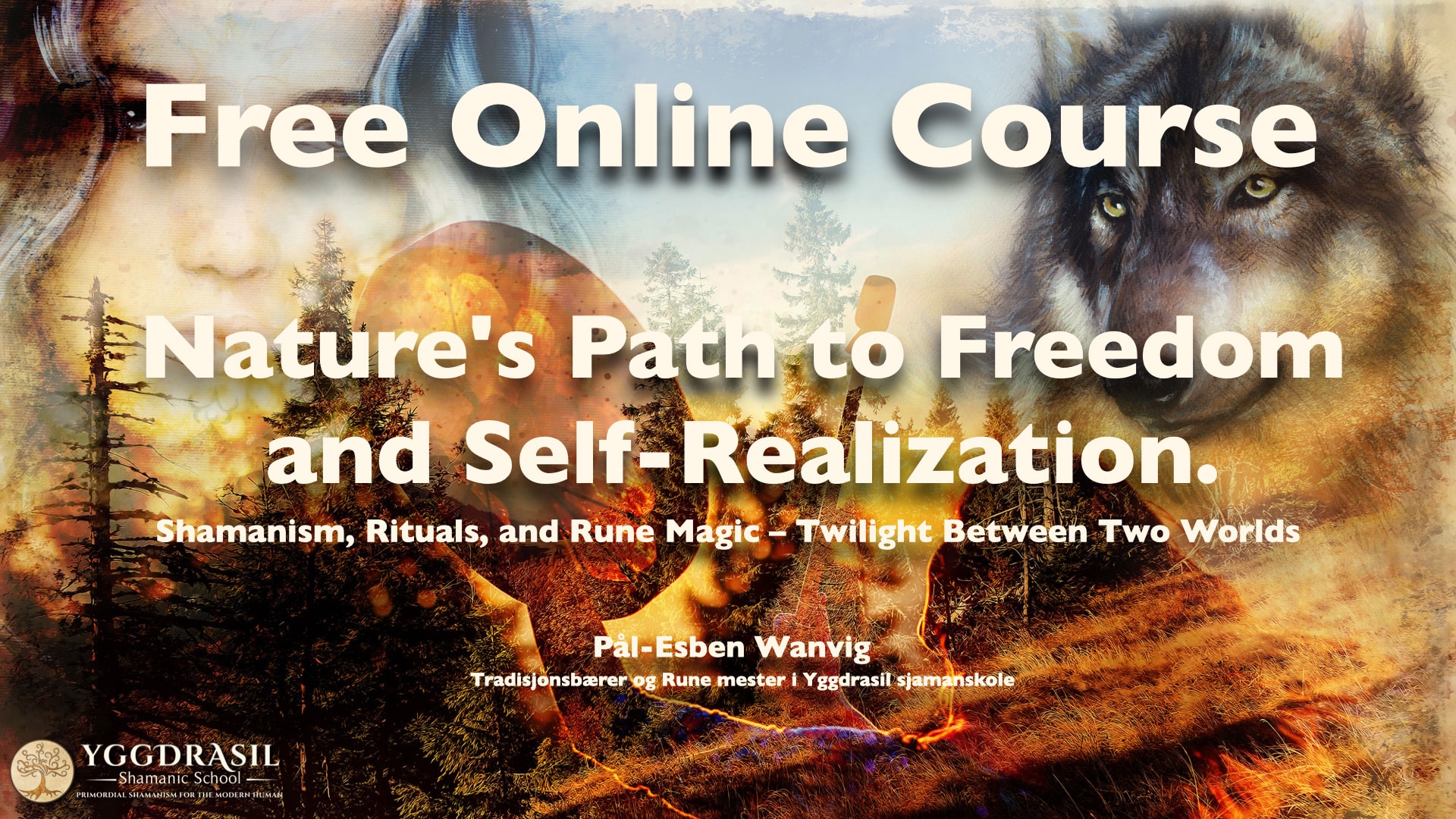
Nature’s Path to Freedom and Self-Realization
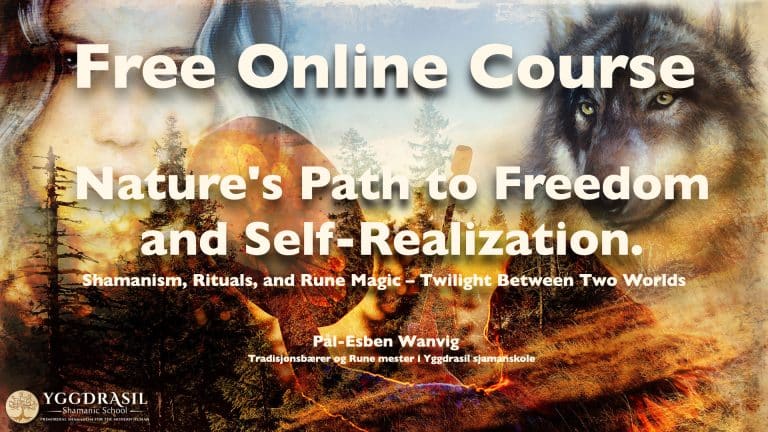
Curious about what primordial shamanism really is, behind the mystique and the misconceptions? In this short online course I tell the story of my own path from skeptical engineer to teacher of primordial shamanism, and give you a first introduction to what I teach: what shamanism and primordial shamanism are and are not, how rituals and rune magic are used in practice, and why the longing for growth matters so much for a good life.
The lessons are recorded in Norwegian; the English version will be ready in November or December 2026. Leave your email on the course page, and I will tell you when it is.