
Episode 18 – Integration and Insight – A Summary and New Insights from the Recent Episodes on Anxiety and Fear
When the first person to confront Pål-Esben told him he was pathologically jealous, he was so furious that he ran out of the restaurant and didn’t speak to them for three months. Amina recently tripped over a dishwasher her partner had left open, and straight away felt the autopilot that wanted to blame him.
In this eighteenth episode, Amina and her teacher and guide, Pål-Esben Wanvig, sum up the recent episodes on fear, anxiety and death. They explore why fear lies at the root of almost all limitation, how Viktor Frankl’s insight helps us take back power over our thoughts and feelings, and why echoes of old fear can surface deeper into the process. It is part of “The Journey to Self-Realization”, a podcast about the bravest journey a human being can set out on: the journey home to yourself.
This episode is an English translation of our Norwegian original, voiced by the digital avatars of Pål-Esben and Amina.
In this episode
- Why the recent episodes on evil, primal anxiety and death matter, and Amina’s life with anxiety before she began
- Why Pål-Esben has yet to meet anyone who isn’t held back by fear, and the student who was too afraid to make any choice
- Getting to know fear without bathing in it, and why blaming the past gives your power away
- Viktor Frankl, the power no one can take from you, and owning your own karma
- Why outside help is needed, and the jealousy that destroyed most of Pål-Esben’s relationships
- The dishwasher, the bowl of sweets and the bus test: why we can self-regulate when there is a consequence
- The onion and its steel layers: why echoes of old fear come up deeper into the process
- What comes next: the shaman’s tools, from axe and hammer to laser cutter, and noticing where you give away your power
This podcast is for you if you:
- Seek real depth in your spiritual practice
- Want to understand yourself on a more fundamental level
- Are curious about shamanism but tired of superficial “new age” spirituality
- Have taken many alternative courses but still feel that something is missing
- Feel an inner longing for freedom, love and wholeness
In a time when so many get lost in external methods and promises of quick fixes, this podcast invites you back to the only place where true answers can be found: your own heart.
Listen above, or read the full conversation below.
Transcript
A warm welcome to the podcast “The Journey to Self-Realization”, a primordial shamanic journey of development back to your true nature. This podcast is a collaboration with our favourite magazine, the health and lifestyle magazine Medium, and is devoted to exploring the bravest journey a human being can set out on: the journey home to oneself. We follow Amina, a student at the Yggdrasil Shamanic School, as she goes through a deep primordial shamanic process of development together with her guide and teacher Pål-Esben. It is a raw, unpolished journey of discovery towards true joy in life, deeper meaning, and a life that truly feels good to live.
This episode is an English translation of our Norwegian original, voiced by the digital avatars of Pål-Esben and Amina.
Pål-Esben: A warm welcome to a new episode, dear Amina.
Amina: Thank you so much, likewise, Pål-Esben.
Pål-Esben: Thank you so much. And a warm welcome to you too, dear listener. Today we’re planning to sum up the last episodes we’ve done, episodes 13 to 18, where we’ve focused a great deal on fear and anxiety and death. It may feel a bit uncomfortable, but there’s a reason why we’ve talked about these topics in such detail, Amina, isn’t there?
Amina: Yes, it’s hugely important.
Why we’ve talked so much about fear
Pål-Esben: You were one of those who held yourself back a great deal because of irrational fear and anxiety and restlessness. Can you briefly sum up what it was like before you started on the path of development to let go of the anxiety that limited your life?
Amina: When I think back to where I was, I believed it was just part of life. I never thought it could get better. I thought there was anxiety and fear, and that was just how it had to be. But as we’ve talked about in some of the episodes, I’ve also had a lot of anxiety and fear driving me, without realising that that was what was driving me. I’ve been in a very vicious spiral, or vicious cycle: “Oh, everything’s going well now,” and then everything goes south. And what’s interesting is that I never believed it was possible to do anything about it. I had resigned myself to that being how it was, while at the same time I felt there had to be a way out. And it was especially interesting when I started training with you and it really hit me right in the face. Then I thought: “Good grief, what am I doing now? This is just making everything worse.” But as I understand today, sometimes things have to get worse before they get better. Everything has to come up to the surface. So when people come to me and tell me about anxiety and fear, and explain it as if it’s completely incomprehensible, I understand. I know how terrible it is, and I also know that there’s a way out of it.
The foundation of all limitation
Pål-Esben: Yes. And now we’ve been through episodes 13 to 18. In episode 13 we discussed what evil is, and what demons are and are not. Then we had a couple of episodes after that on anxiety and primal anxiety. And in the last episode we discussed the challenges of death, and what happens with physical death and the transition. Now, in this podcast you’ve been discussing something very intense, through your own experiences and your fear, and some people listening may say: “Yes, but I don’t have the kind of fear Amina has. It sounds very extreme, and perhaps it doesn’t have much to do with me.” But I’ve worked with people for quite a few years, and I have yet to come across a human being whose life isn’t massively affected by anxiety, fear, insecurity and these things. I’ve never met a human being who doesn’t limit themselves considerably by having this running on a conscious, and especially an unconscious, level: on autopilot, saturated with these things, which go far deeper than the conscious part of us. And the subconscious part steers most of the conscious part, since most people more or less run on autopilot.
What I’ve found after being in contact with a good few thousand people is that the foundation of all limitation, all suffering, all the challenges and problems a human being has, is related to these things. We experience something in our life that we don’t want to be that way, a painful experience, for example, and it triggers a massive outburst of these programmes we’ve discussed in the last five episodes. And then we begin to think and act in a mode that often creates more suffering and more limitation than if you had seen it for what it is. At the start I took my life very, very seriously. Everything that happened, especially things that weren’t good, made me think: “No, I don’t want it to be like this. Why is it like this? Why is the world like this towards me? Why did my car get dented?” All these things. I was in a reactive mode towards the world around me, and then you have very little control over what you think and what you feel, and eventually over how you act. Gradually I learned to understand myself, and I learned to understand my psyche: how my brain and the primate in me work. Because you don’t need to be a rocket scientist to get a grip on what we’ve talked about in connection with anxiety and fear. These are very simple, basic, crude mechanisms that hum away in the biological and emotional system of every human being. It’s so well described in psychology, but most of the people I meet are completely unaware of these crude mechanisms that steer them more or less on autopilot, and that create unnecessary limitation, fear and suffering.
The student who didn’t dare to choose
Pål-Esben: Just before we recorded our podcast, I spoke to a student who was very, very, very stressed and had so much fear of not making the right choice. “Pål-Esben, I’m so afraid of making a choice. Because if I do this, that could happen, and if I do that, something else could happen, and I can’t make any choice, because I fear everything.” Here we have a good example of how this crude mechanism in our brain and our unconscious, including the hippocampus and the amygdala and company, steers a human being completely on autopilot, because this person didn’t see that it’s completely irrational. Why irrational? Well, because there’s no choice we can make where we’re sure what outcome the choice will lead to. It’s called life. We can make a choice, but we never know what will happen tomorrow. It may be a choice that ends in something good, and it may be a choice we have to improve on tomorrow. The anxiety and fear had such a grip on this student, and it created so much stress in their life. That affected their family and children and the whole thing, and it affected their health quite massively, since all this stress creates stress hormones, which in turn create inflammation, which in turn can lead to illness.
So it’s quite exciting when we look at these things. If we were to pick out one topic, one area where a human being can revolutionise their experience of life radically, almost overnight, it would be this: to take what we’ve talked about from episode 13 until now seriously, as something that matters. Because unless you’re willing to resolve the causes of being fear-driven in your behaviour, consciously or unconsciously, it’s impossible to set yourself free. And there’s also a very tight limit on how close to the heart you can come. In episodes 1 to 12 we talked a great deal about the Path of the Heart, and about how life feels when we set our heart free and become masters of gratitude and forgiveness and these things. That isn’t possible as long as we’re controlled by anxiety, which in most cases runs completely on autopilot in the subconscious. It’s quite fascinating: I find this in absolutely everyone I meet.
Recognising the lenses of fear
Amina: Yes, I can certainly relate to that, let’s put it that way. I’ve had an incredibly strong fear of making choices, because what if I made the wrong choice? And I can find that in myself today too. If I’m struggling to make a simple choice, I feel: “Whoa, OK, perhaps I’ve been a bit too stressed, because now I’m starting to think and feel through the lenses of fear.” And then I can recognise it, take a few deep breaths into my belly, go into the forest and sit down, and just feel: “Yes, now I’m back to myself again.” Because human life can take over a bit sometimes when you’re not aware of it. Things happen, everyday life goes on, and unforeseen things come along.
The one in a hundred
Pål-Esben: Yes. And of course, we humans are human, life happens, and shit happens too, but that’s part of life. The question we’re asking now is this: if there were a chance to let go of what creates pretty much all of a human being’s limitation, would you then be willing to engage with it wholeheartedly? And the answer is the strangest thing of all, since 99 out of 100 aren’t willing to. We can talk about the consequences of how completely fear and anxiety control a human being’s experience of life. But when it comes to the point where you have to be willing to look at this and start working your way out of it, most people aren’t willing to do that work, since it’s of course challenging and difficult. That’s one of the things that impresses me about you, Amina: that you’re the one in a hundred who has the courage to be willing to go through this process, to face the anxiety and face the fear, and be willing to look the irrational in the eye.
Because most of the anxiety and fear a human being experiences, at least one who lives in Norway and in the Western world, is irrational fear: 99.9 percent of it. Of course, if you live elsewhere in the world, it may not be quite like that. Then you have reason to fear for your survival, reason to fear that you won’t have enough food on the table tomorrow, reason to fear that a bomb will hit or a missile attack will come. That’s something completely different. But if you live in Norway, or at least in Western Europe, most of the fear a human being has is completely irrational. It has nothing to do with reality. We can go around fearing financial hardship, we can fear the politicians around the world, we can fear war, we can fear this, that and the other, but why go around in fear? Why limit your life with it? Isn’t it time to reach the point where you man up and face the monster, and say that enough is enough?
Getting to know fear without bathing in it
Amina: Yes. And I’ve wanted to give up so many times, because it’s been so difficult, so challenging, so painful, and a bit like: “What is this? Is this all there is?” But for me it’s been important to get to know the fear, to go into the feelings, perhaps see where the trauma came from, where the imprints are. I’ve dived very deep into the pain so as not to run away from it. But for me that was step one, and then I had to decide that I can’t dive into all these feelings of fear and anxiety every time they arise. I have to get an understanding: “OK, this is where they come from, this is what happened.” Because the way I see it from the outside, a great many people slip straight into it as soon as this feeling arises, and just go: “Yes, this is me when I was four, or eleven, or twelve.” They go back to it all the time. For me, and I’ve learned this from you, and it’s been very important, it’s about realising that I have more power over these thoughts and feelings than I think I have. I don’t need to slip into it. Yes, sometimes a wave or a ripple effect of something can come, but I don’t need to bathe in it; I can hold it in a completely different way. So for me it’s been important to dive into it, get to know it, get to know the past, where it stems from, what it is that I don’t want to face. That has also made me much stronger, and I feel I can hold it in a deeper place in myself. And the step after that was, when that thought or fear came in, to remind myself that I’m stronger than those thoughts, I’m stronger than those feelings. I can shift perspective, I can do something else, instead of diving into it all the time, as I see many people do, though of course it’s important for getting an understanding. At some point, at least for me, it’s been important to see that I can’t stay in the past. It’s part of me, part of my body, part of my experiences, but now we have to look ahead, or at least start by being here and now.
Armchair psychology and the power of forgiveness
Pål-Esben: Absolutely. And that’s the challenge when we’ve lived our lives fear-driven, consciously or unconsciously. And again, I just have to say it one more time: I’ve never met a human being in my whole life, at least my adult life, who isn’t massively steered by these fear programmes in their experience of life, in how they live and experience their life. Never. Well, never is a foolish word to use, because I have met a small handful of people, but they’ve freed themselves completely from this. They’ve set themselves free, and that’s another matter. But at least 99.999 percent of the people I meet are more or less fully and completely identified with these things. It has become part of the person’s identity, and it runs 100 percent on autopilot. And when you start touching something a human being identifies with, all the guardian programmes and all the protective mechanisms come up to the surface.
I’ve touched on how it can be a good idea to have an understanding of your past, an understanding of trauma and all sorts of things that have happened, because you sometimes need that to be able to make peace with your past. But what you often find, both in psychology and especially in the esoteric world, is what is in my eyes a meaningless need to go back to the past again and again and say: “Yes, the reason I’m in so much pain today is that Mum did this and that, and that person did that. That’s the reason I have so many problems today.” No. There’s no one but you who is the cause of it, because it’s the choices you make at any given moment. No one is forced to be a victim of their past. When I hear people blaming their mother and father for the hard time they’re having today, well, there are surely situations where that’s justified. But I was also one of those who, at the start, learned this bloody armchair psychology, where I was fed the idea that it’s your mother’s fault you ended up where you ended up. I got this over and over again, this armchair psychology, at the start of my process of development more than 20 years ago, and it ended with me starting to hate my mother. It was her fault I ended up there, her fault I got ill. And the suffering just got worse and worse: the more I blame others instead of myself, the less power I take back. Then you hand all the power over how badly you feel to another person, or other people.
That went on until I met someone who was really switched on, and who told me what I was doing. He was one of the most brilliant people I’ve met in my whole life. He was a psychologist, but a brilliant human being. I told him I hated my mother for having done this and that. And he just looked at me. Then he paused, and kept looking at me. I thought: “What is this?” And then he says: “Do you really believe that’s how it is?” Yes, I believe that’s how it is. And the discussion, to cut a long story short, ended with us seeing that there might have been a reason why my mother wasn’t very focused on me being happy, but on me having to do everything to survive financially. She grew up during the war, in occupied Norway, when the Germans had taken over the farm, and the family went without food for several years. Then you can understand that she was trying to do her best with her boy, so that he wouldn’t experience the same thing. Then I was also able to say: “OK, why should I go around blaming my mother?” She probably did the best she could with the knowledge and insight she had at the time, and today, as a grown man, I can’t go around blaming what happened in my past. That was the point where I understood that forgiveness was an important, important, important thing to get good at. And it isn’t about accepting what a person has done. It’s about letting go of the emotional ties to what was difficult in the past, so that your past no longer steers you emotionally.
That’s why today, when I work with people, students and clients, I have remarkably little interest in the past. We always go through their life story, we look at key events, and if there are really serious traumas, we of course have to go into trauma therapy and these things. You identify the important things, and then we have the task of making peace with the past, and gradually cutting the emotional and energetic ties to it. But going around blaming your past for the hard time you’re having today only limits you, in my experience, because then you give your power away. I’m in favour of us taking back power over our lives. The only one who can change how I feel and experience my life today is me. Like you were when you started, blaming everyone else: no one else can change how you feel and how you experience life. And then we come to topics like taking back self-responsibility and taking back power, so that we can begin to deal with what we can actually deal with, which is ourselves. Through that we can set ourselves free.
Viktor Frankl: the power no one can take from you
Pål-Esben: And Dr Viktor Frankl, whom we’ve mentioned in an earlier episode, and who is one of my heroes, was held in a concentration camp by the Nazis and experienced the worst a human being can experience: torture, and the Nazis killing his family and friends. It was really, really terrible. He’s very, very well known for saying, in essence: “They could take everything from me, they could harm me, they could torture me, they could kill my family and my friends, but they could never take from me the power over what I think and feel and how I act on what happens to me.” That’s a statement that burned itself into my prefrontal cortex when I read it more than 20 years ago. I thought: “Why should I give others power over how I think and feel?” That’s the first step. And then we can begin to deal with where the fear and anxiety and the limitations really lie, which is in ourselves. And what’s so cool is that we alone can set ourselves free. We actually don’t need anyone else to change in order for us to set ourselves free. It isn’t the case that you, Amina, need your kids to change, your mother to change and your partner to change in order for you to become free. Do you?
Owning your own karma
Amina: No. And for me, that’s owning my own karma. There’s something deep and beautiful and important about it. This takes me back a bit to one of the guidance sessions we’ve had. Things had been going very well; I’d managed to see things from new perspectives and take self-responsibility and these things. Then I had a guidance session with you where it was all this happening with the kids, and then there was the kids’ dad, and then there was Mum here, and then that happened there, and suddenly everything was just chaos. And then you said something along these lines to me: “This is about you, not them. You’re the one who has changed, you’re the one who has slipped into suffering and frustration and stress and chaos, because a couple of weeks earlier you’d have handled all those situations.” That aha moment has been hugely important to me, because I can catch myself at it now, every time it happens. If I’ve been stressed, if I’m going through some healing reactions, if a lot has happened, and I feel that first there was this with one kid, and then there was that with the other kid, and suddenly it all got to be a lot, then I think: “Hang on a minute. This is me. I’m the problem, for want of a better word, not all the challenges I have to solve.” Then I take a step back and do the things that are important for me and my energy system. And then I feel that there’s actually still just as much coming and going here, in terms of what’s happening in the outside world, but I can handle it in a different way. That’s because of the instinct or perspective I come from or experience it from; I don’t know if you can call it a frequency. So that’s been very, very important to me. And this business of forgiving your parents for your upbringing, and not bearing a grudge, is hugely important. Because, as I just said about owning my own karma, I’ve now learned a lot about karma and the cycle of incarnation and tendencies, which has been very important to me, very liberating. It has helped me understand that there’s a reason why I experience everything I experience or have experienced, but that it’s also my choice whether I want to change it, and what I want to experience from now on.
The soul hasn’t come here for it to be easy
Pål-Esben: It doesn’t matter what the cause of the problem is, because it can be others, and it can be us. We’re not always in charge of what happens in life, perhaps only very rarely, but we always have the power to decide how we handle and react to what happens to us. That’s what Viktor Frankl is talking about. It’s not that we have control over what happens to us, because there are so many factors, but that we gradually learn to build up what I call the Viktor Frankl muscles, so that we take back more and more power. Then it matters little what happens to you and around you, because you have so much more power over how you interact with and react to what happens, both internally and externally. That’s part of taking this power back over our lives. Is this easy? Of course not. But we haven’t come here for it to be easy. Our soul hasn’t come into this body, into this straitjacket, for it to be easy. We talked about that in several earlier episodes: in episodes 9 to 11 we talked about the soul and how this fits together, and about the soul’s university of life. Of all the places in our universe to incarnate, this is one of the more complex, since we’re in our straitjacket and completely disconnected from what we really are. So we haven’t come here for it to be easy; our process of evolution in this straitjacket is complex, but it’s still a process of evolution. If you expect life to be easy, that isn’t what your soul expects. It has come here for things to be difficult. We aren’t looking for an easy life, but to learn how we find our process of development and evolution. How do we find the themes our soul has brought in with it, which it wants to learn and experience from? And how do we gradually set ourselves more and more free through what we call the 9 Pillars for Finding the Path of the Heart, while at the same time actively dealing with what limits our heart? That is fear and anxiety and all these things that were discussed in the last episodes.
Help from outside: the jealousy that opened my eyes
Pål-Esben: Trying to do this work on your own is, I’d say, as close to impossible as it gets. Most people wouldn’t have a hope. Because if you’re going to start dealing with your primal anxiety and the biggest fears you have, the intellect and the ego and company will be so clever that they manipulate you into saying: “No, you don’t have a problem. We’re just like this, this is natural for me, so we’re not going to do anything about it.” I haven’t been able to do this on my own either; I’ve also had help to go through my processes, the way I’ve helped you. And if I go back to when I started with this in earnest, I can say hand on heart that I wouldn’t have stood a chance doing it on my own. The intellect and the ego were far too powerful for that, far too effective at running their own world. One example from myself, which I’ve talked about before, was my pathological jealousy, which destroyed most of my relationships. I’d been through several cycles, with several live-in partners, where this jealousy would eventually break out and destroy the whole thing, and I’d done it once, twice, three times. Even so, it wasn’t on my radar that the cause of the chaos lay with me, that it was my jealousy. And then I meet the first person who helps me and confronts me: “Well, you are pathologically jealous, Pål-Esben.” And I get so furious that I run out of the restaurant and don’t speak to that person for three months. There you see the power of the intellect, the ego, the karmic memory and the identity, in other words the triangle of suffering, and how it steers us. I can say that I wouldn’t have stood a chance without getting help through this. And it was the same when you came to me, Amina, full of fear and anxiety. How would you have managed this on your own, without competent help? It would have been impossible, I can tell you that straight away. It isn’t about not believing in yourself, but without help from outside I wouldn’t have managed to navigate back to myself.
The dishwasher and the autopilot
Amina: And then there’s being willing to take in that feedback, and also noticing in yourself that you can slip into transferences and projections onto teachers, onto a guide, onto a mentor, because that can often happen too. I can notice it sometimes with the people I guide. This is a path for those who are truly ready to look at themselves in the mirror, and the reflection isn’t always all that comfortable. And what I’ve noticed is how much we believe that we really are all these thoughts and feelings of ours. Both my partner Erik and I notice it sometimes, if for example one of us hasn’t… well, I can take myself as an example. The other day Erik hadn’t closed the dishwasher, so it was standing open, and I tripped over it. Oh well, if it’s not the toilet seat, it’s the dishwasher. And as soon as it happened, I felt that autopilot saying: “If only he’d closed it, my leg wouldn’t be hurting now.” I can recognise that in several things. Both Erik and I are the kind of people who can say it out loud, and then we can laugh: “Whoa, I felt it then. Isn’t it crazy how this head works?” And when you’re not conscious, there are so many unnecessary rows and discussions about basically nothing. I tripped over it; it just happened. All right, perhaps someone forgot to close a door, or left something behind that made you trip. But whoever’s fault it is, it’s now my responsibility, because my leg was where there was a door, and I tripped.
Power over thoughts and feelings
Pål-Esben: Yes. And I also often hear people say they don’t have power over what they think and what they feel. Of course I can understand that most people experience it that way. Something sets you off, your partner or a kid or a friend does something unpleasant, and then you lash out, and then you say: “Yes, but I have no choice, I can’t control this, because I have no control over it.” I can understand that it feels that way, but it has nothing to do with reality. A human being can have full power over what they think and feel at every moment throughout their life, except when the physical survival function in our biology kicks in. That might be fear that a car is going to run us over, or a three-kilo tarantula coming running after us, or something like that where your life is in danger. Have you seen those big tarantulas?
Amina: No.
Pål-Esben: In films, I mean! That’s the exception: when the survival mechanism of the body and brain, physical survival, kicks in, you don’t have control. But that’s very, very, very rare.
Amina: Perhaps that’s important too?
Pål-Esben: Yes, of course it’s important; otherwise Homo sapiens sapiens wouldn’t be alive today. But after all, we live in a part of the world where this doesn’t happen very often, as long as you walk on the pavement and don’t go in for kamikaze stunts or something like that. So in most cases, and I usually say 99.9999 percent, a human being who exercises their Viktor Frankl muscles and goes through similar kinds of processes to those we’ve discussed in our podcast can have 100 percent power over what they think and feel at every moment throughout their life. Because it’s never the intellect or the ego that decides that; you’re the one who decides. But for you to be able to decide, we have to go through a process of development where you take this power back. And that isn’t done overnight. It’s what you’ve been through, through what we call the primordial shamanic process of development at the Yggdrasil Shamanic School, where it is laid out step by step how any human being can go through such a process and come out on the other side with full power back over their life. And of course life feels very different when you take this power back, doesn’t it?
The bowl of sweets
Amina: Oh yes, yes, absolutely, absolutely. That also made me think of one of the older recordings you’ve made, where there was a person talking about how he was going to take a sweet from the bowl, and he couldn’t control himself; it just happened. And then you said: “Do you really mean you can’t control your hand going into the bowl of sweets?” Then all the students laughed, and I laughed, and I laughed, and I laughed. The reason I laughed was that we have so many notions about what we can’t do. And then there’s seeing it from that perspective. Granted, this one is about sweets and a bowl, and someone who was meant to stay off sugar, and it doesn’t always feel that simple, but really it is as simple as that, once you’ve got the hang of it.
The bus test: self-regulation when there’s a cost
Pål-Esben: Yes, correct. And that’s what’s so frightening: how simple it really is. Because the day you understand and experience that you have power over your thoughts and feelings, there’s no bowl of sweets that has power over them any more, and no other people either. When you reach that point, a revolution happens in your life; it’s a big, big, big shift. But of course, as you say and as we’ve talked about, this is something that’s simple. And often, when we get to the core of these topics, my students and clients get a bit sulky and sometimes furious with me. It’s called psychological transference and projection. You feel so bad because you have to take self-responsibility that you aren’t willing to take. Then it’s better to project the blame onto the person who puts their finger on the flaw than to take responsibility for having a flaw that needs resolving. So you often project the blame onto the person who gave the feedback. This is something you need to be alert to as a guide, and you need to understand the mechanisms behind it. Because it doesn’t mean you’re a bad person for projecting blame onto your guide; in most people it’s an automatic mechanism. Most people have never even heard the words psychological transference and psychological projection. They don’t know what it’s about, even though it runs fully on autopilot continuously throughout the day in every human being. That goes on until you learn this, which in my eyes is important: the ABC of understanding your own behaviour.
And just to finish here, I have regular discussions with students and clients where they say: “No, it’s not possible. I have no control over what I think, feel and do in a situation.” Here’s a classic example. You come home, your partner does something or other, and you get irritated, yell and scream, the way people do in homes everywhere when their partner does something they don’t like. And then I say: “So you think you have no control in this setting, when your partner said this and that and the other?” No, I have no control. “So you have no free will to have done it differently?” No, because it just happens by itself. And then I say: bullshit. This happens because you’re not doing anything to stop it happening. And I can easily prove to you that it’s exactly as I say. Here’s an example. You’re sitting on the train or the bus with your partner, and your partner does exactly the same thing, says exactly the same thing, that normally triggers you into all sorts of madness when you’re at home. And you sit there and have no problem handling yourself. You may get a bit huffy, a bit sulky, but it’s not as if you yell and scream and start crying and say: “Why are you saying that?” Because you have a reason to self-regulate: you’d be ashamed if people on the train or the bus looked at you and thought you were an idiot. So the reason you’re not willing to take self-responsibility for your emotions, thoughts, feelings, actions and reactions at home with your partner is that there’s no reason to do it. There’s no consequence of just reacting on autopilot. On the bus, on the train, on the plane there is a consequence, so there you choose to do it. When I use this example, some people get completely up in arms, because they then see that they manage it on the bus but aren’t willing to at home. And who do they project that discomfort onto? Me. Because then they know that they have just as much power when they’re at home too, but they don’t want to use it, because there’s no consequence. And that’s the crux: if we have a good enough reason, most of us are masters at handling how we react, how we act, how we feel, how we think and what we say. These are truths most people experience but won’t acknowledge. As you exercise these muscles, the Viktor Frankl muscles, you become better and better able to do this, even in more extreme situations. It’s part of the profound primordial shamanic process of development: that you take this power back, gradually. I find this incredibly, incredibly exciting, and also very rewarding, when I discover and experience people like Amina, who have had these problems, who go through this and don’t give up, and who come out on the other side freer than they’ve ever been in their life so far. That’s what we want: liberation and freedom.
Echoes from deeper layers
Amina: Yes, absolutely. And when you’re willing to set out on that journey, and you have a mentor, teacher, guide, and you feel transferences, projections or bad feelings, then you can bring that up. I’ve done that with you several times, when I’ve felt and sensed it towards you too. It’s so good, because then you see that it’s OK to feel and sense it, but that you also own it. And this ties in a bit with what you said just now: I’ve now worked through so much fear, so much anxiety, things that have steered my life. After all, I’ve had extreme anxiety. So here I sit talking about how I’ve moved on from it. But I’m still going through a profound primordial shamanic process of development, and we’ve been working quite deep in the material. So lately I’ve had some quite powerful healing reactions, where on one level I can feel that I’m in contact with the soul, with the heart, in other words that I have something safe in myself. At the same time my body, my nervous system, slips into anxiety mode. Then I’ve sometimes thought, when I’m sitting with this: “Good grief, here I’ve been sitting on the podcast saying that I’m free of anxiety and fear and the whole package.” And then I think: “But this isn’t the same as the anxiety and fear I had before.” That’s something I’d like to bring up. What’s going on with this? Is it that the anxiety and fear are still there? Is it about an echo? What’s happening here?
The onion and the steel layers
Pål-Esben: The deeper we get in a process of development, the deeper we come into contact with what we really are: the timeless and spaceless part of ourselves, which our soul is also part of, at least the uppermost layers of the timeless and spaceless. And of course, when we begin to break through these layers and set ourselves more and more free from this straitjacket that the intellect, ego and company control, we go through periods where we feel we’re sliding backwards. Suddenly you no longer master what you mastered a month ago. I usually compare it to peeling an onion. When we set out to find this full freedom, this full liberation and this real awakening, which we’ll discuss in later episodes, you can picture it as peeling an onion. The onion has different layers, which are themes, learning themes and so on. You learn to work with it, and then you get through to the next layer, and you do your healing, your development and evolution, and suddenly you come into the next layer. The deeper you get into the rabbit hole, the deeper into the onion you get. And in this process of development, when you start touching this and especially start having experiences of oneness, you often come up against what are called steel layers in the onion. Then you come to themes that can trigger the madness, that can trigger certain parts of the ego’s and the intellect’s defence system. The intellect and the ego and company are terrified of the process of setting you free from the straitjacket so that you can embrace your timeless and spaceless nature. The more you set yourself free from the straitjacket, the less power the intellect and ego and company have. And there’s nothing wrong with the intellect and ego; we’re completely dependent on them, and we should be friends with them. But they should be the soul’s advisers instead of the soul’s rulers, which they are for most people. We’ll talk more about that later on.
When you get into these slightly tricky layers, an outburst of madness like that can arise. And that’s completely, completely, completely natural. You get into areas where the intellect, ego and company set off their guardian programmes: “Now this is starting to get dangerous, now we’re starting to lose our grip, now we’re starting to lose power. Let’s trigger Amina’s first chakra here, because we know exactly which buttons to press to make this first chakra react.” And then you believe, unconsciously, that a sabre-toothed tiger is coming after you, and you start reacting in old patterns. But that doesn’t mean it’s the same kind of theme as the ones you struggled with at the start. That’s done; that’s been worked through. This is what we call deeper layers and echoes of these things, which come up to the surface, and which are there to be worked through and healed and made peace with, so we can take another layer after that. So when people get deep into the process of development you’re in, we always have an agreement. It’s the agreement the two of us have, and which I have with all my students: we have to be willing to be 100 percent honest with each other. There’s nothing you need to go around carrying. As we talked about a moment ago, if you’re irritated, or put out, or furious, or whatever it may be, with me, the guide, then tell me, so we can discuss it. Because pushing it down into the pressure cooker isn’t much good. And once we’ve been through a few rounds of that, it’s no problem for you to come out with it either, to say straight out: “I experienced these things.” Then you know you don’t need to be ashamed, that you’re not a bad student and haven’t missed the point. This is a natural part of a process of development, and when it comes, you lift it up and say: “This is what I’m experiencing.” And then I can explain why you’re experiencing it, and tell you how to free yourself from it, on the basis of what you’ve already learned. And then you’ve come through what we call a steel layer, which can feel like a giant leap in your development. So you see, when things like this happen, as they did for you not so long ago, we think: “Yes, now we’re exactly on the right track.” That’s exactly what needs to happen; then we just need to get it cleared away and worked through, so we can move on. There’s nothing to be ashamed of. Because that’s rather the point here. You’ve worked on something, got through it, and then suddenly it’s as if you’re experiencing the same thing again. And then you think you haven’t got the point, that you’re a useless fool, an amateur: “Here I sit talking to my students and clients, and talking on the podcast about how far I’ve come with my fear, and then suddenly I experience an echo of a fear again. What kind of idiot am I?” Is that what you were thinking when we talked?
Amina: Yes, absolutely, absolutely. And there you see how quickly this ego-intellect can get a stranglehold if you’re not aware. It gets cleverer and cleverer and cleverer; I’m fascinated, it’s really interesting. But I also see now the importance of what I’ve been through, and of this bigger healing reaction I’ve had. I’ll probably talk more about that in another episode: what it has done to me, and what lenses I see life through now compared with before it happened. I didn’t know it was what I needed, and I feel more and more that it was exactly what I needed. At the beginning it was a bit like: “Good grief, why am I attracting this now? I’ve been doing so well.” Signed, Amina’s ego. And now I feel that that was why. It’s quite a unique thing to feel.
The road ahead: from fear to the shaman’s world
Pål-Esben: Yes. And then you understand that a process of development, at least a real process of development, isn’t a bed of roses where everything goes up in a straight line all the time. You come across the slightly harder layers of the onion, and then it’s important to have professional help that can get you through it. What comes out of it is that you’re often radically strengthened afterwards. The harder this layer is, the more steel there is in it, the more titanium, and you can feel it, the bigger the leap you make in your process. These are particular things that come further on in the process of development, when you start touching your Sahara and the experiences of oneness, and we need to be very, very observant about them. But we’ll devote many episodes to that a bit later, where we’ll talk about the path to awakening, oneness and these things, and explain the process around it.
So, to sum up where we’ve got to today: in episodes 1 to 12 we focused very much on talking about what the Path of the Heart is, why it’s so incredibly important, what it really is, and what love really is, all of which is very practical. And then we discussed the soul and the soul’s journey. Now, in episodes 13 to 18, we’ve focused quite a lot on what stops our heart from setting itself free. That’s everything connected to fear and anxiety, and where it comes from. And for those who are searching and want to walk a profound path of development, these things are something you need to deal with in one way or another. Because it isn’t enough just to sit down and become a master of gratitude if anxiety and fear steer us most of the day. These things have to be worked through in the process if we’re to set ourselves completely free. From episode 19 we’ll start moving on to somewhat more pleasant topics. Then we’re done with, let’s say, heavy topics about anxiety and fear and demons and evil. Let’s talk about something a bit more pleasant! Then we’ll go into the shaman’s world. We’ll talk about rituals, we’ll discuss runes and karma and karmic synchronicity, and we’ll dive into soul hunting. We’ll also look at why these rituals and tools the shaman has available are so insanely powerful and effective in a profound process of development. Now I’m done with heavy topics, Amina; now comes the really joyful part.
Amina: Yes, yes, yes.
A spade is a spade
Pål-Esben: Fortunately we hold both polarities at the Yggdrasil Shamanic School. We do. We have to be direct, we have to take the bull by the horns when it comes to fear and these things, and call a spade a spade. As long as you believe the spade is an egg, you have a problem: you have a subjective perception of reality. We have to get to the point where we take the bull by the horns and call a spade a spade. Because it’s very, very limiting to see the spade as an egg, especially if you’re going to make yourself fried eggs. And it’s just as problematic to believe the egg is a spade when you’re going to dig the soil. But that’s the reality out there. Especially in the esoteric world, you often hear that everyone has their own reality. Yes, you have a subjective reality, which is your own world of fog compared with what reality really is. But a spade will always be a spade, and an egg is an egg, at least in the material world. And there’s a need to take the bull by the horns and face it head-on, so that you gradually get the chance to work through it and clear it away. At the same time you work on opening your heart more and more in connection with the 9 Pillars for Finding the Path of the Heart. Through that you lay the foundation for access to deep shamanic magic, which we’ll discuss from the next episode on. I think it’s going to be really cool. And when we’re done with those episodes, we’ll get our teeth into the path to spiritual enlightenment, spiritual awakening, spiritual self-realization and oneness. That’ll be quite something too. So we have the plan for the next few weeks, Amina.
The shaman’s rhythm: five months’ holiday
Amina: Yes, yes, yes, yes. And after this episode, the next episode won’t be out until September, will it?
Pål-Esben: That’s us shamans, isn’t it? If you’re listening to this as it comes out, the advantage of being a shaman is that we take long holidays. I often say this to my students: I have five months’ holiday a year. I have a long winter holiday and a long summer holiday, because I have all sorts of things I want to do as well, so I organise all my work in blocks. For my part, I work in February and March, have a holiday in April, work in May and June, have a holiday in July and August and a bit of September, and then I start up again. Over time I’ve found my style for doing this, and it’s one of the cool things about getting to do what I do, and what you do. We have a different kind of freedom than if you have a nine-to-five job. So we take a bit of a summer break when it suits us, and a winter break when it suits us, and our plan, I think, is to release the next episode on 12 September. And then we’ll get going with the cool stuff, the stuff that perhaps fascinates a lot of people. It isn’t much fun listening to all this talk about evil and demons, but it’ll get really cool when we start talking about what the runes really are, what shamanic magic really is, and how it can affect our lives and help us.
The workshop: from axe and hammer to laser cutter
Pål-Esben: I often use this metaphor. Say you do personal development in the most traditional way, the way we’re used to in psychology and ordinary personal development, where you learn a bit of psychology and learn methods and techniques, a bit of NLP here and a few things like that. That’s a very crude way of doing your development. It’s as if you have a workshop with an axe, a hammer and a saw available. If you then start mixing in the shaman’s tools, everything from powerful rituals to rune magic to soul hunting to dealing with past traumas, karma and so on, then suddenly you have a workshop with a massive number of tools, and the latest and most precise ones. You have a 3D printer, you have a laser cutter, you have massive, precise tools to build what you need to build in your workshop. Walking a profound path of development with crude methods often takes a very, very long time, and it’s heavy going. With the approach we’re talking about here, you can do development in one month that would normally, the crude way, have taken twelve months. We’ll talk about why that is when we get to the different areas that belong to shamanic magic, and why this goes so much more smoothly and is so much more fun than when you do things the most cumbersome way. That’s what we’ll focus on in the next episodes.
The combination that works
Amina: Yes, I’m looking forward to it. Because a lot of people ask me: “How come this is so effective?” And I really feel the combination of the practical side and energy work and rituals. That combination is the perfect one for me, at least.
Pål-Esben: It is for everyone who opens up to it. Because at our shamanic school we’ve found a unique combination: we take the Western way of seeing things, everything from medicine to psychology, techniques and methods from the Western world, and we combine it with ancient methods from the shaman’s world. When we combine these, everything works so radically more effectively, faster and in a much more brutally direct way, instead of you needing to keep at it for years to get permanent results. And that’s one of the things that makes me… well, even though I’ve been doing this for so many years, I feel so joyful about every single person I get the chance to lead through a process like this. Because I know exactly what will happen within just a few weeks. And when someone has gone through the process for six months, the way it’s designed, it isn’t possible for them not to have experienced a gigantic revolution in their life. I’ve never seen it not happen. Of course I’ve had students who haven’t been willing to do anything at all with what they’ve learned; then you get no results. But those who do it… that’s what it’s all about here. They’re what makes me so fascinated and joyful about every single person I get the chance to help through processes like this. And I think it’s the same for you, Amina, since you do the same. It’s pretty joyful to see what happens to a student when you bring them through such a profound process of development, and how their life changes to such a degree.
Amina: Yes, I can only second that. And with the students who really do this wholeheartedly, who use the one-to-one guidance sessions wholeheartedly, you can feel that we’re heading somewhere. Not long ago one of them said: “Suddenly I just see the world differently. I have more love for myself, and I no longer react to things the way I used to.” And when you work on one thing, it can often have ripple effects on other things you haven’t worked on directly. I’m so grateful for the students’ trust, and for being able to guide people through the same process you’ve guided me through, and still guide me through. It’s… yes, oh, my soul rejoices.
Pål-Esben: It’s exciting, and it’s fun. We live in a world that’s a bit tricky, where there’s so much of the opposite; it’s a slightly chaotic world. And trying to be a small, small, small counterweight to the madness, one that can help people out of the insane limitation that all this chaos often brings into life, is something I find incredibly important. It’s also one of the reasons we do this podcast: to inspire you, dear listener, to gradually believe more and more that there is hope, that it is possible, and that you have a strength and a power that surpass your wildest dreams. It’s just about gradually finding your way to that power, gradually cultivating your way to it. And then you see that what you’re experiencing, Amina, isn’t unique. It’s something most people who go through a process like this experience in time. So I’m incredibly proud of you, dear Amina.
Amina: Thank you. Thank you so, so much.
Words of wisdom: notice where you give away your power
Pål-Esben: I mean it. And I’m very grateful that you’re willing to take part and share good, difficult and challenging experiences through this podcast. I hope you, dear listener, appreciate that too, because it’s quite incredible how Amina lays herself bare here, in the hope of inspiring you. If it’s possible for Amina, it’s possible for you too. So perhaps you have some words of wisdom to wrap up with now, Amina? Perhaps we should finish?
Amina: Words of wisdom to wrap up? Yes, perhaps what we talked about earlier in the episode. Notice, perhaps during the summer months, or whenever you’re listening to this, where you tend to blame others. Think of me and the dishwasher door. Do you have any points like that in your life? Start noticing where you give away your power. Yes, that’s the word of wisdom I’d like to share: start noticing where you give away your power, where it’s easy to blame others. And again, as we’ve talked about many times, it’s not to beat yourself up; it’s just to become aware. Write it down, make a list of where you give away your power, where you blame others instead of yourself, and where you don’t take self-responsibility, and make it a bit playful.
Pål-Esben: Yes, that’s important. Good tip, isn’t it? Do it with fascination instead of resignation. I like being fascinated by my own madness, at any rate, because now and then it shows up in new ways. And instead of being cross with myself or resigned, thinking “Pål-Esben, you haven’t understood a thing”, I laugh more at the madness in myself and say: “OK, this is how the karmic memory plays out together with the intellect and the ego. What a bloody circus!” But that isn’t what I really am, because what I really am is my soul. And the more you come into contact with what you are, the more able you gradually become to distance yourself from your karma. The day you manage to distance yourself enough from your karma, you observe yourself, and then you can laugh at your own madness. So I’m really looking forward to getting our teeth into shamanic tools and magic in the next episodes. Thank you so much for staying with us all the way, dear listener. We really appreciate your feedback, and a five-star rating on Spotify helps our podcast reach more listeners. And thank you so much for being here with me, Amina. I really appreciate it.
Amina: Likewise, Pål-Esben.
Pål-Esben: Thank you for being with us, dear listener. I hope you’ll join us again in the next episode. And until then: have a truly wonderful day, evening, night or morning, wherever you are listening from. Take care.
Outro
Thank you so much for listening to this episode of “The Journey to Self-Realization”, a primordial shamanic journey of development back to your true nature. We hope Amina’s story has inspired you to explore your own journey of self-discovery and development. Remember that the path from suffering to self-realization can be demanding, but with courage, patience and support from a competent guide, mentor, teacher or therapist, almost anything is possible. We wish you all the best on your journey, and we’ll talk again in the next episode.
The Journey to Self-Realization
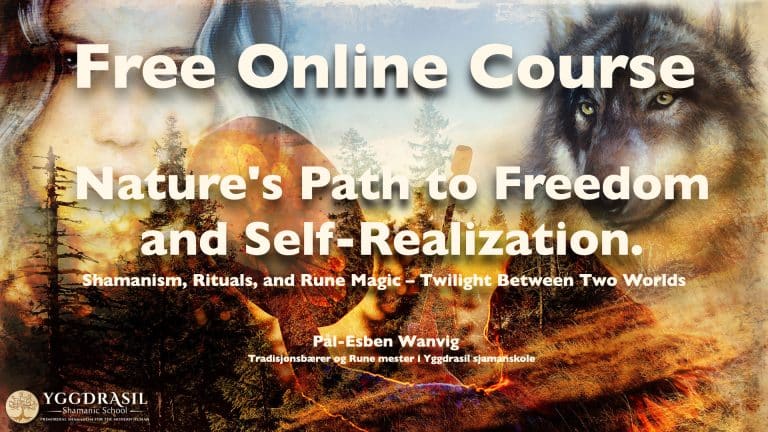
Nature’s Path to Freedom and Self-Realization
Curious about what primordial shamanism really is, behind the mystique and the misconceptions? In this short online course I tell the story of my own path from skeptical engineer to teacher of primordial shamanism, and give you a first introduction to what I teach: what shamanism and primordial shamanism are and are not, how rituals and rune magic are used in practice, and why the longing for growth matters so much for a good life.
The lessons are recorded in Norwegian; the English version will be ready in November or December 2026. Leave your email on the course page, and I will tell you when it is.