
Episode 32 – Experiences of Oneness and the Way Home
Pål-Esben’s own mentor meditated for around six hours a day for 20 years without breaking through, until a Zen master pushed him across into oneness, and he cried for three days. After Amina’s first real experience of oneness, at a three-day retreat, she couldn’t function for weeks and struggled even to read on her computer. A year later she went deeper, and now she no longer needs to remind herself that she is really the Sahara.
In this thirty-second episode, Amina and her teacher and guide, Pål-Esben Wanvig, talk about experiences of oneness and the way home. They explore why plant medicine and kundalini bliss are rarely oneness, why a genuine experience of oneness is a shock to the whole system for weeks afterwards, and why almost nobody finds the way there without a guide. It is part of “The Journey to Self-Realization”, a podcast about the bravest journey a human being can set out on: the journey home to yourself.
This episode is an English translation of our Norwegian original, voiced by the digital avatars of Pål-Esben and Amina.
In this episode
- Amina’s expectations of oneness, coloured by fear and her psychedelic experiences, and why there are no words for the timeless and spaceless
- Plant medicine, extreme yang states and kundalini bliss, and why a hormonal, biochemical cocktail is rarely real oneness
- The deepest yin and the gravitational forces behind the subtle, where there are no images, only certainty
- Touching the Sahara with the big toe, the shock to the system, and the integration process in the weeks afterwards
- Amina’s deeper experience a year later, and personality development on steroids
- Bringing the Sahara into everyday life, and breaking the chains through self-responsibility
- Why nobody manages it alone: the guru’s role, monks who have meditated for 40 years, and the push into oneness
- How to separate the wheat from the chaff among guides, and why Pål-Esben sees his dyslexia as a gift
This podcast is for you if you:
- Seek real depth in your spiritual practice
- Want to understand yourself on a more fundamental level
- Are curious about shamanism but tired of superficial “new age” spirituality
- Have taken many alternative courses but still feel that something is missing
- Feel an inner longing for freedom, love and wholeness
In a time when so many get lost in external methods and promises of quick fixes, this podcast invites you back to the only place where true answers can be found: your own heart.
Listen above, or read the full conversation below.
Transcript
A warm welcome to the podcast “The Journey to Self-Realization”, a primordial shamanic journey of development back to your true nature. This podcast is a collaboration with our favourite magazine, the health and lifestyle magazine Medium, and is devoted to exploring the bravest journey a human being can set out on: the journey home to oneself. We follow Amina, a student at the Yggdrasil Shamanic School, as she goes through a deep primordial shamanic process of development together with her guide and teacher Pål-Esben. It is a raw, unpolished journey of discovery towards true joy in life, deeper meaning, and a life that truly feels good to live.
This episode is an English translation of our Norwegian original, voiced by the digital avatars of Pål-Esben and Amina.
Pål-Esben: Hi, Amina, and a warm welcome to a new episode.
Amina: Hi, Pål-Esben. Thank you, likewise.
Pål-Esben: Thank you. And a warm welcome to you too, dear listener. Today we’re going to talk about a very, very exciting topic. In earlier episodes we’ve talked a great deal about what spiritual enlightenment is, and what oneness is; we’ve discussed the grain of sand, the Sahara and so on. But in this episode we’re going to discuss how experiences of oneness actually feel. Not from a theoretical point of view, because plenty of people have opinions about that, but from the point of view of experience. That’s why I’m very glad to have you here now, Amina, to share what your first experiences of oneness have been like, experiences of the timeless and spaceless, and how it’s actually experienced. And then we’ll talk a little about the deeper, more complex experiences of oneness that come later on along the path of development.
This is also something life-changing, when you experience it in the right way, within a safe and correct framework, where you have enough knowledge and enough pegs to hang your experiences on. So that you aren’t just left hanging in mid-air with experiences you can’t really put into words.
Language falls short
Pål-Esben: Because our language is built around four-dimensional space, that is, time and space, where we describe, for example, a pen, or a stone, or a spade, or a human being. Very linear, very three-dimensional. But when we dive into the place where time and space don’t exist, which we call the timeless and spaceless, which we call oneness, which we call diving into our Sahara, the challenge is that there are no words to explain it. There’s no vocabulary; there’s nothing in our material life that can express it correctly.
So the best we can do, those of us who experience these things, who experience oneness and experience our Sahara, is to take those experiences, try to bring them up to the surface, and try to find some metaphors and images. I call it gurgling: we gurgle something or other out, which is a very, very poor description of a mind-blowing experience. And that’s what we’re going to try to do as well as we can here now, Amina: explain these things. And you get to have a go first. Can you tell us a little about what your ideas about these experiences of oneness were before you started the primordial shamanic process of development with me? How did you picture that moment of spiritual enlightenment? What were your thoughts about it?
Amina’s expectations: fear and bliss
Amina: Well, I’d like to start by saying that when I began my training with you, I didn’t even dream that this was where you’d take me, take all of us. I didn’t really think it was possible, and especially not without psychedelic substances, without plant medicine and things like that. I thought that was impossible, unless you lived in an ashram or were shut away somewhere or other.
But as for my thoughts about oneness and becoming one with everything: I’ve mentioned earlier in the podcast that I have my experiences with plant medicine and things like that, and I thought I’d come across it there. And the experiences I had with that actually also made me very afraid of oneness, of what I thought was oneness. Because I’d had my psychedelic experiences of becoming one with everything, and it was frightening. Very frightening. Of course there were some lovely experiences around it too, but I thought it was about a kind of very strong bliss, ecstasy, an exaltation of some kind.
I’d also heard about people who induced states to reach oneness, without drugs and plant medicine and so on, but I thought it took much more than what I’d come across in my own experiences. So those are the thoughts I had about it, and a bit of fear around it too, because of what I’d experienced and what I heard others talk about. So I had my thoughts and these experiences. But then, over time, I found that what we’re doing now is something completely different. Something completely different from what I could have predicted, and something completely different from anything I ever thought I could dream of.
Plant medicine and bliss: why it is rarely oneness
Pål-Esben: Yes. And that’s often one of the challenges when we talk about these topics: there are a great many opinions about them. And since you’re talking about plant medicine now, I think we’ll have to do a separate episode on it. Say you use psilocybin, magic mushrooms, ayahuasca, mescaline, DMT, whatever it is you do: you shift your state of consciousness in a fairly intense way, and when you end up in, say, bliss, a state of bliss, and believe you’re one with everything, or feel you’re one with everything, you believe it’s oneness. But very often it has nothing to do with oneness. It’s an experience of something where you feel you’re becoming one with everything, but very rarely is it oneness itself.
And if we study, for example, the yogic tradition and all the masters known through history, I’d say that every single one of them warns against using hallucinogens in the process of reaching the state of oneness. Every single one warns against it. I haven’t come across a single one who doesn’t warn against this. And they say that plant medicine, that is, hallucinogens, can be very good for many things medically: if you struggle with depression, if you have post-traumatic stress disorder, and so on. If it’s done in a therapeutic setting, with a therapist, it can have tremendous effects, positive ones, beyond any doubt. But we’re talking now specifically about finding a stable, conscious contact with the Sahara, with oneness. And for that it’s very, very unsuitable.
What it can be suitable for, for example, is having an experience where you discover that things are so much more than you used to think. I call it the time before. Before, most people think the grain of sand is everything, just material existence. Then you go into a hallucinogenic high for a few hours, and you experience that reality is much bigger than the little grain of sand you experience in daily life. And that can be a breakthrough, but once is enough. Having an experience like that once is enough. But you often see people going through these processes again and again, because they think that the more they do this, the more enlightened and the more developed they’ll become. But that’s definitely not my experience from meeting many of the people who do this.
And the challenge with using artificial means to reach these states is that when you bring yourself into a setting like that, whether you use a hallucinogen or do extreme things with your body, with your breath, or whatever it may be, you bring yourself into an extreme yang state, and then you really have no control. You have no control. You’re completely at the mercy of the yang current that arises in you, which is often uncontrolled. It can take you to many, many places. It can lead to your hormone system being activated, massively, with serotonin and dopamine and all these things. So yes, you can feel bliss and an intense feeling of happiness, all these things that throughout history have often been associated with the experience of oneness.
And when you experience this bliss, whether you use your breath, or extreme yoga, or take hallucinogens, or other things, that bliss is valuable in itself, because it’s lovely to slip into a state like that, into a freedom. But very, very often it’s a hormonal, biochemical cocktail being activated in our system that makes us experience what we experience. And in our tradition at least, the view is the same. My mentor, who has been self-realized for more than 30 years, with several decades in temples in Tibet and China, says exactly the same: real oneness, the real thing, if I’m to describe what the experience of being spiritually enlightened actually is, happens in the deepest yin. It happens in the very deepest depths, in the subtle and in the gravitational forces behind the subtle.
The pill or the work
Pål-Esben: But to reach these real states you need to practise. You need to engage, you need to put it into practice. And that’s something very few people today are willing to do. They want quick solutions. Say you’d been given a pill, and someone said: “Oh, here’s the pill for you. When you want to become enlightened, take this one.” Or you’d come to me, and I’d say that this is hard work you need to do for a couple of years, at least a year, before you begin to reach these states. Which would you have chosen?
Amina: I don’t know. If I’d had the option, maybe a weekend course? A cross between a pill and a weekend course.
Pål-Esben: But yes: the intellect and the ego would love that pill, and would love for it to go quickly, and to understand everything at once.
Amina: That’s something I’d also like to talk about a little: this path isn’t for the faint-hearted. But you have that longing as a driving force the whole way. My experience is that I’ve really had to face myself and go through, I’d say, a little mini-hell in several areas to get to where I am today. But we’re here to talk about these experiences of oneness.
No shortcut to oneness
Pål-Esben: Yes, and we’ve talked about that in all the earlier episodes of our podcast: that you have to settle a great many scores with fear, and intellect, and ego, and the imprints, and all these things that have been drummed into us since we were born. Between the ages of 7 and 14, through the imprints, we lose more or less all contact with our soul and our Sahara, and then we go out into experience, as is intended, as our soul and our higher self designed it. But then we come to a point where we feel this emptiness, and where the search for the way home begins.
And then there’s a challenge: you feel this emptiness, or this longing, and then you’re supposed to find your bearings in this crazy esoteric world we live in. It isn’t easy. And you have enough imprints to say: “Oh, there. That person is promoting an easy path to what I’m looking for.” What do we choose? We keep choosing the easiest, because we’ve been brought up to believe that the fastest is best. I’m short of time, I want it as fast as possible. But if you look through history, over the last who knows how many thousand years, and especially in the yogic culture, where this is well described, there’s no shortcut to oneness. There’s work to be done. But it doesn’t need to take 30 years. It can take a couple of years, if it’s done with the kind of structure we use.
Energetic enlightenment: the kundalini bliss
Pål-Esben: But of course, there’s work to be done. And in yogic philosophy you often hear about two forms of enlightenment experience, or spiritual enlightenment. You have what’s called energetic enlightenment, and that’s really what we’re talking about here: you trigger your kundalini energy, then everything bursts open, and energetically, hormonally and biochemically you experience an extreme state of bliss, for example. But it has nothing to do with real oneness. It’s something anyone can train up: if you do enough yoga, for example, train your spine enough and work hard enough at pumping up the energy and activating the kundalini energy, you can experience this tremendous surge of energy.
And that surge of energy affects our nadi system, and it affects our meridian system and our chakra system, which in turn affects our hormone glands, which in turn affect our biochemistry, which in turn floods us with serotonin, dopamine, oxytocin and so on. And then we’re in a state of bliss that’s an energetic, biochemical cocktail, and that’s intense, I can tell you. I’ve experienced it myself, more than 10 years ago: I was completely knocked out, practically out of it for a couple of weeks afterwards. Those were extreme experiences. But over time I realised that this wasn’t the real thing: they’re lovely experiences, but they have nothing to do with access to oneness and our Sahara.
The gravitational forces behind the subtle
Pål-Esben: Because it feels completely different, and that’s what we’re going to talk about today. When we begin to drop into the depths, into the deepest yin, into the deepest silence, and get the necessary pushes from the guide, which we’ve talked about in earlier episodes, we come into what I call the gravitational forces behind the subtle, and what in turn lies behind the gravitational forces. It’s such a deep yin state, such a deep state of silence, but with such tremendous bliss and such tremendous power lying there that it surpasses these yang experiences a millionfold. It’s simply wow, and you can only understand it when you experience it.
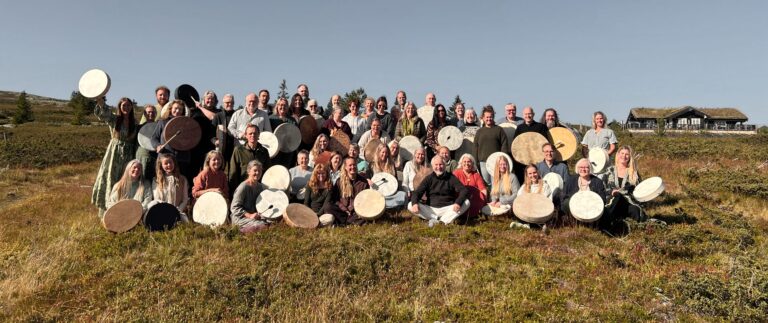
And you have experience of being deep in yang, through plant medicine, and experiencing, let me say, what feels like oneness: this chemical cocktail, hormone cocktail, energy cocktail. Can you now tell us a little about what your first real experiences of oneness were like? You experienced them a year ago, at a retreat I held. Once a year I hold a three-day retreat like this for the most advanced students on the primordial shamanic path to oneness, and especially to spiritual enlightenment, and you were part of it. Tell us a little about what it felt like.
Amina: Yes, so now it’s time for those words. Should I try gurgling a bit too?
Pål-Esben: Yes, go ahead.
The first real experience of oneness
Amina: The first thing I want to say is that there’s a big contrast between what I thought oneness was and how I experienced it during your rituals, and around your rituals. You touched on it just now: there’s a silence, a calm, a peace. That peace and that certainty and that calm and that belonging are, as you say, yin. But it carries such a powerful storm, a hurricane, with it, that you wouldn’t think the two feelings could exist at the same time. My experience is this certainty that lies there, this certainty about all of this that’s so much deeper and so much bigger. Something that goes beyond the intellect, beyond intuition, beyond the visual. It goes beyond picturing things. It goes beyond those videos in your head. It’s something completely different.
No images, only certainty
Pål-Esben: Yes, and just on these images you mention: for example, when you tell us about when you tried ayahuasca, there are masses of images coming, masses of videos, masses of emotions, up and down like a yo-yo. But when you come into a real state of oneness, there aren’t even images. There’s none of that. But there’s something that’s a million times more powerful, and that’s what’s impossible to describe to someone who hasn’t experienced it, because it’s counter-intuitive. How can this tremendous power lie in the deepest yin, in the deepest silence, in the deepest centredness, in the deepest focus? We’ve been brought up to think it lies where there’s yang, where there’s lots of action and lots of images. But that has nothing to do with this.
So that was just to drop in this point about the images, and how hard it is to explain these things. Because you don’t see any images. You don’t see anything, intellectually or visually. But what you experience goes beyond images. It goes beyond emotions. It goes beyond the primary feelings we’ve talked about, like love and happiness and joyfulness. It goes beyond all of that. Dramatically. And that’s the challenge of conveying it to someone who doesn’t experience these things. But everyone who experiences real oneness will understand what we’re talking about here now. Not understand it, but they know that this is what we’re talking about. So that was an attempt to gurgle this out. Go on, Amina.
Love is too poor a word
Amina: Yes, it’s really good that you say something about that, because there are these big contrasts, or not contrasts, but big differences, here. And you touched on love: that’s also something we often hear, that we’re really just love. And love is a far poorer word than what I actually experienced. Love is so small in comparison. I just made a little gesture with my hands here. And not least: it’s very emotionally overwhelming to feel the power of, at least a large part of the power of, what I really am. And at the same time there’s that certainty that it isn’t anything new I’m experiencing. It has always been like this. It isn’t a new experience. It’s a bit like: of course it’s like this.
And trying to explain it in a logical way when I come out of it is so impossible, because there are no words to explain it. When I hear myself trying to explain it, it sounds very biblical, very much like I’ve seen the light. But it’s so much deeper.
The shock and the ripple effects
Amina: And I had experiences of oneness with you last year, and this year, and they’ve had slightly different ripple effects. Last year my system was much more in shock over who I really am, when I came back to my human self. I couldn’t function for several weeks. I struggled to come properly back into my body. I struggled to read on the computer. I struggled to be in the ordinary world. Not only had my energy system had a shock, but what I experienced was also a bodily knowing that there’s no point in stressing, there’s no point in being angry, there’s no point. I was left with a kind of meaninglessness, because we keep rushing around, managing and sorting out all these things that don’t really matter, and at the same time they do matter too. But that’s not the point.
So this time I’m left with somewhat different thoughts and experiences, which I can say a bit about. But for me it was also a little proof that, OK, here I’d touched something that had a kind of ripple effect. Something I learned from last year was that I didn’t cultivate that experience of oneness as well as I could have, and there’s a meaning behind everything and so on, but I went back into the hamster wheel and the stress too quickly after a few weeks, which meant the hamster wheel got a bit of a grip on me. We’ve talked a little about that too: once I’ve felt my true nature, once I’ve been allowed to feel the silence, what I really am, and then don’t feed it, I’ll suffer if I just carry on in stress and the hamster wheel. So that was an important experience. And this year… well, it’s two weeks now since we were at…
The big toe in the Sahara
Pål-Esben: No, let’s hold off on this year for a moment and take the first experience first, so that you, dear listener, also get an idea of the difference as we go deeper into our Sahara. It’s very interesting. The way I’ve designed this: the first time I bring a student into these areas of reality, the real reality, it can be seen metaphorically as going into the depths and touching your Sahara with your big toe. That’s the first touch, which you experience the first time. And it has a tremendous ripple effect for the person who experiences it. Whether it’s just for a millisecond, a second or a minute, it makes no difference.
One of the things that characterise a genuine experience of oneness is that it has a massive impact on a person’s life in the days and weeks after experiencing it. When you go into an energetic, hormonal, chemical, biochemical cocktail of some kind of bliss, it feels good there and then, but you soon come back down to earth and are soon back in the life you live, and there are no active ripple effects in the weeks afterwards. What happens with a genuine, real experience of oneness, like the one you had, and like the ones the rest of your fellow students had too, is that it’s like a shock to the system. And by that I mean the system that has to do with intellect, ego and imprinting. A shock, and a delight for the depths in you that know what you are. It’s a feeling of getting a moment to experience what it’s like to come home. And you carry that with you up out of this indescribable experience.
Metaphorically it can be seen like this: if you read a Word document of 50 pages of text, that’s perhaps a few kilobytes of data. And in an experience like the one you had, you take in a billion, trillion, trillion, trillion terabytes of data, all at once. And you’re one with all this data at the same time. That can give an idea, a metaphorical idea, of the impact this has on our grain of sand. And when the grain of sand has come into contact with it, the way you just barely touched your Sahara with your big toe for a few moments, you have this experience, this reference experience, and you bring the sensation and the experience back with you into the grain of sand. The grain of sand doesn’t understand what this is. It can’t put it into words. It tries to make images of it; it was intense and extreme, but you can’t find the words.
But when you talk to others who have experienced it, you can gurgle together and laugh together, because then you know what you’re talking about.
The integration process: two to four weeks
Pål-Esben: So what happens afterwards is that there’s an integration process the grain of sand needs to go through, that is, our physical body, our psyche and so on. And that integration is about getting used to the experience we’ve had. Because pretty much everything connected to the grain of sand believes you’re a grain of sand. That’s what’s been imprinted into us. We’ve been disconnected from our Sahara since around the age of 7 to 14. So we believe fully and completely that we’re the body, we believe fully and completely that we’re our intellect and our mind, and we believe wholeheartedly that what exists is what’s around us: what we can see, hear, taste and so on.
And the experience of truly touching the Sahara for the first time is a shock to this whole system. It’s like being shaken to your roots. And after an experience like that, once you’ve been shaken to your roots like this, it takes at least somewhere between two and four weeks before you even get back to normal. Like the others, you were prepared six months in advance, so that these after-effects wouldn’t leave you unable to function in daily life. Because if you aren’t prepared, an experience like the one you had the first time will leave you unable to relate to people, unable to relate to your kids, unable to relate to anything at all. Then you need a protected setting to be in, and that’s why in an ashram, for example, you have others to look after you.
But that isn’t our way of doing it at the Yggdrasil Shamanic School. There we want you to be able to live a happy life in the material world, in your grain of sand, while gradually getting one foot in the Sahara and oneness. That means you’re prepared thoroughly, with exercises and insight and all these things: what do you need to do after an experience like that to bring yourself down stably enough into your material life, so that you can actually be a mother to your kids and all these things? When a guide brings a human being into this state, it has to be done responsibly, doesn’t it?
Amina: Yes.
Pål-Esben: So you’re drilled and prepared in this, of course also through the basic training and the senior shaman training you’ve been through beforehand, in addition to six months where we prepare these things. And when you come home after an experience like that, and you’ve had a genuine experience of oneness of the kind we talked about, you’re also in an integration phase for somewhere between three and four weeks minimum. Sometimes it goes on for two or three months, but less intensely. And that’s what you’re telling us about here now?
Amina: Yes.
Pål-Esben: And this is one of the big differences when we separate the wheat from the chaff, a hormonal bliss experience versus a genuine experience of oneness. This is one of them. Because it took quite some time. And not just with you: all the fellow students who have experienced this went through a tremendous process that had to be integrated for several weeks afterwards.
The year after: deeper into the Sahara
Amina: Yes, absolutely. And I noticed that this year too, when we talked around the dinner table and in the breaks: you can see the group as a whole has grown. Last year we were perhaps children in this area; now we’re perhaps a bit more like teenagers, and able to handle our own experiences, impressions and challenges in a completely different way from last year. And what you say is quite right, that we’re thoroughly drilled a good while in advance, and also given input afterwards on how we can integrate it as well as possible. And then it’s the student’s responsibility to take on board the input you give. I learned quite a lot last year: whoops, I thought I was doing it, and then I wasn’t, and that one I perhaps didn’t take so seriously. I’ll do better this year.
So this year I took a three-month summer holiday to prepare myself. I made sure I had several weeks afterwards with nothing planned, so that I was well prepared, while at the same time it was important to me not to lose touch with the world and myself in these preparations, so that it didn’t turn into anything fanatical. And my experience this time is that the experience of oneness now was, I have no words, deeper in a way. I don’t know if I can call it deeper; maybe you can help me with that later on, Pål-Esben. But it felt deeper, though without as much of a state of shock as last year.
What has been very important for me is to keep in contact with the subtle, to keep grounding myself, and not least the creative process that happened both last year and this year, the creative process in me. I’ve never drawn as beautifully as after having experiences of oneness. And the creative process too, that integration: I can feel in my body that it’s about adapting to the new reality. Because reality is no longer the same as before I experienced these things.
But I think the biggest thing that has happened in my life since the ritual now, which was two, two and a half weeks ago, is that the way I see reality has completely changed. The way I see myself in other people has completely changed. I no longer get tired and worn out by ending up in situations where I have to take charge and sort things out. And I have children, and things happen, and there can be disagreements, things you have to spend a lot of energy on. I can feel that I don’t get as upset. I don’t get stuck in secondary feelings. And it isn’t like before: earlier this year I sometimes had to remind myself of the bigger reality. There’s a bigger reality, this is the grain of sand, I’m really the Sahara, this will be fine. Whereas now that certainty is there all the time. I don’t need to say: hey, hey, stop, you’re really the Sahara, you don’t need to stress about this.
So that’s perhaps one of the biggest differences: that I carry it with me through my daily life. I see these changes, I’m able to see people in a different way, I’m able to radiate something different, from a different place than I’ve been able to radiate from before. And, at the risk of it sounding as if I’m sitting on a throne, that’s what I experience, and the feeling is very humble: that I’ve come into contact with my own divinity, with my own light. But it’s a very humble and subtle feeling.
Personality development on steroids
Pål-Esben: But exceptionally powerful, on the other hand. It’s a paradox. And what’s interesting is this: the first time I bring a student in, we touch the Sahara with the big toe, because we have to do this a bit in steps, otherwise the integration process afterwards gets challenging. And the year after, we dive a little way down into the Sahara. Metaphorically again, there isn’t really any Sahara, but we dive a little way down into the Sahara and get deeper access to a larger spectrum of everything that is, if we’re to use the gurgle words for this. And the deeper, let’s use linear words here now, the deeper these experiences go, the more powerfully it begins to seep and flow from our real self, which is connected to our Sahara, into our grains of sand, which are our material existence.
And when you have real experiences of this, the personality begins to change without you needing to do anything. In the old days, when you started with me about two and a half years ago, you learned the rough tools for handling our personality and our challenges in behaviour and so on. Then you learned, among other things, something called the Interrupt Handling Technique, self-regulation: taking a couple of breaths before you react to your partner saying something you don’t like. That’s the rough work, where there’s a lot of effort, practice and new routines; you can find it in a lot of personality development. And that’s the heavy part of the path of development, even though of course you’ve had lots of lovely results, as we’ve described through the podcast episodes.
But when you begin to come into these areas in your process of development, you could say you get personality development on steroids. You don’t need to use any particular methods and techniques; you simply become different. You described it so well: without doing anything specific, you smile more at yourself and the world, even though the world is just as silly as before. You have a greater basic peace with the world and the people around you. You interact with the people and the children around you in a different, more peaceful, more grounded, more empathetic way, without doing anything in particular to bring it about. If you tried to build these qualities through practice, it would be almost impossible with traditional tools from psychology and so on. That’s what begins to happen to a person’s personality when they begin to turn homewards and have genuine experiences of what they actually are, which we metaphorically call our Sahara.
And that, I must say, is one of the most valuable things about a path of development like this: that you get to experience interacting with your grain of sand in a far more rewarding and joyful way than has been possible before. Those are my words for what you’re describing here now.
It lives in all of us
Amina: Yes, I notice it. And it’s that feeling of gratitude and genuine happiness and joy. I wish it for everyone, and it lives in everyone too. That’s what’s so beautiful: it lives in all of us. It’s what we really are. And then we have all these barnacles and all the muck on our hull that we’ve picked up in this incarnation: all the labels, that’s good, that’s not good, this is how you should be, this is how you shouldn’t be, our trauma mechanisms and compensatory mechanisms, the autopilot, which steers us more or less a hundred percent through our everyday lives.
When you break out of this and begin to experience what it really is, you automatically begin to relate to the circus and the madness in a different way. Then you can genuinely begin to delight in it. Because there’s a reason why our soul has come into this hamster wheel, this straitjacket, or whatever we want to call it, where it’s limited by time and space, where from the soul’s point of view it has become deaf and mute, and where it has to deal with learning without any memory of or insight into what it really is. It’s one of the most complex things a soul can do, and in an earlier episode we talked about the elite university for souls, which is this planet of ours, and how this fits together.
Pål-Esben: But of course, when you begin to experience these things, the way you’re beginning to experience them now, you get a completely different perspective, not through theory but through experience, on what the soul is, and what you really are.
For me as a guide, it’s such a joy to get to guide a human being on a path like this, because it’s my contribution to a counterweight to the crazy world we live in, where there’s more and more anxiety and fear and illness and aggression. This is my contribution to creating a small counterweight: every single person I bring into this state will have a massive influence on the people they meet in their daily lives. So one becomes very, very many. And one day, Amina, you’ll be able to do this too.
Amina: I hope so.
Telling the experiences apart
Pål-Esben: So to sum up a little of what we have so far: we have to distinguish between different types of experience. And then there are genuine, real experiences of oneness. In linear language you could also call them experiences of spiritual enlightenment, but I don’t really like using the term spiritual enlightenment; I’d rather say an experience of oneness, an experience of being one with everything, an experience of the Sahara. And that’s a process you need to go through if you want to experience what is real. And there’s no shortcut. But it doesn’t need to take 30 years. In your case it took about a year and a half from when you started with me until you had the first deep experience of oneness you talked about. A year and a half. That means it doesn’t need to take decades.
The next step: the Sahara in everyday life
Pål-Esben: And now you’re two and a half years into your process of development and have gone into deeper experiences. Through the preparation work you do, and the methods and techniques and all these rituals you learn so that this can happen, the next step now is to try to integrate this access to the Sahara into your everyday life, actively, any time, anywhere. That means bringing yourself into contact with your Sahara within a millisecond or a second or two in your daily life.
Because my goal, when I take you and your fellow students through this process, isn’t for you to depend on me to have experiences this deep. My task is to bring you and the others to a point where you can experience this yourselves through your own contact. Now that we’ve dived a little way down into the Sahara, the time is coming to show you the method for bringing this reference experience up into your daily life. When you’re standing there talking to your partner, who perhaps isn’t saying the things you like best, or at any rate when you’re in a difficult situation, you can just close your eyes, take a breath and use this particular method, which takes from one to five seconds, and there you are, in contact with everything. And then you’ll see that communication with your partner, even if it’s difficult, will be very, very simple.
You can also come into contact with it when you sit down and contemplate, meditate, reflect, are in contact with nature and so on. Then, through your own effort, you can help yourself find this state. And that’s the ultimate goal, of course: that you won’t depend on others to be able to find the way home to yourself. That’s what lies ahead of us now, which we’ll work on a bit in the next cycle.
Amina: Yes, I’m really looking forward to that. I’m so grateful to you, Pål-Esben, for guiding us through this journey. Even the word journey is too poor; the process of development, I mean, on the way home. Wow, how lucky we are. Really.
Finding a genuine guide
Pål-Esben: The challenge, the biggest challenge, for a human being who longs for the depths within themselves is finding a suitable, qualified guide out in the esoteric market, which is very, very difficult. You need quite a bit of luck to find someone who’s actually genuine and real. There are far too many theorists out there who have read lots and lots of books on enlightenment and studied the Bhagavad Gita and these older Indian texts. I’m very dyslexic, so I can’t say these words properly. They’ve studied and studied, and they can talk endlessly about oneness and enlightenment, about everything the masters say, but they have absolutely no idea what it’s about.
So when you’re looking for a person to guide you through a process like this, you have to find a person who actually experiences this themselves, and who has a conscious framework, a conscious setting, clear methods, techniques and a clear process for taking a human being forward on this path. That’s often what’s hard to find. And the most skilled of all rarely have time to take on new students. So that’s a challenge. Say you’re going to find a guru in India, for example, who is spiritually self-realized: what do you think the chances are that he’ll be interested in you in particular? You might be one in a thousand or one in ten thousand sitting there doing meditation. So it isn’t that simple. You need quite a bit of luck, and a fair bit of gut feeling, to find someone suited to taking you through a process like this, which is a very special process.
Self-responsibility: breaking the chains
Pål-Esben: The process simply isn’t suited to most people. The reason is that most people are looking for easy solutions and aren’t willing to do the work you’ve done, which we’ve described throughout this podcast series of ours. Because there’s work that has to be done, and most people aren’t willing to do it. There are excuses: there’s too much to do, I don’t have the money, I don’t have the time, I have a family. And then you keep losing motivation, and so on. Then people themselves aren’t willing to do the work you and your fellow students have actually done in order to have any chance at all of experiences like these. Because there’s no shortcut. There’s work that needs to be done.
And to describe that work: today, metaphorically speaking, the ego, the intellect and the karmic memory put their straitjacket on us. It’s so rigid. Because it believes fully and completely that we’re there in time and space, and it has lots of notions about things, lots of opinions it believes in, which have nothing to do with reality. That means you live in a very trapped state. And to be able, in time, to find this path to your Sahara, which you’re on now, you first need to break the chains of the ego-intellect and our behavioural mechanisms, the ones that pull us into the typical ego-mind world, with secondary feelings of fear and anxiety, and problems with forgiving, and grudges, and these things.
You have to turn this around and break these chains by learning what self-responsibility is: that you alone are responsible for your life. You can’t blame anyone else at all for things being the way they are. And just acknowledging that you’re fully and completely responsible for your life is something very few people are willing to do. Because it has a consequence: if I’m the one responsible for yelling and screaming at my partner, even though my partner said something I didn’t like, it means I’m also the one who has to do something about myself. And most people aren’t willing to do that. They’d rather blame their partner, and others, for their difficulties.
But you were one of those who said, “Ugh, Pål-Esben, this is going to be hard,” I remember, at the start. We’ve discussed this a lot all along the way, and you have more power than you think. We start very gently with this. Now we’re so far into our podcast series that we say it straight out; if you go back to the very start, we skirted around it much more. But in the end it comes down to this: a human being who isn’t willing to come to this point and take self-responsibility for how they act, how they think, how they feel, how they behave, is forced to stay in this straitjacket, where the autopilot is in charge.
And at the start that’s the hardest work, that is, when we go through the basic training. That was the hardest part for you; there you’re confronted with all these things: self-responsibility and consciousness and the Path of the Heart, and becoming a master of forgiveness and gratitude, and all these things we’ve talked about. But it’s an absolute necessity for breaking enough of the chains that bring us into our hamster wheel and our straitjacket, so that we’re open and prepared for the deeper part of our path of development. That’s why, before I bring you and my other students into experiences like the ones we talked about, you go through the basic training, where you’re prepared, and the senior shaman training, where you’re prepared to take on some of the other difficult chains, with deep karma, crystallised karma and other things we discuss. Then you’re ready to begin a process like this, because by then enough of the work has been done. You’ve removed enough of these layers that are like a wall around the heart, another metaphor for this. Then you’re ready to begin seeking in the depths, as you did.
So you have every reason to be very proud of yourself there, Amina. And I’m very proud that you had courage enough to be willing to do what the ego and the intellect hate, namely change.
The thread running through and the guru’s role
Amina: Yes. Yes, it certainly hasn’t all been easy, but I haven’t given up, I can tell you. And that’s what you touched on just now: the importance of the thread running through the Yggdrasil Shamanic School, all the way from the basic training to the primordial shamanic path to spiritual enlightenment and oneness. It’s so important, that thread running through. Many people just want to hop onto a course or seminar, or something where you can look at mandalas or sacred geometry, or jump into something or other, or those ecstatic settings, which I don’t judge at all. But I see how important it is to start right from the ground up. It’s no walk in the park. And that’s perhaps also one reason why many people want to skip the deeper personality development. Another pitfall is believing you’ve finished working on it. You think you know what it’s about: “I’m not like that.” You don’t see the truth about yourself. You don’t see where you’re blocking yourself. That’s where I see the importance of having guidance alongside me, where you can point out where I’m tripping myself up, or offer insights I haven’t thought of.
And I think it’s important to say something about this too, because we’re in a time now when people talk a great deal, and you hear a great deal, about the guru’s time being over, the mentor’s time being over. Now everyone is supposed to find the truth within themselves; you shouldn’t be managed and ordered about by others around you. I’ve seen quite a few people talking about that. I can understand the point, but I also see it as yet another delusion. Of course there have been many through the ages, whether priests or gurus or leaders, who have abused their position and led people completely astray. But this is about finding, as you’ve touched on many times, the right school, the right guide, the right mentor. Because I can say with my hand on my heart that I couldn’t have done it alone. Nobody can do it alone, and that’s a big misunderstanding.
When you hear that the guru’s time is over: well, I hope not. Because guru is a problematic word in itself. Problematic, since the guru is often associated with cults, and with having to worship a guru. That’s often done in India: there’s a worship of the guru, where you’re the underling, and then there’s the great guru. So of course it’s good to distance yourself from the concept around it, but not from what guru means. It’s the one who brings the light, who helps you find the light in the darkness. That’s what guru really is: the bringer of light. It’s what brings you out of the darkness. The idea that I should try to do this on my own is so pointless.
Pål-Esben: Imagine, then, a human being trapped in this straitjacket. They run more or less completely on autopilot. Pretty much all their actions, reactions and emotions are spat out on autopilot. They’re full of fear and anxiety and hatred and grudges and polarities. And then a human being like that is supposed to lead themselves into freedom and oneness? That’s as stupid as it gets. It’s as stupid as believing that AI will be able to talk to your dead parents, or your spiritual guides. People need to start waking up from this nonsense. You make blunder after blunder, and then you’re supposed to be able to just wish for anything you want from the universe, I suppose. People, we need to wake up.
If you study, and are willing to invest in studying the main traditions that exist in our world today, the ones that over thousands of years have brought people into genuine oneness, you’ll find in each of these great traditions, and let’s take the yogic tradition as an example, that it isn’t possible without a qualified guru. They call it guru; I call it guide. Because even if, in some miraculous way, we’d freed ourselves from all grudges and hatred and secondary feelings, and all our compensatory, automatic mechanisms, and in some miraculous way had brought ourselves out of it on our own, we still wouldn’t manage the next step. When you’ve sat meditating for 10 to 20 years to become still enough, you can meditate for another 40 years without breaking through to the state of oneness we’re talking about. Because when you’re ripe, you need a push. In yogic philosophy, in the process of falling upwards, it’s called the second birth. There the guide, who is already in contact with this oneness, needs to bring the human being across with what we call a push. And that’s something very few will ever manage on their own.
So you have to get through two almost superhuman tasks. And then I think: why choose a path that’s almost impossible? Why not find a path that’s accessible and possible, if you’re going to set out on this? Why let cloud cuckoo land and the madhouse in our heads decide how and what we do? Why not come down to earth and say: maybe I should calm down a bit? Maybe I should shift into a more contemplative and reflective mode, think through what I say, think through what others say, and listen to people who have experience?
That’s one of the reasons the two of us make this podcast: at least to inspire people with our experiences. And the process of experience that you and your fellow students go through isn’t some theoretical thing. It’s a very experience-based and very clearly designed process you go through. Not something channelled from somewhere or other, where we’re now suddenly supposed to become enlightened.
The monks, the master and the push
Amina: That’s very interesting, and lovely, what you’re bringing up. Because this summer I talked with quite a few monks, and I wondered a bit: these people have meditated for over 40 years and live quite strictly, away from pleasure and the good things life can offer. They have a goal of experiencing oneness, or of becoming an Arahant, as they called it. So that’s where I began to think a bit about the role of the guide, the guru, in this, and how long you can really keep meditating without reaching the finish line, for lack of a better word. You meditate your whole life without reaching the finish line.
Pål-Esben: Several people who come to me have meditated for 20 to 30 years, for example with TM meditation and so on, and they don’t get any further, and of course that can have many reasons. My guide, who lived up in Tibet for a couple of decades, in mystical temples, not religious temples but in the mystical branch of Buddhism, in temples in Tibet and in China, meditated for hours every day for 20 years without reaching these states. For hours, several times a day, of course: meditation in the morning, meditation at lunch, meditation afterwards; he perhaps meditated six hours a day, for 20 years, without breaking through. Well, he had prepared himself, with a still mind and all these things, so everything was prepared. Only when he met his own master, who brought him across, did he get there: Zen master Hogen-san, one of the best-known enlightened Zen masters in history, who through a process pushed him across into oneness, with the same kind of shock you’ve experienced. He cried for three days, and it changed his life for ever.
So meditation is what takes you part of the way in. Because meditation, for a still mind, is of course an important part of this too. We need to cultivate our mind so that it calms down and can focus on one place, towards the silence. And as we manage to do that more and more deeply, we’re more and more able to distance ourselves and dissociate ourselves from our karma. Our karma is our physical body, our thoughts, our feelings, all these opinions. As we become stiller and stiller, and dissociate ourselves more and more from karma, observing our thoughts without thinking the thoughts, for example, then we begin to get somewhere. Then you begin to be prepared for a guru, or a master, or a guide, or a teacher, or whatever it is, who is already present in their own Sahara, to push you across with a featherlight push and into this setting. That’s how it has been done for thousands of years, in pretty much all the great traditions of this world.
The veranda builder and the big words
Pål-Esben: So there are many, many misunderstandings about this, and I understand that too. Many people have opinions about it. A great many of these esoteric theorists, esoteric academics as I call them, want to turn everything they’ve read in all the books about this into academic theory, and then they think they understand what it is. But they have no experience, and you should beware of taking advice from someone who has no experience of what you’re seeking advice about. If you’re going to build a veranda, you don’t ask the neighbour who has never built a veranda how to build a veranda. You ask someone who has built a fine veranda, and who’s capable of giving you good advice about what you need to do, with the foundation or whatever it is, since he’s built a veranda himself. But is that what we do? We don’t ask Granny how she builds the veranda, do we? We’ve got that much sense, at least.
But in the esoteric world it seems that intelligence doesn’t exist. Because there, people believe that anything that glitters, anything that shines, anyone with however many hundred thousand YouTube or TikTok followers, must know all about everything. But that’s rarely how it is, unfortunately. There are many who claim to have built a fine veranda, so how do you separate the wheat from the chaff? Because you can hear it in them: they use these big, fancy words you don’t understand the first thing about, and then you think, whoa, this person must know what he’s talking about, because I don’t understand what he’s talking about, so he can guide me to that fine veranda. And that’s a problem, and there’s no simple solution to it. Because when people learn to use the right words, having studied and read books and listened to those who have these experiences, and then start using these words themselves, it’s almost impossible for a human being to work out what’s wheat and what’s chaff.
Here the simplest way to break through and separate the wheat from the chaff is to take a look at the teacher’s students. That’s where you’ll find the truth. In our tradition, for example, there are many others who have these experiences. You’ll find interviews with some of them on my website, wanvig.no, which tell a little about at least the basics, and in time there’ll also be an interview about experiences of oneness and things like that. So that’s one way of investigating, when you’re looking for a guide, or a teacher, or someone who can lead you. A human being who is to be led on this path should at least have a good deal of scepticism towards everything, especially when they have no first-hand knowledge of it, and be willing to do their research and use a bit of common sense and their gut feeling. When you find someone who uses a great many difficult words you don’t understand, you should always be sceptical.
The dyslexia that became a gift
Pål-Esben: This is a digression, but I have quite a serious form of dyslexia. Back in the day, it was actually only discovered at upper secondary school. So I’d managed to go through the whole school system without anyone realising I had serious dyslexia. On top of that I was half blind: I sat at the back of the class and couldn’t see anything at all on the board, so already then I learned in other ways than the others. And at upper secondary there was a teacher who was trained in dyslexia and these things; I think it was one of the therapists who worked as teachers, with dyslexia as their area of expertise. The teacher was the first to see there was something going on with me. Because I could fool everyone else and wear masks, but with experts it’s very hard to wear masks. So the teacher took me aside: the teacher saw that I had a problem reading and writing, that the words jumped back and forth, and things like that. So I told the teacher I had a problem: I didn’t read books. “You don’t read books?” “No, I don’t read books.” “Then how do you learn?” “I’ve found other ways to learn.” So the teacher went through the tests with me and uncovered a form of dyslexia. And then the teacher asked me: “Do you want more time in exams? Because now you’ll get a lot longer in exams.” “No, I don’t.” Because I wanted to manage as I was. I never saw my dyslexia as a problem.
Today I see my dyslexia as a gift for you and my other students. Because my brain doesn’t have all these fancy words. I have a very simple vocabulary available, and it’s with that simple vocabulary that I explain things, and that’s a gift to you. If I’d had that kind of intellectual thing we often find in the yogic tradition, with gurus who are very, very intellectual and use such complex, fantastic words, if I’d done that, then I’d have understood so much of this with my head, and that would have made it harder to walk this path of development. So I see my serious dyslexia as a gift to my students.
Amina: That’s a very good point, and when you put it that way, it’s very clear. Because goodness, what incredibly difficult concepts you’ve managed to explain to your students in a simple way that makes people understand. It has always fascinated me how things I’ve heard about before, which other people have tried to explain, suddenly just become: yes, I see it.
Pål-Esben: It’s been a good ally, along with the fact that my brain can think very pedagogically; that’s another thing. So it’s a combination of the two. But that was a completely different digression. I don’t understand why I talked about this, but anyway: if you, dear listener, notice that I stumble over words, use the wrong words, or use certain phrases that come up again and again, then that’s just how it is. I get some feedback from people who listen to the podcast that I say specific things all the time; I don’t even remember what they say. And I have no intention of doing anything about it. There are other things to do than doing something about my language, because it isn’t there to be perfect. I like flaws. I don’t like things polished; I like them a bit rustic. And if people can have a little laugh at me, and at the words I use, and at the way I slip up and use the wrong words and so on, I think that’s very good. Very good. Then you don’t need to work on everything. As long as you understand what someone is trying to express, that’s the key thing here. That’s the key thing here. So that was my dyslexia.
Amina: Lovely, OK.
No shortcut into the retreat
Pål-Esben: Yes, OK. So to sum up this conversation, Amina, there’s one more thing I’d like to say before we sum up. Now and then people come to me: “Can’t I just come along? I’ve heard rumours that your students experience extreme things on your retreats in the Norwegian mountains. Can’t I come along to that?” Well, you could come along, but then you wouldn’t be able to live a normal life afterwards. That’s the reason you can’t come along. You’re so prepared for this type of experience, and even you are knocked sideways for weeks after an experience like that. What do you think would happen, then, if you took someone who isn’t prepared in this way, brought them into this and let them touch this oneness, unprepared, and without the tools to balance the system afterwards? It would be completely irresponsible. Because now and then there are people who want to take a shortcut straight to me.
So anyway: very, very exciting, Amina, and I’m excited for you. Things are starting to heat up now. This is where the rubber meets the road: action, and the most exciting part of a human being’s process of development can begin. Or has begun. And I’m looking forward to the road ahead.
Amina: Yes, thank you, likewise. I’m looking forward to it. It’s a truly fantastic journey to get to be part of.
An invitation to you as a listener
Pål-Esben: Do you have any closing words of wisdom, Amina, as we wrap up here?
Amina: Yes, closing words of wisdom always catch me just as unprepared. I’m thinking: now you’ve perhaps listened all the way through, yes, clearly, since you’ve come this far in the episode, you’ve listened to the whole thing, and then perhaps you’ve formed some thoughts and opinions, you as a listener: I agree with that, I disagree with that, that gave my ego a little jolt, and that was nice. And maybe that too. Then I’d just like to invite you to listen to the episode once more, without thinking so much, without using your head, and perhaps see whether some of the words we say, and the things we share, open up something in you of the truth that lives in you, without the intellect getting involved.
Pål-Esben: Yes. And if you’re wondering about these things, I’d recommend getting in touch with Amina directly; have a chat with Amina. It isn’t so easy to get hold of me, so that’s why I have Amina, so you can have a chat with her, hear a little about her experiences, and talk one-to-one about these things. What we can share in this podcast is one thing, but when you meet a person one-to-one, you often get a slightly different impression too. So I encourage you to do that, dear listener: if you’re curious about these things, curious about the process of development Amina has been through, get in touch with Amina directly at aminab.no. There’s a contact form there; get in touch directly. And you have no problem having a chat with people?
Amina: No problem at all. It’s just lovely, so you’re very welcome.
Pål-Esben: Great. And thank you, Amina. How boring it would have been if I’d just sat here talking to myself. Thank you so much for staying with us all the way, dear listener. We really appreciate your feedback, and a five-star rating on Spotify helps our podcast reach more listeners. And thank you so much for being here with me, Amina. I really appreciate it.
Amina: Likewise, Pål-Esben.
Pål-Esben: Thank you for being with us, dear listener. I hope you’ll join us again in the next episode. And until then: have a truly wonderful day, evening, night or morning, wherever you are listening from. Take care.
Outro
Thank you so much for listening to this episode of “The Journey to Self-Realization”, a primordial shamanic journey of development back to your true nature. We hope Amina’s story has inspired you to explore your own journey of self-discovery and development. Remember that the path from suffering to self-realization can be demanding, but with courage, patience and support from a competent guide, mentor, teacher or therapist, almost anything is possible. We wish you all the best on your journey, and we’ll talk again in the next episode.
The Journey to Self-Realization
Nature’s Path to Freedom and Self-Realization
Curious about what primordial shamanism really is, behind the mystique and the misconceptions? In this short online course I tell the story of my own path from skeptical engineer to teacher of primordial shamanism, and give you a first introduction to what I teach: what shamanism and primordial shamanism are and are not, how rituals and rune magic are used in practice, and why the longing for growth matters so much for a good life.
The lessons are recorded in Norwegian; the English version will be ready in November or December 2026. Leave your email on the course page, and I will tell you when it is.