Episode 44 – Natural Disasters, Empathy and Sensitivity – Do You Have to Carry the World’s Suffering?
This past summer, Pål-Esben’s old house of oak and clay in the middle of Germany, which normally stays cool in the heat, got so hot that he started talking about installing air conditioning. As a child, Amina couldn’t even watch children’s films like The Lion King: it took her weeks to get over them.
In this forty-fourth episode, Amina and her teacher and guide, Pål-Esben Wanvig, talk about natural disasters, the first of the listener questions in a new run of episodes. They explore why the Earth’s climate moves in long cycles, why sensitivity is a gift that doesn’t have to make you suffer, and why suffering along with others helps no one. It is part of “The Journey to Self-Realization”, a podcast about the bravest journey a human being can set out on: the journey home to yourself.
This episode is an English translation of our Norwegian original, voiced by the digital avatars of Pål-Esben and Amina.
In this episode
- Natural disasters as punishment from the gods, and why volcanic eruptions, earthquakes and floods follow physical laws
- The spinning top: the Earth’s wobble over 26,000 years, ice cores from the poles, and how human pollution has sped up the warming
- Kali Yuga, earlier cycles of humanity, the underground cities in Turkey, and adapting to more extreme weather without fear
- Numb people and sensitive people, and why sensitivity is a gift that doesn’t have to make you suffer
- Amina’s own story as a sensitive child, how old cultures celebrated the dead, and empathy without suffering
- Whether sending love helps, the indifference in our society, and the 30-day experiment without news and social media
- Amina’s detox, brain rot and the emotional roller coaster of scrolling, and why energetic protection only makes you weaker
- The lesson Pål-Esben learned as a new guide about other people’s free will, and the name of the Earth’s wobble
This podcast is for you if you:
- Seek real depth in your spiritual practice
- Want to understand yourself on a more fundamental level
- Are curious about shamanism but tired of superficial “new age” spirituality
- Have taken many alternative courses but still feel that something is missing
- Feel an inner longing for freedom, love and wholeness
In a time when so many get lost in external methods and promises of quick fixes, this podcast invites you back to the only place where true answers can be found: your own heart.
Listen above, or read the full conversation below.
Transcript
A warm welcome to the podcast “The Journey to Self-Realization”, a primordial shamanic journey of development back to your true nature. This podcast is a collaboration with our favourite magazine, the health and lifestyle magazine Medium, and is devoted to exploring the bravest journey a human being can set out on: the journey home to oneself. We follow Amina, a student at the Yggdrasil Shamanic School, as she goes through a deep primordial shamanic process of development together with her guide and teacher Pål-Esben. It is a raw, unpolished journey of discovery towards true joy in life, deeper meaning, and a life that truly feels good to live.
This episode is an English translation of our Norwegian original, voiced by the digital avatars of Pål-Esben and Amina.
Pål-Esben: Hi, Amina, and a warm welcome to a new episode.
Amina: Hi, Pål-Esben. Thank you so much, and likewise.
Pål-Esben: Thank you. And a warm welcome to you, dear listener. In the episodes to come, we’re changing pace: we’re starting to answer questions we’ve received from our listeners. We’re really looking forward to that, Amina. There are lots of slightly wild topics we’re going to discuss, slightly extreme topics. And we’re looking forward to sharing our thoughts and opinions on these things.
Amina: Yes, many of them are topics that aren’t covered at the Yggdrasil Shamanic School, so it’s going to be very exciting. We’re going to discuss everything from aliens to all sorts of other odds and ends.
Pål-Esben: Oh boy, now you really have something to look forward to, dear listener. So what are we starting with today, as the first topic a lot of people are wondering about?
Natural disasters: the topic many people wonder about
Amina: There are plenty of topics to choose from, but something that’s a hot topic these days is natural disasters and everything happening in the world around them: climate change, volcanoes, nature having its say. And there are lots of thoughts out there. Is it us humans who are to blame? Are we the ones causing this? Is it divine, mystical forces out there? Is it aliens? Is it evil forces doing this? What’s the reason all this is happening?
Many people also talk about how we’re now in a time when more light is coming in on the Earth, and when more light comes in, the darkness has to come out. So Mother Earth is speaking up and saying there’s been a lot of darkness here. So there are many thoughts and a lot of speculation around this. I don’t know much about it, so I’m looking forward to hearing your thoughts.
Mythical accounts and reality
Pål-Esben: Yes. And it’s important that we separate mythical accounts from what is reality, at least the way we see and experience reality. Many people wonder why the Earth is changing so extremely right now. Those who watch the news notice that there’s one natural disaster after another after another. We’ve just been through a scorching summer here in Europe, with over 40 degrees Celsius in some places. Many, many people have lost their lives because of the heat. In other parts of the world there are floods and landslides. And people wonder: is this some form of punishment?
There are many people, especially in alternative circles, who find explanations with mystical, spiritual or divine causes. A country is being punished, people are being punished because they’ve done things that aren’t particularly good, and that’s why they’re suffering in the disaster.
I think it’s important to make a distinction here. Because all the physical phenomena we have in this world are governed by physical laws. But in the mystical realm, people often want mystical explanations for things. They want karmic cycles, karmic explanations. The way I experience Mother Earth and our physical world, everything that happens in the physical world is governed by physical laws.
Take a volcanic eruption as an example. The idea is that it’s caused by some god or demon who gets angry with people, and then suddenly smoke starts pouring out of the volcano, and the eruption comes as a punishment for those who live around it. Those are mythical stories that people perhaps used a thousand, two thousand or three thousand years ago to explain things they didn’t really understand. When people had to explain something they didn’t understand, they usually looked up to the divine, to God, and gave that kind of explanation for the smoke and these things.
But today we know that a volcanic eruption has nothing to do with divine punishment. It’s about purely physical laws: pressure builds up, perhaps the tectonic plates start to move and build up tension, and then comes the release of pressure, which is the eruption itself. The same goes for earthquakes. They’re nothing other than physical aspects of Mother Earth.
I can understand that human beings have needed to explain these things mystically, since they didn’t understand why they happened. Another example: right now, especially in Asia, there’s quite a lot of extreme weather, with landslides and floods, and ice that’s melting drastically. Suddenly the water pours down the valleys and destroys people’s houses. It takes lives. There’s massive, massive suffering for the people who experience this. And then you often see the explanation that a whole group of people is being punished by divine beings.
But when you study the cause of these events, for example that the mountainside gives way, that earth and sand slide over the ice and release meltwater, which in turn creates floods that run through the valleys, you’ll always see that it’s physical laws and physical phenomena that lead to them. Especially in today’s society, where we have modern research, satellites and all kinds of measuring equipment, it’s very easy to see that these are natural things that Mother Earth creates.
Why is it happening more and more?
Pål-Esben: The question that’s perhaps even more interesting is why this is happening on a bigger and bigger scale as the years go by. Because it’s beyond any doubt that when I was young, many, many years ago, we very rarely heard about extreme weather. Admittedly, we didn’t have the internet back then, so perhaps that was one of the reasons. But I’ve noticed that this has become much more intense and much more extreme as time goes by, especially over the last ten to twenty years. It looks as if the planet is going more and more haywire, with more and more extreme weather. And perhaps the most interesting question is: why is this happening now? I don’t know what your thoughts are on that.
Amina: I’m very open; I don’t really know what I think about it. I don’t have a clear answer. I’ve been taught and brought up on the idea that it’s us humans who are causing this, through climate change and all the emissions and everything we’re doing; I’ve certainly heard a lot about that. That’s the closest explanation I have. And in esoteric, alternative circles I’ve heard a long list of different explanations, but it hasn’t been the topic I’ve dived into most, so I’m actually quite open there.
It’s getting warmer, and it’s measurable
Pål-Esben: What’s certain is that climate change is happening. Especially for those of us who live in Europe, this past summer brought the most extreme heat we’ve ever had here. Even where I live, in the middle of Germany, it’s been so hot. We’ve had many, many days of nearly 40 degrees Celsius, something that has never happened up here before. I live in an old house of oak and clay, which normally stays very cool when it’s hot. But this summer it’s boiling, so even here we have to think about installing air conditioning now. That’s quite interesting, because in Germany almost nobody has air conditioning. And now I’m starting to talk about having to install air conditioning, because the weather is changing so drastically.
Of course this is part of climate change, but the question is why this climate change is happening. Because when the temperature rises, extreme weather increases too. That goes without saying. What’s certain is that it’s getting warmer and warmer on this globe. There’s nothing esoteric about that. You can also measure how the temperature has risen steadily since 1980, for example. I don’t know how many degrees it is, whether it’s two or three degrees or something like that, and that’s quite drastic in such a short time.
And when it gets warmer and warmer, you get stronger winds, more fluctuations, more storms and all these things. That’s also a natural phenomenon that happens when the temperature rises. But the question is: why is the temperature rising?
Amina: Yes, is it because we drink our fizzy drinks through plastic straws? Or what’s the reason? That’s an interesting one.
The Earth’s long cycles
Pål-Esben: Many people have opinions about this, and the polarities are quite extreme, right out to the most fanatical positions. What we’re talking about now may be a bit radical, but this is at least how I think about and see these things. Of course we humans affect our environment. Through greenhouse gases and the way we live, we’re helping to raise the temperature. Absolutely.
But what I find interesting is to look at our globe over a much longer span, over many tens of thousands of years. Is something cyclical going on with our planet? We all learned about ice ages back in primary school. Suddenly there’s an ice age, then the ice age goes away, and then it gets warmer and warmer, to the extreme. Then it turns, and it gets colder and colder, until we’re in an ice age. And then it gets warmer again, to the extreme. That’s how it goes, in cycles.
The proof is very simple. When they do core drilling at the North Pole and the South Pole and take ice samples several kilometres down into the ice, the deepest ice is very, very old. There they see the layers from the times when it’s been cold and warm on this globe, and they see that the globe goes through certain cycles. And that isn’t something man-made.
The spinning top: the Earth’s wobble over 26,000 years
Pål-Esben: The cycles are connected to the Earth’s wobble. The Earth is like a spinning top. Of course we spin around, but we also wobble, the way a spinning top wobbles at the end once it’s been set going. This wobble runs over about 26,000 years, and as an astrologer you know this long cycle very well.
When the globe wobbles, it’s tilted a little and moves slightly back and forth while it spins. This happens very, very slowly. And this 26,000-year cycle has a special name that I can never remember. Perhaps you remember what it’s called?
Amina: Yes, it’s on the tip of my tongue, but not quite. If you keep talking, I can look up the name.
Pål-Esben: Researchers have found that through this 26,000-year cycle, the Earth is at slightly different distances from the sun over the course of the wobble. And they’ve found that the climate changes on our planet are very closely in sync with this wobble that runs over 26,000 years. That means it alternates between ice age and extreme heat, back to ice age and extreme heat. That’s how it has gone on for millions of years on this planet.
The last ice age was about 12,000 years ago. Then things gradually began to melt, and this time it was quite an extreme melting, with meteorites that came crashing down and created floods and all the rest of it. But at least over the last 11,000 years it has got warmer and warmer. And now we’re heading towards the peak of the heat.
It’s going to get warmer and warmer, not just because we humans are emitting greenhouse gases, but because the globe is wobbling into the zone where its relationship to the sun affects our planet much more intensely, and makes the temperature rise. In a certain number of years, I don’t know how many, we’ll reach the high point of this heat, which will probably become fairly extreme in time. Perhaps we’ll even get above 50 degrees Celsius here in Europe, and even in Norway; it could become very, very hot. Then we reach the peak, and from that peak it gets colder and colder, until we slide into a new ice age.
There’s nothing esoteric about this. If you’re willing to study the globe and this 26,000-year cycle, this spinning top, you see that it all adds up. And if you connect it with the core drilling in the oldest ice at the North and South Poles, you see that exactly the same layers come back in exactly the same cycle.
Are we ahead of schedule?
Pål-Esben: Then perhaps the question is: do we humans have nothing to do with how hot it is now? Does it matter what we do, or is this happening anyway? And then I say: yes, it’s happening anyway. Whatever we humans do or don’t do, it happened when we lived in caves too, and it’s happening now as well.
The difference now is that, because of all the carbon dioxide, all the greenhouse gases and all the pollution of the Earth, we’re a couple of hundred years ahead of schedule. That means we’ve sped up the process by a couple of hundred years. But again, that’s nothing compared with all the thousands of years between the cycles. We humans aren’t the cause. Through pollution we’ve made sure that we’re a couple of hundred years ahead. It wouldn’t normally have been this hot until a couple of hundred years from now, if we humans hadn’t polluted the natural world.
Amina: Right, so we have a small part in what’s happening?
Pål-Esben: Correct. That’s the only thing here: it’s happening faster than it would have happened naturally, and we humans are responsible for that. But not for the fact that it alternates between ice age and extreme heat over about 12,000 years. I don’t know exactly how long each part is, but it’s roughly like this: you have a peak of ice age and a peak of extreme heat within the 26,000 years. That’s how I see and experience this.
And then it’s important not to conclude that it doesn’t matter how we treat Mother Earth. That would be very irresponsible, as if it doesn’t matter and you can just pollute away. No, of course not. Because our pollution of Mother Earth affects us humans in ways other than the climate: we get poor health, poor drinking water and things like that. As shamans, we’re very clear that we try to take care of Mother Earth.
But whether we take care of Mother Earth or not, Mother Earth goes on, with or without us. She was happy when she was lava and magma four billion years ago. Back then she was just lava, and everything was hot. She’s happy now, and she was happy 10,000 years ago. But that doesn’t mean we humans can’t take care of her.
Kali Yuga and the mythical explanations
Pål-Esben: There’s nothing mystical about this. But if you look at Indian mythology, you’ll find a great deal of mystical material written about it, especially in connection with this 26,000-year cycle. They’ve divided it into four large parts with different names. I don’t remember all the names, but they have their own theories about this.
Amina: Is this the time that’s called the End of Kali Yuga?
Pål-Esben: Correct. It’s the yugas, as they call them. The cycle is divided into four, into eight and so on, with different spiritual meanings and that kind of thing. But we’re dealing with a physical, astronomical aspect of our existence: the globe is tilted a little to one side and wobbles over 26,000 years. There’s nothing mystical about that, nothing karmic, nothing divine. It’s just the laws of nature, and it’s only physical laws that govern this in particular.
But it’s also understandable that humanity, throughout all the years we’ve existed, has tried to find supernatural explanations for why these things happen. There’s nothing supernatural about them. Because whatever we humans do or don’t do, the Earth gets warmer and warmer until we reach a maximum. And after that maximum it gets colder and colder, until we enter the next ice age. That’s just how it is.
Does everything disappear in a new ice age?
Amina: And when we enter a new ice age, does everything disappear then?
Pål-Esben: No. We’ve gone through several cycles with humanity, which we’ll come back to when we start discussing somewhat more extreme things. What we know as humanity over the last 12,000 years is really the sixth round of us as organisms. Before that there were five other cycles, and before that again other kinds of cycles, with other kinds of beings.
So this is something that has been going on for a long time. And at one time we had technology that meant we could survive just as well during an ice age as during extreme heat. In Turkey and other places you find underground cities: cities built beneath the ground, in underground caves, made for tens of thousands of people, with circulation of air and water, the works. So humanity has definitely survived extreme heat, extreme floods and extreme cold. It’s entirely possible to survive, as long as we use our technology and our insight. It isn’t the case that everything disappears in an ice age. No, that’s not how it is.
But that’s the kind of topic we’ll probably go into in a bit more detail later on.
Amina: Yes, the list is an interesting one.
Adapting without fear
Pål-Esben: So that was my view and my observation about nature and nature’s rhythms when it comes to extreme weather, and what we can expect in the years ahead: more and more extreme weather. That’s beyond any doubt. Humanity needs to prepare for more and more extreme weather, in everything from how we build houses to where we live, and things like having to start installing air conditioning here in Germany to cope with the extreme summer heat. It’s all about us humans understanding that this isn’t something we can avoid, but something we have to learn to adapt to, both as individuals and as a group, as countries, as societies.
Amina: So how can we as individuals best prepare for this, without slipping into stress and chaos?
Pål-Esben: The challenge is often that people become overwhelmed and say: “It’s getting worse and worse here. How am I supposed to deal with more and more chaos?” What’s definitely not the solution is to slip into fear and anxiety. This will happen, and it has happened many times before. Our task isn’t to be paralysed by fear, but to take the self-responsibility needed to ask: what do I need to do to deal with these things?
Take an example. Building a house on the riverbank isn’t exactly terribly clever. Or building a house very close to the sea, where there’s only a metre or two from the sea up to your house: really not clever at all. Things like that. And as the ice melts on the glaciers, at the North Pole and the South Pole and in the great mountain ranges, and it’s melting massively now, you’ll see the sea rise. It’s expected to rise by several metres eventually. That will change quite a lot about how people live in a country, in the decades to come. It’s nothing esoteric; it’s something that’s simply going to happen.
Another example is building houses where there will probably be floods. We see it here in Germany: when there’s extreme weather, certain rivers overflow and cause flooding more or less every year. And when everything has been destroyed, people somehow rebuild in the same place, and next year it’s the same thing. Things like that I can’t understand. Perhaps you have to accept that it isn’t so smart to live there. Perhaps you should move a few metres up the hill and build somewhere else instead.
But I think the most important thing for us humans in all this is that we don’t slip into this fear, that we don’t become afraid of what’s coming. We’ll notice the changes, but there won’t be extreme jumps in temperature from one year to the next. It happens gradually. Over the next two or three decades we’ll notice it quite considerably, but the increases are still very slow. The weather is changing, and we need to think these things through, at least when we build something. If I were building a house today, I’d think carefully about where I built and where I lived, especially if I were going to live there for the next ten, twenty, thirty years.
So the most important thing, as I said, is not to fall into the trap and be filled with fear. Because one of the challenges is also that people slip into suffering. Especially in esoteric circles, where there are many sensitive people, it’s easy to be overwhelmed both by your own fear and by other people’s suffering. I’m sure you notice that too, being in esoteric circles yourself: there’s a great deal of discomfort and fear around these things.
When you think you have to suffer along with others
Amina: Yes. It’s almost as if, when you don’t suffer along with those who are suffering, you’re not empathetic or not living in love. Or as if you have to pass the suffering on and share the news about the volcanic eruption or the various things happening here and there. I think that’s important to talk about too, because you quickly think that if you don’t slip into suffering yourself, you don’t care.
But especially with the times the world has entered, and is now going deeper into, I think it’s more important than ever to get a bit of a handle on this. Especially if you’re a very sensitive person, as a great many of those who listen to this podcast are. So it would be good to say something about that too, perhaps a few tips on how you can work with your own sensitivity around this.
Sensitivity is a gift
Pål-Esben: Yes. For me, a sensitive and finely tuned human being is a gift to humanity.
Amina: Yes.
Pål-Esben: There are so many numb people out there. Most people in the modern world are completely numb. They hardly feel anything. They run on autopilot on their hamster wheel, through an everyday life of full-on stress, and just keep pushing on, pushing on, pushing on. I call them numb people. And then there are a few people who can still feel. Sensitive people feel and experience very strongly; those who are numb hardly feel anything.
I have a great deal of experience with numb people. A great many of those who start with me have an academic education. I’m not saying anything bad about academics; I’m an academic myself. But they have the challenge of being very numb. What does that mean in practice? Well, when I recommend that they start a process of gratitude, of being able to experience gratitude, almost ten out of ten of them find it very hard to go back into a situation from their own life where, right there and then, they felt intense gratitude, for example when they had a child or found their partner. They have great difficulty going back in time with their inner eye, going into the situation and reliving and re-experiencing the primary feelings: the gratitude, the love, the joyfulness they experienced perhaps ten or twenty years ago. They don’t stand a chance of going in and activating those feelings today.
Aggression and hatred and resentment? No problem. Those are called secondary feelings. But the primary feelings, the ones connected to the heart, are often very hard for them to access. Much to their frustration. That applies to almost everyone who comes to me with an academic background, because we train ourselves in such a way that we’re not supposed to feel: we’re supposed to be productive, we’re supposed to put up with these things. And men in particular have a big problem with this. Most men who come to me with this background, who are numb, and who start, for example, the gratitude exercises, feel absolutely nothing. They have no contact with their primary feelings.
For many it’s frightening, because it’s only at that point that they realise they’re completely numb. But the good news is that even if they’re numb, this can be trained up again, so that they get their sensitivity back and once again experience fundamental primary feelings such as joyfulness, empathy and gratitude.
But then we also have a group who come to me, and they’re often women. They’re often much more sensitive and finely tuned than the men. And I see those who are sensitive and can feel as a gift to this world. Because far too many run on autopilot in this numb world, and then there are some who can feel. But the challenge for those who can feel is that they’re overwhelmed by the world we live in, and they often suffer from being too sensitive for it. On the one hand they have very close access to the primary feelings, but they have just as close access to destructive secondary feelings.
And when we talk about natural disasters, it’s a gift to be sensitive. You can feel and sense things, and so experience the subtle and the metaphysical much more easily than those who are completely numb and have to train this ability back up again. But those who have this challenge and this gift often take disasters to heart when a disaster happens in this world. It may be a hurricane that kills people, it may be storms, it may be floods. Whatever it is, they suffer along with the people experiencing it.
The way I see it, suffering along with other people isn’t particularly constructive, because it paralyses us. Suffering is really connected to religious dogmas, where we’ve been taught to suffer. Original sin and all that. But there’s nothing constructive in suffering in itself. You don’t have any more love for a person if you suffer in the same way as the person you love. Suffering is something that creates problems for a human being. It’s something that sets a person back and leaves them paralysed.
But I can understand it. When you’re hypersensitive, it’s very easy to pick up emotions from the people around you, especially during major natural disasters. I’m sure you’ve also had students come to you who have trouble sitting on the bus, for example, who take in the emotions of the people sitting around them, and who really suffer when they’re with other people, haven’t you?
Amina’s own story
Amina: Yes, from my own experience. I’ve been sensitive all my life and took in what everyone else was feeling, all the time. At first I thought it was my fault that my moods swung so much, or that I struggled to be in certain places or with certain people. I was very, very sensitive without really understanding what was happening. I understood more of it when I found my way into esoteric, alternative circles. I saw it as a gift, but I didn’t know that I could set boundaries either, until I got to know you. And I see the same thing with the students I have today, who are also very sensitive: you actually can set boundaries there too.
Not that long ago, a good friend of mine and I were at an event, and she had very strong reactions to things we took part in, because she could feel so strongly what everyone else was feeling. It was very painful and difficult for her to bear. And I said to her: “But you know, you don’t have to.” She was completely surprised: “I don’t have to?” “No,” I said. Because it’s very easy to think that you have to. Or, as we’ve also talked about before, that you have to protect yourself and put up big protective shields and that kind of thing. But it really is as you say: it’s a gift you don’t need to suffer for.
It really is a very, very great gift. And I notice it in myself too. It was very painful and difficult for me when other people were suffering, or when there was war, bombing or natural disasters. When I was a child, I couldn’t watch films, not even children’s films. There’d be a family in trouble, there was the one in The Lion King who dies, people and animals suffering. And even though there was very often a happy ending, it took me weeks to get over those films, because I got so caught up in them.
So it has been a journey for me too, this business of sensitivity. But it actually didn’t take long to change, after we had that conversation a good while back: “You don’t need to.” And I don’t need to; I can set boundaries there too, and use the gift for what it’s for, without slipping into suffering. Because if you slip into suffering yourself, it becomes very difficult to be a beacon for other people, which is something you very much want to be when you’re an empath. Then you’re so caught up in suffering that you can’t let your light shine, for yourself or for those around you.
Empathy without suffering
Pål-Esben: Yes, exactly. And the question you should perhaps ask yourself is this. What gets better for me and the people around me if I slip into suffering because others are suffering? And do I need to slip into suffering to show others that I care? Those are the kinds of questions it’s important to ask. At least in my world, I see no reason to suffer just because others are suffering, because there are other ways of showing empathy.
This is about the fact that a sensitive person naturally needs to show and feel empathy, since they’re often empaths. And that’s often where things get stuck, when perhaps you’ve been taught that to show you really care about someone, you should go into their suffering: by suffering along with them, you show that you care.
Amina: Yes, sacrifice yourself?
Pål-Esben: Sacrifice yourself. Those are the kinds of religious beliefs society is steeped in. And the way I see it, nothing gets better in my life or anyone else’s if I suffer.
My task, when I have someone in front of me who is suffering and having a hard time, is of course to be an empathetic human being. But it’s also to be a light that can spread to the one who is suffering, so that perhaps they feel a little better by getting some of my light, my warmth, my kindness, my hope, my optimism. I see that as a much more constructive way of relating to someone who is suffering.
Because if someone around me is suffering, and I go into their suffering, take on their suffering, and become angry and frustrated and despondent, experience shows that it affects everyone around me in a negative way, including myself. That means I’m not doing anyone any good at all.
So I think the bottleneck lies in these belief systems we’ve had imprinted on us through society and our upbringing. They tell us that it’s only when you’re sad, and when you feel what others feel, that you’re a good person, a loving person who shows they care. And we often encounter this when people around us die. Then the people around us and society expect us to react in a very, very particular way: when someone dies, your task is to put on black clothes, be very sad and cry, to show that this person meant a lot to you.
In old cultures, which had a healthier relationship with death, people celebrated a person’s life when they died, because they knew that this person was going to move on. This was just a small step in the cycle, a small drop in the ocean.
These indigenous cultures celebrate a person who has died. They celebrate life: they dance, and they’re happy. And if you try that in Norway, the people around you think there’s something seriously wrong with you. But it’s really the only healthy way to react, given how things are.
Of course, grief is part of being human. Grief is a process of working through things so that you can let go. But I’ve come across people who grieve for years, sometimes their whole life, because they’ve lost someone, and who create suffering for themselves and everyone around them. I don’t find that particularly healthy. It’s something about the culture we live in.
And I regularly see people who come to me with this. Not that long ago I had a female student who said to me: “When my husband died, I felt really good. I felt happy. I had these feelings I couldn’t tell the people around me about.” And then she asked me: “Is there something wrong with me, Pål-Esben?”
“No,” I said. “That shows you have a very healthy relationship with death.” Because death is no end; death is the start of a new cycle for the one who moves on. But often those of us who are left behind have these feelings: why did you leave me? Why did you do this to me? Why did you leave me behind? That’s what we often react to.
So this is something I see regularly: people who think there’s something wrong with them, since they don’t react with the extreme, extreme sadness that’s expected of them. And that’s a bit fascinating.
So here’s the question for those of you who are empaths, who automatically take it on yourselves when other people are hit by accidents and natural disasters, and who feel the extreme sadness along with those who have experienced it. Perhaps you need to ask yourself whether it makes the world a better place to be. Does it make my life a better life? Does it do any good for the other people around me?
Or is it perhaps healthier, instead of suffering along with someone, to ask how I can help that person? For example, the way I do it, and you do it, when we have clients or students who are suffering: you try to give them hope, you try to give them guidance, you try to give them inspiration. But you never suffer along with them. You can have empathy without suffering.
And then the picture becomes one of trying to spread the light, metaphorically, to those around you. So if there’s a big disaster somewhere in the world, a hurricane, perhaps instead of suffering along with the people, you do something practical. Perhaps you collect clothes and food and send them over, perhaps you donate money to a voluntary organisation that’s helping there. Perhaps you even say: “I’m going there as a volunteer to help those in need.” That would be something constructive, instead of just taking other people’s suffering into yourself unchecked. That’s how I see it.
Does sending love help?
Amina: Does it have any effect on the affected areas and people when you send love through various meditative states? When people gather to do that, does it have any effect?
Pål-Esben: I think the most important effect is the effect on those who do it: you’re taking a practical action to show your support for those who are having a hard time. Whether it has an impact? Well, maybe, maybe not. There have been experiments to see whether crime in a city goes down when large groups meditate, and things like that. Sure, it can have an indirect positive influence.
But I think the most important thing is the action you take. Instead of sitting passively, just watching this happen and becoming numb to it, you think: “Let me at least try to do what I can do.” And as long as it doesn’t involve going into other people’s suffering, you’re doing something constructive and positive. So if you feel like it, I think it’s dramatically better to take some kind of action, whether that means sitting down and meditating in a group and sending positive thoughts to the disaster area, or doing other things you’ve learned. Definitely.
I think the worst thing about humanity today is the tremendous indifference in our society. People don’t care any more. People have started to become so numb that they no longer care how their neighbour is doing, and how people are doing. Because they’re so preoccupied with themselves, and with the stress they have to deal with, that they neither see nor are willing to engage with things around them. And that’s much worse than doing something or other that contributes something positive. That’s how I see it, anyway.
This is especially important for hypersensitive people. Say you’re hypersensitive and want to set boundaries, and you say: “I’m not going to take on other people’s suffering, I’m going to try to be the light and do something constructive.” That requires you to take some kind of action. You can’t do this in a passive state, since the emotions are so strong. The negative emotions take over if you don’t take some kind of constructive action.
It can be as simple as sitting down and meditating, with an intention that those who are suffering find solutions and get help. I’m very positive about that. Which action people choose matters very little to me. But that you take some kind of action and don’t become indifferent: that’s what I think makes the big difference here.
Is it OK to shield yourself?
Amina: But do you think that for some people, where they are in their process, it’s important to shield themselves a bit too, if they’re very sensitive? Because we’re at different places in our process, so perhaps it’s healthy for some?
Pål-Esben: I think it’s healthy for everyone. Yes, the happy medium applies here too. The way our society is today, we all receive this destructive input all day long: from the news, local radio, the people around us. We’re overwhelmed by everything that’s destructive and terrible, war and misery and conspiracy theories and whatever else it may be. We’re fed it continuously. That’s definitely not healthy. It makes us tired, numb and anxious, and in the worst case ill.
The 30-day experiment
Pål-Esben: When new students join the Yggdrasil Shamanic School, they get one of the first experiments, as we call them. Because when they come to us, nobody has to do anything at all. First they’re told not to believe anything at all, since this is an experience-based process. Nobody has to do anything; you’re given an impulse.
One of the first experiments I start with, at least with my new students and clients, takes 30 days. That includes those who come to me with burnout, and I have many of those. And it goes like this: switch off social media, switch off the news, switch off everything that’s negative input. That means you uninstall your apps, or block them, and cut out all forms of news, both newspapers and news broadcasts, all this destructive input that feeds your brain all day long. Stop it for 30 days, and see what happens to your health.
What happens after one to two weeks is that people are surprised. Their inner balance and calm increase considerably, their sleep quality improves considerably, their energy level rises considerably, their mood lifts considerably. Life changes quite radically within one to two weeks when you set these boundaries against all the massive destructive input you take in unconsciously. And most people are shocked at how much their system is affected by these things.
After four weeks, during which they keep a diary, I say: “Now you’ve experienced how massively this affects your psyche, your body, your energy, your sleep quality, your mood, all of it. Now you can choose how you want to go on.” Some choose to go fully back to their news, and are shocked that their sleep quality gets worse, their mood gets worse and their energy gets worse within a couple of days. Totally shocked. Then they often go back to taking responsibility for what they feed their brain.
And it doesn’t mean you’re a bad person if you don’t watch the news and keep up with everything happening around the world. It just means you’re taking self-responsibility for setting boundaries against input that you can’t do anything about or influence anyway.
I myself haven’t watched the news for many, many years, and I see no reason to watch it, because most of the news perhaps doesn’t always have all that much to do with reality. But that doesn’t mean I live in a cave and don’t know anything about what’s going on. It seeps through anyway. And I can have a discussion with anyone at all without having read every newspaper at all times. Many people think you have to keep up to date to be able to have conversations with people. Well, that’s not really how it is.
And this applies especially to those who are hypersensitive. You experienced it too, as a hypersensitive person: one of the first experiments you got from me was to try out what this was like. How did you find it?
Amina’s detox
Amina: Liberating. Of course you have that autopilot. For me it wasn’t mostly about the news, but about scrolling and that kind of thing, and you notice that autopilot: “Oh, now I’m picking up the phone. Whoa. No.” You actually notice how robotic you’ve been. I noticed it, anyway.
And also this thing: “Now I’ve deleted Instagram and Facebook, and not least TikTok, for a while.” And then I pick up the phone: “Shall I scroll through a few pictures? Have I got any email?” And then you refresh your email: “Have I got anything now? Have I got anything now?” So I went into a little detox period, and it was very good for me to see my own addiction there. Because you think you’ve got certain things under control, or you think it isn’t such a big problem for you. And then you can see, by taking that test, that yes, it actually is. And not least, when your nerves have settled down, you feel that, wow, this has such a big effect on my life. I noticed it straight away, not least in how I experienced nature, in how I talked with my children, and in the inner dialogue with myself. I found more calm.
And I also notice that today I’m on social media as little as possible, more in some periods than others. But I have these little social media windows where I go in and put up a post, or market something, or that kind of thing. And I make sure I don’t slip into mindless scrolling, and don’t get super, super curious about what comes up in my news feed. Because some picture or other, or some other news item, or something like that can suddenly pop up there, and you take it in.
But you shouldn’t become fanatical either. I felt a bit of that at the beginning: “Oh no, a news item! That person died, I’m not supposed to know about this!” So I got to feel a bit of that too, but it was also really good to see that you can hear that someone has died in Bangladesh without it affecting your nervous system. It’s about this business of feeding it in all the time.
So I’ve noticed a very, very big difference. That includes the periods when I’ve checked in on the news a bit, because I have family in war zones, quite close to the bombing, and also family members who have died. Especially when my dad is down in Lebanon, I’ve checked now and then. But I also notice that it has an impact.
I’ve noticed it especially over the last few years, in the meditation process, which we’ve talked about quite a bit in earlier episodes. It’s often those thoughts that pop up first and have to be processed before I can find the calm. Especially if there’s been something or other with scrolling or news or that kind of thing. There I could also see it much more clearly. It was easier to reach the stillness without a lot of fuss if there had only been everyday interactions, unless something big had happened. I noticed that very clearly there.
So yes, I really never want to go back to the scrolling days. There’s a completely different calm you get when you’re free of that input, and of everything scrolling does to the brain, with emotions going up and down and this way and that.
Conscious choices, not protection
Pål-Esben: Yes. And what we’re doing here isn’t protection. We’re simply making a choice to be more conscious of what we feed our brain with. When we go through an experiment like this for 30 days, we see what this feeding does to how we experience life, our emotions and our stress. With that, you become much more conscious: you start making choices about what you feed your brain with.
Unconsciously feeding your brain with all this destructive stuff all day long means the darkness takes over more and more. And that darkness radiates outwards: to you, to your family, to your kids, to your partner, to your friends. The frustration, the anxiety, the fear, the turmoil. And I say: that won’t make this world a better place to live in.
That’s why I take personal responsibility for what I feed my brain with, and I have no need to watch the news all day long. I have an idea of what’s going on in the world, and I focus my attention on those I can actively help: family members, friends, students, clients. That’s what I use my energy on, and I believe it’s the only way we can create a better world. Not by taking the whole world’s suffering on ourselves, because that helps no one at all, but by trying to see how I can kindle the light in myself, so that I can spread light to those around me. Both with insight, knowledge and wisdom, and with whatever else you can help and support others with.
Brain rot: what scrolling does to the brain
Pål-Esben: When I introduced this many, many years ago, there was no evidence of what happened to our brain when we sit scrolling mindlessly. Today there’s evidence of what physically happens in your brain when you spend half an hour or an hour a day scrolling mindlessly through your feed. And it’s been given a very interesting name: brain rot. Your brain literally rots.
That sounds a bit frightening. But search for brain rot, and search for fMRI tests and brain scans of people who sit scrolling, and you’ll be scared by the physiological changes in a person who scrolls for half an hour or more a day. The brain isn’t just damaged emotionally, but physiologically: the neural network and the white matter shrink. And it’s especially interesting to see this in children. No, not interesting: frightening.
So today you no longer need to go through an experiment like the one we’ve talked about to see that this is relevant. It can be proven through modern brain research, which shows how it damages our brain. And if you’re not scared already, perhaps you should go to YouTube or Google and search for brain rot and some of the research around it. Then perhaps you’ll get the motivation to limit your apps, the social media apps, to ten minutes a day.
Amina: Haven’t you written an article about it too?
Pål-Esben: I’ve written an article on my blog about brain rot, and about what happens to our brain when we sit mindlessly scrolling through short videos, short videos in particular, and through our feed, which changes our emotions radically all the time, up and down and back and forth. And that’s the problem: our brain simply isn’t designed for these rapid emotional shifts within half a minute. From being happy about a cat video, to suffering because others have been in an accident, to getting furious with someone you’re jealous of, and then back to the cat video, and you’re happy again. It’s a roller coaster, and it’s that roller coaster that does this damage to a human being.
And in children they’ve now begun to find that this damage is also permanent, and very difficult to reverse. But that’s another story, one that could scare the living daylights out of parents who sit their six-year-old down with the iPad for two hours. I think that child will have to pay dearly for it as an adult.
But all this is clear in modern research. And those of us who are empathetic people, and especially those who are empaths and hypersensitive, need to give this some thought and ask ourselves these questions. Why should I take these things in? Why should I try to save the whole world by taking in all the negative feelings and the suffering? Why not think instead that perhaps I should go through a process to get a stronger light in myself, so that I can be a better fellow human being for the people around me, including myself? That’s my advice to people, anyway.
Protection makes you weaker
Pål-Esben: But the challenge when we come into the esoteric world is that there are often lots of ideas around these things. They range from the idea that if you don’t suffer along with others, you’re not living in love, as we’ve discussed, to the idea that you should learn to protect yourself. You protect yourself by placing energetic bubbles around you, or with energetic tools, as an empath and as a hypersensitive person. That’s something that makes matters worse. Because protection, that is, energetic protection, just makes you weaker and weaker.
The most interesting research on this has been done on our immune system, with kids who grow up on a farm. There are lots of bacteria there, and they often end up with a super-strong immune system as adults. Kids who grow up in sterile, modern bunkers, like the ones we have today, on the other hand, often have a big problem with their immune system as adults, since they weren’t exposed to all these bacteria. As children, they didn’t get to train their immune system.
It’s the same idea. If you, as a hypersensitive person, as an empath, try to protect yourself energetically against thoughts and feelings around you, it just makes you weaker and weaker and weaker. That’s definitely no solution. The solution is to become more stable, energetically too. That means strengthening our third chakra, for example, which lets us set stronger filters and close down and open up by ourselves, and doing certain practices that make the whole system more coherent.
It’s like training a muscle. You’ve been to the gym and done bodybuilding, so you know what I mean?
Amina: Yes, I thought you’d bring that up.
Pål-Esben: You have an impressive career behind you, even as a bodybuilder.
Amina: Yes, even that.
Pål-Esben: And then you know that if a muscle isn’t trained, it withers away. The same goes for hypersensitive people. If this muscle isn’t actively trained, with a good training programme, it gets weaker and weaker, and you need stronger and stronger protection, and then you suffer more and more.
At our Yggdrasil Shamanic School, we start training hypersensitive people and empaths from day one, so that they can handle their gift in a loving way and be happy and healthy with it, instead of suffering from it. That’s a much better way of looking at it.
Amina: Yes, absolutely.
Pål-Esben: It’s a more constructive way. And if you as a listener have challenges with your hypersensitivity or with being an empath, the good news is that it’s possible to have this as a gift without suffering from it. But there are certain muscle groups, to use the metaphor here, that need to be trained up so that you can love the gift you’ve had from birth, as is often the case with empaths and hypersensitive people.
In my eyes, this world ought to consist of many more hypersensitive empaths and fewer numb people. So one of my tasks, one of my life missions, is to help numb people back to the relationship with their heart and their primary feelings, through this process of awakening we take people through.
And through that, both you and I are actively helping to create a better world for these people. They spread something completely different to their family and friends and the people around them when this wakes up in them, when this light becomes stronger and stronger. That’s our contribution to creating a better world in a very practical way.
Amina: Yes, you see it time and again, through the students’ experiences: it works exceptionally well.
Pål-Esben: It does. And that’s one of the joyful things about getting to be a guide in these things. You see not only how it affects the one going through a profound process of development, but also how it affects their partner, kids, friends, work and family, often in an overwhelmingly positive way.
Amina: Yes, it’s very…
Pål-Esben: That’s one of the reasons why it’s very rewarding to do what we do. So that’s my view on these questions, anyway, covering everything from natural disasters to the purpose of taking on other people’s suffering.
The guide’s own lesson: free will
Pål-Esben: I believed in this too at the start, when I was at my greenest. I thought I had to take responsibility for other people’s lives. When I started as a guide, I had the idea that it was my responsibility to make sure other people had a better life, my responsibility to make sure they made good choices. So when they suffered, I suffered. When they were happy, I was happy. And it was a roller coaster being a guide with that kind of attitude. Very exhausting. Until another guide said to me: “If you carry on like this, I think you’ll get very ill.”
And that brings me to the topic of accepting the free will of the people you’re trying to help, and of me as a guide not trying to steer their free will. I can give impulses, I can give advice, I can inspire. But it’s your free will that must decide what you do with the impulse you’ve received from me. And the day I grasped that, this became fun.
Amina: Yes, I recognise that.
Pål-Esben: I’m sure you’ve been through that too.
Amina: Oh my goodness. Waking up in the night over other people’s problems, good heavens! It wasn’t healthy for anyone at all. But that was how it was right at the beginning; now it’s different. You’ve been a very good role model for me there, Pål-Esben.
Pål-Esben: And that doesn’t mean we’re any less empathetic for it. Because you can be an empathetic human being, but an empathetic human being who is clear that your task is to spread light, inspiration, knowledge and hope, instead of taking in suffering and mirroring suffering back.
Amina: Yes.
Wrapping up
Pål-Esben: Are there other things we need to bring up before we finish here, Amina?
Amina: No, but I can say that I think the word we were looking for earlier was precession of the equinoxes. Could that be right?
Pål-Esben: It’s another name; it has a very special name. But that’s fine. Dear listener, fire up ChatGPT or the like, and look up this wobble of the Earth, this spinning top. When we set a spinning top going, it spins, and right at the end it starts to wobble. That’s how the Earth does it at the end of the 26,000-year cycle. And that’s really the background to climate change and some of what’s happening, or at least one of the most important things behind it.
Amina: Great. I think we’ve covered most things here. And if you have questions about what we’ve talked about today, feel free to comment on Spotify. Leave a comment or a question, or share your experiences. Some people have done that, and it’s been really lovely. Or if something was unclear today that you’d like to know more about, that’s welcome too.
Pål-Esben: And always remember that this is our view of things. We don’t claim that our view is the ultimate view of anything at all, but it’s how we see things, how we experience things, the philosophy of life we have. We don’t claim to have the ultimate truth, because no human being has that.
And again, we really appreciate it if you have questions about topics you’d like us to take up. Feel free to send them to us via Instagram, or on any of the channels where you find us, and we’ll take up all these questions in the episodes ahead. I’m really looking forward to that.
In the next episode we have a topic that’s perhaps a bit more extreme than what we talked about today. Amina has the topics for the coming episodes all lined up, so I’m eagerly looking forward to our next discussion. Thank you so much for staying with us all the way, dear listener. We really appreciate your feedback, and a five-star rating on Spotify helps our podcast reach more listeners. And thank you so much for being here with me, Amina. I really appreciate it.
Amina: Likewise, Pål-Esben.
Pål-Esben: Thank you for being with us, dear listener. I hope you’ll join us again in the next episode. And until then: have a truly wonderful day, evening, night or morning, wherever you are listening from. Take care.
Outro
Thank you so much for listening to this episode of “The Journey to Self-Realization”, a primordial shamanic journey of development back to your true nature. We hope Amina’s story has inspired you to explore your own journey of self-discovery and development. Remember that the path from suffering to self-realization can be demanding, but with courage, patience and support from a competent guide, mentor, teacher or therapist, almost anything is possible. We wish you all the best on your journey, and we’ll talk again in the next episode.
The Journey to Self-Realization
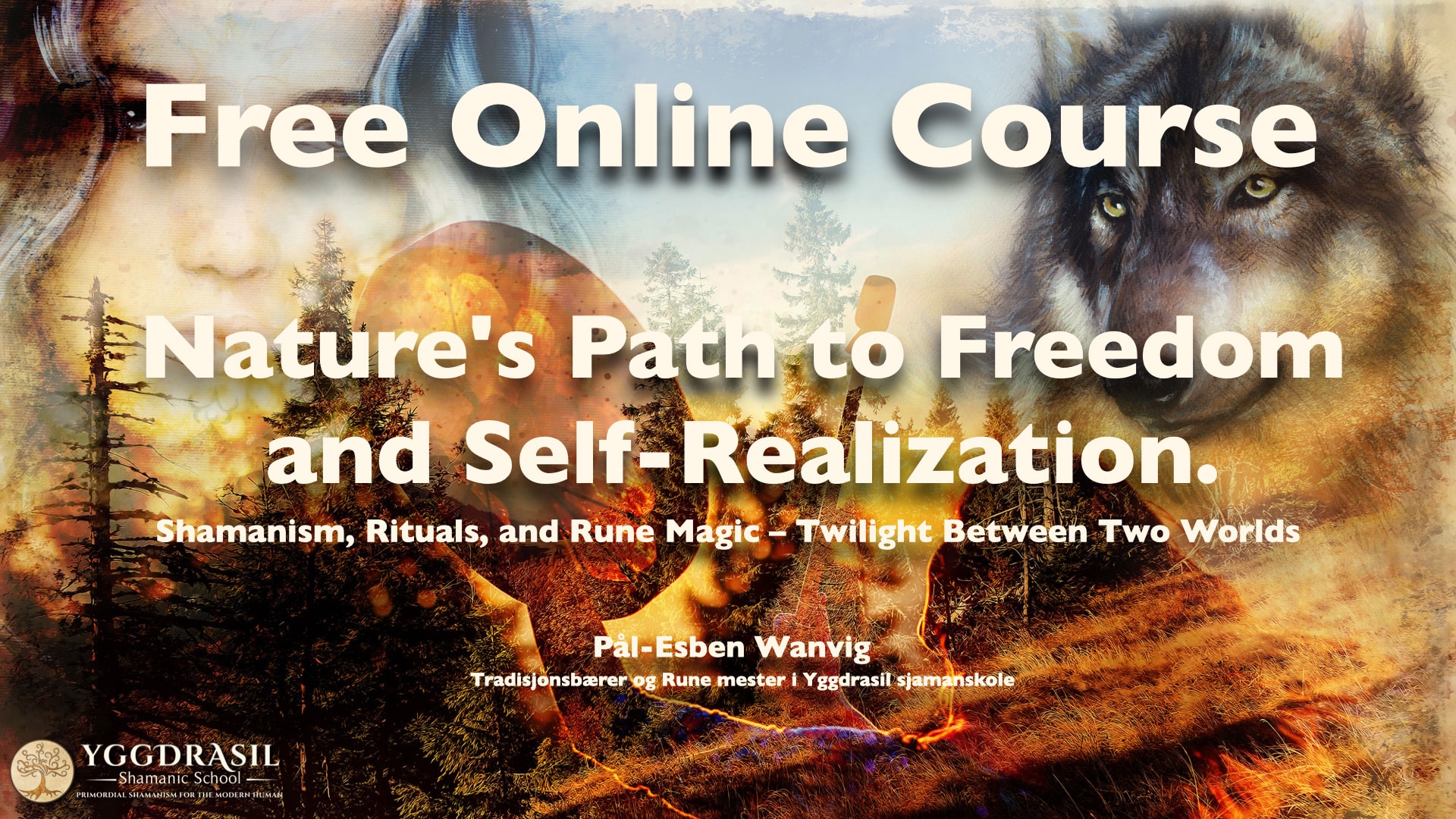
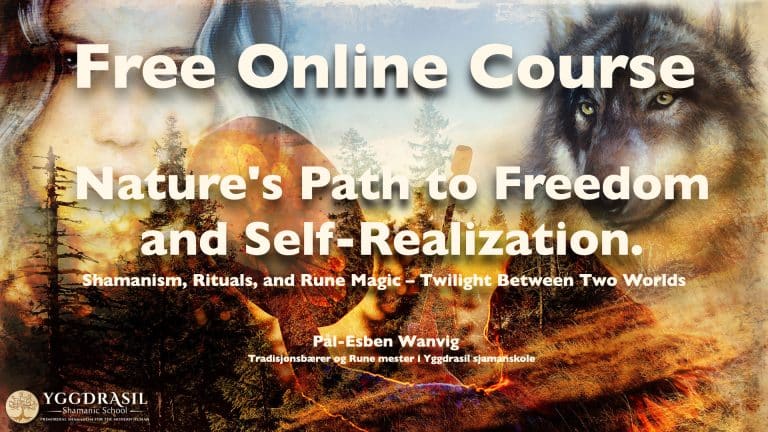
Nature’s Path to Freedom and Self-Realization
Curious about what primordial shamanism really is, behind the mystique and the misconceptions? In this short online course I tell the story of my own path from skeptical engineer to teacher of primordial shamanism, and give you a first introduction to what I teach: what shamanism and primordial shamanism are and are not, how rituals and rune magic are used in practice, and why the longing for growth matters so much for a good life.
The lessons are recorded in Norwegian; the English version will be ready in November or December 2026. Leave your email on the course page, and I will tell you when it is.