
Mother Earth Is a Living Being: Meet Maha Terra
The first time I heard the term “Mother Earth,” I was very young, and I thought the same as most people: Sure, that’s our planet. A ball of magma with a crust on the outside, and trees growing on the crust. It took me many years to understand how impoverished that idea is. This article is about what I found behind the words: that the earth you stand on is a living being, just as alive as you are, and that everything changes the day you truly take that in.
We use the term “Mother Earth” often, and it gives us a good feeling. It has a deep and lovely ring to it. But ask someone what it actually means, and things quickly go quiet. Is it the grass and the trees? Is it the planet as a celestial body? Is it a poetic way of saying “nature”? Most of us have never stopped to ask the question, and so the term lives on as a beautiful phrase.
I believe that is one of the reasons so many people struggle to make contact with nature. They go out into the forest because they have heard it is healthy, and it is. But they are going out to something they don’t know. You can’t have a relationship with a concept. You can have a relationship with a being. And the day the concept becomes a being, everything changes, including your walk in the forest.
In the article “Primordial Shamanism: Nature’s Path to True Spiritual Awakening,” I wrote that you are built of Mother Earth’s building blocks and that she carries your master rhythm in everything she is. There, I left it as a fact. Here, I want to go one step further, into what is, for me, the core of the entire primordial shamanic path: who she actually is.
You can’t have a relationship with a concept. You can have a relationship with a being. And the day the concept becomes a being, everything changes, including your walk in the forest.
Pål-Esben Wanvig
In the podcast, episode 43, “The Sun, Gaia and Your Inner Soul Fire,” we go into this topic in more depth.
Magma, crust, and an impoverished idea
Most of us get our first picture of the earth in school. There we learn how the planet is built, layer by layer. At the very center a core, then the mantle with its magma, then the crust. We learn why lava comes up through volcanoes, how the plates move, and how water is distributed among oceans, rivers, and groundwater. On the outside of it all lies the biosphere, with trees, animals, and us.
None of this is wrong. It is useful knowledge, and as a civil engineer, I appreciate it. But notice the kind of gaze it is written with. It is a static gaze, an engineer’s gaze. The earth is described as a mechanical device: this many layers, temperatures this high, this much water. A machine with known properties that we can measure, drill into, and exploit.
It is exactly the same gaze that modern medicine often turns on human beings. The body is described as a biological machine with certain properties. Organs, hormones, nerve pathways, biochemistry. That isn’t wrong either. I have benefited greatly from skilled doctors myself. But all of us have a feeling that the description is not the whole truth. We sense that there is something in us that the description never reaches. I believe every human being can feel that, whatever they do or don’t believe.
And this is where it starts to get interesting. Because if the mechanical description of you is too impoverished, why should the mechanical description of the earth be complete?
Your body is a user interface
We have something deep within us. Some call it our being. Some call it the deep inner voice. Some call it our true nature, and others call it our soul. The names are many. The point is that there is something more, something this body is built of and around.
I like to use an image from my own former world as an engineer: your body is the user interface. Your eyes, your ears, your skin, your hands, your whole nervous system are the interface between what lies deep within you, call it the soul, and the material reality you live in. Through this interface, your being meets the trees, the sea, and other people. Without the body, your being would have no way of touching this world, and without the being, the body would be nothing but a shell.
This means your body is not you. It is built around you. It is what radiates your being into daily life, what makes it possible for you to love, laugh, work, and hold someone in your arms. A fine instrument, but an instrument.
We already know this, without thinking about it. When someone we love dies, the body lies there, completely intact, with all its organs in place. But we sense immediately that the one we loved is no longer there. Whatever made the body alive has left it. No one needs to explain that to us; we see it at once. The body was the interface, and the being was the one we knew.
Hold on to this image and turn your gaze back to the earth.
As above, so below
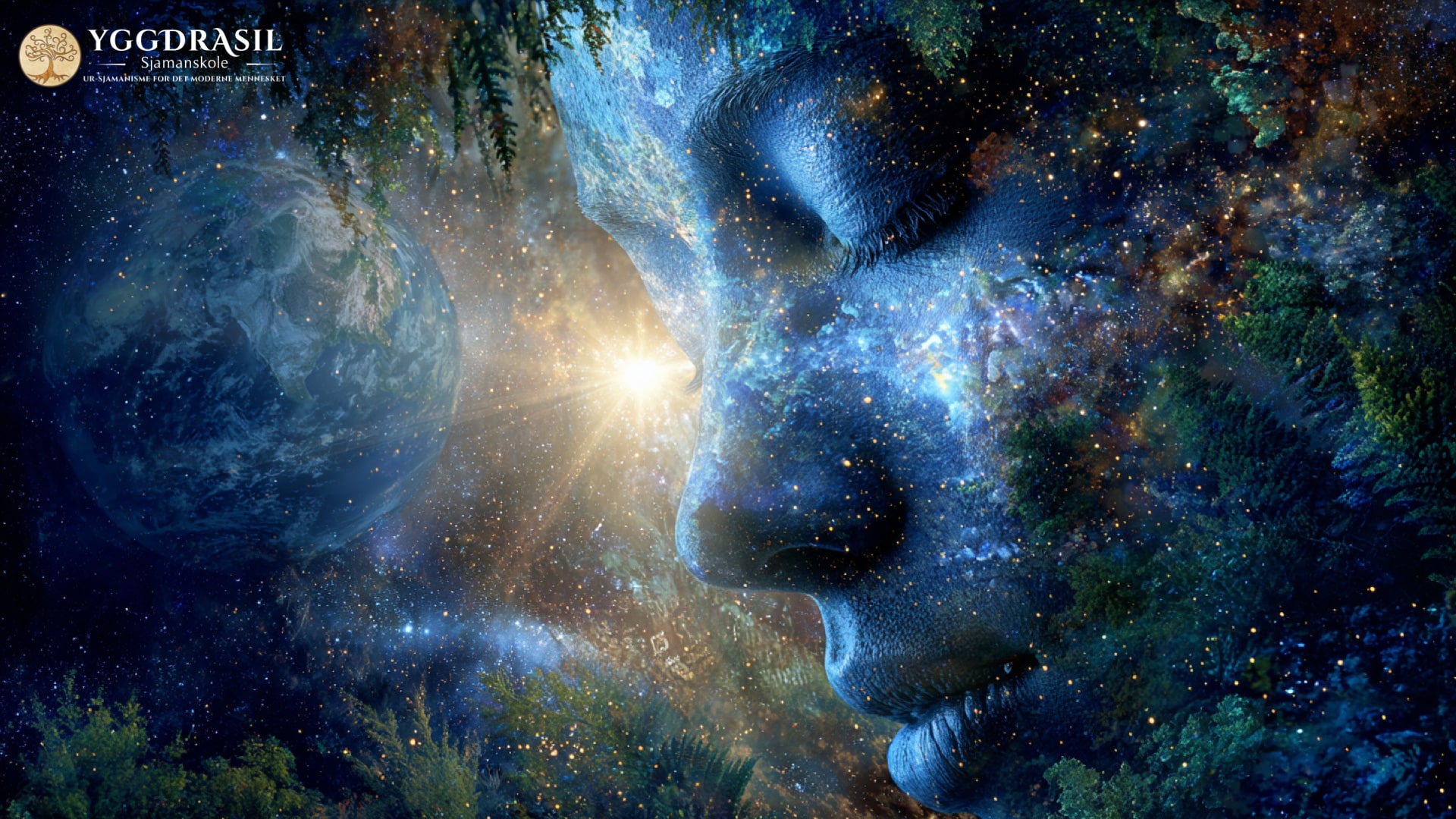
If you are a being that your body is built around, don’t you think Mother Earth is also a being, and that all the physical components we see are built around her? The water, the soil, the mountains, the trees, the biosphere: isn’t that the earth’s body, her user interface, in the same way that your body is yours?
Nature repeats its principles at every level. An atom has a core with something moving around it. A solar system has a core with something moving around it. The patterns in a fern repeat themselves in the small leaves and in the large branches. If the microcosm is like the macrocosm, and everything is mirrored in all its parts, then that also applies to what is most fundamental of all: that there is a being behind the form.
This is not a new thought. The Egyptians knew him as Thoth, and the Greeks called him Hermes Trismegistus. He formulated the principle: “As within, so without. As above, so below. Everything is mirrored in everything.”
I know this is a leap for many people. We have been brought up to believe that consciousness exists in brains and that brains exist in animals and humans. Everything else is dead matter. But that is an assumption, not an observation. No one has ever found consciousness in a brain. We assume it is there because we ourselves experience it from the inside. Whether the earth experiences anything from within is not something we can measure our way to. We can only ask which picture fits best with the rest of what we know, and with what we ourselves experience when we make contact with her.
If I have a soul, and you who are reading this have a soul, and we call the soul our being, then everything that exists will have a being or be part of a being. That means our planet, the globe, Tellus, is a being. It is this being that interacts with everything created around it, with water and trees and animals, just as your body is the result of what is built around your being.
We have been brought up to believe that consciousness exists in brains and that brains exist in animals and humans. Everything else is dead matter. But that is an assumption, not an observation. No one has ever found consciousness in a brain.
Pål-Esben Wanvig
And everything that arises from this being is part of it. The trees are part of it. The mountains are part of it. The sea is part of it. So when you put your arms around a tree, you are also putting your arms around her. You are holding the being of our planet just as much as you are holding the trunk.
Gaia, Terra, and Maha Terra
This being has several names, and the names say something about who gave them.
Gaia is the name most people know. It comes from Greek mythology, where Gaia is the original earth goddess from whom everything else springs. In more recent times, the name had a renaissance through scientists who proposed that the biosphere functions as a self-regulating system. That idea is a scientific echo of something our ancestors knew with their whole bodies.
Terra is the Latin name for the earth.
Maha Terra is the name we use in our primordial shamanic tradition. Maha means “great” in Sanskrit, so Maha Terra is the great Terra. The name expresses respect, and it expresses a relationship: she is not an object we study, but a living being that we as shamans can learn to interact with. In our tradition, we regard her as our greatest and most comprehensive healer and teacher. But no one can get help from a healer they don’t know. First we have to learn to understand her, and then we have to learn to live in harmony with her.
When you see her this way, the impoverished term “Mother Earth” suddenly fills with meaning. It does not denote the grass and the trees, but the mother from whom the grass and the trees grow, and of whom you yourself are built. Your relationship to your entire existence changes overnight, the day you acknowledge this. Because then you can relate to her the same way you relate to any other living being, and stop seeing her as a landscape you move through.
Next time you are out in the forest, walking barefoot on the grass, or lying on the smooth rocks by the sea, you can try this thought: What I have my feet on is a living being. Just as alive as my own being.
A being is not the same as a soul
Here I need to clarify something important, because the words easily blur together. We humans have a soul. Maha Terra does not have a soul in the same way we do. She has a different form of being.
For it is not the case that everything that lives and is intelligent has a soul. The forms of being differ. We humanoids have a soul, which is a very special form of being with its own qualities and its own journey. That is the journey we follow in our podcast and at the Yggdrasil Shamanic School: the soul that comes into this world, dreams itself as a human being, forgets who it is, and finds its way home again.
The planets have their own forms of beings. They are billions of years old, and they come from before the beginning of this universe as we know it. Our galaxy has a being of its own. Our universe has a being of its own. But none of these are souls. They are other forms, with a different relationship to time, to space, and to what we call consciousness.
Why does this matter? Because it changes how you relate to them. Take astrology as an example. I was curious about astrology at the start, as I was about most other things in the esoteric world, and over time I found it rather uninteresting. A mathematical calculation of where the planets stood when you were born, which is then translated into a list of traits. It was only when I understood that the planets are beings that astrology became exciting for me for the first time. Then you no longer relate to Jupiter as a planet in an orbit. You relate to Jupiter in terms of the being that Jupiter is. That is a completely different conversation.
The same goes for Maha Terra. She is a living being much older than your soul, if we are to think in terms of time at all. She is far wiser, far more complex, and far more comprehensive than a soul could ever come close to. Next to her, our souls are like small children next to their mother.
I don’t say this to make us small. I say it because it puts things in the right proportion. We walk around on top of this being and think we are the most intelligent thing in the universe. That is a childish thought. And like all children, we have a mother who is patient with us, more patient than we deserve. The best thing a child can do is not to go on believing it knows best, but to start listening to her.
The sun out there and the sun within
Before I move on to what all this means in practice, I want to take a little detour by way of the sun. It shows the same principle from a different angle, and it ties Maha Terra together with what happens inside you.
Around the Summer Solstice, when the sun stands at its highest, we celebrate in our tradition what makes everything grow: that we have food, that the grain ripens, that the whole biosphere works. Without the sun, Maha Terra’s body would be a lifeless lump of rock. So far, we are doing the same as many cultures have done for thousands of years.
But we take it one step further. We also celebrate our soul fire. The soul fire is the very energy and the talents that come from your soul, via the higher self, into the dreaming existence you live as a human being. It is what drives your primary emotions: love, enthusiasm, joy, and pleasure. It forms the building blocks of all that makes life worth living.
Everything is mirrored in everything, said Hermes Trismegistus. The outer sun warms us and makes the grain grow. But we also have an inner sun that lies deep within us, and that gives us the fundamental emotions and resources we need to face this somewhat chaotic world. The outer sun keeps Maha Terra’s body alive. The inner sun keeps you alive.
The more you know the sun out there, the more easily you find the sun within. The better you know Maha Terra, the better you know yourself. These are not two different paths. It is one path, seen from two sides.
Pål-Esben Wanvig
And like so much else, modern human beings have lost contact with it. As children, we had full access. We rejoiced without restraint, loved without reservation, and got all fired up over a stick and a puddle. Then we grew up, and somewhere along the way the soul fire was covered over by imprints, demands, restlessness, obligations, and the hamster wheel. We function, but the fire is weak, and life often feels a little uncomfortable. That is why, in the Summer Solstice ritual, we bring the students into direct contact with this inner sun: to rekindle their access to it, so that it becomes clear in their lives in the weeks and months that follow.
The more you know the sun out there, the more easily you find the sun within. The better you know Maha Terra, the better you know yourself. These are not two different paths. It is one path, seen from two sides.
The master rhythm is already within you
Remember that every single building block your body is made of has come from her. Every carbon atom, every water molecule, every mineral in your skeleton. None of it originated in you. All of it is something you have received from Mother Earth, and all of it is part of her, even while it is part of you. When you die one day, it goes back to her and becomes something new.
This means you are built of her material, according to her principles and in her rhythm. Your master rhythm is already within you. It is not something you have to acquire. When you were born, your body and your soul played the same music, one to one, in full harmony with Maha Terra’s rhythms. You giggled and squealed and rejoiced without restraint whenever your basic needs were met. It was not an achievement. It was the starting point.
Then adult life began. Through our lifestyle, we as modern people have gradually moved so far away from the natural rhythms that we barely remember they exist. We get up by the clock, not by the light. We eat what is available, not what is in season. We keep the same pace in January as in June. We scroll our way through wars and disasters before breakfast. And the music we radiate as adults has become a kind of rowdy music, a chaotic noise that makes us feel what we feel: stress, emptiness, low mood, numbness.
If you are ill, if you are sad, if you are depressed, if you are empty inside, if you are stressed, whatever it is that makes you suffer, it suggests that your rhythms have fallen out of step with Maha Terra’s master rhythms. The rhythms you are built on, after all. That is not a verdict. It is a diagnosis, and it points straight to the medicine.
We get up by the clock, not by the light. We eat what is available, not what is in season. We keep the same pace in January as in June.
Pål-Esben Wanvig
For Maha Terra shows us the perfect master rhythm, all the time, right outside the door. She has never stopped playing it. And if we open ourselves to her and truly make contact with her, her rhythms will rub off on our rowdy music. Slowly but surely, your music becomes more and more like hers. The emptiness is filled with something other than emptiness. The low mood turns into something other than low mood. No technique does this. It is resonance. Just as a tuning fork can set a string ringing in the same tone, she brings your body, your mind, and your energy system back to the tone you were born with.
This is how shamans since the dawn of time have used nature to retune themselves. But modern people have forgotten how it’s done, so it has to be learned again. That is what we are doing at the Yggdrasil Shamanic School. The whole way, from the first forest bath to the deepest parts of the process, it is at its core about one thing: letting Maha Terra tune you back to who you were when you arrived here.
The seasons are her faces
How do you get to know a being so much greater than yourself? It is like asking how a small child gets to know its mother. The answer is: a little at a time, through what she shows you.
One of the ways we do this is to start with the seasons. Each season has its own atmosphere, its own tone, its own music. Anyone who has stood outside on a clear, frosty morning in January and on a heavy, fragrant evening in July knows that this is not the same world. The temperature differs, but so do the mood, the pace, the light, what is possible and what is not.
In our tradition, we say that each season has its own being. The beings of the seasons are avatars of Maha Terra. They are living beings in their own right, but as avatars they are parts of her, the way a face is part of a person and at the same time expresses the whole person. By learning to interact with these eight beings, one for each of the eight seasonal rituals of the year, you learn to interact far more deeply with Maha Terra herself.
That is also why we use the seasonal rituals the way we do. It is much easier to form a relationship with the being of a season than with Maha Terra directly. She is too vast, too old, and too comprehensive for a human being to meet her all at once. But the being of winter you can meet. The being of summer you can meet. And every time you do, a door opens a little further in.
Our ancestors knew this. The truly ancient cultures, the ones that were not built on patriarchal thinking or religious dogma but were genuine nature cultures, lived in step with the seasons. The Indigenous peoples of Australia are a good example, before colonization destroyed their culture. Their seasons were different from ours up here in the north, but the principle was the same: the rituals that followed the cycle bound the tribe together, and they did something more. They were a celebration of the relationship with Mother Earth, of everything she gives, and an opportunity to tune their own rhythms to hers.
Then came the patriarchal era, two, three, four thousand years ago. The masculine took over from the feminine, man became the one who was to rule, and religion arrived with its dogmas of hell, fear, sin, and demons. Step by step, we grew more distant from her. Today we live in a culture whose umbilical cord to the natural rhythms has been cut, and with it the cord to what Mother Earth shows us. That is why we are stuck in the hamster wheel. That is why so many people feel empty, numb, and driven by a constant chase on autopilot.
The seasonal rituals are a way back. Eight times a year, you get a chance to stop, let your shoulders drop, and ask: Why was this particular time so important to my ancestors? What does it have to do with me? What should I be turning my attention to right now? Am I living a healthy cycle, or do I have summer and full speed all year round, with no winter, no rest, and no regeneration?
Just asking questions like these can turn things upside down. And the answers are surprisingly practical. I see it clearly in my students: those who have integrated the deep stillness of winter, who have truly taken in the yin of the Winter Solstice, find it much easier to express a healthy summer. A yang that is not chaos, but a bubbling joy of life with a deep inner calm underneath. The others, the ones who never stop, get a chaotic yang. They have a lot to do, but little to give.
I have written more about how the seasons mirror our own inner processes in the article “The Art of Living According to Nature’s Healthy Rhythms,” and about winter’s deepest ritual in the article “Shamanic Christmas and New Year: How Our Ancestors Celebrated the Eight Holy Nights.” There you will also find concrete ways to begin. But the point here goes deeper: the seasons are far more than a calendar system for good habits. They are the faces of a living being, and every time you celebrate one of them, you meet her.
In our tradition, when students enter the senior shaman training, we move on from the cultural concepts and into the magical principles of the rituals. The seasonal rituals then become an arena for deep development and healing. But it always begins simply. It begins with you thinking one day: What is summer, really? Why is it summer? And what does it have to do with me?
Take off your socks
So how do you begin to relate to this being? It is simpler than you think.
You are in contact with this gigantic being simply by taking off your socks, going out onto the lawn, closing your eyes, and trying to make contact. That is all. It is the start of relating anew to Maha Terra. No course, no technique, no equipment.
But it requires one thing: your full attention. Then you also see how meaningless much of what we call “contact with nature” really is. I’ll go for a walk in the forest and listen to a podcast. I’ll go for a run. I’ll take the dog for a walk. All of this is fine, and it beats the couch. But it is not rich contact with Maha Terra. It is like visiting your mother and sitting on your phone the whole time. You were there, but you didn’t meet her.
I see this in new students all the time. They come with a long story about how much time they spend outdoors: they head to the mountains every weekend, jog in the woods, and have a cabin by the sea. And then, during their first week of forest bathing, they discover that they have never been present there. They have used nature as a backdrop for something else. It is an honest and slightly painful discovery, and it is the beginning of everything.
For real contact, we need our full attention, and that is what forest bathing is about. A bath, not a walk. You immerse yourself in nature with all your senses open, with no music in your ears, no fitness goal, no dog, and no friend along. Just you and her. At least 30 minutes a day, ideally 90 days in a row. I have described the method and the research that supports it in the article “Forest Bathing: Nature’s Medicine Against Stress, Anxiety, and Burnout,” so I won’t repeat the details here.
What I want to add is what happens to the forest bath the day you know who you are bathing in. For most people, forest bathing starts out as a health practice: it lowers stress, calms the mind, and does you good. All of that is true. But at its deepest, forest bathing is a meeting. The trees you walk among are part of her body. The ground you sit on is her. When you put your arms around a tree, you are putting your arms around her. With that understanding, the 30 minutes become something entirely different from a walk. They become a conversation.
Many people ask me: But how do I make contact with nature? I can’t establish a connection. I sit there and don’t know what to do. My answer is always the same: You are making contact with me right now, aren’t you? You make contact with a friend. You are present with your child. How do you do it? You turn toward them. You listen. You stop thinking about anything else. You are there. Do exactly the same with Mother Earth. Turn toward her the way you turn toward a person you love. No mysticism. Just presence.
The difference lies between being in nature and being with nature. It is a small difference in the words and an enormous difference in the experience.
Pål-Esben Wanvig
This applies to everything you do outdoors. When you dig in the garden in summer, how aware are you that you are digging into this mind-blowing being, which is billions of years old and has lived longer than your soul, since before your soul was even thought of? When you pick an apple? When you lie in the grass? Everything is a point of contact. Everything is an opportunity to meet her.
The difference lies between being in nature and being with nature. It is a small difference in the words and an enormous difference in the experience. When you cultivate this over time, something more gradually arises: a recognition, a support, a primordial safety that is simply there, carrying you. You are no longer alone in the world. You never were.
The doors that open
This is what is so spectacular when the doors begin to open. And it is also an important part of the primordial shamanic development process we take students through: opening these doors, so that you gradually gain more and more contact with the rhythms that lie deeply hidden underneath, yet are really so accessible once you simply open your eyes to them.
In the first year, you think this is about being in nature. That is only the very first rough tuning. Over time, you learn to use nature in far deeper ways. You learn to move in harmony with the beings of the seasons. You learn to use Maha Terra actively in your own development process and your own healing process, and eventually to help others as well. For that there are methods, rituals, and things to keep in mind, and they are learned step by step through the training. But none of them work without the first, simple step: acknowledging that she is a being and turning toward her.
I remember what it was like when this dawned on me. Not as a thought, but as an experience. It is just like when the goosebumps come: What? Is this what it’s really about? Is this the very master rhythm of my existence? Yes. It is. We are not dealing with some technical, biological things. We are dealing with something so much more powerful and so much more far-reaching. That is why nature is so important. That is why nature can show a human being the way from where they stand today, whether they are ill, empty inside, or living a life they don’t feel content with.
But none of this happens by itself. Even if you were perfectly built to begin with, that doesn’t mean you can close your eyes and say everything is fine. That is spray paint on rust. The rhythm is within you, yes, but it has to be rediscovered, and that takes attention, time, and the will to change your perspective. Both on how you team up with your own body, your own soul, and your own deep inner voice, and on how you relate to what makes it possible for you to live at all.
What radiates from your garden
Look around you on a summer day. Everything is in bloom. The apples are coming, the tomatoes are coming, the grass is growing, the whole garden is green. Food is radiating out of the ground. How much power lies in that? How incredibly much, really, when you stop and see it?
So why shouldn’t I be an active part of it? Why shouldn’t I team up with this radiance, open my arms to it, and become a part of it, so that I can become a more complete human being, a more whole being? For the more whole I am, the more joyful I find life. It’s that simple, really. And it lies right outside the door.
This is the impulse I want to give you with this article. It is not a theory about how the planet is built, and not a new reason to feel guilty about how we treat nature. It is an invitation to change the way you look. Next time you hear the term “Mother Earth,” don’t think of magma and crust. Think of her. A living being, older than your soul, wiser than anything you can imagine, patient as only a mother can be, and holding the perfect master rhythm for who you are. She has carried you your whole life. She is only waiting for you to turn around and meet her.
Do you want to go deeper? On my blog and in the podcast The Journey to Self-Realization, you will find the conversations this article builds on.
If you want to walk the path yourself, it begins at the Yggdrasil Shamanic School with our free online course on primordial shamanism: Nature’s Path to Freedom and Self-Realization – Shamanism, Rituals, and Rune Magic – Twilight Between Two Worlds. No path could begin more simply. How far it reaches is up to you.
Nature’s Path to Freedom and Self-Realization
Curious about what primordial shamanism really is, behind the mystique and the misconceptions? In this short online course I tell the story of my own path from skeptical engineer to teacher of primordial shamanism, and give you a first introduction to what I teach: what shamanism and primordial shamanism are and are not, how rituals and rune magic are used in practice, and why the longing for growth matters so much for a good life.
The lessons are recorded in Norwegian; the English version will be ready in November or December 2026. Leave your email on the course page, and I will tell you when it is.