
Shamanic Christmas and New Year: How Our Ancestors Celebrated the Eight Holy Nights

When we understand the roots of the symbols, the decorating and the celebrating can take on a whole new meaning, and the holidays can become something other than stress and obligations.
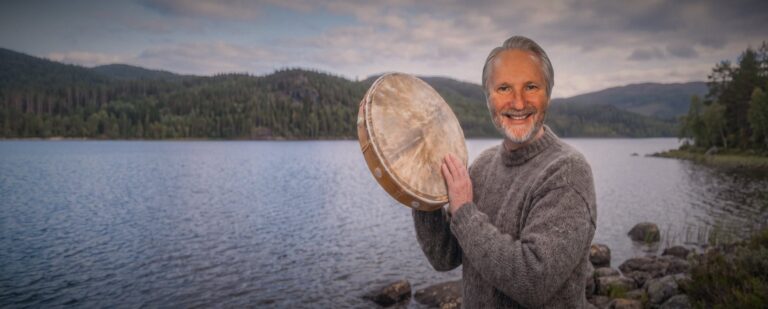
Pål-Esben Wanvig
Have you ever wondered why the chimney sweep brings good luck, or why we decorate our homes with fly agaric mushrooms and eat marzipan pigs at Christmas? Why does the julenisse, Norway’s Santa Claus, come down the chimney, and what does the Christmas tree really symbolize? And what are the eight holy nights, the time that can influence the whole year ahead? Here you will get a glimpse of how our ancestors and their shamans celebrated Christmas and New Year, and how you yourself can draw calm, meaning, and a good start to the new year from the holidays.
Our Christmas symbols are far older than Christianity. They are rooted in a time when people lived close to nature and followed its rhythms through the year. When we understand the roots of the symbols, the decorating and the celebrating can take on a whole new meaning, and the holidays can become something other than stress and obligations.
A shaman’s Christmas
Before my burnout in 2003, when my life changed completely, Christmas was a time filled with hectic stress, unhealthy food, alcohol, and parties. When my shamanic path began in 2004, I was introduced to an entirely different way of celebrating Christmas and New Year, a tradition our ancestors and their shamans followed for thousands of years before Christianity made its entry.
I clearly remember the sense of liberation that first Christmas when I said no to two weeks of stress and instead celebrated the holidays the way our ancestors did. The calm and clarity I found were a remarkable experience. No frantic hunt for Christmas presents, no hangovers in the morning. My batteries were recharged, and the new year got off to a completely different start.
My hope is that you will let yourself be inspired to open up to other qualities in the holidays, and perhaps make room for a little while each day during the eight holy nights to prepare for the year ahead.
The deepest yin
Christmastime is the darkest time of the year, and the night leading into December 21 is the longest. Then the sun turns, and the days slowly grow longer again. The Winter Solstice is one of the year’s two great extremes; the other is the Summer Solstice, when the day is at its longest. After the Summer Solstice, yin grows day by day, the quiet, dark, inward-turned force in nature, until it reaches its deepest point at the Winter Solstice. From there, yang grows again, the active, bright, outward-turned force, toward the next Summer Solstice.
Because the wheel of the year slows down so sharply, the veil between the material and the spiritual world is almost nonexistent around December 21.
Pål-Esben Wanvig
Our ancestors saw the year as a wheel in motion. As the wheel of the year approaches the Winter Solstice and the nights grow longer and longer, the wheel turns slower and slower, and around the Winter Solstice it almost comes to a complete stop before picking up speed again in the other direction. Think of a pendulum: right at the end of its swing, where it turns, its speed is zero, but the forces acting on it are at their greatest. That is how it is with the Winter Solstice. Everything looks still, but in the stillness lies an enormous turning force.
Because the wheel of the year slows down so sharply, the veil between the material and the spiritual world is almost nonexistent around December 21. For shamans, this time is therefore especially valuable: a limited window with an unusually close connection to the ancestors and the spirit world. I use these days for meditation, contemplation, and preparation for the year ahead. I withdraw from everyday life, go deep within myself, and spend much of the time out in nature.
The bear and Mother Earth
When the forces of the plants withdraw into the earth, the bear goes into hibernation until the days grow longer again. Alongside the wolf, the bear was one of the most important power animals for our ancestors. The animal was sacred, and its meat, fur, and bones were treated with the deepest respect.
In mythology, the bear is Mother Earth’s companion through the winter. Caves have always been seen as one of the few entrances to her world, the shamanic Lower World, and that is exactly where the bear sleeps through the winter. At Samhain, at the end of October, Mother Earth withdraws into the Lower World, and there the new light is conceived. Through the darkest time, the light is carried and nourished in silence, before it is born at Imbolc, at the beginning of February, when she returns and gives strength to the plants so that spring can come again. The Winter Solstice stands in the middle of this process: the light has been conceived but not yet born, and everything rests in the deepest stillness.

The eight holy nights
The eight holy nights run from December 21 to 28. Here, “night” means night and day together: the first holy night is the night leading into December 21 and the day of December 21, and so on. The nights represent the transition between the year that has passed and the year to come, a transition that is a process over several days, not a moment on the clock on New Year’s Eve.
Our ancestors divided the year into eight seasons with eight great festivals: the Winter Solstice, Imbolc, the Spring Equinox, Beltane, the Summer Solstice, Lughnasa, the Autumn Equinox, and Samhain. Each of the eight holy nights is closely connected with one of the eight periods of the year to come:
- December 21: the period from the Winter Solstice to Imbolc
- December 22: the period from Imbolc to the Spring Equinox
- December 23: the period from the Spring Equinox to Beltane
- December 24: the period from Beltane to the Summer Solstice
- December 25: the period from the Summer Solstice to Lughnasa
- December 26: the period from Lughnasa to the Autumn Equinox
- December 27: the period from the Autumn Equinox to Samhain
- December 28: the period from Samhain to the next Winter Solstice
How we spend each of the nights, what we do, what we feel, and what state we are in can have a great influence on the period that night represents. That is why our ancestors used the nights consciously, for rest, reflection, and preparation for the year to come.
Oracle work during the holy nights
If you are familiar with oracle work, using runes, tarot, or the I Ching, for example, you can work with the oracles for a little while on each of the eight days. First find your calm, perhaps with a few minutes of meditation or a breathing exercise. Then ask the questions for the period the day represents. I recommend three questions, here with the rune oracle as an example:
- Draw the first rune with an open question asking for help, for example: What is my most important spiritual learning task in the period from the Winter Solstice to Imbolc? You can also ask about a specific theme in your life, such as your health, your relationship, or your work. Avoid yes/no questions and any expectation of fortune-telling.
- Draw the second rune with the question: What is my greatest inner resistance to this?
- Draw the third rune with the question: What can heal this inner resistance?
Write down the runes you draw, with the date. In this way, you prepare the whole cycle of the year over the eight nights, and at each turning point of the year, you can take out the runes again for the period you are entering, contemplate them, and let them accompany you.
Your attitude matters: don’t try to wish for a particular outcome or to fulfill the ego’s wishes. Be present here and now, in a meditative state. And keep it simple. Ten to fifteen minutes a day is enough, and it is better to do a little with full presence than a lot with stress. If you want to learn more about the runes as an oracle, you will find an introduction in the article “Rune Magic Is Our Hidden Magical Heritage.”

The julenisse and the chimney

For thousands of years, it was often women who were the healers and shamans of the tribe, and they were the ones who led the sweat lodge ceremonies. During the rituals, the floor of the lodge may have been covered with a sacred herb that helped the shaman prepare for the spirit journey: mugwort (Artemisia vulgaris), burot in Norwegian. In modern New Age spirituality, mugwort is often confused with sage, a Mediterranean plant that had no place in pre-Christian Germanic or Norse culture. Mugwort, on the other hand, was the Northern European herb above all others: the Anglo-Saxon “Nine Herbs Charm” calls it the oldest of the herbs, and grave finds and written sources show that it held sacred status in Northern Europe from the Bronze Age at the latest.
The shamans sent out their souls to communicate with beings of light, a collective term for angels, power animals, gods, elves, dwarves, and gnomes, to receive and deliver important messages and to exchange information between the material and the spiritual world. The opening in the house where the smoke came out was therefore a sacred place. The shaman’s soul traveled out that way, and all kinds of spirits and beings of light came into the home the same way, through the chimney. During the eight holy nights, many shamanic rituals and journeys were performed, and it was then crucial to keep the chimney clean so that only good spirits with positive intentions came in. Whoever cleaned and looked after the chimneys was highly respected. That is why the chimney sweep still brings good luck and graces our Christmas decorations. And after the shamanic tradition fell into oblivion, one good spirit kept coming down the chimney: the julenisse.
At Christmastime, some shamans used a particular mushroom to send out the soul: the red fly agaric with the white spots. On such journeys, the shaman often met the small beings of light first, such as dwarves. That is where the idea comes from that dwarves and gnomes live in mushroom houses, and that is why the fly agaric still hangs on the Christmas tree and is made out of marzipan.
(Important: leave the fly agaric alone! The mushroom can be harmful to your health, and you should never experiment with it. Skilled shamans today have entirely different methods for their work. At the Yggdrasil Shamanic School, we do not use hallucinogens or intoxicants of any kind.)
The Christmas goose is no coincidence either. The goose has always been seen as one of Mother Earth’s animals, a carrier of the souls that have not yet incarnated or have just left life. Since both Samhain and Christmas are about birth and death, the goose was part of the celebration, and the tradition of seasoning the goose with mugwort is a quiet reminder of that culture.

The Christmas tree is Yggdrasil

The evergreen spruce is a reminder that life endures, even when nature seems devoid of life in the middle of winter. And the Christmas tree carries an even older symbol: it stands for Yggdrasil, the World Tree of Norse cosmology, the tree that bears all that is. Our ancestors brought the tree inside, decorated it, and gave it gifts, because through the tree they honored Yggdrasil. And under the tree, gifts were exchanged between people, a living exchange carried by the rune Gebo: the balance between giving and taking.
When you decorate your Christmas tree, you can turn the decorating into a small ritual. Hang each ornament with a wish, for yourself or for someone you love, or let each branch represent a part of your life and place symbolic gifts on the branches. Whether the tree is spruce or plastic, large or just a decorated stick, does not matter. What counts is the symbol, and the awareness you bring into the process. Every time you see the tree, it can remind you of the World Tree, of the deepest stillness in the north, and of the light that is on its way.

Freyja, Hildisvíni, and the marzipan pig

Freyja is accompanied by a gigantic wild boar with a shining golden coat: Hildisvíni, “the battle swine,” her mount and favorite animal. Because of its golden coat, it is also called the sun boar. When the wheel of the year almost comes to a standstill at the Winter Solstice, it is Hildisvíni who gives the wheel a push with its head so that it starts moving again toward brighter times. That is why both Freyja and Hildisvíni play a central role in the celebration of the Winter Solstice.
Our ancestors regarded the pig as a sacred animal. It pushes its snout into the earth when it searches for food, and so it resonates strongly with Mother Earth’s Lower World. The marzipan pig that belongs to Christmas in Norway is an echo of Hildisvíni, and it brings good luck, just like the chimney sweep. The fact that some religions still do not eat pork is also connected to the pig once being seen as a sacred, spiritual animal.
New Year as a process
A single date marking the new year is practical in today’s society. In reality, the turn of the year is a transition that takes time, at least the eight holy nights. At the threshold, on December 21, you can perform a simple, symbolic act to close the old year: write down what you want to let go of, such as conflicts, grief, anger, or destructive patterns, and burn the paper while you ask the spiritual world for support and blessing.
On the last of the eight holy nights, December 28, it is a good time to carry out an energetic cleansing ritual in your home, for example a shamanic incense ritual, ideally together with the people you live with. In this way, you mark the end of the holy time and open up to the new year. And when everyday life starts again in the new year, the work begins: we gradually move from rest, contemplation, and planning into action, in step with the growing light and yang. You can read more about living with the alternation between yin and yang through the year in the article “The Art of Living According to Nature’s Healthy Rhythms.”
A single date marking the new year is practical in today’s society. In reality, the turn of the year is a transition that takes time, at least the eight holy nights.
Pål-Esben Wanvig

Family and friends at Christmas
By now you may have the impression that I do nothing but meditate and reflect at Christmas. That is not the case. The work with the holy nights takes a little while each day; the rest of the time, I read a good book, go for long walks, visit power places in the area, and have good conversations with my wife.
If you have a big family and enjoy meeting people and going to parties, that’s wonderful. Through the eight holy nights, we can come into close contact with the people we love. It is a perfect time to be with your soul family, which reaches further than your biological family. If you experience love, good conversations, and people who stir good feelings in you, you have an optimal setting for the months ahead. But if you are with people who make you stressed and tense, perhaps it is time for a change?
In closing
Our ancestors were in close contact with the rhythms of nature and understood the year as a living wheel. There is a great deal of wisdom and practical experience in the way they celebrated, gathered over hundreds of generations. You don’t need to change everything at once. Even just a different awareness of the days, and a few minutes of the eight holy nights given to oracle work and reflection, can make a big difference.
I wish you a very merry Christmas, and I hope that some of the habits and customs now make more sense. Perhaps you will decorate your home and your Christmas tree differently this year, and feel more strongly connected to the spiritual world through the holy time. For me, Christmas has become a time when I receive many beautiful gifts that are not of the material kind.
Do you want to go deeper? On my blog and in the podcast The Journey to Self-Realization, we explore the topics in this text in more depth. If you want to walk the path yourself, it begins at the Yggdrasil Shamanic School with our free online course on primordial shamanism: Nature’s Path to Freedom and Self-Realization. No path could begin more simply. How far it reaches is up to you.
Nature’s Path to Freedom and Self-Realization
Curious about what primordial shamanism really is, behind the mystique and the misconceptions? In this short online course I tell the story of my own path from skeptical engineer to teacher of primordial shamanism, and give you a first introduction to what I teach: what shamanism and primordial shamanism are and are not, how rituals and rune magic are used in practice, and why the longing for growth matters so much for a good life.
The lessons are recorded in Norwegian; the English version will be ready in November or December 2026. Leave your email on the course page, and I will tell you when it is.