



What Can Norwegian Business Leaders Learn from a Shaman? Here’s How to Build a Strong Personal Character

One of the most exciting life projects we can engage in is the study of ethics, personal value systems, and how we build a healthy and strong personal character. It has a great influence on every aspect of life. Ignoring it can have equally great consequences, only negative ones.
I want to show why it is important for us human beings, and especially for those who are leaders and role models for others, such as parents, teachers, politicians, and business leaders, to have good ethics and good value systems. My claim is that all people, regardless of background, profession, and life situation, can considerably improve their quality of life by engaging in this.
I want to share a simple and effective method for developing a healthy personal character rooted in a good value system. You will probably be just as surprised by your own state in these areas as nine out of ten of my students are when they complete the first exercise, which I describe later.
You will get a clear and pragmatic answer to what ethics is, what the difference is between ethics and morals, which core values and value systems a healthy character and identity should be built on, and how you can do this in a practical and simple way by investing five minutes a day. This is also decisive for how far you can go in your own personality development and spiritual development. The consequences for your life and for the people around you can be enormous.
An important theme in our lives
In my eyes, ethics is probably the most important topic for improving quality of life, for becoming a better partner, leader, parent, and friend, and for everyone working on personality development and spiritual development. In all my training programs, ethics and the cultivation of a healthy character are something I place great emphasis on together with the students.
It does little good to say that you are an ethical person with a solidly developed character. The only valid measure is how we actually live this out in our daily lives in a practical way.
Pål-Esben Wanvig
Why is this so important? The answer is: How can we be the best version of ourselves if we do not know what we ourselves stand for, and where the line is drawn between right and wrong? How is it even possible to lead another human being in a healthy and good way when this is not in place? How is it possible to have a good self-image and good self-confidence when we are neither sure of nor conscious of the very foundation of our lives?
Time and again, we see the consequences of children not learning sound ethics from their parents, or of business leaders who have neither training in nor awareness of sound ethics and character building, and who lead both themselves and their companies into disaster. Internet trolls are another good example of a complete lack of training in ethics. It also shows clearly in TV debates, where the participants display a lack of respect for one another. It does little good to say that you are an ethical person with a solidly developed character. The only valid measure is how we actually live this out in our daily lives in a practical way.
The difference between ethics and morals
The Norwegian encyclopedia Store norske leksikon defines ethics like this: “Ethics, the study of morality; the same as moral philosophy. The purpose of ethics is to study how one ought to act, and to understand the concepts we use when we evaluate actions, persons who act, and the outcomes of actions.”1
The Norwegian Wikipedia defines ethics like this: “Ethics (from Greek ethos, moral) or moral philosophy is the part of philosophy that seeks to answer questions such as ‘what is good,’ ‘what is right,’ ‘how should one behave.’”2
The problem with these definitions is that they mix up ethics and morals, which in my eyes are two different concepts.
Ethics are the values that lie at the very foundation of most people in all cultures all over the world, and that are not governed by religious moral dogmas or other moral rules. These values are largely the same all over the world and are often called virtues, such as honesty, integrity, courage, love, loyalty, forgiveness, reliability, responsibility, tolerance, compassion, and kindness.
Morals are based on rules that are adapted to each individual culture, and that are often built on religious dogmas and various belief systems. A couple of examples: “You shall have no other gods before me” (religion) and “you shall not think you are better than others” (the Scandinavian Law of Jante).
Morals often throw religious tenets and virtues together into one pot, which creates confusion. Moral rules are mainly based on the ego’s values, such as anxiety, fear, hatred, jealousy, bullying, envy, greed, lust for power, fear of competition, egocentricity, and indifference. In my experience, the more we mix these concepts together, the harder it becomes to get the results we want.
Cheating and corruption in business
Unfortunately, the society we live in is becoming more and more permeated by corruption, financial crime, fraud, and cheating. Volkswagen, Deutsche Bank, VimpelCom, Yara, the IOC, FIFA, and widespread doping in international sports are just a few examples from the mid-2010s. How can a large corporation like Volkswagen, with 600,000 employees, almost collapse overnight because of cheating with software that manipulated the results of diesel emissions tests? The answer is the leaders’ ethical attitudes and value system, which in turn determine the corporate culture and the employees’ attitudes toward what is right and wrong.
The main problem is that ethical training for leaders, and control mechanisms among leaders and employees, are virtually nonexistent in many companies. Most of the business leaders I talk to agree with this completely. In their companies, it is first and foremost about achieving results. Ethical attitudes about right and wrong are not that interesting as long as you don’t get caught. “It’s acceptable to be in the gray area, since everyone else is doing it too” is often used as an argument.
I must honestly admit that it frightens me when I interview these leaders about their level of integrity, toward themselves and toward the company. Power, career, control, money, and recognition override sound ethics. But unfortunately, the problem is not limited to leaders and companies. We find it everywhere in today’s society.
Ethics and character are the key
The more people develop a healthy ethical personality and a character built on a healthy value system, with honesty, integrity, courage, love, loyalty, forgiveness, reliability, responsibility, tolerance, compassion, and kindness as its main pillars, the better our society and our world will be to live in. This in turn affects the corporate culture and the long-term results of a company.
The prerequisite for this to work in companies is that the process starts with the top executives. In other words, the art of cultivating our character is an important key both to our own quality of life and to the results we can achieve in our lives. Of course, many people believe they have no problem with this, but unfortunately that often does not quite match reality.
Meeting my martial arts master
At fifteen, I was fortunate enough to meet my martial arts master, who was an authority in his field. In a practical way, he taught me to develop a strong character and a healthy understanding of what ethics involves, and how it is lived out in everyday life.
“The more power you acquire, the greater the consequences when you abuse that power. That is why it is important that we train your character and your ethical management system before you gain access to more power,” was one of his mantras. When you are trained in potentially lethal defense techniques and use them for aggression rather than defense, that is an abuse of power that can have catastrophic results.
As a beginner, it was not easy to understand what this meant in practice, but as I advanced through the ranks and earned my black belt, it became crystal clear. My master spent a lot of time helping me understand all its facets. The deep conversations took place when we were alone. “Most people think martial arts are about training to hit the hardest, jump the highest, and be the fastest. But very few understand that 95 percent of your strength is in your head and not in your muscles. If you don’t train your head, there is a limit to how far you can go.” The first time I heard this, I understood little of what it was about. But gradually the wisdom sank in.
We find parallels to this everywhere in our modern world. People are mostly interested in learning techniques where the goal is reached as quickly as possible with the best possible results, and where ethics is skipped. A banking system that is not interested in what is best for its customers, but is aimed only at profit, is one example of this. A salesperson specially trained in NLP or subtle rhetoric can manipulate almost anyone into buying anything.
Cackling leaders
In my first job after graduating as a civil engineer, I worked for a large research institute in Norway. While carrying out a comprehensive reorganization project in the company, I got to know the leadership and corporate culture well, and for me it was a shock. After many years of leadership training with my martial arts master, this was like being thrown into a henhouse, where each individual leader was interested only in their own needs for power and control, and had little willingness to cooperate. They talked behind each other’s backs like hens and engaged in scheming and manipulation in the corridors. And I’m not talking about the middle managers alone. The directors were the worst.
At a management meeting in the largest department, I was supposed to talk about my experiences from the reorganization project. They were expecting a thirty-minute talk about the strategies we had followed to change the computer system for more than 2,000 workstations in just a few months, but they got a two-hour thundering speech about a rotten leadership culture and the consequences it had for the employees and the company. It was a shock for everyone present, and I wasn’t entirely sure whether they would send me home from the mountain hotel afterward. In the bar after dinner, the top executive came over to me, and after a long pause he looked at me and said, “That was quite a talk,” with a hint of a smile.
Of course, he did not agree with everything I said, but a few weeks later he sent his management team on a course. Whether it had much of an impact, I’m not so sure, since most of the leaders I meet who have been on such courses are no better able to answer my simple questions about ethics, value systems, and character than those who have not had this kind of training. A weekend course in ethics and character building is, of course, a joke in this context.
The following Monday, I was called on the carpet by the director of my department. This is the end, I thought, now I’m getting fired. My pulse was racing and my hands were sweating as the secretary showed me into his office. “I hear you’ve been busy this weekend,” he said, glowering at me. “Your performance has spread like wildfire through the management team, and you’ve really set off quite a few reactions.” He stood up and came toward me with quick steps. My pulse shoots sky-high as he wraps me in a solid bear hug. “I am so proud of you. You have done something I myself have never dared to do!”
The director was a fine human being who was exceptionally skilled in his field, and an outstanding communicator and networker. But he had never been given training in ethics or the opportunity to build a solid and stable character on the basis of a value system. Very few of the leaders I meet have such training, and I don’t find the uproar over rotten leadership and corporate cultures in Norway and abroad all that strange. These topics are often regarded as “unproductive,” and all efforts go into optimizing profit and growth.
Do I even have a problem with this?
Of course, our parents shape what is right and wrong for us, and how we live it out in everyday life. But as a rule, this rests on the parents’ own ethical and moral rules being passed on to their children without a filter, and the quality of these value systems varies a great deal. That is not so strange, since not many people have gone through systematic training and development in these areas. Taking it for granted that I know what I stand for and what healthy justice is, and that I live it out in my life without any problem, is a dangerous conclusion, since it rarely matches reality.
This may sound harsh and categorical, but over more than twenty years I have helped several thousand people build a healthy character, and it has definitely had a great impact both on themselves and on the world around them.
Almost all of them believed they had no problems with their identity, character, values, and ethics, and that there was definitely no need to engage much in this. Anyone who believes they know what they do not actually know of course has a problem, because their internal map of reality is wrong. I call this the Almighty Syndrome, which is probably the most important reason that we, myself included, fail. You can read more in the article “The Almighty Syndrome: The Art of Accepting What We Don’t Know.”
My statistics show that most of the people I have helped have not been aware of what their value system is really like, and almost everyone who has gone through the introductory exercise I describe below has been shocked when they became aware of the real state of things.
Anyone who believes they know what they do not actually know of course has a problem, because their internal map of reality is wrong.
Pål-Esben Wanvig
Ethics and spiritual development
In my eyes, it is not possible to pursue true spiritual development without, in parallel, building a stable and well-anchored character based on a healthy ethical value system. I am not talking here about esoteric development, where you learn methods and techniques such as channeling and healing. I am talking about spiritual development, which cannot be done without the heart, consciousness, and self-responsibility. You can read more about the difference between esoteric development and spiritual development in the article “ABC Guide to Finding Your Spiritual Teacher.”
The more we are governed by the ego’s anxiety and need for control, the further away we are from the heart, the soul, and a spiritual path of development. This means that advanced, true spiritual development cannot be done without ethics.
Pål-Esben Wanvig
Most of the great spiritual traditions of the world have a clear focus on ethics and character building for advanced students, since it is not possible to reach the deeper layers of the heart and the soul as long as the ego’s negative values govern our belief system and our behavior. The only way to reach the deeper layers of your heart, which in turn is the door to the soul, is to work through and heal the sides of the ego that prevent this, such as anxiety, fear, hatred, jealousy, bullying, envy, greed, lust for power, fear of competition, egocentricity, and indifference.
The more we are governed by the ego’s anxiety and need for control, the further away we are from the heart, the soul, and a spiritual path of development. This means that advanced, true spiritual development cannot be done without ethics.
Ethics and shamanism
As a shaman, you are completely dependent on working together with angels, power animals, and other beings of light to achieve results. They are the ones who give power to our rituals and help us with our astral journeys to the shamanic Upper and Lower Worlds, and with all the other tasks we carry out as shamans. They give us access to magical forces such as rune powers and ritual magic, and to mystical insight and understanding.
At the Yggdrasil Shamanic School, students receive extensive energetic initiations as early as the first seminar, so that they can immediately do shamanic work with objectively measurable results. But this is only the beginning of a shamanic path of development. It is entirely up to the spiritual beings who work with our tradition whether or not the shaman gains access to the deeper layers of shamanic magic.
The more far-reaching the changes you can make with your shamanic magic, the more you must be able to remain uninfluenced by the ego’s fear and desire for control, since the consequences can be far-reaching.
The spiritual beings observe each individual student continuously to see how far the shaman has come in healing the ego’s negative sides, and under no circumstances will they give more power to anyone who might abuse it.
In all my training programs that last a year or longer, understanding ethics and value systems and building a healthy character is an important theme, but it is up to each individual student how much she or he engages in it.
One of the most effective and fascinating methods for gaining access to deeper insight and more power as a shaman is to engage wholeheartedly in cultivating core values, and to live them out in your daily life. The only proof of whether you have succeeded is how you live out your value system toward your family, children, colleagues, friends, and the other people you spend time with. How you express yourself on social media is also revealing.
This is one of the most effective keys to moving the ego from being the soul’s ruler to becoming the soul’s adviser. The process is called the shamanic death. It is, in turn, absolutely crucial for a shamanic path of development, and for how far you can go.
For teachers, healthy character building is of course a mandatory subject, since they will be leading others. A teacher who does not do this is often governed by the ego, which in turn leads to a poor outcome for the students and the group, where envy, backbiting, and mudslinging can quickly become part of the culture.
Results
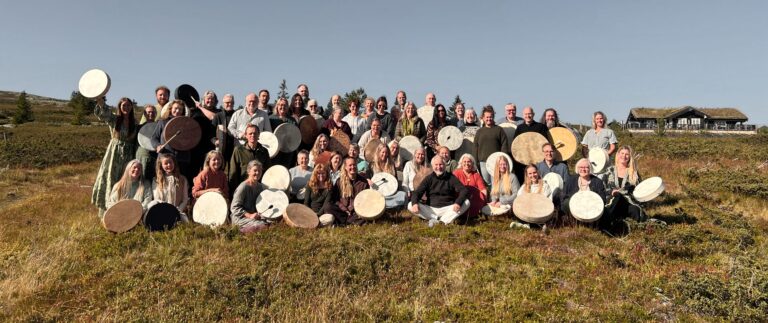
If you want to see the practical results of this in a group that has worked actively with value systems, character, and ethics, you can observe the cooperation among my students in Norway. Here, about 40 teachers work together at the largest alternative fairs in Norway, where since 2004 we have had a joint booth, where everyone helps each other, and where fear of competition, bullying, and backbiting do not exist. You are met by an open and warmhearted community that is inclusive of everyone, which you will notice when you visit us.
When the boss, or the parents for that matter, has a healthy character and a good value system, there is no room for the ego’s power games in the group, since they help find solutions to the problems that arise rather than reinforcing or ignoring them. This creates security, cohesion, and growth, and at the same time it is satisfying to be a member of such a group.
The recipe for developing a healthy and strong character
A brief introduction to the first steps of the process I follow to help students, teachers, clients, and business leaders cultivate a healthy character rooted in a solid value system:
Phase 1: create awareness of the state of things
Until we become aware of the real state of things, it is difficult to do anything about a problem that exists (cf. the Almighty Syndrome). One of the most effective books to read to find out how things stand with your character and your value system is “Listen, Little Man!” by the psychologist Wilhelm Reich. As you read the book, analyze in which areas of your life you are the little man, and where he shows himself. Also analyze the people around you, and find out where they are the little man.
Warning: doing these tasks can be a heavy strain. When you discover that your glossy image of yourself does not quite match reality, it can be a hard experience. I have had students who found this book so emotionally difficult to read that it took them more than a year to get through it, even though it can be read in a few hours. It can be a good idea to get help from a teacher, therapist, coach, or similar while you do the task. It is a prerequisite that the person helping you has experience with this kind of work; otherwise, the conclusions are quickly based on moral principles.
Phase 2: decide which values you want to build your character on
These can be values such as honesty, integrity, courage, love, loyalty, forgiveness, reliability, responsibility, tolerance, compassion, and kindness. The problem is that values are just empty phrases if we cannot define what each value really means and how it can be lived out in practice in everyday life.
For this work, I recommend the virtue cards, which you can buy in Norwegian or find in English from the Virtues Project3. I recommend the Norwegian virtue cards “Refleksjonskort – 100 Dyder” (Reflection Cards: 100 Virtues)4. Note: a value, for example integrity, only becomes a virtue when the value is lived out in practice in your daily life.
Use the virtue cards to find ten values you want to start working with, and that you want to be the foundation on which you develop your character. Don’t be too preoccupied with finding the “perfect” values. The art is to start, and then change them later as you gain more experience.
Phase 3: the art of turning a value into a virtue
Now comes the most difficult task. I recommend that you start by working with only one value at a time, until you are able to practice it in your everyday life so that it becomes a virtue. A simple way to do this:
- In the morning, before you start your day, read through the definition of the value you want to turn into a virtue.
- Be aware of the value throughout the day, and in every situation you encounter along the way.
- In the evening, read through the definition of the value again and note in your journal how you managed to live the value out in practice (I recommend a separate journal for this). Also note where you failed, and what you can learn from it so that you don’t make the same mistake tomorrow. There is a limit to how much progress you can expect without using a journal for this.
- Don’t get frustrated at the start. In the beginning, it is completely normal to fail often. Over time, it gets easier.
- It can often take several weeks before a value is so ingrained that it becomes a virtue. When you get too frustrated, or find it boring, you can switch to another virtue to wake up your inner child, which in turn will give you motivational energy.
- Over time, you can begin to combine several values at once, with the goal that within about a year you are able to live out all the values you have chosen, simultaneously, so that they all become active virtues.
On the one hand, this work can be very rewarding, exciting, and fascinating, but on the other hand, frustrating. Those of my students and clients who get the best results with their character building have regular conversations with me, where we discuss and analyze their experiences and the process. It is often helpful to have an objective person who does this work together with you.
A great opportunity
I am impressed by what happens to people who engage wholeheartedly in such a process. They often change how they view themselves and the world around them, and they become better able to stand tall even when life gets stormy. Having a conscious relationship with your own value system and your own character creates strength, joy, contentment, self-confidence, and pride. It also permeates every single aspect of life, all the people we meet, and the results we achieve.
Respect cannot be demanded. It can only be earned. Who do you respect? People who give way in every situation and have no position of their own, or people who come forward with a clear and healthy identity, character, and a clear value system, and who are able to set loving and healthy boundaries for themselves and everyone else on that basis?
If you have children, I recommend giving them “Dydekort for barn og unge” (virtue cards for children and young people) and working with the virtues together with them. The awareness, power, security, strength, and self-confidence you can give your children through this are indispensable. Several of the people I help do this together with their children, with very exciting results. It also lays the foundation for future generations of leaders, politicians, and teachers to have a different set of values to relate to than what we often see today.
Respect cannot be demanded. It can only be earned. Who do you respect?
Pål-Esben Wanvig
If you are a business leader, I recommend training yourself and your entire management team in this process. What does not work is giving them free rein to do this on their own, or doing it at a weekend seminar. What is needed here is a mentor who masters the process and who provides both individual follow-up and group guidance. In addition, there needs to be a control function that the leaders must answer to.
If you are a spiritual teacher, student, or therapist, you will get a great deal out of working with this process. For every effort you make to set your heart free, you come one step closer to your soul and your essence. You will experience more calm and inner peace, you will become less hung up on what others do and don’t do, and your path toward better health, joy, happiness, and an enchanting life will become much easier.
Want to know more?
Life can be good to live if we choose that ourselves. All problems can be solved, and the solution is often right in front of our nose. I wish you good luck on the path toward good health, joy, happiness, and an enchanting life.
Do you want to go deeper? On my blog and in the podcast The Journey to Self-Realization, we explore the topics in this text in more depth. If you want to walk the path yourself, it begins at the Yggdrasil Shamanic School with our free online course on primordial shamanism: Nature’s Path to Freedom and Self-Realization. No path could begin more simply. How far it reaches is up to you.
This content does not replace professional medical help from a doctor or other health professional, and it is not intended as medical treatment. If you are ill, always see a doctor first.
Sources
- “Etikk” [Ethics], Store norske leksikon [The Great Norwegian Encyclopedia], https://snl.no/etikk. ↩︎
- “Etikk” [Ethics], Wikipedia, https://no.wikipedia.org/wiki/Etikk. ↩︎
- The Virtues Project, https://www.virtuesproject.com/. ↩︎
- The virtue cards in Norwegian, http://www.virtues.no/. ↩︎

Nature’s Path to Freedom and Self-Realization
Curious about what primordial shamanism really is, behind the mystique and the misconceptions? In this short online course I tell the story of my own path from skeptical engineer to teacher of primordial shamanism, and give you a first introduction to what I teach: what shamanism and primordial shamanism are and are not, how rituals and rune magic are used in practice, and why the longing for growth matters so much for a good life.
The lessons are recorded in Norwegian; the English version will be ready in November or December 2026. Leave your email on the course page, and I will tell you when it is.