What Is the Meaning of Life?

What is the meaning of life? The question can reach us like a quiet echo in everyday life, or like a cry when life shakes our very foundation. For many, it comes in times of crisis, illness, burnout, or great upheaval. For others, it appears in the midst of prosperity, when everything seems to be in place and yet still feels empty.
Here we look at why we are really here: the soul’s purpose, the mysteries of incarnation, and what creates real meaning. Drawing on both my own life path and more than twenty years of shamanic work, I share how we can find our way back to our essence and live a life that feels real, alive, and full of direction.
I still remember the despair of the months before and after I hit the wall in 2003, completely burned out and in a life-threatening condition. On paper, I had everything I had ever dreamed of: success, a career, recognition, fame, material wealth, and financial security. The outer facade was perfect.
But on the inside, it was as if something had broken.
Despite everything I had achieved, I felt a gnawing emptiness. A frustration that would not be stilled. A quiet but overwhelming feeling that I had lost my way.
My thoughts kept circling restlessly:
“Is this all there is? Is this really the meaning of my life? Is this why I am here?”
When modern conventional medicine could not explain why my body had collapsed, I realized I had to do the searching myself. It was the beginning of a journey I could never have imagined, a search that led me, among other things, into deep studies of shamanism. Today, more than twenty years later, those studies are still one of the most meaningful and life-changing parts of my path back to good health, wholeness, and inner fulfillment.
Through shamanism, I found the answers I had longed for all my life:
- Why I am here
- Where I come from
- What gives my life meaning
- What life task my soul carries in this incarnation
These insights changed everything.
Today I am a tradition bearer and teacher at the Yggdrasil Shamanic School, and one of my most important tasks is to help others find their own answers: the answers that open the door to a life that does not merely function, but feels real, alive, and full of meaning.
The great misunderstanding
We live in a society that, as I see it, is gradually losing its grip on what really matters to us as human beings, measured against the deepest existential questions. And it is only when crises come, when our security frays a little at the edges, that the truths we otherwise overlook suddenly rise to the surface.
Have you ever stopped and asked yourself:
How does our economic system actually work? What does it depend on at the most basic level?
Most people I meet have never thought about it. Many are genuinely shocked when they see how astonishingly fragile our economy actually is.
Because every time consumption drops by a few percentage points, or GDP does not grow quite as fast as last year, the alarm bells go off immediately. We see dramatic headlines like these:
- “Crisis: economy in free fall!”
- “New shock figures rattle the market!”
- “Dramatic rise in unemployment!”
- “Norway trembles!”
- “Everything is heading down!”
The media are filled to the brim with doomsday gloom, even when what is really happening is a completely natural and temporary downturn.
If we look at it from a higher perspective, the picture becomes clearer:
Our entire economic system is built on one fragile assumption:
That you and I keep buying. A lot. Often. And preferably things we don’t even need.
When a crisis arises, the most natural thing in the world is to take a breath, become more careful, cut back on consumption, and prioritize what really matters. But that is exactly what the experts fear most. Because the national and global economy stands or falls on a level of consumption that is not natural for us, not healthy for us, and not in line with our deep human nature.
Shopping hysteria
We live in a time when consumption has become a lifestyle, almost a reflex. Many people buy new clothes every month even though the closet is already full. We replace cell phones as if they were perishable goods, buy robot lawnmowers and robot vacuums even though the old solution works perfectly well, lease cars, get cosmetic procedures, and fill our homes with more jewelry, shoes, watches, PCs, and TVs than we will ever have time to use.
We have been taught to believe that this is normal. That this is what “a good life” is supposed to look like.
The whole system around us tells us that the more we have, the happier we will be. That the things we buy, all the objects and services we don’t really need, will fill the void, give us meaning, create real joy.
We are also told that the goal of life is a successful career, a nice car, a big house, a cabin in the mountains, and financial abundance. Our society and our economy are, unfortunately, completely dependent on our believing it. On our constantly striving for more, better, bigger.
I believed it too.
I followed the recipe to the letter. But over time I discovered a brutal but liberating truth:
This is one of the greatest misunderstandings a human being can live by.
Because the chase for more does not satisfy the heart. It does not lead us to real joy, inner peace, or a deeper understanding of why we are actually here. It only keeps us trapped in an endless hamster wheel, far away from ourselves, from our soul, and from our true life path.
From start to finish
We come into this life naked, without possessions, titles, or achievements. And one day we leave it in exactly the same way. Nothing we gather along the way comes with us. Not the house. Not the car. Not the watches, the clothes, the cabins, or the status.
So why are we humans so fixated on filling our lives with things?
We come into this life naked, without possessions, titles, or achievements. And one day we leave it in exactly the same way.
Pål-Esben Wanvig
Why do we spend so much of our precious time, energy, and attention building our own little Ali Baba’s cave of objects that, in the end, have no lasting significance?
The simplest answer is this:
We have been taught to.
From an early age, we are programmed to believe that happiness lies in what we can buy, own, or achieve. The ads tell us that if we can just get that body, that cabin, that car, that iPad, or lose those five kilos, then, then life will finally fall into place. Then we will feel valuable. Then we will feel whole.
But the promise is almost always a castle in the air.
If we look at older indigenous cultures, such as the Aboriginal people of Australia before Western influence, we find something striking:
Most of the values we in the West believe are necessary for happiness barely existed there. And at the same time, almost none of the diseases that mark our modern age were found there: depression, anxiety, cancer, cardiovascular disease, dementia, and a range of chronic conditions were virtually absent.
How is that possible?
Because their attention was somewhere else entirely. They had a deep, living connection to nature, to the community, to the rhythms that carry life. They had no word for financial success, because the concept made no sense in their reality. And yet they lived with a wholeness and a balance many modern people can only dream of.
It is a strange paradox:
We live in the richest time in human history, and at the same time we have never been sicker, more stressed, more unhappy, or more dependent on medication for anxiety, sleep, and depression.
Does this mean we should go back to the Stone Age? Of course not.
I am at least as glad as you are that we have the internet and cell phones, and that we don’t have to sit in an outhouse at minus ten degrees Celsius.
But we need to understand one thing:
Everything we are taught to chase in the modern world, everything that is “supposed” to make us happy, has little to do with the deeper meaning of life. It has nothing to do with why we are here.
And the sooner we wake up to that, the closer we come to the freedom and joy we are really seeking.
Time that makes us sick
Our natural rhythms are woven together with nature’s own pulse: day and night, light and darkness, the slowly changing seasons. In earlier times, this went without saying. We went to bed when darkness fell, and we got up with the sun.
Spring and summer invited activity, creation, and movement. Autumn marked the transition into a quieter time, while winter made room for calm, reflection, rest, and regeneration. That is how nature has guided us for thousands of years.
(There is more about this in the article “The Art of Living According to Nature’s Healthy Rhythms.”)
But something began to happen when the mechanical clock was invented in the late 1200s. What had been a natural rhythm became a unit of measurement. And over time, the clock became the very judge of our lives, an unbroken whisper that we must hurry, that we are falling behind, that we are not good enough.
Today, modern people’s relationship with time has become one of our greatest sources of illness.
Everything has to go faster.
We have to get more done.
We chase time as if it were an enemy we have to beat.
We look at the clock as if our whole life depended on it.
This constant race against time drives us into a level of chronic stress that our nervous system was not made to withstand. The autonomic nervous system stays in alarm mode, day after day, year after year, and that lays the foundation for:
- chronic illness
- burnout
- depression and anxiety
- cardiovascular disease
- loss of energy, frustration, and inner emptiness
(I go into this in more detail in the article “How to Measure Chronic Stress and Burnout in a Simple Way.”)
And as if that were not enough, our relationship with aging has also become distorted. Instead of seeing old age as a natural and beautiful part of the circle of life, we treat it as a threat, something to be fought, hidden, or postponed at any cost.
It is no wonder we get sick.
Neither time nor money has anything to do with why we are here. They are human-made concepts, useful in a practical sense, but entirely without significance when it comes to meaning, purpose, and the deep journey the soul is on.
When we let clocks, calendars, and financial goals run our lives, we lose touch with what really matters: the rhythms of nature, our own inner balance, and the quiet voice in the heart that knows what we truly long for.

Seen from the soul’s perspective
If we lift our gaze and look at life from the soul’s perspective, it becomes clear how meaningless our modern chase really is. We run after time as if we could catch it. We pour our energy into acquiring wealth, status, recognition, and the “perfect” body, even though none of it follows us when we die and once again enter a new incarnation.
Seen from the soul’s true nature, a place without time, space, limitations, or form, this obsession simply makes no sense.
So we might ask ourselves:
Why would the soul voluntarily step into a kind of cosmic “straitjacket,” a life in which it is limited by time, a body, forgetfulness, and uncertainty about who it really is?
The answer is simple:
The soul incarnates to learn. To experience. To grow in ways that are impossible in its boundless nature.
Because in its natural state, the soul cannot experience taste, touch, longing, joy, or pain. It cannot smell the forest after rain. It cannot love a child and feel a heart beat against its own. It cannot sit on a mountaintop and watch the sun sink into the sea. It cannot tremble with fear, burst with laughter, or melt when it falls in love.
The soul incarnates to learn. To experience. To grow in ways that are impossible in its boundless nature.
Pål-Esben Wanvig
Only here, in the body, within limitation, can the soul experience all of this.
That is why it chooses to come here again and again.
Each incarnation cycle, which often consists of several dozen lives if we look at it linearly, is devoted to specific learning themes. And these cycles are part of even larger meta-incarnation cycles that can stretch over hundreds, even thousands, of lives.
There can be many themes, for example:
- how to use power in a loving way
- how to find freedom through the use of free will
- how to heal anxiety, darkness, or depression
- how to create meaning and joy even in difficult circumstances
- how to open the heart again after loss
- how to stay true to yourself in the face of resistance
- how to live with greater wisdom, love, and integrity
All of these are experiences the soul cannot have “at home.” They are experiences that are only possible in a life like ours: complex, beautiful, limited, full of contradictions and opportunities for growth.
That is why you are here.
And that is why this life, your life, is infinitely greater than time, money, achievement, or outward success.
It is about the journey your soul is on.
Your journey.
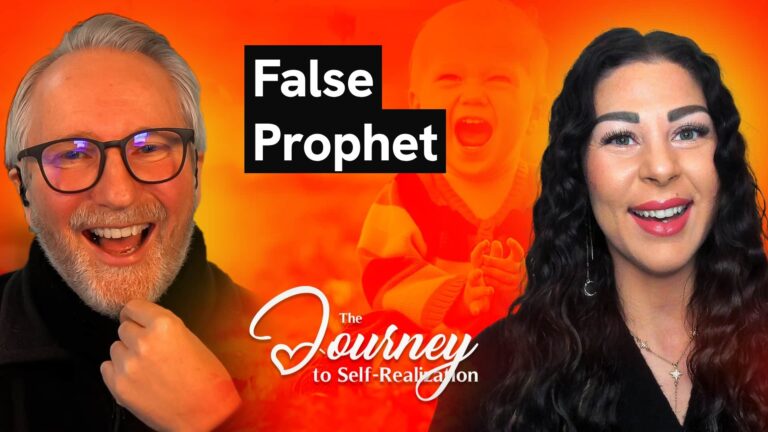
If you want to understand more about the deep and fascinating passage through life, death, and new incarnations, you will find a fuller explanation in the article “The Secrets Behind Death and Reincarnation: What Happens After Death?” and in the podcast The Journey to Self-Realization, where Amina and I go thoroughly into these and many other topics:
- Episode 9, “What Does Your Soul Really Want, Why Is It Here, and How Do You Find Your Life Mission?”
- Episode 10, “Gaia: The Elite University of Souls”
- Episode 11, “Soul Friends, Soul Family, Karmic Relationships and the Great Misunderstanding About Twin Souls”

No learning without karma and dharma
Karma and dharma are not mystical concepts from a distant tradition. They are entirely fundamental laws of cause and effect, the very structure that makes learning possible in our human “straitjacket.” Every single action, thought, and intention we have creates a consequence that either opens us up or limits us.
When our motivation springs from the shadow sides of the ego, from fear, anxiety, jealousy, the need for control, or hatred, we create karma.
When it springs from the heart, from love, integrity, compassion, and respect for the free will of others, we create dharma.
An example:
Imagine that the main theme of your incarnation cycle is “loving and constructive use of power.” If you misuse your power again and again to manipulate, control, or push other people against their free will, you create karma. Like stones in a backpack, the karma grows heavier every time you act against the soul’s purpose. And in the end, the weight becomes so great that you can no longer move forward until you stop, look inward, and begin to learn.
This is what karma is for.
Without consequences, we would never learn.
Without resistance, we would never grow.
Without connections between motivation, actions, and their results, incarnation cycles would be meaningless.
Imagine a life where nothing had consequences, where you could do anything at all without anything changing. How would you then find the motivation to work on a demanding incarnation theme through hundreds of lives? Karma is not punishment. It is a driving force for learning.
Unfortunately, many people have a negative relationship with karma.
Mine is the opposite.
For me, karma is a gift.
A quiet but unshakable helper that points me back to what my soul actually came here to learn.
Karma is covered in more detail in the podcast The Journey to Self-Realization:
- Episode 22, “Karma – The Choices That Shape Your Life”
- Episode 23, “Karmic and Dharmic Synchronicity: The Invisible Rules of the Game That Govern Your Life”
When I burned out in 2003, I had been driven by fear for many years: fear of not being enough, not having enough, not being seen enough. The ego’s engine was running in high gear. I chased money, status, success, and recognition. Looking back, I can clearly see how I created greater and greater karmic pressure, until the backpack finally became so heavy that I collapsed.
But the collapse was not the end.
It was a restart, one of the soul’s most radical ways of saying:
“Now you have to listen. Now you have to go back to what you really came here for.”
The experience became the way into my greatest transformation.
It led me back to the soul’s intention for this incarnation and opened the door to a life filled with meaning, joy, depth, and wholeness.
And an important clarification:
Not all illness or suffering is caused by karma. Some of life’s challenges have entirely different causes, and it is important to meet everything with respect and nuance.

The path to finding out why you are here
Why has your soul chosen exactly this life, with exactly this body, this family, these challenges, and these opportunities?
It is one of the deepest questions a human being can ask, and at the same time one of the most personal. There is no universal answer key. Each soul has its own reasons, its own themes, its own unique journey.
For many years, when my students asked me, “Why am I here?” I used to give them the answer.
Through shamanic work, looking behind the veil, listening to their guides, and reading in the Akashic Records, where the information about the soul’s journey of development is kept, it is not difficult to uncover which incarnation themes a person carries, and how they have fared with them in previous lives.
But I discovered something important:
It did not help them.
Even though the answer was often fascinating and gave them exciting aha moments, in practice it did very little for their development. Most of them made no noticeable changes in their lives. They became more informed, but not more changed.
The same thing happens when a skilled astrologer gives people insight into their birth chart and the common thread in their life plan. It is exciting to hear about, but very few people do anything with it.
And eventually I understood why:
My most important task as a shaman and spiritual mentor is not to tell people who they are, but to help them find their own way back to their essence.
Only when blockages, old patterns, fear, and inner barriers are gradually healed does the gateway to the soul’s purpose open. Then the answers come naturally, from within, not as information you receive, but as wisdom you remember.
My most important task as a shaman and spiritual mentor is not to tell people who they are, but to help them find their own way back to their essence.
Pål-Esben Wanvig
That cannot happen through books, articles, or YouTube videos alone.
Inspiration can come from there, absolutely.
But real transformation happens only by walking an actual path of development over time, in the company of a competent teacher and a safe community.
It is a journey that has to be lived and experienced, not read.
Amina and I share a glimpse of what such a journey can look like in the podcast The Journey to Self-Realization. It shows how inner work, practice, and continuous development slowly but surely open the doors to the answers we long for, including the biggest of them all:
Who am I, and why am I here?
An exciting journey to the answers
I see the active spiritual path of development, the work of understanding who you really are and what is true in this world, as one of the most fascinating and life-changing experiences a human being can set out on. It is a path that is deep, rich, challenging, and exceptionally rewarding.
But it is also a path that is hard to walk alone.
One of the main reasons is that we are subjective about ourselves. We do not see our own blind spots. We are governed by patterns, habits, and automatic reactions that often spring from fear: fear of change, fear of losing control, fear of opening doors that feel unfamiliar. These patterns pull us back to the familiar, even when the familiar is not good for us.
To find our essence again, the deep wisdom and the divine spark that lives in all of us, we have to change precisely those sides of ourselves. We have to heal what keeps us from listening to the soul’s voice, and what holds us back from living in line with the truth we already know deep down.
Many great philosophers and spiritual teachers have said:
“All answers are found deep within yourself.”
“Enlightenment lies right in front of the tip of your nose.”
When I first heard that, it frustrated me. I wanted the answers now. I wanted to understand everything at once. I longed for an answer key, a simple explanation, a “here is the answer.”
But over time I discovered something:
The journey itself is the answer.
It is the walking that opens the doors.
It is the inner steps, one by one, that gradually make us ready to see what has been there all along.
And once we begin to walk the path, with a competent mentor beside us, it becomes not only instructive but also deeply exciting, life-giving, and filled with revelations large and small.
Where you can start
If you feel this path calling you but are not yet ready to seek out a spiritual teacher or enter a deep process of development like the one we talk about in the podcast The Journey to Self-Realization, that is completely fine. Many people begin right here: alone, curious, open, and with a quiet hope of coming closer to something real.
The most important thing is that you take the first step.
And to make the start safe, inspiring, and meaningful, I recommend that you begin with these articles:
- “The 9 Pillars for Finding the Path of the Heart: The Way to Happiness, Meaning, and Shamanic Magic”
- “This Could Be Your Most Important Decision: Learn How to Live a Happy and Meaningful Life in Your Current Situation”
- “To Kindle the Spark of Life, We Need Hope and a Positive Outlook on Life”
- “Learn the 7 Pillars of True Forgiveness: Free Yourself Through Forgiveness”
- “Forest Bathing: Nature’s Medicine Against Stress, Anxiety, and Burnout”
- “The Intelligence of Trees: Our Natural Guides to a Fulfilled and Happy Life”
- “The Art of Living According to Nature’s Healthy Rhythms”
Find the right spiritual mentor for you
Walking the path alone can be both challenging and lonely. Not because you lack willpower, but because we all carry inherent fear, old patterns, and resistance to change. When we try to find all the answers ourselves, it easily becomes heavy, confusing, and at times quite frustrating.
That is why there is a simpler and far more rewarding way to walk it:
Finding a spiritual mentor who can walk with you.
An experienced teacher can help you see what you cannot see yourself, support you when resistance shows up, and show you the shortcuts home to your own inner light. You will find advice on how to find a safe and competent mentor in the article “ABC Guide to Finding Your Spiritual Teacher.”
I have walked a long and demanding path myself to find my way back to the light within me. My life today looks completely different from when I collapsed from burnout in 2003. Now I live in a 240-year-old rustic house of oak and clay in the countryside, surrounded by silence and the rhythms of nature. I do not miss status, quick updates, or a brand-new phone every year. I buy clothes only every three to five years: sturdy, organic garments that last a long time. I do not need fame or a glittering career to feel whole.
An experienced teacher can help you see what you cannot see yourself, support you when resistance shows up, and show you the shortcuts home to your own inner light.
Pål-Esben Wanvig
Because what really matters is found somewhere else entirely.
One of the most meaningful tasks I have today is helping people find their way back to their own light, to the divine spark that lives in them. Because in that spark lie all the answers:
Who you are.
Why you are here.
And what the deepest meaning of your life is.
For students who want to walk this exceptionally exciting and life-changing path, I offer a deep primordial shamanic development process in the basic training at the Yggdrasil Shamanic School. There I follow each student closely, step by step, as far and as long as they wish, all the way back to the core of who they really are.
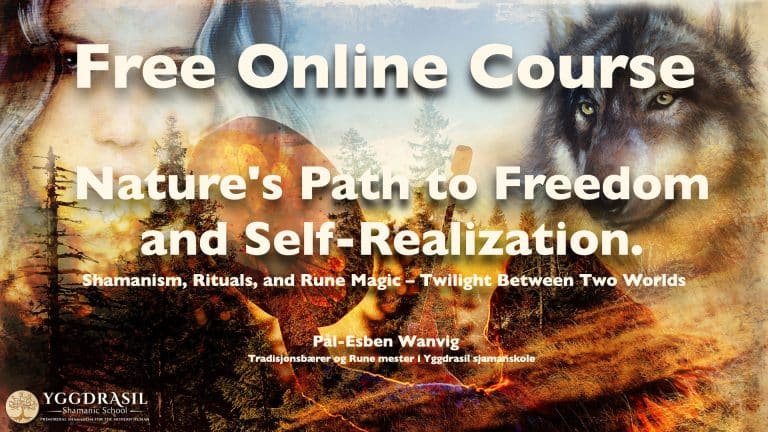
Do you want to go deeper? On my blog and in the podcast The Journey to Self-Realization, we explore the topics in this text in more depth. If you want to walk the path yourself, it begins at the Yggdrasil Shamanic School with our free online course on primordial shamanism: Nature’s Path to Freedom and Self-Realization. No path could begin more simply. How far it reaches is up to you.
This content does not replace professional medical help from a doctor or other health professional, and it is not intended as medical treatment. If you are ill, always see a doctor first.
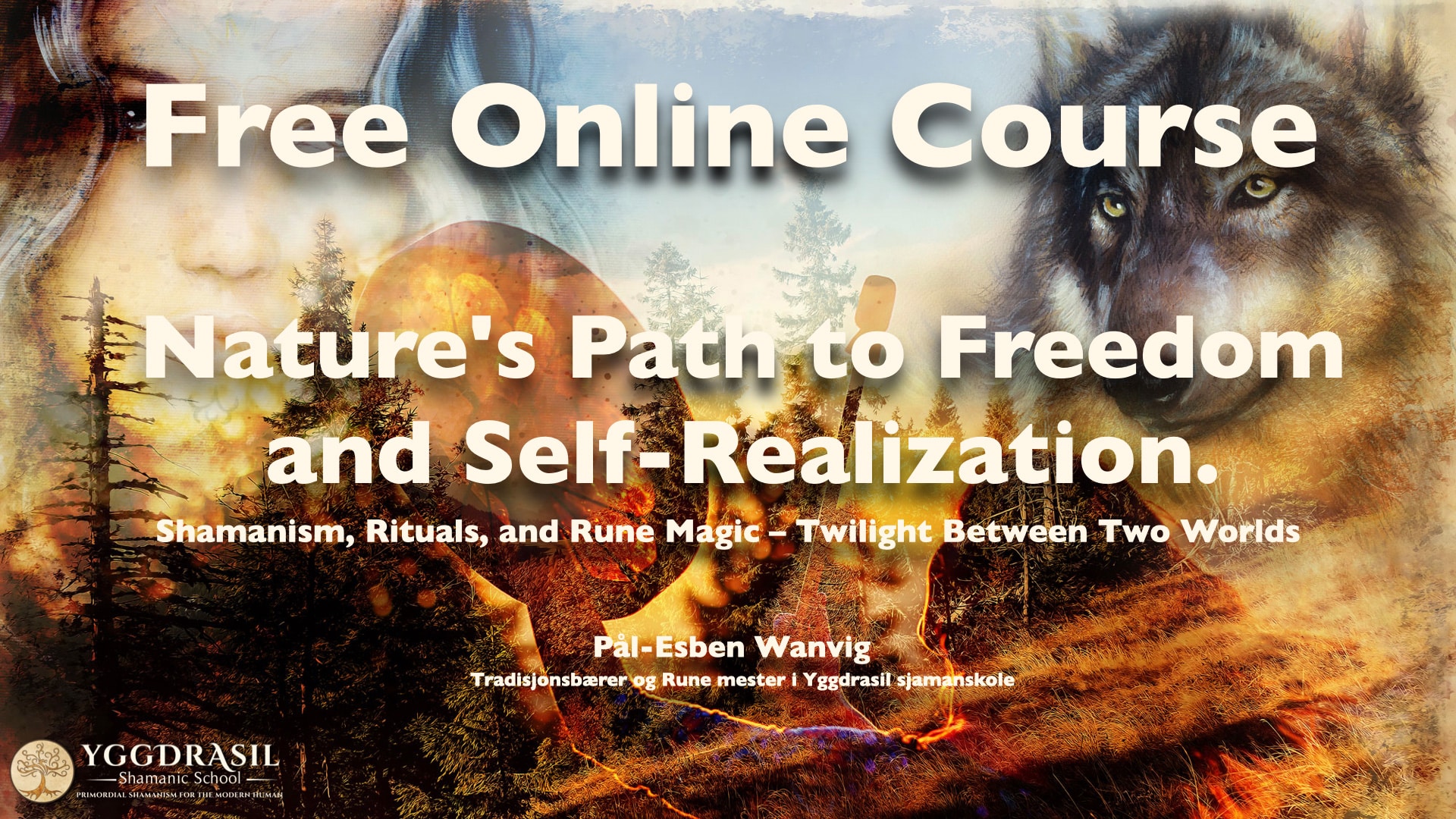
Nature’s Path to Freedom and Self-Realization
Curious about what primordial shamanism really is, behind the mystique and the misconceptions? In this short online course I tell the story of my own path from skeptical engineer to teacher of primordial shamanism, and give you a first introduction to what I teach: what shamanism and primordial shamanism are and are not, how rituals and rune magic are used in practice, and why the longing for growth matters so much for a good life.
The lessons are recorded in Norwegian; the English version will be ready in November or December 2026. Leave your email on the course page, and I will tell you when it is.