Episode 5 – Living from the Heart – How to Build Values and an Optimistic Outlook on Life
Standing in a queue at a petrol station, stressed and in a hurry, Amina felt a strange attitude rise up in her: that the people in front of her had no right to be ahead of her in the queue, because of where they came from. She had always seen herself as someone who accepts everyone, and the discovery showed her how much can lie hidden in our own depths.
In this fifth episode, she and her teacher and guide, Pål-Esben Wanvig, talk about the next two of the 9 Pillars for Finding the Path of the Heart: building a healthy value system and a strong personal character, and seeing the glass as half full. They explore why a deep path of development requires stability, and why a problem is also an opportunity for growth. It is part of “The Journey to Self-Realization”, a podcast about the bravest journey a human being can set out on: the journey home to yourself.
This episode is an English translation of our Norwegian original, voiced by the digital avatars of Pål-Esben and Amina.
In this episode
- Why the 9 Pillars change lives, and the straitjacket that holds us
- Pillar 4, a healthy value system: the straw that bends with the wind, and why the transcendental transition requires stability
- The queue at the petrol station, and why it isn’t your fault but it becomes your responsibility
- The exercise with 50 values that made a group explode, and the recipe in The 7 Golden Keys
- Why a teacher has to be coherent and able to handle discomfort
- Pillar 5, seeing the glass as half full: no spray paint on rust, and the bathroom that had to be torn out again
- Why a problem is an opportunity for growth, and why you shouldn’t do this alone, or with your partner
- Virtue cards at the breakfast table: working on values with your children
This podcast is for you if you:
- Seek real depth in your spiritual practice
- Want to understand yourself on a more fundamental level
- Are curious about shamanism but tired of superficial “new age” spirituality
- Have taken many alternative courses but still feel that something is missing
- Feel an inner longing for freedom, love and wholeness
In a time when so many get lost in external methods and promises of quick fixes, this podcast invites you back to the only place where true answers can be found: your own heart.
Listen above, or read the full conversation below.
Transcript
A warm welcome to the podcast “The Journey to Self-Realization”, a primordial shamanic journey of development back to your true nature. This podcast is a collaboration with our favourite magazine, the health and lifestyle magazine Medium, and is devoted to exploring the bravest journey a human being can set out on: the journey home to oneself. We follow Amina, a student at the Yggdrasil Shamanic School, as she goes through a deep primordial shamanic process of development together with her guide and teacher Pål-Esben. It is a raw, unpolished journey of discovery towards true joy in life, deeper meaning, and a life that truly feels good to live.
This episode is an English translation of our Norwegian original, voiced by the digital avatars of Pål-Esben and Amina.
Why the pillars change lives
Pål-Esben: Hi, and a warm welcome, Amina!
Amina: Thank you, and likewise, Pål-Esben!
Pål-Esben: Thank you. Today we’re going to continue our exciting discussion about the 9 Pillars for Finding the Path of the Heart.
Amina: We are.
Pål-Esben: And we’re going to get into quite a few very interesting and exciting things. But first, let’s say a little about why the 9 Pillars for Finding the Path of the Heart are so important. We talked about it in the previous episode and went into it in detail, but shall we sum up briefly, so that everyone can keep up? Can you tell us a little about how these nine pillars have changed your life?
Amina: Yes. As I touched on in the previous episode, part 1 of the Path of the Heart, I had big problems living out love in a practical way in my life. I was in these alternative circles where I got to know love, and we lived in love, and it was nice and lovely, but nothing practical changed in my life. Getting to know the 9 Pillars for Finding the Path of the Heart has meant that I can stand steady in any storm. It means that I get back up faster than before if I stumble. It means that I feel a sense of meaning; quite simply, I have a meaningful life, which also means that I can have good relationships. I can understand myself better and other people better, and not least these deeper layers of myself. That’s it, short and simple.
The straitjacket and what holds us in it
Pål-Esben: Yes. Because people often come to me who have been out on an esoteric journey and are frustrated that their life hasn’t changed. They’ve learned reiki, they’ve learned channelling, they’ve learned about chakras and the aura, they’ve learned whatever it may be. And still they feel that their life hasn’t changed. Yes, what they learn is fascinating in itself, but it doesn’t bring that kind of transformation in how we experience our life: how we experience everyday life, our relationship, our friends, the fullness in ourselves. That’s the challenge. What we’re talking about here in our podcast is what we do in order to go to that depth, what we call a profound process of development. Among other things, it leads to the kind of results you have, which I call life-transforming. And after all, you haven’t been doing this for many years. So far the process has lasted around 18 months, but already after two or three months this began to take hold in your process of development.
What’s important here is this: if we’re going to make this transformation in our lives, where we let go of anxiety, fear, unease, emptiness and limitations, it takes something more than learning about chakras, channelling and healing with angels. That’s my experience with quite a few thousand students over the last two decades. For those who are ready for this profound process of development, a number of things need to be in place. One of them is how we loosen the grip that the straitjacket, as I call it, has on us. In our materialistic world, I use the image that we’re wearing a straitjacket. What keeps us in the straitjacket is fear, the need for control, anxiety, lack of forgiveness, insecurity and so on. As long as we’re in this straitjacket, and as long as it governs most of what we think, consciously and unconsciously, and most of our behaviour, it’s very difficult to set ourselves free and open up, so that the heart gets the most room in our everyday life. And for that we have the 9 Pillars for Finding the Path of the Heart, which I’d say are among the most important things of all, if anyone asks me.
One piece of advice after 20 years
Amina: Over 20 years, Pål-Esben, you’ve experienced a great many things, and you’ve done a great many things. If there were one thing, out of everything you’ve dived into over the last 20 years, that I could do to improve my life, what would you recommend?
Pål-Esben: If I pick out one thing, it’s the 9 Pillars for Finding the Path of the Heart. I’ve never come across a student who engages with these things whose life hasn’t changed profoundly. And you’re one of them. We bring this down to a very practical level. If you’ve learned in esoteric circles to live in love, that’s very good, but what about the other 99 percent of your life, when you’re not actively doing an exercise to live in love? Then you come home to your kids, and you’re stressed and you yell and scream. There isn’t much love in that. So how do we go from that one percent, where we do a specific exercise to live in love, to this becoming something we live by, on autopilot, in our daily lives? That’s what we’re talking about here. For that we need the practical things, and we covered the first three pillars last time: becoming a master of gratitude, a master of forgiving yourself and others, and a master of self-regulation.
Pillar 4: building a healthy value system
Pål-Esben: Pillar number four, let’s jump straight into it, is building a healthy value system. Tell us a little about your experience with this. What is a healthy value system, and what have you done?
Amina: Yes, it’s quite an interesting pillar. Because I’ve always been a very empathetic person; I’ve always been able to put myself in other people’s shoes when it comes to their challenges and problems. And for large parts of my life I also took on a great deal of other people’s opinions, other people’s value systems, other people’s ethics, what’s right and wrong. I was like this: if he thought something, well, then that’s how it was, and if she thought something, well, then that’s how it was. Earlier in life I also mirrored a lot in order to be liked, of course.
But I’ve had some challenges with this pillar, and that was because I didn’t know what my value system was, in other words my personal ethics. On a superficial level I can tell right from wrong: it’s wrong to steal, it’s wrong to lie. But in various situations I found myself in, and I remember talking to you about this, it became: “Yes, but I understand why that person did what they did.” And when you can see the reason why someone does what they do, how are you supposed to put your foot down? That’s where you taught me to look at this in a different way. First I have to know what my values are, and dare to stand up for them. Then I’ll also stand more steadily in the storm, and others can’t rock my boat. If someone comes along and wants to persuade me that it’s OK to steal, I can say: no, it actually isn’t OK to steal. Because then I know it in myself.
This was something I struggled with in life in general, long before I even knew there was a pillar for it. But perhaps especially after I came into the alternative, esoteric world, where everything is love and we’re supposed to understand everything: “And so-and-so did this, and so-and-so did that. Oh well, that’s fine.” No, it isn’t really quite fine. Through this pillar I’ve also seen a bit more of the shadow sides in myself and others. Finding out what I myself stand for, and living it out even if it isn’t necessarily as popular with everyone around me, has been very important, but actually a bit challenging. It sounds simple: “What are your values?” But it’s been a bit challenging for me.
Ethics from the taekwondo hall
Pål-Esben: Not just for you. For everyone I’ve inspired to go deeper into ethics, it’s perhaps one of the hardest things a human being can do. I’ve been teaching ethics for almost 40 years now, ever since I was an instructor in the martial art of taekwondo, where ethics was extraordinarily important. Because say you teach someone methods and techniques that can harm another human being quite considerably. If you don’t really teach that person the ethics of what is right and not right to do, then in the worst case they can misuse their abilities, and that can be catastrophic. My taekwondo master 40 years ago, an utterly brilliant man, said: “If we don’t teach ethics and a value system so that it becomes something the student has, we can’t teach more complex things either, things that can harm others and themselves.” That was my first introduction to how important it is to cultivate ethics and a value system in a human being. Since then it has been with me as a central pillar in my life.
Because I prefer to deal with people who are coherent, people you know where you stand with, who stand for something. That’s different from those who sway like a straw blowing in the wind. You can never feel safe with them. One moment they’re pleasant to deal with, and suddenly, out of the blue, they stab you in the back and bad-mouth you. You’ve probably experienced quite a bit of that too, Amina, and how challenging it is.
The straw that bends with the wind
Pål-Esben: And why is this so important for a profound process of development? Well: the more we bend like a straw blowing in the wind, the shakier our foundation is, and the less of a mountain we are; the more we live at the mercy of wind and weather, that is, of what people think, say and believe. And when you waver, it’s very difficult to be connected to your heart. One moment you may be loving, the next you’re filled with hatred and resentment, and it goes up and down. The deeper you go into this rabbit hole, shamanic magic included, the more power you gain access to, and the more stable you need to be. And seen from the 9 Pillars for Finding the Path of the Heart, it’s clear that it’s easy to go into an emotional state of suffering when we’re insecure in our value system. As you told us: it’s easy to go into frustration and emotional fear when you’re unstable.
Amina: Yes, absolutely.
Pål-Esben: You experience it: one person says something, and “have you heard that so-and-so has done this and that?” And there you are: “Oh my, oh my.” Then you bring yourself into the emotional states of suffering we talked about in the previous episode. Then you’re far from your heart, far from joyfulness, far from the fullness of life. So the further along and the deeper you go in a process of development, the more important ethics and the value system become.
The transcendental transition requires stability
Pål-Esben: When we’re going to take this all the way to our spaceless and timeless state, where everything is one, a state of spiritual enlightenment, it’s clear: if you don’t have this stability, if you’re unstable, it’s still the ego in charge, the straitjacket in charge. And as you begin to move into the transition between time and space and the timeless and spaceless, which I call the transcendental transition, you’ll run into big problems right there if you aren’t stable enough, with a stable enough value system and foundation. Because in the regions towards oneness, everything is so sensitive that hard, coarse impulses, connected to the ego and to instability in a person’s character, will be enough to just go “kaboom”.
Many people claim to be awakened or enlightened, but it’s very easy to see that it can’t be true when you observe them in their daily life. You see that there’s a great deal of talk and many fine words, but when you see how the person lives their life, you see that it wouldn’t be possible. Because there’s too much chaos in their life, and with that chaos you don’t find stable access to the timeless and spaceless.
Amina: Yes, I talked to someone not long ago. This person was into meditation and was in oneness, and it was all lovely and nice. And straight afterwards he told me that he didn’t like that type of people, and that type of people, and that type of people. Then it’s interesting to see how you can have such strong opinions, really a bit of hatred too, while at the same time saying you have constant experiences of oneness. Because in my experience, those two don’t quite fit together. Something in the personality changes when you touch these parts, at least as far as I can tell from having been lucky enough to dip a toe in.
Pål-Esben: Yes. Because the day you have a real experience of oneness and experience that everything is one, you experience the illusion we live in. I call it the grain of sand, while the Sahara is our full nature, which is one with everything. Once you’ve had a real experience of oneness, your perspective on life changes quite considerably. The basis for getting irritated, hating and running down things that aren’t the way you want them more or less falls away. Because you’ve experienced the full existence, not just the grain of sand that most people believe is reality. It’s quite fascinating, but we’ll talk a lot about that in later episodes. Should we start talking about things like that as well? Perhaps you, the listener, are thinking: “What are they talking about? That’s the exciting part!” Or: “Can’t they stop going on about these things? It demands so much. No, I don’t like that, I don’t want that.” That’s completely OK. But if you don’t take the foundation we’ve discussed seriously, no stable state of the timeless and spaceless can arise.
That’s shown by many thousands of years of yogic cultures and other cultures, like the mystical parts of Buddhist culture, if you look at Zen. There, a great deal of work goes into building stability in a person’s character and way of being. Because these gurus and yogis know that it’s impossible to become stable in a state of oneness unless we take this seriously. That’s one of the reasons we have the 9 Pillars for Finding the Path of the Heart. Not just so that we can have a better life and be more joyful in everyday life, which is really good enough for most people, but for those who have a longing for their complete, total existence. For them, this is mandatory. It’s a must.
So the value system, the fourth pillar, is difficult. Because as soon as we start poking at a person’s value system, they get angry and sulky. People say: “I’m so good, I have such integrity, I’m such an honest person.” And when you show that this person is anything but honest and a person of integrity, they’re confronted with honesty and reality, and then they react and get a bit irritated. How was it for you? This is a path for the bravest.
The petrol station: radical honesty
Amina: I remember a few years ago, maybe only two or three years ago, I was standing in a queue at a petrol station. I was very stressed, in a terrible hurry, and then there was a queue. And this is a bit unpleasant to say, but I hope someone can benefit from it. I felt something come up in me: that the people standing in front of me in the queue had no right to be in front of me, because they were from such-and-such a place and were like this and that. It came up as a strange, strange attitude. And I thought: “But Amina, you don’t have attitudes like that! You love all people and animals and planets and cultures and races.” And perhaps you can’t say “races” any more, but you know what I mean. I had a real aha moment about how much can lie deep inside me that I’m not aware of. Because I’d like to think of myself as someone who accepts everyone, and in my conscious mind I actually believe I am.
What I took away from that experience was: “Whoa, if that’s in there, what else is in there?” And I did a little examination of myself: how do I think and feel when I see this person, that type of person, that type of situation? But it requires radical honesty with yourself, and that isn’t always much fun. Because you know that if you have an attitude or an opinion like that deep inside, it isn’t cool. Then you’re a bit of an idiot. So it’s a path for the bravest.
It isn’t your fault, but it becomes your responsibility
Pål-Esben: Yes, it is, absolutely. Because of course you want to be good. You want to have integrity, you want to be loyal, you want to be an empathetic fellow human being, to name some examples of values you can build a value system with. But it’s one thing to want it, and another to actually be it. And I don’t think it’s the individual’s fault that they aren’t the way they want to be. It has to do with our imprints, it has to do with our society. We’re drilled into an autopilot: most of what we think, feel and do runs on the autopilot imprinted on us by the society we live in. So it isn’t you as a human being who is the problem; the imprints are the problem. I often say: it isn’t your fault, Amina, that you were like that. It’s just a result of what you’ve been imprinted with, which has become part of your reality. And when we enter a profound process of development, we need to look at what reality is, and that’s what hurts. But only when you’re aware of reality can you begin to do something about it. If you don’t want to become aware of it, you don’t stand a chance.
The blunder with the fifty values
Pål-Esben: When I was younger, 17, 18, 19 years ago, many years ago, I tried to do this in a somewhat drastic way, because I wanted my students to make rapid progress. What I did was to start from a list of 50 different values. For those who know about virtues and virtue cards, you can start from those; they describe values like humanity, honesty, loyalty, integrity and love. Then I asked my students to assess themselves: based on the ten most important ones, where do you stand in relation to them? And everyone did it: “Well, it’s not so bad here. I’m doing well at this.” Then I split them into groups of ten, I think, and the others in the group were to give objective feedback on how they saw that person. It was anonymous, it came in to me, and then we built a list. And from that feedback, most of them saw that they were far, far away from where they thought they were.
That was one of the blunders of my younger days. Because what happened in the group was that they exploded. I had a big problem with the group dynamics: there was anger, transferences, projections, and of course everything was my fault, since I’d set them off on something like that. That’s how most people react when they experience something painful. When it’s so painful that they can’t bear it, they project the blame onto something innocent. After that I learned to do this in a more balanced and calm way, step by step, the way you were introduced to it: “Well, dear Amina, shouldn’t you have a little look at this now?” And then you reflect a little on that value, and then you see how you live it out in everyday life. We went about it gently, even though it was uncomfortable.
Amina: Yes, and I thought it was fun once I got the hang of it. Uncomfortable, but also a bit fun: “Whoa, what do I find here today? Oh yes, that wasn’t so good. Well then, let’s do it a bit better.” Making these things a bit fun as well, not just deadly serious and monotonous, but getting a bit of play into it.
The recipe is in the book
Pål-Esben: Yes! And how do we do this? That’s a slightly longer story. In my book, The 7 Golden Keys, there’s a chapter where I describe this in detail: why and how you do it, and how you go about it in practice. Because it’s a task that needs to be done over a few months, and preferably together with a guide, teacher, therapist or someone else who can be objective. Because this is hard: seeing and acknowledging the truth about yourself. But unless we become aware of it, how are we going to change it? So this pillar with the value system is perhaps a bit more challenging. But it’s possible. Can you tell us very briefly how the process has been, and how you see it today?
Standing steady in yourself
Amina: Yes. It’s about building a proper foundation that you stand for and can live out in your daily life from now on, whichever way the wind blows and whatever impulses you get. I find it very liberating to feel that I can now notice very clearly in my body when something doesn’t match my value system, if I’m with people or get invited to join in something. Or when there’s something I don’t want to play along with. I see it more easily, and I find it easier to stand by my choice not to do it. Of course I choose my words with care, but it’s easier for me to see what I want to be part of. It’s easier to know who I am, even when I’m with others who may not be living out an optimal value system, and who may not even know it themselves. Most people go around unaware, after all, so I don’t go around judging what others do and don’t do. But I’ve come to know that I can stand steady in what’s mine, even if others have theirs.
We’ve had quite a few conversations about this that have helped me, and that’s also where you see how important it is to have someone who can see you from the outside. I’ve asked to talk to you because there was something I was sensing, something that wasn’t right in a conversation or a setting: “Is it me, or what’s going on here?” And again and again I’ve experienced it, and seen it from the outside afterwards: “Yes, OK, this is your body talking. There’s something in you telling you that you don’t want to be part of this.” When I was guided from the outside back to myself and my own guidance system, I got more reference experiences of this. So today I can stand more steadily in myself around these things.
And then there’s what you said earlier, that it isn’t our fault, but it becomes our responsibility: taking responsibility around this. It means that I increasingly feel I can stand steady in life’s storm, at least to a much greater degree than before. So yes, truly. I can’t say it’s the most important pillar, because all the pillars are important, but it’s been very important for me, perhaps especially this last year.
80 percent at the start, 97 for teachers
Pål-Esben: Yes. And we’re not talking about reaching 100 percent at the start. At the start, 80 percent is always good enough. But as you practise, and especially for those who are going into a really deep process, I’d say that 95 to 97 percent is the minimum for how well you manage to live it out. Because we all have a first chakra; we all have an anxiety generator inside us. When we get strong enough impulses, the emotion comes up through fear. That’s part of being human. But if you manage 80 percent at the start, you’ve come a long way.
Where you are now, we’re moving towards 97 percent, because there’s another context where this matters too: when you’re dealing with clients and students. I want to say a few words about that. To be able to create safety for your clients and students, you need to be coherent. Otherwise you’ll never be able to create the safety they need to be helped through a profound process of development. And in your case, I think it took 14 months from when you started at the end of 2022 until you became a teacher. So 14 months in the basic training at the Yggdrasil Shamanic School. Today you have 15 students of your own. And I never train teachers or give them a licence to teach until I see that they have a healthy value system that they’re able to live out. Because unless you as a teacher stand securely in yourself, how are you going to guide another human being through a sensitive process of development? So there’s another aspect here, which of course is also motivating for you, because you want to be the best teacher and guide you can be.
Amina: Yes, absolutely. And I’m very, very grateful for it today, and I see how important it is: not being thrown off balance if something happens in the group, if someone has an opinion, if something doesn’t go as it should, if someone gets triggered, or if someone disagrees about something. All nine pillars are important for being able to stand steady in myself. And as you’ve shown us: things can happen around you, but we always know that Pål-Esben is Pål-Esben. He stands there, he stands steady, and if there’s anything, we can come to him. He isn’t lying in the corner crying afterwards. He’s a safe place to come to. Your character, and who you are as a guide and teacher, has inspired me greatly on my way to where I am today. We all need people we can feel safe with, whom we can come to and say: “No, actually, I disagree there. I reacted to what you said there.” And then have a teacher and guide who says: “Yes, but that’s OK. Let’s discuss it instead and find out what it is.”
The teacher who can handle discomfort
Pål-Esben: Because what you experience as a teacher, especially if you do this properly, is that you also have to get into topics that are uncomfortable for the students. Say that as a teacher you’re only in the light, “now we’re going into the light and talking to angels”, and everything is so good. Then only a very superficial development can happen, since we never reach the parts of the ego that sit there blocking the person. We have to talk openly about things that are difficult. That means you get transferences and projections from your students, and in my teacher training you’re drilled in how to handle that in a healthy and loving way. Because the point is to be able to help a human being. But how are you going to help someone out of limitations, fear and anxiety if you can’t get into topics that are uncomfortable for them, topics connected to their fear, their anxiety and their limitation? If you aren’t steady in yourself, how can you talk about things like that? So a teacher who isn’t steady in themselves, and who doesn’t have a good value system and strong ethics, avoids topics that might trigger the students. They just keep trying to please them. And that’s very limiting, since the straitjacket is governed by fear, and our task is to bring people out of this straitjacket so that they can set themselves free.
And another thing is important: as a teacher and guide, I encourage my students and clients to be honest with me, whatever it’s about. If they say: “Pål-Esben, I didn’t like what you said”, or “I disagree with what you said, that’s not how it is”, then I say: “OK, good. I’m glad you’re telling me.” How are we going to go further into difficult things if you as a guide or teacher demand that students and clients agree with you? How’s that going to work? I believe that the safety you radiate to your students and clients as a teacher and guide is very important for how deep into the process of development they can go. Because it’s about being able to trust the guide, being able to trust you as a teacher.
And we don’t see most of it in what a person says; we see it in their body language. It’s very easy for a human being to see whether another human being is coherent or not. Let me give an example. Many people think that what we say is what the other person picks up, but what we say is only a few percent of our communication. If you say something and your body language shows that it isn’t true, the unconscious of the person receiving it will react. Perhaps not consciously straight away, but gradually, unconsciously, a feeling of insecurity towards you arises. On top of that, the aura changes, as we talked about in a previous episode. Like with my wife at the start, when I tried to get away with a white lie. She says: “That’s not true, Pål-Esben.” “Yes, it is true,” I say. “No, that isn’t true.” So I had to learn to deal with having a wife who is exceptionally psychic, and on top of that able to see the aura and the chakra system. And eventually those who practise these things become like that, consciously or unconsciously.
That means: if you as a teacher and guide want to bring your students into a deep process of development back to themselves, this coherence is of course essential, this stability that the value system is the foundation for. Imagine sharing the deepest things on your heart, the most vulnerable things, with someone you can’t feel 100 percent safe with, who then goes off and stabs you in the back with someone else. You can’t do that. At least I can’t. So that’s the fourth pillar, and you’ll find the recipe in my book The 7 Golden Keys. It’s well worth engaging with, because this is incredibly exciting.
Pillar 5: the glass is half full
Pål-Esben: Right, let’s see. We’ve talked about that one. Shall we move on to the next one, which is perhaps a bit easier to relate to? It’s becoming a master of seeing the glass as half full. What’s that, then, Amina?
Amina: Yes, this is about seeing possibilities instead of limitations. And it’s a pillar I feel I live out quite well today. Because I’ve always been a positive person on the outside, perhaps, but inside I’ve also been a bit more negative, seeing the glass as half empty when life throws things at me during the day. Then you have to look: “Oh right, OK, how can I see this in a slightly more positive way? Yes, the washing machine has broken down, but it isn’t the washing machine and the tumble dryer and the car all at once.” That was a bit of a muddled explanation, perhaps. But it’s about seeing what I still have of all the good things, even if something negative has happened, even if you’ve ended up in a situation that isn’t so fortunate, or you get some bad news. It’s about having a positive mind. But whoa, the sun’s just come through the window and it’s really dazzling me, so you’ll have to take over for a bit while I close the curtain here.
Pål-Esben: That’s fine. What we’re talking about is this: those who typically see the glass as half empty see problems in everything. They see problems in pretty much everything they come across. Those who typically see the glass as half full see possibilities, even in the problems that arise. That of course has a very big bearing on how many rich emotional states we can have in life, such as joy, love, empathy and joyfulness, as opposed to how many emotional states of suffering, such as fear and low mood. This is a philosophy of life: seeing the possibilities in things. It doesn’t mean that we say affirmations like “every day, things get better and better”. No, it has nothing to do with that; that’s spray paint on rust. The question is how we take a challenging situation in life and are constructive about it, that is, solution-focused, instead of saying: “Oh, this is so terrible, this is hopeless. Why me? Why do I have this karma?” If something has happened, it has happened. Why not deal with it in a constructive way, to find solutions?
And being with people who have the glass-half-empty philosophy of life is very tiring. They complain and moan about pretty much everything. Whatever it is, they’re in negative mode. Even if life is 95 percent good, they get stuck on the 5 percent that isn’t, and it goes on and on. For me, at least, that’s very tiring to be around, and that’s why I don’t have people like that in my life. I’ve chosen to spend time only with people who see the glass as half full. I make an exception for students, of course, because this is a process they have to learn; you don’t expect anything when they start. But in my free time, with the people I choose to spend it with, life is too short to spend it with people who are destructive about everything. It’s too tiring. And seen from the 9 Pillars for Finding the Path of the Heart, where we want to find more of the rich emotional states in everyday life, as we talked about in the previous episode, it’s of course very important to learn to see things from the perspective of the glass half full. This is perhaps one of the easiest pillars to get started with, because you can choose how you look at things.
The bathroom, part two: the glass half full in practice
Pål-Esben: Sometimes terrible things happen. In my case, for example, with my burnout in 2003, which nearly killed me. There and then, I don’t think I saw it with the glass half full, because it was horrible to go through. But as I came back to myself, I switched to the glass half full and said: “OK, I’m ill. How do I find a solution to this? Am I just going to accept that the doctors in Norway couldn’t find the solution for me?” The answer was no, and I began to search in other parts of the world, which meant that in the end I found the solutions I needed.
Another thing, from this summer; I’m going to share something from my personal life. Twelve years ago we built a whole new bathroom. Lots and lots of money. We live in an old house here, 240 years old now, I think, made of oak and clay, so this house isn’t built to normal building standards; it’s a bit complex when you have to do things. Twelve years ago we tore out the whole bathroom, since there were leaks and a rotten load-bearing structure, and everything was replaced. It cost lots of money, and the bathroom looked perfect. And this summer, someone who came to redo the grout discovered that something was wrong: the water had got under the floor and up into the walls, the whole package. It turned out that everything had to be torn out again, and we were a couple of years too late to make a claim against the tradesmen, so we had to pay for everything ourselves.
How can you see this with the glass half full? This is a massive cost; it’s perhaps about 17,000 euros, since bathrooms aren’t simple, at least not in old houses. I have other things to spend the money on, so it’s easy to slip into the glass half empty: “Why me? Why didn’t they do a proper job? I was cheated.” But both my wife and I saw it like this: “OK, that’s how it is. Nothing we can do about it. Let’s find a solution.” We didn’t waste an ounce of energy on negative feelings. There and then, when this became clear, I have to honestly admit that I saw red: my first chakra was triggered, and I got furious. “Why didn’t these bloody tradesmen do a good job?” For a moment that emotion rose up in me, and then: “OK, I can’t carry on like this. Let’s see what this is.” We took a constructive approach to it and got an expert to check. He said: “There’s nothing to be done. You can choose to go to court and spend money on it.” I said: “No, I can’t face that. Let’s solve this instead.” Then we found a solution. And a couple of months without a bathroom over the summer isn’t fun either, when you have to stand at the kitchen sink brushing your teeth and washing your hair. But why should I spend my precious time, my precious life, on destructive things I can’t do anything about? Let me find a constructive solution instead.
Has it always been like this? No. 20 years ago, before my burnout, I was glass half full, and then glass half empty when things didn’t go my way. Very tiring. I’m like you, a fundamental optimist by nature, so I became a bit schizophrenic in the old days. One moment the glass was half full, because everything was fine, and when things suddenly went wrong, the glass was half empty, and my mood went up and down. So this is very exciting to start working on: observing yourself in everyday life. When something happens that you don’t like, how do you react? Why see it with the glass half empty? Why not adopt a constructive attitude, the glass half full, and try to find a solution to the problem? That’s what we’re talking about here, you know, Amina.
Amina: Yes. And as you say, that emotion can come up: “Oh, this is awful!” But then it doesn’t take long before it becomes: “OK, but we’ve got to find a solution to this.” To refer back to episode 3, when we talked about how the people around you react when you’re in a process of change: “OK, all this has happened. How can you still be optimistic? How can you still have a good day? Are you unfeeling?” No, but I truly believe that all problems and challenges also come with a set of solutions. It’s just that you don’t always like those solutions. You want to pick and choose: “I want that one, I don’t want that one.” And then it becomes very limited. You have to look at the solutions that exist, and then quite simply choose one of them. It may sound ridiculously simple, but …
Pål-Esben: Yes, it may sound simple when you tell it, but of course it takes practice, and getting it wrong along the way. For my part, I live a much better life when I can go in and look for solutions straight away. Because OK, this has happened. It doesn’t help to dwell on what I could have done 10 or 15 years ago, when these tradesmen were here: “Was there something I didn’t see? How could I have known?” No: this is the hand we’ve been dealt; let’s find the solutions, and let’s approach it in a slightly playful way too. A lesson from the summer: if you’re having work done, you must always have a professional site manager check every step of what a tradesperson does. And there’s something good about the new bathroom, which will be finished this week: we’ll finally have underfloor heating. It’s something I’ve missed from Norway, underfloor heating in the bathroom. So there’s something positive about it too.
A problem is a problem, the solution is a choice
Pål-Esben: Before we move on to the next pillar, as we wrap up, we need to separate this from the idea that everything is fine no matter what, that we have to see everything positively no matter what. In other words, that you just push the problems down into your pressure cooker because you don’t talk about them. That’s what I call spray paint on rust. What we do is see a problem as a problem. When a problem is there, it’s a problem. To those who say there are never any problems, I say: I’ve lived a life, and I experience problems regularly, but I see them as a challenge to find a good solution. I don’t get stuck in the problem with the glass half empty, but see it as: “OK, what do we do about that problem? Let me find a solution to the challenge.” Maybe I don’t find it myself, and then I seek out an expert: perhaps a lawyer, a guide, a teacher, whatever it may be. An example: perhaps you’re chronically ill and go to your GP, and your GP doesn’t understand the cause. Then I say: OK, instead of walking around with the glass half empty, perhaps you should seek out an expert who isn’t a GP, but a more holistic doctor who can dig in and look at the root causes of the illness. That would be an example of the glass half full. Not that it’s good to be chronically ill, or that “being chronically ill isn’t really a problem”; that’s spray paint on rust; you push it down into your pressure cooker, and that’s not what we’re talking about. We’re talking about a mature way of handling challenges, a specific philosophy of life for how you deal with challenges in life, where you don’t forget the good things you have, as we talked about with gratitude. Most of us have at least 80 percent of our life to be grateful for. That’s also part of the glass half full: focusing on what you’re grateful for, and trying to find solutions to whatever the problem is. Because most people keep their full attention on what isn’t good. So this is very exciting, and actually quite simple to start with.
Amina: Yes, absolutely. And I think many people are looking for the one recipe, the one book, the one pillar, the one pill or the one diet that means they’ll never have to face a problem in their life again. The way I see it, that’s not what this is about. It’s about who you can become, who you can be, and what you can experience when problems and challenges arise. We’re human, and I believe there’s a meaning in things not always running smoothly, not least because of everything you learn from it. With this bathroom, you’ve now learned: “OK, next time we’ll do it like this.” The next time I upgrade a room in my house, it’ll be the bathroom. Your next bathroom will definitely be in your next incarnation; this has to be the last time now, right?
The most sought-after existence
Pål-Esben: It’s this fundamental philosophy of life that has such a big influence on how we experience and live our lives. In the old days I saw a problem as just a problem; today I see it in a very different way. The way I see it, our soul has come into this body to learn and experience. It’s quite interesting that a soul that is timeless and spaceless by nature, for some reason or other, chooses to come into a state where it’s limited by the straitjacket, by time and space and all these things. Put simply, I think: why in heaven’s name would a soul come into this yoke of a world? But this world we live in is one of the most sought-after existences a soul can experience.
Amina: The first time you said that, I laughed a bit. And then I realised you meant it seriously.
Pål-Esben: Literally. Because there are many ways a soul can experience things in this multiverse we live in. If you look at it from the beginning, from what many call the Big Bang, which is another story in itself, but which many believe is where the material part of our existence began, the metaphysical as well as these parts of our multiverse, then everything since has been evolution. Evolution means development, evolution means growth. We see it on our planet too: full evolution and development all the time. And everything that is there, including us humans, is here for evolution and development. For that to happen, for us to be able to learn and grow, we must have challenges. If you have a hundred million euros in your account and a castle somewhere or other and don’t need to do anything at all, no development happens. Then there’s just implosion and emptiness, which we see in many people who have lots of money. In my experience, they often have more emptiness than people with bigger challenges in life.
That’s why a problem, a challenge, is an opportunity, an opportunity for growth. After all, we’ve come here to learn and grow, and that’s why we depend on challenges and problems. The most difficult situation with students who come to me is if they have no challenges in their life. No challenges, no problems, no emptiness, nothing. Then I say: then we really do have a challenging process of development ahead of us. Because a process of development requires that we have things to work on in daily life in order to go through this process of growth. When you came to me, I didn’t say it to you, of course, but you had quite a lot of problems, as we talked about in episode 1, and I thought: “Here we have potential. This will be exciting; this will be a process of development with a flying start.” Because you had enough baggage to bring into this, and that made you motivated enough to enter an authentic process of development. That’s how I see it today.
Of course, when we’re standing in the middle of a big problem, it’s very hard to see anything positive in it. But my burnout in 2003, which at the time was my biggest low and the biggest problem I’d experienced in life, has turned out in hindsight to be the biggest gift I’ve been given. Without it I wouldn’t be here today. Without it I wouldn’t have the insights I have today, and without it I wouldn’t be sitting here talking with you today. And without it my life wouldn’t have been a joyful life, where I see things in a very different way than in the old days. And in your case: these traumas you experienced growing up, which were harsh, as we talked about in episode 1, you’ve used as a driving force and a source of motivation, haven’t you?
Amina: Yes, absolutely. And I’ve thought a lot about my path here: why I, unlike other fellow students, have experienced so many “demons”, quote unquote, and these kinds of difficulties. “Maybe I’ll never get there”, and then the fear starts spiralling. But as I understand it today, we all have our own sets of challenges and lessons to learn. But my point, what was it? Oh yes: I see how much value there is in it for my own development, and in what I find in these rooms that used to be very frightening. But also when I’m with clients and students who are going through the same things. Because I can look them in the eye and truly say: “I know how you feel”, as far as anyone can from the outside. And give hope, and talk about my own experiences where it’s needed. Because I also think that perhaps we attract the people we’re most able to help, because we are who we are, with our own lessons, experiences, insights, wisdom and knowledge.
Not alone: the teacher’s role
Pål-Esben: Definitely. So this is a slightly different way of seeing our existence, at least the way the two of us do it. It’s each person’s choice how they relate to this. But this is what we mean by seeing life with the glass half full. Once you master this, you start being able to do it with the harsher, more difficult things in life too. At the start it’s a learning process, and you shouldn’t take the whip to yourself too hard, because we all started somewhere. You weren’t like this after a week either. It took a few months before this began to fall into place, with a bit of intensive attention and focus. And you had a teacher, who in this case was me, who was able to follow you closely and discuss these things. Because on your own, it’s impossible.
When we come face to face with ourselves and have to be objective about ourselves with these difficult things, it’s very hard. That’s where you should definitely seek out a teacher, a guide or a therapist who can guide you through the process, so that it doesn’t take far too many years. Because this part doesn’t need to take more than a year or so.
Amina: Yes, absolutely. And the way I found it: there’s also a limit to how much you should offload onto your friends if you’re dealing with big, tough things again and again. My experience is that having a teacher, a guide you can talk to, is something else. I’m not saying you shouldn’t open up to your friends and get advice, but when the themes are this big, it’s easy to fall into the trap of just dumping all your baggage onto your friends all the time. If I’d done that, I don’t think I’d have many friends left, because there’s a fair bit of baggage. So having one person, for me at least, has been very, very important.
Pål-Esben: Yes. The challenge when you do it with friends is that they’re subjective. They say: “Oh yes, poor Amina, I understand your problem. Yes, that person is pretty awful.” But they never get to the foundation, because they don’t have the knowledge to see these things, and they’re loyal to you. They want to be kind and good to you. And even if there were something in you that isn’t good, they’d take good care not to say it, because they know how people react to that. So it’s a bit tricky to do this with friends. Or the worst: you do it with your partner. Then you’ve really got trouble on your hands, especially if one partner is going to be teacher and guide for the other. That’s really not so smart.
Amina: No, it’s not so smart.
Words of wisdom and virtue cards
Pål-Esben: Right. We’ve been going for an hour now, so we’ll try to keep to that. Do you have some words of wisdom as we wrap up? We’ve talked about a healthy value system and the glass half full today, and next time we’ll move on to the next pillars. But do you have some words of wisdom for the listener?
Amina: Some words of wisdom to wrap up. It must be getting to know yourself and your own value system. Write down which values you think you have, and see how you actually live out these values. Dare to be a bit honest, and at the same time do it in a slightly fun way, without running yourself down and taking the whip to yourself if you find: “Oh, good grief, I can see that maybe I’m not as honest or as kind as I think.” Just dare to get to know your own value system over the coming period. And since we’ve also talked about seeing the glass half full instead of half empty: become aware of yourself around this. Over the coming weeks, get a bit curious: “Whoa, did I see the glass as half full or half empty in this situation?” Or maybe it’s not so easy to see it in the situation, but at the end of the day: “How did I see the glass today, half full or half empty?”
Pål-Esben: Yes. And not least: for those who are parents, it can be very smart to work on this together with your children. I have good students who sit with their kids in the morning and draw a virtue card, for example: what is honesty? Then they discuss it briefly at the breakfast table, the children keep an eye on it through their day, and then they discuss it when they get home. That way, small children learn these things together with their parents, and in my eyes that’s something that should be standard in every child’s upbringing. Many of my students have quite spectacular results with their children around this, because it can be made very exciting and fun. All you need is to buy a set of virtue cards; they’re available in many languages, even in Norwegian, and there are separate themes for children. So the virtues are values, and a value only becomes a virtue when it’s lived out in everyday life; otherwise it remains a value. That was perhaps my tip to wrap up, for those who are parents. Very exciting stuff.
Amina: That’s a really good tip.
Pål-Esben: Thank you so much for staying with us all the way, dear listener. We really appreciate your feedback, and a five-star rating on Spotify helps our podcast reach more listeners. And thank you so much for being here with me, Amina. I really appreciate it.
Amina: Likewise, Pål-Esben.
Pål-Esben: Thank you for being with us, dear listener. I hope you’ll join us again in the next episode. And until then: have a truly wonderful day, evening, night or morning, wherever you are listening from. Take care.
Outro
Thank you so much for listening to this episode of “The Journey to Self-Realization”, a primordial shamanic journey of development back to your true nature. We hope Amina’s story has inspired you to explore your own journey of self-discovery and development. Remember that the path from suffering to self-realization can be demanding, but with courage, patience and support from a competent guide, mentor, teacher or therapist, almost anything is possible. We wish you all the best on your journey, and we’ll talk again in the next episode.
The Journey to Self-Realization
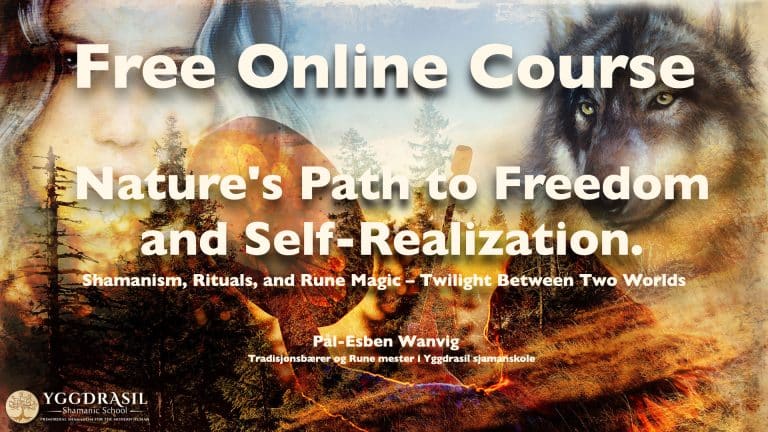
Nature’s Path to Freedom and Self-Realization
Curious about what primordial shamanism really is, behind the mystique and the misconceptions? In this short online course I tell the story of my own path from skeptical engineer to teacher of primordial shamanism, and give you a first introduction to what I teach: what shamanism and primordial shamanism are and are not, how rituals and rune magic are used in practice, and why the longing for growth matters so much for a good life.
The lessons are recorded in Norwegian; the English version will be ready in November or December 2026. Leave your email on the course page, and I will tell you when it is.