
Episode 40 – Guest Special – Three Fellow Students on Life After Experiences of Oneness
Daniel André once searched everywhere for enlightenment: in the third eye, in kundalini, in DMT and ayahuasca. Then, in the middle of a noisy kindergarten, he watched his thoughts and feelings drift away like a cloud. Eva is still in the same demanding job, but now she walks to work bubbling with joy. And Linda Helene compares coming home to oneness with coming home to her childhood home, times a very big number.
In this fortieth episode, Amina and her teacher and guide, Pål-Esben Wanvig, are joined by three fellow students, Linda Helene, Daniel André and Eva, who talk about how life changes after experiences of oneness. They explore the feeling of coming home, why the real experiences are found in the deepest yin and not in kundalini or psychedelics, and what happens when you discover that it is your thoughts that think you. It is part of “The Journey to Self-Realization”, a podcast about the bravest journey a human being can set out on: the journey home to yourself.
This episode is an English translation of our Norwegian original, voiced by the digital avatars of Pål-Esben, Amina and our three guests.
In this episode
- Three advanced students at the Yggdrasil Shamanic School, and Eva’s life before and after: the same job, but with calm, energy and joy
- Standing with one foot in the Sahara and one in the grain of sand, and Linda Helene’s cabin trip as an image of what you can’t imagine
- Daniel André’s journey from esoteric searching to measurable results, and the noisy kindergarten as a training ground
- The feeling of coming home, the echo after the experience, and why fear loses its grip
- Energetic experiences versus the deepest yin, the kundalini misunderstanding, and the nothing that is at the same time everything
- Bliss redefined as a deep joyfulness, and why hallucinogens are a dead end on the path to oneness
- The thoughts that think you, the still eye of the storm, and what it means for mental illness when you experience that you are not your illness
- Power over the circus, the theatre stage, Sisyphus’s stone, and why waking up is the most effective way to create a better world
This podcast is for you if you:
- Seek real depth in your spiritual practice
- Want to understand yourself on a more fundamental level
- Are curious about shamanism but tired of superficial “new age” spirituality
- Have taken many alternative courses but still feel that something is missing
- Feel an inner longing for freedom, love and wholeness
In a time when so many get lost in external methods and promises of quick fixes, this podcast invites you back to the only place where true answers can be found: your own heart.
Listen above, or read the full conversation below.
Transcript
A warm welcome to the podcast “The Journey to Self-Realization”, a primordial shamanic journey of development back to your true nature. This podcast is a collaboration with our favourite magazine, the health and lifestyle magazine Medium, and is devoted to exploring the bravest journey a human being can set out on: the journey home to oneself. We follow Amina, a student at the Yggdrasil Shamanic School, as she goes through a deep primordial shamanic process of development together with her guide and teacher Pål-Esben. It is a raw, unpolished journey of discovery towards true joy in life, deeper meaning, and a life that truly feels good to live.
This episode is an English translation of our Norwegian original, voiced by the digital avatars of Pål-Esben, Amina and our three guests.
Pål-Esben: Hi, Amina, and a warm welcome to a new episode.
Amina: Hi, Pål-Esben, thank you so much, likewise.
Pål-Esben: Thank you. And a warm welcome to you too, dear listener. Today we have quite a treat for you: we have some special guests with us, and it’s the first time in our podcast that we’ve had other people on to interview. We have the great pleasure of being joined by some of your fellow students, Amina.
Amina: Yes.
Pål-Esben: Isn’t that cool?
Amina: Yes, it’s really cool, and I’ve been looking forward to this so much: getting some perspectives other than my own on this path, because there are so many different ways to experience the same journey.
Three fellow students in the studio
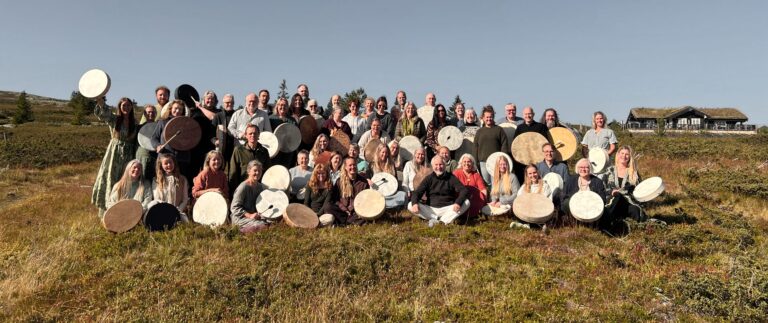
Pål-Esben: Yes, and they’re part of a group of more than 50 advanced students at the Yggdrasil Shamanic School, who are all working with the experience of oneness and these things. So we thought we’d shed light on this a bit more broadly, from several perspectives, as you say. First I’d like to give a warm welcome to Linda.
Linda Helene: Thank you so much. Thank you for letting me be part of this.
Pål-Esben: Can you tell us a little about yourself, Linda? Who you are, and where you come from?
Linda Helene: Yes, my name has already been mentioned: Linda Nilsen. I live in Askim with my partner, Daniel, who is also here today. I have my own clinic in Askim, where I work with therapy and healing and I’m a shamanic teacher. And I also teach at the Yggdrasil Shamanic School, like several others here. I really love it, and I love helping other people both to a deeper understanding of themselves and to come further and further out of suffering.
Pål-Esben: Yes, and we’re going to drill down a bit into how you experience standing with one foot in the Sahara and one foot in the grain of sand, even though it’s hard to put into words. Thank you so much for being here, Linda. And let’s jump over to your partner, Daniel André. A warm welcome as a special guest.
Daniel André: Hello there, hello there! Thank you so very much for inviting me onto the podcast today. Briefly, about what I do: I work as a kindergarten assistant, and I love it. That’s been a surprise in my life. I also run my own small business, where I work as a holistic coach and healer, and I’m a teacher for the Yggdrasil Shamanic School. So life couldn’t be better than it is right now.
Pål-Esben: Exciting. A warm welcome, Daniel André. And our last special guest: Eva. A warm welcome, Eva.
Eva: Thank you so very much for the invitation. This is really fun.
Pål-Esben: We’ve got two people from Trøndelag, in central Norway, here today.
Eva: Yes, I’m in Trondheim. I’ve been part of this since 2020, I think. An incredibly rewarding path. I have an ordinary job in a company, with management responsibility. I have four kids, the youngest is 18, and a wonderful husband I’ve been with for 33 years. That’s me in brief.
Eva: life before and after
Pål-Esben: Can we start with you, Eva, now that we’re going to discuss how life has changed? You come from a position of responsibility in a large Norwegian company, an existence that’s very much about work and responsibility, and more work and even more responsibility. Can you tell us a little about what life was like before you began to touch reality, before you began to experience that you’re actually living in a dream? It’s very hard for a human being even to acknowledge that the soul is dreaming, and that we believe that dream is reality. The first time you heard something like that, Eva, what did you think of it, and what was your life like then?
Eva: In my life before, there was more and more stress. I was a typical workaholic, as it’s called, if we’re going to put a label on it. I was flat out from early morning until I collapsed into bed at night, with a full agenda all the time. Seen from the outside, I had everything in place: wonderful kids, a lovely husband, a really exciting job, nice hobbies. But inside I was very empty, and I became almost a bit frantic in my searching. I felt something in me that was just crying out for something else: what is it? I think I was probably pretty close to the edge of burnout.
And then I found you. Then life changed, gradually at first, and in time radically. Seen from the outside I have the same things in my life now, but life is completely different from what it was before. Now I have calm, I have energy to spare, I’m full of joy, I feel free. It’s quite strange. Through the experiences we have at the Yggdrasil Shamanic School, we experience that life is something other than that circus, as I call it, which by the way is a great joy to observe. On different levels you feel that there’s something much more than the material. This is a dream, and then cracks start to appear in it on the physical plane: whoa, there was something more behind this. That’s the short version of before and now.
One foot in the Sahara, one foot in the grain of sand
Pål-Esben: So you’re still in the same job, and there’s just as much stress there. But we’ve talked a lot about the Sahara in the last few episodes, about the timeless and spaceless, which has nothing whatsoever to do with the metaphysical, nothing to do with energy and angels, but is what lies behind everything. In India I’d call it Brahman. One of the things we work with in our tradition is being able to stand with one foot in your Sahara, in the timeless and spaceless, while at the same time having one foot firmly planted in the grain of sand, our everyday life. Can you tell us a little about how you experience that, for example when you’re at work leading a meeting? How do your working life and your private life change?
Eva: What I’ve noticed and wondered a bit about is that with every impulse where we’re taken deeper into the Sahara and towards the divine, I find that I’m taken deeper into material life, in the sense that I embrace it and appreciate it much more. I take joy in material life. I can be walking to work and just feel it bubbling inside me. I’m full of joy about the day ahead, without anything special being about to happen. That’s a very big difference from before, when I’d arrive with my shoulders up round my ears, in a hurry, keeping track of everything I had to do.
And then there’s this business of beginning to stand with one foot in each world. What I’m doing is building up my muscles in the material: managing to be physically focused and present with what I’m doing in this world, even though I can feel parts of the Sahara. I feel gravity pulling at me, I feel energies moving through my body. My vision can get a bit hazy. Someone might be saying something, and at the same time there’s something else going on beyond the words. But what I often experience at work is that my encounters with people have changed. It’s as if I see them much more than I did before. I also embrace them much more, and that helps in the situations we have: it’s easier to understand, easier to untangle things or move on. And it’s a great joy to be present and get to experience the different things that happen, because there’s a lot happening all the time. In time you’ll experience the dream, begin to open one eye and actually see that it’s a dream, and be able to interact with reality in a different way than you could before. That’s what’s so spectacular, and impossible to explain in words.
Linda Helene: the idea of oneness
Pål-Esben: Linda, you come from the esoteric world. You have esoteric experience, don’t you?
Linda Helene: Not all that much, really. But some: I’ve been to a few alternative fairs and taken in what was there, before I started to dive deeper into it myself.
Pål-Esben: And what were your thoughts about spiritual awakening, oneness and these things before you really started your experiential process?
Linda Helene: Well, it came down to what I observed, and what I thought about what I observed. First and foremost I was curious, so I started poking around a bit at alternative fairs, and got the feeling that something didn’t quite add up. But then I thought: well, this is the path I feel I’m meant to take, anyway. Back then the path was wider than it is now, if you can put it like that. There was a lot of focus on the typical light and love, and it seemed that a great many people had “the answer”, quote unquote. But I was curious.
And what I’m experiencing now is that the idea I had of what oneness was, the way it was described, is something completely different from what you experience. There are things today that are slowly but surely blossoming or being unpacked, and that are new experiences. In that experience I notice that the atmosphere around me changes, and I feel that there’s something here, as if something is opening up. In the moment I just take it in, while the reflection on what it was comes afterwards. Then we have discussions with you, where I realise that I’ve touched something, and afterwards I sit reflecting, thinking that what’s unfolding is simply something completely different from the idea I’d had. It’s as if what happens lies outside what an idea is able to hold. And that brings us to the fact that this is an experience-based process. Because when I heard that this was an experience-based process, I’d also formed an idea of what the experience would be, and then I get it, and it’s just: oh, right.
The cabin trip: an image of what you can’t imagine
Linda Helene: If I were to compare it with something: everyone has probably been invited on a trip to a cabin, and then you picture what this cabin is like. You know it’s by the sea, and it’s red, and it’s probably like this and that, and you have a nice picture. Then you get there, and it’s completely different. It’s still nice, but it’s a kind of different that you can’t picture until you’re there and see the cabin with your own eyes, and the forest and everything around it: whoa, are there that many trees so close? You feel in your whole system that the experience is something completely different from the conviction you had. And by conviction I mean: I was convinced that this is what touching oneness is like, in the same way that I’m convinced the cabin looks like this. I “know” that, quote unquote; that is, I think I know.
Pål-Esben: And that’s the challenge here: what we’re talking about now can’t be expressed in words. We can mumble around it and come up with a few metaphors and images, but what we can measure is how our life changes. Can you say a little about how your practical, everyday life has changed as you’ve begun to touch more and more of the Sahara, and to experience that reality is actually different from what you thought?
Linda Helene: One big change, among others, is in things that used to turn quickly into suffering and conflict: more and more, I’m able to step back, that is, to create a distance from my feelings and my thoughts and observe them, and then relate to the situation in a completely different way than I did before. Where there used to be conflict, whether with others or with myself, and further down that line suffering, there’s now much quicker acceptance, at least if it’s to do with my own things. If I’m having what you might call a bad day, I can see that it’s just a fluctuation or a cycle in energy, and I know that tomorrow will be different. I used to say that to myself before too, but then it was an intellectual thing, because it’s something you’ve heard. Now the memory of those experiences falls into place much more quickly, when I’m able to step back a little from what’s going on on the outside. I’m able to choose not to slip into the suffering around the situation, even though the situation is the same as before. Whether it’s money or health, I can now choose: you know what, I’m not going to let this drag me down more than it needs to. That doesn’t mean I lie back and ignore what’s going on, but I’m able to rest much more around it and into it, and have a much more harmonious relationship with it. And that makes life a great deal better.
Playing with karma
Pål-Esben: What you’re touching on now is one of the things that’s brought to light in a process of development like this: that we are neither our thoughts nor our feelings. We learn how to separate ourselves from them, separate ourselves from our karma, begin to experience our own Atman, and can begin to play with karma. When you first heard it, when I said: “Now, Linda, I’m going to show you all how to learn to play with karma”, what were your thoughts then about playing with your karma, compared with how you experience it today?
Linda Helene: That was the intellect again, trying to grasp and understand. But it awakened a great curiosity in me, so it’s almost a bit hard to think back to what I thought about it. But I remember thinking: that’s where I want to get to. And now I’m beginning to be able to touch it, and it’s an intriguing process and an intriguing experience, quite simply. Back to the point that it simply has to be experienced to be grasped.
Pål-Esben: Yes, we’ll come back to this a bit later in the episode: how you begin to experience that life changes when you understand that you’re not your thoughts and not your feelings, that you’re something else, and begin to control the construct instead of the construct steering you: the intellect, the ego and company. So thank you, Linda, for now. Then I’ll jump over to Daniel André. What do you think about these things? This has made a difference in your life too.
Daniel André: from esoteric searching to measurable results
Daniel André: A pretty massive one. Let me go back a bit: I was the one who was very deep into the esoteric, and I was really searching everywhere to find the answer to who I am, why I’m here, what happens after I die. You asked earlier what thoughts I had back then about enlightenment. For me it was about opening the third eye; that was very important. Then it was about getting the kundalini to rise, that was the big thing, and then coming into love and being able to live in love. I followed many gurus, and I’m a person who likes to test things to see whether they actually create any change in life: I took a course here and a course there, and did one thing and another. I carried a very heavy load of suffering from the past, with drugs and crime and violence and addictions, chronic problems in my body, right up until I came to the Yggdrasil Shamanic School.
What fascinated me so much about what we learned there was, first of all, that it was something completely different. And here I began to see objective, measurable results actually happening in my life. I didn’t experience that when I was into the esoteric, because there I was very stuck on getting this and that opened, energy work, and it was all supposed to be so lovely. Yes, there were a lot of lovely experiences, but it never went beyond the experiences. Then everyday life came back, and it was the same suffering, the same depression, the same pattern of suffering. And we went further and further into the training. I’ve been with you for many years too, but the last three years have been an explosion, something out of this world.
Pål-Esben: Tell us a little. What has changed in your daily life, now that you’ve actively begun the process of touching your Sahara regularly, the timeless and spaceless? Because the more reference experiences you get of this, the more of these echoes you bring with you into the grain of sand, into your daily life. Because what has happened in your life is really quite radical.
Silence as the keynote
Daniel André: Yes, it’s so tremendous. I didn’t know I was as chronically stressed as I was. I was very trapped in myself, in my own bubble of thoughts. I couldn’t be present here and now, present with my senses, present with my feelings. I was a victim of all these things; I was quite simply stuck. The biggest thing for me now is the extreme presence that has come, the inner calm I carry with me. It’s fundamental throughout the whole day: right deep inside myself there’s just a calm, there’s just a silence. I don’t know how else to explain it, other than that it’s a silence. But from that silence I can see and observe myself in a way that’s actually really trippy. And out of that, the choices I make and what I experience during the day become completely different. I can still have stressful thoughts, and things can come up, but how I experience it, and how it changes in this silence, is just a great miracle.
Pål-Esben: And it really affects every area of life? Your relationship and your work and other things?
The kindergarten as a training ground
Daniel André: Yes. I started working in a kindergarten six months ago. I felt really stressed when I was about to start there, because by then I’d built up so much experience and inner calm with nature, and I thought: oh, shit, now I’m going to start working in the opposite, it’s total chaos here. I remember having the conversation with you, and you said this was going to be the perfect learning ground, the perfect training ground. And it was. I didn’t get it at the start, because I thought you didn’t know what you were talking about, since you’ve never worked in a kindergarten. But I threw myself into it, and it’s no walk in the park working in a kindergarten with a medical history of candida, histamine problems and dysbiosis and so on, which creates extreme brain fog and is very hard on your health.
And what fascinated me: six months ago, just before the winter, I started making some extreme choices about taking the path even more seriously, and then things changed, and now in a big way. It’s also through forest bathing and all these things. In the first months at the kindergarten I got exhausted. It was terribly draining. I came home, had a chance to wind down, and then it was fine: the energy came back, the peace came back, I was with nature. But the shift happened after an experience of oneness I had in the forest. I was forest bathing with a tree and had a very deep experience, and then things began to change, because then it hooked onto something that made what I was working with stronger. And then I noticed, when I got to the kindergarten, and it was so incredible, I’ll never forget it: when I got there, it was the same noise. I had just as many challenges with my health. But I was sitting there, and suddenly I saw my thoughts and feelings coming up, and then what we’d learned about karma came to me. I just thought: this is only memory, this is only karma. And then it vanished like a cloud, and something so incredible came up, I don’t know what to call it, because it has nothing to do with emotions, but it was something else that I became and was through the whole thing. I saw the children, I saw everything, I was so peaceful. It was a completely incredible experience just to be with it, and that’s how it carries on and continues.
Pål-Esben: And here we are again: the more you come into contact with this, the more you’ll experience that you’re not your thoughts and not your feelings. They belong to our false identity, our false self, which is imprinted on us through this life, but they have nothing to do with our essence, nothing to do with our soul. It’s an artificial layer built up through the imprinting from our upbringing and the society we live in. And most people believe that this is reality, and that they are their thoughts. I’ve never met a human being who doesn’t believe that they’re the one thinking their thoughts. But what you’re beginning to experience here is that you’re not your thoughts, and that as a rule it’s the thoughts that think you. It’s pretty spectacular when you begin to learn to handle this, and we’ll talk a bit more about that later: how this small shift, which is really a gigantic shift, turns a human being’s life completely upside down. The day you acknowledge that you’re not your thoughts, that you’re not your feelings.
And that’s what you’re talking about here, that you got a glimpse of this. You’re in the kindergarten, it’s chaotic with howling and screaming, and for someone who is sensitive, both emotionally and in their hearing, that normally sets off a tremendous stress process. And in this moment you experience that the stress process and those thoughts and those feelings are just there, in it. In that moment you experience a separation between your karma and what you are. That’s what you’re telling us here, in my words. And how does this spread into your relationship, for example? How has your relationship changed?
The relationship, and needs that change
Daniel André: That’s interesting too, because humility has become very essential in this. When you’re in a couple, the person closest to you is the biggest trigger. Before, I could get very triggered by little things and get stuck. I was the one who locked up or froze inside myself and couldn’t get out of something. The way I experience it now, being in a relationship is completely different. It’s much calmer, much more peaceful. Another thing that’s very special about this process is that you get so much love for yourself. I feel much more whole in myself, and that creates a sense of security. And I’m very lucky to have a partner who walks the same path as me, someone I can speak the same language with. It means an incredible amount that we can go through this process together. So for me it’s night and day, how it was before and how it feels now. And the needs become completely different, I notice. Time alone has also become very essential: it feels safe to be able to just be with yourself and your own things, because silence has become very important in life.
Pål-Esben: Later we’ll talk a bit more about how needs change. The more you begin to touch your real nature, the more the needs you have as a human being will change, quite extensively. Thank you so far, Daniel André. And Amina, what do you think when you hear your fellow students talk about this?
Amina: My thoughts? It’s really like hearing myself from several different angles. Several times, when I hear fellow students describe things about their lives, how things were before and how things are now, I notice several things in my own life that I haven’t quite managed to put into words, or hadn’t even realised had changed. So it’s really lovely to hear others share about this.
Pål-Esben: Do you have any questions you’d like to ask our special guests?
The feeling of coming home
Amina: Yes, I do. There are so many things you could ask about, but I’m wondering whether any of you would like to talk about the feeling of coming home. Perhaps you, Daniel, since you were the last one we talked to: the feeling you’re left with of having come home, in different kinds of experiences of oneness?
Daniel André: Absolutely. First of all, it was completely different from anything I could have imagined. I’d never imagined what home is. I remember people in the training starting to talk about feeling at home when they’d come home, and then I began to form my own thoughts about it. I feel that I have a deep longing for something, which has been with me for a very long time. And this feeling of home is the most incredible thing I’ve experienced. Very often I can get it after I’ve finished a forest bath, if I’ve been in the subtle and come into the gravitational forces and been drawn in there. When I come back, I just sit there, I don’t know how, it’s this business of explaining things in words. And that’s what I like about this journey, that it’s an experience-based process, because it has to be experienced for you to understand what it is. It isn’t something you can read in a book. It’s a feeling that has nothing to do with emotions. It’s something that lies behind: that I’m complete, a deep inner calm, a feeling of being. And what happens afterwards: I feel invincible, I feel I can do anything, be anything, and I have a deep feeling that everything is exactly as it should be. I feel the words fall short here, but it’s an incredible experience.
Amina: Yes, we’re in the same boat; it isn’t easy to put these things into words. That question hadn’t come to me before either; I just felt it come up.
Daniel André: Yes, I can understand that. But what I find is that it has to be experienced for you to understand what it is, while what comes afterwards can be easier to explain. There’s something else that stays with you for a while, and it isn’t there for ever either, because it has to be cultivated; we have to take care of it. And that’s what’s so lovely about this path: there are no shortcuts. We have to work, we have to be authentic in following the 9 Pillars for Finding the Path of the Heart. There’s no way around it, and you notice that when you begin to touch these things: the friction in life that wears you out, for example. Then you feel: good heavens, yes, this is essential.
Amina: How lovely. Thank you.
Pål-Esben: Perhaps the others would like to say something too. We often talk about coming home, and just to define home here: home is connected to our complete nature, which has nothing to do with the dream, nothing to do with the grain of sand, but is the full, complete, whole being without limitation. That’s what we call home. And Amina, before we move on to the others: how do you experience the feeling of coming home?
Amina: It’s that state, that being. It isn’t anything new; it’s something that has always been there, and of course it is. It’s, as several of us have explained, a completeness. It’s so hard to explain, but you could say that everything changes after experiences like that. And as Daniel touched on, this business of continuing to cultivate it: nothing is a quick fix. But my goodness, I really thought home was more about spiritual experiences, the chakra system, energies, healing, the light body, auras, mediumship, all those things. I thought that was more my true nature, and I suppose I never really managed to place it. One thing I’m often left with after experiences of oneness is that you have reality, and then you have what isn’t reality. And that’s when you also realise that there’s nothing to fear, nothing to be anxious about. Being short of time, what does that mean? That person doesn’t like me, what does that matter? When you carry that experience with you into life, especially right afterwards, things become very magical and anchored in a completely different way, and you can stand in situations in a completely different way, because you carry this home with you, this anchor.
But the description of coming home itself: here I have been for ever, and here I can stay for ever, without it being an intellectual thought. Because the thoughts aren’t there, the images aren’t there, all those colours, lights, videos that can play in your head, they aren’t there. There’s just a deep knowledge, a deep knowing, a deep being. And for me, in those experiences, it hasn’t mattered whether I come back or not; not that I thought about it then either, but I’ve thought about it afterwards. So that was my gurgling about it. And especially after experiences of oneness at Spidsbergseter, at your big rituals: the gratitude I’ve had and still have towards you, the guide who shows us the way home, and towards several of my other fellow students: there’s no gratitude in the world big enough to cover what that means. And the longing you carry with you all your life, which you perhaps don’t quite understand, especially on the spiritual search: am I from that planet, or from that one? Am I really a starseed, a star child? Where do I really come from? And never being satisfied by the answers out there, only by what lies deep in my own core.
Pål-Esben: And then all of this becomes unimportant, because you experience what you are, in a waking state, not in the dream. And one of the things that’s unavoidable then: if you’ve felt some form of emptiness or longing early in your life, as a great many people do today, where they mostly have everything they need but feel this numbness, this emptiness inside, then it isn’t possible to experience that in this state, because there you are complete. That’s one of the things that can radically change a person’s life: that more and more of this becomes integrated into the grain of sand.
Linda’s homesickness: the safety of Mum, times a very big number
Pål-Esben: And how about you, Linda? What are your thoughts about what we’re talking about now?
Linda Helene: Coming home. Trying to describe coming home. I’m actually going back to my childhood right now to try to come up with a description. I have memories from when I was little and away from home, whether at a summer camp or with family, and you could get that homesickness, an aching homesickness, really missing home and missing Mum. And when I then came home, it was: ah, now it’s safe, now I can rest. I know all of this: my room, my toys, the smell. It’s a bit like that, times a very big number. The times I’ve been able to come and touch, or visit, something close to oneness, it’s that: I recognise this. It’s a place where everything is embraced, where everything feels safe, just like when I came home to my childhood home when I was little, and there was that feeling of being safe with Mum. On top of that, I notice that when I lean into this space, the longing goes quiet too. It’s like being able to just breathe out, and that out-breath just carries on into eternity. Everyone has probably felt it when something is over, and you have that lovely out-breath. It’s as if that out-breath just sails into eternity in a very pleasant way.
The echo after the experience
Pål-Esben: Yes, and in that setting something happens. Because the moment you experience the completeness, at least in the hours or days afterwards, while it’s more or less accessible and fresh, the way you interact with other people changes too. We humans are often very concerned with what others think of us. That changes completely, doesn’t it?
Linda Helene: It does. It’s just as if, in the same way that I feel myself embraced and held in this space, even though in a way I’m no longer there, because the sense of self dissolves. OK, now I’ll try not to tumble too far into that part. But it feels as if I bring much more of this space back with me, and that I’m able to hold this reality in the same way that this space holds me.
Pål-Esben: OK, yes, try to keep it on track for me now, Linda. I think you’re doing well, because it’s incredibly hard to put into words, isn’t it? I think you’re doing great.
Linda Helene: Oh yes, thank you for that. Well, when you then come across people and other people’s opinions and attitudes, I notice that I don’t feel that I’m judging. It’s as if I observe what’s going on from a more or less neutral perspective, and it isn’t completely neutral, because I’m back inside my person again. But it’s seeing situations, whatever the situation, with a kind of fascination too, and being able to embrace it with more love, I think that’s actually the right word to use here, even though it isn’t that glittering kind of love. Funny word. Yes.
Pål-Esben: Again, it’s incredibly hard to put these things into words. But when you come from a state like that, where you’ve been inside some of these Saharas we talk about, the timeless and spaceless nature, and have had a spark of an experience of oneness, or a longer experience of oneness, a satori, as I think I’ve called it, you bring this echo, this image, back with you. And the more you’ve cultivated it, the more permanent it becomes. It’s a state you don’t think your way into, or do anything specific to get into. It’s what you are. It isn’t a technique you do to be there; it’s something you experience. And through experiencing being there, you interact very differently with stress, for example fear of war, anxiety, all these things that go on in the grain of sand. Because suddenly there’s no reason to react with fear any more, since you’ve experienced what reality is. Isn’t that so?
Linda Helene: Yes, absolutely.
Pål-Esben: And this is one of the most spectacular things, which can totally change a person’s life, and Amina has talked about it over the last few episodes: what it’s like when you consciously bring your real nature back with you into your daily life. Then it’s impossible to experience anxiety, fear, turmoil, hatred, jealousy. Not because you do a technique or method for it, but because you’re simply the opposite, and because being afraid would now be very irrational. You wouldn’t even understand it. It would be so silly to go back in and be afraid, because it’s so pointless. And this is pretty paradoxical when we begin to experience it. Stuff like this makes you think you’re a bit crazy at the start. Funny, isn’t it? And Eva, can you tell us a little about how you’ve experienced this?
Eva: the answer to the longing
Eva: Yes, for me, coming home was the answer to the longing I’ve felt so very strongly, the emptiness I’ve had, which steered me onto this path. When you have a certain kind of experience of oneness, I call it being in contact with the truth, and parts of that truth change me and come back with me when I’m out of the experience. It’s so life-changing, how you experience dealing with life after you’ve had experiences of this kind. At the start we work with straitjackets and expose ego structures and get to know which triggers you have, and those kinds of triggers no longer trigger the ego. I observe them and notice them, but the perspective is different, and it doesn’t lead me into any suffering. I just think: oh, right, then we’ll move that, or then we’ll do it like this. It’s very strange, because things often fall into place by themselves.
And as for describing an experience of oneness like that, I almost shy away from it, because it sounds so feeble when you put it into words. But in a way you dissolve and come into contact with everything that is. You no longer have a body, you no longer have thoughts, it’s completely still. You hardly breathe. And then there’s an expansion that’s very strange to feel. When I come back, I feel a bit too cramped, too small to hold what I am. It isn’t primary feelings; it’s something that lies behind, and that it isn’t possible to put into words. And that feeling that everything is perfect, it’s as it should be. When you bring this with you into your own life, it has a massive impact in every area: your dealings with your partner, with work, with friends, with nature, with yourself. All of it changes without you doing a technique or method. And that’s what’s so paradoxical about this. You become something other than you’ve been before, or something more complete than you’ve been before. And by becoming something more complete, you automatically begin to interact with yourself and the world around you in a different way.
Pål-Esben: Yes, that’s how it is.
Eva: And then the echo after an experience like that is very present. For my part, I feel there’s a need for time to integrate after an experience like that, to let it settle in me. Because where I am today, it can suddenly just come, without me having any control over it: a little drop from the Sahara came. So integration is very important, and there nature is a fantastic being. I notice that my relationship with nature is much deeper than it used to be. And my encounters with people are completely different from before, where you don’t judge, you just observe, and you have no need to fight for your opinions. So it’s incredibly beautiful.
Energetic experiences of oneness and the deepest yin
Pål-Esben: Yes, it’s incredibly beautiful. And what’s a bit intriguing is this: before you start a process like this, many people have ideas about what an experience like that, of oneness or awakening, is supposed to be like. You hear things and read books, and then the kundalini has to rise, and then you have explosive yang experiences and explosive bliss, where you’ve popped out of your body, and everything is so grand and lovely. That’s what you hear out there. But that isn’t quite how it is. That’s what’s called an energetic experience of oneness, which really has nothing to do with a real experience of oneness, since it’s an energetic jolt happening in your spine. When I begin to discuss that the real experiences are found in the deepest yin, where there’s really nothing, but where the bliss is so extreme, drastically more extreme than in what you have as a yang experience: can you tell us a little about your experience of this, Eva?
Eva: Yes, it’s a form of bliss we experience in the deepest silence, but it’s completely different from the energetic yang. I’ve had a bit of that during my development, as kinds of energy discharges in my body, where I felt I was almost being kicked off my chair, or as if lightning struck into me. What I experienced with that was that it took me out of the process, if it was a meditation process for example, and I went off course a bit, so to speak, instead of going further and floating down towards the truth that lies in the silence. So it’s much, much bigger, and really impossible to describe in words, what the bliss is like in the depths of the silence, or when you touch the Sahara. It’s something much more than the energetic discharges or explosions.
The kundalini misunderstanding
Pål-Esben: And here there’s typically a big misunderstanding in the alternative world: people think it’s the kundalini energy you have to raise up your spine to be able to move on to an experience of oneness. A gigantic misunderstanding of the whole thing. Because you don’t need any kundalini raising to experience what things really are. It’s actually a problem: the more active the kundalini is, the more revved up you are, the more you’re in a sympathetic state in your nervous system, and the harder it is to get a grip on what really is. And what we’re talking about now is rather counter-intuitive. When we slip into the real silence, as part of what we call our Sahara, we can say that there’s nothing there. But on the other hand, absolutely everything is there. The seeker expects there to be something. Our cognitive self expects that if we go into that space, there’ll be an angel there, or whatever it may be. You expect fantastic colours and lights and spectacle, the way the intellect imagines it. But when you come into these depths, there’s absolutely nothing, and yet it’s absolutely everything. Can you say a few words about that, Eva? I know this is hard to express, but it’s wild, and you have a lot of experience here, don’t you?
Nothing, and at the same time everything
Eva: It’s very strange. It’s completely still, it’s dead quiet, and there’s nothing. You hardly breathe, you don’t have a body, you don’t have any thoughts, nothing. Then there’s a feeling of an incredible power, an incredible force that you feel, without there being any energetic explosions or anything in me any more, but you feel that it fills you on different levels. And when you’re back in ordinary life, or back in the material, that truth comes with you. I can’t turn what I’ve felt into really clever cognitive teachings, but I feel that I carry something with me, perhaps it’s a knowing: I carry a truth with me. And when I have that, I have what I need. I don’t need anything else; that’s sort of the feeling.
Pål-Esben: Curious. Linda, how do you experience this?
Linda Helene: Yes, that’s almost what I want to say: the two of you have already said it. Because now you’re asking about my experience of touching oneness. Yes: completeness, calm, the ultimate calm. And as Eva says, there’s no space, the body isn’t there, the thoughts aren’t there. What’s called Linda isn’t really there; there’s just a kind of observation of a completeness. Like bathing, even though there’s no body bathing in anything, but still there’s an embrace. We do have to use words for this, but at the same time, when we use words, I feel with every word that drops out: no, it isn’t like that. Then I try a word I think is even better, and no, that wasn’t quite right either. And again, here we are trying to explain in words something that’s outside the intellect, and words only exist inside the intellect, so we’re really doing an impossible task. So I just want to make gurgling sounds and say: there you go. But it’s a very peaceful state.
Pål-Esben: Yes. So it’s often very counter-intuitive: if you’ve read books about this, and been into the esoteric and on YouTube, you hear about a truly spiritually awakened state, and then you often hear about wild, spectacular stuff, with siddhis and extraordinary abilities you get, and the whole thing. But it isn’t like that. Because when you come into this reality, first of all there’s nothing there, but on the other hand everything is there too. There are no explosive, extreme things, but the silence is still the most explosive thing you can experience. This paradox is totally counter-intuitive, and it isn’t possible for a human being to understand it before experiencing it, is it?
Linda Helene: No, it isn’t, and I like the word you’re using here: paradoxical. For me it’s a pretty fitting word, if we’re going to use words at all. So it’s paradoxical, quite simply.
Daniel André: surprised by the path of yin
Pål-Esben: And Daniel André, how is it with you around this? After all, you come from the esoteric world and had lots of ideas about how we have to raise our kundalinis, and then suddenly you come to a real experience.
Daniel André: Oh, I was very surprised that this path went through the deepest yin. That wasn’t something I’d imagined, because for me it was about yang experiences. I didn’t understand that they were yang experiences either, but kundalini was the thing: taking psilocybin, smoking DMT, drinking ayahuasca, and doing these things to reach these states. I’ve been through that too, not all of it with the kundalini, but I’ve smoked DMT and all sorts of weird stuff, and thought: oh, I’ve experienced bliss. And then we came to you, and you get thrown out into the forest to start forest bathing, so that you settle your mind, so that you become friends with the deepest yin. It was very much the opposite of what I thought it would be. But eventually, when we had our first experience at Spidsbergseter, with the whole gang and you, I had my first experience there, which was a very powerful experience for me. And again, I don’t know how to put it into words, but it’s as she says here, I like the way she says it: it’s nothing, but it’s everything, because you aren’t what you think you are. It’s just not possible to imagine what this is like.
But I had a very interesting experience in the forest. I had a forest bath a month ago, or a month and a half, or two; time doesn’t matter. I’m lying in the forest, naked in the heather on my sheepskin, perfectly content, doing my forest bath and feeling the subtle, feeling it begin to flow down into the ground. Then the wind comes, and I was drawn so strongly into an experience, and it’s the longest I’ve had where I’ve felt this deep contact with it. I felt I became a bit vulnerable, actually. But when I came out of it, it was so overwhelming, because I felt so fooled by reality. What struck me was just: oh no, what is the esoteric, and astrology and numerology? It isn’t this, it’s what lies behind. Everything is behind. And then I understood that everything I’d been doing before had taken me further away from it, because it’s the ego that has steered me in a yang process. I haven’t been anywhere near being able to get into what has to do with yin. And I get shivers just saying it. So it’s completely incredible, I just have to say it: what you lead us through, what we practise through Yggdrasil, and what life becomes like afterwards. It’s a completely incredible experience to be able to live the way my life is now. For me, that’s bliss.
Redefining bliss
Pål-Esben: Exactly that. And we’re redefining bliss. If any of you have a better word for bliss, just interrupt me. What is bliss in plain words, Amina?
Amina: I don’t know, but I’ll find out.
Pål-Esben: Good. So, Daniel André: bliss. Try to explain bliss. What is it?
Daniel André: For me it’s simply when I wake up and get up and feel this deep feeling of gratitude. It’s a being of gratitude, a lovely feeling that things are exactly as they should be, and it hasn’t been like that before. There’s nothing right, there’s nothing wrong, it’s just how it is, and it’s a very peaceful experience to be with what is. I’m not saying it’s like that all the time, but it’s something that’s growing and getting bigger and bigger in me. And it’s the way Eva put it too: what my bike rides are like, how I feel the wind, how I feel nature. It’s a wholeness, while at the same time it isn’t me. It just feels completely incredible to be able to live in what is, because you see that it’s an illusion. And then you have that, I call it being: that it’s become so gentle. When I get up to the kindergarten, there’s a calm, it’s lovely, I’m looking forward to doing what I’m going to do. Nature has become my greatest partner, my best friend. I love nature and use it almost every day. And contact with nature, with trees: what a radiance, what a warmth, what a potency there is just in trees. I remember walking up to the kindergarten. It was winter, it was minus ten degrees Celsius, I was walking in snow up to my knees with the course recordings in my ears. So I’m walking up, and in the end I feel an enormous warmth. I look down into the snow, and then I feel an enormous warmth. I come out onto the patch of forest and just feel the pulse, how it radiates from the hedge, from the trees, and it’s just: oh, wow. Words fall very short of what it’s like. And you take in so much: when I see birds flying and feel it inside me, it’s just as if I become the bird, in some strange way. It just tickles inside me, the way things are experienced.
Pål-Esben: Yes, it’s this joyfulness. If we’re going to use a word I like to use for this bliss, it’s a deep form of joyfulness, which you don’t do specific things to trigger, but which just seeps up from the ground. Very yin, but still extremely powerful, and it permeates how you experience, see and live life. It might be, for example, that you’re just sitting looking at a blade of grass, and then you feel this bliss flowing through you. From the smallest thing to the biggest, it doesn’t matter. Because this source of bliss, of joyfulness, or if we’re going to use Sanskrit, ananda, is something that permeates us without us doing anything. And that’s the most spectacular part. Because through a process of development in the usual way, you learn to do technique A, B, C, D, tap here, breathe like this, and then some kind of thing or other is supposed to be generated. But here this is something that permeates you more and more by itself, without you doing anything. And that’s fascinating, or spectacular, or paradoxical, Daniel André.
Daniel André: For me it certainly is, because I’ve worked a lot with breathing techniques and tapping and all sorts of weird methods. I’ve been through so much crazy stuff, and it’s nowhere near what this is like. Because it’s just something that’s with you through the day, and it isn’t me, but it is me. It’s carried by a tone, by an energy, by something or other, and it’s so mighty, but at the same time so very yin, so very present. I’ve spent so much time with silence, because just being with what is gives so much. And I’ve got a relationship with wind. I don’t know what it is, but wind has done something or other: when I feel and hear wind, something happens that’s completely incredible. How I feel when my feet are in the grass, and just the feeling of how it’s experienced, it’s really exciting.
Hallucinogens as a dead end
Pål-Esben: Fascinating. Before we go back to Amina here: Amina talked a little about why using hallucinogens such as psilocybin, LSD, DMT, ayahuasca, mescaline and so on never led to what we’re talking about here. And since you have experience with several of these hallucinogens in the hunt for these states you’re experiencing now: can you say a little about why it didn’t lead you to what you were searching for?
Daniel André: First of all, what I find with psychedelics, for example, is that it’s first and foremost an emotional experience. It’s a biochemical process happening in my body. You can get extreme things that have nothing to do with reality here, but they’re still things: there’s geometry you can see and experience, which creates extreme emotions and other perspectives on life, absolutely. But no change happened in my life from having these experiences. It never went beyond the experience, and that was that. And that’s what shocked me so much about the path we’re walking, which has to do with the deepest yin. Because it has to do with the opposite, and it’s something deeper, which in turn lies behind. This has nothing to do with the body either, nothing to do with seeing crazy images that are supposed to be ultra-spiritual, and dwelling in this love, or whatever it was I was trying to get hold of. It’s something else that’s much deeper, much more spectacular.
And before I started with this, I also had the idea, when I heard about enlightenment, that once you hit it, you stayed there, and then life was 100 percent perfect. Your body was healthy, lots of money, everything was just a success. But the way I experience my life now, I still have challenges in life, but I’m not part of them, and for me that’s the greatest gift of this. It’s so peaceful. Because it’s so hard to understand this, but we aren’t our thoughts, we aren’t our feelings, we aren’t Daniel, I’m not this one. It’s more like something else. And when you carry that with you, all these illusions burst. And the need I had so much of, to waste time on silly things because you’re running away from yourself, has gone; instead you find peace and calm with what is. And that’s the biggest thing. We’ve won the lottery, that’s what it is, life here, actually getting to experience this. It’s pretty spectacular.
Pål-Esben: Yes, and psychedelics can of course be used for many good things in medicine, for example to help heal post-traumatic stress disorder, addictions and so on. There’s use in a therapeutic setting where it can be very helpful. But in relation to finding the way to your complete, full nature, it’s completely useless, because it takes us away from what we’re searching for. It takes us into cloud cuckoo land, where we think we’ve experienced reality, but where we definitely haven’t. When you’re on a psychedelic high, you can get incredible images of light and angels and God and what looks like oneness, and then you think: oh, now I’ve been there, because it felt so extreme. But it’s only when you begin to experience what you’ve experienced now that you can see it has nothing to do with it.
Daniel André: Yes. And I understand that I’ll never use those things again. But with the deepest yin you notice that you have to be careful about what you do, because things like that take us further into the straitjacket that we’re working to break open and get out of. And then there’s everything that creates friction. Before, I was very good at listening to others, other people’s opinions about this and that. After you’ve had some experiences of oneness, it’s very strange for me, but it doesn’t feel as if very many people actually know what they’re talking about. It turns into a lot of fine words. For me that was something that also bound me further into my straitjacket, that I listened blindly to anyone at all in the esoteric world, on YouTube and so on. I realised that it created a lot of friction in me. There’s so much information out there that you get very misled, and I was misled. But then I saw: when I made a choice and started working with one fixed thing, the way you do it at Yggdrasil, which is a very structured set-up, then things started to happen. So that’s quite a big difference compared with hunting here and there, because now there’s so much out there that glitters.
Pål-Esben: That’s probably the challenge with a path like this. So, Amina, back to you. You probably have thoughts about what we’re discussing now.
The observer: the thoughts that think you
Amina: Yes, we’ve touched on quite a few different things now, so where should I pick up the thread? If we’re going to continue a thread, I’m thinking of the episode where we talked about the observer, the inner commentator, Atman, Brahman, where we aren’t our thoughts. We talked about the artificial construct, the artificial self that was created. Shall we slip a little into that, then?
Pål-Esben: What we talked about there is something you can have a theoretical idea about. And for you, dear listener, who didn’t catch that episode: I think it was episode number 38, where we went into the topic that the thoughts being thought are created by an artificial part of you, which has been imprinted with intellect, ego and so on through your upbringing, and which constantly thinks thoughts. But that isn’t what you really are. We talked about the observer, which is what you really are, that is, Atman, and we talked about the inner commentator, which thinks all the time and feels all the time, and about that distinction. As part of this process of development, it’s an unavoidable experience you’ll have in time: that it’s actually the thoughts that think you, and not the other way round. So, Amina: in theory it’s interesting, but what’s it like when we begin to experience it?
Amina: Yes, and here we go again with the words.
Pål-Esben: What happens in your life when you begin to realise that it’s a construct, made up of intellect, ego, the karmic memory, what you identify with, which runs you on autopilot constantly, and which you think is you? When, through experience with the depths of your Sahara, you begin to acknowledge that it’s actually an artificial construct, what happens in practice in your life then?
Amina: First of all, it makes you more resilient. I can notice it in things with my children, in the way I handle stress, in bodily reactions, when I come into the role of the observer more, where I see that I’m not all these thoughts, I’m not all these feelings. It’s been especially so since I’ve had deeper experiences of it through the meditation process, by being the observer, or shifting into that state, if you can use those words for it. It’s so very easy to think that you are all these thoughts and feelings, but when you get them at a distance, you can also handle life in a completely different way. And while we’re on the subject of realisation: goodness, what kind of words should I use here? I’ve had some experiences of realisation too. I can’t find a good enough word for it, and that’s the thing: we can experience so many different degrees and angles of what we’re talking about now, and then we have the words we have to use, and really we’re talking about very different things. But you could say that my experience of having experienced more from the role of the observer is that I become more resilient. It’s like this: why should I bother messing around with this? After all, that isn’t who I really am. And then there are periods when I’ve thought my way to it mentally, and there’s a big difference between when I mentally think: but I’m not my thoughts, I’m not my feelings, OK, straighten your spine, pull on your grown-up trousers, this is going to be fine. There’s a big difference between that and when you feel it inside you. You carry it in a completely different way; it comes from a different place.
Pål-Esben: Correct, you experience it, and that’s what’s incomprehensible about this. You can think your way to all of this: oh no, my thoughts, and I’m going to control my thoughts. But that isn’t what we’re talking about here. We’re talking about when we begin to experience, when we begin to observe a thought without thinking the thought. Go on. Sorry for butting in.
The still eye of the storm
Amina: No, that’s absolutely fine. I really appreciate it, because sometimes we need you to translate a bit of what we’re actually trying to get across, because it isn’t easy. Luckily you’re very good at that, Pål-Esben, so thank you for translating. And what’s interesting is this: the more experiences you get of observing your stream of thoughts, the more you understand that what we bathe ourselves in every single day, of suffering, of thoughts, of feelings, is really completely insane. My experience is that I’ve observed so many words and expressions and sentences and opinions and beliefs, belief systems, that I’m just: wow, OK, this lives in me, and much of it steers my life very unconsciously. I’m like: whoa, I didn’t know I had that attitude towards this thing, or that person. Or: oh dear, that wasn’t exactly a good ethical foundation for a value system. And then it also becomes a bit fun, because we use a lot of humour and the joyful child in this; that’s important for us at the Yggdrasil Shamanic School. Then it also becomes a bit like: good heavens, to think I’ve believed I’m all that stuff my whole life, that I’m everything that happens to me, that I’m everything others, quote unquote, subject me to. And then of course on this path you forget yourself from time to time, and then it doesn’t take long before you come back again. Because we’re walking this path where, I was about to say the goal, to use words: the goal is to have a stable state in oneness while we wander around here on earth. The other day an image like a glitch came up inside me, where I feel myself being pulled towards that side, and then I’m on that side, and then I can forget it, and then I remember it, and then there are periods when it flows much more naturally. So we’re a bit there: I feel like a child learning to walk. You stumble a bit, and then you get up, and then suddenly you can walk slightly longer stretches. And that’s really one of the first things you begin to get experience of when you start the meditation process, and perhaps some of the most important, at least some of the first things on this path: that you begin to see and experience that, whoa, I’m the still eye of the storm. Yes.
Not being your illness
Pål-Esben: Yes, and this has some stark consequences. The day a human being, through experience, not through cognitive thinking, sees that they aren’t their thoughts and feelings: you observe the thought, you observe the feeling, but you don’t think the thought. That has stark consequences, for example for mental illness. Because there, a depressed person experiences that they aren’t their depression. Someone with anxiety experiences that they aren’t their anxiety. And when a human being eventually experiences that, this is the shortcut to de-identifying with their illness. Because most people who struggle with depression believe they’re depressive. They identify with their low mood or depression and say: that’s just how I am. And when you then experience that you aren’t your depression, something radical happens inside your head. Then you’ve had your first experience of not being your illness. Then you can imagine how much more effective a healing programme can be, together with a counsellor or therapist, the day you have that experience. Radical.
One of my teachers uses this actively, even in severe cases, where he brings people into a setting where they experience that they aren’t the mental illness they have. He gets incredible results with it. Compare that with going to a therapist and discussing your depression, where does the anxiety come from, where does the depression come from: that can take years of work, especially if you’re in psychoanalytic therapy, and in the end most people who are depressed never come out of their depression. Compare that with bringing the person into an experience of not being their depression, because then you identify the depression as something outside yourself. Then you can imagine what speed the healing process can pick up. And Eva, what are your thoughts about this? We’re talking about how we aren’t our thoughts, aren’t our feelings, aren’t our construct. What were your thoughts when you first heard these ideas, compared with when you began to experience them?
Eva: My thoughts about not being my thoughts?
Pål-Esben: Or that your thoughts think you, and it isn’t you thinking the thoughts. And that the construct is what steers you fully and completely, and not the other way round.
Eva: Yes. First of all, it’s a great joy to observe the thoughts. And experiencing that you aren’t the thoughts, for example as Amina said, in the depths of meditation, or in the still eye of the storm: there you notice that you have a distance from the thoughts. You can observe them, and it isn’t me thinking them either. But then you’ve taught us some really simple exercises for feeling that you aren’t the thought, by asking yourself a simple question: who is noticing this thought now? In that moment you feel and see the thought from the outside, and then you’re no longer the thought. That was a really fun 15-second exercise that I did a lot at the start. But then there’s this business of taking it a notch deeper. We’re so lucky in this training: we have recordings of all the teaching you do with us, and we have personal conversations with you, and we spend some time repeating and mulling it over, speculating, writing a bit about it on a sheet of paper, and letting it sink in. And there I had an experience where I realised what you’re talking about now. It was very profound, and the echoes afterwards were such that I couldn’t allow myself to think about it, because then I was completely bowled over again, with tears and shivers and a feeling of being flooded right through. It was that kind of realisation, and afterwards it changed me a great deal in relation to the topic of Atman and the commentator.
Power over the circus
Pål-Esben: Yes, and when the seeker begins to experience this, and actively begins to learn to separate from the thoughts, the feelings, the construct and the identity, and can observe it at a distance, it also means you gain power over the circus. I call it the circus. You have power over it; it no longer has power over you. Of course, at the start of the training, when we experience the first chakra being triggered, for example, then kaboom: you end up in the construct and feel all the secondary feelings. But you come out of it fairly quickly. When you begin to practise this, you can eventually choose to go actively into the construct and experience through it and let yourself be part of the circus, but at any moment you can step out of it and take control of the construct again. It’s pretty wild when a human being begins to master these things. Because then you’re no longer a victim. You have full power over your life in relation to what you think, what you feel, how you interact with what happens around you and inside you. You’re no longer a victim of your surroundings, of your thoughts, of your belief systems, your autopilot. You take back control of your own life. That’s another thing that changes a person’s life radically when they begin to master this, as in your case, and the rest of you who are here now.
Eva: Yes, absolutely. And that you can consciously take the role of observer instead of letting yourself be dragged into whatever is going on around you. And then for me an important part of the picture is that we actually live in a construct, that reality is something much more than this.
Pål-Esben: You notice it when you’re told: OK, when your soul decides on an experience, you pop out your higher self, and in the higher self the dream is created, where the soul dreams, but where you, who are the chess piece, or the player in that dream, believe it’s reality. When you hear this for the first time, you might say: yes, that sounds interesting, or: I don’t believe that. But what you’re talking about now is something completely different: when you begin to experience this, you experience that what you’ve believed all your life was reality is actually a dream, and that behind the dream lies the most spectacular of the spectacular, which is the ultimate thing for a human being to be able to experience again, in order to become complete. And that’s what we call, when we’re at the elite university for souls, going into the final year at university and starting on our doctoral thesis. That’s exactly what’s happening then, Eva.
Eva: Yes, and then you become aware of it. I don’t know whether it’s because you carry with you this idea that it’s a construct, but you feel incredibly privileged to get to take part and play in this beautiful construct. That was something I could never have dreamed would be part of this path, because I thought that we’d go into experiences of oneness and float in them. But that feeling is incredibly strong.
Pål-Esben: Yes, because here you also learn to love the construct for what it is, to love the dream for what it is. After all, that’s where your soul comes in to create experiences, at least in the first part of your life, until you decide to go through a structured process to wake up, as those of you here now have chosen. Because it would be completely wrong to distance yourself from the material world. Then the whole thing is misunderstood, because then you’re saying that your soul hasn’t got a clue when it comes in here to dream. And that’s wrong. Coming here to create these experiences, especially in the first part of our life, is something we need to go through. The cutting of the umbilical cord, where we lose our memory of being a soul. Then we go through our life with all the ups and downs, and then perhaps we come to a point where this emptiness becomes so strong that you have everything, but really nothing. Then you begin to search, and then the real process of awakening begins, and a whole new chapter of life starts, the one you’re in the middle of now, Eva. Pretty cool, isn’t it? And Linda, can you say a little about how you experience this?
The theatre stage: from leading role to the audience
Linda Helene: First and foremost I have to say that it’s very liberating to experience that I’m not my thoughts, that I’m not my feelings. But I’m still at the stage where I stumble along, fall into the circus and into the emotional traps. So it’s one step in, one back, in, out. Earlier in life, when these experiences weren’t part of my life, it was like being at the theatre: I was up on the stage all the time, part of the theatre, and all the roles being played out in the theatre, I had all the leading roles. I was the one with a comfortable role, I was the one with a role of suffering. The self-critic was up there, or I called it the critic, and The Joker. And as the roles played out, it was just as if I jumped into each of the roles and was those roles completely. Now I sit in the audience instead and watch, or, to put it better: I’m able to sit down in the audience and watch. Because when I go to the shop and talk to people and friends, and others in the shamanic training too, I’m at least partly on this stage. I’m on the stage a lot as well, but with more awareness. And then there’s the fact that I’m now able to step right out. Perhaps not always when I’m in the middle of a situation, but yes, sometimes that works too, that I manage to zoom out while I’m interacting. So that’s how it feels.
Pål-Esben: Yes, and at the start this is a very schizophrenic experience. In psychology this would be called schizophrenia, and it feels a bit schizophrenic at the beginning: on the one hand you’re an active player in your life; you’re part of the karma. On the other hand you can observe the game from a meta-perspective. And you can choose whether you sit down in the cinema or go into the screen, or onto the theatre stage, depending on how you see it. Where you are now in your process of development, you’re building up these muscles, so this becomes more and more stable. Eventually you come to a point where you’re no longer dragged in by the first chakra, where you really have full power over this. The only exception is if something extreme happens in life, for example someone close to you suddenly dies, and the first chakra is seriously triggered. Then we will, genetically conditioned as primates, kick into the madhouse, that is, the land of emotional chaos. But that will only be an exception, compared with what often happens at the start, when you don’t quite have control of this yet. It’s just part of a healthy process of development, and after all it’s a maturing we have to go through. We can’t go from A to Z overnight. It’s a process of maturing, and I call it strengthening these muscles. And you notice it too, Linda: at the start the muscles were weak, but gradually they get stronger and stronger, don’t they?
Linda Helene: Oh yes, I notice it: it’s much rarer that I let myself be unconsciously dragged into the drama going on on the stage. Very much rarer. And I’d also like to share that I use this story. I share it with the people who come to me for healing, guidance, therapy. Because so often people come to me and say: oh, I have so many thoughts, there’s chaos in my feelings, there’s chaos in my thoughts. And then I tell them: now I’m going to tell you something, and that’s that you aren’t your feelings, you aren’t your thoughts. You have them. Then I explain it in a bit more detail, explain that you are the one who has. And at the end I tell them that in that last sentence, we go into the mystery of being human. The other day I had a woman here, and she’s a language teacher, and she looks at me with big eyes, and it’s so interesting, because you can see that they’re actually touching a knowing in this, unconsciously, I think. And then she says: yes, that’s true, isn’t it? Before that I’d also explained to her that we have a habit of saying “I am angry” or “I am happy”. But the truth is really that you have angry, and you have happy. So really our language should have been like this: I have angry, I have happy. Then she gets a bit flustered and smiles and says: yes, I can’t argue with that, but I can feel my brain twisting, because I’m also a language teacher. So I love sharing this, because I see that a space opens up in them, a hopeful space, which I see them resting into when I share this. And that’s rewarding.
Pål-Esben: Yes, and it opens up completely different possibilities, also as a therapist, counsellor, teacher. You’re working from a completely different level. You can help people in a much deeper and much more effective way. You take shortcuts with things like this. Incredibly exciting. And Daniel André, what are your thoughts and experiences with these things? What was it like at the start, when I began to talk about this?
Daniel André: Let me start before you introduced me to it. It was in 2014. I was watching a documentary, lying on the sofa, tired and ill. The documentary got right under my skin, and at the end of the last sequence the narrator started talking about “You are not your thoughts”. I felt nauseous, because it made so much sense, and it was so uncomfortable to hear: huh, aren’t they my thoughts? What am I, then? It was so strange, because I was so super-identified with Daniel and suffering and everything that came with it. So when we came to you, and you started introducing this, I was singing a different tune, definitely. Because, as Amina touched on: in the meditation process we’ve begun to have these experiences, to get this distance from the thoughts and feelings. And when you get a bit further down there, something else happens, connected to the disconnection that also happens, which is a very peculiar thing. It isn’t just like when you sit in meditation and observe the thoughts as a cloud, because I had a feeling that it was just an observation. The way I experience it now, it’s that on steroids. The observer, the way I experience it now in daily life, is, as Linda also says, in and out of this, a muscle being built up.
But what fascinates me a lot about it is my own circus. When you come into that role and are present with what’s happening, and you observe it: for me, I just start laughing. Sometimes I get a fit of the giggles at how strange it is to sit there having those thoughts, how it goes on and how it carries on. And where I have a lot of those schizophrenic experiences is in encounters with people, and the people we come across most now are people at the kindergarten. When they stand there talking, I feel that I’m not part of what’s happening in it. My thoughts are going, but I’m not connected to them. And then I can drift off a bit: whoa, what time is it now, actually? And then I drop out of the whole thing a bit and just talk. And this one guy stood there looking at me, just: huh? And I just answered: yeah, hi. So there can be some strange experiences like that with this. And that’s where I like the new contemplation practice, because I had an interesting experience when I was sitting after my forest bath. I asked this question: what am I behind all the stories about myself and the memories of myself? And then this void came, because I was sitting there just being, and it wasn’t some tremendous experience, but what happened to me in that experience stayed with me for quite a while. It lasted many days, where I carried a completely different tone with me, or whatever I should call it. It was just, well, I’ll leave it at that.
Closing words: the calling that calls us home
Pål-Esben: I’m so impressed with all of you, doing your very best to express in words something that’s impossible to express in words. But we have to try to find some images for it. Because in this podcast I’m also here to tell you a bit about how things can feel when you’re in a deep, primordial shamanic process of development, and not least to give some practical things: what is it that happens in a human being’s life? Even though we can’t explain exactly what it is, which you can only understand once you’ve experienced it, I think you’re impressive, what you manage to express. And Amina, when you hear this, what your fellow students are saying, and what you yourself experience: what are your reflections on it?
Amina: Well, from which perspective, I think straight away. While the others have been talking and sharing their experiences, I remembered one of my experiences in the meditation process. One day, when my thoughts were really racing, I went through the meditation process, where I had these thoughts that weren’t nice, and then I came across the thoughts that were nice, and then there was this war between these thoughts. And then I got an insight that I’m not the unpleasant thought, and I’m not the pleasant thought either, a realisation of that, and then everything just went dead quiet. Completely quiet. That’s what’s so fascinating about this process of development. What we share here may not make sense to people who haven’t walked this path of development, but I hope it can inspire them to see that it’s actually possible to go through a process of development like this. And it doesn’t have to be far away either. The greatest gift you can give yourself is not to abandon your human self. Not that the human self or the personality or the role you have in life is unimportant, but the more you come home to who you really are and get to experience it, the more yourself you can also become as a human being, as a personality, in the choices you make, in what you radiate, and not least in how you can inspire and help other people in turn on the way home to themselves. It’s a ripple effect you get when you start with yourself. Yes, that’s what I wanted to share.
Pål-Esben: Yes, and remember this: what we’re discussing now is what, in the older traditions, for example in the yogic and Hindu tradition, is described in the most secret works ever written. You find this in the innermost rooms of the Vedas, the Upanishads, which are the innermost, most secret room of the Vedas. That’s where what we’re discussing now is described, about Atman and Brahman and the observer: that we aren’t our thoughts. You can read about these things, because they’re available, and that’s one thing. But when you begin to experience that it’s actually reality, in your own body, that’s when the shock comes. You can’t prepare yourself for that. That’s what feels so schizophrenic, so paradoxical. When you begin to experience it, it’s something completely different, something much more brutal, much more comprehensive, much more dramatic, even though it’s the deepest yin. And to do the closing round here now, Amina: we’re at almost two hours now, so let’s give the floor to each of you, if there’s anything you’d like to say as we wrap up. We can start with Eva, and then you finish right at the end, Amina. Is that OK?
Amina: Yes. I’ll just let you know that Daniel had to leave.
Pål-Esben: Yes, Daniel disappeared; he had to go to work. So we thank Daniel, and that leaves the two of you. Eva, can you say a few closing words?
Eva: I really just want to say that if I’d heard myself say what I do today, six years ago, I wouldn’t have believed it was possible at all. It’s so extremely different being me today from what it was before I began to search in line with my longing. So I just want to say: if there are others who feel, but I have everything in life, why am I not, what’s wrong with me, why am I not content? If there’s anyone who feels that, then it’s certainly possible to turn it completely upside down. And with the way it was done here, I feel an incredible humility and gratitude at getting to be part of this, and for having you as a guide, Pål-Esben. We’re so privileged, and we get things served to us on a silver platter. Yes, it’s a bit like that at the start, when you have to peel off a bit of ego stuff, but it’s incredibly exciting and fun too, getting to know yourself and seeing what imprints you have. And then it’s a bit like a stone we’re pushing up a hill. At some point it gets to the top, and when the stone then rolls down the other side by itself, the further maturing and development happens in a natural way, without you suffering. So I’m having an absolutely fantastic time in my life, thanks to you, Pål-Esben, and the Yggdrasil Shamanic School and all the fantastic fellow students we have. It’s an incredibly lovely, supportive and inclusive group. That was really what I wanted to say.
Pål-Esben: Thank you so much, Eva. And not least: that you’ve chosen to engage authentically in a real path of development. Because it’s one thing to learn something in theory, and another to begin to do something with it. So I just want to congratulate you on that, Eva. I’m so deeply impressed by what you’ve achieved, and very glad that you took the time to be part of this episode, to shed light on this from where you stand. Thank you. And Linda, can you say your closing words?
Linda Helene: First and foremost, thank you so much to Amina and you for letting me be part of the podcast today. I feel that I’d like to emphasise this business of an experience-based process, and chewing a bit on what experience-based actually means. Because just hearing “an experience-based process” is something that first and foremost goes straight into the intellect. And this really is an experience-based process. So dive a little into what the difference between intellectual understanding and experience actually is. I’m eternally grateful that this is an experience-based process, and that you lead us into experience after experience after experience, and point it out again and again, until we feel in our own body, our own cells, our own consciousness and so on what experience actually is. And I’m very grateful to have a competent teacher, that is, a teacher who has walked a very deep path himself, and who can lead us from his own experience. So thank you so much.
Pål-Esben: Thank you for being who you are, Linda. I’m deeply impressed by you too, and that you’ve had the courage to do this. Because it does take a bit of courage; especially when we have to deal with our own shadow sides, it takes a big helping of courage, doesn’t it? But it’s as Eva says: a bit like Sisyphus pushing his stone up the mountain, except that here you come to a point where the stone begins to roll down the other side by itself. And that’s where you are now. And isn’t that beautiful?
Linda Helene: Yes, it is, quite simply.
Pål-Esben: And it doesn’t have to take that long either, and that’s what’s so exciting. This doesn’t have to take 10 years, 20 years, 30 years; it can happen in a couple of years today, while you live an ordinary life. You don’t need to keep at it for decades. Thank you so much for taking the time to be here with me and Amina in this episode. I really appreciate it.
Linda Helene: Thank you, thank you.
Pål-Esben: And Amina, do you have any closing words as we wrap up?
Amina: Yes. This has been a lovely episode, a lovely recording, really lovely to have you other fellow students here. And it’s so interesting, because you realise more and more that there is no war, neither outside nor inside. The only thing we’re fighting and fussing with is ourselves. Not least on a journey of development like this, where we work on healing our stuff, personal development, facing shadow sides, belief systems, transferences, and stand in all these battles where in the end you let the heart win. In one of the conversations I’ve had with you, where I’d found yet another layer of this onion, and then I have to work with that, and then I have to work with that, you said to me: “But there is no onion.” And then I understand that it’s a bit like that; you can’t say it to someone who’s completely new, but that one in particular has helped me so much. That doesn’t mean I don’t go through difficult things in life, but these impulses we keep getting through the course of the training help remind us of what we really are, why we’re really here, what we’re really doing. You have a unique way of, not reeling us back in, but reminding us of what we already know, through experience. Not what we already know because you’ve said it, but what we already know from our own experience. And those who are listening to this episode: there must be some kind of calling in them, at least once they’ve listened to the whole episode, the whole podcast. When they listen to this, there’s something in them saying: perhaps there’s something more, perhaps there’s something in this, a longing. I wholeheartedly recommend surrendering to that longing. Of course, find a competent path, whether it’s a school, guide, guru, teacher or counsellor. But that calling is there for a reason. It’s calling us home, quite simply.
Pål-Esben: So true. It’s your soul calling you home. It’s time. And that doesn’t mean leaving this world; it just means that now it’s time to wake up. Now we’ve been through our learning process, with what we need to do in the illusion, or our dream. Now it’s time to take the step out. Start your doctoral thesis and get something finished, so that we can wake up and do something other than come back into dreams like this. There are many other exciting places for the soul to dream, which are much more exciting than this planet, perhaps.
So, last of all: why do we do this, seen from a bigger picture? Many people come to me and ask: “Pål-Esben, what can we do to make this world a better world to live in? Should we sit and meditate? Should we send energy?” And my answer is always: if a human being really wants to do something to create a better world, you can’t change others. The most effective thing a human being can do is to take the step out and wake up from this dream we’re discussing now, because that changes everything in how you interact with the world. It changes how you treat your children, how you treat yourself, how you treat the people around you, how you become able to inspire and bring your light into the world around you. That’s what will make a difference if we’re going to create a better world. Not sitting and meditating so that things get better, but taking a practical action in genuinely becoming what we are. Because by becoming what we really are, we can no longer act with aggression, we can no longer act with hatred, we can no longer feel envy. We become what we are. And there’s nothing more powerful in this world than a human being who wakes up, and who through that begins to spread this light to those around them. That’s what we need in this world: more people who wake up.
And through that I believe, in my fantasy world, or in my dream world, that if there were a movement in this world where real awakening was on offer, then this world could move into the new world, as you often hear in the esoteric world: now we’re going into a new world, where everything is so good, and the sun is shining, and the angels are playing harps and lyres. Nothing will happen unless we humans do what’s necessary for it to happen. It can happen, but not by sitting and waiting for aliens to take over, or for some mystical shift to happen in our universe, or the next turn of the 26,000-year cycle. Nothing will happen through that. In my eyes, this only happens if we can create a movement where people begin to wake up. Then we can create the world that many people long for: without war, without strife, without chaos, but with what we really are by our nature.
That’s the reason I have so much passion for what I do here: because I have a mission. And whether I do it with the three of you, or with 50 or 100 or 1,000, makes no difference to me. Because if I’ve shown just one, two, three, four people this path, I know it affects a hundred, if not thousands, of people around them. That was it. Now you get the last words.
Amina: Then I get the last tearful words. Yes, this, as perhaps many of you can hear and see and understand, goes very deep, and it’s very, very big. Yes, those were my closing words.
Pål-Esben: I think we’ll finish there, and say a big thank you to Daniel André, Linda and Eva for coming and sharing your insight and experience. Without you, Amina, this would have been a very boring podcast, a monologue from me. And we hope we’re helping to bring a little more light into your life, dear listener, a little more hope and inspiration, because life is so incredible, or can be so much more than our mind and intellect can imagine. Thank you so much for staying with us all the way, dear listener. We really appreciate your feedback, and a five-star rating on Spotify helps our podcast reach more listeners. And thank you so much for being here with me, Amina. I really appreciate it.
Amina: Likewise, Pål-Esben.
Pål-Esben: Thank you for being with us, dear listener. I hope you’ll join us again in the next episode. And until then: have a truly wonderful day, evening, night or morning, wherever you are listening from. Take care.
Outro
Thank you so much for listening to this episode of “The Journey to Self-Realization”, a primordial shamanic journey of development back to your true nature. We hope Amina’s story has inspired you to explore your own journey of self-discovery and development. Remember that the path from suffering to self-realization can be demanding, but with courage, patience and support from a competent guide, mentor, teacher or therapist, almost anything is possible. We wish you all the best on your journey, and we’ll talk again in the next episode.
The Journey to Self-Realization
Nature’s Path to Freedom and Self-Realization
Curious about what primordial shamanism really is, behind the mystique and the misconceptions? In this short online course I tell the story of my own path from skeptical engineer to teacher of primordial shamanism, and give you a first introduction to what I teach: what shamanism and primordial shamanism are and are not, how rituals and rune magic are used in practice, and why the longing for growth matters so much for a good life.
The lessons are recorded in Norwegian; the English version will be ready in November or December 2026. Leave your email on the course page, and I will tell you when it is.